Blog

  • Honolulu Better Buildings Benchmarking (Ord. 22-17): June 30 Oahu Compliance Guide

    Honolulu Better Buildings Benchmarking (Ord. 22-17): June 30 Oahu Compliance Guide

    Short answer: On Oahu, hotels, retail centers, commercial office towers, and residential condominium associations >=25,000 gross sq ft must file whole-building energy and water usage every June 30 under Honolulu’s Better Buildings Benchmarking Ordinance (ROH Ch. 32 / Ord. 22-17). Following the final 2025 rollout of the 25,000–49,999 sq ft tier, all covered private and public Oahu parcels >=25k sq ft are now active.

    Because the State of Hawaii maintains no statewide private building benchmarking or performance standard, Honolulu Ordinance 22-17 functions as the islands’ primary commercial real estate energy transparency law. Association boards (AOs), resort operators in Waikiki, and commercial property managers should coordinate both Hawaiian Electric (HECO) and Board of Water Supply (BWS) aggregated accounts well ahead of June 30.

    Statutory Status at a Glance
    • Full >=25,000 Sq Ft Rollout Active: Phased 2023 (>=100k), 2024 (>=50k), and 2025+ (>=25k) milestones are complete — every Oahu commercial and multifamily building >=25k sq ft files annually.
    • Energy + Water Dual Scope: Portfolio Manager reports track electric/gas utilities alongside Oahu Board of Water Supply consumption.
    • Condominium Associations (AOs): Residential condo high-rises >=25,000 sq ft fall inside Ch. 32 coverage, placing compliance duties directly on boards and managing agents.
    • No GHG Caps: Ordinance 22-17 mandates annual disclosure and public transparency without numeric emissions-cap fines like NYC LL97.
    Print-First Compliance Brief

    Download the Honolulu Better Buildings Benchmarking Guide

    2-page Print-First PDF covering Honolulu Ord. 22-17 (>=25k sq ft), June 30 deadlines, HECO + BWS meter setup, and condo/AOAO coverage.

    Coordinating HECO & Board of Water Supply Data for Waikiki & Kaka'ako Towers

    Multi-tenant commercial arcades and residential condominium towers on Oahu often run split tenant meters alongside central chilled-water plants and cooling towers. Requesting aggregated whole-building electric data from HECO and verifying sub-metered or master water accounts from Honolulu Board of Water Supply early in Q2 ensures June 30 filings avoid incomplete-meter notices.

    Confirm your parcel’s Honolulu Building ID number in Resilient Oahu’s Covered Buildings List before submitting via Portfolio Manager so automated compliance confirmation links cleanly to Tax Map Key (TMK) records.

    • Verify TMK Parcels: Multiple buildings sharing a single TMK may trigger aggregate square-footage coverage above 25,000 sq ft.
    • Check Hospitality Load Profiles: Resorts with pools, kitchens, and centralized laundry facilities should verify space-use breakdown in Portfolio Manager to avoid distorted ENERGY STAR scores.
    Cohort / WaveCovered Oahu BuildingsJune 30 StatusMetrics & Portals
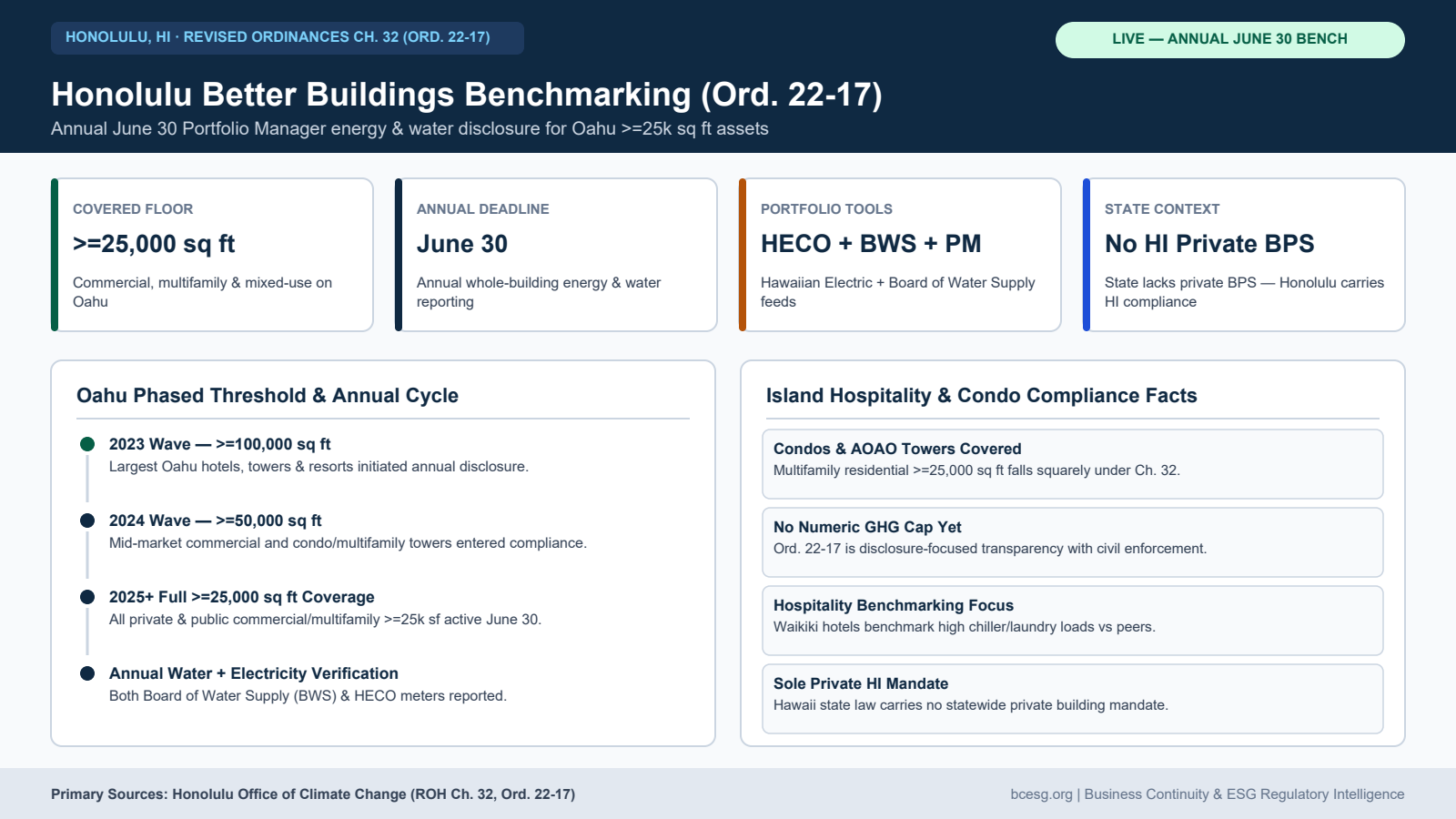
    Wave 1 (>=100k sf)Commercial, resorts & multifamily >=100kLive since 2023 (Annual June 30)HECO + Gas + BWS Water via PM
    Wave 2 (>=50k sf)Commercial & multifamily 50k–99,999 sfLive since 2024 (Annual June 30)HECO + Gas + BWS Water via PM
    Wave 3 (>=25k sf)Commercial & multifamily 25k–49,999 sfLive since 2025+ (Annual June 30)HECO + Gas + BWS Water via PM
    Compliance architecture of Honolulu Revised Ordinances Ch. 32 (Ord. 22-17): June 30 Portfolio Manager reporting of electricity and water for Oahu properties >=25,000 sq ft.
    Honolulu Better Buildings Benchmarking (Ord. 22-17): annual June 30 energy and water disclosure covering Oahu commercial and multifamily towers >=25k sq ft.

    Compliance Execution Checklist

    StepOwner / TeamAuditable Deliverable
    1. Verify Covered TMK ListManaging Agent / AOAOConfirm Honolulu Building ID and >=25,000 sq ft gross area on city portal.
    2. HECO + BWS Meter PullBuilding EngineerObtain whole-building HECO electric & BWS water feeds by May 1.
    3. June 30 PM SubmissionCompliance LeadShare validated Portfolio Manager template via Resilient Oahu link before June 30.
    Field & Print Package

    Keep This Honolulu, HI Compliance Checklist Handy

    Download the formatted 2-page PDF reference brief or pull the structured Markdown edition for internal compliance documentation.

    Frequently Asked Questions

    Do Honolulu residential condominium buildings >=25,000 sq ft have to comply with Ordinance 22-17?

    Yes. Revised Ordinances of Honolulu Chapter 32 covers multifamily residential buildings including condominium associations >=25,000 gross sq ft across Oahu.

    Does Honolulu Better Buildings Benchmarking include water reporting?

    Yes. Covered buildings report whole-building electricity/fuel energy and Board of Water Supply consumption annually by June 30 via ENERGY STAR Portfolio Manager.

    Primary Authorities & Official Resources

    Informational notice: This guide summarizes enacted statutes, regulations, or pending legislative records from the primary authorities linked above as of November 14, 2026. It is not legal, accounting, or licensed engineering advice.
  • San Diego & Chula Vista BESO Compliance Guide: June 1 Filings & Audit Targets

    San Diego & Chula Vista BESO Compliance Guide: June 1 Filings & Audit Targets

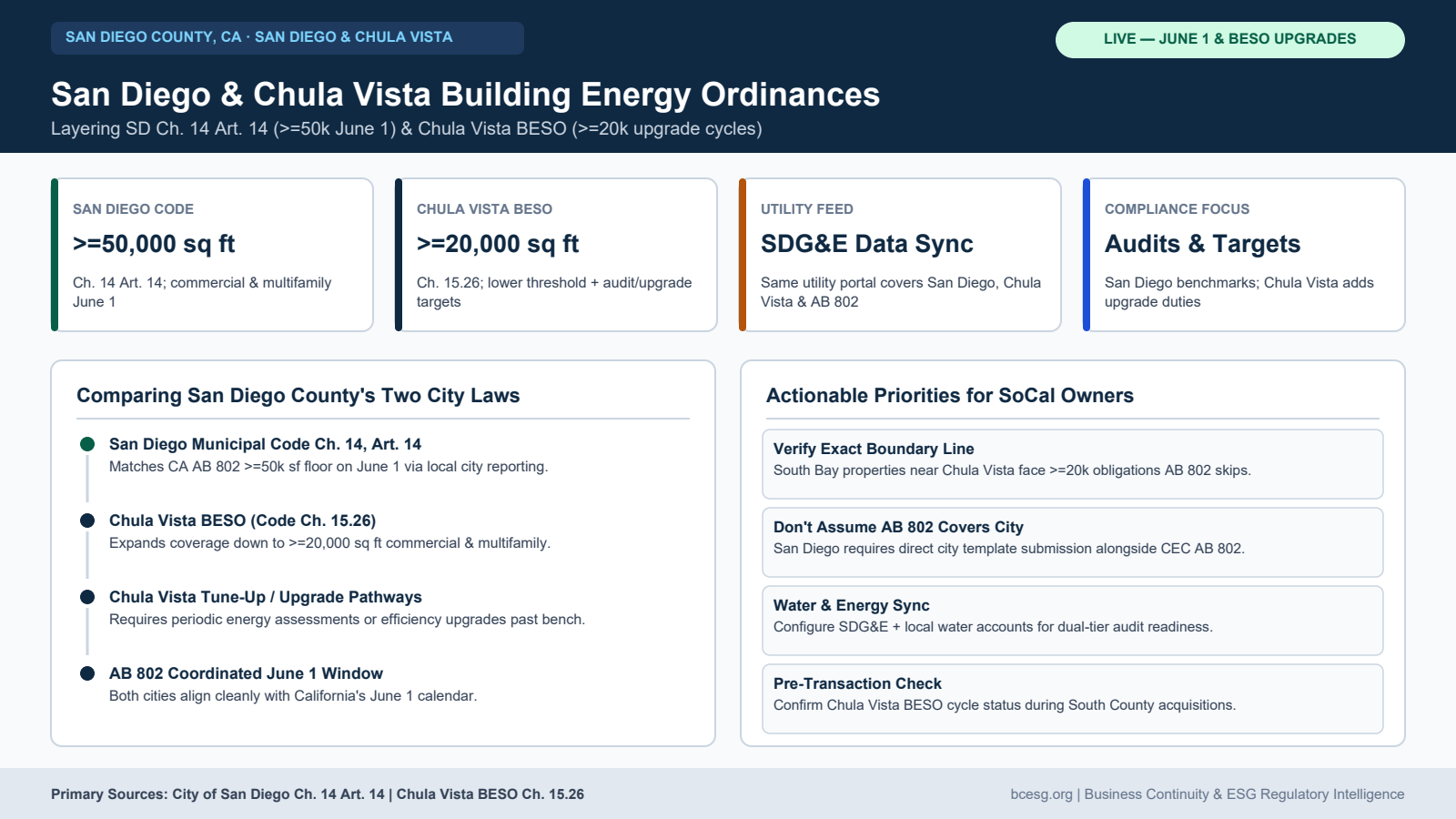
    Short answer: Commercial and multifamily landlords operating across San Diego County encounter two separate municipal ordinances running alongside California statewide AB 802: San Diego Municipal Code Chapter 14, Article 14 (annual June 1 benchmarking at >=50,000 sq ft) and Chula Vista BESO (Municipal Code Ch. 15.26), which sweeps smaller >=20,000 sq ft buildings into benchmarking plus periodic audit/efficiency upgrade duties.

    Even inside the City of San Diego, matching AB 802’s >=50,000 sq ft cutoff does not substitute for local compliance: property owners must share Portfolio Manager reporting templates directly with San Diego’s City Planning Department every June 1, while South Bay landlords inside Chula Vista track sub-50k buildings excluded from AB 802 altogether.

    Statutory Status at a Glance
    • San Diego (Ch. 14, Art. 14 — >=50,000 sq ft): Annual June 1 whole-building energy disclosure via Portfolio Manager for commercial and multifamily buildings; aligns date with CEC AB 802.
    • Chula Vista BESO (Ch. 15.26 — >=20,000 sq ft): Lower floor pulls 20k–49,999 sq ft retail, office, and apartment properties into annual benchmarking plus phased audit/upgrade compliance.
    • SDG&E Automated Sync: Setting up SDG&E aggregated electric and natural gas feeds once covers CEC AB 802, City of San Diego, and Chula Vista filings cleanly.
    Print-First Compliance Brief

    Download the San Diego & Chula Vista Compliance Sheet

    2-page Print-First PDF separating San Diego’s June 1 >=50k benchmarking rule from Chula Vista BESO’s >=20k sq ft performance requirements.

    Handling Jurisdictional Borders & Chula Vista Upgrade Duties

    Regional asset managers with retail centers or industrial-flex parks spanning Mission Valley, Sorrento Mesa, and Eastlake/Chula Vista should verify municipal boundary lines on County parcel maps: Chula Vista’s >=20,000 sq ft threshold captures dozens of medical offices and multifamily complexes invisible to statewide AB 802.

    Where Chula Vista BESO identifies below-threshold performance during audit phases, owners should check whether recent HVAC, lighting, or high-performance ENERGY STAR scores qualify for compliance deferral or exemption prior to commissioning engineering studies.

    • Direct City Share Required: Confirm separate Portfolio Manager sharing links for San Diego City Planning and Chula Vista Sustainability.
    • June 1 Combined Sprint: Complete SDG&E data pulls in April to clear municipal and AB 802 filings on June 1 simultaneously.
    City & CitationCovered Floor AreaAnnual TimingMandate Scope
    San Diego (Ch. 14 Art. 14)Commercial & multifamily >=50k sfAnnual June 1Benchmarking & municipal public transparency
    Chula Vista BESO (Ch. 15.26)Commercial & multifamily >=20k sfPhased annual cycleBenchmarking + energy audits / upgrade pathways
    Side-by-side comparison of San Diego Benchmarking (Ch. 14 Art. 14, >=50,000 sq ft June 1) and Chula Vista BESO (Ch. 15.26, >=20,000 sq ft benchmarking and audit/upgrade targets).
    San Diego County's two city mandates: San Diego's >=50k sq ft benchmarking portal vs. Chula Vista BESO's stricter >=20k sq ft audit/upgrade rule.

    Compliance Execution Checklist

    StepOwner / TeamAuditable Deliverable
    1. City Boundary AuditAsset ManagementSeparate >=50k San Diego parcels from >=20k Chula Vista assets.
    2. SDG&E Auto-BenchmarkingProperty OpsEnable SDG&E aggregated Portfolio Manager meters by mid-April.
    3. Chula Vista BESO StatusEngineering / ComplianceVerify benchmarking scores and periodic audit/upgrade compliance window.
    Field & Print Package

    Keep This San Diego & Chula Vista, CA Compliance Checklist Handy

    Download the formatted 2-page PDF reference brief or pull the structured Markdown edition for internal compliance documentation.

    Frequently Asked Questions

    If my San Diego building >=50,000 sq ft already files California AB 802, do I still file locally?

    Yes. San Diego Municipal Code Ch. 14, Art. 14 requires submitting a Portfolio Manager benchmarking report directly through the City of San Diego's municipal reporting template by June 1.

    How is Chula Vista BESO different from San Diego's benchmarking ordinance?

    Chula Vista BESO (Ch. 15.26) covers smaller properties starting at >=20,000 sq ft rather than 50,000 sq ft, and adds phased energy audit or performance upgrade obligations beyond benchmarking.

    Primary Authorities & Official Resources

    Informational notice: This guide summarizes enacted statutes, regulations, or pending legislative records from the primary authorities linked above as of November 14, 2026. It is not legal, accounting, or licensed engineering advice.
  • Bay Area Building Compliance: San Jose BPO, Berkeley BESO & Brisbane BBEP Guide

    Bay Area Building Compliance: San Jose BPO, Berkeley BESO & Brisbane BBEP Guide

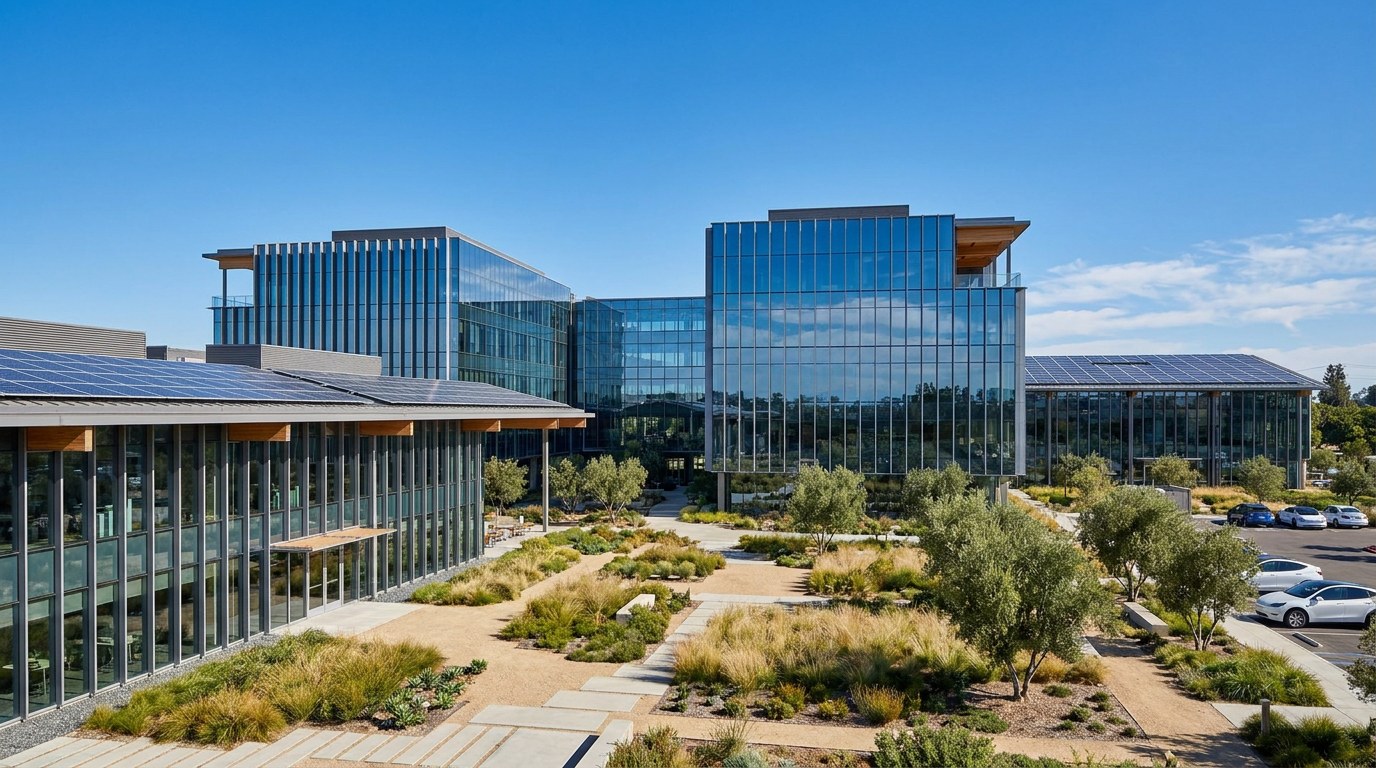
    Short answer: Outside San Francisco, three Northern California municipalities enforce aggressive building laws capturing real estate far below California AB 802’s 50,000 sq ft floor: San Jose’s Building Performance Ordinance (BPO, Ch. 17.85) at >=20,000 sq ft, Berkeley’s Building Emissions Saving Ordinance (BESO, Ch. 19.81) tied to both time-of-sale and >=25,000 sq ft cycles, and Brisbane’s Building Efficiency Program (BBEP, Ch. 15.82) down to >=10,000 sq ft.

    Institutional investors and REITs buying R&D flex parks along US-101, I-880, or the East Bay corridor frequently overlook local ‘Beyond Benchmarking’ 5-year audit duties — or miss Berkeley’s real-estate transaction assessment trigger entirely prior to escrow close.

    Statutory Status at a Glance
    • San Jose BPO (Ch. 17.85 — May 1): Commercial & multifamily >=20k sf submit annual energy and water benchmarking via Portfolio Manager; assets below performance thresholds execute 5-year Beyond Benchmarking pathways (energy audit, RCx, or upgrades).
    • Berkeley BESO (Ch. 19.81 — Time-of-Sale & >=25k Cycles): Requires registered BESO energy assessments and disclosure at property sale/transfer alongside cyclical compliance for >=25,000 sq ft buildings transitioning toward decarbonization.
    • Brisbane BBEP (Ch. 15.82 — May 15): Commercial, industrial, and multifamily buildings >=10,000 sq ft file annual May 15 energy/water benchmarking plus repeating 5-year Beyond Benchmarking audit/high-performance compliance.
    • PG&E Integration: Since PG&E supplies electricity and gas across all three Bay Area markets (alongside San Jose Clean Energy / EBCE / Peninsula Clean Energy), one PG&E whole-building portal feeds May 1, May 15, and June 1 filings.
    Print-First Compliance Brief

    Download the Bay Area Municipal Building Comparison

    2-page Print-First PDF tracking San Jose BPO, Berkeley BESO, and Brisbane BBEP thresholds, May due dates, time-of-sale rules, and AB 802 overlap.

    Escrow Traps in Berkeley vs. 5-Year 'Beyond Benchmarking' in San Jose & Brisbane

    Real estate transaction counsel should flag Berkeley BESO Ch. 19.81 early in purchase diligence: transfer of title on covered residential and commercial buildings activates time-of-sale BESO assessment obligations (unless an active cycle assessment or approved deferral agreement sits on file).

    In San Jose and Brisbane, meanwhile, owners who clear annual May benchmarking without checking their ENERGY STAR score or EUI exemption threshold can walk straight into an unbudgeted 5-year ASHRAE audit or retro-commissioning order. Maintaining ENERGY STAR >=75 or documented LED/HVAC upgrades preserves low-cost high-performance exemptions.

    • Check Industrial Included in Brisbane: Brisbane Ch. 15.82 explicitly covers industrial warehouses >=10,000 sq ft alongside commercial offices and multifamily buildings.
    • Align CA AB 802 Submissions: Ensure buildings >=50k sq ft satisfy both municipal templates (May 1/15) and CEC AB 802 (June 1).
    City & CitationThresholdAnnual / Trigger TimingBeyond Benchmarking Requirement
    San Jose BPO (Ch. 17.85)Commercial & multifamily >=20k sfAnnual May 1 (Energy & water)5-yr audit, RCx, or efficiency upgrade
    Berkeley BESO (Ch. 19.81)Comm, multi & 1–4 units (>=25k cycle)Time-of-Sale + cyclical scheduleRegistered BESO energy assessment & decarb path
    Brisbane BBEP (Ch. 15.82)Comm, ind & multifamily >=10k sfAnnual May 15 (Energy & water)5-yr Beyond Benchmarking audit or ESTAR path
    Comparison of three Bay Area municipal building laws: San Jose Ch. 17.85 (>=20k May 1 + Beyond Benchmarking), Berkeley Ch. 19.81 BESO (time-of-sale + >=25k), and Brisbane Ch. 15.82 (>=10k May 15).
    Three Bay Area municipal ordinances extending far below California AB 802's 50,000 sq ft floor with audits, time-of-sale triggers, and Beyond Benchmarking paths.

    Compliance Execution Checklist

    StepOwner / TeamAuditable Deliverable
    1. Portfolio Map Below 50kAsset ManagementIdentify all 10k–49,999 sq ft parcels in San Jose, Berkeley & Brisbane.
    2. May 1 / May 15 SyncProperty OpsUpload PG&E whole-building data ahead of San Jose (May 1) & Brisbane (May 15).
    3. Escrow & 5-Yr DiligenceLegal / EngineeringVerify Berkeley time-of-sale BESO status and San Jose/Brisbane 5-yr exemptions.
    Field & Print Package

    Keep This San Jose, Berkeley & Brisbane, CA Compliance Checklist Handy

    Download the formatted 2-page PDF reference brief or pull the structured Markdown edition for internal compliance documentation.

    Frequently Asked Questions

    Do small commercial buildings under 50,000 sq ft have compliance duties in San Jose or Brisbane?

    Yes. San Jose BPO starts at 20,000 sq ft and Brisbane BBEP starts at 10,000 sq ft (including industrial and multifamily properties), well below California AB 802's 50,000 sq ft state floor.

    What triggers Berkeley's BESO ordinance for commercial and residential owners?

    Under Berkeley Municipal Code Ch. 19.81, BESO triggers both on scheduled large-building cycles (>=25,000 sq ft) and at point of property sale/transfer across covered residential and commercial real estate.

    Primary Authorities & Official Resources

    Informational notice: This guide summarizes enacted statutes, regulations, or pending legislative records from the primary authorities linked above as of November 14, 2026. It is not legal, accounting, or licensed engineering advice.
  • San Francisco EBO (Ch. 20) & Chapter 30: May 1 Benchmarking, Audits & 100% Renewable Rule

    San Francisco EBO (Ch. 20) & Chapter 30: May 1 Benchmarking, Audits & 100% Renewable Rule

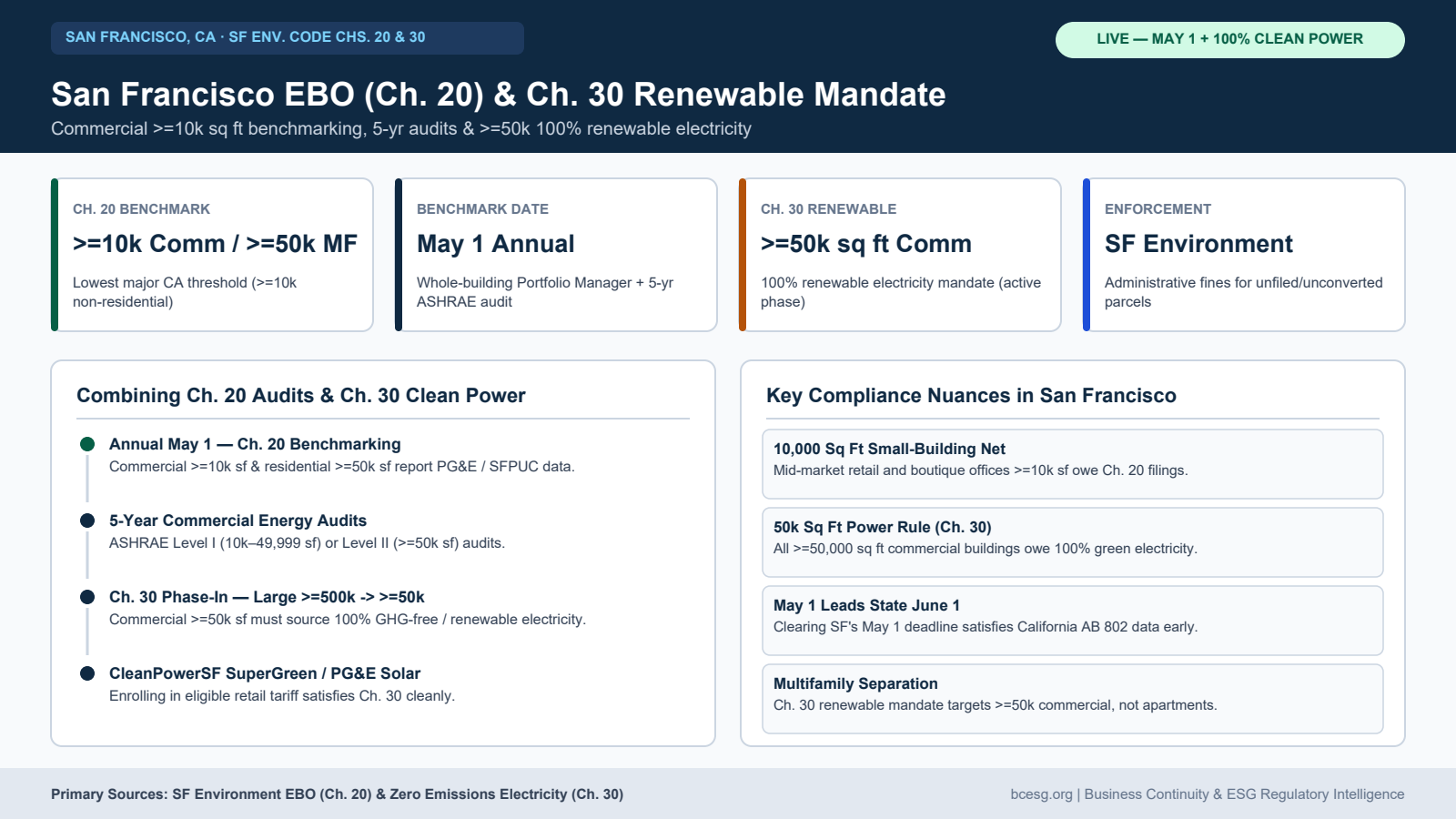
    Short answer: Commercial property operators in San Francisco navigate two separate Environment Code ordinances every spring: Chapter 20 (Existing Buildings Energy Ordinance — EBO) and Chapter 30 (Ord. 220-19 Zero-Emissions Electricity). Under Ch. 20, non-residential properties starting at just >=10,000 sq ft (and multifamily apartments >=50,000 sq ft) must complete annual May 1 ENERGY STAR Portfolio Manager benchmarking alongside 5-year commercial energy audits.

    Under Chapter 30, commercial buildings >=50,000 sq ft carry an affirmative mandate to procure 100% GHG-free / renewable electricity across base building and landlord accounts — turning clean-power tariff enrollment into an enforceable municipal law sitting a month ahead of California AB 802’s June 1 state deadline.

    Statutory Status at a Glance
    • Ch. 20 Small-Commercial Reach (>=10k sf): Non-residential 10k–49,999 sq ft owe annual May 1 Portfolio Manager reporting and 5-year ASHRAE Level I audits; >=50k commercial owe ASHRAE Level II audits every 5 years.
    • Ch. 20 Residential Scope (>=50k sf): Multifamily buildings >=50,000 sq ft owe May 1 annual benchmarking without Chapter 30 renewable-electricity caps.
    • Ch. 30 100% Clean Electricity (>=50k Comm): Phased across >=500k (2022), >=250k (2024), and >=50k–249k tiers, requiring 100% eligible renewable electric supply via CleanPowerSF SuperGreen, PG&E Solar Choice, or qualifying direct-access green tariffs.
    • Direct State Alignment: Submitting PG&E whole-building feeds by May 1 satisfies SF Environment early while feeding June 1 AB 802 reporting cleanly.
    Print-First Compliance Brief

    Download the San Francisco Ch. 20 & Ch. 30 Compliance Guide

    2-page Print-First PDF pairing San Francisco’s May 1 >=10k benchmarking & 5-yr audits (Ch. 20) with its Ch. 30 100% renewable electricity mandate.

    Clearing Chapter 20 Audits & Chapter 30 Clean-Power Tariffs Without Fines

    Unlike numeric building emissions caps in Boston or NYC that allow natural gas retrofits over multi-year timelines, San Francisco Chapter 30 isolates commercial electricity procurement as an immediate 100% renewable requirement. Owners enrolled in default CleanPowerSF Green (lower % renewable) rather than SuperGreen (100% renewable) can accidentally violate Ch. 30 despite thinking their building already runs on community choice power.

    Confirm every landlord electric account — common corridors, elevators, chiller plants, and vacant suites — matches a certified 100% renewable tariff, and log periodic ASHRAE Level I/II audit reports on SF Environment’s portal ahead of May 1 due cycles.

    • Audit Tiering Matters: Commercial assets 10,000–49,999 sq ft qualify for streamlined ASHRAE Level I audits rather than full Level II engineering studies.
    • Verify Direct-Access / Tenant Meters: Master-metered or full-service commercial leases must account for landlord compliance responsibility.
    SF OrdinanceCovered Building ScopeDeadlines & IntervalsCore Requirement
    Ch. 20 BenchmarkingComm >=10k sf; Multifamily >=50k sfAnnual May 1 (Portfolio Mgr)Energy benchmarking (meets AB 802 early)
    Ch. 20 Energy AuditsCommercial >=10k sf (Level I/II)Repeating 5-year audit cyclesASHRAE Level I (10k–49k) / Level II (>=50k)
    Ch. 30 Renewable MandateCommercial >=50,000 sfPhased 2022–2030 active tiers100% GHG-free / renewable electricity tariff
    Infographic covering San Francisco Environment Code Chapters 20 and 30: May 1 >=10k commercial benchmarking, 5-year energy audits, and >=50k 100% renewable electricity.
    San Francisco's dual commercial framework under SF Environment Code Chapters 20 & 30: low >=10k benchmarking, 5-yr audits, and >=50k 100% clean power.

    Compliance Execution Checklist

    StepOwner / TeamAuditable Deliverable
    1. PG&E / SFPUC May 1 FilingProperty OpsUpload May 1 Portfolio Manager disclosures for >=10k comm / >=50k multi.
    2. SuperGreen Tariff AuditEnergy / ProcurementVerify 100% renewable power enrollment on all >=50k commercial accounts.
    3. 5-Year ASHRAE Audit CheckQualified AuditorConfirm due year for Level I/II audit or verified exemption status.
    Field & Print Package

    Keep This San Francisco, CA Compliance Checklist Handy

    Download the formatted 2-page PDF reference brief or pull the structured Markdown edition for internal compliance documentation.

    Frequently Asked Questions

    Does San Francisco Ch. 30's 100% renewable electricity law cover apartment buildings?

    No. SF Environment Code Ch. 30 applies to non-residential commercial buildings >=50,000 sq ft, while multifamily apartments >=50,000 sq ft owe annual May 1 energy benchmarking under Ch. 20.

    What threshold triggers San Francisco's commercial energy audit requirement?

    Under Ch. 20, non-residential buildings 10,000–49,999 sq ft must complete ASHRAE Level I energy audits every 5 years, and commercial buildings >=50,000 sq ft must complete Level II audits every 5 years.

    Primary Authorities & Official Resources

    Informational notice: This guide summarizes enacted statutes, regulations, or pending legislative records from the primary authorities linked above as of November 14, 2026. It is not legal, accounting, or licensed engineering advice.

  • Los Angeles EBEWE Guide: June 1 Benchmarking & 5-Year Audits/RCx (Ord. 184674)

    Los Angeles EBEWE Guide: June 1 Benchmarking & 5-Year Audits/RCx (Ord. 184674)

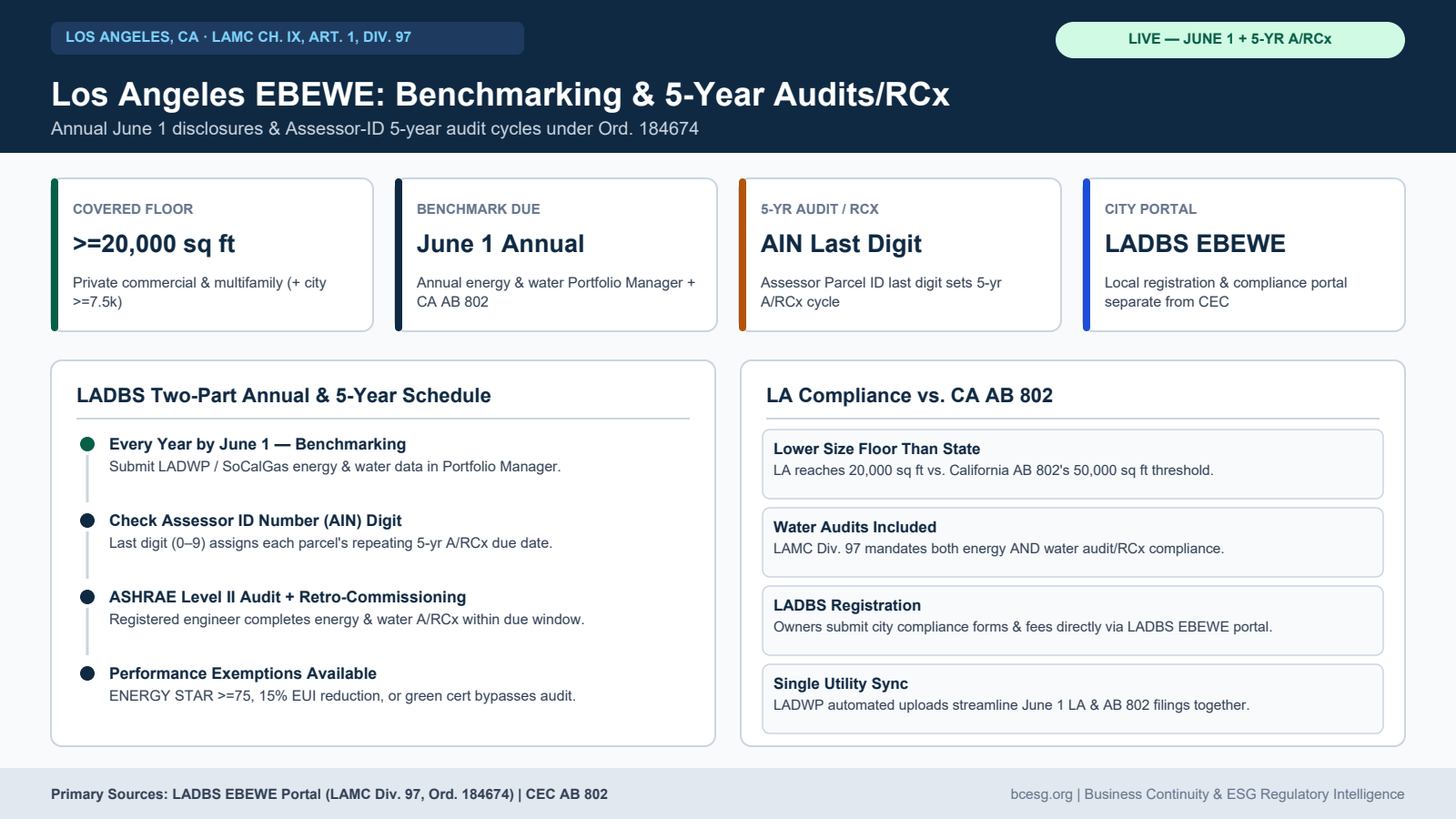
    Short answer: Under Los Angeles Municipal Code Division 97 (Ord. 184674 — EBEWE), owners of private commercial and multifamily buildings >=20,000 sq ft owe two intertwined filings to the LA Department of Building and Safety (LADBS): annual June 1 benchmarking of whole-building energy and water usage, plus a repeating 5-year Energy and Water Audit & Retro-Commissioning (A/RCx) cycle assigned by the final digit of the property’s County Assessor ID Number (AIN).

    Many portfolio teams mistakenly treat California’s statewide June 1 disclosure law (California AB 802, which starts at >50,000 sq ft and requires benchmarking only) as sufficient in Los Angeles. It is not: LA enforces a 20,000 sq ft threshold, requires water benchmarking, mandates LADBS portal submissions and processing fees, and enforces 5-year technical audits and retro-commissioning on a rolling 10-digit Assessor ID calendar.

    Statutory Status at a Glance
    • Covered Thresholds: Private commercial & multifamily buildings >=20,000 sq ft; City-owned facilities >=7,500 sq ft.
    • June 1 Annual Benchmarking: Whole-building electricity, gas, and LADWP water data uploaded to ENERGY STAR Portfolio Manager and submitted directly to LADBS EBEWE alongside a city administrative filing.
    • Assessor-ID 5-Year A/RCx Rotation: Each property’s County AIN ending digit (0–9) determines its repeating five-year window for ASHRAE Level II energy audits, water audits, and building retro-commissioning.
    • Audit Exemptions: Earning ENERGY STAR >=75 (for energy exemption), Water Score / conservation criteria, or verifiable 15% EUI reduction over 5 years waives expensive field audits when filed cleanly inside your cycle window.
    Print-First Compliance Brief

    Download the Los Angeles EBEWE & Audit Cycle Guide

    2-page Print-First PDF organizing LA’s >=20k sq ft June 1 benchmarking, Assessor-ID 5-year energy/water audit/RCx schedule, and CA AB 802 overlap.

    Synchronizing LADWP Meter Feeds, AIN Digits & California AB 802

    Because Los Angeles Department of Water and Power (LADWP) serves both electricity and municipal water across most of the City (alongside SoCalGas for natural gas), owners should enable automated Portfolio Manager utility web services before April so a single clean June 1 Portfolio Manager sync feeds both LADBS EBEWE and CEC AB 802.

    Do not wait until the final year of your 5-year A/RCx window to inspect ENERGY STAR scores: maintaining a score >=75 requires multi-month operational tuning and clean space-use attributes inside Portfolio Manager well ahead of filing exemptions.

    • Check Both Energy & Water Triggers: Remember that EBEWE covers water efficiency audits/RCx separately from energy exemptions — verify both tracks prior to submitting to LADBS.
    • Verify AIN Digit Calendar: Confirm parcel-level Assessor ID last digits across multi-parcel retail strips or campus assets.
    EBEWE TrackCovered ScopeSchedule / TriggerExemptions & Portal
    Annual BenchmarkingPrivate >=20k sf; City >=7.5k sfAnnual June 1 (PM + LADBS fee)LADWP/SoCalGas auto-sync; feeds AB 802
    5-Yr Energy & Water A/RCxPrivate >=20k sfRepeating 5-yr cycle via AIN digitESTAR >=75, LEED, or 15% verified drop
    Diagram showing Los Angeles EBEWE LAMC Div. 97 rules: >=20,000 sq ft June 1 benchmarking, Assessor Parcel ID 5-year audit/RCx rotation, and ENERGY STAR >=75 exemptions.
    Los Angeles EBEWE (LAMC Div. 97 / Ord. 184674): annual June 1 disclosures plus Assessor-ID 5-year energy and water audit/retro-commissioning cycles.

    Compliance Execution Checklist

    StepOwner / TeamAuditable Deliverable
    1. AIN Digit & Tier AuditAsset OperationsPull LA County Assessor ID last digit for every building >=20,000 sq ft.
    2. June 1 LADBS + AB 802Property ManagerUpload LADWP/SoCalGas electric, gas & water data and pay LADBS registration.
    3. A/RCx vs. ExemptionQualified PE / CEMVerify ENERGY STAR >=75 exemption or launch Level II A/RCx ahead of cycle end.
    Field & Print Package

    Keep This Los Angeles, CA Compliance Checklist Handy

    Download the formatted 2-page PDF reference brief or pull the structured Markdown edition for internal compliance documentation.

    Frequently Asked Questions

    How does Los Angeles EBEWE differ from California AB 802?

    California AB 802 mandates annual benchmarking only at >50,000 sq ft, whereas LA EBEWE applies starting at >=20,000 sq ft, requires water benchmarking and LADBS portal registration, and adds repeating 5-year energy/water audits and retro-commissioning.

    How do I know when my 5-year LA EBEWE audit/RCx is due?

    LADBS schedules five-year Audit & Retro-Commissioning due dates based on the final digit (0–9) of each covered property's Los Angeles County Assessor Identification Number (AIN).

    Primary Authorities & Official Resources

    Informational notice: This guide summarizes enacted statutes, regulations, or pending legislative records from the primary authorities linked above as of November 14, 2026. It is not legal, accounting, or licensed engineering advice.
  • Seattle BEPS Compliance Guide: 2027 GHG Verification, 2031 GHGI Caps & WA CBPS

    Seattle BEPS Compliance Guide: 2027 GHG Verification, 2031 GHGI Caps & WA CBPS

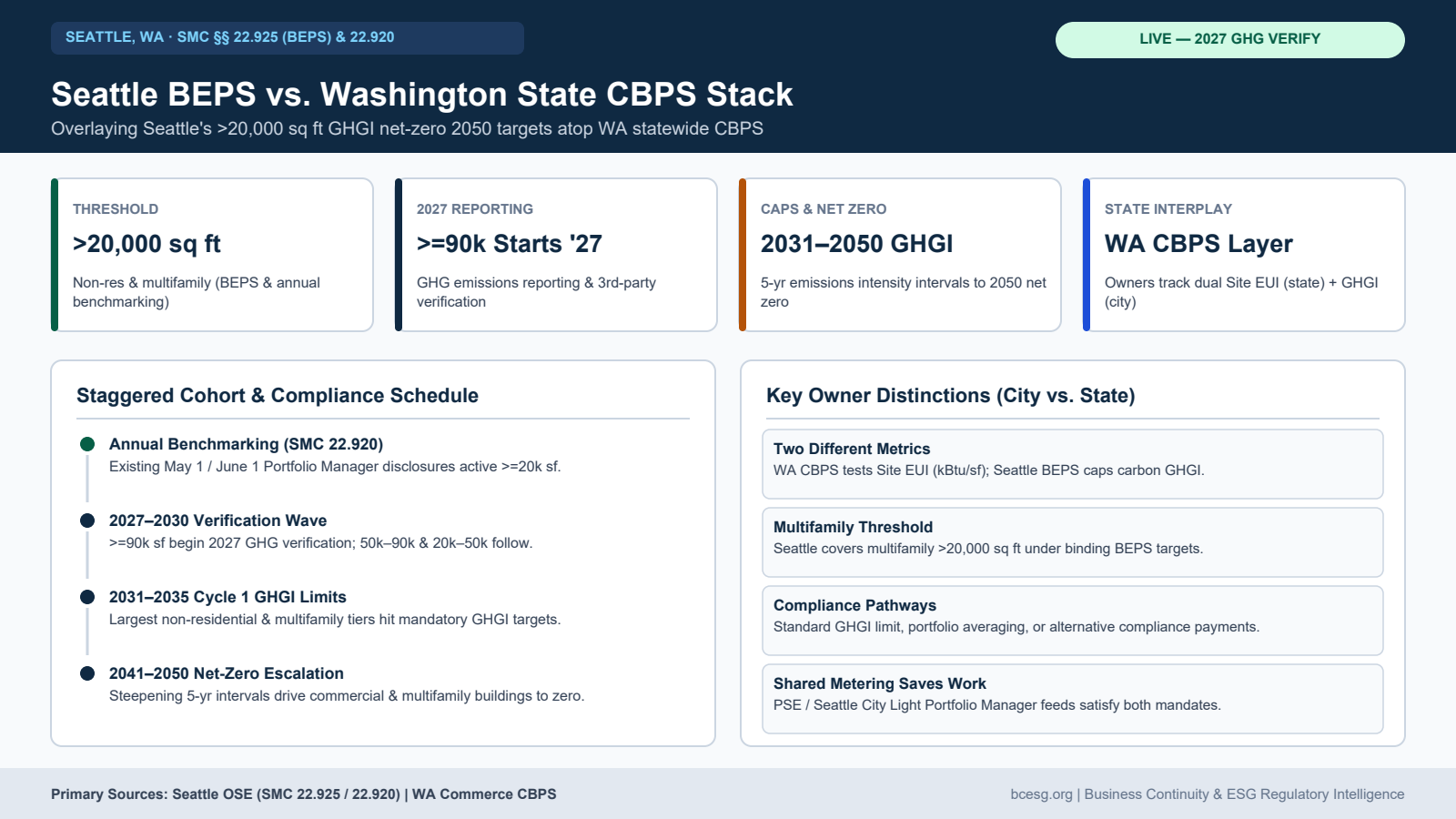
    Short answer: Commercial and multifamily landlords inside Seattle city limits face layered municipal and state mandates. Alongside annual Portfolio Manager disclosures under SMC § 22.920, Seattle’s Building Emissions Performance Standard (BEPS, SMC § 22.925 / Ord. 126973) subjects non-residential and multifamily buildings >20,000 sq ft to emissions verification beginning in 2027 (>=90,000 sq ft wave) and stepped GHGI (greenhouse gas intensity) limits starting in 2031 through net-zero 2050.

    Crucially, complying with Seattle BEPS does NOT exempt a building from Washington State’s Clean Buildings Performance Standard (CBPS) — and meeting WA CBPS’s energy-efficiency Site EUI rule does not automatically satisfy Seattle BEPS’s fossil-fuel decarbonization schedule. Clean Seattle City Light hydroelectric power keeps electric buildings’ carbon intensity low, spotlighting gas space heating and service water systems as the primary Seattle compliance risk.

    Statutory Status at a Glance
    • Covered Scope (>20,000 sq ft): Non-residential commercial and multifamily residential buildings >20k heated/conditioned floor area (excluding manufacturing/industrial per OSE definitions).
    • Staggered Cohorts (2027–2050): Wave 1 (>=90k sf) opens GHG reporting/verification in 2027 with Cycle 1 GHGI caps in 2031–2035; smaller 50k–90k and 20k–50k cohorts follow through 2050.
    • Annual Benchmarking Remains Active: SMC § 22.920 Portfolio Manager reporting continues annually every spring/summer (~May 1 / June 1 OSE schedule).
    • Flexibility Options: Standard building-type GHGI limits, portfolio averaging, alternative compliance payments, and decarbonization extensions for equipment replacement constraints.
    Print-First Compliance Brief

    Download the Seattle BEPS & WA CBPS Overlap Reference

    2-page Print-First PDF separating Seattle’s GHG emissions cap (GHGI) under SMC § 22.925 from Washington State’s Site EUI CBPS targets.

    Coordinating Seattle BEPS Carbon Limits With WA CBPS Site EUI Targets

    Seattle City Light supplies predominantly hydroelectric grid electricity, giving Seattle properties a dramatically lower electric emission factor than fossil natural gas or steam heat. As a result, a building running electric resistance boilers might struggle to meet Washington State CBPS’s kBtu/sq ft Site EUI target while easily clearing Seattle BEPS’s 2031–2035 GHGI ceiling — whereas an efficient condensing-gas building could pass WA CBPS early while facing escalating Seattle carbon gaps through 2040.

    Owners preparing CY2026 utility baselines ahead of 2027 third-party GHG verification should audit submeter splits between tenant retail and multifamily domestic hot water plants before selecting heat-pump conversions or compliance extensions.

    • Verify Dual Reporting Timelines: Keep Washington Commerce CBPS Tier 1 (>=50k sf 2026–2028) milestones aligned alongside Seattle’s 2027 (>=90k sf) verification kickoff.
    • Multifamily Early Prep: Unlike WA CBPS Tier 1 (commercial-focused until Tier 2 benchmarking), Seattle BEPS places multifamily >20,000 sq ft directly on a net-zero emissions path.
    Obligation & CodeCovered Floor AreaKey 2026–2031 TimelinePrimary Compliance Metric
    Seattle Benchmarking (SMC 22.920)Nonres & multifamily >20,000 sfAnnual spring/June Portfolio MgrWhole-building Site EUI + ENERGY STAR
    Seattle BEPS (SMC 22.925)Nonres & multifamily >20,000 sf2027 GHG verify (>=90k); 2031 capsGHGI (kgCO2e/sf) to net-zero 2050
    WA State CBPS OverlayTier 1 >=50k nonres; Tier 2 >=20k/multi2026–2028 Tier 1; 2027 Tier 2Weather-normalized Site EUI + EMP/O&M
    Timeline comparing Seattle BEPS (>20,000 sq ft, 2027 GHG reporting, 2031–2050 GHGI net-zero caps) alongside Washington State CBPS Site EUI rules.
    How Seattle BEPS (SMC § 22.925) layers greenhouse gas intensity (GHGI) net-zero 2050 mandates over Washington State's Site EUI CBPS.

    Compliance Execution Checklist

    StepOwner / TeamAuditable Deliverable
    1. Cohort ConfirmationCompliance / LegalConfirm property gross sq ft tier (>90k vs 50k–90k vs 20k–50k) under OSE rules.
    2. Dual Utility Feed AuditProperty OpsLock Seattle City Light & Puget Sound Energy PM aggregation prior to spring close.
    3. Fuel-Switching CapExEngineering / Asset MgmtModel heat-pump / domestic hot water electrification to satisfy GHGI + Site EUI together.
    Field & Print Package

    Keep This Seattle, WA Compliance Checklist Handy

    Download the formatted 2-page PDF reference brief or pull the structured Markdown edition for internal compliance documentation.

    Frequently Asked Questions

    Does complying with Washington's statewide CBPS satisfy Seattle BEPS?

    No. Washington State CBPS regulates energy consumption (Site EUI) whereas Seattle BEPS (SMC § 22.925) caps carbon emissions intensity (GHGI) toward net-zero 2050 and covers multifamily properties >20,000 sq ft.

    When do Seattle BEPS requirements start taking effect?

    Annual energy benchmarking under SMC § 22.920 is active now, third-party GHG reporting begins in 2027 for buildings >=90,000 sq ft, and mandatory 5-year GHGI emissions limits start in 2031.

    Primary Authorities & Official Resources

    Informational notice: This guide summarizes enacted statutes, regulations, or pending legislative records from the primary authorities linked above as of November 14, 2026. It is not legal, accounting, or licensed engineering advice.

  • Atlanta CBEEO & Orlando BEWES: Sunbelt Benchmarking & Audit Guide (2026)

    Atlanta CBEEO & Orlando BEWES: Sunbelt Benchmarking & Audit Guide (2026)

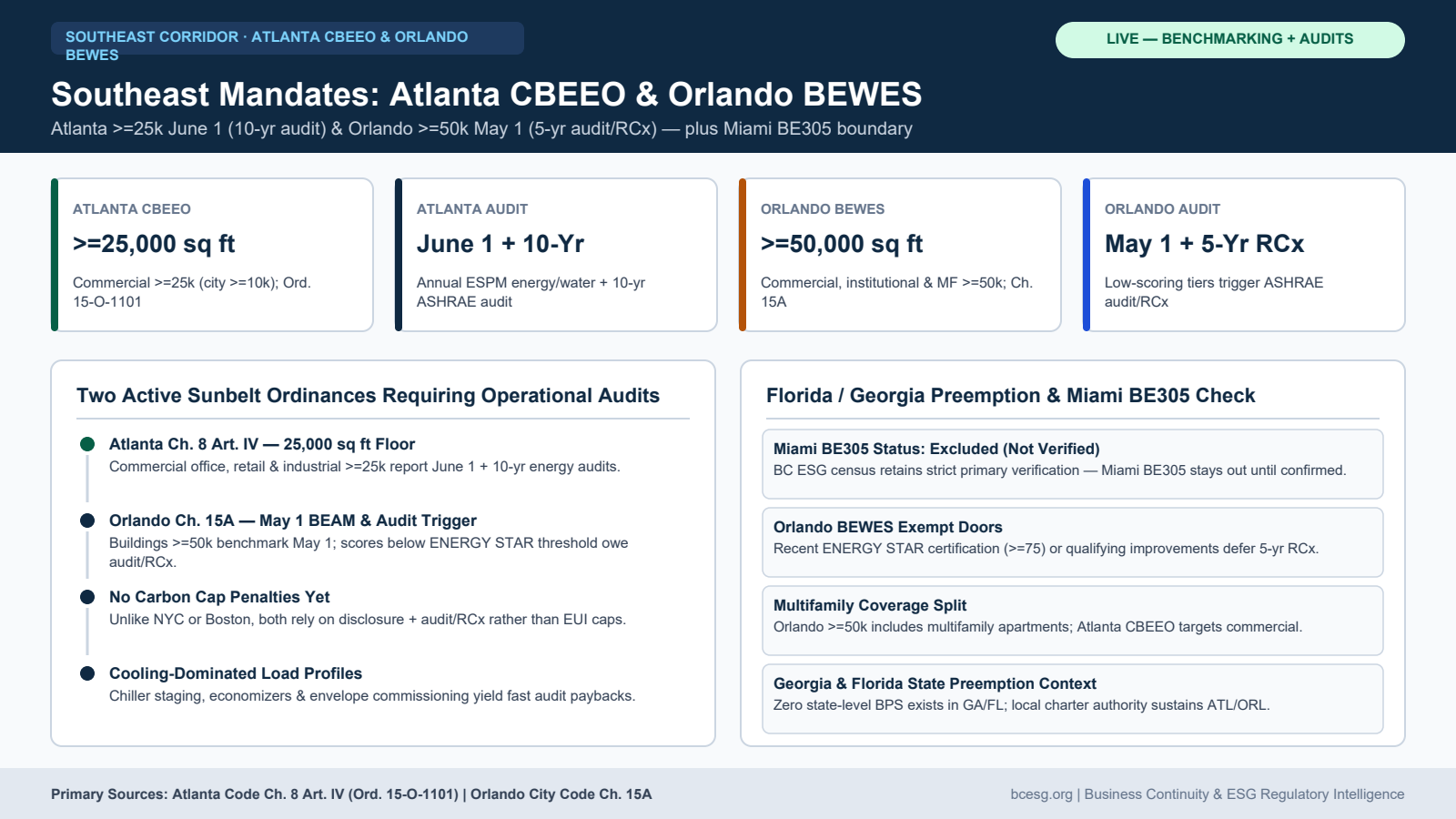
    Short answer: Real estate compliance in the Southeast is concentrated inside two verified municipal ordinances carrying both annual disclosure and periodic audit obligations: Atlanta’s Commercial Buildings Energy Efficiency Ordinance (CBEEO, City Code Ch. 8, Art. IV) due every June 1 (>=25,000 sq ft commercial), and Orlando’s Building Energy and Water Efficiency Strategy (BEWES, City Code Ch. 15A) due every May 1 (>=50,000 sq ft commercial, institutional, and multifamily).

    Neither ordinance imposes coastal carbon-tax caps like NYC LL97, yet neither stops at passive benchmarking: Atlanta mandates repeating 10-year ASHRAE energy audits or retro-commissioning, while Orlando triggers 5-year audit/RCx requirements specifically when low ENERGY STAR scores fall beneath city thresholds. Note that other Sunbelt proposals outside our primary-source verified threshold — including Miami’s BE305 — remain excluded from live mandatory status pending verification.

    Statutory Status at a Glance
    • Atlanta CBEEO (Ch. 8, Art. IV — June 1): Applies to commercial buildings >=25,000 sq ft under the Mayor’s Office of Resilience; mandates annual Portfolio Manager energy/water submissions plus 10-year energy audit / RCx cycles.
    • Orlando BEWES (Ch. 15A — May 1): Applies to commercial, institutional, and multifamily properties >=50,000 sq ft under Orlando Green Works via Portfolio Manager / BEAM, triggering 5-year audits/RCx for properties scoring below benchmarks unless exempted.
    • Audit Escape Hatches: High ENERGY STAR ratings, recent LEED certifications, or verified energy improvements commonly satisfy periodic audit mandates without full field expenses — check property-level exemptions prior to due years.
    • Zero State Law Overlay: Because Georgia and Florida carry no statewide private benchmarking mandates, municipal compliance begins and ends with Atlanta and Orlando city limits in this regional census.
    Print-First Compliance Brief

    Download the Atlanta & Orlando Sunbelt Compliance Guide

    2-page Print-First PDF detailing Atlanta CBEEO (>=25k sf, June 1) and Orlando BEWES (>=50k sf, May 1) benchmarking and audit/retro-commissioning rules.

    Managing Audit Triggers Across Two Sunbelt Utility Markets

    Whereas Atlanta reaches smaller commercial buildings starting at 25,000 sq ft regardless of current ENERGY STAR performance on a 10-year rotation, Orlando’s 50,000 sq ft BEWES ordinance covers multifamily properties alongside offices and ties 5-year ASHRAE audits/retro-commissioning directly to low benchmarking performance — creating a direct operational incentive to cure metering anomalies or poor ENERGY STAR inputs before score issuance.

    Utility data integration with Georgia Power and OUC (Orlando Utilities Commission) should start by March ahead of Orlando’s May 1 deadline so portfolio managers catch missing tenant accounts well ahead of Atlanta’s June 1 close.

    • Commercial vs. Multifamily Split: Atlanta CBEEO excludes purely residential multifamily properties; Orlando BEWES covers multifamily buildings >=50,000 sq ft.
    • Verify Exclusion vs. Live Scope: Keep Miami BE305 flagged as unverified/excluded rather than bundling speculative local proposals into Sunbelt capital plans.
    Ordinance & CodeCovered ScopeAnnual FilingAudit / RCx Mandate
    Atlanta CBEEO (Ch. 8 Art. IV)Commercial >=25,000 sq ftJune 1 (ENERGY STAR PM)Mandatory 10-year energy audit / RCx cycle
    Orlando BEWES (Ch. 15A)Commercial, inst & multifamily >=50,000 sq ftMay 1 (PM / BEAM)5-year audit/RCx triggered for low-scoring assets
    Comparison of Atlanta CBEEO (Code Ch. 8 Art. IV, >=25k sq ft June 1 + 10-yr audit) and Orlando BEWES (Ch. 15A, >=50k sq ft May 1 + 5-yr audit triggers).
    Sunbelt commercial building ordinances: Atlanta CBEEO's >=25k sq ft 10-year audit rule vs. Orlando BEWES's >=50k sq ft 5-year low-score audit trigger.

    Compliance Execution Checklist

    StepOwner / TeamAuditable Deliverable
    1. March OUC / GA Power PullProperty OpsRequest aggregated whole-building utility accounts before May 1 / June 1 deadlines.
    2. Score & Audit TriageEnergy EngineeringCheck Orlando BEWES scores against audit exemptions and verify Atlanta 10-yr due dates.
    3. Municipal ConfirmationsCompliance RecordsArchive BEAM / City of Atlanta submission confirmations per parcel ID.
    Field & Print Package

    Keep This Atlanta, GA & Orlando, FL Compliance Checklist Handy

    Download the formatted 2-page PDF reference brief or pull the structured Markdown edition for internal compliance documentation.

    Frequently Asked Questions

    Do Atlanta CBEEO and Orlando BEWES cover multifamily residential buildings?

    Orlando BEWES (Ch. 15A) covers multifamily buildings >=50,000 sq ft alongside commercial properties, whereas Atlanta CBEEO (Ch. 8, Art. IV) applies to commercial buildings >=25,000 sq ft only.

    Does Orlando BEWES require an energy audit for every covered building?

    No. Orlando triggers 5-year audit/retro-commissioning duties primarily for low-scoring properties falling below BEWES performance benchmarks, while high-performing or LEED/ENERGY STAR certified assets qualify for exemptions.

    Primary Authorities & Official Resources

    Informational notice: This guide summarizes enacted statutes, regulations, or pending legislative records from the primary authorities linked above as of November 14, 2026. It is not legal, accounting, or licensed engineering advice.
  • Pittsburgh & Columbus Building Energy Benchmarking Guide: Shared June 1 Deadline

    Pittsburgh & Columbus Building Energy Benchmarking Guide: Shared June 1 Deadline

    Short answer: Regional Midwest and Appalachian real estate portfolios share a convenient calendar anchor on June 1: both Pittsburgh (Code Ch. 633) and Columbus (City Code Ch. 4118) enforce active >=50,000 sq ft whole-building energy and water benchmarking via EPA’s ENERGY STAR Portfolio Manager on the exact same date.

    The operational trap lies in residential coverage: Pittsburgh Ch. 633 applies exclusively to non-residential buildings >=50,000 sq ft (skipping purely residential apartments), whereas Columbus Ch. 4118 covers both commercial and multifamily buildings >=50,000 sq ft. Compare Pittsburgh’s light-touch transparency reporting with statewide peer Philadelphia’s June 30 benchmarking + 5-year BEPP tune-up rules.

    Statutory Status at a Glance
    • Pittsburgh, PA (Ch. 633 — Non-Residential >=50k sq ft): Administered by Pittsburgh Dept. of City Planning; annual June 1 whole-building electricity, fuel, and water reporting for private non-residential parcels >=50,000 sq ft.
    • Columbus, OH (Ch. 4118 — Commercial & Multifamily >=50k sq ft): Administered by Columbus Dept. of Building and Zoning Services; annual June 1 energy/water benchmarking covering commercial, institutional, and apartment properties >=50,000 sq ft.
    • Shared Utility Setup: Duquesne Light, Peoples Gas, and PWSA (Pittsburgh) vs. AEP Ohio, Columbia Gas, and Columbus Public Utilities operate different multi-tenant whole-building data workflows requiring early spring requests.
    • Disclosure Only: Neither city currently mandates energy audits, retro-commissioning, or building emissions caps.
    Print-First Compliance Brief

    Download the Pittsburgh & Columbus June 1 Benchmarking Sheet

    2-page Print-First PDF contrasting Pittsburgh Ch. 633 (non-residential only) and Columbus Ch. 4118 (commercial + multifamily) for shared June 1 filings.

    Executing Unified June 1 Filings Across PA & OH Portfolios

    For REITs and regional property managers with both Ohio Valley offices and Columbus multifamily complexes, treating June 1 as a single utility-aggregation sprint eliminates late data exceptions. Request whole-building aggregate meters in April, double-check gross floor area excluding parking garages per ENERGY STAR guidance, and retain confirmation screenshots from each municipal submission template.

    Because Ohio prohibits no municipal benchmarking despite lacking a state-level building statute, Columbus remains Ohio’s sole active local benchmarking jurisdiction while Pennsylvania separates Philadelphia’s active RCx law from Pittsburgh’s benchmarking-only ordinance.

    • Verify Mixed-Use Triggers in Pittsburgh: Mixed-use assets containing >=50,000 sq ft of non-residential floor area remain subject to Ch. 633 even with residential upper floors.
    • Columbus 25k City Exception: Municipal Columbus properties enter benchmarking down at 25,000 sq ft, whereas private commercial and multifamily buildings start at 50,000 sq ft.
    City & CodeCovered Private ThresholdAnnual Due DateMultifamily Included?
    Pittsburgh, PA (Ch. 633)Non-residential >=50,000 sq ftJune 1 (Energy & water PM)NO — commercial/non-residential only
    Columbus, OH (Ch. 4118)Commercial & multifamily >=50,000 sq ftJune 1 (Energy & water PM)YES — private multifamily >=50k covered
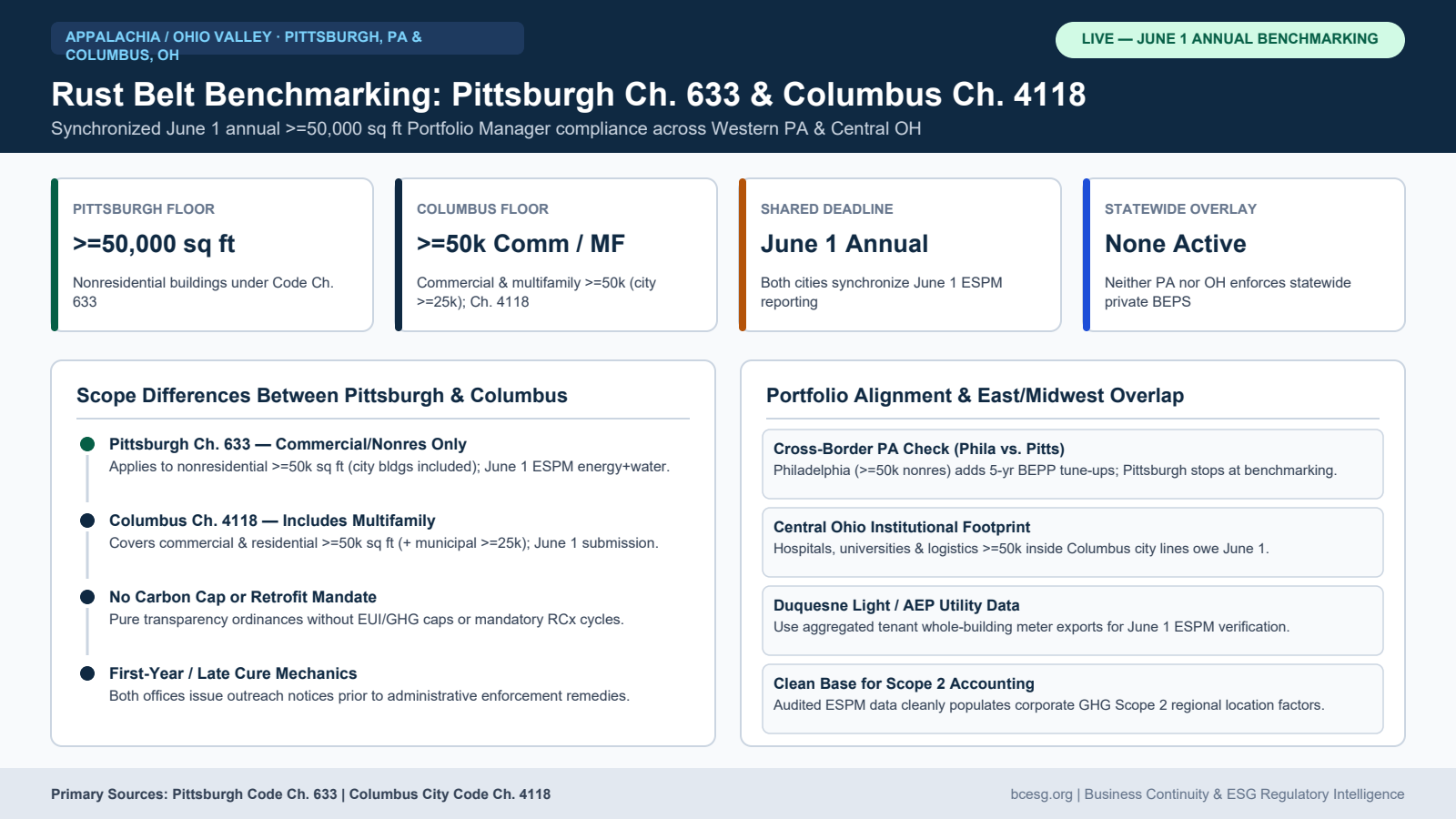
    Side-by-side comparison of Pittsburgh Ch. 633 (Non-residential >=50,000 sq ft) and Columbus Ch. 4118 (Commercial & multifamily >=50,000 sq ft) June 1 Portfolio Manager rules.
    Rust Belt / Appalachian gateway benchmarking: shared June 1 ENERGY STAR Portfolio Manager due dates with critical multifamily vs. non-residential coverage differences.

    Compliance Execution Checklist

    StepOwner / TeamAuditable Deliverable
    1. April Meter PullProperty OpsGather Duquesne/PWSA (Pittsburgh) and AEP/Columbia Gas (Columbus) aggregate feeds.
    2. Portfolio ClassificationAsset ManagementSeparate Pittsburgh non-residential >=50k sf from exempt multifamily parcels.
    3. June 1 Municipal ShareCompliance LeadSubmit City-specific Portfolio Manager reporting links and archive compliance receipts.
    Field & Print Package

    Keep This Pittsburgh, PA & Columbus, OH Compliance Checklist Handy

    Download the formatted 2-page PDF reference brief or pull the structured Markdown edition for internal compliance documentation.

    Frequently Asked Questions

    Do multifamily apartment buildings >=50,000 sq ft have to file benchmarking in Pittsburgh?

    No. Pittsburgh Code Ch. 633 applies strictly to non-residential buildings >=50,000 sq ft, unlike Columbus Ch. 4118 which explicitly covers both commercial and multifamily properties >=50,000 sq ft.

    Are energy and water utilities both included in Pittsburgh and Columbus benchmarking?

    Yes. Both cities require whole-building electricity, heating fuels, and water consumption submitted through ENERGY STAR Portfolio Manager by June 1 annually.

    Primary Authorities & Official Resources

    Informational notice: This guide summarizes enacted statutes, regulations, or pending legislative records from the primary authorities linked above as of November 14, 2026. It is not legal, accounting, or licensed engineering advice.

  • Montgomery County, MD BEPS Compliance Guide: Site EUI Targets & MD HB 49 Bridge

    Montgomery County, MD BEPS Compliance Guide: Site EUI Targets & MD HB 49 Bridge

    Short answer: Commercial and multifamily owners in Bethesda, Silver Spring, Rockville, and Gaithersburg operate inside one of Maryland’s toughest local efficiency regimes: Montgomery County BEPS (Code § 18A-38 / Bill 16-21). Covering properties >=25,000 gross sq ft, the County evaluates long-term compliance using Weather-Normalized Site EUI (kBtu/sq ft/yr) rather than carbon intensity — creating an immediate technical split between Montgomery County compliance and regional neighbors.

    Critically, owners compliant with Montgomery County BEPS also benefit from coordination enacted in Maryland HB 49 (Statewide BEPS), which shields qualifying compliant county properties from duplicate state filing burdens. DMV portfolio managers holding assets across the District line should likewise contrast Site EUI targets against ENERGY STAR-weighted trajectories in our Washington, DC BEPS Guide.

    Statutory Status at a Glance
    • Covered Thresholds: Commercial, multifamily, and County buildings >=25,000 gross sq ft (phased Group timelines separating >=50,000 sq ft commercial, 25k–50k sq ft, and multifamily cohorts).
    • June 1 Benchmarking + Verification: Annual Portfolio Manager filing by June 1, with third-party qualified data verification required at baseline and compliance checkpoints.
    • Site EUI Metric vs. GHG Caps: Compliance requires hitting property-type final Site EUI targets (or 30% Site EUI reduction if below 2028/2033 curves) rather than purchasing renewable energy offsets.
    • Building Performance Improvement Plan (BPIP): Assets with physical or financial hardship may propose an approved BPIP with staggered interim targets through County DEP review.
    Print-First Compliance Brief

    Download the Montgomery County BEPS & MD HB 49 Playbook

    2-page Print-First PDF aligning Montgomery County § 18A-38 Site EUI cycles (2028–2033) with Maryland state HB 49 compliance exemption rules.

    Why Site EUI Differs Fundamentally From Maryland State Net-Direct Emissions

    Maryland’s statewide BEPS (COMAR 26.28 / HB 49) removes renewable electricity compliance focus and targets zero direct on-site fossil-fuel emissions, whereas Montgomery County BEPS measures total site gas and electricity consumed per square foot (Site EUI). In practice, upgrading electric chillers, variable-frequency drives, and envelope glazing improves Montgomery County Site EUI immediately even when grid electricity remains partly fossil-fueled.

    Under HB 49, Maryland MDE recognizes qualifying Montgomery County properties governed by local standards equivalent to or stricter than state floors, preventing double reporting — provided the owner remains in active verified compliance with County DEP.

    • Verify County Exemption Filing Rules: Confirm with MDE and Montgomery County DEP whether any building-type exemptions require separate state notice.
    • 2028/2029 Cohort Prep: Commercial buildings >=50,000 sq ft sit closest to interim Site EUI compliance checkpoints, leaving tight lead time for 2027 commissioning.
    Obligation & CohortThresholdTarget TimelineCore Standard & Coordination
    Annual Benchmarking & VerifyCommercial & multifamily >=25k sfAnnual June 1 (+ verify yrs)ENERGY STAR PM + third-party verifier attestation
    Wave 1 Interim/Final EUICommercial >=50k sf (Group 1/2)2028/2029 interim -> 2033+ finalWeather-normalized Site EUI targets (no RECs)
    Multifamily & 25k–50k WaveMultifamily >=25k & small commStaggered 2029–2035 scheduleSite EUI or BPIP flexibility; MD HB 49 bridge
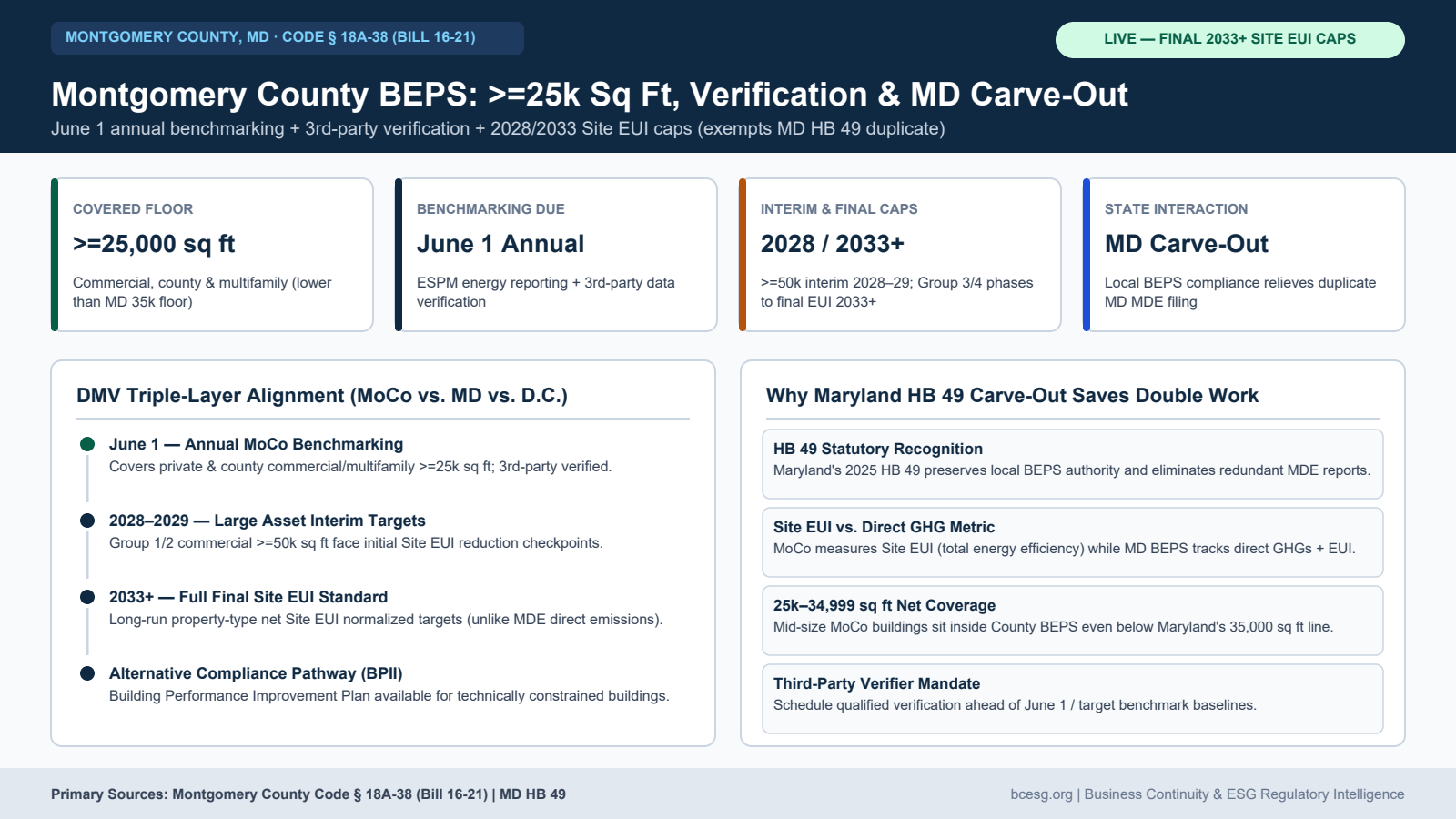
    Compliance architecture of Montgomery County Code § 18A-38 BEPS covering >=25,000 sq ft Site EUI targets (2028–2033), June 1 verification, and Maryland HB 49 duplicate-filing exemption.
    Montgomery County BEPS (Code § 18A-38, Bill 16-21): Site EUI reduction metric and how compliant county parcels coordinate with Maryland's HB 49 state BEPS exemption.

    Compliance Execution Checklist

    StepOwner / TeamAuditable Deliverable
    1. June 1 Verified DataProperty Ops / VerifierComplete Pepco/Washington Gas upload and third-party verification before June 1.
    2. Interim 2028 Gap AnalysisEnergy EngineeringBenchmark baseline Weather-Normalized Site EUI against DEP final target.
    3. HB 49 Non-Duplicate CheckMaryland Legal CounselVerify building meets Montgomery County active status for MD state relief.
    Field & Print Package

    Keep This Montgomery County, MD Compliance Checklist Handy

    Download the formatted 2-page PDF reference brief or pull the structured Markdown edition for internal compliance documentation.

    Frequently Asked Questions

    How does Montgomery County BEPS coordinate with Maryland's statewide BEPS?

    Under Maryland HB 49, qualifying buildings actively regulated by and compliant with Montgomery County's BEPS (>=25,000 sq ft) are spared duplicate reporting under Maryland's statewide BEPS program.

    Can solar RECs satisfy Montgomery County BEPS Site EUI limits?

    No. Montgomery County BEPS targets weather-normalized Site Energy Use Intensity (kBtu/sq ft), requiring actual building energy efficiency or on-site generation rather than off-site REC purchases.

    Primary Authorities & Official Resources

    Informational notice: This guide summarizes enacted statutes, regulations, or pending legislative records from the primary authorities linked above as of November 14, 2026. It is not legal, accounting, or licensed engineering advice.
  • Philadelphia BEPP Guide: 5-Year Tune-Ups (NOT a Carbon Cap) & June 30 Benchmarking

    Philadelphia BEPP Guide: 5-Year Tune-Ups (NOT a Carbon Cap) & June 30 Benchmarking

    Short answer: Multi-market compliance teams routinely misread Philadelphia as another numeric emissions-cap city like New York or Washington, DC. In reality, Philadelphia’s Building Energy Performance Program (BEPP, Phila. Code § 9-3403 / Ord. 190600) is a mandatory 5-year operational tune-up (retro-commissioning) requirement — not a numeric EUI cap or carbon price — running alongside annual June 30 benchmarking under Phila. Code § 9-3402.

    Just as important is coverage separation: commercial and multifamily buildings >=50,000 sq ft must file annual June 30 Portfolio Manager benchmarking, whereas only non-residential buildings >=50,000 sq ft fall under 5-year BEPP tune-up cycles (multifamily is excluded from BEPP). Compare this tune-up architecture against numeric cap statutes like NYC LL97, DC BEPS, or regional peer Pittsburgh Benchmarking.

    Statutory Status at a Glance
    • Code § 9-3402 (Annual Benchmarking — June 30): Commercial and multifamily properties >=50,000 sq ft (plus municipal properties >=10,000 sq ft) report via ENERGY STAR Portfolio Manager + $100 annual administrative fee.
    • Code § 9-3403 (BEPP 5-Year Tune-Ups — Sept 30 / Oct Cycles): Non-residential buildings >=50,000 sq ft (staggered across 200k+, 100k–200k, 70k–100k, and 50k–70k sq ft cohorts entering repeating 5-year cycles) must engage a Qualified Tune-Up Specialist.
    • High-Performance Exemptions: Buildings earning ENERGY STAR score >=75, LEED O+M Gold or Platinum, Net-Zero Energy certification, recent major energy code renovation, or 15% site-EUI reduction file a simple exemption instead of a field tune-up.
    • Penalties & 180-Day Repairs: Specialists inspect base-building HVAC, lighting controls, domestic hot water, and envelope seals; low/no-cost operational corrections must be completed within 180 days/prior to submission, or owners risk $2,000 initial + $500/day after 30 days.
    Print-First Compliance Brief

    Download the Philadelphia BEPP & Benchmarking Compliance Guide

    2-page Print-First PDF separating Philadelphia’s June 30 benchmarking (§ 9-3402) from its 5-year BEPP non-residential tune-up mandate (§ 9-3403).

    Inside a Qualifying BEPP Tune-Up vs. High-Performance Exemption Doors

    Under Philadelphia Office of Sustainability rules, a BEPP submission must be signed by a Qualified Tune-Up Specialist holding eligible PE, CEM, CEA, BEAP, or certified commissioning credentials. The scope focuses on practical operational waste — failed economizers, simultaneous heating and cooling, misaligned occupancy schedules, defective steam traps, or malfunctioning lighting sensors — rather than forcing full capital boiler replacement.

    Wait too late to review your June 30 Portfolio Manager scores, however, and you miss the easiest compliance exit: properties reaching an ENERGY STAR rating of 75 or higher on their benchmarking submission can file an exemption application, bypassing field RCx expense entirely for that five-year cycle.

    • Multifamily Clarification: Purely residential multifamily towers >=50,000 sq ft still pay the $100 annual fee and file June 30 benchmarking under § 9-3402, but do NOT owe § 9-3403 BEPP tune-ups.
    • Mixed-Use Space Allocation: Buildings containing >=50,000 sq ft of strictly non-residential floor area fall inside BEPP even when sitting beneath residential floors.
    Provision & CitationCovered ThresholdDeadline / CadenceCompliance Standard & Penalty
    Benchmarking (§ 9-3402)Commercial & multifamily >=50k sf (+ city >=10k)Annual June 30 (+ $100 fee)ENERGY STAR PM filing; $300 initial + $100/day
    BEPP Tune-Up (§ 9-3403)Non-residential >=50k sf ONLY (no multifamily)5-year repeating cohort cycles (Sept 30)RCx tune-up OR ESTAR >=75 exempt; $2,000 + $500/day
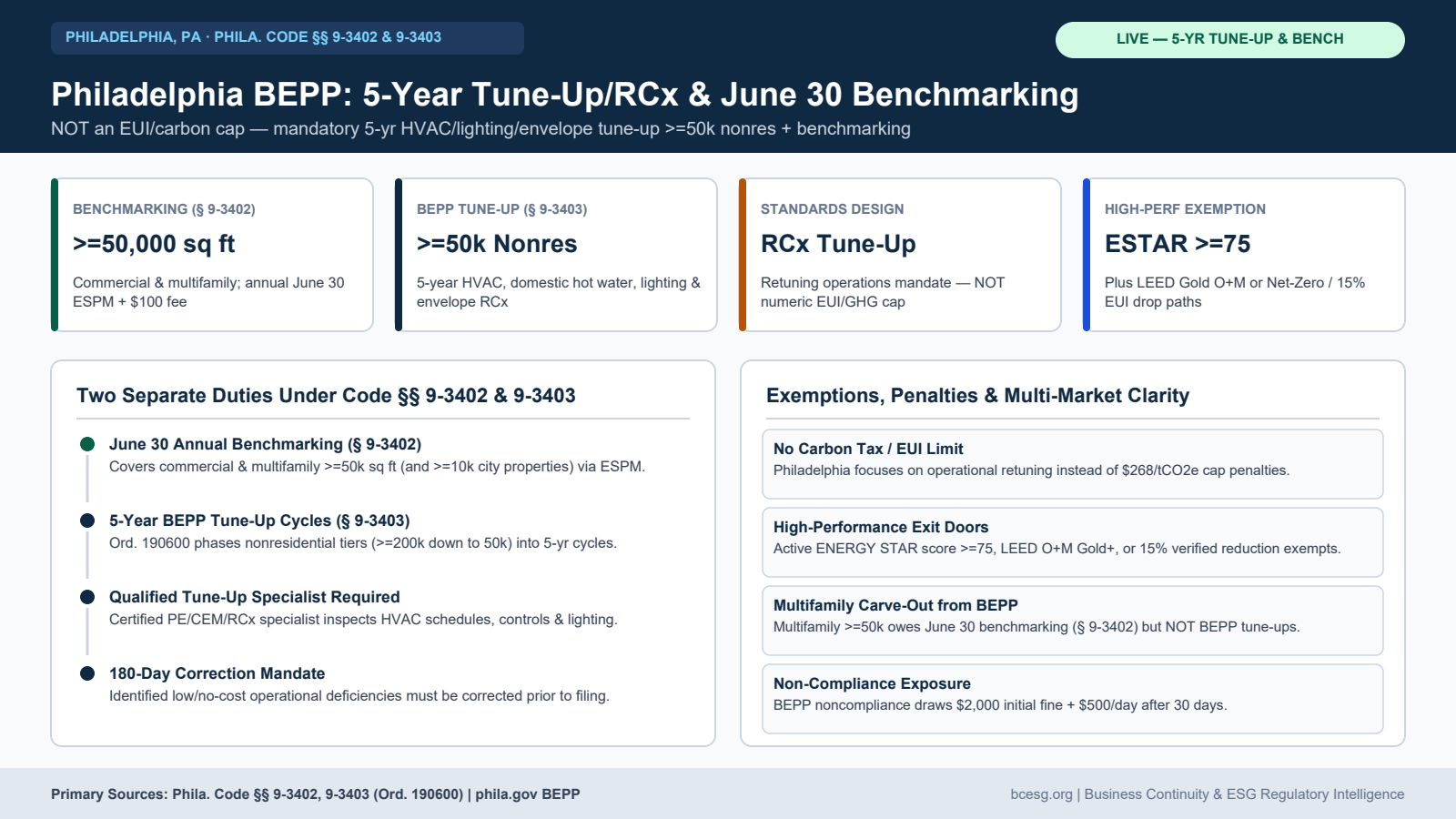
    Compliance architecture of Philadelphia Code §§ 9-3402 and 9-3403 explaining 5-year HVAC/lighting/envelope RCx tune-ups, June 30 benchmarking, ENERGY STAR >=75 exemptions, and why BEPP is NOT a carbon cap.
    Philadelphia's dual building mandate under Code §§ 9-3402 & 9-3403: June 30 benchmarking plus 5-year RCx tune-ups — distinct from numeric GHG/EUI cap BEPS laws.

    Compliance Execution Checklist

    StepOwner / TeamAuditable Deliverable
    1. June 30 Portfolio MgrProperty OpsSubmit PECO/PGW/PWD energy + water data and $100 fee; check ENERGY STAR score.
    2. Cohort & Exemption CheckSustainability / Asset MgrVerify 5-year BEPP cycle date and evaluate ESTAR >=75 / LEED Gold exemption.
    3. Specialist Tune-UpQualified PE / CEM / RCxComplete HVAC/lighting audit, execute operational corrections, and file BEPP report.
    Field & Print Package

    Keep This Philadelphia, PA Compliance Checklist Handy

    Download the formatted 2-page PDF reference brief or pull the structured Markdown edition for internal compliance documentation.

    Frequently Asked Questions

    Does Philadelphia BEPP impose a fine if a building exceeds an EUI or GHG emissions limit?

    No. Unlike NYC LL97 or Boston BERDO, Philadelphia Code § 9-3403 is a 5-year retro-commissioning (tune-up) mandate requiring inspection and correction of HVAC, lighting, water, and envelope operations — fines ($2,000 + $500/day) apply only for failing to complete or file the tune-up/exemption.

    Do multifamily apartment buildings have to comply with Philadelphia BEPP?

    Multifamily buildings >=50,000 sq ft must complete annual June 30 energy/water benchmarking under Phila. Code § 9-3402, but they are excluded from § 9-3403 5-year BEPP tune-ups unless non-residential space alone meets coverage thresholds.

    Primary Authorities & Official Resources

    Informational notice: This guide summarizes enacted statutes, regulations, or pending legislative records from the primary authorities linked above as of November 14, 2026. It is not legal, accounting, or licensed engineering advice.
  • Portland, ME & Providence, RI Building Energy Benchmarking Guide (May Deadlines)

    Portland, ME & Providence, RI Building Energy Benchmarking Guide (May Deadlines)

    Short answer: Outside Massachusetts, two coastal New England hubs carry active private-sector building energy benchmarking ordinances with back-to-back May deadlines: Portland, Maine (City Code Ch. 6, Art. X) due annually on May 1, and Providence, Rhode Island (Code Ch. 5, Art. X, ORD-2023-35) due annually on May 15.

    Both ordinances use EPA’s ENERGY STAR Portfolio Manager down to a 20,000 sq ft floor — and neither is superseded by state law, because Maine lacks any private benchmarking statute while Rhode Island’s state statute covers public state properties only. Portfolio owners operating across northern and southern New England should bundle May 1/15 submissions cleanly alongside Massachusetts LBER and Boston BERDO 2.0.

    Statutory Status at a Glance
    • Portland, ME (Code Ch. 6, Art. X — May 1): Private buildings >=20,000 sq ft (single-tenant active, multi-tenant phased) and municipal properties >=5,000 sq ft report whole-building energy and water use to the City Sustainability Office.
    • Providence, RI BERO (ORD-2023-35 — May 15): Commercial and multifamily buildings >=50,000 sq ft started May 15, 2025; the second wave covering >=20,000 sq ft joined live May 15, 2026.
    • Rhode Island Public-Only Distinction: R.I. Gen. Laws § 42-140-3.1 governs state agencies only, so commercial owners owe filings only inside Providence.
    • Transparency Scope: Neither Portland ME nor Providence RI currently attaches $268/tCO2e emissions caps — compliance focuses on accurate Portfolio Manager submissions and public disclosure.
    Print-First Compliance Brief

    Download the Portland ME & Providence RI Benchmarking Sheet

    2-page Print-First PDF covering Portland ME Ch. 6 Art. X (May 1) and Providence RI BERO Ch. 5 Art. X (May 15) Portfolio Manager requirements.

    Managing May 1 (Portland ME) & May 15 (Providence RI) in One Spring Cycle

    Because Central Maine Power / Unitil and Rhode Island Energy each handle multi-tenant aggregated meter requests on varying 2-to-4-week turnaround schedules, property teams managing assets in both cities should initiate utility data pulls by March 15 to clear Portland’s May 1 cutoff first, followed by Providence’s May 15 submission.

    Providence’s >=20,000 sq ft second cohort expanded city coverage markedly in 2026, pulling mid-sized commercial offices, mill-converted mixed-use properties, and smaller apartment complexes into public Portfolio Manager disclosure.

    • Verify Covered Property IDs: Confirm city-assigned building IDs on Portland’s Sustainability portal and Providence’s Office of Sustainability directory before sharing PM properties.
    • Water Requirement Check: Portland Ch. 6 Art. X includes water benchmarking alongside electricity and heating fuels.
    City & CitationThresholdAnnual DeadlineAdministering Agency & Scope
    Portland, ME (Ch. 6 Art. X)Private >=20k sf; municipal >=5k sfMay 1 annualPortland Sustainability Office (Energy & water PM)
    Providence, RI (Ch. 5 Art. X / ORD-2023-35)>=50k (2025); >=20k (2026+) comm & multiMay 15 annualProvidence Office of Sustainability (Energy PM + public)
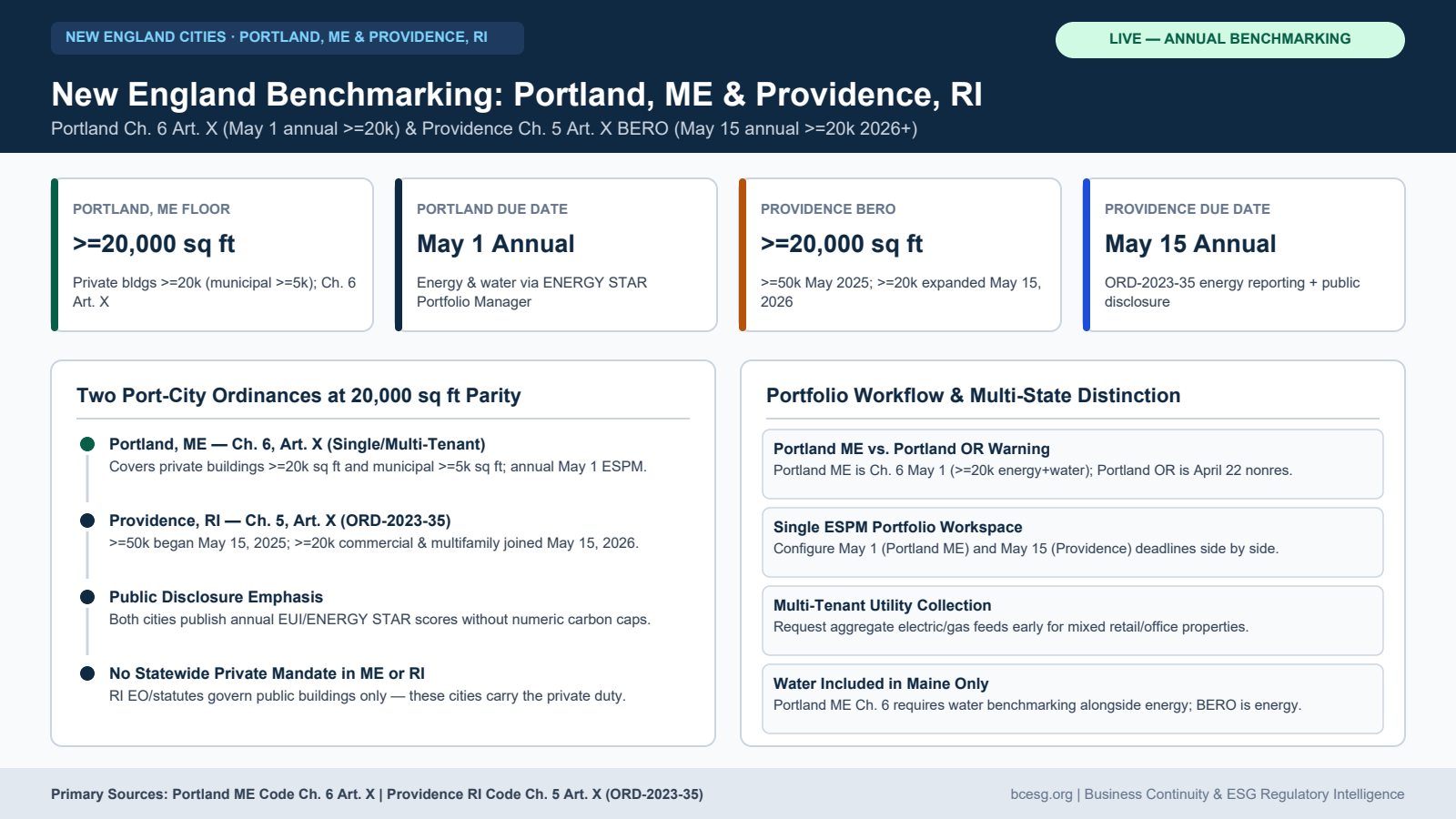
    Regional comparison of Portland ME Energy Benchmarking (Code Ch. 6 Art. X, >=20k sq ft May 1) and Providence RI BERO (Code Ch. 5 Art. X, >=50k 2025 / >=20k 2026 May 15).
    Coastal New England city benchmarking outside Massachusetts: Portland ME (May 1) and Providence RI's >=20,000 sq ft phase-in (May 15).

    Compliance Execution Checklist

    StepOwner / TeamAuditable Deliverable
    1. March Utility PullProperty OpsRequest aggregated CMP/Unitil/RI Energy whole-building data by mid-March.
    2. May 1 & May 15 UploadsCompliance LeadShare Portfolio Manager reports to Portland (May 1) and Providence (May 15) templates.
    3. Archive ConfirmationsAsset RecordsStore automated receipt emails and building IDs ahead of public municipal tables.
    Field & Print Package

    Keep This Portland, ME & Providence, RI Compliance Checklist Handy

    Download the formatted 2-page PDF reference brief or pull the structured Markdown edition for internal compliance documentation.

    Frequently Asked Questions

    When did Providence RI's >=20,000 sq ft reporting requirement take effect?

    Under Providence ORD-2023-35 (Code Ch. 5, Art. X), buildings >=50,000 sq ft began May 15, 2025, and buildings >=20,000 sq ft entered active reporting on May 15, 2026.

    Does Portland Maine require water reporting alongside energy benchmarking?

    Yes. Under Portland City Code Ch. 6, Art. X, covered buildings >=20,000 sq ft submit both energy and water consumption via ENERGY STAR Portfolio Manager by May 1 annually.

    Primary Authorities & Official Resources

    Informational notice: This guide summarizes enacted statutes, regulations, or pending legislative records from the primary authorities linked above as of November 14, 2026. It is not legal, accounting, or licensed engineering advice.
  • Newton BERDO & Lexington BEU-D: MetroWest MA Building Compliance Guide (2026)

    Newton BERDO & Lexington BEU-D: MetroWest MA Building Compliance Guide (2026)

    Short answer: Greater Boston building compliance extends well outside downtown cores along the Route 128 / I-95 corridor. Both Newton (BERDO, Revised Ordinances Ch. 29) and Lexington (BEU-D General Bylaw) enforce independent local ordinances governing commercial, institutional, and multifamily real estate — creating critical distinctions between Newton’s full emissions-reduction trajectory and Lexington’s disclosure-plus-assessment model.

    Although Massachusetts LBER (225 CMR 27.00) requires statewide benchmarking at >=20,000 sq ft without emissions limits, Newton and Lexington enforce autonomous municipal deadlines, local advisory review mechanisms, and (in Newton’s case) enforceable emissions targets matching the pattern established in Boston BERDO 2.0.

    Statutory Status at a Glance
    • Newton BERDO (Ch. 29 — >=20,000 sq ft): Covers commercial, institutional, and large residential buildings >=20,000 sq ft; phased 2025–2026 reporting and third-party verification scaling into emissions caps stepping down to net-zero 2050.
    • Lexington BEU-D (>25,000 sq ft): Covers commercial and residential buildings >25,000 sq ft plus municipal facilities under the Town’s 2022 General Bylaw via annual Portfolio Manager energy/water filings and periodic energy assessments.
    • Administering Agencies: Newton Climate & Energy Team / BERDO Advisory Commission vs. Town of Lexington Sustainability Department.
    • Regional Contrast: Newton imposes enforceable declining GHG caps modeled on Boston BERDO; Lexington centers on annual transparency disclosure and building energy assessment cycles.
    Print-First Compliance Brief

    Download the MetroWest MA Building Compliance Comparison

    2-page Print-First PDF contrasting Newton BERDO’s 20,000 sq ft emissions caps with Lexington BEU-D’s >25,000 sq ft disclosure & assessment schedule.

    Two Neighboring Towns, Two Different Legal Mechanics

    Portfolio managers running Greater Boston suburban assets frequently misclassify Lexington BEU-D as an emissions-cap ordinance identical to Newton BERDO or Boston BERDO 2.0. Lexington’s 2022 bylaw mandates annual ENERGY STAR Portfolio Manager submissions and periodic building energy assessments to inform capital retrofits, without enforcing statutory CO2e dollar-per-ton caps or Alternative Compliance Payments.

    Newton BERDO (Revised Ordinances Ch. 29), by contrast, combines annual reporting and data verification with binding multi-year emissions targets ramping from initial cohorts in 2025–2026 through 2050. Commercial landlords operating across both towns should verify municipal assessment roll square footage and track whether campus parcels contain aggregate buildings crossing Newton’s 20,000 sq ft floor.

    • Newton 2025–2026 On-Ramp: Confirm tier placement and whether multi-building lots trigger Newton’s aggregate >=20,000 sq ft definition.
    • Lexington Phased Assessments: Track due years for periodic energy assessments alongside annual Portfolio Manager uploads.
    Ordinance & CitationThresholdCore MandateEmissions Caps?
    Newton BERDO (Ch. 29)Commercial, institutional & large res >=20,000 sq ftAnnual disclosure + 2025–2026 phased verificationYES — declining caps to net-zero 2050
    Lexington BEU-D (2022 Bylaw)Commercial & res >25,000 sq ft + municipalAnnual Portfolio Manager + energy assessmentsNO — disclosure & assessment mandate
    MA Statewide LBER (225 CMR 27.00)Statewide buildings >=20,000 sq ftJune 30 utility-led annual energy disclosureNO — statewide transparency only
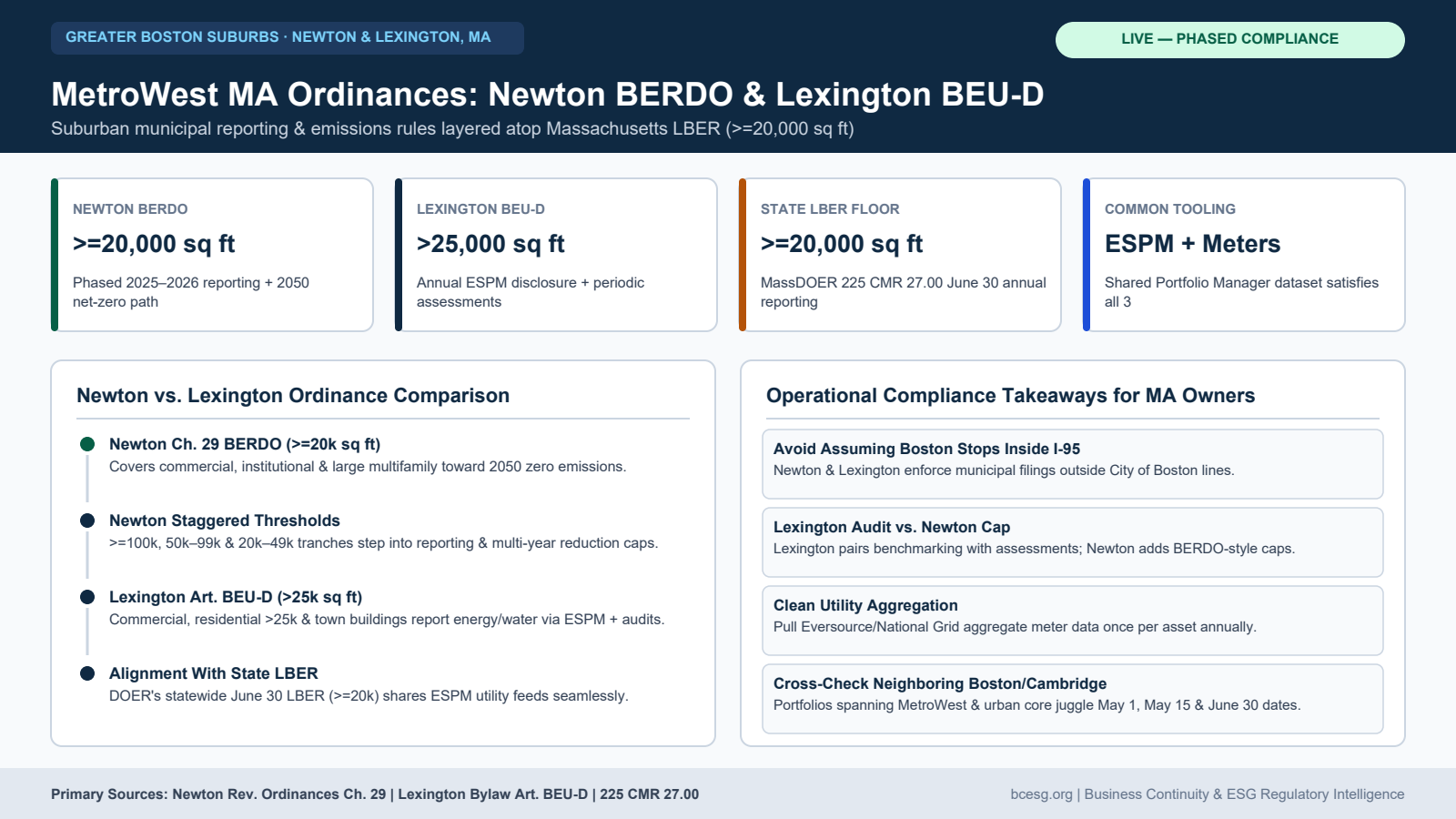
    Side-by-side comparison of Newton BERDO (Revised Ordinances Ch. 29, >=20,000 sq ft emissions caps) and Lexington BEU-D (>25,000 sq ft benchmarking & assessments).
    MetroWest Massachusetts building rules: Newton BERDO's >=20,000 sq ft emissions trajectory vs. Lexington BEU-D's >25,000 sq ft disclosure and assessment mandates.

    Compliance Execution Checklist

    StepOwner / TeamAuditable Deliverable
    1. Jurisdictional MappingAsset ManagementTag every Route 128 parcel by municipality (Newton vs Lexington vs MA-only).
    2. Utility Data AccessProperty OpsEnable Eversource/National Grid whole-building meters for PM & town portals.
    3. Newton Verification PrepSustainability / PESchedule third-party verification and 2026–2030 emissions forecast for Newton assets.
    Field & Print Package

    Keep This Newton & Lexington, MA Compliance Checklist Handy

    Download the formatted 2-page PDF reference brief or pull the structured Markdown edition for internal compliance documentation.

    Frequently Asked Questions

    Does Newton BERDO include residential buildings?

    Yes. Newton Revised Ordinances Ch. 29 covers commercial, institutional, and large residential buildings >=20,000 sq ft, administering phased 2025–2026 reporting and emissions targets toward net-zero 2050.

    Does Lexington BEU-D fine building owners for exceeding emissions caps?

    No. Lexington's Building Energy Use Disclosure Bylaw focuses on annual ENERGY STAR Portfolio Manager energy/water disclosure and periodic building energy assessments for buildings >25,000 sq ft, without numeric GHG cap penalties.

    Primary Authorities & Official Resources

    Informational notice: This guide summarizes enacted statutes, regulations, or pending legislative records from the primary authorities linked above as of November 14, 2026. It is not legal, accounting, or licensed engineering advice.

BC ESG

ESG Strategy, Sustainability Intelligence, and Business Continuity for Forward-Thinking Organizations

© 2026 BC ESG — Business Continuity, ESG & Sustainability Intelligence