
Short answer: Greater Boston building compliance extends well outside downtown cores along the Route 128 / I-95 corridor. Both Newton (BERDO, Revised Ordinances Ch. 29) and Lexington (BEU-D General Bylaw) enforce independent local ordinances governing commercial, institutional, and multifamily real estate — creating critical distinctions between Newton’s full emissions-reduction trajectory and Lexington’s disclosure-plus-assessment model.
Although Massachusetts LBER (225 CMR 27.00) requires statewide benchmarking at >=20,000 sq ft without emissions limits, Newton and Lexington enforce autonomous municipal deadlines, local advisory review mechanisms, and (in Newton’s case) enforceable emissions targets matching the pattern established in Boston BERDO 2.0.
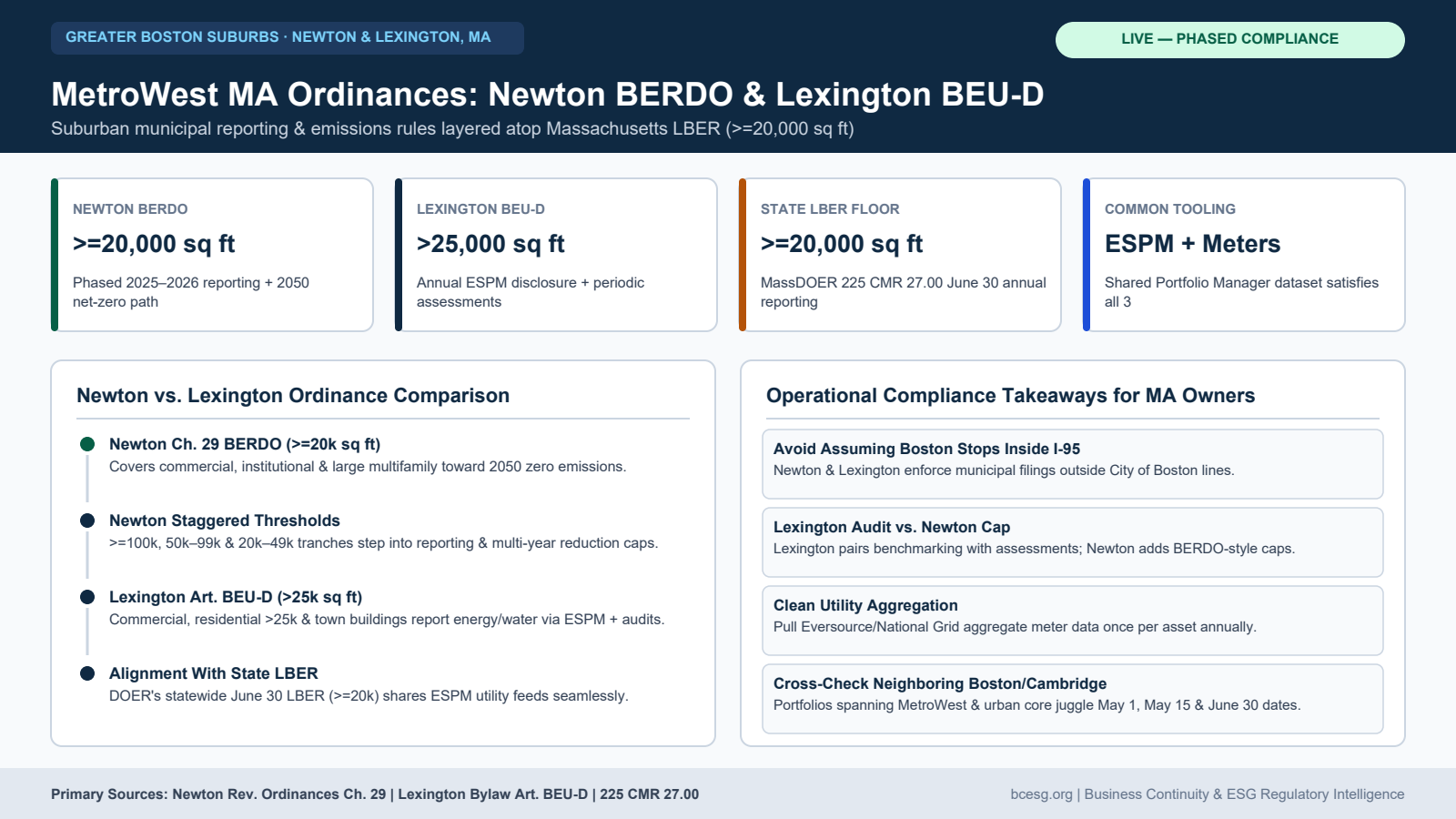
- Newton BERDO (Ch. 29 — >=20,000 sq ft): Covers commercial, institutional, and large residential buildings >=20,000 sq ft; phased 2025–2026 reporting and third-party verification scaling into emissions caps stepping down to net-zero 2050.
- Lexington BEU-D (>25,000 sq ft): Covers commercial and residential buildings >25,000 sq ft plus municipal facilities under the Town’s 2022 General Bylaw via annual Portfolio Manager energy/water filings and periodic energy assessments.
- Administering Agencies: Newton Climate & Energy Team / BERDO Advisory Commission vs. Town of Lexington Sustainability Department.
- Regional Contrast: Newton imposes enforceable declining GHG caps modeled on Boston BERDO; Lexington centers on annual transparency disclosure and building energy assessment cycles.
Download the MetroWest MA Building Compliance Comparison
Two Neighboring Towns, Two Different Legal Mechanics
Portfolio managers running Greater Boston suburban assets frequently misclassify Lexington BEU-D as an emissions-cap ordinance identical to Newton BERDO or Boston BERDO 2.0. Lexington’s 2022 bylaw mandates annual ENERGY STAR Portfolio Manager submissions and periodic building energy assessments to inform capital retrofits, without enforcing statutory CO2e dollar-per-ton caps or Alternative Compliance Payments.
Newton BERDO (Revised Ordinances Ch. 29), by contrast, combines annual reporting and data verification with binding multi-year emissions targets ramping from initial cohorts in 2025–2026 through 2050. Commercial landlords operating across both towns should verify municipal assessment roll square footage and track whether campus parcels contain aggregate buildings crossing Newton’s 20,000 sq ft floor.
- Newton 2025–2026 On-Ramp: Confirm tier placement and whether multi-building lots trigger Newton’s aggregate >=20,000 sq ft definition.
- Lexington Phased Assessments: Track due years for periodic energy assessments alongside annual Portfolio Manager uploads.
| Ordinance & Citation | Threshold | Core Mandate | Emissions Caps? |
|---|---|---|---|
| Newton BERDO (Ch. 29) | Commercial, institutional & large res >=20,000 sq ft | Annual disclosure + 2025–2026 phased verification | YES — declining caps to net-zero 2050 |
| Lexington BEU-D (2022 Bylaw) | Commercial & res >25,000 sq ft + municipal | Annual Portfolio Manager + energy assessments | NO — disclosure & assessment mandate |
| MA Statewide LBER (225 CMR 27.00) | Statewide buildings >=20,000 sq ft | June 30 utility-led annual energy disclosure | NO — statewide transparency only |
Compliance Execution Checklist
| Step | Owner / Team | Auditable Deliverable |
|---|---|---|
| 1. Jurisdictional Mapping | Asset Management | Tag every Route 128 parcel by municipality (Newton vs Lexington vs MA-only). |
| 2. Utility Data Access | Property Ops | Enable Eversource/National Grid whole-building meters for PM & town portals. |
| 3. Newton Verification Prep | Sustainability / PE | Schedule third-party verification and 2026–2030 emissions forecast for Newton assets. |
Keep This Newton & Lexington, MA Compliance Checklist Handy
Frequently Asked Questions
Does Newton BERDO include residential buildings?
Yes. Newton Revised Ordinances Ch. 29 covers commercial, institutional, and large residential buildings >=20,000 sq ft, administering phased 2025–2026 reporting and emissions targets toward net-zero 2050.
Does Lexington BEU-D fine building owners for exceeding emissions caps?
No. Lexington's Building Energy Use Disclosure Bylaw focuses on annual ENERGY STAR Portfolio Manager energy/water disclosure and periodic building energy assessments for buildings >25,000 sq ft, without numeric GHG cap penalties.
Primary Authorities & Official Resources
- City of Newton — BERDO Compliance Guidance Document
- Town of Lexington — Building Energy Use Disclosure (BEU-D)
Informational notice: This guide summarizes enacted statutes, regulations, or pending legislative records from the primary authorities linked above as of November 14, 2026. It is not legal, accounting, or licensed engineering advice.