
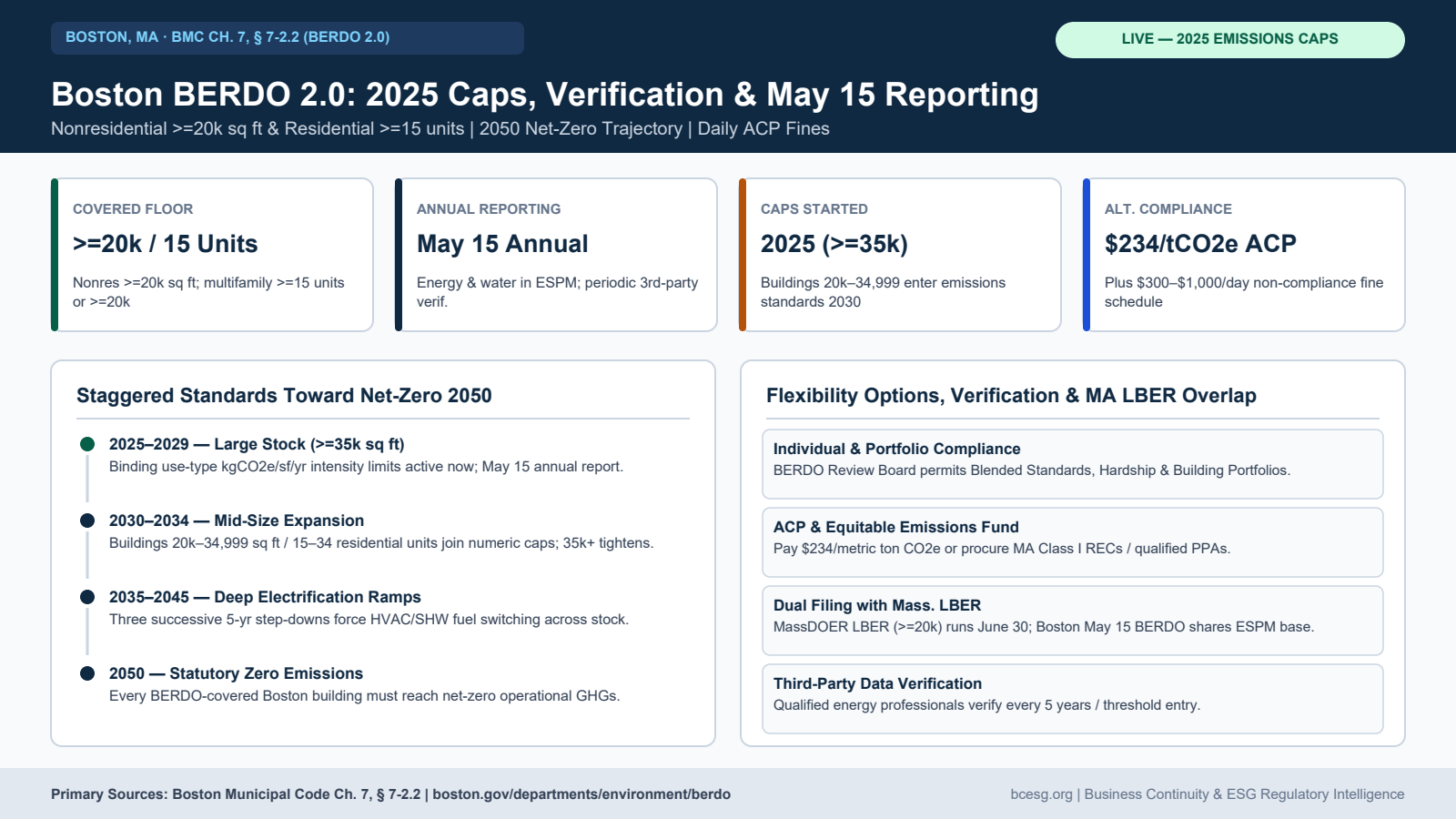
Short answer: Enacted under Boston Municipal Code Chapter 7, § 7-2.2, Boston’s Building Emissions Reduction and Disclosure Ordinance (BERDO 2.0) is one of the tightest active municipal building decarbonization laws in the United States. Large commercial and multifamily properties (>=35,000 sq ft, or residential properties with >=35 units) entered binding 5-year GHG intensity caps on January 1, 2025, requiring active emissions compliance alongside annual May 15 reporting and periodic third-party data verification.
Mid-tier buildings (20,000–34,999 sq ft or 15–34 units) already owe annual May 15 energy/water disclosure and step into emissions caps in 2030, progressing uniformly toward net-zero emissions in 2050. Because Massachusetts simultaneously enforces statewide LBER reporting (225 CMR 27.00) — and neighboring Cambridge BEUDO enforces its own net-zero timeline — regional owners should harmonize utility metering across both jurisdictions.
- Covered Thresholds: Non-residential >=20,000 sq ft; residential >=15 units or >=20,000 sq ft; or multiple buildings on the same parcel totaling >=20,000 sq ft (or >=15 units).
- Two-Wave Emissions Caps: >=35,000 sq ft started emissions limits Jan 1, 2025 (with first emissions-year reports covered in 2026); 20,000–34,999 sq ft start emissions caps in 2030.
- May 15 Annual Deadline & Third-Party Verification: Whole-building energy and water use due annually May 15 via ENERGY STAR Portfolio Manager, paired with third-party qualified verifier attestation every five years (plus first-year baseline verification).
- Alternative Compliance Payments (ACP) vs. Fines: Excess emissions above occupancy-weighted CO2e limits may be retired at $234 per MTCO2e (deposited into Boston’s Equitable Emissions Investment Fund), whereas failing to comply with emissions standards draws statutory daily fines ($1,000/day for >=35k sf; $300/day for 20k–35k sf).
Download the Boston BERDO 2.0 Compliance Reference
Blended Emissions Limits, Class I RECs & Alternative Compliance Payments
Boston calculates asset limits using 5-year primary-use CO2e intensity factors (kgCO2e/sq ft/yr) blended proportionally across mixed uses inside a parcel (for instance, office vs. multifamily vs. laboratory/healthcare allocations). Where physical fuel switching or heat-pump retrofits lag the 2025–2029 schedule, BERDO 2.0 allows owners to apply eligible Clean Energy purchases — specifically bundled Massachusetts Class I RECs or qualifying Power Purchase Agreements — to electricity emissions.
Owners facing stubborn fossil-heating loads or phased lease rollovers can apply to the BERDO Review Board for a Blended Emissions Standard (pooling multi-building portfolios), a Hardship Compliance Plan, or an Individual Compliance Schedule modifying interim reduction trajectories — or retire remaining shortfalls via $234/MTCO2e Alternative Compliance Payments.
- Lab & Healthcare Tiers: High-process facilities receive higher starting EUI/GHG allowances than standard commercial offices, though still stepping to zero by 2050.
- Mandatory Verification Gate: Unlike simple benchmarking cities, BERDO 2.0 prohibits unverified self-reporting during emissions-cap transition years.
| Building Tier | Annual Reporting | Emissions Caps Start | Compliance Relief & Daily Non-Filing Fines |
|---|---|---|---|
| Large (>=35k sf or >=35 units) | May 15 (PM + 3rd-party verify cycle) | Jan 1, 2025 (2025–2029 period) | $234/MTCO2e ACP; $1,000/day emissions violation |
| Small/Mid (20k–34,999 sf / 15–34 units) | May 15 annual energy & water | Jan 1, 2030 (2030–2034 period) | $234/MTCO2e ACP; $300/day violation (~2030+) |
| Multi-Building Parcels | >=20k sf combined -> follows >=20k/35k tier | Matched to aggregate tier | Blended Emissions Standard / Individual Schedule option |
Coordinating Boston BERDO 2.0 With Massachusetts LBER (225 CMR 27.00)
Massachusetts’s statewide Large Building Energy Reporting (LBER) program (225 CMR 27.00, >=20,000 sq ft) relies largely on utility-pushed data delivered to DOER on a June 30 cycle, whereas Boston BERDO places strict affirmative legal responsibility directly on building owners every May 15. Confirm whether Eversource and National Grid automated meters align seamlessly across both systems to avoid mismatched square footage or unattributed tenant meters.
- Utility Data Authorization: Verify whole-building aggregated data consent with Eversource and National Grid ahead of April so tenant-level privacy thresholds do not block May 15 submissions.
- 2030 Cohort Pre-Audit: Owners of 20,000–34,999 sq ft buildings have four years to use annual BERDO disclosures to cost out 2030 compliance before caps lock in.
Compliance Execution Checklist
| Step | Owner / Team | Auditable Deliverable |
|---|---|---|
| 1. Parcel Use & Tier Audit | Compliance / Legal | Confirm primary occupancy classification and >=35k vs 20k–34,999 sq ft cohort. |
| 2. 3rd-Party Verifier Sign-Off | PE / CEM / Qualified Verifier | Complete BERDO data verification checklist ahead of the May 15 filing deadline. |
| 3. ACP vs REC Economics | Treasury / Sustainability | Compare MA Class I REC cost against $234/MTCO2e ACP exposure per asset. |
| 4. MA LBER Reconciliation | Property Operations | Cross-check DOER June 30 utility-reported LBER dataset against BERDO May 15 numbers. |
Keep This Boston, MA Compliance Checklist Handy
Frequently Asked Questions
When did Boston BERDO 2.0 emissions caps actually start?
Emissions standards took effect January 1, 2025 for buildings >=35,000 sq ft (or residential buildings >=35 units), while smaller covered buildings (20,000–34,999 sq ft) begin active emissions limits in 2030.
What is Boston BERDO's Alternative Compliance Payment rate?
Excess CO2e emissions can be settled via Alternative Compliance Payments set at $234 per metric ton of CO2e (MTCO2e), which feed Boston's Equitable Emissions Investment Fund, rather than paying noncompliance fines.
Does reporting under Boston BERDO exempt a building from Massachusetts statewide LBER?
Massachusetts LBER (225 CMR 27.00) coordinates municipal reporting for utilities, but building owners must still verify Boston-specific BERDO May 15 disclosures, third-party verifications, and emissions-compliance schedules directly with the City.
Primary Authorities & Official Resources
- City of Boston Environment Dept. — BERDO 2.0 Program Portal
- Boston Municipal Code Ch. 7, § 7-2.2 & BERDO Regulations
Informational notice: This guide summarizes enacted statutes, regulations, or pending legislative records from the primary authorities linked above as of November 14, 2026. It is not legal, accounting, or licensed engineering advice.