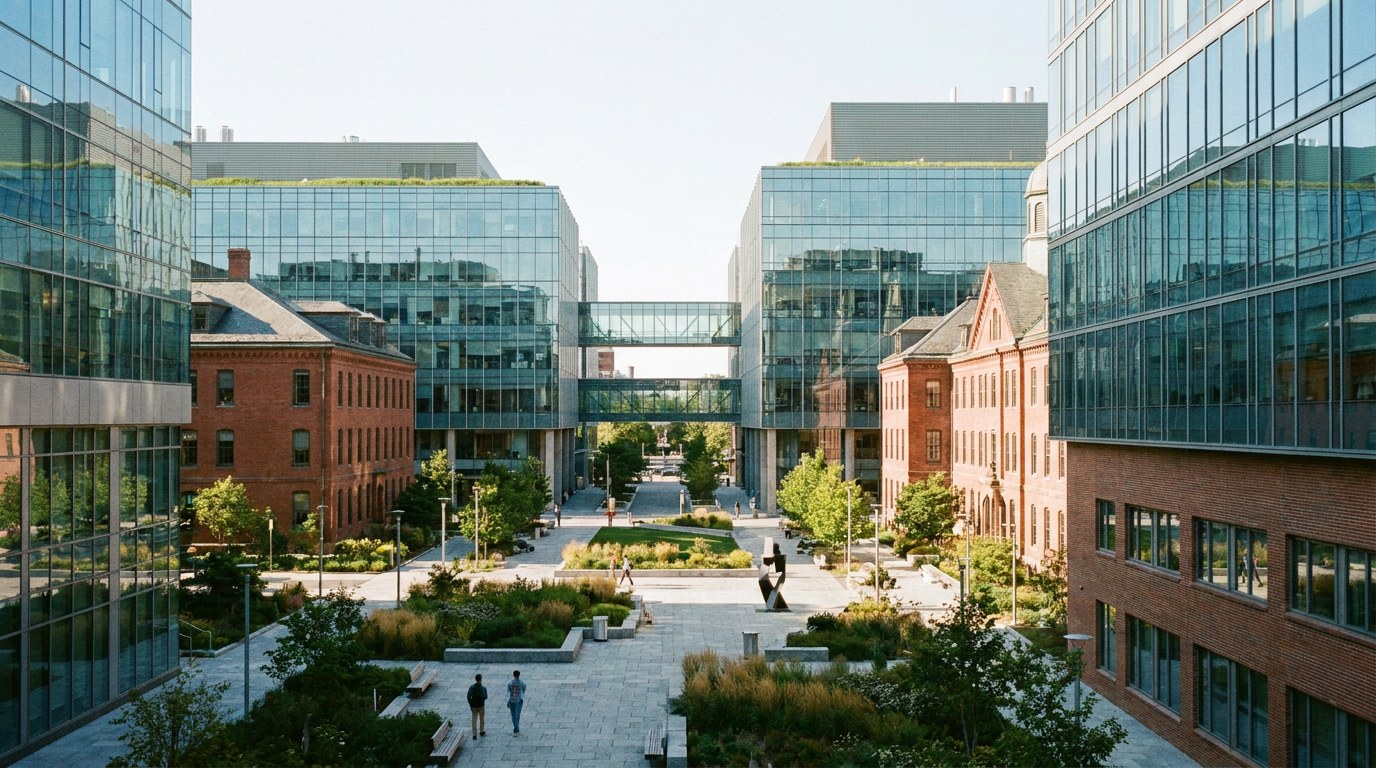
Short answer: Following its 2023 overhaul under Cambridge Municipal Code Chapter 8.67, Cambridge’s Building Energy Use Disclosure Ordinance (BEUDO) imposes the fastest major commercial net-zero timeline in the United States. Every non-residential parcel >=100,000 sq ft entered phased GHG emissions reductions across 2025–2026 and must hit net-zero emissions by 2035 — fully fifteen years ahead of Boston’s 2050 horizon.
For Kendall Square life-science laboratories, university buildings, and large corporate campuses, a 2035 zero-carbon finish line puts immediate pressure on electrification capital cycles, green-power contracting, and Massachusetts LBER (225 CMR 27.00) data integration. Compare neighboring municipal mechanics in our Boston BERDO 2.0 Guide and Newton & Lexington MA Guide.
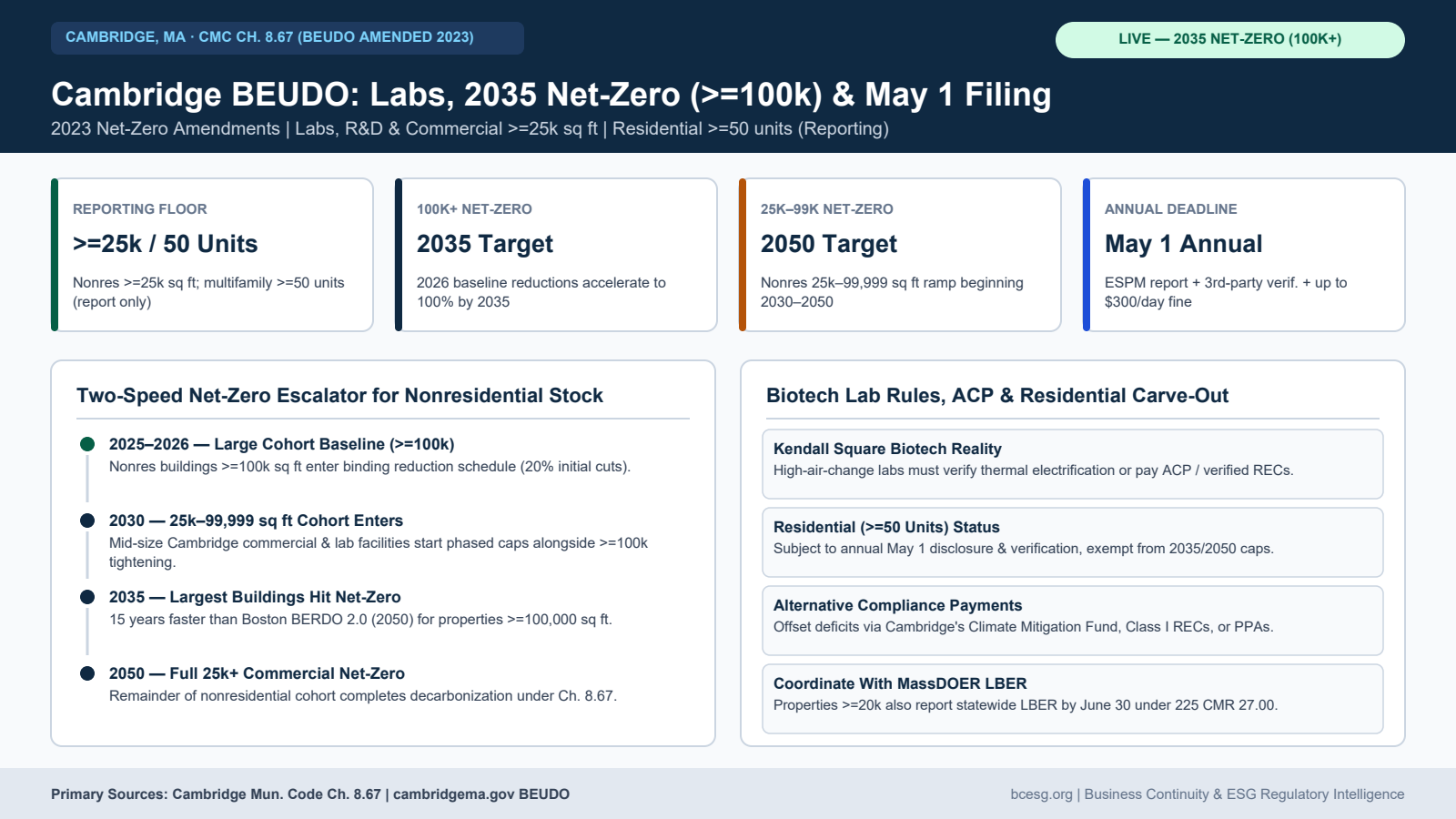
- Large Non-Residential (>=100,000 sq ft): Annual May 1 Portfolio Manager reporting; 20% baseline reduction already started in 2025, escalating toward 60% in 2030 and 100% net-zero in 2035.
- Mid-Size Non-Residential (25,000–99,999 sq ft): Annual May 1 energy/GHG disclosure active now; emissions caps take effect in 2030 (40% reduction) reaching net-zero by 2050.
- Multifamily Residential (>=50 units): Annual May 1 energy and water benchmarking mandatory; no BEUDO emissions caps currently apply to purely residential buildings >=50 units.
- Enforcement & Compliance Tools: Includes Cambridge-approved Class I RECs / verified PPAs, Alternative Compliance Payments ($234/MTCO2e), Hardship Compliance Plans, and statutory $300/day noncompliance penalties.
Download the Cambridge BEUDO 2035 Net-Zero Playbook
Why 2035 Changes Lease, Lab HVAC & Financing Math in Cambridge
Conventional commercial lease terms run seven to ten years — meaning any lease signed today for a 100,000+ sq ft Cambridge property extends squarely across the 2035 net-zero mandate. High-air-change biomedical laboratories and steam-heated offices cannot treat decarbonization as a post-2040 renovation problem; owners must evaluate central plant heat-recovery chillers, district energy contracts, or multi-year green-power PPAs inside current capital plans.
Cambridge provides temporary flexibility through qualified third-party RECs and Alternative Compliance Payments ($234/MTCO2e), as well as Portfolio Compliance pooling and Review Board extensions, yet each option requires structured documentation ahead of annual May 1 filings.
- Baseline Verification Matters: Because percentage reductions scale against historic asset/baseline emissions under Ch. 8.67, verifying utility meter boundaries early prevents overstated reduction burdens.
- Residential Exemption Scope: Mixed-use towers containing >=25,000 sq ft of non-residential retail or commercial floorspace remain subject to non-residential BEUDO targets on those portions.
| Property Category | Benchmarking (Annual May 1) | Emissions Caps & Net-Zero Cutoff | Flexibility & Violations |
|---|---|---|---|
| Non-Residential >=100,000 sf | Required (ENERGY STAR PM) | Active 2025–2026 -> Net-Zero 2035 | Qualified RECs/PPAs, $234/t ACP, $300/day fine |
| Non-Residential 25k–99,999 sf | Required (ENERGY STAR PM) | Caps start 2030 -> Net-Zero 2050 | Phased targets + hardship/board plans |
| Residential >=50 units | Required (ENERGY STAR PM) | Disclosure only (no BEUDO emissions cap) | $300/day non-reporting penalties |
Compliance Execution Checklist
| Step | Owner / Team | Auditable Deliverable |
|---|---|---|
| 1. Baseline Audit | Engineering / Operations | Confirm non-residential gross sq ft (>=100k vs 25k–99,999) and baseline emissions. |
| 2. May 1 Filing Lock | Sustainability Team | Upload verified whole-building Eversource energy/water logs prior to May 1. |
| 3. 2030–2035 CapEx Model | Capital Projects / Finance | Model heat-pump / chiller conversion vs REC + $234/t ACP over 2026–2035 lease cycles. |
Keep This Cambridge, MA Compliance Checklist Handy
Frequently Asked Questions
Which Cambridge buildings must hit net-zero emissions by 2035 under BEUDO?
Under Cambridge Municipal Code Ch. 8.67, non-residential buildings >=100,000 sq ft entered emissions limits in 2025–2026 and must achieve net-zero emissions by 2035; buildings 25,000–99,999 sq ft follow a 2030–2050 schedule.
Are residential apartment buildings subject to Cambridge BEUDO's emissions caps?
No. Residential buildings with 50 or more units must complete annual May 1 energy and water benchmarking disclosures, but Cambridge's 2023 amendment left purely residential multifamily assets out of the numeric net-zero emissions caps.
Primary Authorities & Official Resources
- City of Cambridge Office of Sustainability — BEUDO Portal
- Massachusetts DOER — Statewide LBER Reference (225 CMR 27.00)
Informational notice: This guide summarizes enacted statutes, regulations, or pending legislative records from the primary authorities linked above as of November 14, 2026. It is not legal, accounting, or licensed engineering advice.