
Short answer: Massachusetts enforces one of the nation’s broadest statewide building energy-reporting thresholds under the Climate Act of 2022 (M.G.L. c. 25A § 20) and Department of Energy Resources regulation 225 CMR 27.00 (MA DOER LBER). Covered commercial, institutional, industrial, and multifamily buildings ≥20,000 gross sq ft must track and reconcile annual whole-building energy consumption with DOER by June 30.
For Greater Boston owners, statewide LBER serves as the reporting baseline underneath strict local decarbonization ordinances: Boston BERDO 2.0 (≥20k sq ft / 15+ units), Cambridge BEUDO (≥25k sq ft / ≥50 units), Newton BERDO (≥20k), and Lexington BEU-D (>25k) all enforce independent municipal spring filings and active emissions limits.
- Governing Authority: M.G.L. c. 25A § 20 (2022 Climate Act) & 225 CMR 27.00.
- Administering Agency: Massachusetts Department of Energy Resources (DOER).
- Covered Threshold: Commercial, industrial, institutional, and multifamily buildings ≥20,000 gross sq ft statewide.
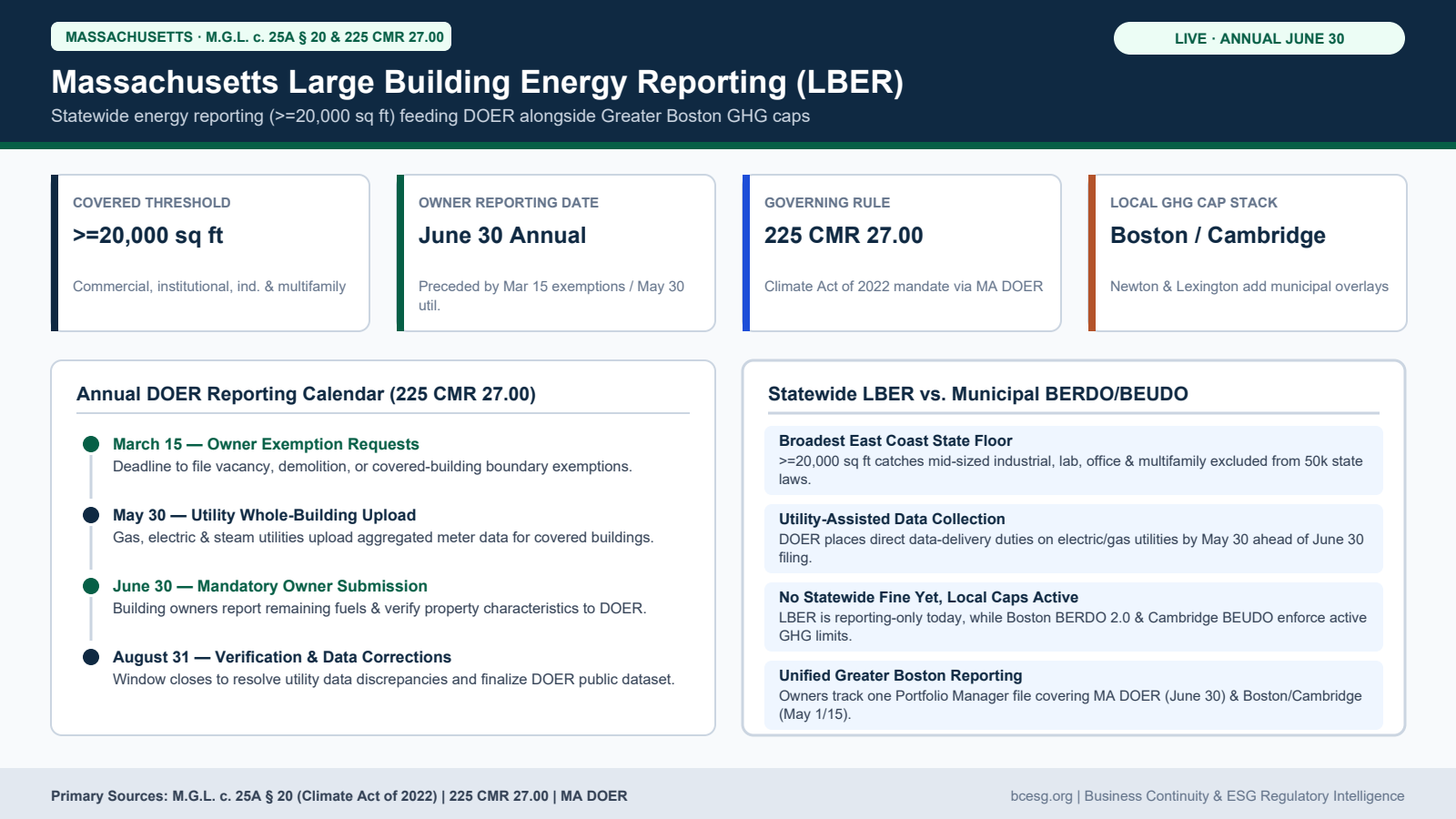
- 4-Step Annual Calendar: March 15 (exemptions) → May 30 (utilities upload metered electric/gas/steam) → June 30 (owner reporting) → August 31 (verification/corrections).
- Performance vs. Reporting Split: Statewide LBER is reporting-only today; municipal Boston BERDO 2.0 and Cambridge BEUDO impose binding GHG limits starting 2025–2026.
Align Massachusetts >=20,000 sq ft LBER Filing With Local BERDO & BEUDO Caps
Inside DOER's Four-Date LBER Reporting Architecture
Unlike state benchmarking programs that leave owners chasing tenant meter consent, 225 CMR 27.00 places a direct statutory data-delivery duty on Massachusetts electric, gas, and steam distribution utilities. By May 30 each year, utilities submit aggregated consumption records for covered premises directly into the DOER system.
Property owners remain legally responsible for verifying parcel coverage, submitting delivered-fuel bills (fuel oil, propane, biomass), claiming vacancies or industrial exemptions by March 15, completing owner submissions by June 30, and resolving any utility anomalies prior to August 31.
- Industrial & Lab Coverage: Because M.G.L. c. 25A § 20 includes industrial buildings ≥20,000 sq ft, Route 128 life-science labs, cold storage, and suburban manufacturing plants are swept in alongside office towers.
- Parcel vs. Condominium Boundaries: Multiple buildings sharing single parcels require careful gross-floor-area verification against municipal assessor records before the March 15 exemption cutoff.
| DOER Milestone Date | Responsible Party | Action Under 225 CMR 27.00 |
|---|---|---|
| March 15 | Building Owner | Submit boundary, vacancy, or statutory exemption requests to DOER |
| May 30 | Utilities (Electric/Gas/Steam) | Upload aggregated whole-building energy usage for covered >=20k properties |
| June 30 | Building Owner | Complete owner energy submission (incl. delivered oil/propane & property metadata) |
| August 31 | Owner & DOER Verification | Finalize discrepancy corrections before public DOER dataset publication |
Synchronizing Statewide LBER With Boston BERDO 2.0 & Neighboring States
Inside Boston and Cambridge, owners run two distinct calendars out of the same Portfolio Manager dataset: Cambridge BEUDO filings land on May 1 and Boston BERDO 2.0 filings land on May 15—more than six weeks before Massachusetts DOER’s June 30 owner deadline. Ensuring third-party data verification covers both local emissions compliance and DOER records eliminates mid-summer rework.
Northeast regional managers should track Massachusetts alongside New Jersey’s July 1 benchmarking (>25k sq ft) and NYC’s May 1 LL84/LL97 stack.
Compliance Execution Checklist
| Step | Owner / Team | Auditable Deliverable |
|---|---|---|
| 1. DOER List Audit | Asset Mgmt | Check DOER covered-building list for every MA commercial/industrial/MF parcel >=20,000 sq ft. |
| 2. Mar 15 Exemptions | Compliance Lead | File any demolition, under-threshold, or vacancy exemption documentation prior to March 15. |
| 3. Utility Match | Facilities /Ops | Confirm May 30 utility uploads capture all meters and compile delivered heating oil/propane invoices. |
| 4. Local Overlay Sync | Sustainability | Align May 1 (Cambridge) / May 15 (Boston) filings with June 30 MA LBER owner certification. |
Keep This Massachusetts Compliance Checklist Handy
Frequently Asked Questions
Are industrial warehouses and life-science labs covered by Massachusetts LBER?
Yes. M.G.L. c. 25A § 20 and 225 CMR 27.00 explicitly include commercial, institutional, industrial, and multifamily buildings of 20,000 gross sq ft or more.
Does Massachusetts LBER impose carbon emissions fines like Boston BERDO 2.0?
Statewide LBER is an annual energy reporting mandate overseen by DOER and does not currently levy numeric carbon-cap penalties, whereas Boston BERDO 2.0 and Cambridge BEUDO impose binding emissions limits and Alternative Compliance Payments locally.
When must a building owner submit LBER reports to DOER?
Owner reports are due June 30 annually, following March 15 exemption filings and May 30 utility uploads, with verification/corrections closing August 31.
Primary Authorities & Official Resources
- Massachusetts General Laws c. 25A § 20 (Climate Act Building Reporting)
- MA DOER — Large Building Energy Reporting (225 CMR 27.00)
- New Jersey Clean Energy Act Benchmarking Guide — BC ESG
- NYC Local Law 84 Benchmarking & LL97 Prerequisite — BC ESG
Informational notice: This guide summarizes enacted statutes, regulations, or pending legislative records from the primary authorities linked above as of November 14, 2026. It is not legal, accounting, or licensed engineering advice.