
Short answer: California’s statewide AB 802 Building Energy Benchmarking Program (Cal. Pub. Res. Code § 25402.10; 20 CCR §§ 1680–1684) requires owners of commercial and multifamily buildings over 50,000 gross sq ft with 17 or more active utility accounts to report whole-building energy use via ENERGY STAR Portfolio Manager every June 1.
Even for corporations focused on California’s broader corporate rules—such as SB 253 Scope 1–3 GHG reporting—AB 802 is the operational data engine: its mandatory utility aggregation rule unlocks tenant-metered whole-building electricity and gas figures that feed directly into corporate Scope 2 inventories and local municipal audits across seven California cities.
- Governing Authority: Cal. Pub. Res. Code § 25402.10 (AB 802) & CEC Regulations 20 CCR §§ 1680–1684.
- Administering Agency: California Energy Commission (CEC).
- Covered Threshold: Commercial buildings (>50,000 sq ft, any account count above utility aggregation rules—generally >50k w/ 0/17+ rules per CEC account triggers) and multifamily buildings (>50,000 sq ft with ≥17 active residential/commercial utility accounts).
- Deadline & Penalty: Annual June 1 filing; civil penalties of $500–$2,000 per day after 30-day uncured violation notice.
- Local Exemptions: CEC recognizes approved local programs (LA EBEWE, SF EBO, San Jose BPO, San Diego) so owners avoid redundant state reporting while complying locally.
Connect California AB 802 Meter Data to Municipal Audits & SB 253 Scope 2
Threshold Nuances: The 17-Utility-Account Rule & Utility Data Rights
AB 802 pairs two legal triggers that separate multi-tenant assets from single-user campuses: a building must exceed 50,000 gross sq ft and fall within CEC’s active utility account rules (notably 17+ active utility accounts for multifamily residential, or covered commercial configurations with no residential/non-residential exceptions).
Crucially, AB 802 empowers owners against recalcitrant tenants: utilities must provide aggregated whole-building energy usage within four weeks of request, automatically bypassing individual tenant written authorization when a building contains at least 3 commercial accounts or 5+ residential accounts.
- Public Transparency: CEC publishes benchmarked Energy Use Intensity (EUI) and ENERGY STAR scores on a public database for disclosable buildings.
- 30-Day Cure Notice: Before imposing daily fines ($500–$2,000/day), CEC issues a formal written warning granting 30 days to cure missing submissions.
| Program Element | AB 802 Rule Citation | Owner Requirement & Enforcement |
|---|---|---|
| Covered Size & Accounts | Cal. Pub. Res. Code § 25402.10 | >50,000 gross sq ft commercial & multifamily (>=17 active utility accts) |
| Utility Aggregation | 20 CCR § 1682 / Utility Mandate | Utilities deliver 12-mo aggregated data within 4 weeks (3 com / 5 res thresh) |
| Annual CEC Deadline | 20 CCR § 1683 | Annual June 1 ENERGY STAR Portfolio Manager submission |
| Civil Penalty Schedule | Cal. Pub. Res. Code § 25402.10(f) | $500–$2,000/day after 30-day uncured CEC notice |
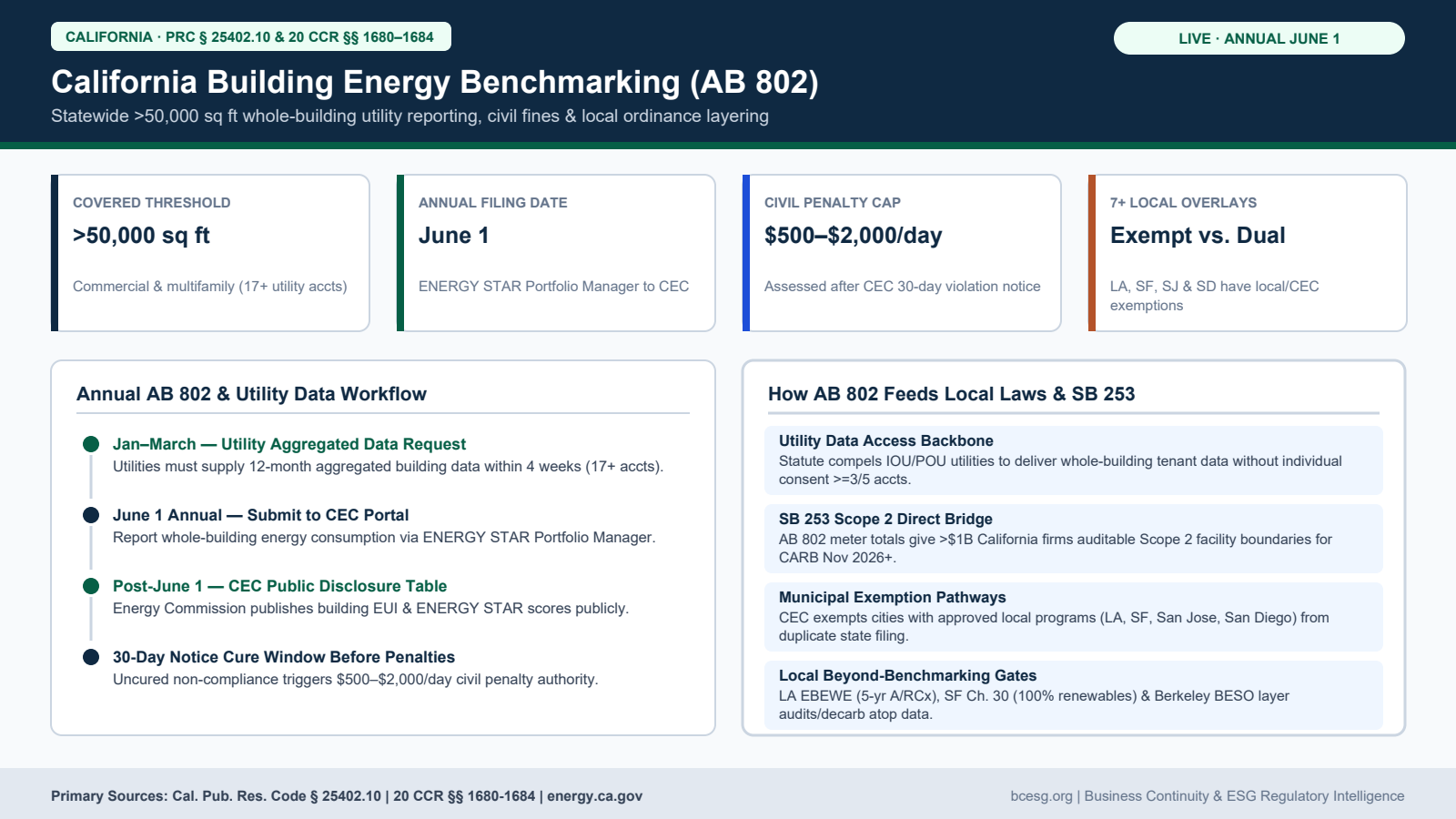
Bridge to California Local Ordinances & SB 253 Scope 2 Inventories
California does not enforce a single statewide Building Performance Standard cap yet—local cities carry the performance and audit teeth. While CEC exempts properties already reporting under approved local ordinances (Los Angeles EBEWE, San Francisco EBO, San Jose BPO, and San Diego), owners inside those cities face much lower square-footage floors (10,000–20,000 sq ft) and five-year retro-commissioning or renewable electricity obligations.
Meanwhile, large corporations (>$1B revenue) subject to California SB 253 Scope 1 and Scope 2 disclosures rely on AB 802 utility aggregates to reconcile leased-building operational boundaries without double counting.
Compliance Execution Checklist
| Step | Owner / Team | Auditable Deliverable |
|---|---|---|
| 1. Local vs. CEC Check | Portfolio Lead | Verify if building sits in a CEC-exempt approved city (LA, SF, San Jose, San Diego) vs. direct CEC filing. |
| 2. Request Utility Feeds | Property Ops | Request aggregated 12-month data from IOU/POU utilities in Feb/Mar (allow 4+ weeks SLA). |
| 3. File by June 1 | Asset Mgmt | Run Portfolio Manager data quality checker and submit via annual CEC reporting link before June 1. |
| 4. Reconcile SB 253 | Corporate ESG | Map Portfolio Manager meter boundaries to corporate SB 253 Scope 2 & Cat 13 disclosures. |
Keep This California Compliance Checklist Handy
Frequently Asked Questions
Do buildings in Los Angeles or San Francisco have to file twice for AB 802 and local ordinances?
No, provided the property complies fully with a CEC-approved local benchmarking program (including LA EBEWE, San Francisco EBO, San Jose BPO, and San Diego), CEC exempts the building from duplicate state submission—though local filing deadlines (such as May 1 in SF/SJ) differ from June 1.
Why does AB 802 matter for California SB 253 Scope 2 compliance?
AB 802's statutory whole-building utility aggregation gives corporate tenants and building owners auditable electricity and gas totals across multi-tenant assets needed for Scope 2 and Scope 3 Category 13 GHG inventories.
What is the penalty for ignoring a California Energy Commission AB 802 notice?
After issuing a 30-day written notice of violation, the CEC may assess administrative civil penalties ranging from $500 to $2,000 per day until compliance is demonstrated.
Primary Authorities & Official Resources
- California Energy Commission — Building Energy Benchmarking Program (AB 802)
- California SB 253 & SB 261 Compliance Playbook — BC ESG
- Washington CBPS vs. West Coast Laws — BC ESG
Informational notice: This guide summarizes enacted statutes, regulations, or pending legislative records from the primary authorities linked above as of November 14, 2026. It is not legal, accounting, or licensed engineering advice.