Short answer: Oregon adopted a statewide two-tier Building Performance Standard under HB 3409 (codified at ORS 469.275 et seq.) and finalized operational rules in Oregon Department of Energy (ODOE) OAR Chapter 330, Division 300. Modeled directly on Washington’s Clean Buildings architecture, Oregon requires Tier 1 nonresidential buildings (≥35,000 sq ft) to hit Energy Use Intensity targets or investment criteria starting June 1, 2028, while Tier 2 commercial and institutional/multifamily properties begin mandatory reporting, EMP, and O&M compliance on July 1, 2028.
Crucial rule-citation note: ODOE’s binding BPS rules live in OAR 330-300 (not OAR 330-135), and statewide compliance runs separately from Portland’s local energy reporting and 2050 carbon step-down ordinance track.
- Governing Authority: HB 3409 (2023), ORS 469.275 et seq., and ODOE Administrative Rules OAR 330-300.
- Administering Agency: Oregon Department of Energy (ODOE).
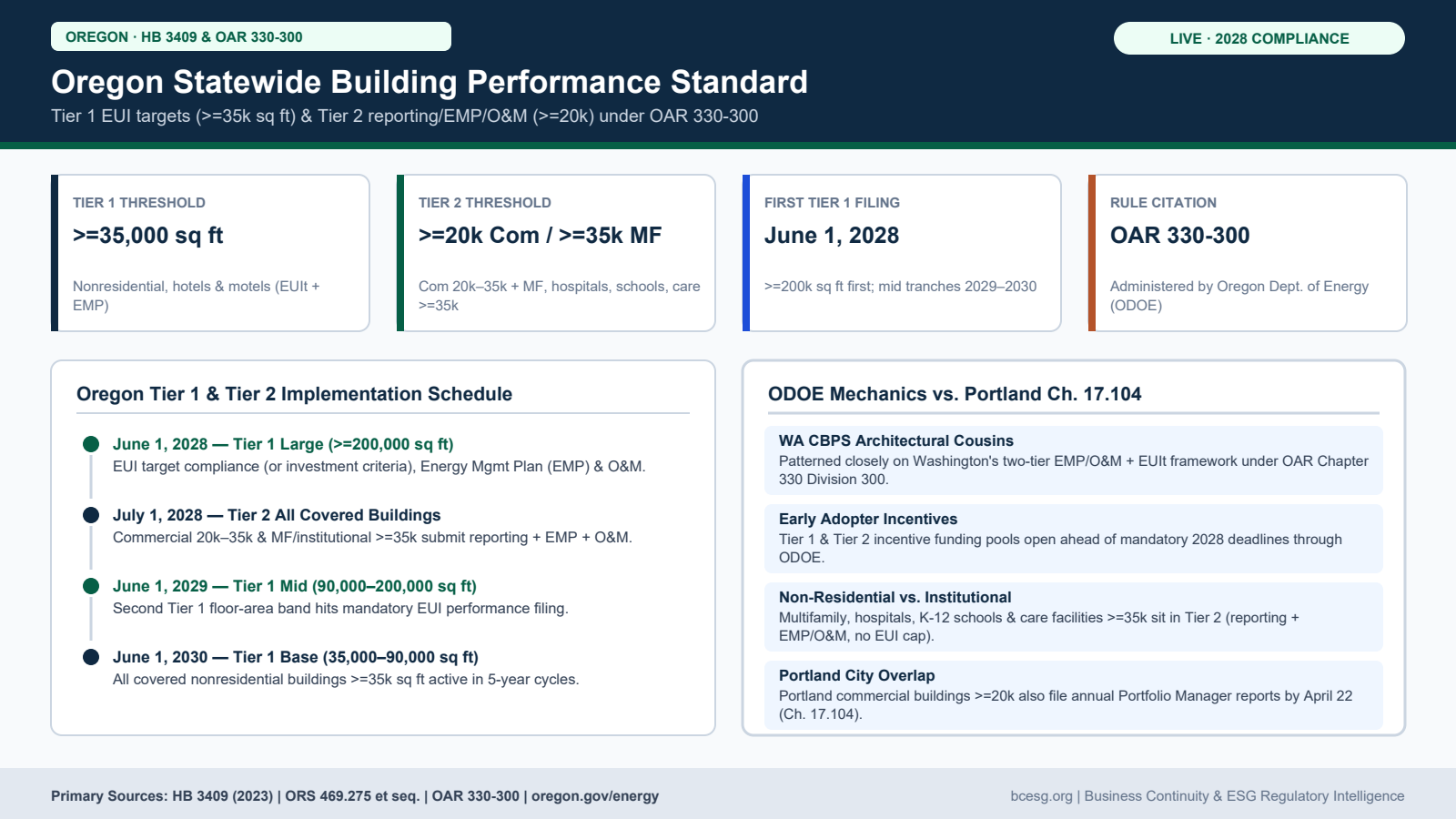
- Tier 1 (≥35,000 sq ft Nonresidential/Hotels/Motels): EUI target (or LCCA investment criteria) + EMP + O&M due June 1, 2028 (≥200k), June 1, 2029 (90k–200k), and June 1, 2030 (35k–90k).
- Tier 2 (20k–35k Com & ≥35k MF/Hospitals/Schools/Care): Reporting + EMP + O&M due July 1, 2028 (no numeric Tier 1 EUIt cap in Cycle 1).
- Incentives Window: ODOE Early Adopter Incentive funds support early Tier 1 & Tier 2 compliance preparation prior to 2028 enforcement.
Map Oregon HB 3409 Tier 1 & Tier 2 Compliance Under OAR 330-300
Tier 1 vs. Tier 2 Classification Under OAR 330-300
Understanding where an Oregon asset lands between Tier 1 and Tier 2 determines whether the owner faces capital retrofit obligations (or an LCCA investment audit) versus operational governance and energy reporting. Unlike Washington’s >50,000 sq ft Tier 1 floor, Oregon pulls nonresidential buildings down to 35,000 sq ft inside Tier 1.
Conversely, Oregon places multifamily housing, hospitals, K-12 schools, universities, and senior care buildings ≥35,000 sq ft into Tier 2 alongside smaller commercial buildings (20,000–34,999 sq ft)—requiring benchmarking, an Energy Management Plan, and an O&M program without immediate EUIt caps.
- ASHRAE Standard 100 Adaptation: ODOE builds EUIt benchmarks by building activity type and climate zone, requiring a qualified Energy Manager to sign EMP and O&M documentation.
- 5-Year Recurring Cycles: After initial 2028–2030 filings, covered Tier 1 & Tier 2 buildings re-verify compliance every five years.
| Oregon BPS Tier | Building Types & Square Footage | First Compliance Date & Core Duties |
|---|---|---|
| Tier 1 — Largest | Nonresidential, hotels, motels >=200,000 sq ft | June 1, 2028 — EUIt / LCCA + EMP + O&M |
| Tier 1 — Mid | Nonresidential, hotels, motels 90,000–199,999 sq ft | June 1, 2029 — EUIt / LCCA + EMP + O&M |
| Tier 1 — Base | Nonresidential, hotels, motels 35,000–89,999 sq ft | June 1, 2030 — EUIt / LCCA + EMP + O&M |
| Tier 2 — Com & Inst/MF | Commercial 20k–35k sq ft; MF/hospitals/schools >=35k | July 1, 2028 — Energy reporting + EMP + O&M |
Pacific Northwest Portfolio Alignment: Oregon, Washington & Portland
For commercial real estate portfolios spanning I-5 from Seattle to Portland, Oregon’s OAR 330-300 deliberately tracks Washington’s CBPS (WAC 194-50)—allowing engineering teams to reuse Energy Management Plan templates and O&M manuals with Oregon-specific EUIt tables.
Inside Portland city limits, owners must also track Portland City Code Chapter 17.104 (annual April 22 energy reporting for commercial buildings ≥20,000 sq ft) alongside the city’s 2050 building carbon step-down policy. Waiting until 2028 leaves insufficient time for a mandatory 12-month metered O&M baseline.
Compliance Execution Checklist
| Step | Owner / Team | Auditable Deliverable |
|---|---|---|
| 1. Tier Verification | Asset Mgmt | Classify each OR property >=20,000 sq ft under Tier 1 (>=35k nonres) vs Tier 2 under OAR 330-300. |
| 2. Incentive Screen | Finance / ESG | Check ODOE Early Adopter Incentive eligibility before 2028 funding windows close. |
| 3. EMP & O&M Build | Operations | Stand up written EMP and 12 months of logged preventive O&M records at least 18 months pre-deadline. |
| 4. Portland Sync | Compliance Lead | Pair statewide ODOE preparation with Portland April 22 Ch. 17.104 annual Portfolio Manager filings. |
Keep This Oregon Compliance Checklist Handy
Frequently Asked Questions
Where are Oregon's binding BPS rules codified?
Oregon Department of Energy (ODOE) implements HB 3409 (ORS 469.275 et seq.) inside Oregon Administrative Rules Chapter 330, Division 300 (OAR 330-300).
Are Oregon multifamily buildings subject to numeric Tier 1 EUI caps?
No. Multifamily residential buildings of 35,000 sq ft or larger fall under Tier 2, requiring energy use reporting, an Energy Management Plan (EMP), and an O&M program starting July 1, 2028.
Does complying with Portland Ch. 17.104 satisfy Oregon HB 3409?
No. Portland City Code Chapter 17.104 governs annual April 22 commercial energy reporting in Portland, whereas OAR 330-300 enforces statewide Tier 1 EUIt targets and Tier 2 EMP/O&M governance through ODOE.
Primary Authorities & Official Resources
- Oregon Department of Energy — Statewide Building Performance Standard (HB 3409)
- Oregon Secretary of State — OAR Chapter 330, Division 300 Administrative Rules
- Portland Building Carbon Standards & Energy Reporting — BC ESG
- Washington CBPS Dual-State Comparison Guide — BC ESG
Informational notice: This guide summarizes enacted statutes, regulations, or pending legislative records from the primary authorities linked above as of November 14, 2026. It is not legal, accounting, or licensed engineering advice.