Last verified: August 22, 2026. By Will Tygart. Built-environment disaster recovery — not a generic IT encyclopedia.
“Disaster recovery planning” is one of the most competitive information spaces on the web. BCESG’s job is not to out-general Wikipedia. This page is for portfolio operators: multi-BIN realities, tenants, life safety, vendors, insurance, and — in NYC — the link to performance-law evidence files.
If you need the broader program-standards walkthrough, start with our existing complete DR framework. If you need ISO-centric BIA tooling, use continuityhub.org and come back here for CRE packaging.
Why specialize for commercial real estate
A server-room runbook does not restore a 400,000-square-foot mixed-use asset. CRE recovery has to keep people alive, keep the building legal to occupy, keep tenants informed, and keep claims and compliance files intact. In New York, that last bucket includes ENERGY STAR Portfolio Manager access and Local Law 97 artifacts — credentials that often live in one person’s laptop.
CRE DR stack (six layers)
- Life safety and emergency action — evacuate, account, coordinate with responders
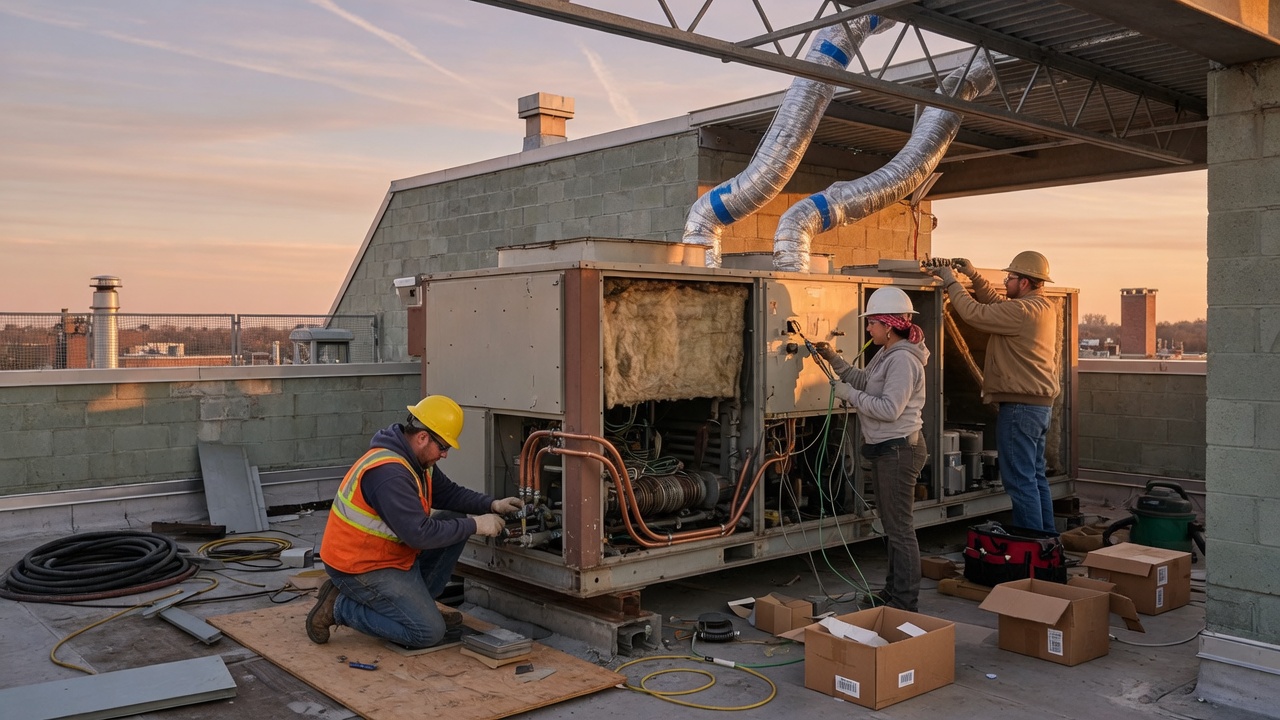
- Building systems recovery — power, water, HVAC, elevators, fire/life safety, BMS
- Tenant operations — communications, access, partial occupancy strategies
- Vendor network — pre-positioned restoration, shoring, board-up, temporary power
- Data and documents — drawings, insurance policies, LL97 / ESPM access, contracts
- Capital and claims — documentation that survives adjusters and boards
RTO thinking for buildings
| Function |
Question to answer before the event |
| Fire / life safety |
What must be restored before any re-entry? |
| Vertical transportation |
Which banks first for partial operations? |
| Heat / cool in extreme weather |
What is the tenant risk window? |
| Broadband / access control |
Hybrid work makes this a CRE issue, not an IT footnote |
| ESPM / compliance portals |
Who has credentials if the PM lead is offline? |
Playbook you can steal
Before
- Vendor MSA and after-hours numbers tested quarterly
- Credential vault for utilities plus DOB / ESPM / BEAM
- Photo baseline of critical equipment
- Insurance schedule mapped to BINs
During
- Single incident commander per asset
- Timestamped log (who decided what)
- Tenant message templates
- Separation of life-safety tasks from property-conservation tasks
After
- Claims package with photos, logs, and invoices
- Lessons learned into CapEx
- Emissions / energy impact notes for compliance files
- Update the property-management BC playbook with what actually broke
Relationship to the older “complete DR framework” article
The existing site guide remains useful as a broad framework. This page is the CRE portfolio specialization and should be the start-here URL if you operate buildings. Do not treat the two as competing pillars — they stack.
Related on BCESG
Positioning note: generic “disaster recovery planning” queries are a classic-search sink. This page stays in the built-environment operator lane on purpose.
Related reading: LL97 data to continuity and insurance, tenant communication playbook, and lender evidence pack. Sister hubs: Restoration Intel, Healthcare Facility Hub, Continuity Hub, Risk Coverage Hub, and Tygart Media.