Short answer: Maryland’s statewide Building Energy Performance Standards (MDE BEPS / COMAR 26.28) moved from initial grace benchmarking into verified, fee-backed execution on June 1, 2026. Owners of commercial, multifamily, and state buildings ≥35,000 gross sq ft must file CY2025 energy data backed by third-party data verification and a $100 annual reporting fee—on the path toward 2030 interim and 2040 net-zero direct emissions caps.
Just as critical for DMV-area portfolios: House Bill 49 (2025) resolved the state-versus-county overlap by exempting buildings complying with Montgomery County’s BEPS ordinance from filing duplicate state reports—while neighboring Washington, D.C. BEPS drops its Cycle 2 threshold to 25,000 sq ft on January 1, 2027.
- Governing Authority: Md. Code Envir. § 2-1602 (Climate Solutions Now Act of 2022), amended by HB 49 (2025); COMAR 26.28.
- Administering Agency: Maryland Department of the Environment (MDE) Clean Buildings Program.
- Covered Threshold: Commercial, multifamily, and state-owned buildings ≥35,000 gross sq ft (excluding parking garages).
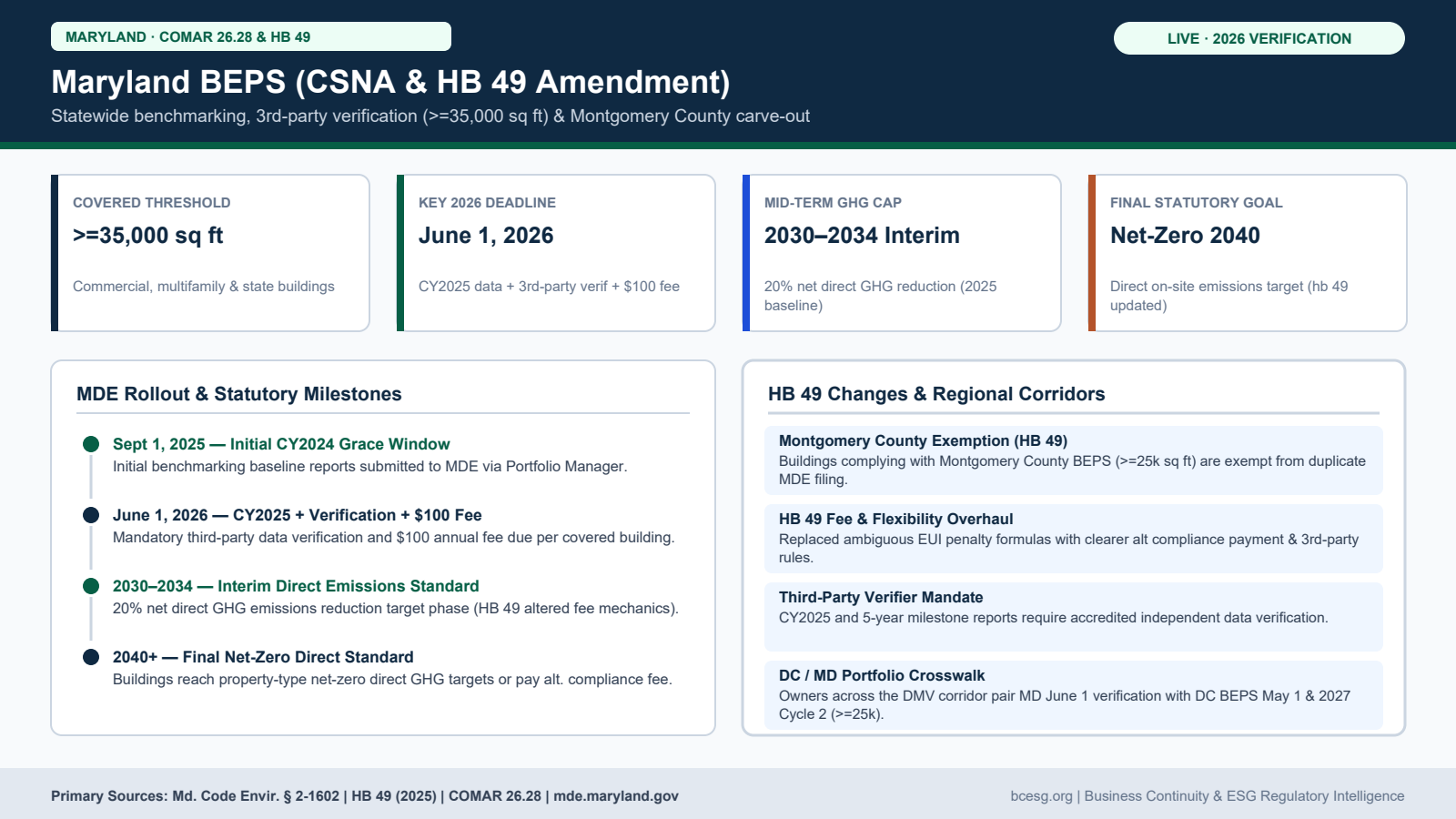
- Annual Verification & Fee: June 1 annual Portfolio Manager filing; CY2025 milestone (June 1, 2026) introduced mandatory third-party verification + $100 fee.
- Direct GHG Trajectory: Interim 2030–2034 targets leading to net-zero direct (Scope 1) on-site emissions in 2040.
Prepare Maryland >=35,000 sq ft Buildings for Third-Party Verification & Direct GHG Caps
What HB 49 Changed for Owners, Fees, and Local Carve-Outs
When MDE first promulgated COMAR 26.28, building owners challenged both the initial EUI compliance friction and duplicate state/county compliance burdens in Montgomery County. The 2025 passage of HB 49 streamlined administration without delaying decarbonization.
First, HB 49 clarified that buildings covered by and compliant with Montgomery County BEPS (≥25,000 sq ft) need not submit duplicative filings under MDE’s state program. Second, HB 49 formalized the $100 annual benchmarking fee schedule and adjusted EUI vs. direct GHG alternative-compliance fee structures to align with achievable electrification cycles.
- Direct vs. Site EUI Lens: Maryland uniquely targets net direct (on-site fossil fuel) greenhouse gas emissions rather than electricity-heavy total emissions caps—accelerating heat-pump water heating and HVAC electrification.
- Accredited Verifiers Required: Starting with CY2025 reports and recurring every five years (as well as interim compliance milestones), an accredited third-party verifier must attest to meter boundaries and square footage.
| Milestone / Provision | Applicability | Statutory Deadline & Rule |
|---|---|---|
| Initial CY2024 Benchmarking | >=35,000 sq ft commercial/MF/state | Sept 1, 2025 (initial grace deadline completed) |
| CY2025 Verified Filing | Non-exempt buildings >=35,000 sq ft | June 1, 2026 + mandatory 3rd-party verifier + $100 fee |
| Montgomery County Exemption | Montgomery County BEPS >=25k buildings | Exempt from duplicate MDE state filing per HB 49 (2025) |
| 2030 & 2040 Direct GHG Caps | Interim 2030–2034 -> Final 2040 | 20% net direct GHG cut (2030+) -> Net-zero direct 2040 |
Synchronizing Maryland (≥35k) With D.C. BEPS (≥25k) and Regional Law
Real estate operators across the Baltimore–Washington corridor manage overlapping calendars: Washington D.C. closes BEPS Cycle 1 (≥50k sq ft) on December 31, 2026 and drops into Cycle 2 (≥25,000 sq ft) on January 1, 2027, with annual D.C. benchmarking due May 1. One month later, Maryland owners face their June 1 MDE filing deadline.
Read alongside our D.C. BEPS Cycle 1 & Cycle 2 pathway guide and New Jersey CEA benchmarking guide, Mid-Atlantic asset teams can consolidate ENERGY STAR Portfolio Manager utility feeds and third-party verifier engagements into one spring assurance window.
Compliance Execution Checklist
| Step | Owner / Team | Auditable Deliverable |
|---|---|---|
| 1. Exemption Check | Compliance Lead | Confirm whether assets sit in Montgomery County BEPS carve-out or <35k sq ft exclusion (excl. parking). |
| 2. Retain Verifier | Facilities / PE | Contract an MDE-recognized third-party data verifier ahead of spring utility reconciliation. |
| 3. File & Remit $100 | Property Ops | Submit verified CY data in Portfolio Manager + pay $100 annual fee to MDE by June 1. |
| 4. Electrification Plan | CapEx Engineering | Model on-site gas equipment replacements ahead of 2030 direct GHG targets and 2040 net-zero rules. |
Keep This Maryland Compliance Checklist Handy
Frequently Asked Questions
What buildings are exempt under HB 49's Montgomery County provision?
Buildings located in Montgomery County that comply with Montgomery County's local Building Energy Performance Standards (>=25,000 sq ft) are exempt from filing duplicate statewide reports with MDE under HB 49 (2025).
When is Maryland BEPS third-party verification required?
First required with CY2025 data due June 1, 2026 (alongside the $100 annual fee), and at subsequent 5-year compliance verification milestones under COMAR 26.28.
Does Maryland BEPS regulate electricity emissions or only on-site gas?
Maryland's interim 2030 and 2040 statutory standards focus specifically on direct on-site greenhouse gas emissions (Scope 1 combustion), though whole-building electric and fuel consumption are both benchmarked annually.
Primary Authorities & Official Resources
- Maryland Department of the Environment — Building Energy Performance Standards (BEPS)
- Maryland General Assembly — House Bill 49 (2025 Session)
- D.C. BEPS Cycle 1 & Cycle 2 Reference Guide — BC ESG
- New Jersey Clean Energy Act Benchmarking Guide — BC ESG
Informational notice: This guide summarizes enacted statutes, regulations, or pending legislative records from the primary authorities linked above as of November 14, 2026. It is not legal, accounting, or licensed engineering advice.