Short answer: With New York City’s Cycle 1 (2024–2029) reporting windows past May 1, June 30, and August 29 and preemption challenges rejected by the New York Court of Appeals in Glen Oaks Village Owners, Inc. v. City of New York, NYC Local Law 97 (Admin. Code §§ 28-320 & 28-321) is in full active DOB enforcement. For unfiled or delinquent covered properties (>25,000 sq ft single building, or >50,000 sq ft across multiple buildings on one tax lot), the immediate cash risk is not the carbon cap itself — it is the compounding $0.50 per square foot per month non-filing penalty running retroactively to May 1.
Once DOB receives a certified Registered Design Professional (RDP) report, monthly late fees stop accruing and evaluation shifts to the underlying occupancy-group cap (e.g., 0.00758 tCO2e/sq ft for Business Group B offices in 2024–2029) and whether the owner qualified for mitigated penalties under 1 RCNY § 103-14(i)(2). Pair this operational manual with our NYC LL84, LL88, LL97 & LL33 Calendar Guide and LL84 Benchmarking Prerequisite Walkthrough.
- Covered Thresholds: Single buildings >25,000 gross sq ft; 2+ buildings on the same tax lot >50,000 sq ft; or 2+ condo buildings governed by the same board >50,000 sq ft.
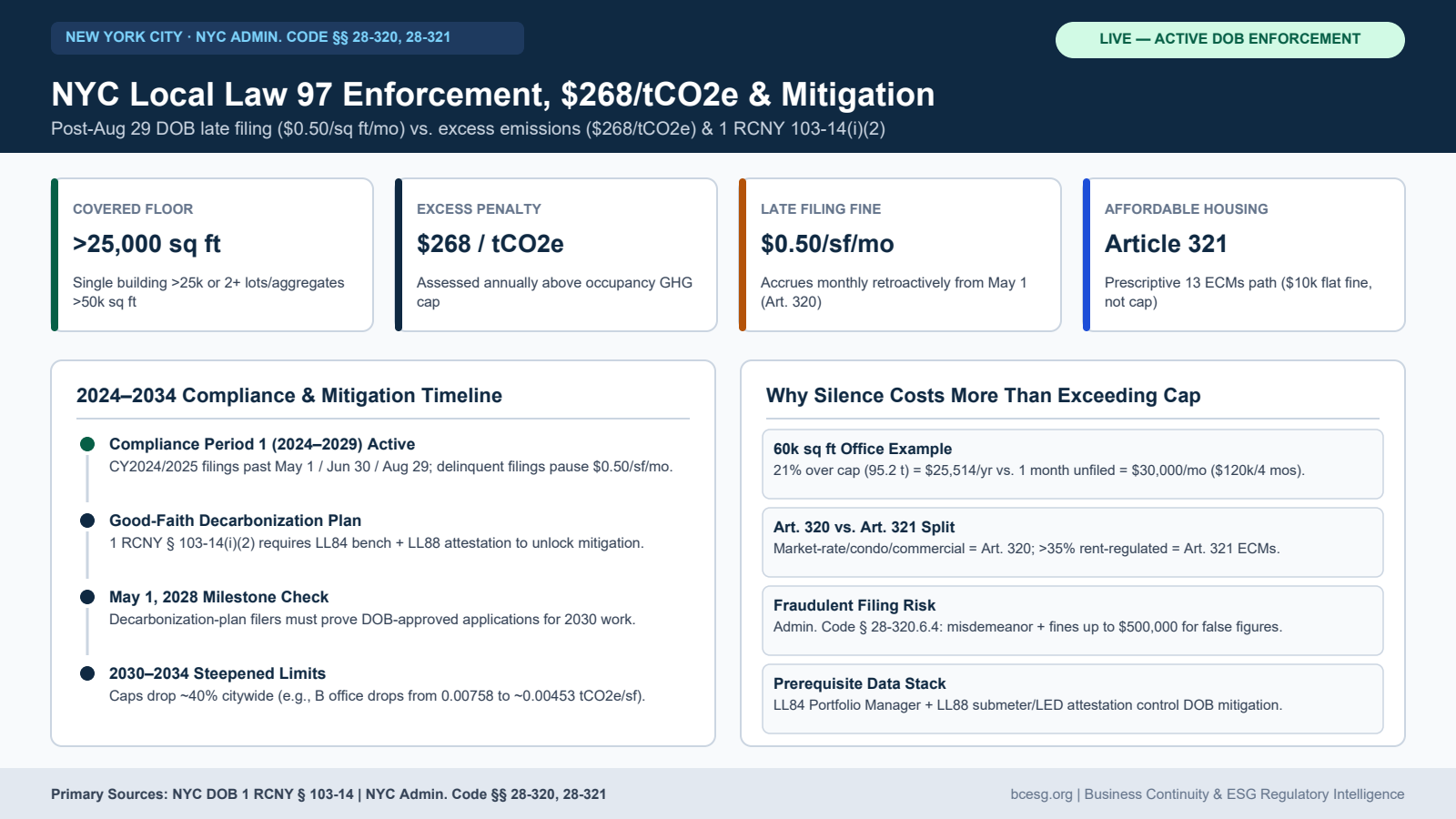
- Two Legal Tracks: Article 320 (market-rate commercial, institutional, and residential <=35% rent-regulated) faces annual carbon caps and $268/tCO2e fines; Article 321 (affordable/rent-regulated >35% or NYCHA/HUD-assisted) follows the one-time 13 Prescriptive Energy Conservation Measures (PECMs) or 2030 cap demonstration ($10,000 flat non-compliance fine).
- Penalty Asymmetry: An unfiled 60,000 sq ft Group B office at 21% over cap incurs ~$25,514/year for emissions vs. $30,000/month ($120,000 over 4 months) simply for remaining unfiled past May 1.
- Good-Faith Mitigation Gate: Under 1 RCNY § 103-14(i)(2), owners invoking a Decarbonization Plan must hold submitted LL84 benchmarking and LL88 lighting/submetering attestations on file and hit the May 1, 2028 DOB permit/approval milestone.
- 2030 Cliff Prep: Cycle 2 (2030–2034) drops commercial Group B office intensity caps roughly 40% (~0.00453 tCO2e/sq ft), shifting electrification economics well ahead of 2029.
Download the NYC Local Law 97 Enforcement & Mitigation Reference
Late-Filing Mathematics vs. $268/tCO2e Carbon Caps & Criminal Misstatement Risk
Building owners who miss annual May 1 reporting (or approved June 30 / August 29 extension windows) often confuse carbon-overage liability with administrative filing delinquency. Under NYC Admin. Code § 28-320.6, the $0.50/sq ft/month failure-to-file penalty is statutory, accumulates continuously from May 1 until DOB accepts a certified filing, and cannot be waived simply because actual emissions sat below the occupancy cap.
Equally critical is filing accuracy. Under Admin. Code § 28-320.6.4, knowingly submitting a false LL97 report or fraudulent Registered Design Professional attestation is a misdemeanor carrying fines up to $500,000. Owners resolving delinquent filings must reconcile Portfolio Manager meter boundaries, co-gen/steam coefficients, and space-type square footage directly against DOB property records.
- Filing First Stops the Bleed: Even if final emissions confirm an overage at $268/tCO2e, submitting the certified filing halts the monthly $0.50/sq ft clock immediately.
- Extension Mechanics (1 RCNY § 103-14): Standard extensions run only through timely May 1/June 30 administrative requests; once an un-extended deadline passes, DOB treats the parcel as delinquent.
- Renewable Energy Credits (RECs) & Deductions: Only NYSERDA Tier 4 NYC-deliverable RECs (credited strictly against electricity emissions) qualify — general out-of-state voluntary RECs do not offset LL97 overages.
| Track & Citation | Covered Building Scope | Primary Compliance Metric | Maximum Statutory Penalty |
|---|---|---|---|
| Article 320 (2024–2029) | Commercial, condo & residential <=35% rent-regulated >25k sf | Occupancy GHG limit (e.g., 0.00758 tCO2e/sf Group B) | $268/tCO2e excess + $0.50/sf/mo unfiled |
| Article 320 Mitigation (1 RCNY § 103-14) | Unmet Cycle 1 Art. 320 w/ LL84 + LL88 + Decarb Plan | No RECs; May 1, 2028 DOB permit proof + 2030 work | Reduced DOB mitigated penalty scale |
| Article 321 (Affordable) | >35% rent-regulated, NYCHA, Mitchell-Lama >25k sf | One-time 13 Prescriptive ECMs OR meet 2030 limit | $10,000 flat violation (not $268/tCO2e) |
| Cycle 2 (2030–2034) | All Art. 320 covered parcels >25k sf | Steepened limits (~0.00453 tCO2e/sf Group B office) | $268/tCO2e + stricter false-filing rules |
Article 320 Good-Faith Mitigation, Article 321 PECMs & The 2028/2030 Horizon
For Article 320 buildings unable to meet 2024–2029 limits economically on day one, 1 RCNY § 103-14(i)(2) offers mitigated penalties — provided the owner filed LL84 benchmarking on time, completed LL88 lighting and submetering attestations, and submitted a stamped Decarbonization Plan demonstrating net-zero 2050 alignment with no REC offsets allowed inside that mitigation period.
Meanwhile, Article 321 qualifying properties (buildings with >35% rent-regulated units, Mitchell-Lama, or HDFC cooperatives) operate on an entirely separate track: demonstrating compliance either with the 2030 emissions limit or installing all 13 applicable Prescriptive Energy Conservation Measures (pipe insulation, steam traps, low-flow fixtures, weatherization, etc.), where missed filings draw a $10,000 flat violation rather than $268/tCO2e.
- Decarbonization Plan Lock-In: Choosing good-faith mitigation waives REC compliance through 2029 and legally commits the asset to securing DOB-approved work permits by May 1, 2028.
- State-Local Portfolio Note: New York’s executive-order state benchmarking covers state-owned assets only — private NYC landlords follow LL97 and LL84 as their exclusive statutory baseline.
Compliance Execution Checklist
| Step | Owner / Team | Auditable Deliverable |
|---|---|---|
| 1. Prerequisite Gate Check | Property / Compliance | Verify LL84 Portfolio Manager acceptance and LL88 attestation on DOB NOW. |
| 2. Art. 320 vs 321 Confirm | Legal / Tax Lot Counsel | Pull DHCR/HPD rent-regulation counts or tax-lot square footage from DOF records. |
| 3. RDP Emissions Audit | Registered Design Prof. | Audit ConEd/National Grid intervals + BBL mapping; file via BEAM/DOB NOW. |
| 4. 2028/2030 CapEx Plan | Engineering / Asset Mgmt | Quantify Cycle 2 40% intensity cliff and lock May 1, 2028 permit schedule if mitigated. |
Keep This New York City, NY Compliance Checklist Handy
Frequently Asked Questions
How do NYC Local Law 97 late-filing fines compare to the $268/tCO2e emissions penalty?
Under NYC Admin. Code § 28-320.6, failing to file an LL97 report incurs $0.50 per gross square foot per month starting May 1. For a 60,000 sq ft office moderately above cap, four months unfiled costs $120,000 — nearly five times a full year's $25,514 overage penalty.
What does an Article 320 Good-Faith Effort mitigation plan require?
Under 1 RCNY § 103-14(i)(2), owners must demonstrate on-time LL84 benchmarking, LL88 lighting/submetering attestation, and an RDP-stamped Decarbonization Plan with DOB-approved construction applications by May 1, 2028.
Is Local Law 97 still facing preemption litigation?
No. In Glen Oaks Village Owners, Inc. v. City of New York (2025), the New York Court of Appeals ruled in the City's favor, confirming New York State's CLCPA did not preempt NYC's local emissions caps.
Primary Authorities & Official Resources
- NYC DOB — Local Law 97 Greenhouse Gas Emissions Reductions
- NYC DOB Rule 1 RCNY § 103-14 (Implementation & Mitigation PDF)
- NYC Admin. Code § 28-320 (DOB Covered Buildings Guidance)
Informational notice: This guide summarizes enacted statutes, regulations, or pending legislative records from the primary authorities linked above as of November 14, 2026. It is not legal, accounting, or licensed engineering advice.