Category: Local Law 97

LL97 compliance for NYC commercial real estate

  • LL84, LL88, LL97, and LL33: The NYC Building Compliance Stack as One Calendar (2026)

    Last updated: June 10, 2026. By Will Tygart. One calendar, four laws, every threshold and fine from primary sources.

    New York City’s building energy laws are not four separate compliance problems — they are one data pipeline with four filing outputs, and the law with the fines (LL97) legally depends on the two you might be tempted to ignore (LL84 and LL88). The same ENERGY STAR Portfolio Manager record feeds the LL84 benchmark and the LL97 emissions report, both due May 1. The LL84 data generates your LL33 letter grade each fall. And if your building is ever over its LL97 cap, the good-faith-efforts mitigation that can save six figures requires current LL84 benchmarking and an LL88 attestation as legal prerequisites (1 RCNY 103-14(i)(2)). Treat them as one workflow and the marginal cost of each additional law approaches zero; treat them separately and you pay four consultants to chase one dataset.

    The four laws in one table

    Law What it requires Who is covered Deadline Penalty
    LL84 (benchmarking) Annual energy + water data via ESPM Single buildings >25,000 gsf; 2+ buildings on one lot together >100,000 gsf May 1 $500/quarter, max $2,000/yr
    LL88 (lighting + submeters) Lighting to current code; submeters in tenant spaces >5,000 gsf — both were due Jan 1, 2025 Same thresholds as LL84 Reports due May 1, 2026 for buildings not yet compliant Violations + blocks LL97 mitigation
    LL97 (emissions caps) RDP-certified annual emissions report in BEAM; stay under the cap Single buildings >25,000 gsf; aggregates >50,000 gsf May 1 (grace to Jun 30) $268/tCO2e over; $0.50/sqft/month unfiled
    LL33/95 (grades) Post the A–F energy grade at every public entrance All LL84-benchmarked buildings Oct 1–31 Violations for failure to post

    Two traps hide in that table. First, the aggregation thresholds differ: LL84 aggregates multi-building lots at 100,000 sqft while LL97 aggregates at 50,000 — so a three-building, 70,000 sqft tax lot can be covered by LL97 and not by LL84. Never assume one Covered Buildings List answers for the other. Second, an A grade does not mean LL97 compliance: LL33 grades score your ENERGY STAR percentile relative to peers, while LL97 caps are absolute carbon limits. A building full of efficient-but-electric-resistant systems can post a B in the lobby and still owe $268-per-ton penalties — and vice versa.

    The dependency nobody prices in: LL84 + LL88 are your LL97 insurance

    If your building exceeds its cap, the difference between paying full freight and paying little or nothing usually runs through good-faith-efforts mitigation. The rule’s mandatory entry criteria (1 RCNY 103-14(i)(2)): a filed emissions report, uploaded LL84 benchmarking data, and an attestation of LL88 lighting upgrades and tenant submetering — before any of the qualifying pathways (decarbonization plan, approved compliance work, electric readiness, a prior under-cap year) even get considered. A skipped $500-a-quarter LL84 filing can therefore disqualify a building from mitigation worth tens or hundreds of thousands. Compliance with the cheap laws is the admission ticket for relief from the expensive one.

    The unified compliance calendar (rest of 2026 and beyond)

    Date Filing
    June 30, 2026 LL97 CY2025 grace ends; last day for the $60 extension (to Aug 29) — full guide
    Aug 1 / Nov 1 / Feb 1 LL84 quarterly violation cure deadlines if you missed May 1
    Oct 1–31, 2026 LL33 grade posted at every public entrance
    Dec 31, 2026 LL87 energy audit + retro-commissioning reports for buildings in the 2026 cycle (10-year rotation by block number)
    Jan–Apr 2027 Tenant data collection → ESPM → LL84 + LL97 prep (the pipeline restarts)
    May 1, 2028 Good-faith decarbonization-plan filers must show DOB-approved applications for 2030-cap work
    Jan 1, 2030 LL97 caps tighten 50–79% by property type — run both periods in the calculator

    Run it as one workflow

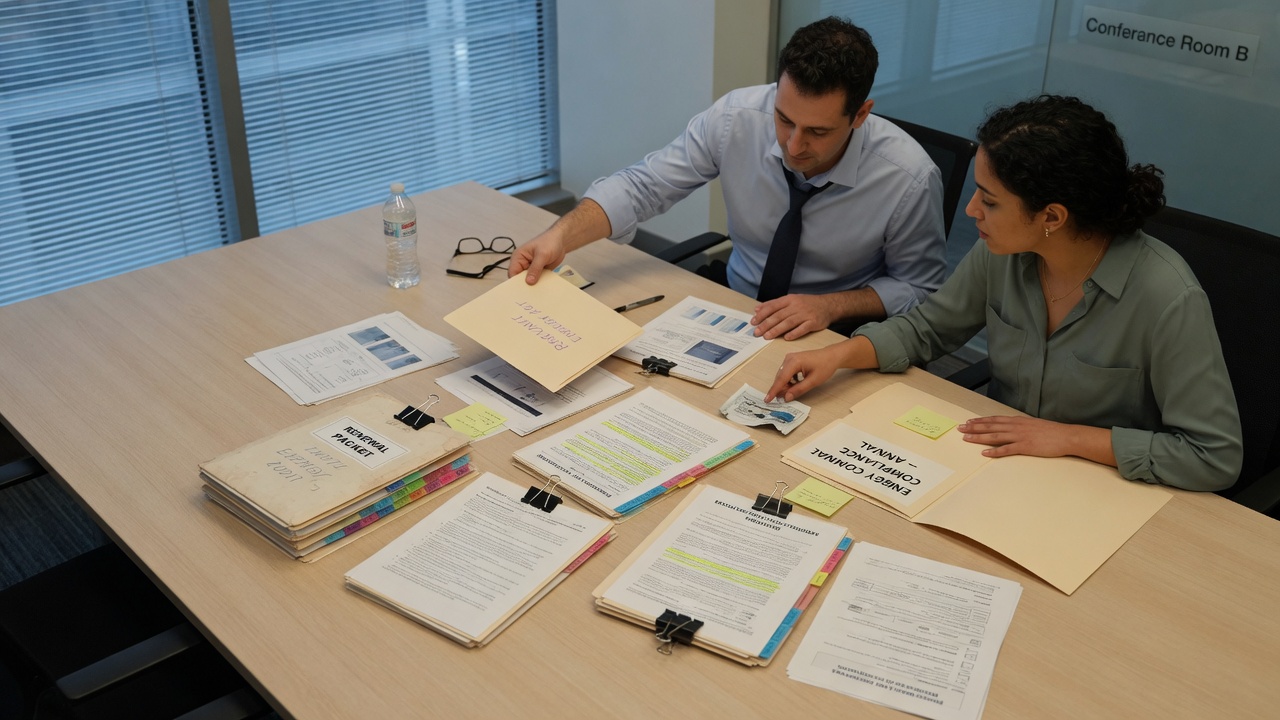
    1. One data owner. A single person (or consultant) holds the ESPM record, the tenant-data chase, and the utility authorizations. Every law downstream consumes their output.
    2. One January kickoff. Tenant energy requests, ESPM access verification, and property-type checks happen once, in January — not once per law in April.
    3. One filing sprint. LL84 and LL97 are due the same day from the same dataset; file them as a pair through the three-portal sequence.
    4. One evidence file. LL88 attestations, LL87 reports, grades, and any disaster documentation live in one place — because the day you need good-faith mitigation, DOB asks for all of it at once.

    What this means for each seat at the table

    If you are the… The stack means…
    Owner Budget the stack as one program. The $2,000-capped LL84 fine is trivial; its absence disqualifying you from LL97 mitigation is not.
    Facility / property manager You own the pipeline: one ESPM record feeds four filings. Calendar the January kickoff and the stack mostly runs itself.
    Tenant Your submeter (LL88) and your consumption (LL84/97) are inside the building’s legal machinery, and the grade at the door (LL33) is partly your doing. Lease language increasingly formalizes all three.

    Frequently asked questions

    What is the difference between Local Law 84 and Local Law 97?

    LL84 is annual energy and water benchmarking — data disclosure through ENERGY STAR Portfolio Manager, penalties capped at $2,000 a year. LL97 is an emissions cap with real teeth: $268 per ton over the limit and $0.50 per square foot per month for not filing. LL84’s data feeds LL97’s report, and both are due May 1.

    Does a good LL33 letter grade mean my building complies with LL97?

    No. Grades score your ENERGY STAR percentile relative to similar buildings; LL97 caps are absolute carbon limits. A building can post a B and still owe LL97 penalties, or post a D while staying under its cap.

    What is Local Law 88?

    LL88 required covered buildings to upgrade lighting to current code and install electrical submeters in tenant spaces over 5,000 sqft by January 1, 2025; buildings not yet compliant file reports due May 1, 2026. The LL88 attestation is also a mandatory prerequisite for LL97 good-faith-efforts penalty mitigation.

    Why is my building covered by LL97 but not LL84?

    The aggregation thresholds differ: multi-building tax lots aggregate at 50,000 sqft for LL97 but 100,000 sqft for LL84. Single buildings over 25,000 sqft are covered by both.

    What is due December 31, 2026?

    LL87 energy audit and retro-commissioning reports for buildings whose block numbers fall in the 2026 cycle — the ten-year rotating requirement that pairs with the annual stack.

    Primary sources

  • Local Law 97 Fines: The $268-Per-Ton Math and a Calculator Built From the Rule Itself (2026)

    Last updated: June 9, 2026. By Will Tygart. Every factor in the calculator below was extracted from the current consolidated text of 1 RCNY 103-14 and verified against the rule on June 9, 2026.

    A Local Law 97 fine is calculated in one line: (your building’s actual annual emissions − its emissions limit) × $268 per metric ton of CO2e, assessed every year you remain over the cap. The limit is your gross floor area times a published factor for your property type — 0.00758 tCO2e per square foot for an office today, falling to 0.002690852 in 2030. The separate failure-to-file penalty is gross floor area × $0.50 per month. Use the calculator below for your building, then read the part nobody’s calculator shows you: what the 2030 factors do to a building that is comfortably compliant today.

    LL97 Penalty Calculator — emissions factors as printed in 1 RCNY 103-14(c)(3); penalty rate $268/tCO2e per Admin Code §28-320.6.

    Estimates only. Mixed-use buildings use square-footage-weighted factors; for 2024–2025 owners could elect the statutory occupancy-group limits instead; good-faith-efforts mitigation, RECs, AHRF offsets, and the disaster provision can reduce penalties. Always confirm against 1 RCNY 103-14 and your Registered Design Professional.

    The formula, worked by hand

    Take a 60,000 sq ft Midtown office building:

    • Limit today: 60,000 × 0.00758 = 454.8 tCO2e/year
    • If it emits 550 tCO2e: (550 − 454.8) × $268 = $25,514/year
    • If it never files: 60,000 × $0.50 = $30,000/month — one month of silence costs more than a year of being 21% over the cap. Whatever else is true about your building, file.

    The 2030 cliff, in numbers nobody publishes

    Most LL97 coverage says the 2030 limits get “roughly 40% stricter.” The actual factors in the rule (1 RCNY 103-14(c)(3)(iii)) are far more dramatic for some property types:

    ESPM property type 2024–2029 factor 2030–2034 factor Reduction
    Office 0.00758 0.002690852 −65%
    Multifamily Housing 0.00675 0.003346640 −50%
    Hotel 0.00987 0.003850668 −61%
    Retail Store 0.00758 0.002104490 −72%
    Non-Refrigerated Warehouse 0.00426 0.000883187 −79%
    Hospital 0.02381 0.007335204 −69%
    Data Center 0.02381 0.014791131 −38%
    Restaurant 0.01181 0.004038374 −66%
    K-12 School 0.00675 0.002230588 −67%
    Medical Office 0.01074 0.002912778 −73%

    (Factors are tCO2e per square foot per year, as printed in the rule. The 2030 table also cuts the grid-electricity coefficient roughly in half — to 0.000145 tCO2e/kWh — reflecting expected grid cleanup, which softens the blow for electrified buildings specifically.)

    What that does to a real building: the same 60,000 sq ft office emitting 400 tCO2e is comfortably under its 454.8-ton cap today — penalty $0. In 2030 its cap drops to 161.5 tons. Same building, same energy use: 238.5 tons over, $63,931 per year, every year. That is why Urban Green’s finding — only ~9% of properties exceed today’s caps but ~57% exceed the 2030 caps — is the single most important number in NYC real estate planning, and why a “we’re compliant” answer in 2026 is only half an answer.

    The fines-versus-retrofit math, honestly

    Some owners are paying. Habitat’s reporting quotes a senior official at a prominent real estate firm: eliminating the fines would mean investing “15 to 20 times the fine amount,” and an energy manager’s example pits an $8–10M retrofit against a ~$180,000-a-year penalty (Habitat, March 2025). For 2026, that arithmetic can be rational.

    It stops being rational on three clocks. First, fines repeat annually, forever — a $180K/year penalty is $1.8M over a decade against a one-time retrofit. Second, the 2030 factors multiply the overage: the building paying $180K today may be paying three to five times that from 2030. Third, equipment dies on its own schedule anyway — the cheapest compliance is the boiler you were already replacing, replaced electric, with beneficial-electrification credits that are richest before December 2026. REBNY projects citywide fines approaching $900 million a year once the 2030 limits bite — the buildings that avoid contributing to that number are the ones doing the math now, while the retrofit can ride the capital calendar instead of fighting it.

    Five things that legitimately reduce an LL97 penalty

    1. Good-faith-efforts mitigation (1 RCNY 103-14(i)(2)) — requires a filed report, current LL84 benchmarking, and LL88 attestation, plus a qualifying path such as an RDP-certified decarbonization plan or an approved application for compliance work.
    2. RECs — offset electricity-attributable emissions only, must be NYC-deliverable, currently uncapped (decarbonization-plan filers excluded); Zone J Tier 4 supply (CHPE, Clean Path NY) becomes materially available during 2026.
    3. AHRF offsets — capped at 10% of your limit, priced at $268/ton (deliberately equal to the penalty), funding affordable-housing decarbonization.
    4. The disaster provision (1 RCNY 103-14(i)(1)) — documented hurricane, severe flooding, or fire damage that precluded compliance can zero the year’s penalty. Your restoration contractor’s job file is the evidence; see what LL97 does and does not count.
    5. Mediated resolution — a negotiated DOB compliance plan in lieu of penalty, case by case.

    What this means for each seat at the table

    If you are the… The penalty math says…
    Owner Run the calculator twice — today’s factor and 2030’s. The second number belongs in the capital plan and the next refinancing conversation, because lenders are already running it.
    Facility / property manager Your energy data is the input to a six-figure equation. Tight ESPM records, submetering, and vendor documentation are what make the difference between an estimated overage and a defended one.
    Tenant Your consumption is inside the building’s number, and lease structures increasingly pass LL97 exposure through. A tenant who can demonstrate efficiency is negotiating leverage; one who cannot is a cost center.

    Frequently asked questions

    How are Local Law 97 fines calculated?

    (Actual annual building emissions − the building’s emissions limit) × $268 per metric ton CO2e, assessed annually. The limit is gross floor area × the published factor for your ESPM property type — 0.00758 tCO2e/sqft for offices in 2024–2029, dropping to 0.002690852 in 2030.

    How much is the LL97 penalty per ton?

    $268 per metric ton of CO2e over the limit, per year. The Affordable Housing Reinvestment Fund offset is deliberately priced at the same $268 — the city set the escape hatch at exactly the cost of the penalty.

    What is the penalty for not filing an LL97 report?

    Gross floor area × $0.50 per month, retroactive to May 1 of the filing year. On a 60,000 sq ft building that is $30,000 a month — typically far worse than the overage penalty itself.

    When do LL97 fines start?

    They already have: caps took effect January 1, 2024, first reports were due in 2025, and DOB confirmed in April 2026 that ~1,400 non-filers are in the enforcement pipeline with OATH cases in preparation. The much larger fine wave arrives with the 2030 limits, which roughly 57% of covered buildings currently exceed.

    How much stricter do LL97 limits get in 2030?

    It depends on property type: offices drop 65%, retail 72%, warehouses 79%, multifamily 50%, data centers 38% — per the factors printed in 1 RCNY 103-14(c)(3)(iii). A building comfortably compliant today can face a six-figure annual penalty in 2030 at the same energy use.

    Is there an official LL97 penalty calculator?

    DOB publishes the factors and formula but no official calculator; NYC Accelerator’s Building Energy Snapshot is the closest city tool. The calculator on this page applies the rule’s printed factors directly and shows both compliance periods side by side.

    Primary sources

  • Local Law 97 for Co-ops and Condos: Pathways, Penalties, and the 2026 Board Playbook

    Last updated: June 9, 2026. By Will Tygart. Written for co-op and condo boards and the managing agents who serve them — every claim links to a primary source.

    If your co-op or condo building is over 25,000 square feet, Local Law 97 applies to you — but which version applies, and what it costs, depends on your building’s rent-regulation mix, and 2026 is the year one of the gentler pathways gets real. The legal challenge is over (the Glen Oaks suit — brought by a Queens co-op — lost at New York’s highest court in May 2025, with no appeal possible), the Council bill to delay penalties for moderate-value condos and co-ops died at the end of session, and multifamily buildings filed their first-year reports at a 94% rate. The question for boards is no longer whether LL97 is happening. It is which pathway you are on, and what the next capital plan should assume.

    First question: which pathway is your building on?

    LL97 is not one rule for all residential buildings — coverage splits on rent regulation and affordability status (DOB LL97 page):

    Pathway Who is on it What applies
    Article 320, standard (Pathway 0) Most market-rate co-ops and condos >25,000 sqft (or condo buildings sharing a board totaling >50,000 sqft) Emissions caps from 2024, annual RDP-certified reports, $268/tCO2e overage penalties
    Article 320, 2026 start (Pathway 1) Buildings with at least one but no more than 35% rent-regulated units Cap compliance began January 1, 2026 — this year is their first capped year
    Article 320, 2035 start (Pathway 2) Certain buildings under §28-320.3.9 Caps begin 2035
    Article 321, prescriptive (Pathway 3) >35% rent-regulated, HDFC co-ops, Mitchell-Lama, income-restricted, project-based federal housing One-time prescriptive energy measures (a defined checklist of upgrades) instead of caps; $10,000 penalties for non-compliance

    Your pathway is shown on the Covered Buildings List published each year on DOB’s LL97 page; disputes go through a BEAM portal ticket. If your building has a mix of rent-regulated units, checking the percentage against DOF records is the single highest-value hour a managing agent can spend this year — Pathway 1 buildings are in their first capped year right now, and many boards do not know it.

    The math boards actually face

    The multifamily emissions cap for 2024–2029 is 0.00675 tCO2e per square foot (1 RCNY 103-14). For a 120,000 sq ft co-op, that is an annual limit of 810 tCO2e. Exceed it by 100 tons and the penalty is $26,800 a year. Fail to file at all and the penalty is 120,000 × $0.50 = $60,000 per month — which is why “we’re under the cap so we don’t need to do anything” is the most expensive sentence in co-op governance. Filing is mandatory regardless of emissions; for most buildings under the cap it costs the $210 fee plus the engineer.

    About 9% of covered properties exceed today’s caps — but roughly 57% exceed the 2030 caps (Urban Green Council). For residential boards the 2030 number is the one that belongs in the reserve study, because the realistic retrofit menu — heat pump conversions, window and envelope work, boiler replacement timed to end-of-life — takes more than one budget cycle to finance and execute. Habitat’s reporting captured the honest owner calculus: some owners are choosing fines over retrofits because, as one put it, eliminating the fine would cost “15 to 20 times the fine amount” (Habitat, March 2025). That math can be rational in 2026 — and flips as the caps tighten and the fines repeat annually, forever.

    What boards hoping for a rescue should know

    • The lawsuit is over. Glen Oaks Village Owners — a Queens garden co-op — argued the state climate law preempted LL97. The NY Court of Appeals rejected the challenge on May 22, 2025 (opinion); as a state-law ruling from the highest court, it cannot be appealed further.
    • The relief bills stalled. Int 1197 (Lee/Ung), which would have delayed penalties for condos and co-ops with average unit assessed value under $65,000, was never moved by the Speaker; Int 1180’s REC cap also died at end of session. No amendment has touched the $268 rate, the caps, or the May 1 cycle.
    • Enforcement has started. DOB’s April 22, 2026 release: 93% of covered properties filed, ~1,400 non-filers are receiving Notices of Deficiency, and OATH penalty cases are being prepared (DOB press release).

    The board playbook for 2026

    1. Confirm your pathway and your filing status today. If the CY2025 report is not filed, the grace period ends June 30, 2026 — a $60 extension (applied for in BEAM by June 30) buys you until August 29. See the full deadline guide.
    2. Get the real number before the meeting. An energy audit that converts “we might be over” into “we are 110 tons over, which is $29,480 a year, and these three measures close 80% of it” changes the quality of every board conversation that follows.
    3. Time retrofits to equipment life, not to panic. The cheapest decarbonization is the boiler you were going to replace anyway, replaced with the electric option, with the beneficial-electrification credits that remain richest before December 2026.
    4. Know the mitigation menu before you need it: good-faith-efforts (requires filed reports + current LL84 + LL88 attestation plus a qualifying path like an RDP-certified decarbonization plan); RECs (electricity-attributable emissions only, NYC-deliverable); AHRF offsets (capped at 10% of your limit, $268/ton); and after a fire or flood, the disaster provision that can zero a penalty year with documentation (1 RCNY 103-14(i)(1)).
    5. Use the free help. NYC Accelerator provides no-cost LL97 compliance guidance, and the Building Energy Exchange published a co-op/condo-specific playbook, Cutting Carbon in Co-ops & Condos, in May 2026.

    What this means for each seat at the table

    If you are the… LL97 in 2026 means…
    Board (the owner) The penalty exposure and the capital plan are yours. Put the 2030 number in the reserve study now; annual fines are a recurring line item, not a one-time fee.
    Managing agent (the coordinator) Pathway verification, the three-portal filing chain, the RDP booking, and the mitigation paperwork run through you — including the disaster documentation if the building ever floods or burns.
    Shareholders / unit owners (the residents) LL97 costs reach you through maintenance and common charges either as planned retrofit financing or as unplanned fines — and the planned version is almost always cheaper. The A–F energy grade at the entrance is your building’s public report card.

    Frequently asked questions

    Does Local Law 97 apply to co-ops and condos?

    Yes — co-op and condo buildings over 25,000 square feet (or condo buildings under one board totaling over 50,000 square feet) are covered. The applicable pathway depends on rent-regulation and affordability status: most market-rate buildings face Article 320 caps; buildings over 35% rent-regulated, HDFC, and Mitchell-Lama follow Article 321’s one-time prescriptive measures instead.

    What is the LL97 penalty for a co-op?

    The same as any Article 320 building: (actual emissions minus the cap) × $268 per ton CO2e per year, and $0.50 per square foot per month for failing to file. Article 321 buildings face $10,000 penalties for late or missing compliance reports.

    What changed for partially rent-regulated buildings in 2026?

    Buildings with at least one but no more than 35% rent-regulated units (Pathway 1) began cap compliance on January 1, 2026 — 2026 is their first capped calendar year, reportable in 2027.

    Did the co-op lawsuit against LL97 succeed?

    No. Glen Oaks Village Owners v. City of New York was decided against the challengers by the NY Court of Appeals on May 22, 2025, and cannot be appealed further. LL97 is settled law.

    Will LL97 raise my maintenance or common charges?

    For buildings over their caps, yes — the only question is whether the increase funds planned retrofits (often with incentives, and timed to equipment replacement) or recurring annual fines. The retrofit usually wins over a ten-year horizon, especially with 2030’s stricter caps.

    Where can a board get free LL97 help?

    NYC Accelerator (accelerator.nyc/ll97) offers free compliance guidance, and the Building Energy Exchange’s May 2026 “Cutting Carbon in Co-ops & Condos” playbook is written specifically for residential boards.

    Primary sources

  • How to File a Local Law 97 Report: The DOB NOW, ESPM, and BEAM Walkthrough Nobody Gives You

    Last updated: June 9, 2026. By Will Tygart. Written for the property managers and facility managers who coordinate LL97 filings — every fee, portal, and gotcha below links to a primary source.

    Filing a Local Law 97 report takes three separate city systems used in a fixed order — pay the fee in DOB NOW: Safety, stage your energy data in ENERGY STAR Portfolio Manager, then file in BEAM — and because the systems sync overnight, the whole sequence physically cannot be completed in one day. That is not an exaggeration; it is the Department of Buildings’ own guidance. As DOB’s assistant commissioner for sustainability put it: “You cannot complete a report in one day and you need to plan for that” (Habitat, March 2025).

    Here is the full walkthrough — who does what, in what order, with which fees — written for the person actually coordinating it.

    Before you touch a portal: the five things to line up

    1. Confirm your building is on the Covered Buildings List. The current-year CBL is published on DOB’s LL97 page; coverage follows Department of Finance records (>25,000 gsf single building; 50,000 gsf tax-lot or condo-board aggregates). Disputes are filed as a ticket in BEAM — not by email, not by phone.
    2. Book your Registered Design Professional now. Only a NY-licensed PE or RA can certify and submit an Article 320 report. RDP calendars compress brutally in May and June; the engineer, not the portal, is the real bottleneck.
    3. Gather your identifiers: BBL (borough-block-lot) and BIN numbers, plus the ESPM property ID. Reports and fees are keyed to these.
    4. Align the email addresses. The owner, the property manager, and the energy consultant must use consistent email addresses across all three systems — mismatched emails are the most common reason a filing stalls with no error message.
    5. Check your ESPM property type. “Other” and “Mixed Use” property types are prohibited for LL97 reporting. If your building is typed that way in Portfolio Manager, fix it before anything else — the report cannot file against it.

    Step 1 — DOB NOW: Safety: pay first, or nothing unlocks

    All LL97 fees are paid in DOB NOW: Safety, and BEAM will not accept your report until the payment clears — which happens in the overnight sync, not instantly. The fee schedule (1 RCNY 101-03):

    Filing Fee
    Simple annual emissions report $210
    Complex annual emissions report $615
    Extension request $60
    Good-faith-efforts report $950
    Article 321 mediated resolution report $800

    Practical translation: if your deadline is June 30, the last safe day to pay is June 29 — and treating June 26 as the real deadline is what a coordinator who has done this before actually does.

    Step 2 — ENERGY STAR Portfolio Manager: where the numbers live

    Your building’s energy consumption — electricity, gas, steam, fuel oil — flows from ESPM, the same system used for LL84 benchmarking (due the same May 1). Three coordinator notes:

    • Find your ESPM Data Administrator early. Buildings change managers and consultants; the person who holds administrative rights over the ESPM record is frequently someone who left two years ago. Recovering access takes days you may not have.
    • Whole-building data means tenant data. If tenants are separately metered, their consumption still counts against the building’s number — the annual tenant-data chase should start in January, not May.
    • LL84 and LL97 feed from the same trough. Upload once, comply twice: current LL84 benchmarking is also a legal prerequisite for LL97 good-faith-efforts penalty mitigation.

    Step 3 — BEAM: where the report actually files

    The BEAM portal (launched March 3, 2025) is where the RDP certifies and submits the report — and where everything else LL97 happens too, as numbered tickets: extension requests, Covered Buildings List disputes, penalty-mitigation claims, and deductions. Two things to know:

    • BEAM unlocks only after your DOB NOW payment has cleared overnight. Pay Monday, file Tuesday at the earliest.
    • The RDP submits; you prepare. A smooth filing is one where the engineer logs in to a record with clean ESPM data, matching emails, and a cleared fee — and spends their billable hour certifying instead of troubleshooting.

    The complete sequence, as a checklist

    When Action System Who
    January Start tenant energy data collection; verify ESPM access and property type ESPM PM / consultant
    February Book the RDP; confirm CBL status; align emails across systems PM
    March–April Complete ESPM data for the calendar year; run LL84 benchmarking ESPM Consultant
    April Pay the LL97 filing fee DOB NOW: Safety PM
    By May 1 RDP certifies and submits the report BEAM RDP
    If late: by June 30 File within grace, or pay $60 and apply for extension to Aug 29 BEAM + DOB NOW PM

    If something goes wrong

    • Building should not be on the CBL (sold, demolished, under threshold)? File the CBL dispute ticket in BEAM with DOF documentation — do not simply skip filing; the $0.50/sqft/month non-filing penalty attaches to the listed property until the list changes.
    • Over the cap? File anyway — filing and penalty exposure are separate questions — then pursue good-faith-efforts mitigation (1 RCNY 103-14(i)(2)) or, after a documented disaster, the penalty-zero provision (103-14(i)(1)).
    • Missed June 30 with no extension? File as fast as possible: penalties accrue monthly and retroactively to May 1, so every month of delay on a 60,000 sq ft building is another $30,000.

    What this means for each seat at the table

    If you are the… Your part of the filing is…
    Owner Authorize fees early and sign off on the RDP engagement in Q1, not Q2. The cheapest LL97 program is the one that never touches the penalty schedule.
    Facility / property manager You are the integration layer: CBL status, identifiers, email consistency, ESPM access, tenant data, fee payment, and the RDP’s calendar. The portals don’t talk to each other — you are the API.
    Tenant Your meter data is part of the building’s filing. Answering the energy-data request in February instead of April is the single most helpful thing you can do — and increasingly, leases require it.

    Frequently asked questions

    How do I file a Local Law 97 report?

    In three systems, in order: pay the filing fee in DOB NOW: Safety ($210 simple / $615 complex), stage the building’s energy data in ENERGY STAR Portfolio Manager, then have a Registered Design Professional certify and submit the report in the BEAM portal. The systems sync overnight, so the sequence takes a minimum of two days.

    What is the BEAM portal?

    BEAM (nyc.beam-portal.org) is DOB’s LL97 filing system, launched March 3, 2025. Reports, extension requests, Covered Buildings List disputes, and penalty-mitigation claims are all submitted there as numbered tickets.

    Why won’t BEAM accept my report?

    The two most common causes: the DOB NOW fee payment has not cleared the overnight sync yet, or the email addresses on the BEAM, DOB NOW, and ESPM records do not match. A prohibited ESPM property type (“Other” or “Mixed Use”) will also block the filing.

    Can I file the LL97 report myself?

    No. An Article 320 report must be certified and submitted by a Registered Design Professional — a NY-licensed Professional Engineer or Registered Architect. The property manager prepares and coordinates; the RDP files.

    How much does it cost to file?

    $210 for a simple annual report, $615 for a complex one, $60 for an extension application, $950 for a good-faith-efforts report — all paid in DOB NOW: Safety, all per 1 RCNY 101-03. The RDP’s professional fee is separate and market-rate.

    Do LL84 and LL97 use the same data?

    Largely yes — both draw on the building’s ENERGY STAR Portfolio Manager record, and both are due May 1. Keeping LL84 benchmarking current is also a legal prerequisite for LL97 good-faith-efforts penalty mitigation.

    Primary sources

  • Local Law 97 Deadline June 30, 2026: File Your Report or Buy the $60 Extension

    Last updated: June 9, 2026. By Will Tygart, author of the Commercial Restoration Carbon Protocol (CRCP) and a filed public commenter in CARB’s SB 253 Scope 3 rulemaking. Every regulatory claim in this article links to its primary source.

    If a covered NYC building has not yet filed its Local Law 97 emissions report for calendar year 2025, there are exactly two moves left, and both expire on June 30, 2026: file the report in the BEAM portal by June 30, or apply by June 30 for a $60 extension that moves the filing deadline to August 29, 2026. The Department of Buildings has stated in writing that the blanket extensions it granted in 2025 do not apply to filing year 2026. There is no December reprieve coming this time.

    This guide is written for the person who actually coordinates the filing: the property manager. It covers what is due, what missing the deadline costs (in real dollars per month), how the three-portal filing process works, and what to do if your building is over its cap.

    The 2026 LL97 deadline, in one table

    Date What happens Source
    May 1, 2026 LL97 report on calendar-year-2025 emissions was due (Admin Code §28-320.6.2) DOB service notice, Feb 27, 2026
    June 30, 2026 Hard end of the 60-day grace period — AND the last day to apply for an extension Same notice; 1 RCNY 103-14(g)(2)
    August 29, 2026 Extended filing deadline, only for buildings that applied by June 30 ($60 fee) Same notice

    The extension is applied for as a ticket inside the BEAM portal; the $60 fee is paid separately in DOB NOW: Safety. No professional attestation is required to request it. Sixty dollars is the cheapest insurance in NYC real estate this month.

    What missing the deadline actually costs

    Local Law 97 has two separate penalties, and the one for not filing is usually worse than the one for emitting too much.

    • Failure to file: gross floor area × $0.50 per month, assessed for each month the report is not submitted within the 12 months following May 1 — and if you file after the grace period, penalties accrue retroactively to May 1 (DOB violations page).
    • Exceeding the cap: (actual emissions − emissions limit) × $268 per metric ton of CO2e, assessed annually.
    • False filing: a misdemeanor, with fines up to $500,000.

    Worked example: a 60,000 sq ft Midtown office building

    The 2024–2029 emissions cap for office space is 0.00758 tCO2e per square foot (1 RCNY 103-14). So the building’s annual limit is 60,000 × 0.00758 = 454.8 tCO2e.

    • If the building actually emitted 550 tCO2e in 2025, the overage penalty is (550 − 454.8) × $268 = $25,514 for the year.
    • If the same building simply fails to file, the penalty is 60,000 × $0.50 = $30,000 per month.

    Read that again: one month of not filing costs more than a full year of being 21% over the cap. Whatever your building’s emissions situation is, filing is always the cheaper move — and for the roughly 91% of buildings currently under their 2024–2029 caps, the report costs only the filing fee ($210 for a simple report) and the engineer’s time.

    Enforcement is no longer theoretical

    On April 22, 2026, DOB published its first-year results (press release): approximately 93% of covered privately-owned properties filed their CY2024 reports, the DOB Sustainability Bureau is now auditing filings from roughly 28,000 buildings, and about 1,400 properties that never filed are receiving Notices of Deficiency with a 60-day cure window before DOB attorneys take the cases to OATH.

    Filing rates by borough: Manhattan 95%, Brooklyn 93%, Bronx 92%, Queens 91%, Staten Island 83%. By building type, offices and hotels led at 95%; houses of worship (81%) and garages (80%) trailed. If your portfolio includes the laggard categories, your buildings are statistically the ones DOB’s enforcement queue is built from.

    How the filing actually works (the three-portal reality)

    The single most common operational complaint about LL97 is that compliance lives in three systems that sync overnight. As DOB’s own assistant commissioner for sustainability put it: “You cannot complete a report in one day and you need to plan for that.” (Habitat, March 2025)

    1. DOB NOW: Safety — pay the filing fee first ($210 simple report / $615 complex / $60 extension / $950 good-faith-efforts report, per 1 RCNY 101-03). BEAM does not unlock until the payment clears, which happens overnight.
    2. ENERGY STAR Portfolio Manager (ESPM) — your building’s energy data flows from here. Note: “Other” and “Mixed Use” property types are prohibited for LL97 reporting; the building must be typed correctly.
    3. BEAM (nyc.beam-portal.org) — where the report itself is filed, and where extensions, Covered Buildings List disputes, and penalty-mitigation requests are submitted as numbered tickets.

    Two coordination traps: the email addresses for the owner, property manager, and energy provider must be consistent across all three systems, and only a Registered Design Professional (a licensed PE or RA) can certify and submit the Article 320 report. The property manager does not file — the property manager coordinates: portal access, BBL/BIN numbers, fee payment, utility data, and the RDP’s calendar. If you have not booked your RDP yet, that is today’s call, not June 29’s.

    Over your cap? File anyway — then mitigate

    Filing and penalty exposure are separate questions. If your building exceeded its 2025 cap:

    • Good-faith efforts mitigation (1 RCNY 103-14(i)(2)) can reduce penalties — but it legally requires the annual report to be filed, LL84 benchmarking to be current, and an LL88 lighting/sub-metering attestation, plus one qualifying path (a decarbonization plan, an approved DOB application for compliance work, electric-readiness upgrades, a prior under-cap year, critical-facility status, or a pending adjustment).
    • RECs can offset emissions attributable to electricity only, must be NYC-deliverable, and are currently uncapped for the 2024–2029 period — except that buildings using the decarbonization-plan path are barred from them (DOB REC policy).
    • Offsets are capped at 10% of your emissions limit and the only eligible program is the city’s Affordable Housing Reinvestment Fund, priced at $268/ton — deliberately equal to the penalty rate.
    • Disaster damage is a named mitigating factor: under 1 RCNY 103-14(i)(1), an owner who documents that a hurricane, severe flooding, or fire precluded compliance in a calendar year — with photographs and a narrative — “may result in a penalty of zero dollars” for that year. If your building had a major loss event in 2025, your restoration contractor’s job file is now LL97 evidence. Ask for it.

    What this deadline means for each seat at the table

    If you are the… June 30 means…
    Owner You bear the penalty: $0.50/sqft/month for silence, $268/ton for overage. The $60 extension protects you for $60. Authorize it today.
    Facility / property manager You own the pipeline: three portals, matching emails, the RDP booking, the utility data, and the ticket trail. The overnight-sync delays mean June 30 work must start this week.
    Tenant Your energy use counts against the building’s whole-building number, and the A–F energy grade posted at your entrance every October comes from the same data. Expect your landlord to get more interested in your submeter.

    The rest of the 2026 compliance calendar

    Deadline Obligation
    June 30, 2026 LL97 CY2025 report grace ends; last day for $60 extension application
    Aug 29, 2026 Extended LL97 filing deadline (extension-approved buildings only)
    Oct 1–31, 2026 LL33/LL95 energy grade labels (A–F) must be posted near every public entrance
    Dec 31, 2026 LL87 Energy Efficiency Reports due for buildings in the 2026 cycle
    May 1, 2028 Good-faith decarbonization-plan filers must show a DOB-approved application for their 2030-cap work
    Jan 1, 2030 The cliff: caps tighten sharply — roughly 57% of covered properties currently emit more than their 2030 limit (Urban Green Council)

    That last row is the real story of 2026. Only about 9% of properties exceed today’s caps; about 57% exceed the 2030 caps. The buildings that use this filing cycle to understand their numbers — including the carbon that enters and leaves through their vendors and capital projects — are the ones that will plan their way under the 2030 line instead of writing checks over it.

    Frequently asked questions

    When is the Local Law 97 report due in 2026?

    The report on calendar-year-2025 emissions was due May 1, 2026, with a statutory grace period through June 30, 2026. Buildings that apply by June 30 for a $60 extension have until August 29, 2026.

    What happens if my building misses the June 30, 2026 deadline?

    Without an approved extension, the failure-to-file penalty is gross floor area × $0.50 per month, assessed retroactively to May 1 — $30,000 per month on a 60,000 sq ft building. Filing late stops the clock; it does not refund it.

    How much does an LL97 extension cost and how do I get one?

    $60. Apply as a ticket in the BEAM portal by June 30, 2026 and pay the fee in DOB NOW: Safety; the deadline moves to August 29, 2026. No professional attestation is required to apply.

    Who can actually file the LL97 report?

    Only a Registered Design Professional — a New York licensed Professional Engineer or Registered Architect — can certify and submit an Article 320 emissions report. The property manager coordinates the data, portals, and payment, but cannot self-file.

    Will DOB extend the deadline again like it did in 2025?

    No. DOB’s February 27, 2026 service notice states that “deadline extensions issued by service notice in 2025 do not apply to filing year 2026.” Plan on June 30, not on a repeat of last year’s December reprieve.

    How are Local Law 97 fines calculated?

    Overage: (actual emissions − your building’s limit) × $268 per metric ton CO2e, per year. Non-filing: floor area × $0.50 per month. A false filing is a misdemeanor with fines up to $500,000.

    Does my restoration contractor’s carbon count toward LL97?

    No. LL97 counts only emissions from operating the building — on-site fuel combustion plus purchased electricity and steam. Contractor operations, hauling, disposal, and materials are outside the cap. But that vendor carbon is exactly what GRESB, California SB 253, and corporate tenant reporting increasingly demand — see the Commercial Restoration Carbon Protocol (CRCP) for how property managers are starting to collect it.

    Primary sources

BC ESG

ESG Strategy, Sustainability Intelligence, and Business Continuity for Forward-Thinking Organizations

© 2026 BC ESG — Business Continuity, ESG & Sustainability Intelligence