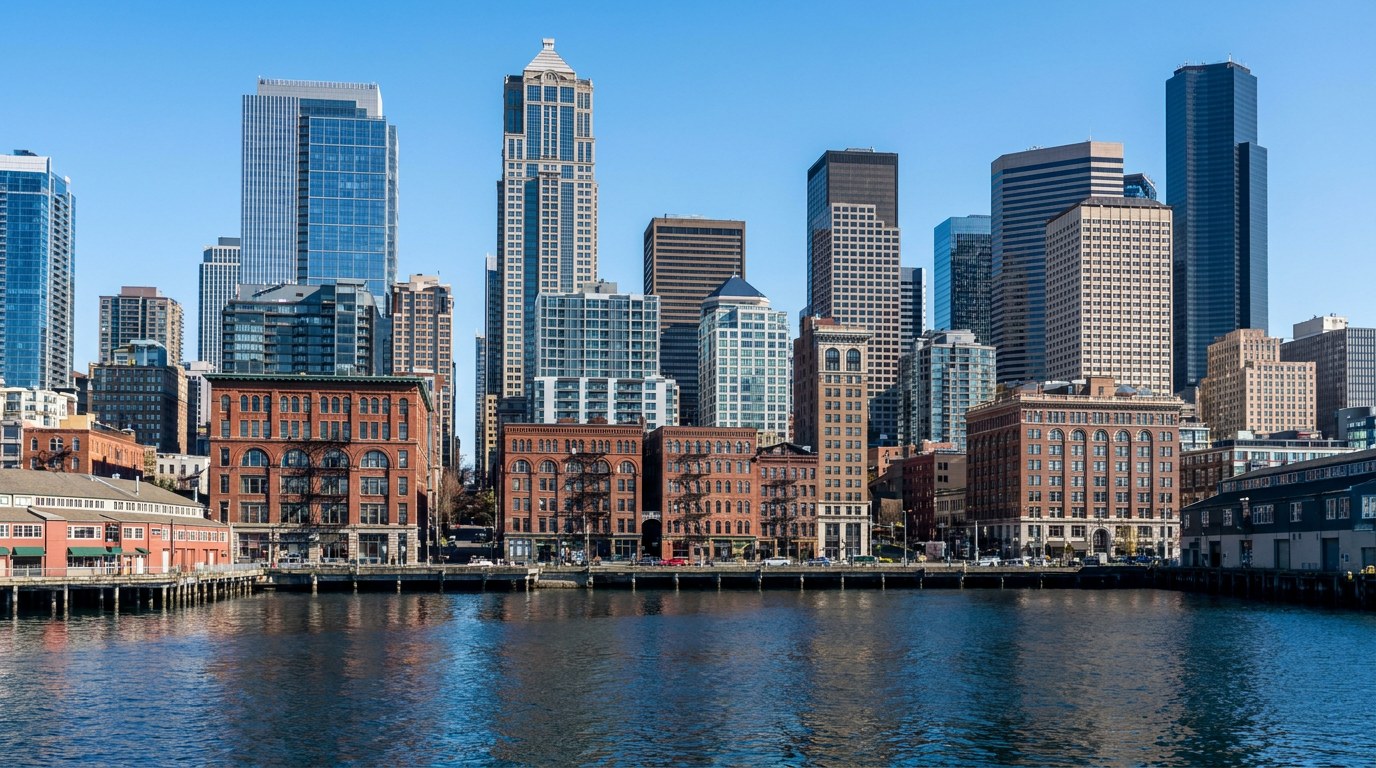
Short answer: Commercial and multifamily landlords inside Seattle city limits face layered municipal and state mandates. Alongside annual Portfolio Manager disclosures under SMC § 22.920, Seattle’s Building Emissions Performance Standard (BEPS, SMC § 22.925 / Ord. 126973) subjects non-residential and multifamily buildings >20,000 sq ft to emissions verification beginning in 2027 (>=90,000 sq ft wave) and stepped GHGI (greenhouse gas intensity) limits starting in 2031 through net-zero 2050.
Crucially, complying with Seattle BEPS does NOT exempt a building from Washington State’s Clean Buildings Performance Standard (CBPS) — and meeting WA CBPS’s energy-efficiency Site EUI rule does not automatically satisfy Seattle BEPS’s fossil-fuel decarbonization schedule. Clean Seattle City Light hydroelectric power keeps electric buildings’ carbon intensity low, spotlighting gas space heating and service water systems as the primary Seattle compliance risk.
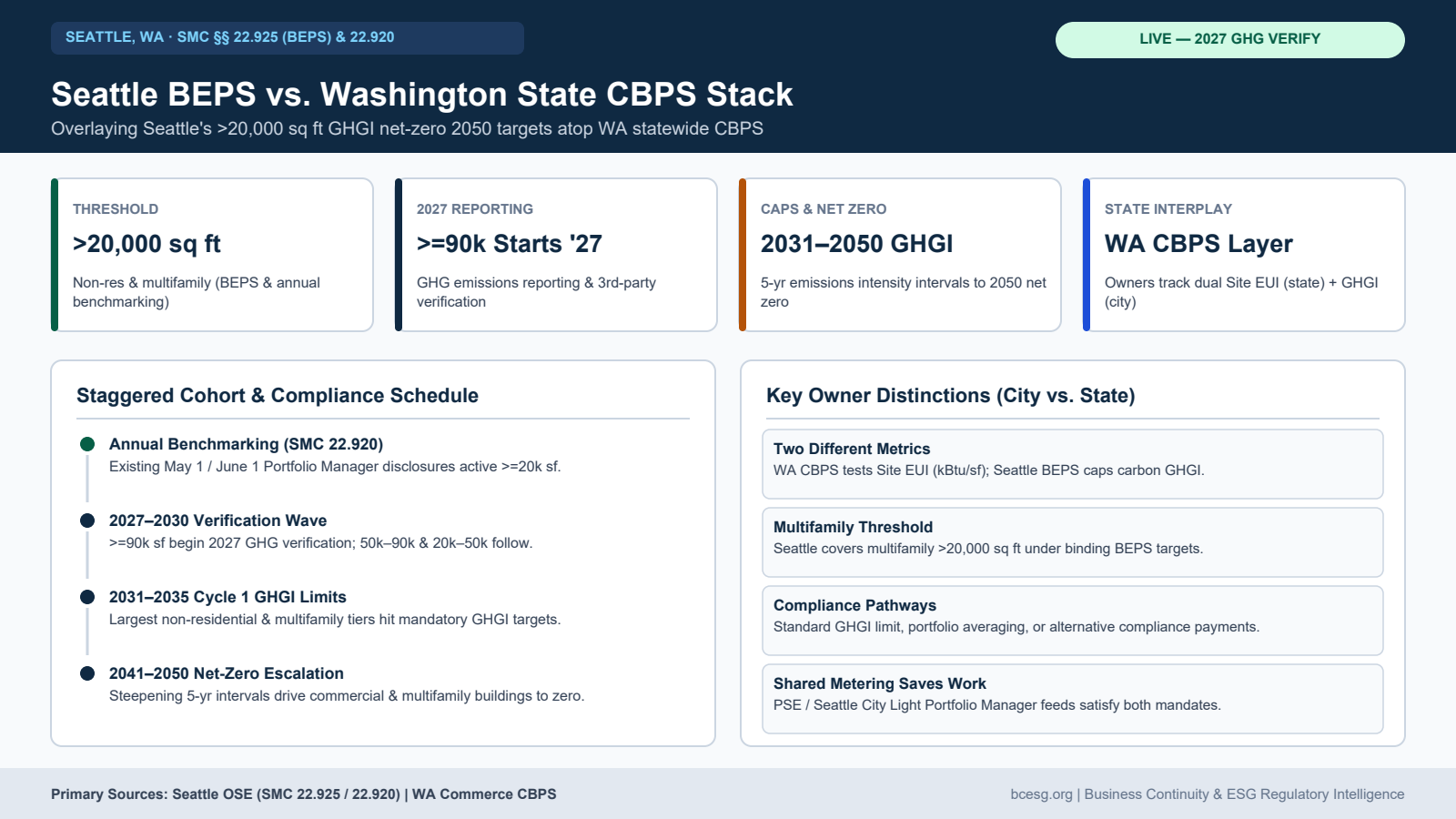
- Covered Scope (>20,000 sq ft): Non-residential commercial and multifamily residential buildings >20k heated/conditioned floor area (excluding manufacturing/industrial per OSE definitions).
- Staggered Cohorts (2027–2050): Wave 1 (>=90k sf) opens GHG reporting/verification in 2027 with Cycle 1 GHGI caps in 2031–2035; smaller 50k–90k and 20k–50k cohorts follow through 2050.
- Annual Benchmarking Remains Active: SMC § 22.920 Portfolio Manager reporting continues annually every spring/summer (~May 1 / June 1 OSE schedule).
- Flexibility Options: Standard building-type GHGI limits, portfolio averaging, alternative compliance payments, and decarbonization extensions for equipment replacement constraints.
Download the Seattle BEPS & WA CBPS Overlap Reference
Coordinating Seattle BEPS Carbon Limits With WA CBPS Site EUI Targets
Seattle City Light supplies predominantly hydroelectric grid electricity, giving Seattle properties a dramatically lower electric emission factor than fossil natural gas or steam heat. As a result, a building running electric resistance boilers might struggle to meet Washington State CBPS’s kBtu/sq ft Site EUI target while easily clearing Seattle BEPS’s 2031–2035 GHGI ceiling — whereas an efficient condensing-gas building could pass WA CBPS early while facing escalating Seattle carbon gaps through 2040.
Owners preparing CY2026 utility baselines ahead of 2027 third-party GHG verification should audit submeter splits between tenant retail and multifamily domestic hot water plants before selecting heat-pump conversions or compliance extensions.
- Verify Dual Reporting Timelines: Keep Washington Commerce CBPS Tier 1 (>=50k sf 2026–2028) milestones aligned alongside Seattle’s 2027 (>=90k sf) verification kickoff.
- Multifamily Early Prep: Unlike WA CBPS Tier 1 (commercial-focused until Tier 2 benchmarking), Seattle BEPS places multifamily >20,000 sq ft directly on a net-zero emissions path.
| Obligation & Code | Covered Floor Area | Key 2026–2031 Timeline | Primary Compliance Metric |
|---|---|---|---|
| Seattle Benchmarking (SMC 22.920) | Nonres & multifamily >20,000 sf | Annual spring/June Portfolio Mgr | Whole-building Site EUI + ENERGY STAR |
| Seattle BEPS (SMC 22.925) | Nonres & multifamily >20,000 sf | 2027 GHG verify (>=90k); 2031 caps | GHGI (kgCO2e/sf) to net-zero 2050 |
| WA State CBPS Overlay | Tier 1 >=50k nonres; Tier 2 >=20k/multi | 2026–2028 Tier 1; 2027 Tier 2 | Weather-normalized Site EUI + EMP/O&M |
Compliance Execution Checklist
| Step | Owner / Team | Auditable Deliverable |
|---|---|---|
| 1. Cohort Confirmation | Compliance / Legal | Confirm property gross sq ft tier (>90k vs 50k–90k vs 20k–50k) under OSE rules. |
| 2. Dual Utility Feed Audit | Property Ops | Lock Seattle City Light & Puget Sound Energy PM aggregation prior to spring close. |
| 3. Fuel-Switching CapEx | Engineering / Asset Mgmt | Model heat-pump / domestic hot water electrification to satisfy GHGI + Site EUI together. |
Keep This Seattle, WA Compliance Checklist Handy
Frequently Asked Questions
Does complying with Washington's statewide CBPS satisfy Seattle BEPS?
No. Washington State CBPS regulates energy consumption (Site EUI) whereas Seattle BEPS (SMC § 22.925) caps carbon emissions intensity (GHGI) toward net-zero 2050 and covers multifamily properties >20,000 sq ft.
When do Seattle BEPS requirements start taking effect?
Annual energy benchmarking under SMC § 22.920 is active now, third-party GHG reporting begins in 2027 for buildings >=90,000 sq ft, and mandatory 5-year GHGI emissions limits start in 2031.
Primary Authorities & Official Resources
- City of Seattle OSE — Building Emissions Performance Standard (BEPS)
- Washington State CBPS Guide (Dual-Metric Context)
Informational notice: This guide summarizes enacted statutes, regulations, or pending legislative records from the primary authorities linked above as of November 14, 2026. It is not legal, accounting, or licensed engineering advice.