
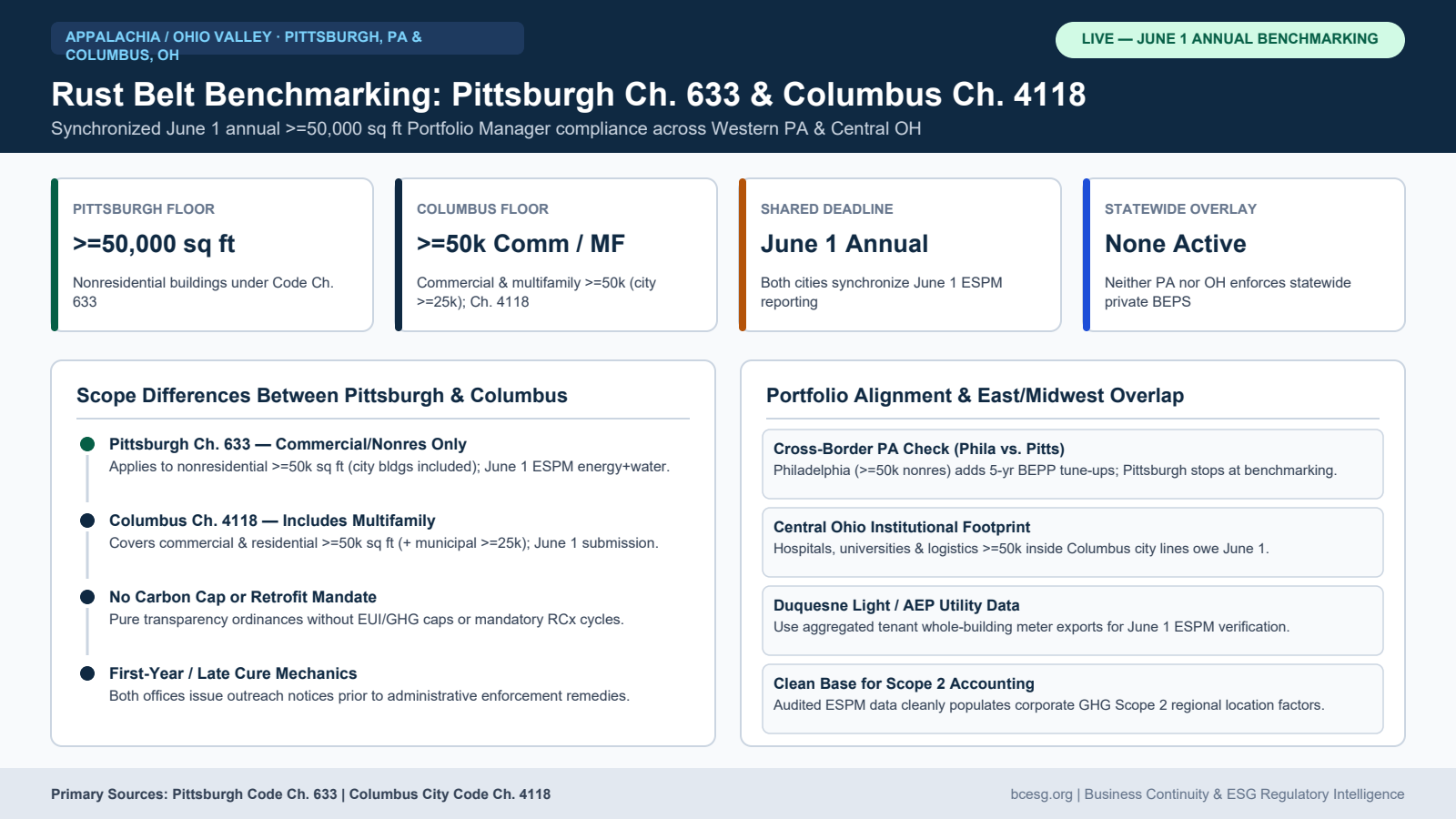
Short answer: Regional Midwest and Appalachian real estate portfolios share a convenient calendar anchor on June 1: both Pittsburgh (Code Ch. 633) and Columbus (City Code Ch. 4118) enforce active >=50,000 sq ft whole-building energy and water benchmarking via EPA’s ENERGY STAR Portfolio Manager on the exact same date.
The operational trap lies in residential coverage: Pittsburgh Ch. 633 applies exclusively to non-residential buildings >=50,000 sq ft (skipping purely residential apartments), whereas Columbus Ch. 4118 covers both commercial and multifamily buildings >=50,000 sq ft. Compare Pittsburgh’s light-touch transparency reporting with statewide peer Philadelphia’s June 30 benchmarking + 5-year BEPP tune-up rules.
- Pittsburgh, PA (Ch. 633 — Non-Residential >=50k sq ft): Administered by Pittsburgh Dept. of City Planning; annual June 1 whole-building electricity, fuel, and water reporting for private non-residential parcels >=50,000 sq ft.
- Columbus, OH (Ch. 4118 — Commercial & Multifamily >=50k sq ft): Administered by Columbus Dept. of Building and Zoning Services; annual June 1 energy/water benchmarking covering commercial, institutional, and apartment properties >=50,000 sq ft.
- Shared Utility Setup: Duquesne Light, Peoples Gas, and PWSA (Pittsburgh) vs. AEP Ohio, Columbia Gas, and Columbus Public Utilities operate different multi-tenant whole-building data workflows requiring early spring requests.
- Disclosure Only: Neither city currently mandates energy audits, retro-commissioning, or building emissions caps.
Download the Pittsburgh & Columbus June 1 Benchmarking Sheet
Executing Unified June 1 Filings Across PA & OH Portfolios
For REITs and regional property managers with both Ohio Valley offices and Columbus multifamily complexes, treating June 1 as a single utility-aggregation sprint eliminates late data exceptions. Request whole-building aggregate meters in April, double-check gross floor area excluding parking garages per ENERGY STAR guidance, and retain confirmation screenshots from each municipal submission template.
Because Ohio prohibits no municipal benchmarking despite lacking a state-level building statute, Columbus remains Ohio’s sole active local benchmarking jurisdiction while Pennsylvania separates Philadelphia’s active RCx law from Pittsburgh’s benchmarking-only ordinance.
- Verify Mixed-Use Triggers in Pittsburgh: Mixed-use assets containing >=50,000 sq ft of non-residential floor area remain subject to Ch. 633 even with residential upper floors.
- Columbus 25k City Exception: Municipal Columbus properties enter benchmarking down at 25,000 sq ft, whereas private commercial and multifamily buildings start at 50,000 sq ft.
| City & Code | Covered Private Threshold | Annual Due Date | Multifamily Included? |
|---|---|---|---|
| Pittsburgh, PA (Ch. 633) | Non-residential >=50,000 sq ft | June 1 (Energy & water PM) | NO — commercial/non-residential only |
| Columbus, OH (Ch. 4118) | Commercial & multifamily >=50,000 sq ft | June 1 (Energy & water PM) | YES — private multifamily >=50k covered |
Compliance Execution Checklist
| Step | Owner / Team | Auditable Deliverable |
|---|---|---|
| 1. April Meter Pull | Property Ops | Gather Duquesne/PWSA (Pittsburgh) and AEP/Columbia Gas (Columbus) aggregate feeds. |
| 2. Portfolio Classification | Asset Management | Separate Pittsburgh non-residential >=50k sf from exempt multifamily parcels. |
| 3. June 1 Municipal Share | Compliance Lead | Submit City-specific Portfolio Manager reporting links and archive compliance receipts. |
Keep This Pittsburgh, PA & Columbus, OH Compliance Checklist Handy
Frequently Asked Questions
Do multifamily apartment buildings >=50,000 sq ft have to file benchmarking in Pittsburgh?
No. Pittsburgh Code Ch. 633 applies strictly to non-residential buildings >=50,000 sq ft, unlike Columbus Ch. 4118 which explicitly covers both commercial and multifamily properties >=50,000 sq ft.
Are energy and water utilities both included in Pittsburgh and Columbus benchmarking?
Yes. Both cities require whole-building electricity, heating fuels, and water consumption submitted through ENERGY STAR Portfolio Manager by June 1 annually.
Primary Authorities & Official Resources
- City of Pittsburgh Dept. of City Planning — Building Benchmarking FAQ (Ch. 633)
- City of Columbus — Benchmarking & Transparency Annual Report (Ch. 4118)
Informational notice: This guide summarizes enacted statutes, regulations, or pending legislative records from the primary authorities linked above as of November 14, 2026. It is not legal, accounting, or licensed engineering advice.