Blog

  • Enterprise AI Compute Sits Where Corporate Carbon Sat Before Custody Registries

    Enterprise AI Compute Sits Where Corporate Carbon Sat Before Custody Registries

    BC ESG · Regulatory Intelligence and Assurance Posture
    Statutory and Market Baseline (November 14, 2026): No current U.S. federal, state—including California’s SB 253 or AB 1305—or international sustainability disclosure statute mandates AI compute provenance or token-custody reporting today, and certified compute (named-issuer, watermarked, spend-once tokens backed by certifier risk absorption) does not exist as a commercial product, technical protocol, or assurance standard. This brief presents BC ESG’s corporate governance lens—explicitly framed as institutional inference—on why enterprise AI token spend now exhibits the same chain-of-custody blind spots corporate carbon faced before serialized registries.

    Four days ago, on November 10, 2026, corporate sustainability governance crossed a hard procedural threshold when the inaugural Scope 1 and Scope 2 reporting gate closed under California’s Climate Corporate Data Accountability Act (SB 253, Cal. Health and Safety Code § 38532) and the California Air Resources Board (CARB) implementing regulations at 17 CCR §§ 96070–96077, approved by the California Office of Administrative Law effective October 12, 2026. For decades prior, large enterprises treated greenhouse gas totals as voluntary estimates assembled from monthly utility spend. Once counterparty questionnaires, anti-greenwashing statutes, and third-party assurance arrived, raw utility invoices stopped passing scrutiny. Controllers had to prove chain of custody.

    Enterprise artificial intelligence compute now sits in that exact pre-registry posture. Across corporate networks audited between September 15 and November 14, 2026, Non-Human Identities (NHIs) and OAuth tokens outnumber human employees by 45:1 to 144:1, while autonomous threat campaigns such as ARTEX harvest exposed bearer API keys to fund external cybercrime on the victim’s cloud invoice. Finance teams see a rapidly compounding line item for inference tokens, yet neither the CFO, the CISO, nor the audit committee holds an attestation-grade sub-ledger proving which authorized internal workflow consumed which token.

    Keeping the legal boundary exact is essential for board oversight: no legislature, securities regulator, or sustainability standards body currently requires companies to track or disclose the provenance of AI inference tokens, and no vendor sells certified, spend-once compute today. Examining AI compute through BC ESG’s carbon-accounting framework—strictly as governance inference—shows how unattributed bearer tokens create silent internal-control leakage today, and sketches the custody architecture audit committees and procurement desks may eventually press for.

    2-PAGE GOVERNANCE BRIEF

    Download the Board and Audit Committee Compute Custody Brief (PDF)

    Print-first two-page reference mapping SB 253 and GHG Protocol carbon custody controls onto enterprise AI bearer-token risk, complete with a seven-point audit committee readiness checklist.

    1. Statutory Baseline: What Climate and ESG Law Covers Today—and What It Does Not

    Compliance teams closing fourth-quarter sustainability filings do not need imaginary mandates added to their register. As of November 14, 2026, zero U.S. federal, state, or international sustainability reporting statutes cover AI compute provenance, token serialization, or inference chain of custody. Where artificial intelligence intersects statutory ESG reporting today, it appears indirectly as electricity load inside data-center emissions inventories or operationally under risk-based model rules—a boundary we mapped in Responsible AI Meets ESG Reporting and across our institutional compliance frameworks guide.

    BC ESG’s newly completed 116-row U.S. climate disclosure and building-performance census—spanning all 50 states, Washington, D.C., and 42 active municipal and county jurisdictions—shows how concentrated formal corporate disclosure statutes remain even for carbon. California is the sole U.S. state with enacted cross-sector private corporate greenhouse gas and carbon-claim laws: SB 253 (for U.S. entities above $1 billion in revenue doing business in California, whose first Scope 1 and Scope 2 filing gate closed November 10, 2026 ahead of 2027 Scope 3 reporting, as detailed in Three Doors Into November 10), AB 1305 (Cal. Health and Safety Code §§ 44475–44475.3, live since January 1, 2024 for voluntary carbon offsets and net-zero claims), and SB 261 (Cal. Health and Safety Code § 38533, whose statutory January 1, 2026 climate-risk deadline remains preliminarily enjoined by the Ninth Circuit pending appeal in Chamber of Commerce of the U.S. v. Sanchez). Across the other 49 states and D.C., no cross-sector corporate climate statute is enacted—though three $1 billion corporate bills sit pending in New York (S9072A), New Jersey (S679), and Illinois (HB 3673), alongside 29 NAIC insurer survey jurisdictions, eight states plus D.C. enforcing state- or district-wide private building performance or benchmarking rules, and 43 active local city and county ordinances across those 42 local jurisdictions.

    Regulatory Boundary and Concept Status
    Observed Statutory Fact: Neither California’s SB 253 (17 CCR §§ 96070–96077) nor AB 1305 requires token-level AI compute provenance, and no commercial vendor currently offers certified, watermarked, spend-once compute. Governance Inference: Because enterprise AI spend scales across opaque SaaS supply chains just as purchased power and supplier emissions did a decade ago, pressure for auditable compute custody will likely arrive first through audit committees, enterprise procurement riders, and cyber-risk questionnaires long before any statutory mandate.

    2. How Voluntary Corporate Carbon Collapsed Into Custody Registries and Attestation

    To understand why aggregate AI API invoices face growing scrutiny under board-level oversight, recall why aggregate electricity bills stopped satisfying sustainability auditors. Early voluntary ESG reports routinely converted annual utility spend into rough grid-average estimates without instrument proof. That informal era ended across three accounting reforms—each closing a specific custody gap.

    First came instrument serialization and single-retirement rules. Under the GHG Protocol Corporate Accounting and Reporting Standard, the GHG Protocol Scope 2 Guidance, and U.S. EPA Scopes 1 and 2 Emissions Inventorying Guidance, accounting standards separated physical location-based grid factors from contractual market-based instruments. A company claiming low-carbon electricity under the market-based method must hold serialized Energy Attribute Certificates (EACs), such as Renewable Energy Certificates (RECs), tracked on a registry and permanently retired once on the reporting entity’s behalf. Without single-use retirement, two buyers could claim the same megawatt-hour—the core integrity issue examined in BC ESG’s analysis of Scope 2 market-based methodology reforms.

    Second came value-chain boundary discipline and anti-greenwashing substantiation. Under GHG Protocol Scope 3 Calculation Guidance, enterprises replaced rough spend multipliers with primary supplier activity records—a shift covered in our field guide to Scope 3 supplier data across specialty trades. California then enacted AB 1305, requiring companies marketing or using voluntary carbon offsets or net-zero claims to publish registry names, project identification numbers, and verification protocols online under civil penalties up to $2,500 per day ($500,000 cap), as mapped in our California SB 253, SB 261, and AB 1305 compliance pack.

    Third came independent third-party assurance. Under SB 253 and professional attestation standards maintained by AICPA audit and assurance frameworks, assurance practitioners test completeness, cutoff, organizational boundaries, meter-to-ledger reconciliation, and registry retirement statements. Carbon moved from voluntary narrative to custody accounting because unserialized claims invite double-counting and undetected leakage.
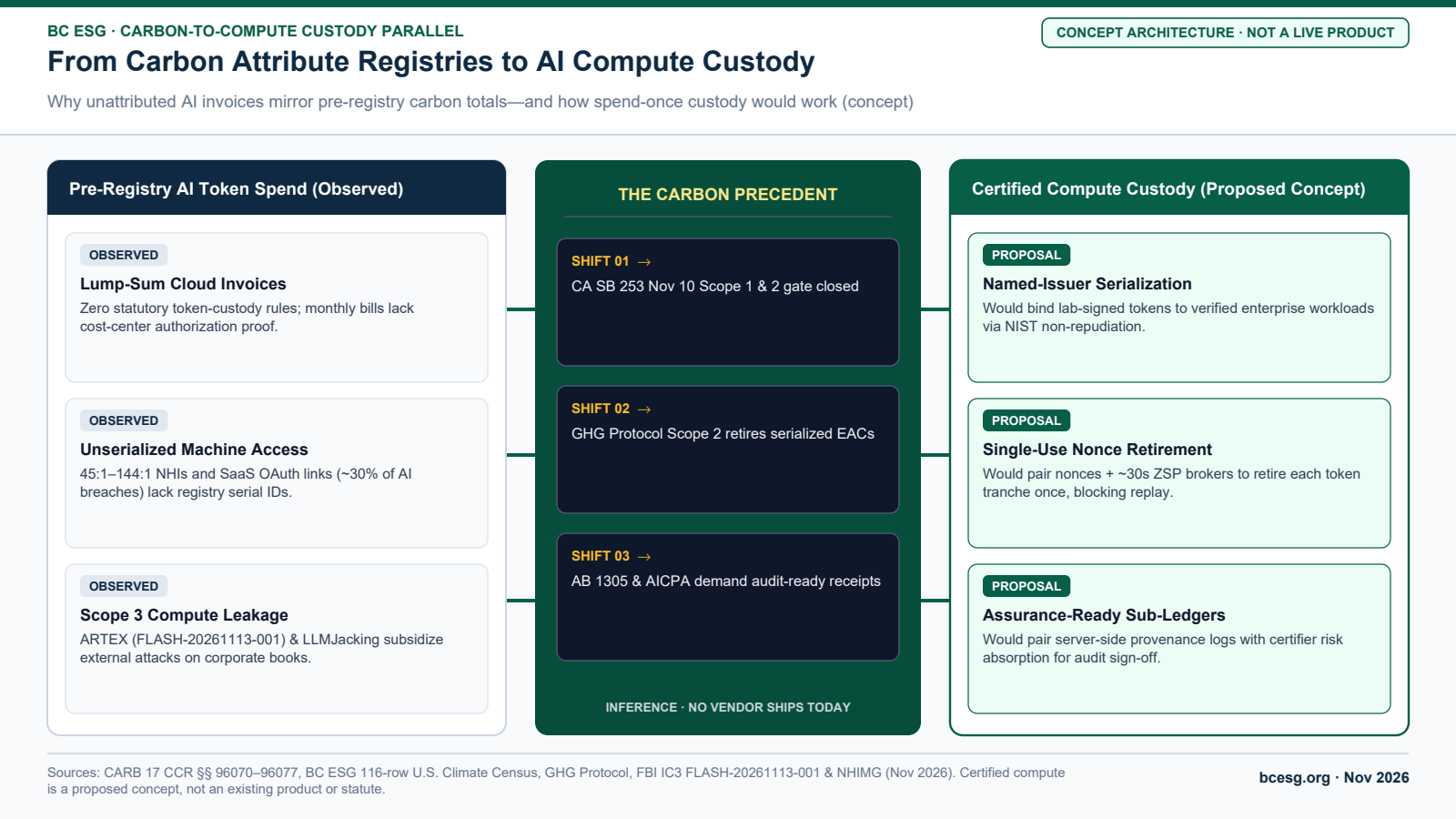
    Three-stage governance diagram contrasting statutory corporate carbon custody under SB 253 and GHG Protocol with unverified bearer AI tokens and proposed spend-once certified compute
    Corporate carbon moved from unverified utility invoices to serialized, retired attribute certificates and statutory filing gates; enterprise AI compute still runs on static bearer API keys with zero chain of custody. Certified compute (right) is an analytical governance concept, not an existing commercial product or legal mandate.

    3. Scope 3 Compute Leakage: Where Enterprise AI Token Spend Sits Today

    Measured against those core assurance assertions—completeness, authorization, cutoff, and custody—enterprise AI compute in late 2026 runs without a registry. Public breach disclosures, federal advisories, and engineering post-mortems recorded between September 15 and November 14, 2026 demonstrate why monthly API spend totals fail basic internal-control tests.

    • 45:1 to 144:1 Non-Human Identity Ratios: Data published in the NHIMG State of NHI and AI Agent Breaches Report shows corporate service accounts, OAuth grants, and machine tokens outnumbering human staff by 45:1 to 144:1; across 239 examined AI incidents, 44% were driven by credential compromise and roughly 30% (71 of 239) entered through third-party SaaS and OAuth supply chains outside application prompt controls.
    • External Cybercrime Subsidized via Corporate Keys (FLASH-20261113-001): Telemetry gathered by Amazon Threat Intelligence across MadPot decoys (October 3–November 5, 2026) and formalized in FBI IC3 Flash Alert FLASH-20261113-001 (November 13, 2026) documented autonomous ARTEX agents executing sub-three-hour intrusions and harvesting credentials from exposed LiteLLM and One API gateways so victim accounts paid for the attackers’ subsequent model runs.
    • Sub-Processor Custody Compromise (LLMJacking): Sub-processor exposure surfaced twice at inference vendor Fireworks AI during October 2026 (October 6 and October 23–24, 2026), where Unit 42-investigated LLMJacking compute theft and internal R&D lateral movement reached downstream SaaS integrations, including access to fewer than 1% of customer chat transcripts at Notion.
    • Mathematical and Checkpoint Control Limits: Neither input rules nor pre-release model checks establish runtime custody: a June 2026 NIST formal proof grounded in Gödel’s incompleteness theorems established that static rule sets inevitably leave gaps across unbounded natural language, and November 2026 Microsoft Defender and AI Red Team research on Lazarus backdoors demonstrated that surgical edits to under 10 dormant neurons allow open-weight checkpoints to clear pre-deployment reviews while firing hidden coding-agent payloads in 84.1%–94.8% of trials (and up to 98.8% on Nemotron-Terminal-8B).

    Rigorous board reporting must likewise distinguish unauthorized token leakage from non-malicious infrastructure halts in the same quarter. Primary post-mortems verify that the November 12–14 Microsoft 365 disruption (MO1550821) exceeding 24 hours across 74+ countries (stemmed from a capacity rollout and health-probe configuration error), the November 13 U.S. FAA nationwide flight halt (4 hours, 20 minutes between 3:54 and 8:15 p.m. EST, attributed at a joint DHS and DOT briefing to scheduled fiber cutover work on legacy 1980s analog copper circuits overloading regional switches), and the October 20 Google Cloud London europe-west2-b outage (Xs2XTHzAVC9YnafnPyzj) (6 hours, 8 minutes after October 14 Feeder B maintenance isolation combined with upstream PLC voltage-sensor wiring left standby diesels unstarted and depleted UPS batteries in roughly 7 minutes) reflected physical and common-mode operational risk rather than transmissible AI threats.

    Routing static bearer API keys across up to 144:1 machine identities and third-party gateways creates “Scope 3 compute leakage”—external threat actors burning corporate inference budgets with zero chain of custody on the victim’s general ledger.

    We use Scope 3 compute leakage strictly as a governance parallel, not a statutory greenhouse gas category. Because standard API keys operate as anonymous bearer strings, any human, SaaS sub-processor, or ARTEX agent holding the key can draw down enterprise credits—leaving internal audit unable to prove at quarter-end that billed inference actually served authorized corporate operations.

    4. What Attestation-Grade Compute Custody Would Require (Governance Proposal)

    If boards, enterprise buyers, or assurance practitioners eventually press AI labs for the chain-of-custody rigor that GHG Protocol Scope 2 registries brought to clean power, what would that instrument require? Framed strictly as a conceptual governance proposal—since no such product or standard exists today—attestation-grade certified compute would combine four controls.

    1. Named-Issuer Serialization and Signer Non-Repudiation: Instead of static bearer strings shared across SaaS connectors, a named frontier lab or clearinghouse would mint serialized compute tranches bound to a verified enterprise workload identity under NIST CSRC signer non-repudiation principles, establishing cryptographic origin for every inference request.
    2. Spend-Once Token Retirement and Replay Prevention: Just as a REC serial number is retired upon redemption to prevent double-counting, certified compute units would be spendable once. Pairing cryptographic nonces with Zero Standing Privilege (ZSP) brokers issuing roughly 30-second single-use tokens—plus hardware-backed Inalienable Human-in-the-Loop (arXiv:2610.35835) sign-off for high-impact actions—would neutralize stolen-key replay and ARTEX self-funding.
    3. Execution-Time Provenance With Honest Red-Team Boundaries: At execution, the runtime ledger would bind input-output hashes, weight digests, and policy state—drawing conceptually on C2PA v2.4 Content Credentials, hardware enclave attestation (Proof-of-Guardrail, arXiv:2603.05786), formal runtime verification (arXiv:2610.09793), and NIST AI Risk Management Framework governance. Primary 2026 red-team evidence shows why none of those tools suffice alone today: C2PA metadata is stripped by screenshots and faces first-mile capture limits, statistical watermarks degrade under paraphrasing, and TEE enclaves prove code integrity without semantic immunity against prompt injection. Assurance-grade custody would therefore need to anchor on an immutable server-side spend ledger rather than client-side file tags.
    4. Certifier Risk Absorption and Reconcilable Sub-Ledgers: Under this proposed model, serialized compute attestation would carry assurance weight only if the issuer stood behind its registry—absorbing counterfeit or replayed token losses that cleared its settlement rail while exporting signed sub-ledgers reconcilable to corporate cost centers.

    5. Carbon Attestation vs. Compute Custody Governance Matrix

    For audit committees, general counsel, and sustainability controllers operating post-November 10 SB 253 controls, the matrix below maps established corporate carbon custody rules against observed 2026 AI bearer-token exposure and the proposed certified-compute model.

    Governance DimensionCorporate Carbon Accounting (Observed Law and Practice)Enterprise AI Compute Today (Observed 2026 Reality)Certified Spend-Once Compute (Proposed Custody Concept)
    Statutory and Assurance BaselineCA SB 253 (17 CCR §§ 96070–96077, Nov 10, 2026 Scope 1 and 2 gate); CA AB 1305 claims substantiation; phased AICPA assurance.Zero U.S. federal, state, or international statutes require AI compute provenance or token-custody disclosure today.Potential future enterprise procurement, cyber-insurer, and internal-control attestation standard (governance inference).
    Unit of Account and InstrumentMetric tons CO2e backed by utility meters and serialized EACs / RECs (MWh) under GHG Protocol Scope 2.Aggregate monthly API token invoices and static bearer keys shared across LiteLLM, One API, and SaaS proxies.Named-issuer, workload-bound compute tranches watermarked and logged at execution (proposed concept).
    Organizational and Identity BoundaryDefined operational or financial control boundaries across metered facilities (116 U.S. census rows).NHI and OAuth tokens outnumber staff 45:1 to 144:1; ~30% (71/239) of AI breaches hit SaaS/OAuth chains.Cryptographic workload identity paired with ~30s ephemeral Zero Standing Privilege scoping (proposed concept).
    Double-Counting and Replay ControlRegistry serial-number retirement prevents two entities from claiming the same renewable MWh or carbon offset.Static bearer strings can be exfiltrated and spent concurrently until billing spikes trigger manual key rotation.Cryptographic nonces, spend-once retirement, and hardware sign-off would block unauthorized replay (proposed concept).
    Value-Chain / Scope 3 LeakageGHG Protocol Scope 3 tracks upstream and downstream suppliers; AB 1305 mandates offset project IDs and protocols.Scope 3 compute leakage: ARTEX (FLASH-20261113-001) and LLMJacking steal corporate keys to fund external attacks.Unbound external token replay would be rejected at settlement; certifier would back registry integrity (proposed concept).
    Audit Evidence GradeUtility invoices, registry retirement statements, engineering logs, and assurance working papers.Lump-sum cloud invoices unable to separate authorized internal engineering from hijacked third-party inference.Cryptographically signed spend-and-authorization sub-ledger reconcilable to cost centers (proposed concept).

    6. Board and Audit Committee Readiness Checklist

    Boards and audit committees do not need to wait for a certified-compute market or future legislation to close internal-control gaps over AI spend and machine credentials. Governance committees setting fourth-quarter 2026 and fiscal-year 2027 audit plans can execute seven controls immediately.

    1. Commission a Non-Human Identity and OAuth Proxy Census: Direct the CISO and CIO to measure the live machine-to-human identity ratio against the 45:1–144:1 benchmark, cataloging every internal gateway (LiteLLM, One API) and SaaS OAuth integration holding model credentials.
    2. Enforce Sub-Ledger Cost Attribution and Spend Circuit-Breakers: Segment AI API accounts by single application and environment rather than pooled enterprise keys, pairing sub-accounts with automated spend caps that trip within minutes of an ARTEX-style anomaly.
    3. Migrate From Static Bearer Keys to Ephemeral ZSP Brokers: Replace long-lived bearer strings in production agent workflows with Zero Standing Privilege brokers issuing short-lived (~30s) scoped tokens and hardware cryptographic sign-off for high-impact database or treasury actions.
    4. Separate Common-Mode Outages From Parasitic Breaches in Board Packs: Distinguish non-malicious monoculture and physical maintenance outages (Microsoft MO1550821, the November 13 FAA copper-to-fiber ground stop, and Google Cloud europe-west2-b PLC faults) from verified credential-theft pathogens (ARTEX, Fireworks AI LLMJacking).
    5. Audit Open-Weight Checkpoints and SaaS Sub-Processors: Screen open-weight models for post-training weight tampering (such as Lazarus fewer-than-10-neuron coding-agent backdoors) and require SaaS vendors to disclose downstream inference routing, key isolation, and breach notification SLAs.
    6. Substantiate Any AI Clean-Energy Claims Under Existing Carbon Law: Verify that any public claim of “carbon-neutral” or “100% renewable” AI operations satisfies live GHG Protocol Scope 2 certificate retirement rules and California AB 1305 website substantiation mandates.
    7. Negotiate Custody-Readiness Clauses in 2027 Model Agreements: Request per-workload cryptographic request signing, exportable inference audit logs, and explicit billing relief for vendor-side credential exposure during enterprise contract renewals.

    Frequently Asked Questions: AI Compute Provenance and Corporate Governance

    Does California SB 253, SB 261, or AB 1305 require companies to report AI compute provenance or token custody?

    No. Neither California SB 253, enjoined SB 261, nor AB 1305—nor any current U.S. federal, state, or international sustainability statute—mandates AI token provenance or compute chain-of-custody reporting. Under SB 253 (Cal. Health and Safety Code § 38532 and CARB rules 17 CCR §§ 96070–96077, whose inaugural Scope 1 and Scope 2 deadline closed November 10, 2026), covered entities over $1 billion in revenue report greenhouse gas emissions in metric tons of CO2e, where AI data-center power appears only indirectly inside Scope 2 or Scope 3 energy totals. AB 1305 applies only when an enterprise markets or uses voluntary carbon offsets or makes public net-zero or low-carbon claims.

    Does certified, spend-once compute exist today as a commercial cloud product or AICPA assurance standard?

    No. Certified compute—defined here as inference tokens issued by a named lab, watermarked at execution, spendable once via cryptographic replay prevention, and backed by certifier risk absorption—does not exist as a commercial product, technical standard, or AICPA attestation framework today. Individual building blocks exist separately, including C2PA v2.4 Content Credentials, hardware enclave attestation (arXiv:2603.05786), and ephemeral Zero Standing Privilege brokers, but no model provider currently bundles serialized spend-once compute with issuer registry backing.

    What is Scope 3 compute leakage, and why should corporate audit committees monitor it?

    Scope 3 compute leakage is BC ESG’s governance term (an analytical parallel, not a statutory GHG Protocol category) for unauthorized external AI inference paid for by a company’s compromised bearer API credentials. As documented in FBI IC3 Flash Alert FLASH-20261113-001 and the October 2026 Fireworks AI LLMJacking bulletins, autonomous agents such as ARTEX harvest keys from exposed LiteLLM and One API gateways to self-fund external cyberattacks, blending stolen compute into legitimate cloud expenses.

    Why do static prompt guardrails and output watermarks fail to establish an auditable chain of custody?

    Primary 2026 security receipts identify structural limits in both layers. NIST’s June 2026 Gödel incompleteness proof established that static prompt filters cannot cover an infinite natural-language attack space, while roughly 30% (71/239) of AI breaches bypass prompts completely via SaaS/OAuth credentials. Meanwhile, client-side C2PA metadata can be stripped by screenshots or intermediaries, statistical watermarks degrade under paraphrasing, and hardware TEE enclaves verify code integrity without preventing semantic prompt injection.

    How does BC ESG’s 116-row U.S. climate law census inform where AI compute oversight may travel next?

    BC ESG’s November 2026 census across all 50 states, D.C., and 42 local jurisdictions shows that U.S. corporate accountability rarely begins with a uniform federal statute; instead, it consolidates through anchor-state rules (California SB 253 and AB 1305), sectoral insurance surveys (29 NAIC jurisdictions), local building ordinances (43 municipal rows), and enterprise procurement riders. By governance inference, AI compute custody pressure is likely to emerge first inside enterprise vendor questionnaires, cyber-insurance underwriting, and internal audit controls over 45:1–144:1 machine identities long before statutory mandates exist.

    Primary Receipts & Official Authorities

    BOARD PACKET BRIEF & ASSURANCE MATRIX

    Save the 2-Page Carbon-to-Compute Custody Governance Brief

    Download the print-ready PDF governance matrix and seven-point audit committee checklist for Q4 2026 board packets, formatted for assurance review and archival.

    Informational Legal, Accounting, and Governance Disclaimer: This BC ESG brief is published solely for institutional regulatory intelligence, corporate governance, and internal-control analysis. Nothing in this publication constitutes legal advice, statutory compliance counsel, financial accounting guidance, or CPA audit or attestation services. As stated explicitly throughout, no current U.S. federal, state (including California SB 253, SB 261, or AB 1305), or international sustainability disclosure statute mandates AI compute provenance or token-custody reporting today, and “certified compute” is analyzed strictly as a conceptual governance proposal rather than an existing commercial product or assurance standard. Organizations should consult qualified legal counsel and independent assurance practitioners regarding statutory filings under 17 CCR §§ 96070–96077 and internal controls over enterprise AI infrastructure.
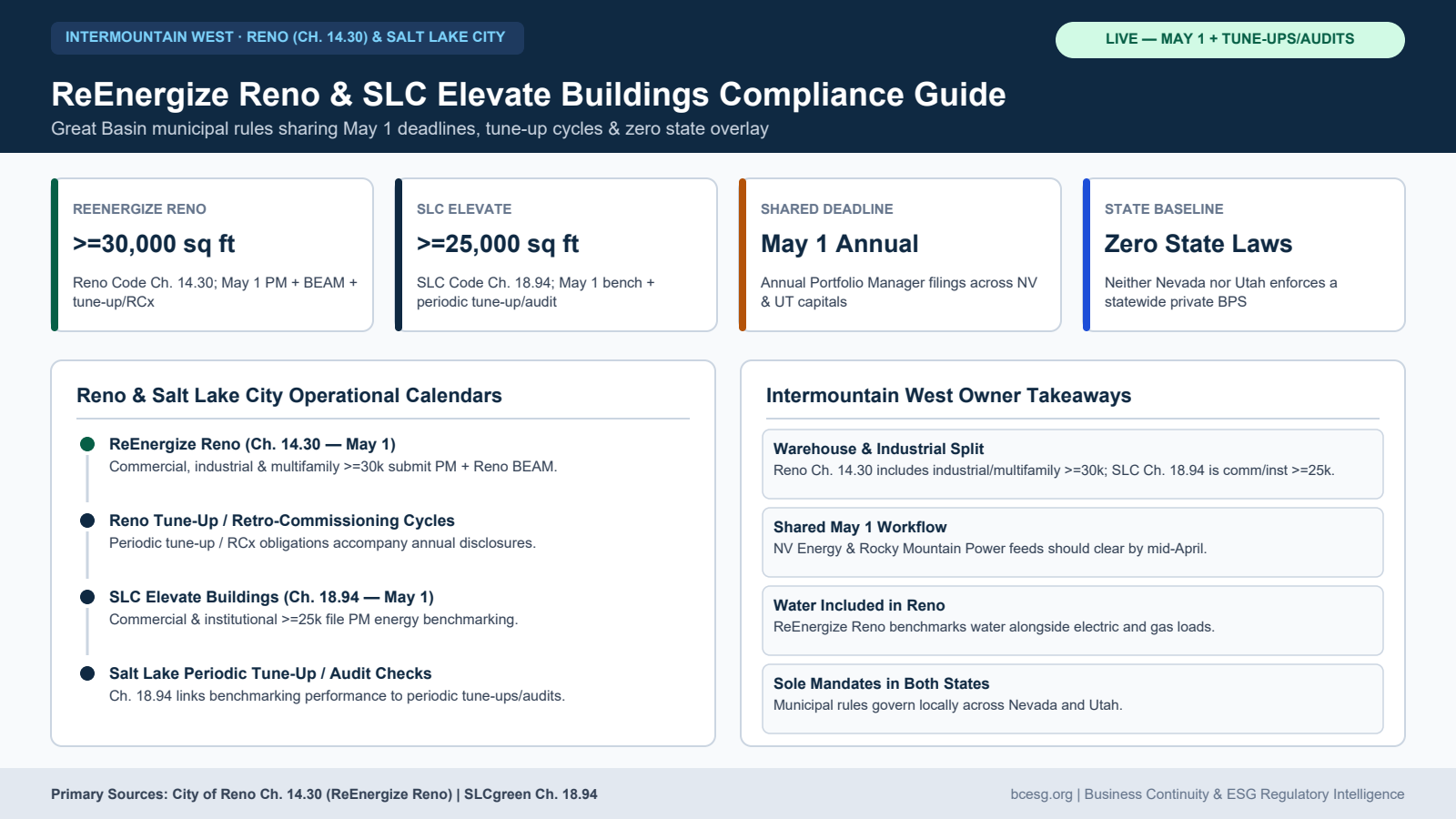
  • ReEnergize Reno (Ch. 14.30) & Salt Lake City Elevate Buildings: May 1 Compliance Guide

    ReEnergize Reno (Ch. 14.30) & Salt Lake City Elevate Buildings: May 1 Compliance Guide

    Short answer: Across the Great Basin corridor, commercial and logistics landlords encounter an exact calendar pairing every May 1: ReEnergize Reno (Reno Code Ch. 14.30) and Salt Lake City’s Elevate Buildings Ordinance (SLC Code Ch. 18.94). Neither state imposes statewide building benchmarking or decarbonization caps — concentrating Intermountain compliance directly inside Reno (>=30,000 sq ft) and Salt Lake City (>=25,000 sq ft).

    Crucially, both cities look past simple transparency spreadsheets to include periodic tune-up, retro-commissioning, or audit requirements alongside Portfolio Manager reporting — and differ sharply on industrial/multifamily inclusion.

    Statutory Status at a Glance
    • ReEnergize Reno (Ch. 14.30 — >=30,000 sq ft Comm, Ind & MF): Annual May 1 energy AND water reporting submitted via ENERGY STAR Portfolio Manager into Reno’s BEAM platform, coupled with repeating tune-up / RCx schedules.
    • SLC Elevate Buildings (Ch. 18.94 — >=25,000 sq ft Comm & Inst): Annual May 1 energy benchmarking via Portfolio Manager administered by SLCgreen, with periodic tune-up/audit pathways for lower-scoring properties.
    • Utility Data Workflow: NV Energy & Truckee Meadows Water Authority (Reno) and Rocky Mountain Power & Enbridge Gas Utah / Dominion (Salt Lake City) provide commercial whole-building account exports.
    Print-First Compliance Brief

    Download the Reno & Salt Lake City May 1 Guide

    2-page Print-First PDF aligning ReEnergize Reno Ch. 14.30 (>=30k sf + tune-ups) and SLC Elevate Buildings Ch. 18.94 (>=25k sf + audits) for May 1.

    Checking Warehouse & Multifamily Inclusion Between Reno & Salt Lake City

    Industrial real estate funds active in northern Nevada distribution corridors should note that Reno Ch. 14.30 pulls both logistics warehouses/industrial plants and multifamily apartments starting at >=30,000 sq ft into annual May 1 energy and water filings plus tune-up/RCx obligations. In Salt Lake City, by contrast, commercial offices, hotels, medical, and institutional structures >=25,000 sq ft sit inside Elevate Buildings while pure residential stays outside Ch. 18.94.

    Confirm Reno BEAM portal account linkage and SLCgreen covered-building IDs in March ahead of May 1 submissions, and review periodic tune-up/audit exemption options (such as active ENERGY STAR >=75 or verified LEED certifications).

    • Reno Includes Water Benchmarking: Track TMWA municipal water meters alongside NV Energy electric/gas totals in Portfolio Manager.
    • Early May 1 Target: Both Great Basin portals close May 1 — a full month ahead of June 1 coastal peers.
    City & CitationThreshold & Building TypesAnnual Due DateMandate Beyond Benchmarking
    ReEnergize Reno (Ch. 14.30)Comm, industrial & multi >=30k sfMay 1 (PM + BEAM + water)Periodic tune-up / retro-commissioning cycles
    SLC Elevate Buildings (Ch. 18.94)Comm & institutional >=25k sfMay 1 (Portfolio Mgr)Periodic tune-up / audit provisions
    Intermountain West comparison of ReEnergize Reno (>=30,000 sq ft energy/water + tune-ups) and Salt Lake City Elevate Buildings (>=25,000 sq ft commercial/institutional + audits), both due May 1.
    Intermountain West compliance calendar: May 1 Portfolio Manager submissions plus periodic tune-up/audit cycles in Reno NV and Salt Lake City UT.

    Compliance Execution Checklist

    StepOwner / TeamAuditable Deliverable
    1. Reno Ind/MF CheckAsset ManagementInclude >=30k NV warehouses & multifamily; check >=25k UT commercial/inst.
    2. March Utility ExportProperty OpsRequest NV Energy/TMWA (Reno) and Rocky Mountain Power/Enbridge (SLC) data.
    3. May 1 & Audit VerifyEngineering / ComplianceSubmit BEAM & SLCgreen links before May 1; check tune-up exemption dates.
    Field & Print Package

    Keep This Reno, NV & Salt Lake City, UT Compliance Checklist Handy

    Download the formatted 2-page PDF reference brief or pull the structured Markdown edition for internal compliance documentation.

    Frequently Asked Questions

    Do Reno warehouses and industrial buildings have to report under ReEnergize Reno?

    Yes. Reno Municipal Code Ch. 14.30 covers commercial, industrial, and multifamily buildings >=30,000 sq ft via annual May 1 energy and water benchmarking plus periodic tune-up/RCx cycles.

    What properties are covered by Salt Lake City's Elevate Buildings Ordinance?

    SLC Code Ch. 18.94 applies to commercial and institutional buildings >=25,000 sq ft, requiring annual May 1 ENERGY STAR Portfolio Manager benchmarking and periodic tune-up/audit compliance.

    Primary Authorities & Official Resources

    Informational notice: This guide summarizes enacted statutes, regulations, or pending legislative records from the primary authorities linked above as of November 14, 2026. It is not legal, accounting, or licensed engineering advice.

  • Austin ECAD Ordinance Guide: Commercial June 1 Filings, Multifamily Audits & Ch. 6-7

    Austin ECAD Ordinance Guide: Commercial June 1 Filings, Multifamily Audits & Ch. 6-7

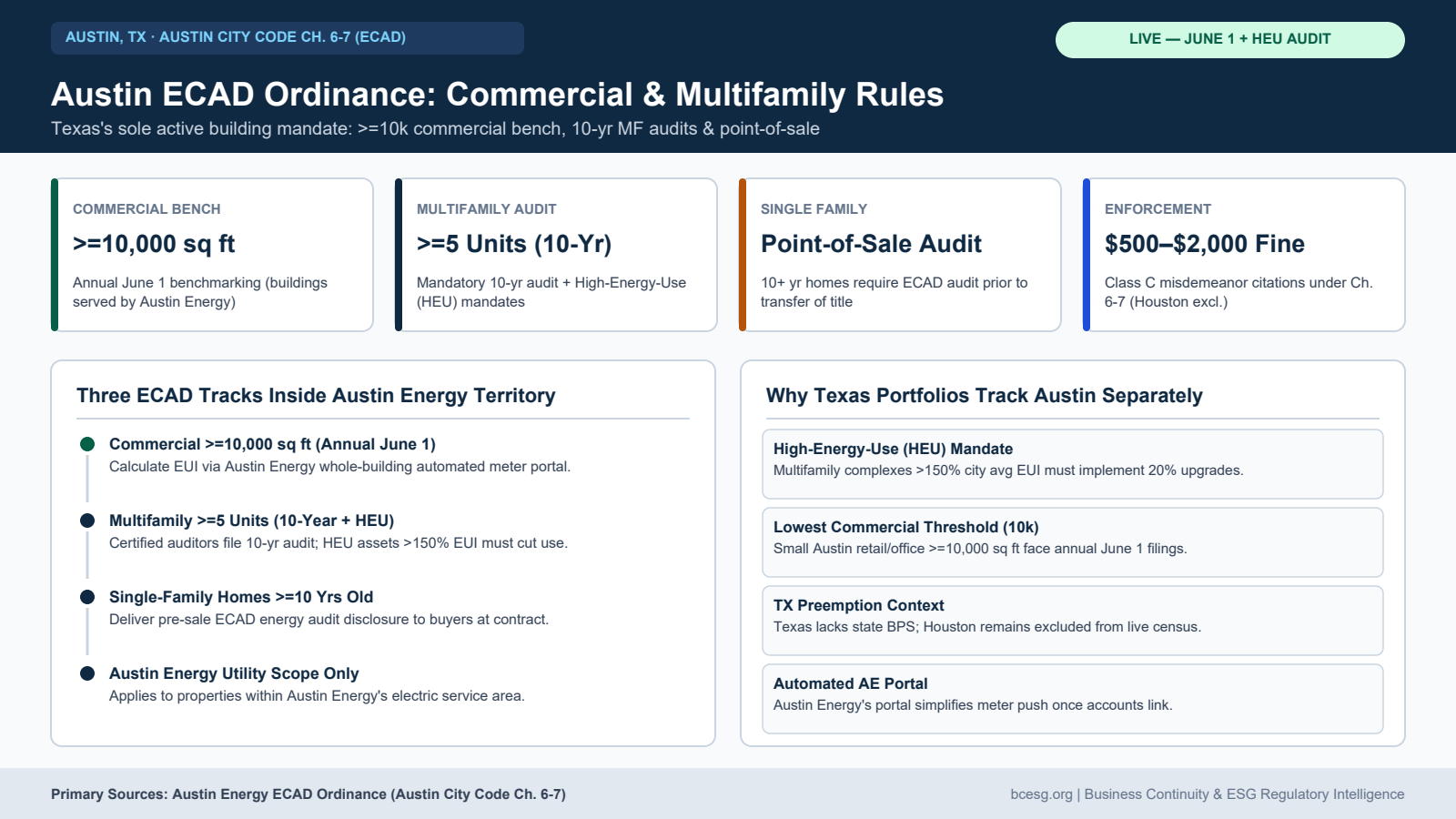
    Short answer: Inside Texas, Austin’s Energy Conservation Audit and Disclosure (ECAD) Ordinance (City Code Ch. 6-7) stands alone as an active, enforceable municipal building law across the state’s commercial, multifamily, and residential stock. Served directly through municipally owned Austin Energy, ECAD splits into three enforceable tracks: annual June 1 commercial benchmarking down to >=10,000 sq ft, repeating 10-year multifamily audits (>=5 units) with High-Energy-Use (HEU) retrofit duties, and pre-sale residential audit disclosures.

    Noncompliance carries Class C misdemeanor fines from $500 to $2,000 per violation. Meanwhile, Texas commercial operators holding assets in Houston or Dallas encounter no statewide building mandate — keeping Houston separate (`EXCL-TX-HOUSTON`: excluded from verified live statutory coverage) while centering Texas compliance strictly on Austin Energy accounts.

    Statutory Status at a Glance
    • Commercial Track (>=10,000 sq ft — June 1 Annual): Covers offices, retail, medical, and industrial facilities receiving Austin Energy service (regardless of whether within Travis/Williamson County boundaries) via Austin Energy’s automated EUI portal.
    • Multifamily Track (>=5 Units — 10-Year Audits + HEU): Apartment owners commission certified ECAD audits every 10 years, post notice to tenants, and — if flagged as a High-Energy-Use facility (>150% average multifamily EUI) — must reduce energy consumption by 20% under city audit supervision.
    • Single-Family Sale Disclosure: Homes 10+ years old inside Austin Energy service territory require an ECAD audit delivered to buyers before closing.
    Print-First Compliance Brief

    Download the Austin ECAD Three-Track Reference

    2-page Print-First PDF organizing Austin Code Ch. 6-7 commercial June 1 benchmarking (>=10k sf), 10-yr multifamily audits, and HEU upgrade triggers.

    Clearing Commercial June 1 Filings & Multifamily High-Energy-Use (HEU) Triggers

    Many Texas commercial owners overlook ECAD because its trigger relies on Austin Energy service territory rather than strict City of Austin municipal tax lines — and starts all the way down at 10,000 sq ft. Meanwhile, apartment investors acquiring 1980s-vintage garden apartments (>=5 units) in Austin face real capital exposure if a 10-year audit flags High-Energy-Use (HEU) status above 150% peer EUI, triggering statutory weatherization, duct sealing, and HVAC/lighting upgrades (often co-funded through Austin Energy multifamily rebates).

    • Verify Utility Provider Map First: Confirm whether a suburban Cedar Park / Round Rock / Travis parcel takes power from Austin Energy (ECAD applies) vs. Oncor/PEC (no ECAD).
    • Audit Acquisition Diligence: Pull existing 10-year multifamily ECAD certificates and any open HEU compliance orders prior to closing apartment trades.
    ECAD Track (Ch. 6-7)Threshold & TerritoryDeadline / CadenceMandate & Penalty
    Commercial Benchmarking>=10,000 sf (Austin Energy svc)Annual June 1Automated EUI reporting ($500–$2k Class C)
    Multifamily Audits + HEU>=5 units (Austin Energy svc)Every 10 yrs (May/June schedule)Certified audit + 20% cut if HEU (>150% avg)
    Single-Family SaleHomes >=10 yrs oldPrior to transfer of titlePoint-of-sale ECAD audit disclosure to buyer
    Breakdown of Austin Code Ch. 6-7 ECAD: annual June 1 >=10k commercial benchmarking, >=5 unit 10-year multifamily audits & High-Energy-Use rules, and point-of-sale home audits.
    Austin Energy's ECAD Ordinance (Austin City Code Ch. 6-7): Texas's sole live building energy disclosure & audit ordinance.

    Compliance Execution Checklist

    StepOwner / TeamAuditable Deliverable
    1. Austin Energy Service CheckAsset / DiligenceConfirm >=10k commercial or >=5 unit MF sits on Austin Energy electric meters.
    2. June 1 Commercial RatingProperty OpsSubmit automated Austin Energy EUI calculation via city portal before June 1.
    3. Multifamily 10-Yr / HEUEngineering / MgmtSchedule certified 10-yr ECAD audit and evaluate AE rebates if near HEU cutoff.
    Field & Print Package

    Keep This Austin, TX Compliance Checklist Handy

    Download the formatted 2-page PDF reference brief or pull the structured Markdown edition for internal compliance documentation.

    Frequently Asked Questions

    What commercial buildings are subject to Austin's ECAD Ordinance?

    Under Austin City Code Ch. 6-7, commercial buildings >=10,000 sq ft served by Austin Energy must calculate and disclose annual energy ratings by June 1 — even if located in unincorporated or neighboring areas served by Austin Energy.

    What happens if an Austin apartment property fails an ECAD audit as High-Energy-Use?

    Multifamily properties (>=5 units) determined to consume more than 150% of the average Austin multifamily EUI on their 10-year audit must execute qualifying energy upgrades lowering use by 20% under Austin Energy oversight.

    Primary Authorities & Official Resources

    Informational notice: This guide summarizes enacted statutes, regulations, or pending legislative records from the primary authorities linked above as of November 14, 2026. It is not legal, accounting, or licensed engineering advice.

  • Midwest City Building Compliance: Madison BESP, Indianapolis Ch. 604 & Des Moines

    Midwest City Building Compliance: Madison BESP, Indianapolis Ch. 604 & Des Moines

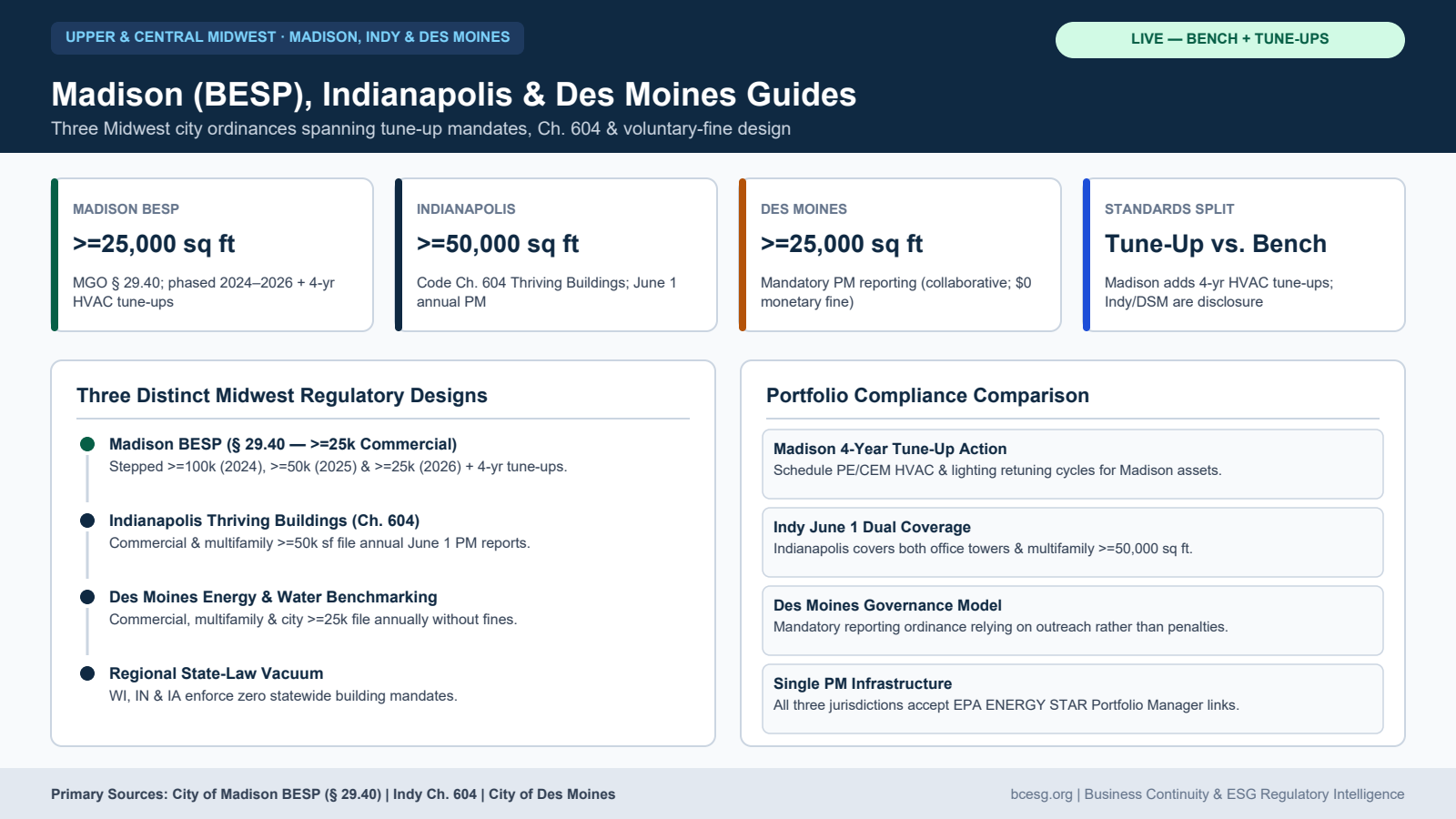
    Short answer: Across Wisconsin, Indiana, and Iowa — three states with zero statewide private building laws — regional landlords manage distinct local programs across three state capitals: Madison BESP (MGO § 29.40), Indianapolis Thriving Buildings (Ch. 604), and Des Moines Energy & Water Benchmarking.

    The operational outlier is Madison: starting at >=25,000 sq ft commercial (now at full 2026+ phased reach), Madison pairs annual benchmarking with mandatory repeating 4-year HVAC/building tune-ups — whereas Indianapolis (>=50k comm & multi) and Des Moines (>=25k comm & multi) focus on ENERGY STAR Portfolio Manager transparency without periodic audit/tune-up mandates.

    Statutory Status at a Glance
    • Madison BESP (MGO § 29.40 — >=25,000 sq ft Commercial): Phased >=100k (2024), >=50k (2025), and >=25k (2026+); requires annual Portfolio Manager benchmarking AND repeating 4-year HVAC/building tune-ups (exemptions via high ENERGY STAR / green certs).
    • Indianapolis Ch. 604 (>=50,000 sq ft Commercial & Multifamily): Annual June 1 whole-building energy & water reporting via Portfolio Manager across Marion County consolidated city boundaries.
    • Des Moines (>=25,000 sq ft Commercial, Multifamily & City): Mandatory annual energy & water benchmarking structured collaboratively without financial noncompliance fines.
    Print-First Compliance Brief

    Download the Madison, Indianapolis & Des Moines Guide

    2-page Print-First PDF separating Madison’s 4-year commercial tune-ups from Indianapolis Ch. 604 June 1 filings and Des Moines collaborative reporting.

    Preventing Surprise 4-Year Tune-Up Filings in Madison vs. Clean Transparency in Indy & DSM

    Regional asset managers rotating standard benchmarking schedules across Heartland portfolios frequently miss two rules: Madison’s commercial-only >=25k scope requires a qualified specialist to file repeating 4-year HVAC tune-ups (not unlike Philadelphia’s 5-year RCx rule), whereas Des Moines and Indianapolis require no field tune-ups but explicitly bring multifamily apartment buildings into annual energy and water reporting.

    • Madison High-Performance Exit: Verify whether ENERGY STAR scores or LEED certifications qualify covered commercial offices in Madison for tune-up waivers.
    • Water Accounts in Indy & Des Moines: Coordinate Citizens Energy / AES Indiana (Indy) and MidAmerican / Des Moines Water Works early each spring.
    City & CitationThreshold & Property TypesAnnual TimingTune-Up / Penalty Design
    Madison BESP (§ 29.40)Commercial >=25,000 sf (2026+)Annual bench + 4-yr cycleMandatory 4-year HVAC tune-up (or exemption)
    Indianapolis (Ch. 604)Commercial & multifamily >=50k sfAnnual June 1Benchmarking transparency (energy & water)
    Des Moines (Muni Code)Comm, multifamily & city >=25k sfAnnual cycleMandatory PM reporting (no monetary fines)
    Regional comparison of Madison BESP (§ 29.40 >=25k commercial + 4-year HVAC tune-ups), Indianapolis Thriving Buildings (Ch. 604 >=50k June 1), and Des Moines (>=25k collaborative benchmarking).
    Three Midwest benchmarking approaches where state laws are absent: Madison's 4-year HVAC tune-up mandate vs. Indianapolis & Des Moines disclosure models.

    Compliance Execution Checklist

    StepOwner / TeamAuditable Deliverable
    1. Commercial vs MF SplitAsset ManagementTag Madison >=25k commercial tune-ups vs Indy (>=50k) & Des Moines (>=25k) MF.
    2. Spring Utility AggregationProperty OpsGather MG&E (Madison), AES/Citizens (Indy), and MidAmerican/DMWW (Des Moines).
    3. Madison Tune-Up AuditQualified PE / CEMSchedule 4-yr HVAC inspection or verify ENERGY STAR high-performance exemption.
    Field & Print Package

    Keep This Madison, WI · Indianapolis, IN · Des Moines, IA Compliance Checklist Handy

    Download the formatted 2-page PDF reference brief or pull the structured Markdown edition for internal compliance documentation.

    Frequently Asked Questions

    Does Madison BESP (§ 29.40) cover multifamily residential apartment buildings?

    Madison's BESP ordinance applies to commercial buildings >=25,000 sq ft (following 2024 >=100k and 2025 >=50k tiers), unlike Indianapolis and Des Moines which include multifamily properties.

    Does Des Moines fine property owners for missing its benchmarking ordinance?

    No. Des Moines operates a mandatory annual >=25,000 sq ft energy and water benchmarking program modeled explicitly around collaborative education without monetary noncompliance fines.

    Primary Authorities & Official Resources

    Informational notice: This guide summarizes enacted statutes, regulations, or pending legislative records from the primary authorities linked above as of November 14, 2026. It is not legal, accounting, or licensed engineering advice.

  • Detroit & Ann Arbor Energy & Water Benchmarking Guide (June 1 Michigan Compliance)

    Detroit & Ann Arbor Energy & Water Benchmarking Guide (June 1 Michigan Compliance)

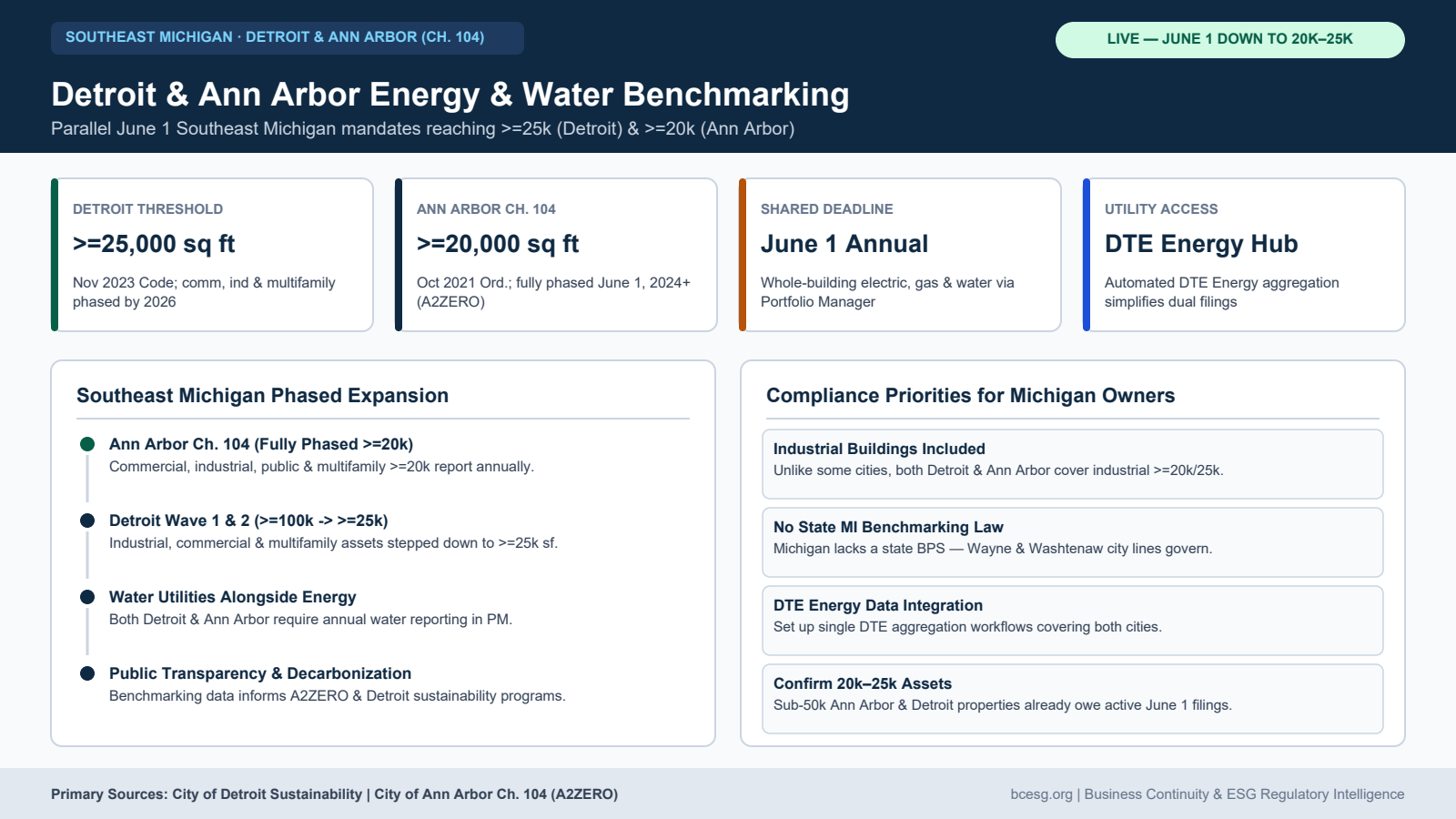
    Short answer: Across Southeast Michigan, commercial, industrial, and multifamily landlords operate inside two closely aligned June 1 municipal transparency mandates: Detroit’s Energy and Water Benchmarking Ordinance (phased down to >=25,000 sq ft across 2024–2026) and Ann Arbor Code Chapter 104 / A2ZERO (fully phased down to >=20,000 sq ft).

    Because Michigan has no statewide building benchmarking law, every statutory obligation rests locally inside Wayne and Washtenaw County municipal lines. Critically, unlike cities that carve out manufacturing and warehouse sheds, both Detroit and Ann Arbor explicitly pull industrial properties into annual June 1 electricity, gas, and water submissions — using shared DTE Energy automated data feeds.

    Statutory Status at a Glance
    • Detroit (>=25,000 sq ft): Enacted Nov 2023; stepped down from >=100k to >=25k commercial, industrial, and multifamily buildings due annually June 1.
    • Ann Arbor Ch. 104 (>=20,000 sq ft): Fully phased June 1, 2024 across commercial, industrial, public, and multifamily properties >=20,000 sq ft.
    • Energy + Municipal Water: Both ordinances pair electricity and gas benchmarking with municipal water consumption in Portfolio Manager.
    • Disclosure Only (No Numeric Caps): Neither Michigan city currently attaches GHG dollar caps or mandatory retro-commissioning cycles.
    Print-First Compliance Brief

    Download the Detroit & Ann Arbor Benchmarking Checklist

    2-page Print-First PDF tracking Detroit (>=25k sf) and Ann Arbor Ch. 104 (>=20k sf) annual June 1 Portfolio Manager energy/water workflows.

    Handling DTE Energy Aggregation & Industrial / Multi-Building Parcels

    Regional logistics centers, R&D labs, and multifamily towers spanning Midtown Detroit, Corktown, and Ann Arbor share DTE Energy’s electric (and in many Ann Arbor parcels, DTE Gas) aggregated benchmarking service. Request whole-building tenant-aggregated CSV/web-service feeds in April so single-building industrial warehouses with triple-net tenant utility meters meet June 1 deadlines without chasing individual tenant invoices.

    • Verify Triple-Net Industrial Leases: Warehouse owners often lack direct tenant gas/electric accounts — use DTE Energy’s landlord whole-building aggregation portal.
    • Track Water Sub-Accounts: Pull Detroit Water & Sewerage Dept. (DWSD) and City of Ann Arbor municipal water logs alongside DTE meters.
    City & CitationThreshold & CoverageAnnual Due DateUtilities Covered
    Detroit (Nov 2023 Code)Comm, ind & multifamily >=25,000 sfAnnual June 1Electricity, gas & municipal water (PM)
    Ann Arbor (Ch. 104 / A2ZERO)Comm, ind, public & multi >=20,000 sfAnnual June 1Electricity, gas & municipal water (PM)
    Southeast Michigan comparison showing Detroit's phased >=25,000 sq ft ordinance and Ann Arbor Code Ch. 104 (>=20,000 sq ft), sharing annual June 1 energy & water reporting.
    Southeast Michigan's dual June 1 Portfolio Manager rules: Detroit (down to >=25k sq ft) and Ann Arbor Ch. 104 (>=20k sq ft) — covering industrial assets too.

    Compliance Execution Checklist

    StepOwner / TeamAuditable Deliverable
    1. Industrial & MF SweepAsset ManagementInclude >=25k Detroit & >=20k Ann Arbor industrial/warehouse/multi assets.
    2. April DTE & Water PullProperty OpsRequest DTE Energy aggregated data + DWSD / Ann Arbor water bills.
    3. June 1 PM SubmissionCompliance LeadShare municipal Portfolio Manager links cleanly before June 1.
    Field & Print Package

    Keep This Detroit & Ann Arbor, MI Compliance Checklist Handy

    Download the formatted 2-page PDF reference brief or pull the structured Markdown edition for internal compliance documentation.

    Frequently Asked Questions

    Are industrial warehouses covered under Detroit and Ann Arbor benchmarking ordinances?

    Yes. Both Detroit (>=25,000 sq ft) and Ann Arbor Ch. 104 (>=20,000 sq ft) cover commercial, industrial, and multifamily buildings annually by June 1.

    What size threshold currently triggers Detroit's benchmarking rule?

    Passed in November 2023 on a 2024–2026 phase-down from >=100,000 sq ft, Detroit's ordinance covers buildings starting at >=25,000 sq ft.

    Primary Authorities & Official Resources

    Informational notice: This guide summarizes enacted statutes, regulations, or pending legislative records from the primary authorities linked above as of November 14, 2026. It is not legal, accounting, or licensed engineering advice.

  • Minneapolis & Edina Building Benchmarking: Coordinating City Rules & MN § 216C.331

    Minneapolis & Edina Building Benchmarking: Coordinating City Rules & MN § 216C.331

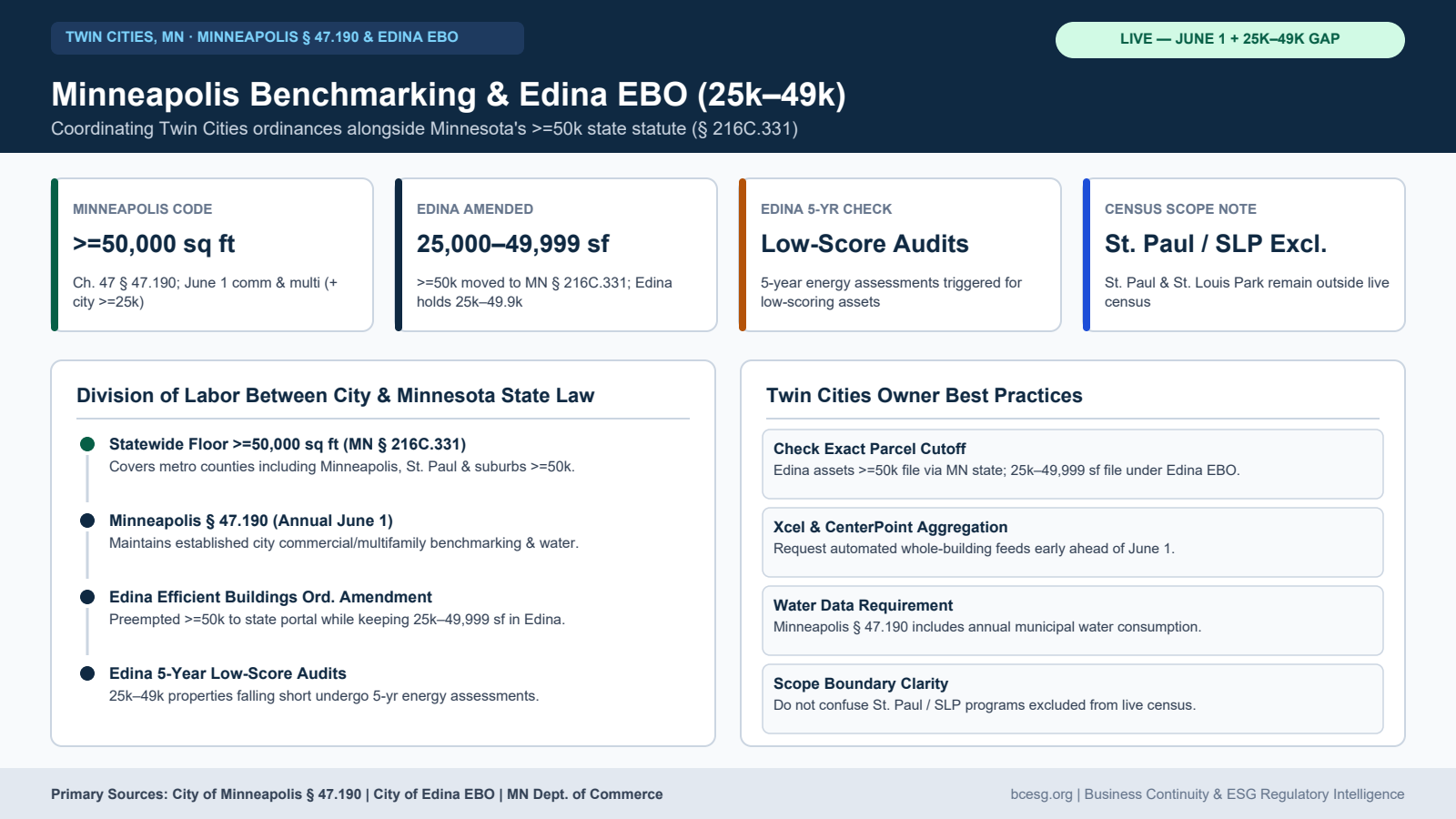
    Short answer: Following Minnesota’s rollout of statewide commercial & multifamily benchmarking (Minn. Stat. § 216C.331, >=50,000 sq ft), the Twin Cities operate an intentionally divided local compliance map on June 1: Minneapolis Code § 47.190 keeps established city-level annual June 1 energy and water filings for >=50k sq ft properties (plus city assets >=25k), whereas Edina amended its Efficient Buildings Ordinance (EBO) to hand >=50k sf buildings to the state while actively regulating mid-market 25,000–49,999 sq ft assets locally.

    In addition, Edina retains a 5-year energy assessment duty specifically for low-performing 25,000–49,999 sq ft properties — creating an efficiency trigger missing from statewide § 216C.331. Other local Twin Cities initiatives such as St. Paul and St. Louis Park remain excluded from live statutory enforcement in BC ESG’s census.

    Statutory Status at a Glance
    • Minneapolis (§ 47.190 — >=50k Private): Commercial and multifamily buildings >=50,000 sq ft (city buildings >=25k sf) submit whole-building Xcel Energy / CenterPoint / city water data annually June 1.
    • Edina EBO (Amended — 25,000–49,999 sq ft): Edina assets >=50k sq ft transition into Minnesota Dept. of Commerce’s statewide June 1 portal; properties 25k–49,999 sq ft stay on Edina’s municipal June 1 + 5-year low-score audit track.
    • Water Data Difference: Minneapolis § 47.190 and Edina EBO include municipal water usage alongside electricity and heating gas.
    Print-First Compliance Brief

    Download the Twin Cities & Minnesota Benchmarking Playbook

    2-page Print-First PDF separating Minneapolis § 47.190, Edina’s amended 25k–49,999 sq ft EBO, and statewide MN § 216C.331 reporting.

    Preventing Portfolio Blind Spots Between 25k–49k Edina & >=50k State Portals

    Commercial real estate teams running metro-wide portfolios often sort Minnesota properties solely by the state’s >=50,000 sq ft floor and miss mid-sized Edina office parks and apartments sitting between 25,000 and 49,999 sq ft. Because Edina shifted only its >=50,000 sq ft cohort over to the state statute, sub-50k buildings along France Avenue and I-494 still owe June 1 Edina EBO benchmarking and face 5-year energy assessments when scores lag benchmarks.

    Meanwhile inside Minneapolis, check both city and Minnesota Commerce submission confirmations each spring so one Portfolio Manager upload satisfies municipal water disclosure and state benchmarking together.

    • Verify Xcel & CenterPoint Feeds: Authorize automated whole-building consumption across both Hennepin County utilities by April 15.
    • Audit Scope Boundary: Treat St. Paul and St. Louis Park as non-enforcing/excluded local entries alongside Minnesota’s statewide >=50k statute.
    Jurisdiction & StatuteCovered Private ThresholdAnnual DeadlineScope Beyond Benchmarking
    Minneapolis (§ 47.190)Comm & multifamily >=50k sf (City >=25k)June 1 annualEnergy + municipal water (syncs w/ MN state)
    Edina EBO (Amended)Comm, multi & public 25,000–49,999 sfJune 1 annualEnergy + water + 5-yr low-score assessments
    Minnesota (§ 216C.331)Metro/greater MN >=50,000 sfJune 1 annualState Commerce benchmarking (absorbs >=50k Edina)
    Twin Cities governance chart showing Minneapolis § 47.190 (>=50k June 1), Edina EBO (amended down to 25k–49,999 sq ft + 5-yr audits), and Minnesota state § 216C.331.
    Twin Cities benchmarking allocation after Minnesota enacted § 216C.331: Minneapolis § 47.190, Edina's 25k–49,999 sq ft focus, and excluded neighbor clarity.

    Compliance Execution Checklist

    StepOwner / TeamAuditable Deliverable
    1. Size-Split Minnesota AssetsAsset ManagementTag Edina 25k–49,999 sq ft separately from >=50,000 sq ft statewide parcels.
    2. June 1 Dual Utility SyncProperty OpsLoad Xcel Energy, CenterPoint & city water feeds in Portfolio Manager.
    3. Edina 5-Yr Score AuditEnergy EngineeringCheck Edina EBO low-score audit triggers for 25k–49,999 sq ft holdings.
    Field & Print Package

    Keep This Minneapolis & Edina, MN Compliance Checklist Handy

    Download the formatted 2-page PDF reference brief or pull the structured Markdown edition for internal compliance documentation.

    Frequently Asked Questions

    Did Minnesota's statewide § 216C.331 law eliminate Edina's benchmarking ordinance?

    No. Edina amended its Efficient Buildings Ordinance so >=50,000 sq ft assets comply through the Minnesota statewide program, while retaining city-level June 1 benchmarking and 5-year low-score assessments for buildings sized 25,000–49,999 sq ft.

    What utilities must be reported in Minneapolis under § 47.190?

    Covered Minneapolis properties >=50,000 sq ft report annual whole-building energy (electric, gas, district systems) and municipal water usage by June 1 via ENERGY STAR Portfolio Manager.

    Primary Authorities & Official Resources

    Informational notice: This guide summarizes enacted statutes, regulations, or pending legislative records from the primary authorities linked above as of November 14, 2026. It is not legal, accounting, or licensed engineering advice.

  • Evanston Healthy Buildings Ordinance & Oak Park Benchmarking Guide (IL)

    Evanston Healthy Buildings Ordinance & Oak Park Benchmarking Guide (IL)

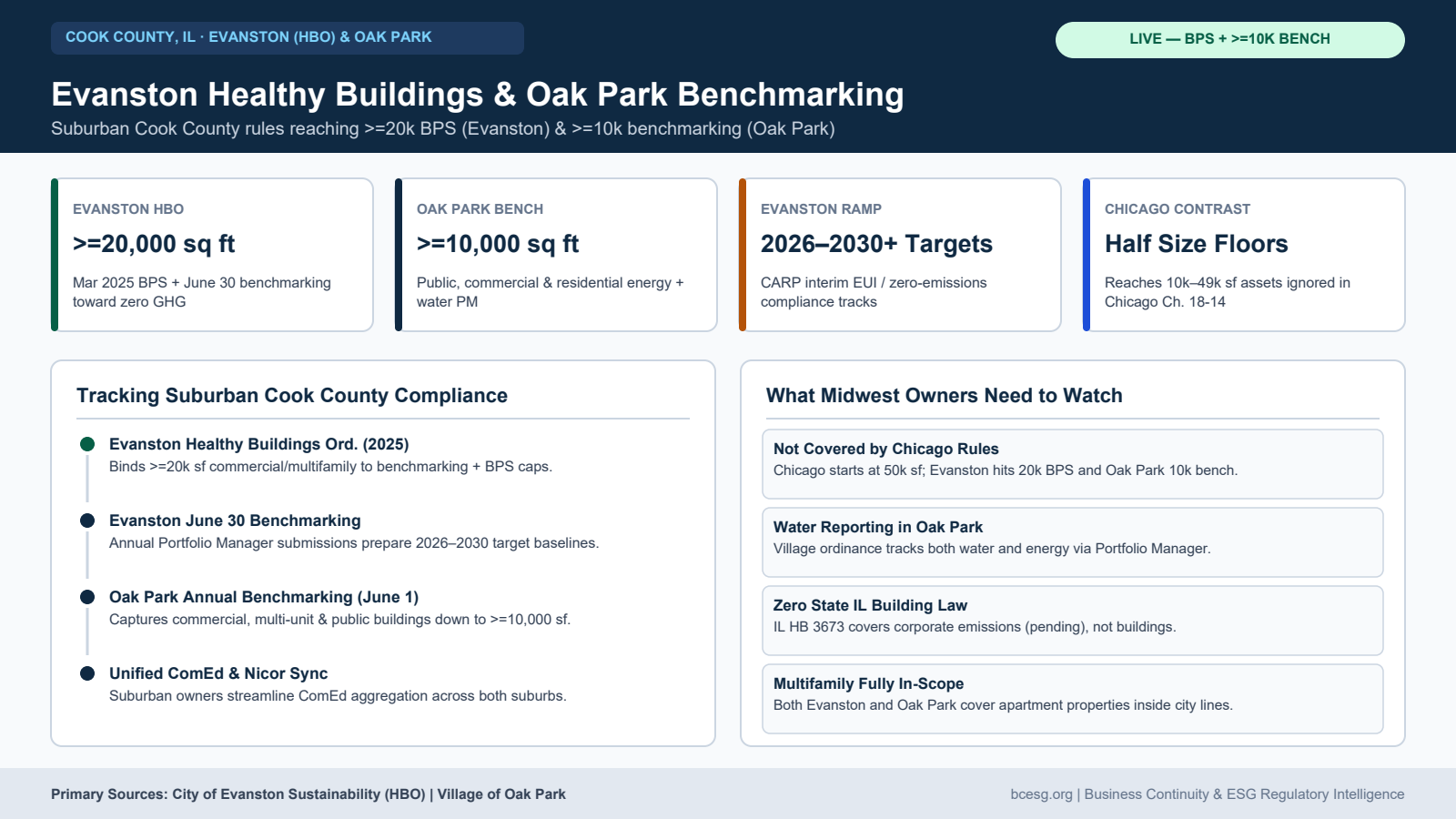
    Short answer: Real estate investors expanding out from downtown Chicago immediately hit two tighter municipal codes inside Cook County: Evanston’s Healthy Buildings Ordinance (HBO) and the Village of Oak Park’s Energy & Water Benchmarking Ordinance. Passed in March 2025, Evanston HBO moves commercial, multifamily, and municipal buildings >=20,000 sq ft from June 30 disclosure into binding 2026–2030+ EUI and zero-emissions targets — Illinois’s first municipal BPS.

    Oak Park simultaneously enforces annual whole-building energy and water benchmarking down to just >=10,000 sq ft across public, commercial, and multi-unit residential properties. Compare suburban obligations against our Chicago Ch. 18-14 Compliance Guide.

    Statutory Status at a Glance
    • Evanston HBO (>=20,000 sq ft): Combines annual June 30 Portfolio Manager benchmarking with phased EUI / zero-emissions BPS targets starting across 2026–2030+ cohorts.
    • Oak Park (>=10,000 sq ft): Lowest size cutoff in Illinois; includes commercial retail strips, offices, and residential apartment buildings >=10k sf reporting energy AND municipal water.
    • Unified ComEd & Nicor Feeds: Automated ComEd electric aggregation covers all three Cook County municipal jurisdictions from one utility portal.
    Print-First Compliance Brief

    Download the Evanston HBO & Oak Park Compliance Reference

    2-page Print-First PDF separating Evanston’s 2025 Healthy Buildings BPS (>=20k sf) from Oak Park’s >=10,000 sq ft energy and water benchmarking rule.

    Transitioning From Benchmarking Into Evanston Healthy Buildings Compliance

    For apartment associations and campus landlords along Chicago Avenue and Davis Street in Evanston, passing the 2025 HBO transformed Portfolio Manager benchmarking from a passive annual spreadsheet into the binding baseline governing 2026–2030+ performance targets. Auditing Nicor Gas heating plant efficiency, domestic hot water electrification schedules, and clean-energy sourcing early protects multifamily operating budgets.

    Meanwhile in Oak Park, condo boards and neighborhood commercial owners >=10,000 sq ft must verify municipal water billing alongside ComEd/Nicor meters ahead of annual filings.

    • Verify Thresholds Across Multi-Unit Buildings: Even 8- to 12-unit vintage brick courtyards easily cross Oak Park’s 10,000 sq ft gross area rule.
    • Track Evanston HBO Cohort Windows: Separate immediate >=50k/100k interim onboarding timelines from 20k–49k phased BPS dates.
    MunicipalityCovered ScopeAnnual FilingCore Standard Beyond Disclosure
    Evanston (HBO + Bench)Comm, multi & city >=20,000 sfJune 30 annual PMPhased 2026–2030+ EUI / zero-emissions BPS
    Oak Park (Benchmarking)Public, comm & res >=10,000 sfAnnual June 1 / Village cycleWhole-building energy + water Portfolio Mgr
    Comparison of Evanston Healthy Buildings Ordinance (>=20,000 sq ft BPS + June 30 benchmarking) and Oak Park Energy & Water Benchmarking (>=10,000 sq ft).
    Cook County suburbs outpacing Chicago's 50k floor: Evanston's 2025 Healthy Buildings BPS (>=20k sf) and Oak Park's >=10k sq ft benchmarking mandate.

    Compliance Execution Checklist

    StepOwner / TeamAuditable Deliverable
    1. Small-Building AuditProperty OpsFlag 10k–49k Cook County holdings inside Oak Park (>=10k) & Evanston (>=20k).
    2. ComEd / Nicor + WaterFacility / OpsAuthorize whole-building ComEd, Nicor Gas & Oak Park water uploads.
    3. Evanston 2026–30 CapExAsset / EngineeringAssess boiler electrification / EUI gaps against Evanston HBO milestones.
    Field & Print Package

    Keep This Evanston & Oak Park, IL Compliance Checklist Handy

    Download the formatted 2-page PDF reference brief or pull the structured Markdown edition for internal compliance documentation.

    Frequently Asked Questions

    How does Evanston's Healthy Buildings Ordinance affect multifamily owners?

    Passed in March 2025, Evanston HBO covers commercial, multifamily, and municipal buildings >=20,000 sq ft, pairing annual June 30 benchmarking with phased 2026–2030+ EUI and zero-emissions compliance requirements.

    What threshold triggers Oak Park's energy and water benchmarking ordinance?

    Oak Park applies annually down to >=10,000 sq ft across public, commercial, and residential buildings, requiring both energy and municipal water data in ENERGY STAR Portfolio Manager.

    Primary Authorities & Official Resources

    Informational notice: This guide summarizes enacted statutes, regulations, or pending legislative records from the primary authorities linked above as of November 14, 2026. It is not legal, accounting, or licensed engineering advice.

  • Chicago Energy Benchmarking Guide: June 1 Filings, 3-Yr Verification & 0–4 Star Placards

    Chicago Energy Benchmarking Guide: June 1 Filings, 3-Yr Verification & 0–4 Star Placards

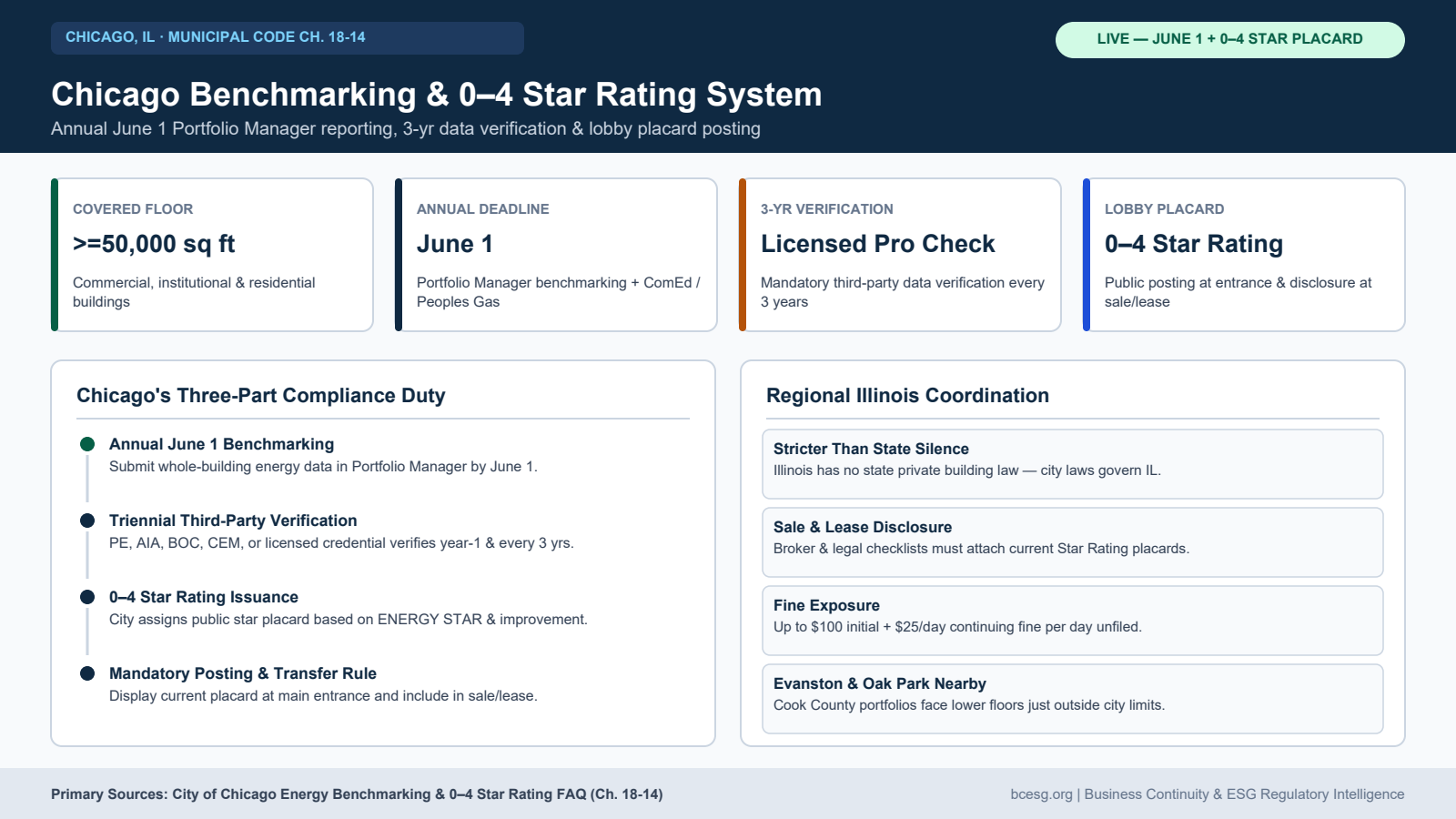
    Short answer: Under Municipal Code of Chicago Chapter 18-14, Loop skyscrapers, industrial-converted lofts, and residential towers >=50,000 sq ft comply with a three-layer transparency regime: annual June 1 ENERGY STAR Portfolio Manager submissions, triennial third-party professional data verification, and mandatory physical posting — plus sale and lease transaction disclosure — of Chicago’s 0–4 Star Energy Rating placard.

    Because Illinois maintains no statewide building benchmarking law (proposed Illinois HB 3673 targets corporate Scope 1/2/3 disclosures only), real estate obligations cluster locally in Chicago (>=50k sf) and neighboring Cook County suburbs covered in our Evanston HBO & Oak Park Benchmarking Guide.

    Statutory Status at a Glance
    • Covered Scope (>=50,000 sq ft): All commercial, institutional, and multifamily residential buildings >=50k sq ft inside Chicago.
    • Triennial Licensed Verification: Every three years (and first reporting year), an Illinois-licensed architect, professional engineer (PE), Certified Energy Manager (CEM), BOC, or ASHRAE BEAP must sign the Portfolio Manager Data Verification Checklist.
    • 0–4 Star Rating System: Based on ENERGY STAR 1–100 score (or two-year improvement points), scored out of 4 stars and printed as a municipal placard required in visible entrance lobbies and real-estate sale/lease listings.
    • ComEd & Peoples Gas Sync: Automated whole-building aggregated utility reporting streamlines multi-tenant residential condominium and commercial office uploads ahead of June 1.
    Print-First Compliance Brief

    Download the Chicago Benchmarking & Star Rating Checklist

    2-page Print-First PDF detailing Chicago MCC Ch. 18-14 June 1 filings, 3-year PE/CEM/AIA verification rules, and 0–4 Star lobby/lease placard rules.

    Handling Triennial Data Verification & 0–4 Star Placard Sales Disclosures

    Commercial buyers and leasing counsel routinely catch sellers forgetting Chicago’s two secondary duties under Ch. 18-14: properties must display their current-year 0–4 Star placard at the main public entrance AND include the rating inside sale contracts and tenant lease materials. Even a timely June 1 upload draws administrative notices if the building skipped its required 3-year credentialed verifier stamp.

    Confirm your Chicago Energy Benchmarking ID year-in/year-out whether this calendar year sits on a verification cycle (years divisible by three from initial cohort compliance) and ensure Condo Association (HOA) boards retain copies in annual ownership packs.

    • Score Optimization Ahead of June 1: Audit operating hours, server-room square footage, and vacant spaces inside Portfolio Manager — correcting under-counted occupancy boosts ENERGY STAR star tiers legitimately.
    • Sale/Lease Contract Clause: Attach the PDF Star Rating certificate in every Loop commercial lease rider and condo disclosure package.
    Ch. 18-14 RequirementCovered BuildingsCadence / DeadlineVerification & Posting Duty
    Benchmarking FilingComm, inst & res >=50k sfAnnual June 1Portfolio Manager whole-building energy
    3rd-Party VerificationAll >=50k covered parcelsEvery 3 years (+ yr 1)Signed by PE, AIA, CEM, BOC, or approved pro
    0–4 Star Rating PlacardAll >=50k covered parcelsUpdated annually post-filingPost in public entrance + share in sale/leases
    Compliance architecture of Municipal Code of Chicago Ch. 18-14 covering >=50,000 sq ft annual June 1 benchmarking, triennial licensed data verification, and 0-4 Star lobby placard posting.
    Chicago Energy Benchmarking (MCC Ch. 18-14): annual June 1 reporting, triennial professional verification, and mandatory 0–4 Star lobby placards.

    Compliance Execution Checklist

    StepOwner / TeamAuditable Deliverable
    1. ComEd & Peoples Gas PullProperty OpsSync automated whole-building utility intervals in Portfolio Manager by April 15.
    2. 3-Yr Verification CheckCompliance / PECheck Chicago ID year cycle; engage PE/CEM/AIA verifier before June 1 if due.
    3. Placard & Lease RiderBuilding Mgr / CounselDownload updated 0–4 Star placard, frame in lobby & attach to leasing packets.
    Field & Print Package

    Keep This Chicago, IL Compliance Checklist Handy

    Download the formatted 2-page PDF reference brief or pull the structured Markdown edition for internal compliance documentation.

    Frequently Asked Questions

    Do Chicago buildings need third-party verification every year under Ch. 18-14?

    No. Annual June 1 Portfolio Manager reporting is required every year, while third-party verification by a qualified licensed professional (PE, AIA, CEM, BOC, etc.) is required in year one and every three years thereafter.

    Where must Chicago's 0–4 Star Energy Rating placard be posted?

    Covered buildings >=50,000 sq ft must display the municipal 0–4 Star placard in a prominent location at the building's public entrance and disclose the rating upon sale or commercial/residential lease.

    Primary Authorities & Official Resources

    Informational notice: This guide summarizes enacted statutes, regulations, or pending legislative records from the primary authorities linked above as of November 14, 2026. It is not legal, accounting, or licensed engineering advice.

  • Kansas City Energy Empowerment Ordinance (EEO): May 1 Benchmarking Guide

    Kansas City Energy Empowerment Ordinance (EEO): May 1 Benchmarking Guide

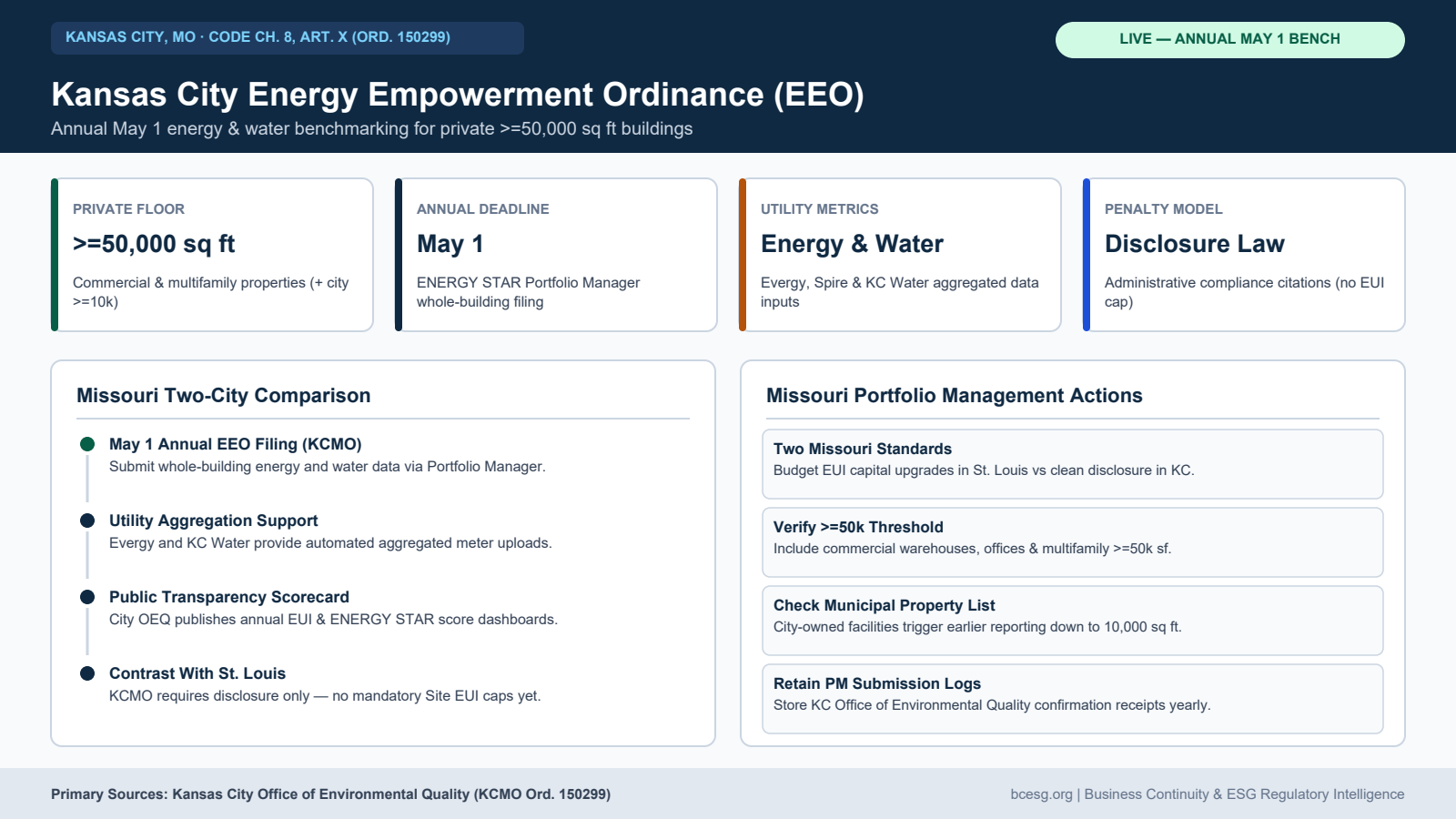
    Short answer: Under Kansas City’s Energy Empowerment Ordinance (EEO, Code Ch. 8, Art. X / Ord. 150299), owners of private commercial and multifamily buildings >=50,000 gross sq ft must report whole-building energy and municipal water usage every May 1 via EPA’s ENERGY STAR Portfolio Manager to the KCMO Office of Environmental Quality.

    Missouri enforces no statewide building energy benchmarking statute, leaving Kansas City’s EEO (benchmarking only) and St. Louis’s binding BEPS targets as the state’s two primary municipal reporting regimes. Property managers active across both metros should synchronize spring meter pulls in March so Portfolio Manager updates cover May 1 deadlines in both Missouri cities cleanly.

    Statutory Status at a Glance
    • Covered Thresholds: Commercial & multifamily buildings >=50,000 sq ft (and municipal buildings >=10,000 sq ft).
    • Energy + Water Scope: Includes Evergy electricity, Spire natural gas, district steam/chilled water, and KC Water consumption.
    • May 1 Annual Cadence: Shared reporting links submitted yearly; City OEQ publishes aggregate performance dashboards for transparency.
    Print-First Compliance Brief

    Download the Kansas City EEO Benchmarking Sheet

    2-page Print-First PDF covering KCMO Code Ch. 8 Art. X (>=50k private / >=10k city), May 1 Portfolio Manager rules, and Evergy/KC Water setup.

    Automating Evergy & KC Water Aggregation Ahead of May 1

    Multi-tenant office towers on the Country Club Plaza or apartment complexes across Jackson, Clay, and Platte Counties inside KCMO limits rely on Evergy and KC Water automated meter uploads to eliminate manual bill entry. Verify KCMO Building IDs against County property tax parcels early — multi-building garden complexes sharing one tax parcel can trigger >=50,000 sq ft aggregate reporting even when individual walk-up buildings sit smaller.

    • Verify Exempt Industrial Carve-Outs: Confirm manufacturing process exclusions carefully against OEQ definitions before skipping filings.
    • Maintain Receipt Archive: Keep OEQ confirmation emails verifying May 1 Portfolio Manager link acceptance.
    AttributePrivate Real Estate RuleMunicipal Asset Rule
    Covered ThresholdCommercial & multifamily >=50,000 sfCity-owned facilities >=10,000 sf
    Annual DeadlineMay 1 (Portfolio Manager)May 1 (Portfolio Manager)
    Required UtilitiesWhole-building energy + KC WaterWhole-building energy + KC Water
    Overview of Kansas City Code Ch. 8 Art. X Energy Empowerment Ordinance covering >=50,000 sq ft commercial & multifamily annual May 1 energy/water reporting.
    Kansas City Energy Empowerment Ordinance (KCMO Code Ch. 8, Art. X): annual May 1 energy and water disclosure covering private assets >=50k sq ft.

    Compliance Execution Checklist

    StepOwner / TeamAuditable Deliverable
    1. Parcel List ConfirmAsset ManagementMatch properties >=50,000 sq ft to KCMO EEO Covered Buildings List IDs.
    2. Utility Portal PullProperty OpsGather Evergy, Spire & KC Water aggregated whole-building feeds by April 1.
    3. May 1 PM SubmissionCompliance LeadShare validated Portfolio Manager template to KCMO OEQ and save receipt.
    Field & Print Package

    Keep This Kansas City, MO Compliance Checklist Handy

    Download the formatted 2-page PDF reference brief or pull the structured Markdown edition for internal compliance documentation.

    Frequently Asked Questions

    Are multifamily apartment properties included in Kansas City's EEO ordinance?

    Yes. KCMO Code Ch. 8, Art. X covers both commercial and multifamily residential buildings >=50,000 sq ft (and city buildings >=10,000 sq ft).

    Does Kansas City require water consumption in annual May 1 filings?

    Yes. Covered buildings report whole-building electricity, fuel, and KC Water consumption via ENERGY STAR Portfolio Manager by May 1 annually.

    Primary Authorities & Official Resources

    Informational notice: This guide summarizes enacted statutes, regulations, or pending legislative records from the primary authorities linked above as of November 14, 2026. It is not legal, accounting, or licensed engineering advice.

  • St. Louis BEPS Guide: Ord. 71132 Site EUI Targets, Extensions & May 1 Benchmarking

    St. Louis BEPS Guide: Ord. 71132 Site EUI Targets, Extensions & May 1 Benchmarking

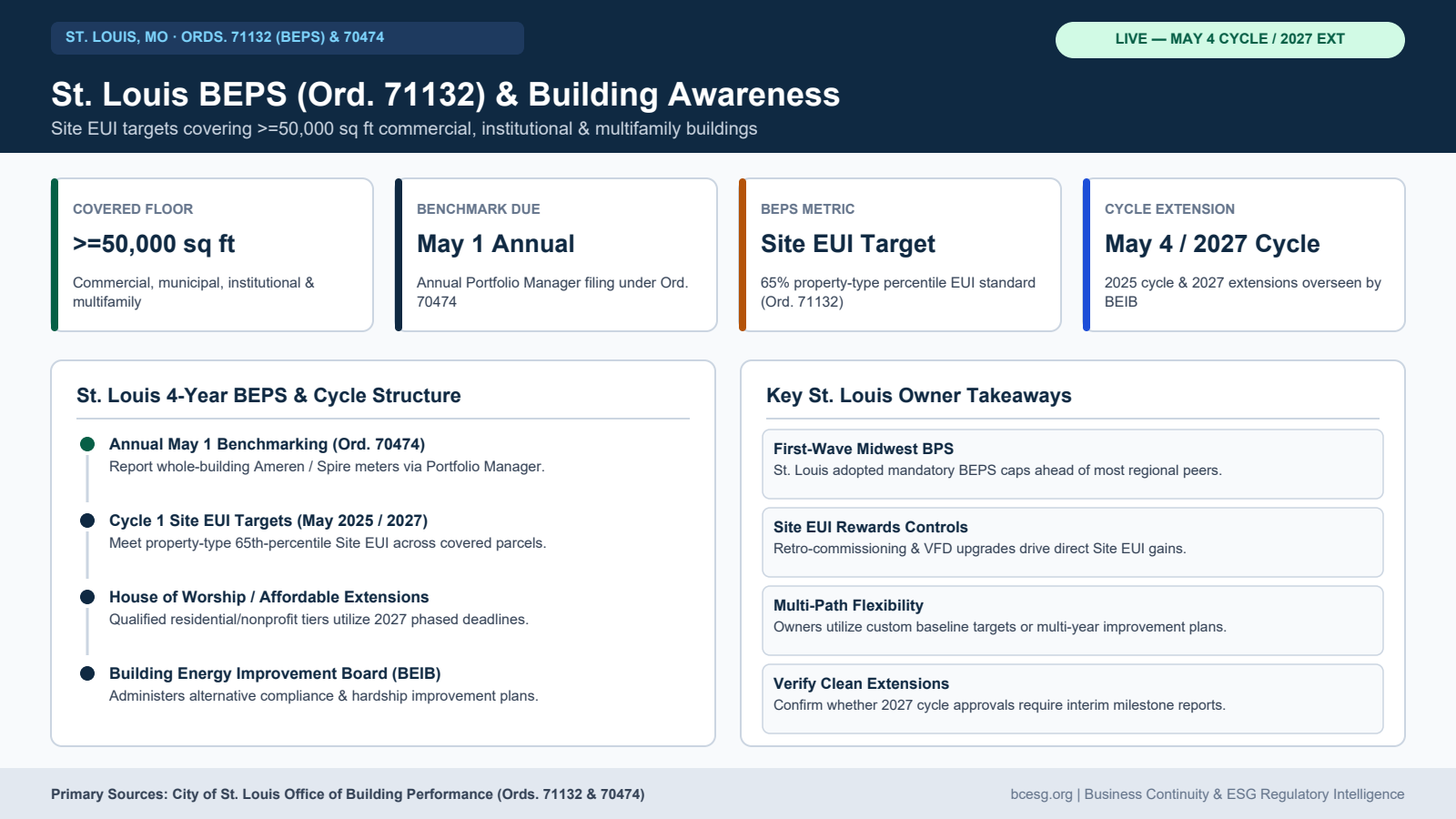
    Short answer: St. Louis operates the Midwest’s earliest active municipal Building Energy Performance Standard. Administered by the Office of Building Performance and the Building Energy Improvement Board (BEIB), Ordinance 71132 (BEPS) and Ordinance 70474 (Building Energy Awareness) govern commercial, institutional, municipal, and multifamily properties >=50,000 sq ft through annual May 1 ENERGY STAR Portfolio Manager filings and repeating 4-year Site EUI reduction cycles.

    Because St. Louis benchmarks property compliance directly on Site EUI (kBtu/sq ft) rather than off-site renewable energy certificates, HVAC optimization, chiller/boiler controls, and heat-pump upgrades generate direct Site EUI improvements — creating an entirely different capital playbook than Missouri peer Kansas City’s disclosure-only Energy Empowerment Ordinance.

    Statutory Status at a Glance
    • Covered Scope (>=50,000 sq ft): Commercial offices, retail, institutional/university properties, city facilities, and multifamily apartments >=50k gross sq ft.
    • Annual May 1 Benchmarking (Ord. 70474): Ameren Missouri electricity, Spire natural gas, and municipal steam feeds reported annually via Portfolio Manager.
    • 4-Year Site EUI Standards (Ord. 71132): Cycle 1 targets hit May 4, 2025 across standard commercial cohorts, with qualifying affordable residential, non-profit/worship, and BEIB-approved extension plans running through May 2027.
    • Alternate Compliance Options: Custom baseline targets, multi-building portfolio pathways, and BEIB-approved multi-year Building Improvement Plans for assets facing capital constraints.
    Print-First Compliance Brief

    Download the St. Louis BEPS & Awareness Reference

    2-page Print-First PDF tracking St. Louis Ord. 71132 4-year Site EUI targets (>=50k sq ft), Ord. 70474 May 1 benchmarking, and 2027 BEIB extension paths.

    BEIB Extension Paths, Alternative Compliance & Mixed-Use Verification

    For >=50,000 sq ft buildings that missed initial Cycle 1 Site EUI goals or carry qualifying affordable/nonprofit extensions running into 2027, early engagement with the Building Energy Improvement Board is decisive. Owners applying for Custom Baselines (e.g., data centers, labs, or 24/7 clinical healthcare) or phased multi-year improvement plans must preserve uninterrupted May 1 benchmarking records so verified Site EUI drops count cleanly.

    Confirm Ameren Missouri and Spire whole-building meter coverage before May 1 each spring — missing tenant sub-meters skew Portfolio Manager Site EUI downward on paper or trigger false noncompliance notices.

    • Verify Cycle 1 vs. 2027 Cohort Status: Confirm on the BEIB portal whether your tax parcel operates under standard Cycle 1 review or a May 2027 extension.
    • No Offset Escape Hatch: Purchasing off-site RECs does not reduce Weather-Normalized Site EUI under St. Louis Ord. 71132.
    Ordinance & CycleCovered ScopeDeadline / CadenceCompliance Metric
    Building Energy Awareness (Ord. 70474)Commercial, inst & multifamily >=50k sfAnnual May 1ENERGY STAR Portfolio Manager disclosure
    St. Louis BEPS Cycle 1 (Ord. 71132)Commercial, inst & multifamily >=50k sfMay 2025 / May 2027 extProperty-type Site EUI targets (65% baseline)
    Compliance structure of St. Louis BEPS (Ord. 71132) and Building Energy Awareness (Ord. 70474): >=50,000 sq ft May 1 benchmarking and 4-year Site EUI reduction cycles.
    St. Louis building mandates (Ords. 71132 & 70474): annual May 1 Portfolio Manager disclosures plus 4-year Site EUI performance targets overseen by the BEIB.

    Compliance Execution Checklist

    StepOwner / TeamAuditable Deliverable
    1. Parcel Target LookupCompliance / OpsVerify building property-type Site EUI goal & 2025/2027 status on BEIB portal.
    2. Annual May 1 FilingProperty ManagerSubmit Ameren/Spire whole-building PM uploads before May 1 cutoff.
    3. BEIB Path DocumentationEngineering / LegalFile ASHRAE/RCx proof or Alternative Compliance Plan where Site EUI lags.
    Field & Print Package

    Keep This St. Louis, MO Compliance Checklist Handy

    Download the formatted 2-page PDF reference brief or pull the structured Markdown edition for internal compliance documentation.

    Frequently Asked Questions

    How does St. Louis BEPS differ from Kansas City's building energy ordinance?

    St. Louis enforces mandatory 4-year Site EUI performance targets (Ord. 71132) alongside annual May 1 benchmarking (Ord. 70474), whereas Kansas City's EEO mandates annual May 1 energy/water benchmarking only without numeric performance limits.

    Can renewable energy certificates satisfy St. Louis BEPS targets?

    No. St. Louis Ord. 71132 measures Weather-Normalized Site EUI (kBtu/sq ft), requiring actual building energy efficiency improvements or qualifying BEIB alternative compliance pathways.

    Primary Authorities & Official Resources

    Informational notice: This guide summarizes enacted statutes, regulations, or pending legislative records from the primary authorities linked above as of November 14, 2026. It is not legal, accounting, or licensed engineering advice.

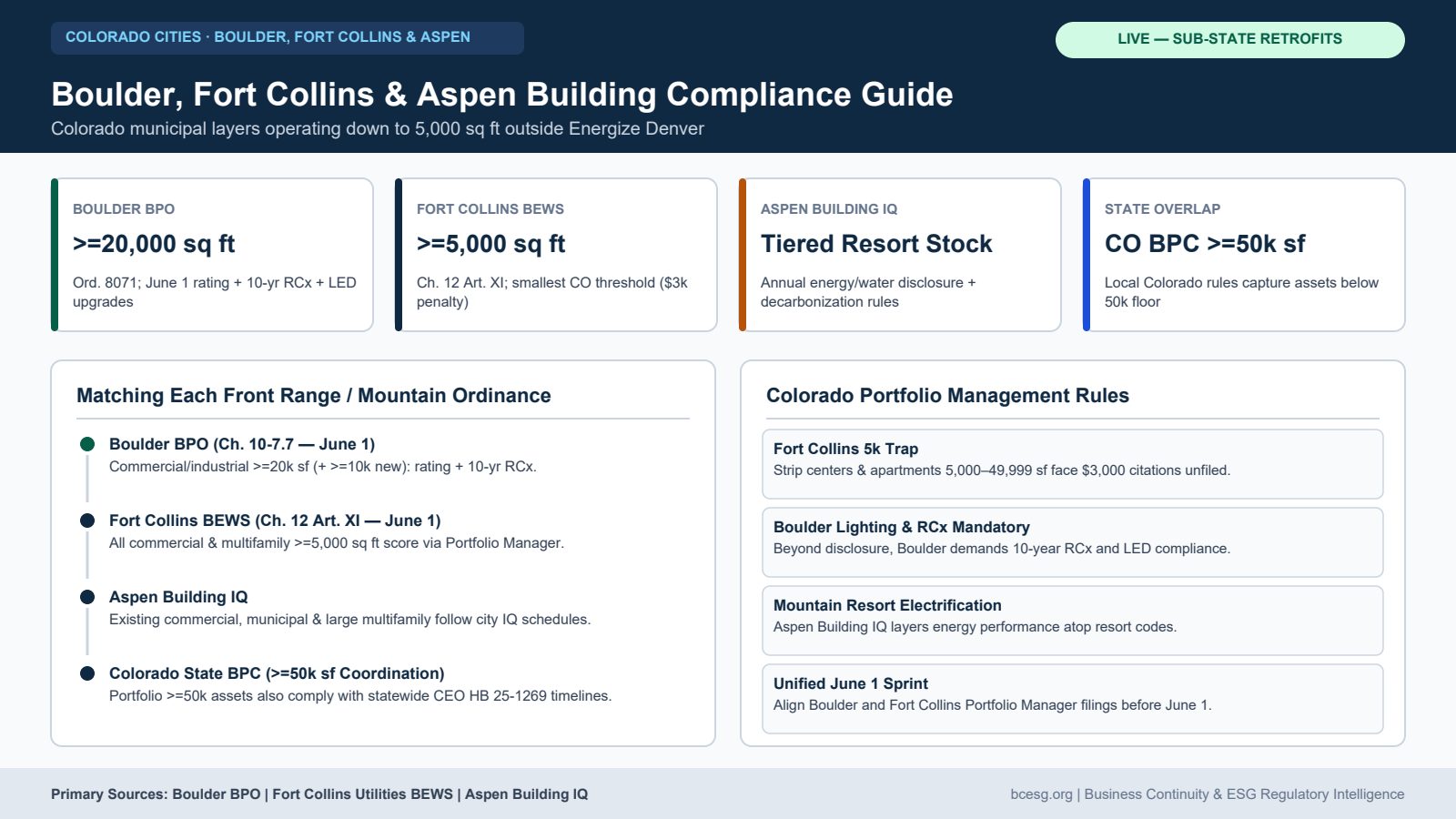
  • Boulder BPO, Fort Collins BEWS & Aspen Building IQ: Colorado Municipal Compliance Guide

    Boulder BPO, Fort Collins BEWS & Aspen Building IQ: Colorado Municipal Compliance Guide

    Short answer: Real estate investors tracking Colorado strictly through statewide Building Performance Colorado (BPC >=50,000 sq ft) and Energize Denver frequently miss three vigorous municipal ordinances along the Northern Front Range and Roaring Fork Valley: Boulder BPO (Ch. 10-7.7), Fort Collins BEWS (Ch. 12 Art. XI), and Aspen Building IQ.

    Most notably, Fort Collins extends annual June 1 energy and water benchmarking all the way down to >=5,000 sq ft commercial and multifamily buildings — backing noncompliance with citations up to $3,000 — while Boulder enforces binding 10-year energy assessments, retro-commissioning (RCx), and prescriptive LED lighting upgrades at >=20,000 sq ft.

    Statutory Status at a Glance
    • Boulder BPO (Ch. 10-7.7 — >=20k sf Comm/Ind): Annual June 1 benchmarking, one-time interior/exterior LED upgrades, and repeating 10-year ASHRAE Level II assessments & retro-commissioning; industrial warehouses >=20k included.
    • Fort Collins BEWS (Ch. 12, Art. XI — >=5k sf Comm & Multi): Smallest benchmarking footprint in Colorado; covers electric and municipal water scoring via Fort Collins Utilities by June 1 annually.
    • Aspen Building IQ (Commercial, Municipal & Large Multi): Combines annual energy/water reporting via CORE/City of Aspen with phased building performance improvement requirements.
    • CO BPC Synchronization: Properties >=50,000 sq ft across Boulder, Larimer, and Pitkin Counties satisfy both local city rules and statewide CO BPC (HB 25-1269) Site EUI/GHG compliance.
    Print-First Compliance Brief

    Download the Boulder, Fort Collins & Aspen Compliance Guide

    2-page Print-First PDF separating Boulder’s 10-yr RCx/LED duties, Fort Collins’s >=5k threshold, and Aspen Building IQ schedules alongside CO BPC.

    Catching Small Commercial Properties & Boulder RCx/LED Cycles Early

    Regional strip retail centers, medical suites, and suburban multifamily complexes between 5,000 and 49,999 sq ft fall cleanly outside Colorado’s statewide BPC (>=50k) — yet inside Fort Collins BEWS (>=5k), Boulder BPO (>=20k), or Aspen Building IQ. Because Fort Collins Utilities operates both electric and water distribution directly, missing a June 1 BEWS upload triggers swift utility-cross-referenced compliance notices.

    In Boulder, asset managers buying older industrial or commercial stock must confirm during diligence whether the prior owner already signed off one-time BPO LED lighting upgrades and current 10-year RCx filings, avoiding inherited compliance backlogs.

    • Check Municipal Utility Feeds: Fort Collins Utilities (City-run) and Xcel Energy (Boulder) use distinct Portfolio Manager aggregation workflows.
    • Verify Aspen Building IQ Schedule: Resort hospitality and multi-unit lodges in Aspen should confirm cohort timelines directly with Aspen / CORE staff.
    City & CitationThresholdAnnual TimingMandates Beyond Benchmarking
    Boulder BPO (Ch. 10-7.7)Comm & ind >=20k sf (+ >=10k new)Annual June 110-yr ASHRAE audits/RCx + LED lighting upgrades
    Fort Collins BEWS (Ch. 12 Art. XI)Comm & multifamily >=5,000 sfAnnual June 1Benchmarking + public scoring ($3k fine risk)
    Aspen Building IQExisting comm, municipal & large multiAnnual scheduleBenchmarking + decarb / efficiency improvements
    Colorado municipal compliance matrix comparing Boulder BPO (>=20k June 1 + 10-yr RCx/LED), Fort Collins BEWS (>=5k June 1 + $3k fine), and Aspen Building IQ.
    Three Colorado municipal ordinances reaching far below Colorado BPC's >=50,000 sq ft floor — down to 5,000 sq ft in Fort Collins.

    Compliance Execution Checklist

    StepOwner / TeamAuditable Deliverable
    1. Sub-50k Colorado SweepAsset ManagementFlag >=5k Fort Collins, >=20k Boulder & covered Aspen properties.
    2. Utility Portal IntegrationProperty OpsConnect Xcel Energy (Boulder), Fort Collins Utilities, and Holy Cross/Black Hills (Aspen).
    3. Boulder LED / RCx StatusEngineering / LegalConfirm Ch. 10-7.7 one-time LED signoff & 10-yr RCx cycle records at diligence.
    Field & Print Package

    Keep This Boulder, Fort Collins & Aspen, CO Compliance Checklist Handy

    Download the formatted 2-page PDF reference brief or pull the structured Markdown edition for internal compliance documentation.

    Frequently Asked Questions

    Why does Fort Collins BEWS apply to much smaller buildings than Colorado BPC?

    While Colorado statewide BPC starts at 50,000 sq ft, Fort Collins Municipal Code Ch. 12, Art. XI covers commercial and multifamily properties >=5,000 sq ft due to direct Fort Collins municipal utility integration.

    What does Boulder BPO require besides annual benchmarking?

    Boulder BPO (Ord. 8071 / Ch. 10-7.7) mandates 10-year energy assessments and retro-commissioning (RCx) alongside verified one-time LED lighting upgrades for buildings >=20,000 sq ft.

    Primary Authorities & Official Resources

    Informational notice: This guide summarizes enacted statutes, regulations, or pending legislative records from the primary authorities linked above as of November 14, 2026. It is not legal, accounting, or licensed engineering advice.

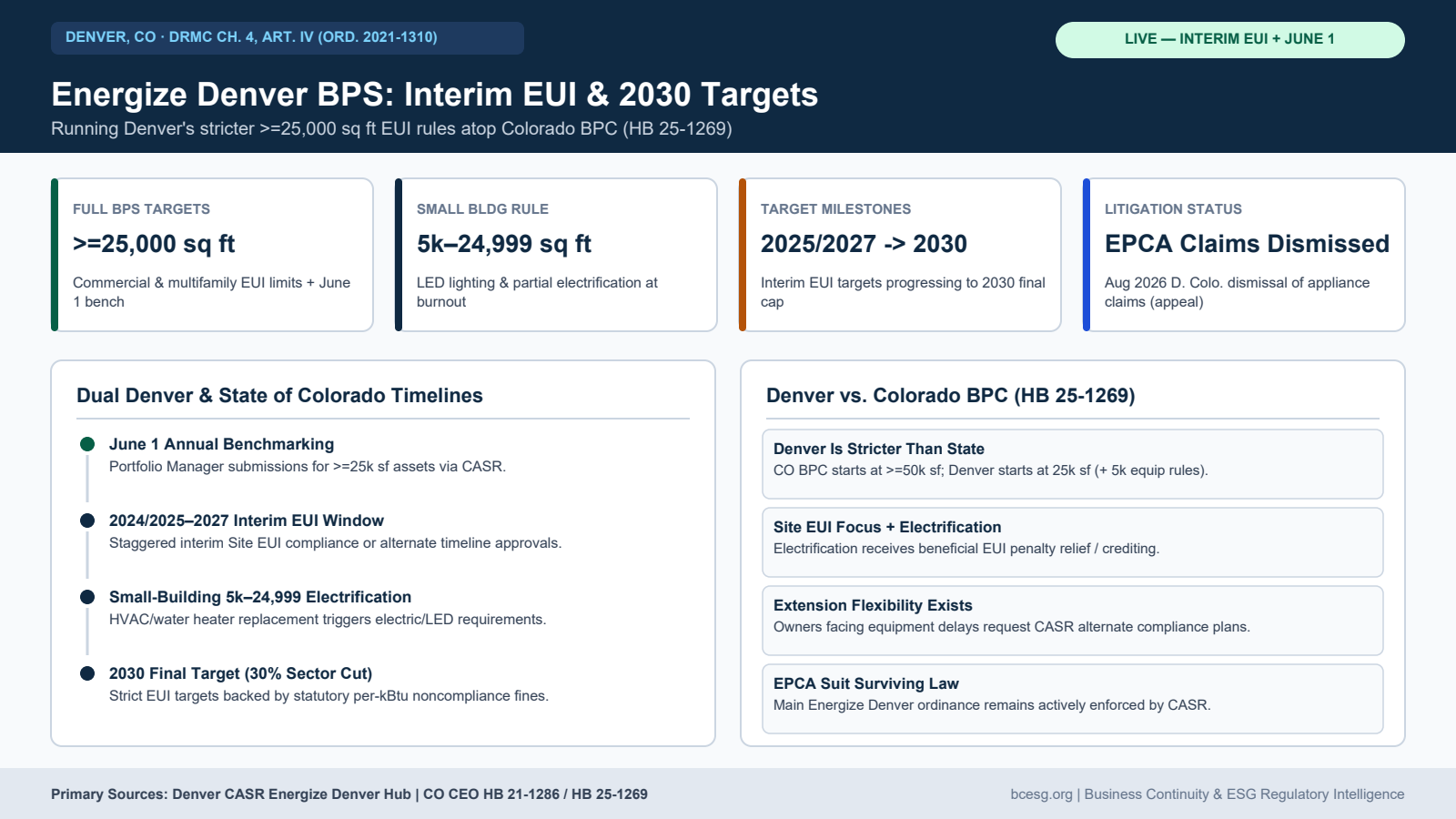
  • Energize Denver BPS Guide: Interim EUI Deadlines, 5k–25k Rules & CO BPC Overlap

    Energize Denver BPS Guide: Interim EUI Deadlines, 5k–25k Rules & CO BPC Overlap

    Short answer: Commercial and multifamily owners in the City and County of Denver operate under a stricter local performance standard sitting directly on top of Colorado’s statewide Building Performance Colorado (BPC, HB 25-1269) program. Enforced by CASR under Energize Denver (DRMC Ch. 4, Art. IV / Ord. 2021-1310), buildings >=25,000 sq ft must file annual June 1 benchmarking while steering through active 2025–2027 interim Site EUI compliance toward mandatory 2030 final EUI targets.

    Even smaller retail strip centers, restaurants, and apartment blocks from 5,000 to 24,999 sq ft face mandatory LED lighting compliance and electric-heat equipment standards upon burnout. Following the federal district court’s August 2026 dismissal of certain EPCA preemption counts in Restaurant Law Center v. City & County of Denver (appeals pending), CASR continues enforcing interim compliance paths and penalty determinations.

    Statutory Status at a Glance
    • Large Building EUI Targets (>=25,000 sq ft): Interim 2024/2025 (with CASR timeline extensions through 2026–2027 where granted) culminating in a ~30% sector-wide EUI cut by 2030.
    • Small-Building Mandate (5,000–24,999 sq ft): No annual benchmarking, but prescriptive LED upgrades plus electrification requirements at mechanical/water-heating replacement.
    • Denver vs. CO BPC Scope Floor: Colorado BPC starts at >=50,000 sq ft statewide; Energize Denver captures 25k–49,999 sq ft full EUI targets (plus 5k–24k burnout triggers) and enforces stricter final intensity numbers.
    • Electrification Credit Advantage: Properties completing qualifying full-building electrification or rooftop/community solar receive EUI-equivalent credits under CASR rules.
    Print-First Compliance Brief

    Download the Energize Denver BPS & CO BPC Reference

    2-page Print-First PDF tracking Energize Denver interim/2030 EUI targets, 5k–24k burnout triggers, Aug 2026 litigation update, and CO state BPC.

    Navigating Interim Extensions, Electrification Credits & State Overlap

    Denver allows covered >=25,000 sq ft owners facing HVAC equipment supply constraints or lease-rollover friction to apply to CASR for timeline adjustments or alternate compliance paths — moving interim targets smoothly if tied to verified capital plans. Waiting passively for litigation relief carries high risk: Energize Denver’s primary Site EUI benchmark structure remains live while federal appellate briefing proceeds.

    Because both Energize Denver and Colorado BPC (HB 25-1269) collect Xcel Energy whole-building datasets in Portfolio Manager, >=50,000 sq ft Denver assets should submit a unified June 1 Portfolio Manager file clearing both state and municipal dashboards at once.

    • Check Penalty Differential: Non-compliance penalties run up to $0.70/kBtu beyond interim/final EUI gaps — modeling heat-pump electrification credits vs. penalties is essential.
    • Verify Alternate Compliance Window: Properties granted interim extensions must deliver milestone documentation per CASR approval letters.
    Tier & CodeCovered ScopeTimeline / MilestonesKey Mechanics
    Large Bldgs (>=25k sf)Commercial & multifamily >=25k sfAnnual June 1; 2025/27 interim -> 2030Site EUI limits; elec credits; alternate timelines
    Small Bldgs (5k–24.9k)Commercial & multifamily 5k–24.9k sfTriggered at equip burnout / scheduleLED upgrades + heat-pump equip transition
    CO BPC Overlay (>=50k sf)Colorado state >=50k sf tierActive state reporting + 2026/2030State HB 25-1269 coordination (less strict floor)
    Timeline of Energize Denver BPS covering >=25,000 sq ft interim/2030 EUI limits, 5k–24,999 sq ft equipment replacement rules, EPCA litigation status, and CO state BPC alignment.
    Energize Denver (DRMC Ch. 4, Art. IV): 25k+ Site EUI limits, 5k–24,999 burnout rules, surviving federal EPCA challenge, and CO HB 25-1269 coordination.

    Compliance Execution Checklist

    StepOwner / TeamAuditable Deliverable
    1. CASR Target Status CheckCompliance / LegalConfirm interim 2025–2027 target or active alternate compliance letter on Denver hub.
    2. June 1 Dual FilingProperty OpsSync Xcel Energy meters for Energize Denver and CO BPC (>=50k sf) simultaneously.
    3. 5k–24k Capital ProtocolFacility ManagerFlag rooftop HVAC / water heater replacements in small Denver properties for spec check.
    Field & Print Package

    Keep This Denver, CO Compliance Checklist Handy

    Download the formatted 2-page PDF reference brief or pull the structured Markdown edition for internal compliance documentation.

    Frequently Asked Questions

    Did the Restaurant Law Center lawsuit pause Energize Denver?

    No. In August 2026 the U.S. District Court dismissed key EPCA preemption claims (with appeals active), and Denver CASR continues enforcing annual June 1 benchmarking and interim/2030 EUI compliance timelines.

    What rules apply to 5,000–24,999 sq ft buildings in Denver?

    Buildings from 5,000 to 24,999 sq ft do not file annual EUI target reports like >=25k properties, but they face LED lighting upgrade mandates and partial electrification requirements when HVAC or water heating equipment is replaced.

    Primary Authorities & Official Resources

    Informational notice: This guide summarizes enacted statutes, regulations, or pending legislative records from the primary authorities linked above as of November 14, 2026. It is not legal, accounting, or licensed engineering advice.

BC ESG

ESG Strategy, Sustainability Intelligence, and Business Continuity for Forward-Thinking Organizations

© 2026 BC ESG — Business Continuity, ESG & Sustainability Intelligence