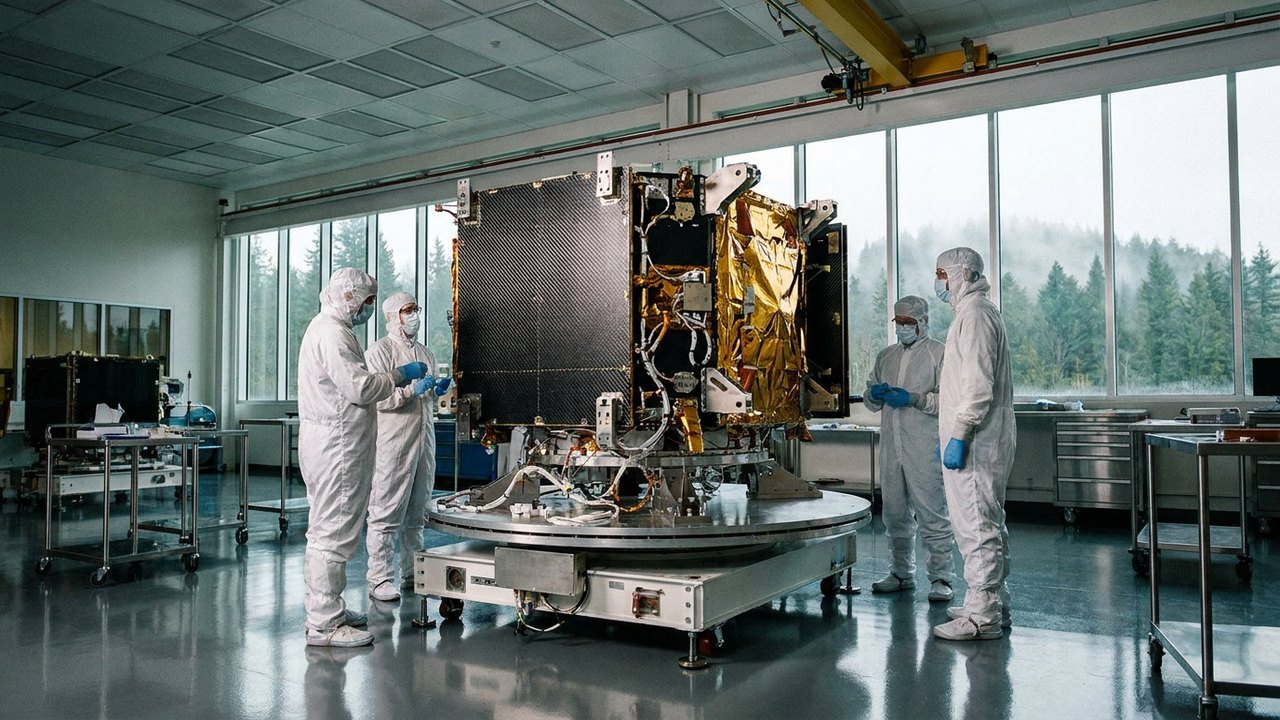
Category: Space Cluster Orbital Sustainability

FCC 5-year post-mission disposal (47 CFR 25.283(e)), NASA ODAR/STD-8719.14C contract deliverables, FAA Part 450, NOAA Part 960, WA servicing & habitat operators (Starfish Space, Gravitics, Portal), constellation scale (SpaceX Redmond, Amazon Leo, BlackSky), ESA/NASA debris measurement, and the orbital Scope 3/ESG standard gap.

  • Mission Designer’s End-of-Life Compliance Checklist: FCC, NASA ODAR, FAA Part 450 & WA Servicing

    Mission Designer’s End-of-Life Compliance Checklist: FCC, NASA ODAR, FAA Part 450 & WA Servicing

    Synthesizes FCC, NASA, FAA, and NOAA requirements verified as of 2026-11-16.

    ORBITAL SUSTAINABILITY · MEASUREMENT & ESG GAP · UNIFIED BINDING INSTRUMENTS (NOV 2026)
    Mission Designer EOL Compliance Checklist
    A unified end-of-life engineering and licensing checklist for mission designers, compliance leads, and founders—mapping every spacecraft gate across FCC 47 CFR § 25.283(e), NASA-STD-8719.14C ODARs, FAA Part 450, NOAA Part 960, and WA servicing contingencies.
    Primary Authority / Source: FCC / NASA / FAA / NOAA  |  As-Of / Horizon: As of Nov 2026
    ORBITAL SUSTAINABILITY · PDF & MARKDOWN TWIN
    Mission Designer EOL Compliance Checklist — Reference Brief
    Download the 2-page printable reference PDF or read the clean Markdown twin for AI and briefing workflows.
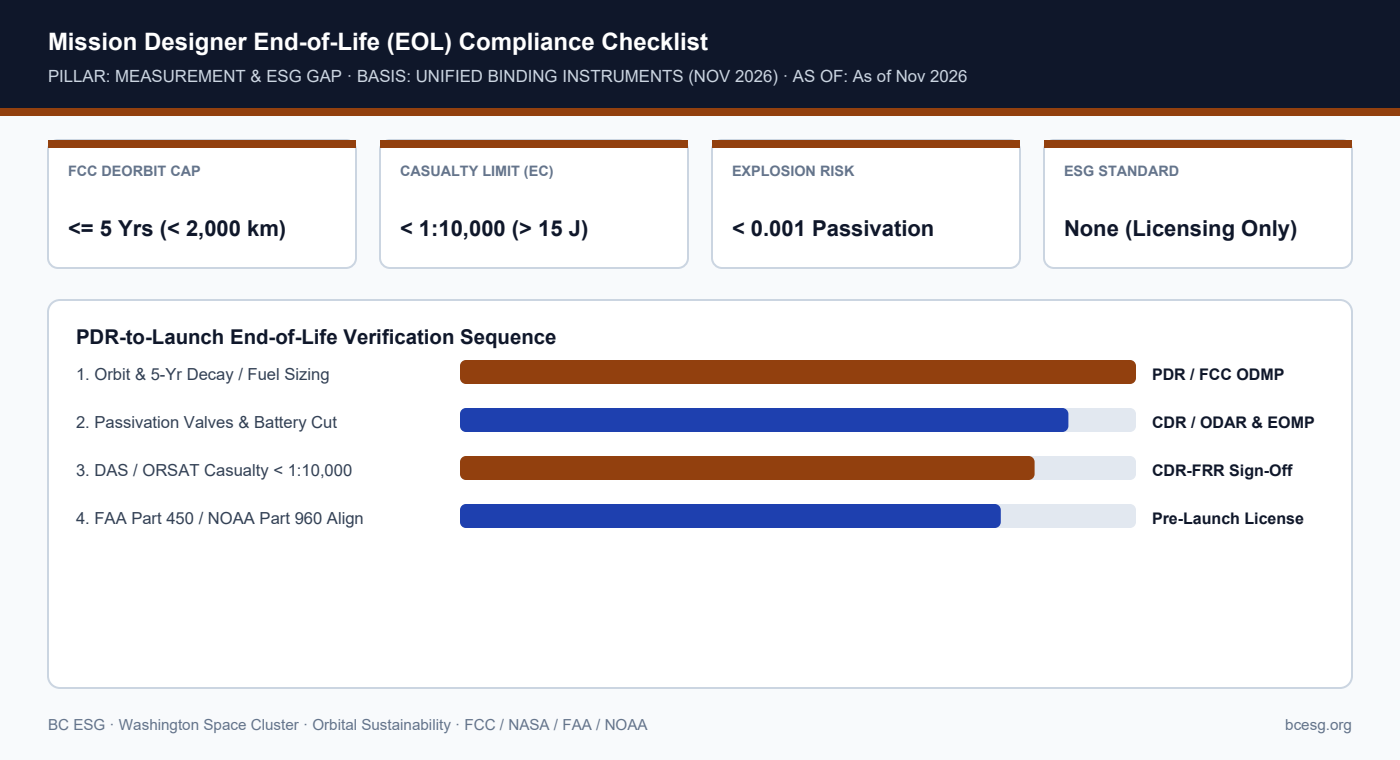
    Mission Designer End-of-Life (EOL) Compliance Checklist
    Mission Designer End-of-Life (EOL) Compliance Checklist

    Documented Instrument & Engineering Record

    • Gate 1 (PDR — Orbit & Propellant): Confirm whether deployment altitude decays passively in <= 5 years under conservative solar flux, or lock in dedicated EOL deorbit delta-v + tank-gauging margin.
    • Gate 2 (CDR — Passivation): Design latch-open propellant/pressurant vents and permanent battery-to-array disconnect relays to keep accidental breakup probability < 0.001.
    • Gate 3 (CDR/FRR — Demisability): Run DAS and ORSAT on all dense components (titanium, steel, optics) to verify Ec < 1:10,000 for > 15 J fragments—or budget controlled SPOUA reentry.
    • Gate 4 (Licensing — Multi-Agency): Align FCC Part 25 ODMP, NASA contract ODAR/EOMP (if NASA-funded/hosted), FAA Part 450 upper-stage COLA, and NOAA Part 960 (if Earth-observing).

    End-of-Life Compliance Checklist by Mission Phase

    PhaseRequired Engineering / Filing ActionBinding Instrument
    Preliminary Design (PDR)5-yr decay / EOL propellant & Preliminary ODARFCC § 25.283(e) / NPR 8715.6B
    Critical Design (CDR)Passivation hardware + ORSAT demisability runNASA-STD-8719.14C
    Pre-Launch LicensingFile FCC ODMP + NOAA Part 960 + FAA Part 45047 CFR 25 / 15 CFR 960 / 14 CFR 450
    End of Mission (EOM)Deorbit burn before COLA loss + vent/dischargeFCC ODMP / EOMP

    Mission Designer, Compliance Lead & Founder Takeaways

    • Keep one single source of truth for component masses, materials, and tank volumes across FCC ODMP and NASA ODAR submissions.
    • Treat WA servicing providers (Starfish Space Otter) and OTVs (Portal Space Supernova) as contingency/roadmap options—never as an excuse to skip onboard passivation.
    • For corporate ESG inquiries, pair terrestrial GHG Protocol Scope 1–3 disclosures with this licensing checklist while noting no space-specific ESG standard exists.

    Connected Census Profiles, Segments & Rules

    Primary Sources & Official Records

  • The Honest Gap: Why No Space-Specific Scope 3 or ESG Standard Exists for Orbital Operations

    The Honest Gap: Why No Space-Specific Scope 3 or ESG Standard Exists for Orbital Operations

    Honest gap verified against GHG Protocol, ISSB IFRS S2, and Batch 5 regulatory records as of 2026-11-16.

    ORBITAL SUSTAINABILITY · MEASUREMENT & ESG GAP · GHG PROTOCOL / ISSB / CSRD / SB 253 AUDIT
    No Space-Specific Scope 3 / ESG Standard
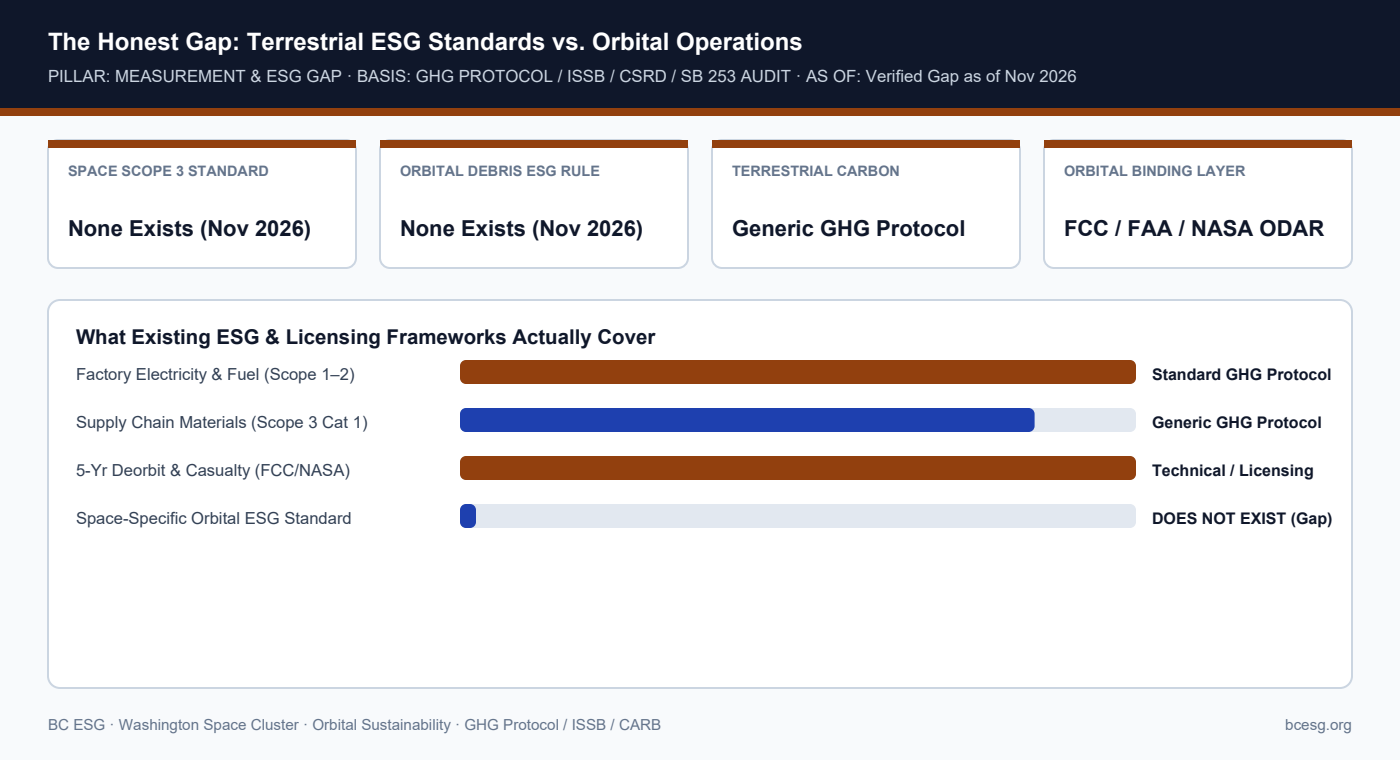
    No space-specific Scope 3 or ESG reporting standard exists for orbital operations in the GHG Protocol, ISSB IFRS S1/S2, EU CSRD, or California SB 253 as of November 2026—terrestrial emissions use generic corporate standards while orbital debris is governed by FCC/FAA/NASA licensing.
    Primary Authority / Source: GHG Protocol / ISSB / CARB  |  As-Of / Horizon: Verified Gap as of Nov 2026
    ORBITAL SUSTAINABILITY · PDF & MARKDOWN TWIN
    No Space-Specific Scope 3 / ESG Standard — Reference Brief
    Download the 2-page printable reference PDF or read the clean Markdown twin for AI and briefing workflows.
    The Honest Gap: Terrestrial ESG Standards vs. Orbital Operations
    The Honest Gap: Terrestrial ESG Standards vs. Orbital Operations

    Documented Instrument & Engineering Record

    • Documented gap: Nowhere in the GHG Protocol Corporate/Scope 3 Standards, ISSB IFRS S1/S2, EU CSRD Omnibus I, or California SB 253 is there a space-specific Scope 3 or orbital ESG standard.
    • What *does* apply to WA space firms: Ground facilities, cleanrooms, static-fire propellant combustion, and purchased titanium/aluminum fall under generic terrestrial GHG Protocol Scope 1, 2, and 3 categories (e.g., Cat 1 Purchased Goods, Cat 12 End-of-Life).
    • What does *not* have an ESG standard: Orbital debris generation, conjunction-avoidance performance, stratospheric reentry ablation, and spectrum/slot stewardship have no standardized ESG scoring or Scope 3 methodology.
    • Why this matters for buyers and compliance leads: Do not mistake voluntary space-sustainability pledges or rating-agency questionnaires for a binding ESG standard; real orbital obligations live in 47 CFR § 25.283(e), 14 CFR Part 450, 15 CFR Part 960, and NASA-STD-8719.14C.

    Framework Audit: Space-Specific Orbital Standard Check (Nov 2026)

    Framework / InstrumentCovers Terrestrial Space Mfg?Space-Specific Orbital ESG Standard?
    GHG Protocol (Scope 1–3)Yes (generic corporate rules)No space-specific orbital standard
    ISSB IFRS S1 / S2Yes (material climate/Scope 3)No space-specific orbital standard
    CA SB 253 (Scope 1+2 / 3)Yes (if >$1B & doing biz in CA)No space-specific orbital standard
    FCC / FAA / NASA ODARLaunch/spacecraft licensingTechnical/safety rules (not ESG reporting)

    Mission Designer, Compliance Lead & Founder Takeaways

    • Sustainability leads asked for 'orbital Scope 3' metrics should report terrestrial Scope 1–3 under GHG Protocol and attach FCC ODMP / NASA ODAR compliance separately.
    • Never fabricate or imply a mandatory 'Space ESG' framework where none exists in law or standard-setting.
    • Cross-reference Batch 5's SB 253 Scope 3 (PARTIAL) and CSRD Omnibus (PARTIAL) verdicts for terrestrial corporate-disclosure thresholds.

    Connected Census Profiles, Segments & Rules

    Primary Sources & Official Records

  • Reentry Ablation, Stratospheric Alumina & Launch Emissions: Physical Science vs. Unsettled Reporting

    Reentry Ablation, Stratospheric Alumina & Launch Emissions: Physical Science vs. Unsettled Reporting

    2025 launch (~10/day) and reentry (>3 intact/day) rates cited from ESA 2026 Space Environment Report (data through end of 2025).

    ORBITAL SUSTAINABILITY · MEASUREMENT & ESG GAP · ATMOSPHERIC SCIENCE VS. REPORTING GAP
    Reentry Ablation & Atmospheric Impact
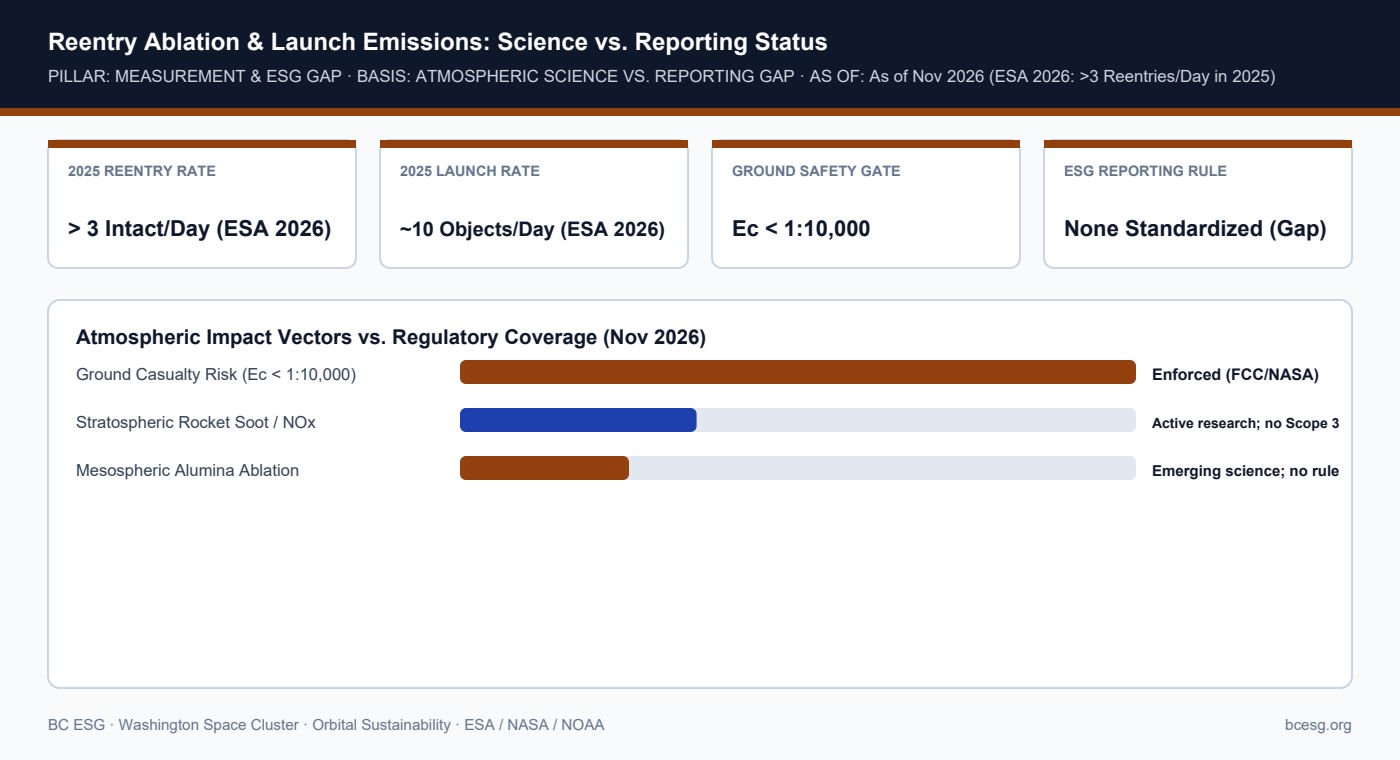
    Design-for-demise prevents ground casualties (< 1:10,000) by vaporizing aluminum spacecraft in the upper atmosphere, but ESA's 2026 Report notes >3 intact objects/rocket bodies reentered daily in 2025—injecting alumina and soot where no standardized ESG accounting protocol exists.
    Primary Authority / Source: ESA / NASA / NOAA  |  As-Of / Horizon: As of Nov 2026 (ESA 2026: >3 Reentries/Day in 2025)
    ORBITAL SUSTAINABILITY · PDF & MARKDOWN TWIN
    Reentry Ablation & Atmospheric Impact — Reference Brief
    Download the 2-page printable reference PDF or read the clean Markdown twin for AI and briefing workflows.
    Reentry Ablation & Launch Emissions: Science vs. Reporting Status
    Reentry Ablation & Launch Emissions: Science vs. Reporting Status

    Documented Instrument & Engineering Record

    • The physical tradeoff: Design-for-demise protects people on the ground by burning up aluminum spacecraft buses in the mesosphere/stratosphere—converting solid metal into aerosolized aluminum oxide (alumina).
    • Scale of traffic (ESA 2026 Report, data through end of 2025): Launch rates reached ~10 objects/day and >3 intact objects or rocket bodies reentered the atmosphere daily in 2025.
    • Launch plume injections: Rocket launches inject black carbon, water vapor, and nitrogen oxides directly into the stratosphere and mesosphere, with different radiative forcing than ground-level combustion.
    • Reporting boundary: While physical atmospheric research is active, neither GHG Protocol, ISSB IFRS S2, EU CSRD, nor FAA/FCC imposes a standardized space-specific radiative-forcing or ablation metric as of November 2026.

    Atmospheric Vectors: Physical Reality vs. Compliance Status

    VectorPhysical MechanismCompliance / ESG Status (Nov 2026)
    Reentry Ground ImpactSurviving fragments > 15 JRegulated: Ec < 1:10,000 (FCC / NASA)
    Mesospheric AluminaVaporized Al bus from demisable satsUnregulated; no ESG reporting standard
    Stratospheric Launch PlumeBlack carbon / NOx / H2O injectionTerrestrial Scope 1 fuel only; no RF multiplier

    Mission Designer, Compliance Lead & Founder Takeaways

    • Compliance leads should not invent custom stratospheric radiative-forcing multipliers inside statutory Scope 1/2/3 filings unless a recognized standard adopts one.
    • Ground casualty safety (< 1:10,000) remains the legally binding priority over speculative atmospheric ablation offsets.
    • Track NOAA, NASA, and ESA atmospheric research separately from statutory ESG disclosures.

    Connected Census Profiles, Segments & Rules

    Primary Sources & Official Records

  • Solar-Cycle Atmospheric Drag Uncertainty & Why Passive 5-Year Decay Fails Above ~500–600 km

    Solar-Cycle Atmospheric Drag Uncertainty & Why Passive 5-Year Decay Fails Above ~500–600 km

    Grounded in NASA ODPO DAS orbital lifetime modeling principles and 47 CFR § 25.283(e) as of 2026-11-16.

    ORBITAL SUSTAINABILITY · MEASUREMENT & ESG GAP · NASA ODPO / THERMOSPHERIC PHYSICS
    Solar-Cycle Drag & 5-Year Decay Limits
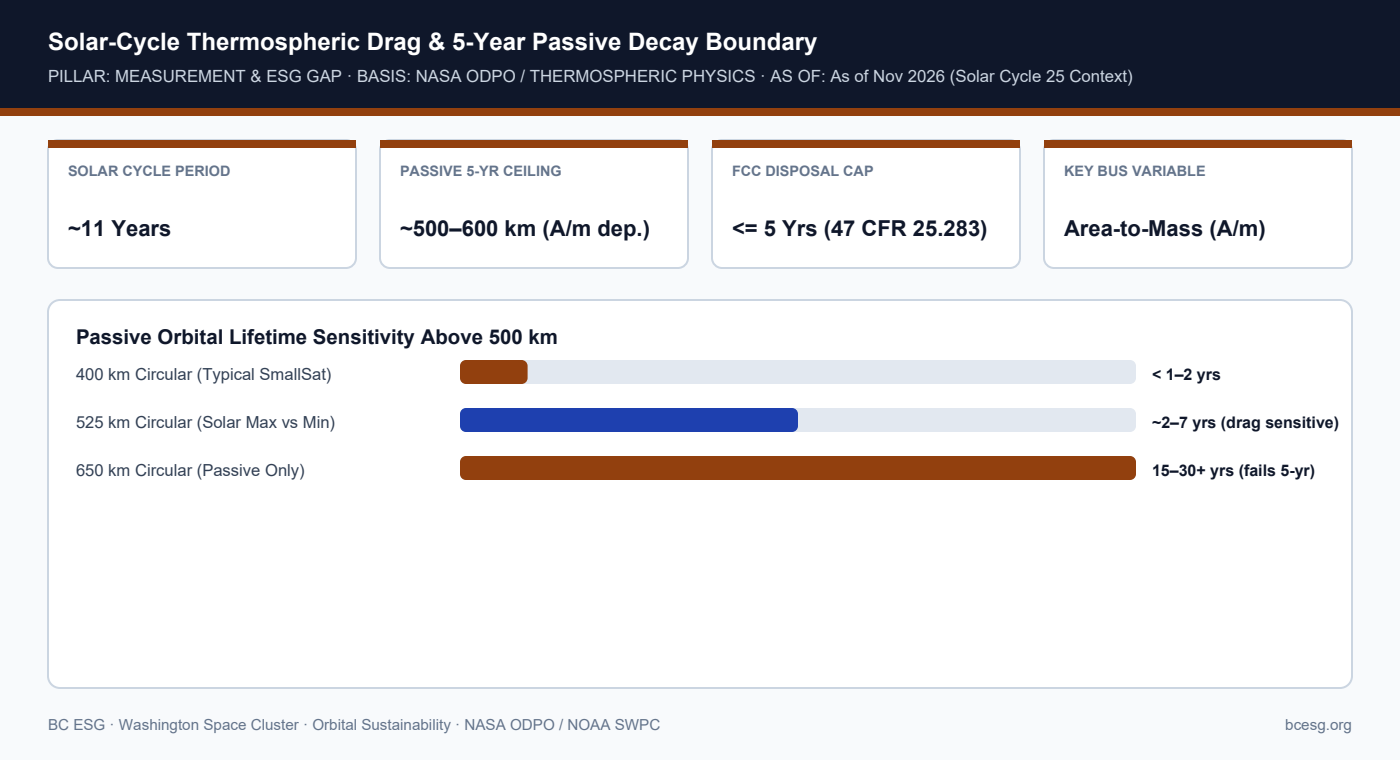
    Upper-atmospheric density in LEO varies by an order of magnitude across the ~11-year solar cycle—meaning a satellite that decays within 5 years at solar maximum can remain in orbit for 15–25+ years at solar minimum if launched above ~500–600 km without propulsion.
    Primary Authority / Source: NASA ODPO / NOAA SWPC  |  As-Of / Horizon: As of Nov 2026 (Solar Cycle 25 Context)
    ORBITAL SUSTAINABILITY · PDF & MARKDOWN TWIN
    Solar-Cycle Drag & 5-Year Decay Limits — Reference Brief
    Download the 2-page printable reference PDF or read the clean Markdown twin for AI and briefing workflows.
    Solar-Cycle Thermospheric Drag & 5-Year Passive Decay Boundary
    Solar-Cycle Thermospheric Drag & 5-Year Passive Decay Boundary

    Documented Instrument & Engineering Record

    • Solar flux drives drag: Extreme ultraviolet (EUV) radiation heats and expands Earth's thermosphere during solar maximum, accelerating orbital decay; during solar minimum, the thermosphere contracts and drag drops sharply.
    • Why ~500–600 km is the cliff: Depending on ballistic coefficient (area-to-mass ratio, A/m), passive unpropelled satellites above ~500–600 km routinely exceed the FCC 5-year post-mission disposal cap during solar minimum.
    • DAS modeling requirement: NASA's Debris Assessment Software (DAS) requires propagating orbital lifetime across realistic solar-flux projections—not cherry-picking solar-maximum density.
    • Drag-sail caveats: Deployable drag sails increase A/m to shorten decay, but also increase collision cross-section area during descent.

    Passive Decay vs. Propulsive Deorbit Design Choices

    Design OptionAltitude SuitabilityFCC 5-Year Risk
    Low-LEO Deployment (<500 km)High-drag shellsLow risk; shortens mission life without reboost
    Deployable Drag Sail~500–650 km SmallSatsIncreases collision area; deployment reliability risk
    Onboard PropulsionAll LEO shells up to 2,000 kmLowest timeline risk if EOL fuel reserved

    Mission Designer, Compliance Lead & Founder Takeaways

    • Mission designers launching into 550–650 km sun-synchronous rideshares without propulsion face high FCC ODMP rejection or waiver risk.
    • Always run sensitivity sweeps in DAS across both 50th-percentile and conservative low-solar-flux scenarios.
    • Station-keeping propulsion for lifetime extension at 450 km simultaneously solves the 5-year disposal problem.

    Connected Census Profiles, Segments & Rules

    Primary Sources & Official Records

  • Untrackable 1 mm–10 cm Debris (~1.5M–230M Modeled Fragments): Shielding & Mission Risk

    Untrackable 1 mm–10 cm Debris (~1.5M–230M Modeled Fragments): Shielding & Mission Risk

    Modeled estimates (~68,450 >10 cm; ~1.5M 1–10 cm; ~230M 1 mm–1 cm) cited from ESA 2026 Space Environment Report (data through end of 2025); NASA >100M 1 mm–1 cm from ODPO (2025–2026).

    ORBITAL SUSTAINABILITY · MEASUREMENT & ESG GAP · ESA MASTER-8 (2026) & NASA ODPO MODELS
    Untrackable 1 mm–10 cm Debris Risk
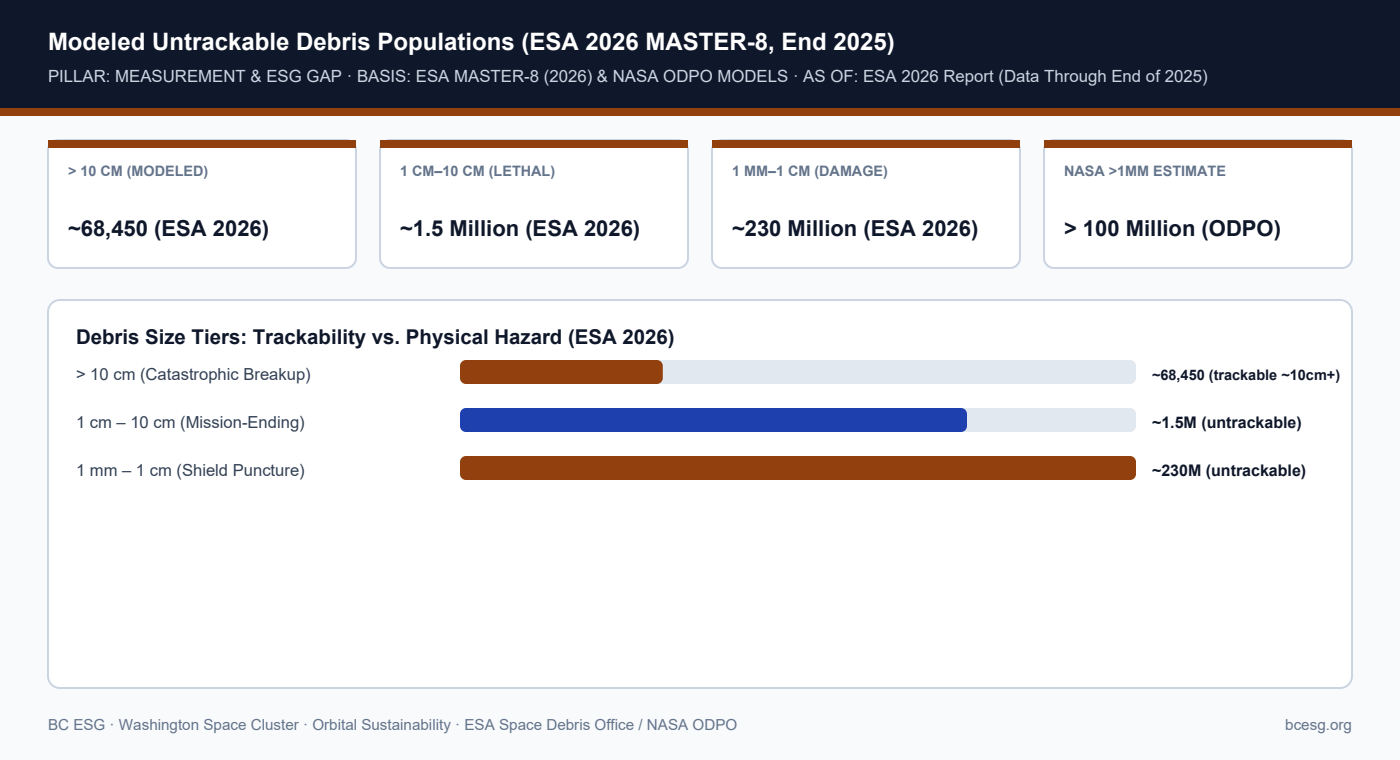
    Ground radar and optical networks cannot routinely track debris smaller than ~10 cm in LEO; ESA's 2026 Space Environment Report (MASTER-8, data through end of 2025) estimates ~1.5 million fragments (1–10 cm) capable of ending missions and ~230 million fragments (1 mm–1 cm).
    Primary Authority / Source: ESA Space Debris Office / NASA ODPO  |  As-Of / Horizon: ESA 2026 Report (Data Through End of 2025)
    ORBITAL SUSTAINABILITY · PDF & MARKDOWN TWIN
    Untrackable 1 mm–10 cm Debris Risk — Reference Brief
    Download the 2-page printable reference PDF or read the clean Markdown twin for AI and briefing workflows.
    Modeled Untrackable Debris Populations (ESA 2026 MASTER-8, End 2025)
    Modeled Untrackable Debris Populations (ESA 2026 MASTER-8, End 2025)

    Documented Instrument & Engineering Record

    • The tracking blind spot: Standard SSN radar/optical tracking degrades below ~10 cm in LEO, meaning collision-avoidance maneuvers cannot protect spacecraft against the vast majority of hazardous fragments.
    • ESA 2026 Space Environment Report (MASTER-8, data through end of 2025): Estimates ~68,450 objects >10 cm, ~1.5 million objects from 1 cm to 10 cm (capable of mission-ending damage), and ~230 million objects from 1 mm to 1 cm (capable of puncturing shields).
    • NASA ODPO comparison (2025–2026): Estimates >100 million untrackable millimeter-sized (1 mm–1 cm) pieces in Earth orbit.
    • Engineering defense: Because you cannot dodge what you cannot track, spacecraft rely on Whipple shields, multi-layer insulation (MLI), harness routing redundancy, and armored propellant/battery enclosures.

    Debris Size Tiers & Mission Design Controls

    Size ClassESA 2026 Estimate (End 2025)Primary Mitigation
    > 10 cm~68,450 objects18th SDS tracking + avoidance burns
    1 cm – 10 cm~1.5 million objectsComponent placement + redundancy (cannot dodge)
    1 mm – 1 cm~230 million objectsWhipple bumpers + MLI + tank shielding

    Mission Designer, Compliance Lead & Founder Takeaways

    • A 1–3 cm fragment strike on a propellant tank or battery can kill attitude control and strand a satellite above its passive 5-year decay altitude.
    • NASA ODARs require micrometeoroid and orbital debris (MMOD) penetration probability assessments using BUMPER / DAS.
    • Protecting passivation valves and battery disconnect relays against 1 mm–1 cm strikes preserves end-of-life deorbit capability.

    Connected Census Profiles, Segments & Rules

    Primary Sources & Official Records

  • Tracked Objects vs. Modeled Debris (ESA 2026 Report & NASA ODPO): Why As-Of Dates Matter

    Tracked Objects vs. Modeled Debris (ESA 2026 Report & NASA ODPO): Why As-Of Dates Matter

    All figures carry explicit source and as-of date: ESA 2026 Space Environment Report (data through end of 2025) and NASA ODPO ODQN (2025–2026).

    ORBITAL SUSTAINABILITY · MEASUREMENT & ESG GAP · ESA 2026 REPORT & NASA ODPO ODQN
    ESA & NASA Debris Counts (2026)
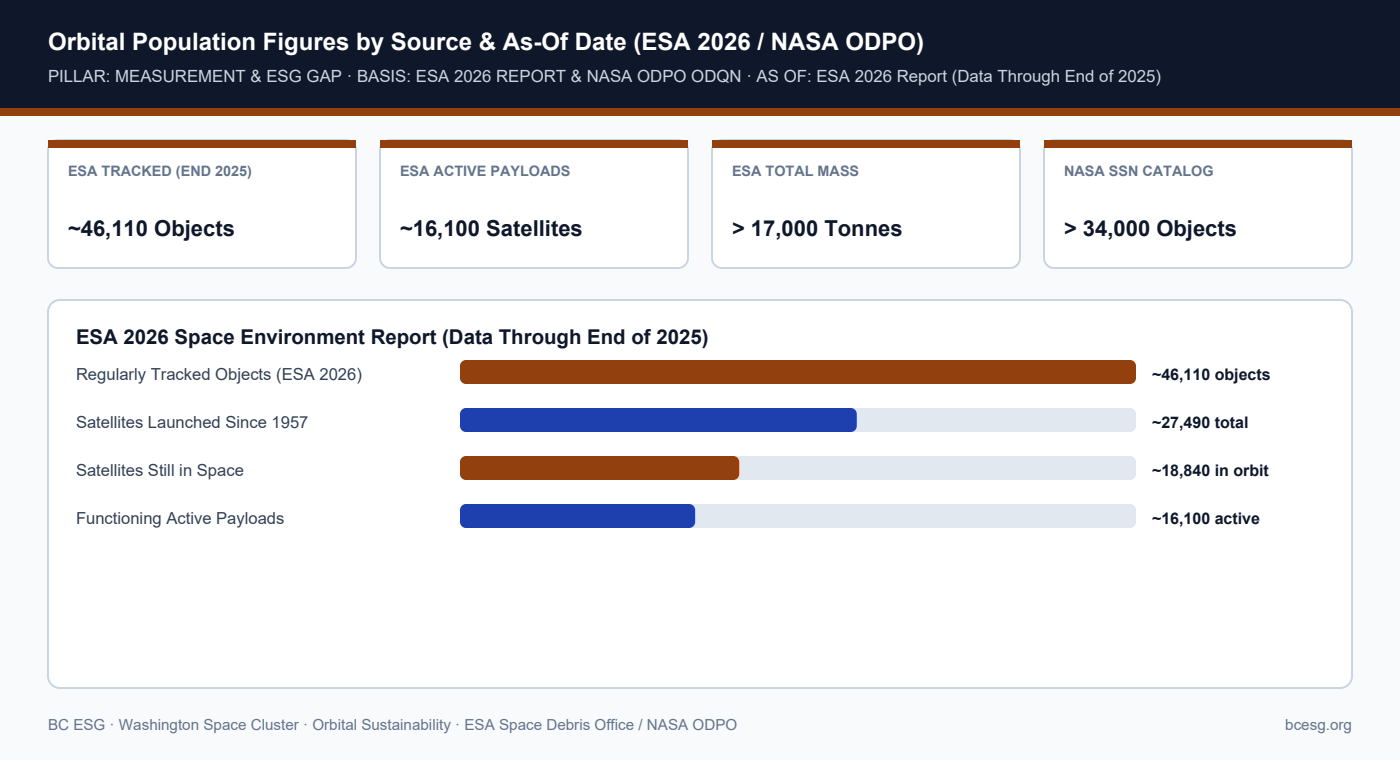
    ESA's 2026 Space Environment Report (data through end of 2025) records ~46,110 regularly tracked objects, ~16,100 active payloads, and >17,000 tonnes in orbit—while NASA ODPO's U.S. Space Surveillance Network catalog exceeds 34,000 objects; differing thresholds explain why every figure must carry its source and as-of date.
    Primary Authority / Source: ESA Space Debris Office / NASA ODPO  |  As-Of / Horizon: ESA 2026 Report (Data Through End of 2025)
    ORBITAL SUSTAINABILITY · PDF & MARKDOWN TWIN
    ESA & NASA Debris Counts (2026) — Reference Brief
    Download the 2-page printable reference PDF or read the clean Markdown twin for AI and briefing workflows.
    Orbital Population Figures by Source & As-Of Date (ESA 2026 / NASA ODPO)
    Orbital Population Figures by Source & As-Of Date (ESA 2026 / NASA ODPO)

    Documented Instrument & Engineering Record

    • Mandatory source-and-date rule: Orbital population numbers move daily (~10 objects launched/day and >3 intact objects/rocket bodies reentering/day in 2025 per ESA 2026); undated claims are unverifiable.
    • ESA 2026 Space Environment Report (Issue 10, data through end of 2025): ~46,110 regularly tracked objects (up from ~40,000 in 2025), ~27,490 satellites placed in orbit since 1957, ~18,840 still in space, ~16,100 active payloads, >17,000 tonnes total mass, and >660 historical breakups.
    • NASA ODPO / ODQN (2025–2026): Reports >34,000 officially cataloged objects in the U.S. Space Surveillance Network (SSN) and 50,000+ broader trackable objects.
    • Why counts differ: SSN catalog numbers reflect publicly maintained TLE/catalog IDs with confirmed origins, whereas ESA's ~46,110 includes broader tracked object sets and MASTER-8 statistical models.

    Authoritative Orbital Population Figures (Dated & Sourced)

    MetricPublished FigureSource & As-Of Date
    Regularly Tracked Objects~46,110 (up from ~40,000)ESA 2026 Space Environment Report (end 2025)
    Functioning / Active Payloads~16,100 (~18,840 still in space)ESA 2026 Space Environment Report (end 2025)
    Total Orbital Mass> 17,000 tonnesESA 2026 Space Environment Report (end 2025)
    U.S. SSN Official Catalog> 34,000 objectsNASA ODPO / ODQN (2025–2026)

    Mission Designer, Compliance Lead & Founder Takeaways

    • Never mix SSN catalog counts (>34,000) with ESA tracked (~46,110) or ESA MASTER-8 >10 cm modeled counts (~68,450) in the same numerator without labeling definitions.
    • Every compliance dossier or investor brief citing orbital congestion should cite ESA DISCOS / Space Environment Report or NASA ODQN with its exact publication issue.
    • High launch rates (~10 objects/day in 2025) make static annual snapshots obsolete within quarters.

    Connected Census Profiles, Segments & Rules

    Primary Sources & Official Records

  • End-of-Life Propellant Margin Budgeting: Trading Payload Mass & Mission Life for 5-Year Deorbit

    End-of-Life Propellant Margin Budgeting: Trading Payload Mass & Mission Life for 5-Year Deorbit

    Grounded in 47 CFR § 25.283(e) EOM trigger and NASA ODPO orbital lifetime mechanics as of 2026-11-16.

    ORBITAL SUSTAINABILITY · CONSTELLATION SCALE · FCC § 25.283(E) & SPACECRAFT SYSTEMS ENGINEERING
    EOL Propellant Margin Budgeting
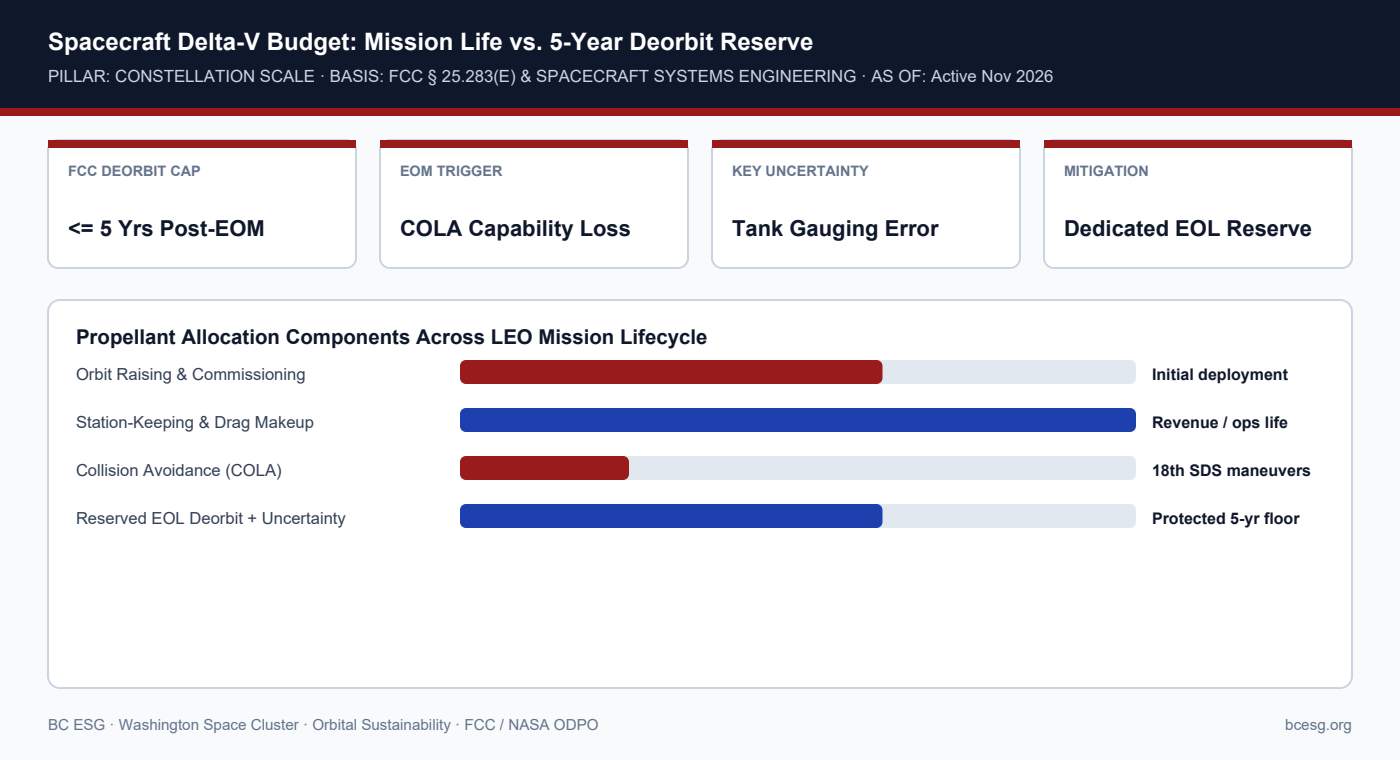
    Meeting the FCC 5-year post-mission disposal rule from mid-to-upper LEO shells requires reserving a dedicated end-of-life delta-v budget—forcing mission designers to trade revenue-generating station-keeping life and payload mass against guaranteed deorbit margin.
    Primary Authority / Source: FCC / NASA ODPO  |  As-Of / Horizon: Active Nov 2026
    ORBITAL SUSTAINABILITY · PDF & MARKDOWN TWIN
    EOL Propellant Margin Budgeting — Reference Brief
    Download the 2-page printable reference PDF or read the clean Markdown twin for AI and briefing workflows.
    Spacecraft Delta-V Budget: Mission Life vs. 5-Year Deorbit Reserve
    Spacecraft Delta-V Budget: Mission Life vs. 5-Year Deorbit Reserve

    Documented Instrument & Engineering Record

    • Why propellant gauging uncertainty matters: Bookkeeping (pressure-volume-temperature and thruster-on-time) errors accumulate over a 5–7 year mission; without a protected reserve floor, a satellite can run dry before its deorbit burn.
    • Regulatory lock-in: Because 47 CFR § 25.283(e) defines EOM as the point when a propulsive spacecraft can no longer conduct collision-avoidance maneuvers, operators must initiate disposal *while* sufficient propellant remains.
    • Altitude sensitivity: Deorbiting from 1,200 km requires substantially more delta-v than deorbiting from 500 km—making propellant mass fraction a decisive architectural driver.
    • Passivation sequencing: After the final perigee-lowering burn, any remaining residual propellant must be vented/depleted to satisfy passivation rules.

    Propellant Margin Tradeoffs by LEO Altitude Band

    Altitude BandPassive Decay WindowPropellant Reserve Strategy
    < 500 kmTypically < 5 yearsSmall EOL margin; passive drag backs up thruster
    500–650 kmSolar-cycle dependent (often >5 yrs)Active deorbit burn required for guaranteed <=5 yrs
    650–2,000 kmDecades to centuriesLarge dedicated EOL delta-v + tank-gauging margin

    Mission Designer, Compliance Lead & Founder Takeaways

    • Finance and program leads must model the revenue impact of retiring a healthy satellite early to protect its EOL deorbit reserve.
    • Electric propulsion (Hall/ion) offers high Isp for lower propellant mass, but requires months-long spiral-down times that must still fit inside the 5-year clock.
    • Contracting an in-space servicer (such as Starfish Space's Otter) is a potential contingency if a spacecraft suffers a propulsion failure, not a substitute for initial ODMP propellant budgeting.

    Connected Census Profiles, Segments & Rules

    Primary Sources & Official Records

  • Conjunction Assessment & Automated Collision Avoidance at Constellation Scale

    Conjunction Assessment & Automated Collision Avoidance at Constellation Scale

    Tracked object count (~46,110, up from ~40,000) and active payloads (~16,100) cited from ESA 2026 Space Environment Report (data through end of 2025).

    ORBITAL SUSTAINABILITY · CONSTELLATION SCALE · 18TH SDS / NASA ODPO / FCC PART 25
    Conjunction Assessment & Collision Avoidance
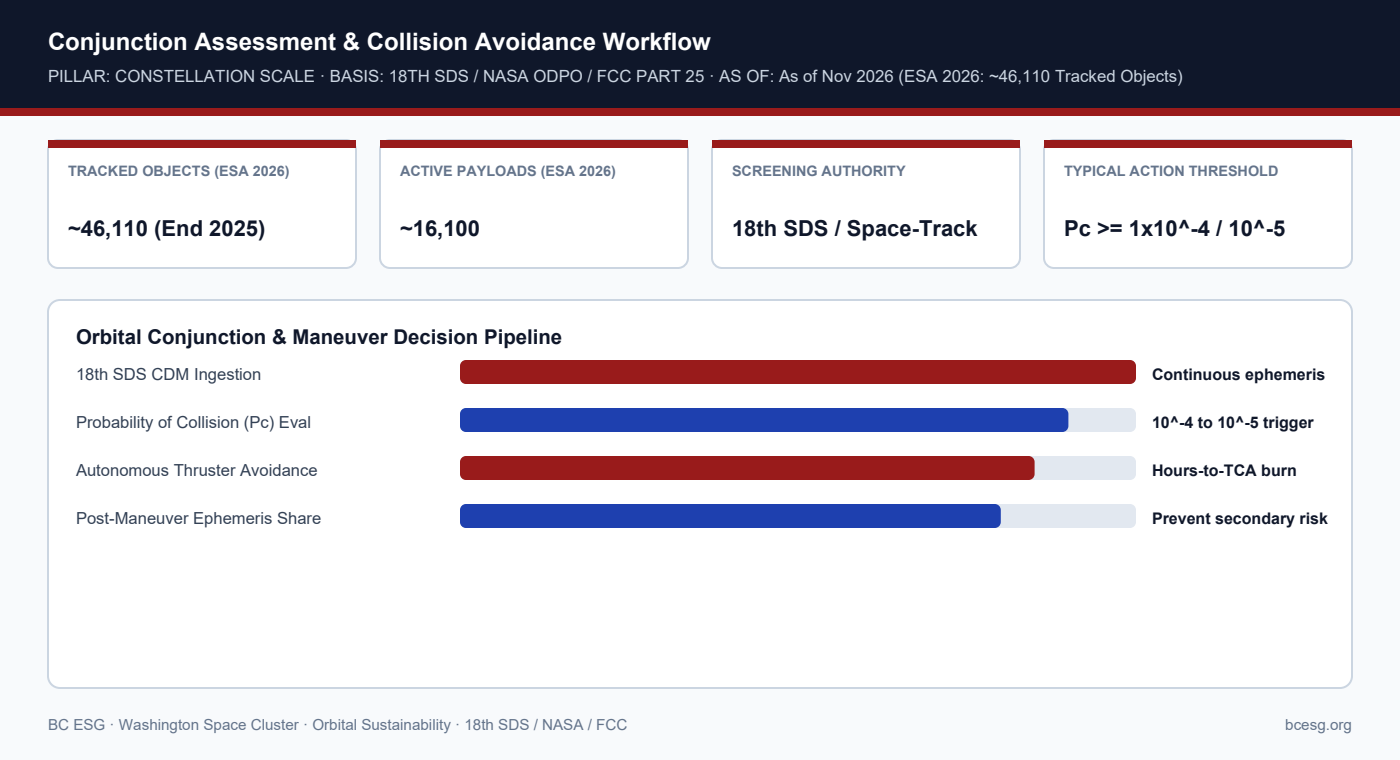
    With ~46,110 regularly tracked objects in orbit (ESA 2026 Space Environment Report, data through end of 2025), constellation operators rely on 18th Space Defense Squadron (Space-Track) Conjunction Data Messages (CDMs) and automated maneuver thresholds (~10^-4 to 10^-5 Pc) to prevent collisions.
    Primary Authority / Source: 18th SDS / NASA / FCC  |  As-Of / Horizon: As of Nov 2026 (ESA 2026: ~46,110 Tracked Objects)
    ORBITAL SUSTAINABILITY · PDF & MARKDOWN TWIN
    Conjunction Assessment & Collision Avoidance — Reference Brief
    Download the 2-page printable reference PDF or read the clean Markdown twin for AI and briefing workflows.
    Conjunction Assessment & Collision Avoidance Workflow
    Conjunction Assessment & Collision Avoidance Workflow

    Documented Instrument & Engineering Record

    • Catalog growth: ESA's 2026 Space Environment Report (data through end of 2025) counts ~46,110 regularly tracked objects (up from ~40,000 in the 2025 report) and ~16,100 functioning payloads.
    • CDM screening: The U.S. 18th Space Defense Squadron (via Space-Track.org) distributes Conjunction Data Messages (CDMs) when predicted miss distances cross screening volumes.
    • Action thresholds: NASA and commercial constellation operators commonly trigger collision-avoidance maneuvers when Probability of Collision (Pc) reaches 10^-4 (red) or 10^-5 (yellow/constellation-tight) thresholds.
    • FCC EOM link: Under 47 CFR § 25.283(e), losing the ability to execute collision-avoidance maneuvers defines End of Mission for propulsive satellites—starting the 5-year disposal clock.

    Conjunction Assessment & Maneuver Parameters

    ParameterOperational PracticeSustainability Impact
    Ephemeris SharingPublish predictive ephemerides to Space-TrackReduces covariance uncertainty across fleets
    Pc Maneuver ThresholdTypically 10^-4 (NASA) to 10^-5 (constellations)Prevents catastrophic breakups
    Automated ExecutionOnboard / ground-automated burn planningScales across thousands of satellites
    Propellant BudgetTracked against EOL deorbit reserveTriggers EOM when reserve floor is hit

    Mission Designer, Compliance Lead & Founder Takeaways

    • High-drag solar-storm events alter atmospheric density rapidly, degrading orbit predictions and increasing false-alarm CDM rates.
    • Manual spreadsheet-based conjunction screening fails above a few dozen satellites; automated CDM pipelines are mandatory for constellation licenses.
    • Every avoidance burn consumes delta-v that must be accounted for in the end-of-life disposal propellant budget.

    Connected Census Profiles, Segments & Rules

    Primary Sources & Official Records

  • BlackSky (Tukwila): Earth-Observation Constellation Operations Under FCC 5-Year & NOAA Part 960

    BlackSky (Tukwila): Earth-Observation Constellation Operations Under FCC 5-Year & NOAA Part 960

    BlackSky Tukwila facility verified against Step 0 Census; regulatory mechanics verified against 15 CFR Part 960 and 47 CFR § 25.283 as of 2026-11-16.

    ORBITAL SUSTAINABILITY · CONSTELLATION SCALE · FCC / NOAA LICENSING & CENSUS RECORD
    BlackSky LEO EO Disposal & Compliance
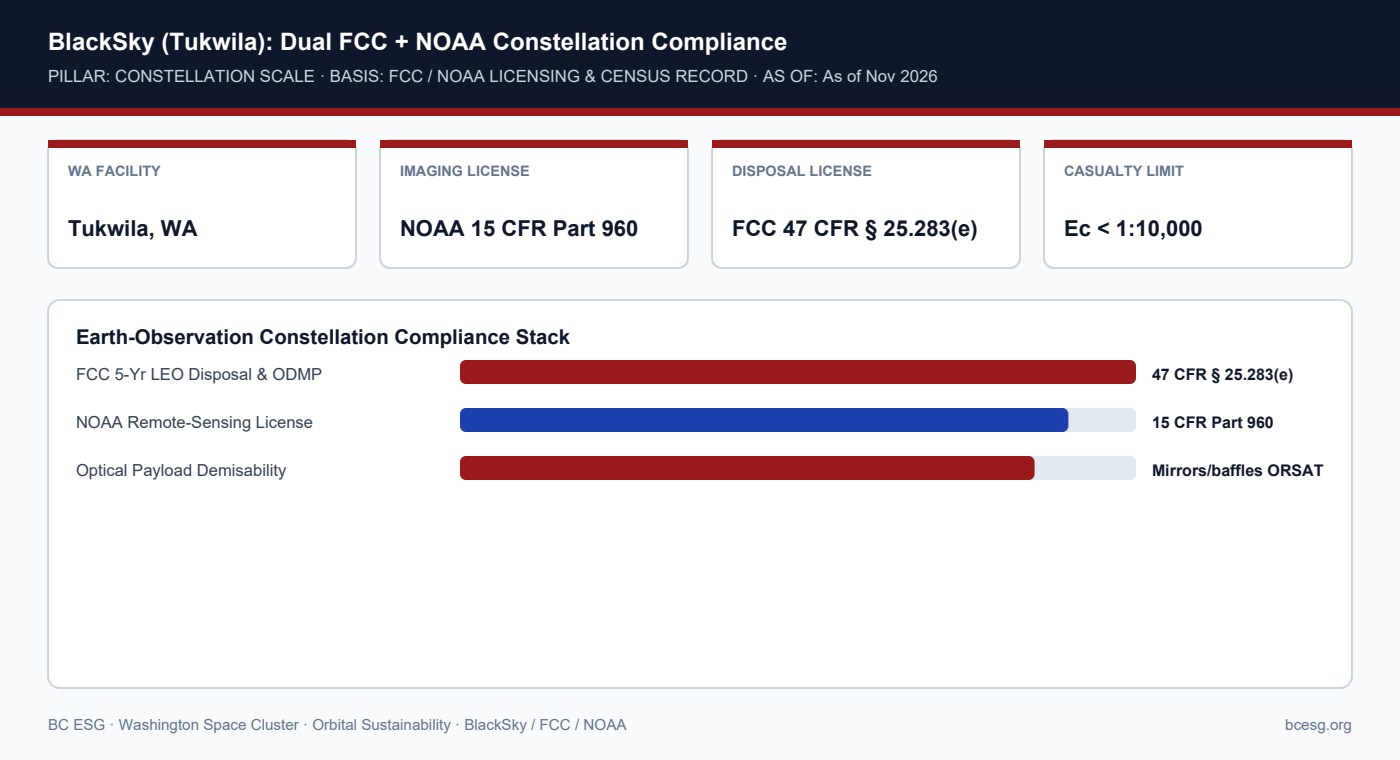
    Tukwila-based BlackSky operates an Earth-observation LEO constellation governed simultaneously by NOAA 15 CFR Part 960 (imaging/data) and FCC 47 CFR § 25.283(e) (5-year post-mission disposal and ODMP compliance).
    Primary Authority / Source: BlackSky / FCC / NOAA  |  As-Of / Horizon: As of Nov 2026
    ORBITAL SUSTAINABILITY · PDF & MARKDOWN TWIN
    BlackSky LEO EO Disposal & Compliance — Reference Brief
    Download the 2-page printable reference PDF or read the clean Markdown twin for AI and briefing workflows.
    BlackSky (Tukwila): Dual FCC + NOAA Constellation Compliance
    BlackSky (Tukwila): Dual FCC + NOAA Constellation Compliance

    Documented Instrument & Engineering Record

    • Tukwila EO operator: BlackSky maintains its Seattle South / Tukwila, WA facility (12501 E Marginal Wy S), operating high-revisit optical imaging satellites in LEO.
    • Dual-agency licensing: BlackSky satellites require NOAA 15 CFR Part 960 authorization for commercial Earth imaging and FCC Part 25 authorization for RF downlinks and orbital debris mitigation.
    • Optical payload demisability challenge: Earth-observation telescopes contain dense optical assemblies (mirrors, mounts, star trackers) that require careful ORSAT thermal modeling to stay under the 1:10,000 casualty threshold.
    • Replenishment cadence: As Gen-3 satellites replace legacy units, each new authorization after September 29, 2024 is bound by the 5-year post-mission disposal ceiling.

    EO Constellation Sustainability Controls (BlackSky Profile)

    Compliance DomainAgency / RuleEO-Specific Engineering Focus
    5-Year Post-Mission DecayFCC 47 CFR § 25.283(e)Low-LEO altitude + propulsion/drag sizing
    Optical Telescope DemiseFCC ODMP / NASA-STD-8719.14CMirror & mount material survivability (<15 J)
    Remote-Sensing ClearanceNOAA 15 CFR Part 960Relies on FCC ODMP; enforces license conditions
    Conjunction Screening18th SDS / Space-TrackManeuver planning across mid-inclination shells

    Mission Designer, Compliance Lead & Founder Takeaways

    • Earth-observation operators face a tighter mass budget than broadband mega-constellations, making telescope demisability a critical early-design check.
    • NOAA's reliance on FCC ODMP reviews means any FCC orbital-debris deficiency can jeopardize remote-sensing license standing.
    • Operating in lower LEO shells improves imaging resolution while simultaneously shortening passive atmospheric decay time.

    Connected Census Profiles, Segments & Rules

    Primary Sources & Official Records

  • Amazon Leo (Redmond): FCC Constellation License Conditions, Krypton Reserves & 5-Year Disposal

    Amazon Leo (Redmond): FCC Constellation License Conditions, Krypton Reserves & 5-Year Disposal

    Grounded in FCC 47 CFR § 25.283(e) and Amazon Leo public disclosures as of 2026-11-16.

    ORBITAL SUSTAINABILITY · CONSTELLATION SCALE · FCC LICENSE CONDITIONS & OPERATOR DISCLOSURES
    Amazon Leo (Redmond) Disposal Compliance
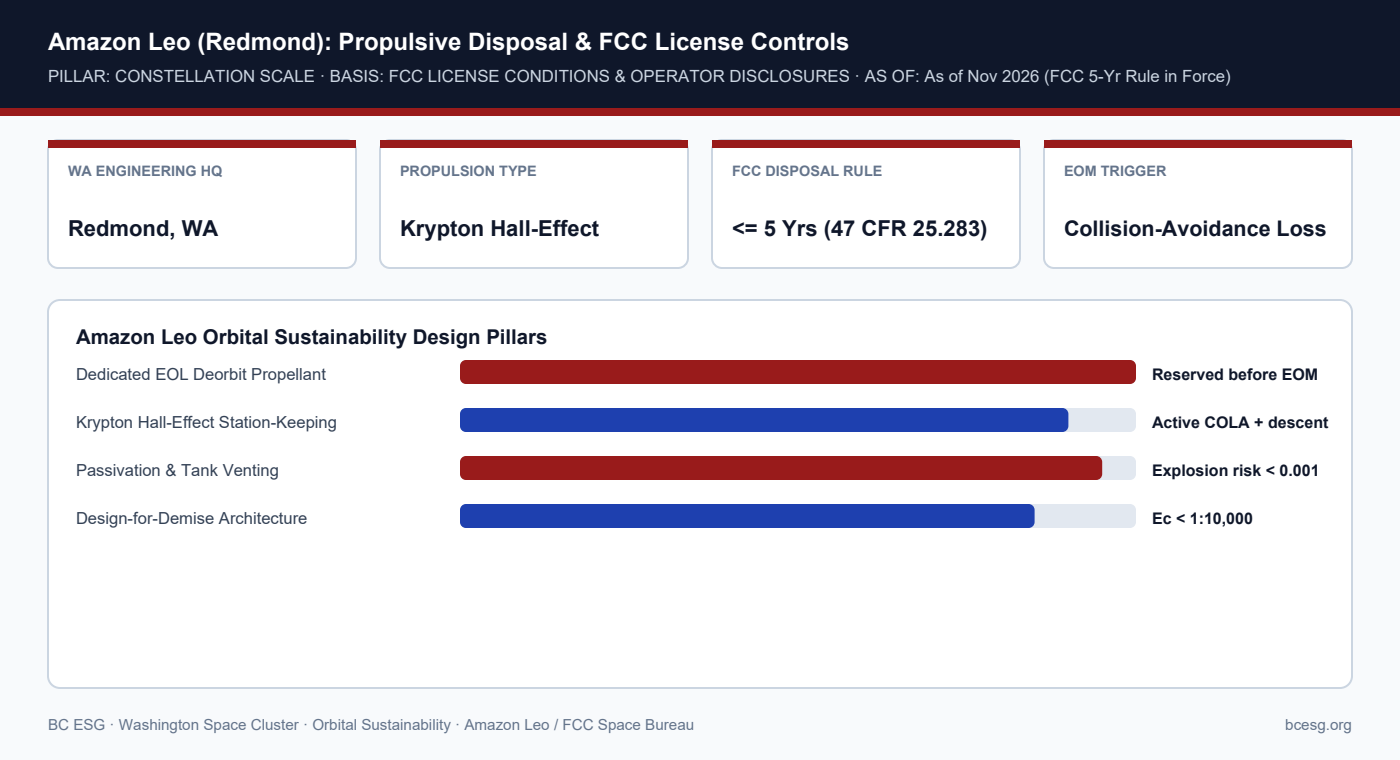
    Amazon Leo (formerly Project Kuiper), engineered and operated out of Redmond, WA, integrates krypton Hall-effect thrusters and dedicated end-of-life propellant margins to meet FCC Part 25 orbital debris conditions and 5-year post-mission disposal.
    Primary Authority / Source: Amazon Leo / FCC Space Bureau  |  As-Of / Horizon: As of Nov 2026 (FCC 5-Yr Rule in Force)
    ORBITAL SUSTAINABILITY · PDF & MARKDOWN TWIN
    Amazon Leo (Redmond) Disposal Compliance — Reference Brief
    Download the 2-page printable reference PDF or read the clean Markdown twin for AI and briefing workflows.
    Amazon Leo (Redmond): Propulsive Disposal & FCC License Controls
    Amazon Leo (Redmond): Propulsive Disposal & FCC License Controls

    Documented Instrument & Engineering Record

    • Redmond constellation hub: Amazon Leo (rebranded from Project Kuiper) develops its broadband constellation hardware and mission operations in Redmond, WA.
    • Propulsive deorbit necessity: Constellations operating around ~590–630 km cannot rely solely on rapid natural atmospheric decay during solar minima—making onboard krypton Hall-effect propulsion essential for guaranteed <= 5-year disposal.
    • Propellant reserve discipline: Under 47 CFR § 25.283(e), end of mission for a maneuverable satellite is triggered when it can no longer perform collision-avoidance maneuvers, requiring operators to lock in deorbit propellant margins before commercial service ends.
    • FCC license conditions: Amazon Leo's Part 25 authorization carries ongoing orbital debris reporting, failure-rate tracking, and post-mission disposal verification obligations.

    Amazon Leo FCC Orbital Debris Compliance Matrix

    RequirementTechnical MechanismRegulatory Instrument
    5-Year LEO DeorbitActive krypton Hall-effect descent47 CFR § 25.283(e)
    Collision AvoidanceAutomated maneuver + 18th SDS dataFCC Part 25 ODMP
    PassivationPropellant depletion + battery disconnectFCC § 25.283 / ODMSP
    Reentry CasualtyDemisable materials (< 1:10,000 Ec)FCC ODMP / NASA-STD-8719.14C

    Mission Designer, Compliance Lead & Founder Takeaways

    • Dedicated EOL propellant reserves directly reduce on-orbit commercial revenue life—making thruster Isp and mass-budget optimization a core sustainability-finance tradeoff.
    • Redmond suppliers providing propulsion, power, or structural components to Amazon Leo inherit strict traceability for ODMP and demisability compliance.
    • Loss of propulsion before EOM triggers contingency reporting and elevates the value of backup deorbit servicing.

    Connected Census Profiles, Segments & Rules

    Primary Sources & Official Records

  • SpaceX Redmond (Starlink): Constellation-Scale Propulsive Deorbit, Low Altitude & Demisability

    SpaceX Redmond (Starlink): Constellation-Scale Propulsive Deorbit, Low Altitude & Demisability

    Global active payload count (~16,100) cited from ESA 2026 Space Environment Report (data through end of 2025); Starlink shell context from NASA ODQN (2025–2026).

    ORBITAL SUSTAINABILITY · CONSTELLATION SCALE · FCC FILINGS & NASA/ESA CONTEXT
    SpaceX Redmond Constellation Disposal
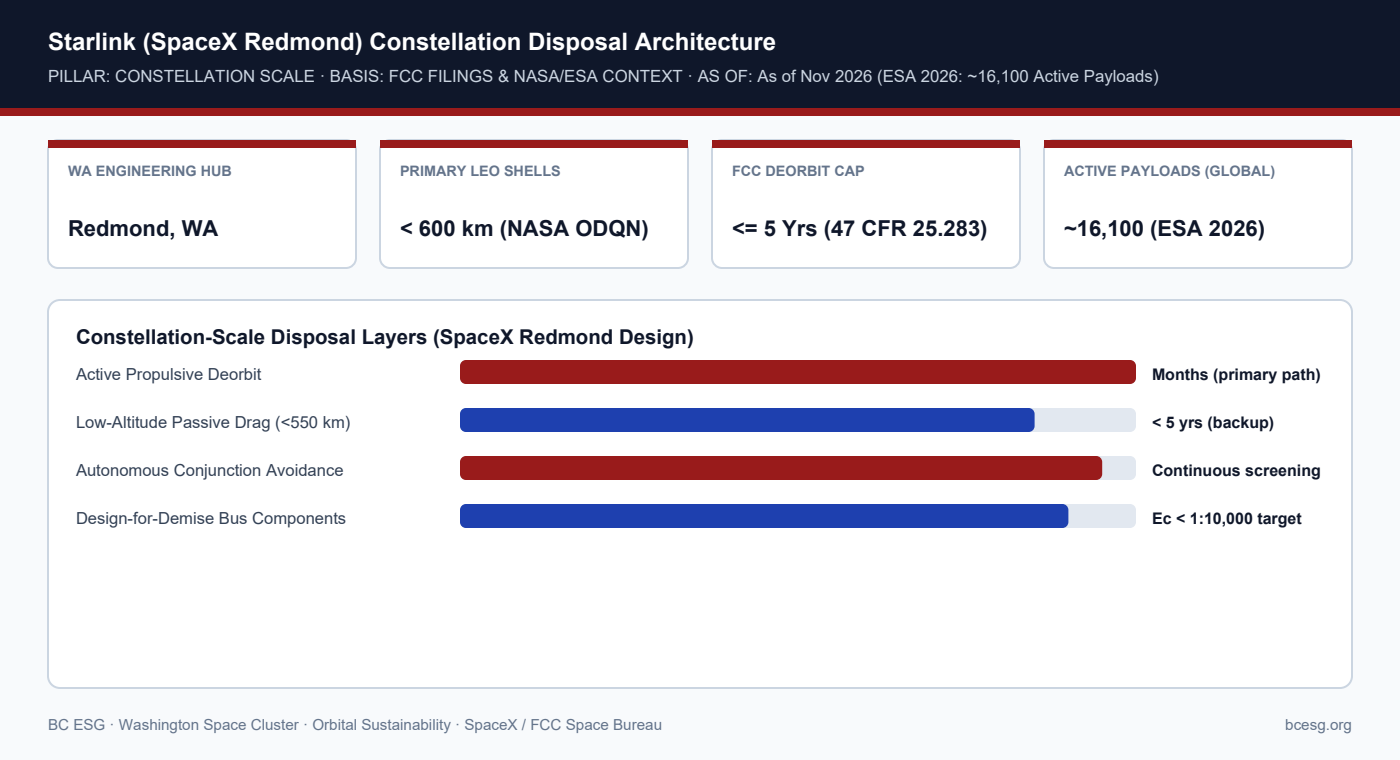
    SpaceX's Redmond-engineered Starlink constellation operates primarily below 600 km, pairing onboard Hall-effect thrusters for active propulsive deorbit with low-altitude passive drag backup and demisable bus design to satisfy FCC 5-year and 1:10,000 limits at fleet scale.
    Primary Authority / Source: SpaceX / FCC Space Bureau  |  As-Of / Horizon: As of Nov 2026 (ESA 2026: ~16,100 Active Payloads)
    ORBITAL SUSTAINABILITY · PDF & MARKDOWN TWIN
    SpaceX Redmond Constellation Disposal — Reference Brief
    Download the 2-page printable reference PDF or read the clean Markdown twin for AI and briefing workflows.
    Starlink (SpaceX Redmond) Constellation Disposal Architecture
    Starlink (SpaceX Redmond) Constellation Disposal Architecture

    Documented Instrument & Engineering Record

    • Redmond engineering anchor: SpaceX's Redmond, WA facility designs and builds Starlink satellites, making Puget Sound a primary engineering center for mega-constellation orbital sustainability.
    • Low-altitude safety net: As noted in NASA ODPO's Orbital Debris Quarterly News (ODQN, 2025–2026), Starlink operates primarily below 600 km—where residual atmospheric drag naturally clears defunct spacecraft well inside the 5-year FCC ceiling even if propulsion fails.
    • Active propulsive deorbit: Nominal end-of-life satellites use onboard electric propulsion to lower perigee rapidly in months rather than waiting years for passive decay.
    • Aggregate casualty scrutiny: At thousands of active satellites—part of ~16,100 functioning payloads worldwide per ESA's 2026 Space Environment Report (data through end of 2025)—regulators evaluate both per-satellite demisability and fleet-wide reentry risk.

    Constellation-Scale Disposal Obligations vs. Single-Satellite Rules

    Compliance DimensionSingle-Satellite BaselineMega-Constellation Multiplier
    Deorbit Timeline<= 5 years post-EOMMonths via propulsive descent; <5-yr passive backup
    Reentry Casualty (Ec)< 1:10,000 per eventFleet-wide demisability or controlled reentry
    Collision AvoidanceManual / ad-hoc maneuversAutonomous onboard conjunction screening
    Propulsion ReliabilityPass/fail single unitStatistical failure-rate disclosure in FCC ODMP

    Mission Designer, Compliance Lead & Founder Takeaways

    • Operating below ~550–600 km provides a physical passive-decay backstop that higher-altitude constellations lack.
    • Suppliers providing avionics, solar arrays, or structural brackets to constellation primes must meet strict material-demisability specs.
    • Every constellation replenishment cycle increases launch cadence and reentry mass—driving regulatory focus on aggregate fleet reliability.

    Connected Census Profiles, Segments & Rules

    Primary Sources & Official Records

  • Orbital Transfer Vehicles & Space Tugs in WA: Disposal & Passivation Duties

    Orbital Transfer Vehicles & Space Tugs in WA: Disposal & Passivation Duties

    Portal Space Systems Bothell expansion ($350K SRF, Dec 2025) verified against Batch 8/Census records; distinguishes roadmap OTVs from operational fleets.

    ORBITAL SUSTAINABILITY · WA SERVICING & HABITATS · FCC PART 25 / NASA ODAR / OPERATOR RECORDS
    WA Orbital Transfer Vehicles & Disposal
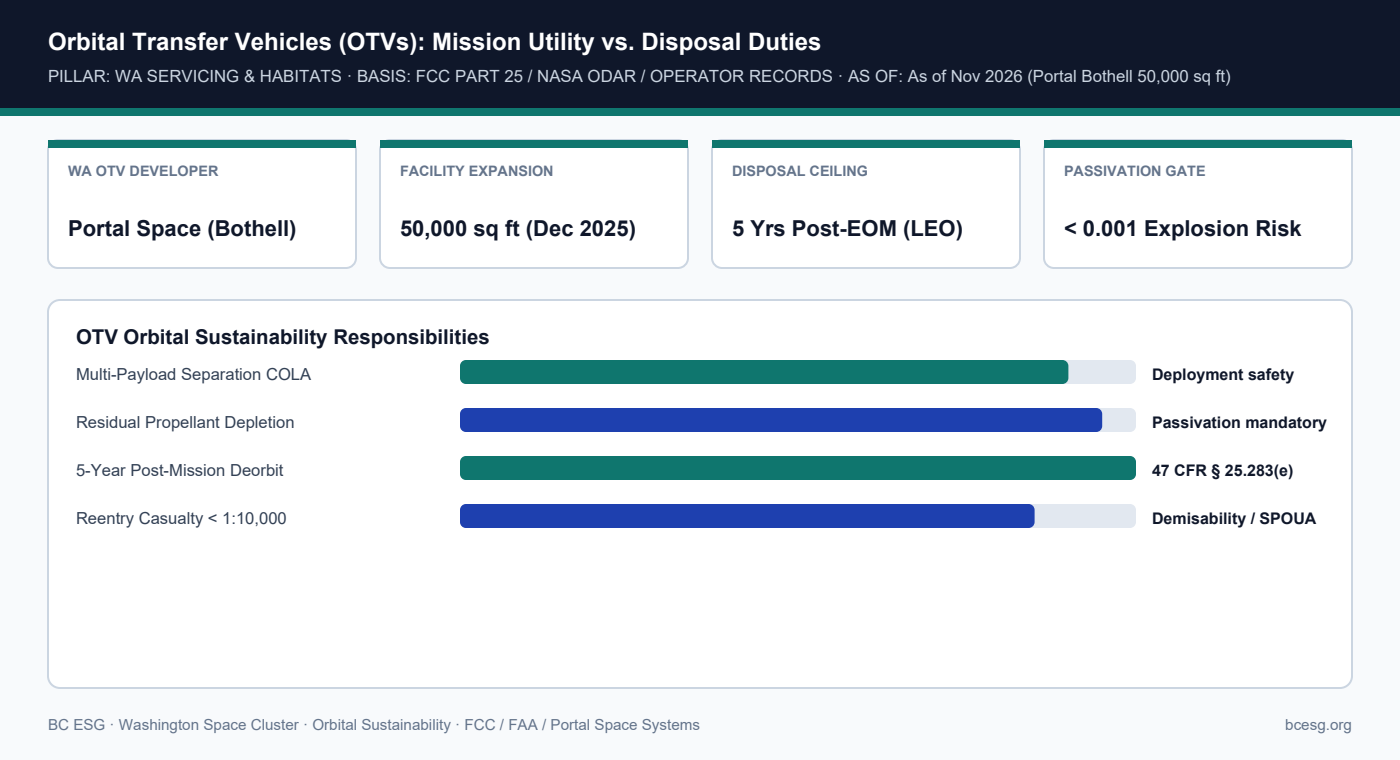
    High-delta-v orbital transfer vehicles (OTVs) and space tugs—including Bothell-based Portal Space Systems' Supernova solar-thermal tug—reduce rideshare deployment clutter by maneuvering payloads, but inherit full FCC 5-year deorbit and passivation duties.
    Primary Authority / Source: FCC / FAA / Portal Space Systems  |  As-Of / Horizon: As of Nov 2026 (Portal Bothell 50,000 sq ft)
    ORBITAL SUSTAINABILITY · PDF & MARKDOWN TWIN
    WA Orbital Transfer Vehicles & Disposal — Reference Brief
    Download the 2-page printable reference PDF or read the clean Markdown twin for AI and briefing workflows.
    Orbital Transfer Vehicles (OTVs): Mission Utility vs. Disposal Duties
    Orbital Transfer Vehicles (OTVs): Mission Utility vs. Disposal Duties

    Documented Instrument & Engineering Record

    • Why OTVs matter for orbital sustainability: Instead of rideshare satellites separating into crowded sun-synchronous drop-off shells without propulsion, OTVs ferry payloads to custom altitudes and inclinations.
    • WA OTV operator: Portal Space Systems (Bothell, WA — 22118 20th Ave SE, awarded $350K WA Strategic Reserve Fund in Dec 2025 for a 50,000 sq ft expansion) is developing the solar-thermal Supernova spacecraft (roadmap hardware).
    • Full spacecraft obligations: Because an OTV remains an active maneuverable space station after payload deployment, it is subject to FCC § 25.283(e) 5-year LEO disposal (or graveyard disposal above LEO), full passivation, and < 1:10,000 reentry casualty limits.
    • High-energy propulsion note: Solar-thermal, bipropellant, or high-pressure electric OTVs carry larger propellant tanks and pressure vessels—making ORSAT demisability and tank venting critical.

    OTV Sustainability & Compliance Obligations

    Lifecycle PhaseOperational ActionGoverning Standard
    Rideshare SeparationVerified deployment timing & COLAFAA Part 450 / FCC ODMP
    Payload FerryingActive collision avoidance maneuversFCC Part 25 / 18th SDS
    End of MissionReserve delta-v for <5-yr LEO deorbit47 CFR § 25.283(e)
    Passivation & ReentryVent tanks + Ec < 1:10,000NASA-STD-8719.14C / ODMSP

    Mission Designer, Compliance Lead & Founder Takeaways

    • Payload customers riding on an OTV must verify in contract who files the FCC ODMP for the host tug versus the deployed free-flyers.
    • Portal Space Systems' Supernova and Starfish Space's Otter represent complementary WA OTV/servicing architectures—both in ground/early flight development rather than mature fleet operations as of November 2026.
    • Always budget OTV EOL deorbit propellant before committing final delta-v to late-manifest payload plane changes.

    Connected Census Profiles, Segments & Rules

    Primary Sources & Official Records

BC ESG

ESG Strategy, Sustainability Intelligence, and Business Continuity for Forward-Thinking Organizations

© 2026 BC ESG — Business Continuity, ESG & Sustainability Intelligence