Grounded in FCC 47 CFR § 25.283(e) and Amazon Leo public disclosures as of 2026-11-16.
ORBITAL SUSTAINABILITY · CONSTELLATION SCALE · FCC LICENSE CONDITIONS & OPERATOR DISCLOSURES
Amazon Leo (Redmond) Disposal Compliance
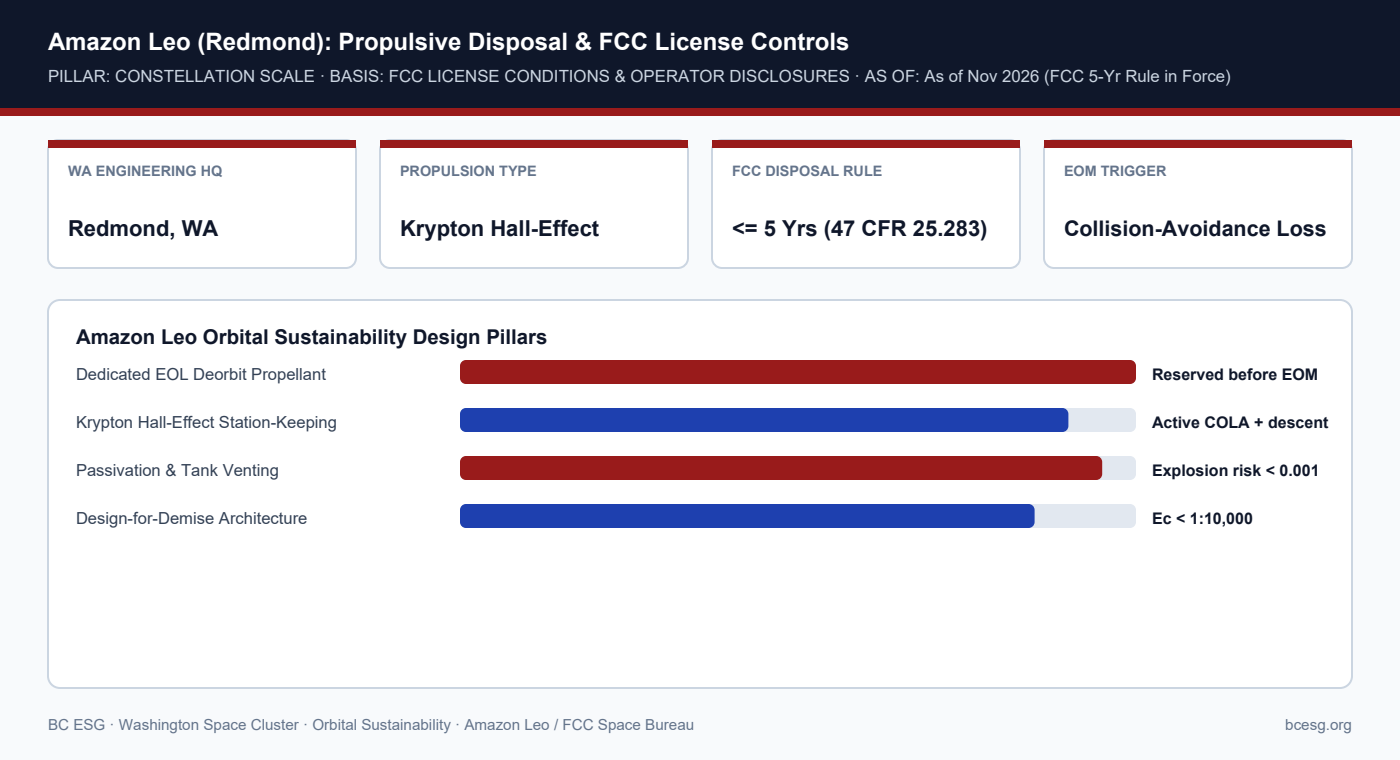
Amazon Leo (formerly Project Kuiper), engineered and operated out of Redmond, WA, integrates krypton Hall-effect thrusters and dedicated end-of-life propellant margins to meet FCC Part 25 orbital debris conditions and 5-year post-mission disposal.
Primary Authority / Source: Amazon Leo / FCC Space Bureau | As-Of / Horizon: As of Nov 2026 (FCC 5-Yr Rule in Force)
Documented Instrument & Engineering Record
- Redmond constellation hub: Amazon Leo (rebranded from Project Kuiper) develops its broadband constellation hardware and mission operations in Redmond, WA.
- Propulsive deorbit necessity: Constellations operating around ~590–630 km cannot rely solely on rapid natural atmospheric decay during solar minima—making onboard krypton Hall-effect propulsion essential for guaranteed <= 5-year disposal.
- Propellant reserve discipline: Under 47 CFR § 25.283(e), end of mission for a maneuverable satellite is triggered when it can no longer perform collision-avoidance maneuvers, requiring operators to lock in deorbit propellant margins before commercial service ends.
- FCC license conditions: Amazon Leo's Part 25 authorization carries ongoing orbital debris reporting, failure-rate tracking, and post-mission disposal verification obligations.
Amazon Leo FCC Orbital Debris Compliance Matrix
| Requirement | Technical Mechanism | Regulatory Instrument |
|---|---|---|
| 5-Year LEO Deorbit | Active krypton Hall-effect descent | 47 CFR § 25.283(e) |
| Collision Avoidance | Automated maneuver + 18th SDS data | FCC Part 25 ODMP |
| Passivation | Propellant depletion + battery disconnect | FCC § 25.283 / ODMSP |
| Reentry Casualty | Demisable materials (< 1:10,000 Ec) | FCC ODMP / NASA-STD-8719.14C |
Mission Designer, Compliance Lead & Founder Takeaways
- Dedicated EOL propellant reserves directly reduce on-orbit commercial revenue life—making thruster Isp and mass-budget optimization a core sustainability-finance tradeoff.
- Redmond suppliers providing propulsion, power, or structural components to Amazon Leo inherit strict traceability for ODMP and demisability compliance.
- Loss of propulsion before EOM triggers contingency reporting and elevates the value of backup deorbit servicing.
Connected Census Profiles, Segments & Rules
- Amazon Leo (Redmond) Census Profile
- End-of-Life Propellant Margin Budgeting
- FCC 5-Year Disposal Rule Mechanics