
Grounded in 47 CFR § 25.283(e) EOM trigger and NASA ODPO orbital lifetime mechanics as of 2026-11-16.
ORBITAL SUSTAINABILITY · CONSTELLATION SCALE · FCC § 25.283(E) & SPACECRAFT SYSTEMS ENGINEERING
EOL Propellant Margin Budgeting
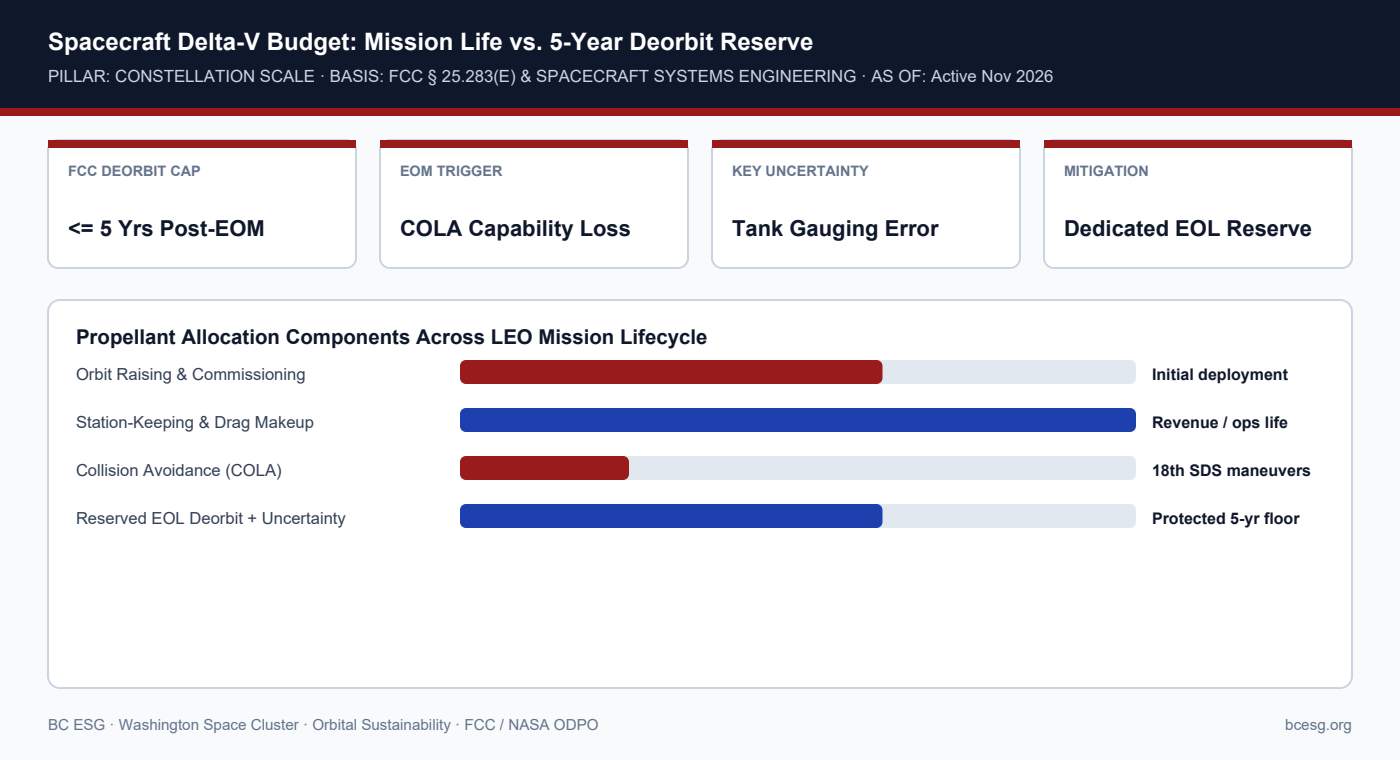
Meeting the FCC 5-year post-mission disposal rule from mid-to-upper LEO shells requires reserving a dedicated end-of-life delta-v budget—forcing mission designers to trade revenue-generating station-keeping life and payload mass against guaranteed deorbit margin.
Primary Authority / Source: FCC / NASA ODPO | As-Of / Horizon: Active Nov 2026
Documented Instrument & Engineering Record
- Why propellant gauging uncertainty matters: Bookkeeping (pressure-volume-temperature and thruster-on-time) errors accumulate over a 5–7 year mission; without a protected reserve floor, a satellite can run dry before its deorbit burn.
- Regulatory lock-in: Because 47 CFR § 25.283(e) defines EOM as the point when a propulsive spacecraft can no longer conduct collision-avoidance maneuvers, operators must initiate disposal *while* sufficient propellant remains.
- Altitude sensitivity: Deorbiting from 1,200 km requires substantially more delta-v than deorbiting from 500 km—making propellant mass fraction a decisive architectural driver.
- Passivation sequencing: After the final perigee-lowering burn, any remaining residual propellant must be vented/depleted to satisfy passivation rules.
Propellant Margin Tradeoffs by LEO Altitude Band
| Altitude Band | Passive Decay Window | Propellant Reserve Strategy |
|---|---|---|
| < 500 km | Typically < 5 years | Small EOL margin; passive drag backs up thruster |
| 500–650 km | Solar-cycle dependent (often >5 yrs) | Active deorbit burn required for guaranteed <=5 yrs |
| 650–2,000 km | Decades to centuries | Large dedicated EOL delta-v + tank-gauging margin |
Mission Designer, Compliance Lead & Founder Takeaways
- Finance and program leads must model the revenue impact of retiring a healthy satellite early to protect its EOL deorbit reserve.
- Electric propulsion (Hall/ion) offers high Isp for lower propellant mass, but requires months-long spiral-down times that must still fit inside the 5-year clock.
- Contracting an in-space servicer (such as Starfish Space's Otter) is a potential contingency if a spacecraft suffers a propulsion failure, not a substitute for initial ODMP propellant budgeting.
Connected Census Profiles, Segments & Rules
- Amazon Leo (Redmond) Disposal Compliance
- Solar-Cycle Drag Uncertainty (<500–600 km)
- FCC 5-Year Disposal Rule Mechanics