
Tracked object count (~46,110, up from ~40,000) and active payloads (~16,100) cited from ESA 2026 Space Environment Report (data through end of 2025).
ORBITAL SUSTAINABILITY · CONSTELLATION SCALE · 18TH SDS / NASA ODPO / FCC PART 25
Conjunction Assessment & Collision Avoidance
With ~46,110 regularly tracked objects in orbit (ESA 2026 Space Environment Report, data through end of 2025), constellation operators rely on 18th Space Defense Squadron (Space-Track) Conjunction Data Messages (CDMs) and automated maneuver thresholds (~10^-4 to 10^-5 Pc) to prevent collisions.
Primary Authority / Source: 18th SDS / NASA / FCC | As-Of / Horizon: As of Nov 2026 (ESA 2026: ~46,110 Tracked Objects)
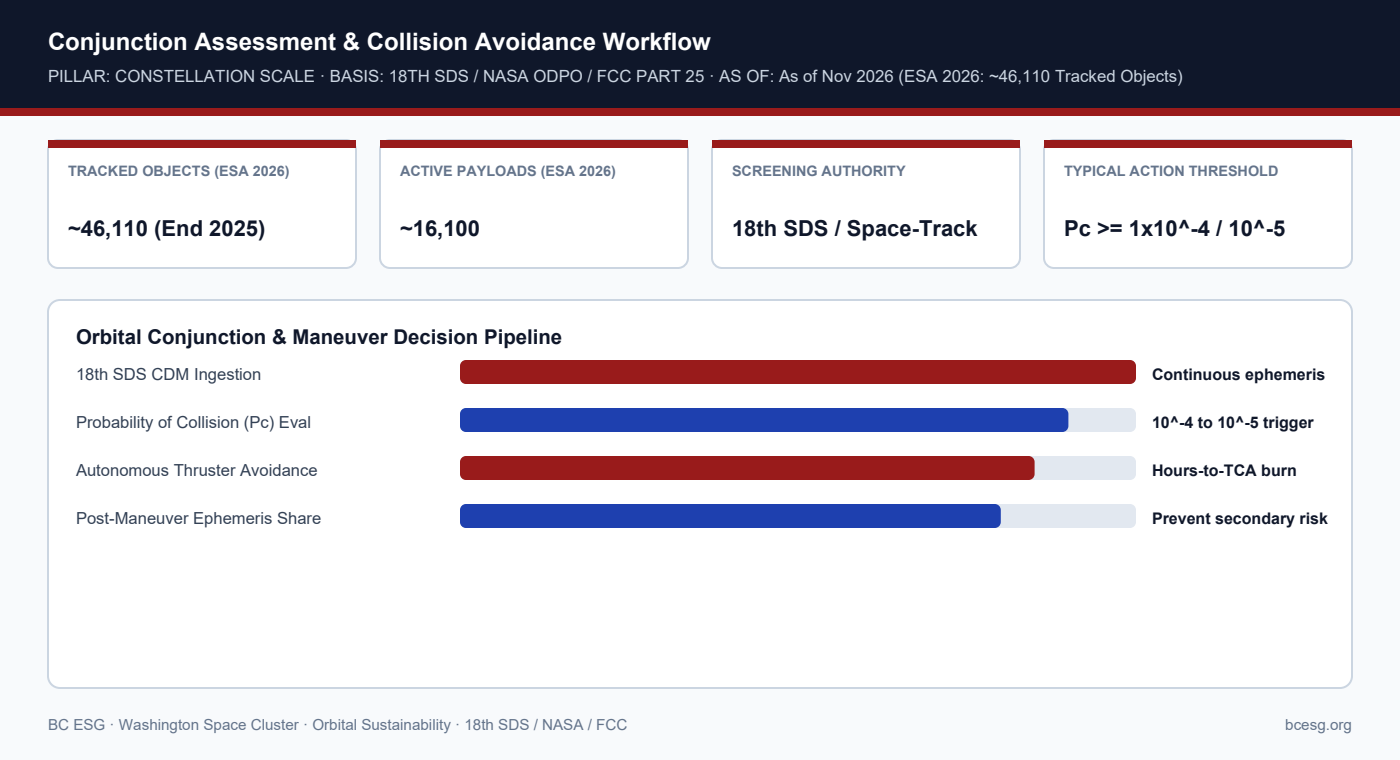
Documented Instrument & Engineering Record
- Catalog growth: ESA's 2026 Space Environment Report (data through end of 2025) counts ~46,110 regularly tracked objects (up from ~40,000 in the 2025 report) and ~16,100 functioning payloads.
- CDM screening: The U.S. 18th Space Defense Squadron (via Space-Track.org) distributes Conjunction Data Messages (CDMs) when predicted miss distances cross screening volumes.
- Action thresholds: NASA and commercial constellation operators commonly trigger collision-avoidance maneuvers when Probability of Collision (Pc) reaches 10^-4 (red) or 10^-5 (yellow/constellation-tight) thresholds.
- FCC EOM link: Under 47 CFR § 25.283(e), losing the ability to execute collision-avoidance maneuvers defines End of Mission for propulsive satellites—starting the 5-year disposal clock.
Conjunction Assessment & Maneuver Parameters
| Parameter | Operational Practice | Sustainability Impact |
|---|---|---|
| Ephemeris Sharing | Publish predictive ephemerides to Space-Track | Reduces covariance uncertainty across fleets |
| Pc Maneuver Threshold | Typically 10^-4 (NASA) to 10^-5 (constellations) | Prevents catastrophic breakups |
| Automated Execution | Onboard / ground-automated burn planning | Scales across thousands of satellites |
| Propellant Budget | Tracked against EOL deorbit reserve | Triggers EOM when reserve floor is hit |
Mission Designer, Compliance Lead & Founder Takeaways
- High-drag solar-storm events alter atmospheric density rapidly, degrading orbit predictions and increasing false-alarm CDM rates.
- Manual spreadsheet-based conjunction screening fails above a few dozen satellites; automated CDM pipelines are mandatory for constellation licenses.
- Every avoidance burn consumes delta-v that must be accounted for in the end-of-life disposal propellant budget.
Connected Census Profiles, Segments & Rules
- Tracked Objects vs. Modeled Debris (2026)
- SpaceX Redmond Constellation Disposal
- End-of-Life Propellant Margin Budgeting