Grounded in NASA ODPO DAS orbital lifetime modeling principles and 47 CFR § 25.283(e) as of 2026-11-16.
ORBITAL SUSTAINABILITY · MEASUREMENT & ESG GAP · NASA ODPO / THERMOSPHERIC PHYSICS
Solar-Cycle Drag & 5-Year Decay Limits
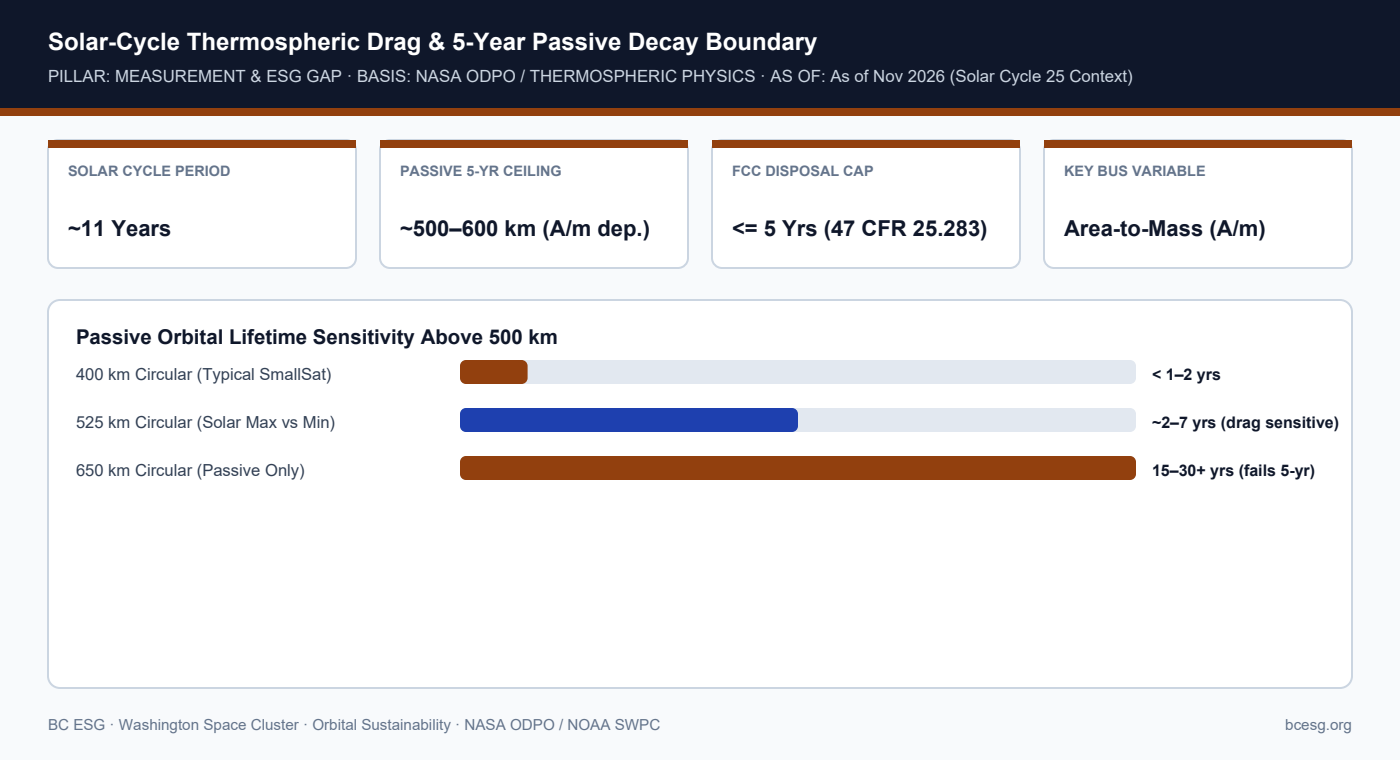
Upper-atmospheric density in LEO varies by an order of magnitude across the ~11-year solar cycle—meaning a satellite that decays within 5 years at solar maximum can remain in orbit for 15–25+ years at solar minimum if launched above ~500–600 km without propulsion.
Primary Authority / Source: NASA ODPO / NOAA SWPC | As-Of / Horizon: As of Nov 2026 (Solar Cycle 25 Context)
Documented Instrument & Engineering Record
- Solar flux drives drag: Extreme ultraviolet (EUV) radiation heats and expands Earth's thermosphere during solar maximum, accelerating orbital decay; during solar minimum, the thermosphere contracts and drag drops sharply.
- Why ~500–600 km is the cliff: Depending on ballistic coefficient (area-to-mass ratio, A/m), passive unpropelled satellites above ~500–600 km routinely exceed the FCC 5-year post-mission disposal cap during solar minimum.
- DAS modeling requirement: NASA's Debris Assessment Software (DAS) requires propagating orbital lifetime across realistic solar-flux projections—not cherry-picking solar-maximum density.
- Drag-sail caveats: Deployable drag sails increase A/m to shorten decay, but also increase collision cross-section area during descent.
Passive Decay vs. Propulsive Deorbit Design Choices
| Design Option | Altitude Suitability | FCC 5-Year Risk |
|---|---|---|
| Low-LEO Deployment (<500 km) | High-drag shells | Low risk; shortens mission life without reboost |
| Deployable Drag Sail | ~500–650 km SmallSats | Increases collision area; deployment reliability risk |
| Onboard Propulsion | All LEO shells up to 2,000 km | Lowest timeline risk if EOL fuel reserved |
Mission Designer, Compliance Lead & Founder Takeaways
- Mission designers launching into 550–650 km sun-synchronous rideshares without propulsion face high FCC ODMP rejection or waiver risk.
- Always run sensitivity sweeps in DAS across both 50th-percentile and conservative low-solar-flux scenarios.
- Station-keeping propulsion for lifetime extension at 450 km simultaneously solves the 5-year disposal problem.
Connected Census Profiles, Segments & Rules
- FCC 5-Year Disposal Rule Mechanics
- EOL Propellant Margin Budgeting
- NASA ODAR Contract Deliverable Guide