
Primary-source check against 47 CFR § 25.283(e) (eCFR) as of 2026-11-16; distinct from Batch 5 status verdict #1960.
ORBITAL SUSTAINABILITY · DISPOSAL REGIME · FEDERAL REGULATION (47 CFR § 25.283(E))
FCC 5-Year Disposal Rule Mechanics
Under 47 CFR § 25.283(e), space stations ending missions in or passing through Low Earth Orbit below 2,000 km must complete atmospheric reentry as soon as practicable and no later than 5 years after end of mission—replacing the legacy 25-year guideline.
Primary Authority / Source: FCC Space Bureau / eCFR | As-Of / Horizon: Effective Sept 9, 2024; Compliance Sept 29, 2024
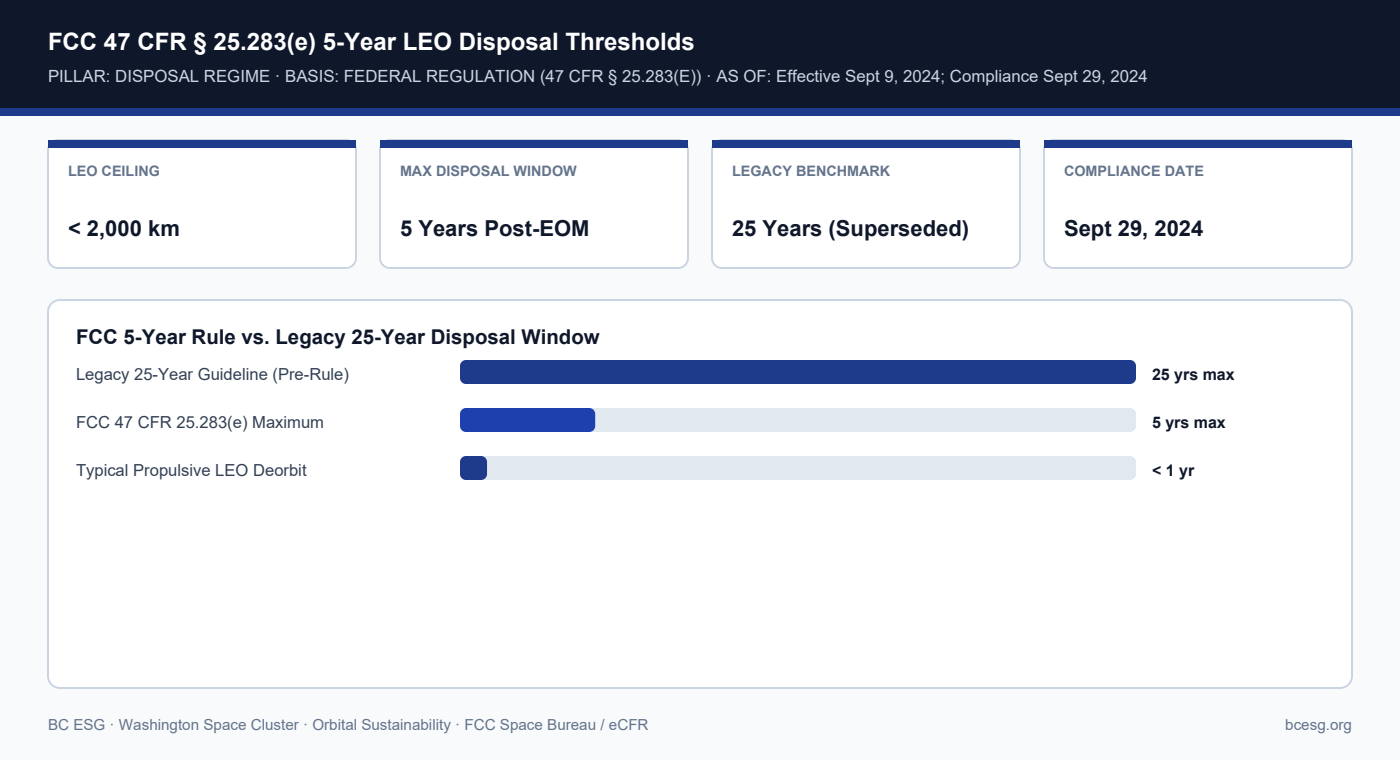
Documented Instrument & Engineering Record
- Altitude scope: Applies to all U.S.-licensed satellites (Part 25) and non-U.S. satellites seeking U.S. market access whose missions end in or pass through LEO below 2,000 km.
- End-of-mission (EOM) trigger: For spacecraft with propulsion and collision avoidance, EOM occurs when the satellite can no longer conduct collision-avoidance maneuvers; for non-maneuverable spacecraft, EOM is completion of the primary mission.
- Grandfathering boundary: Satellites already in orbit prior to the September 29, 2024 compliance date (and certain grandfathered authorizations) remain under prior license terms unless modified.
- Angle split with Batch 5: Batch 5 Post #1960 establishes that the rule is LIVE; this brief details the engineering triggers, EOM definition, and waiver/licensing mechanics required of mission designers.
47 CFR § 25.283(e) Instrument Parameters
| Parameter | Instrument Requirement | Engineering Impact |
|---|---|---|
| Altitude Scope | LEO region below 2,000 km | Covers nearly all WA constellation & EO orbits |
| Disposal Deadline | As soon as practicable; <= 5 years post-EOM | Forces propulsion or <=500 km deployment |
| EOM Trigger (Propulsive) | Loss of collision-avoidance capability | Requires reserved EOL propellant before depletion |
| EOM Trigger (Non-Propulsive) | Completion of primary mission | Passive drag must decay orbit within 5 years |
| Jurisdictional Reach | U.S. Part 25 + non-U.S. market access | Binds foreign operators serving U.S. customers |
Mission Designer, Compliance Lead & Founder Takeaways
- Mission designers cannot treat 5 years as a passive-drag guarantee above ~500–600 km; solar-cycle minima can push unpropelled decay past 5 years.
- Compliance leads must align FCC Orbital Debris Mitigation Plan (ODMP) disclosures with propellant-reserve telemetry and EOM triggers.
- WA constellation operators (SpaceX Redmond, Amazon Leo, BlackSky) and servicing providers (Starfish Space) design directly around this 5-year ceiling.
Connected Census Profiles, Segments & Rules
- Batch 5 Verdict: FCC 5-Year Deorbit Rule (LIVE)
- WA Space Cluster Hub
- Amazon Leo (Redmond) Census Profile
- SpaceX Redmond Census Profile