Portal Space Systems Bothell expansion ($350K SRF, Dec 2025) verified against Batch 8/Census records; distinguishes roadmap OTVs from operational fleets.
ORBITAL SUSTAINABILITY · WA SERVICING & HABITATS · FCC PART 25 / NASA ODAR / OPERATOR RECORDS
WA Orbital Transfer Vehicles & Disposal
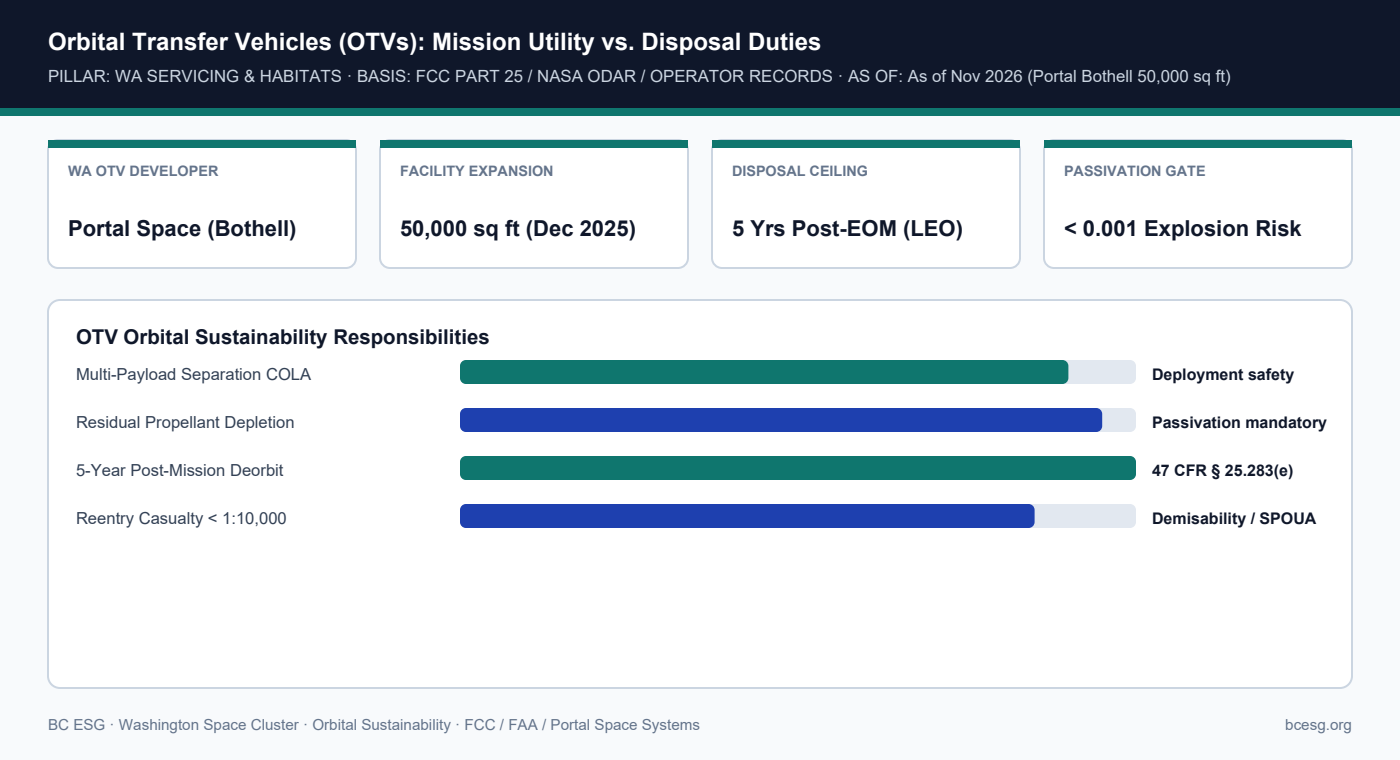
High-delta-v orbital transfer vehicles (OTVs) and space tugs—including Bothell-based Portal Space Systems' Supernova solar-thermal tug—reduce rideshare deployment clutter by maneuvering payloads, but inherit full FCC 5-year deorbit and passivation duties.
Primary Authority / Source: FCC / FAA / Portal Space Systems | As-Of / Horizon: As of Nov 2026 (Portal Bothell 50,000 sq ft)
Documented Instrument & Engineering Record
- Why OTVs matter for orbital sustainability: Instead of rideshare satellites separating into crowded sun-synchronous drop-off shells without propulsion, OTVs ferry payloads to custom altitudes and inclinations.
- WA OTV operator: Portal Space Systems (Bothell, WA — 22118 20th Ave SE, awarded $350K WA Strategic Reserve Fund in Dec 2025 for a 50,000 sq ft expansion) is developing the solar-thermal Supernova spacecraft (roadmap hardware).
- Full spacecraft obligations: Because an OTV remains an active maneuverable space station after payload deployment, it is subject to FCC § 25.283(e) 5-year LEO disposal (or graveyard disposal above LEO), full passivation, and < 1:10,000 reentry casualty limits.
- High-energy propulsion note: Solar-thermal, bipropellant, or high-pressure electric OTVs carry larger propellant tanks and pressure vessels—making ORSAT demisability and tank venting critical.
OTV Sustainability & Compliance Obligations
| Lifecycle Phase | Operational Action | Governing Standard |
|---|---|---|
| Rideshare Separation | Verified deployment timing & COLA | FAA Part 450 / FCC ODMP |
| Payload Ferrying | Active collision avoidance maneuvers | FCC Part 25 / 18th SDS |
| End of Mission | Reserve delta-v for <5-yr LEO deorbit | 47 CFR § 25.283(e) |
| Passivation & Reentry | Vent tanks + Ec < 1:10,000 | NASA-STD-8719.14C / ODMSP |
Mission Designer, Compliance Lead & Founder Takeaways
- Payload customers riding on an OTV must verify in contract who files the FCC ODMP for the host tug versus the deployed free-flyers.
- Portal Space Systems' Supernova and Starfish Space's Otter represent complementary WA OTV/servicing architectures—both in ground/early flight development rather than mature fleet operations as of November 2026.
- Always budget OTV EOL deorbit propellant before committing final delta-v to late-manifest payload plane changes.
Connected Census Profiles, Segments & Rules
- Portal Space Systems Census Profile
- Portal Space Strategic Reserve Fund ($350K)
- Passivation & Stored-Energy Guide