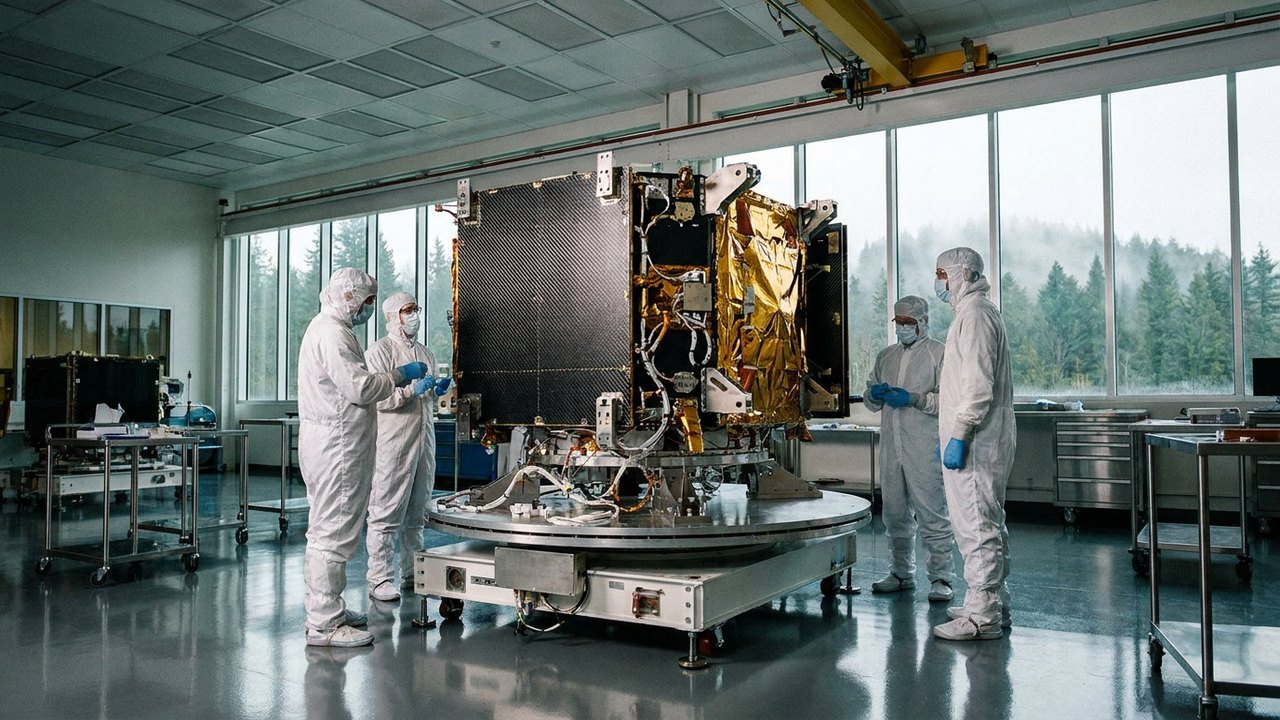
Category: Space Cluster Orbital Sustainability

FCC 5-year post-mission disposal (47 CFR 25.283(e)), NASA ODAR/STD-8719.14C contract deliverables, FAA Part 450, NOAA Part 960, WA servicing & habitat operators (Starfish Space, Gravitics, Portal), constellation scale (SpaceX Redmond, Amazon Leo, BlackSky), ESA/NASA debris measurement, and the orbital Scope 3/ESG standard gap.

  • Satellite Life Extension vs. Active Debris Removal (ADR): Economics & Disposal Handoff

    Satellite Life Extension vs. Active Debris Removal (ADR): Economics & Disposal Handoff

    Comparative analysis grounded in Starfish Space public contracts (SDA/SES/NASA) and FCC/ESA frameworks as of 2026-11-16.

    ORBITAL SUSTAINABILITY · WA SERVICING & HABITATS · AGENCY CONTRACTS & COMMERCIAL MODELS
    Life Extension vs. Active Debris Removal
    In-space servicing splits into revenue-generating life extension (station-keeping for active GEO/LEO assets) and Active Debris Removal (deorbiting defunct satellites or rocket bodies)—with different payers, liability rules, and FCC/ODAR disposal handoffs.
    Primary Authority / Source: USSF SDA / NASA / ESA  |  As-Of / Horizon: As of Nov 2026
    ORBITAL SUSTAINABILITY · PDF & MARKDOWN TWIN
    Life Extension vs. Active Debris Removal — Reference Brief
    Download the 2-page printable reference PDF or read the clean Markdown twin for AI and briefing workflows.
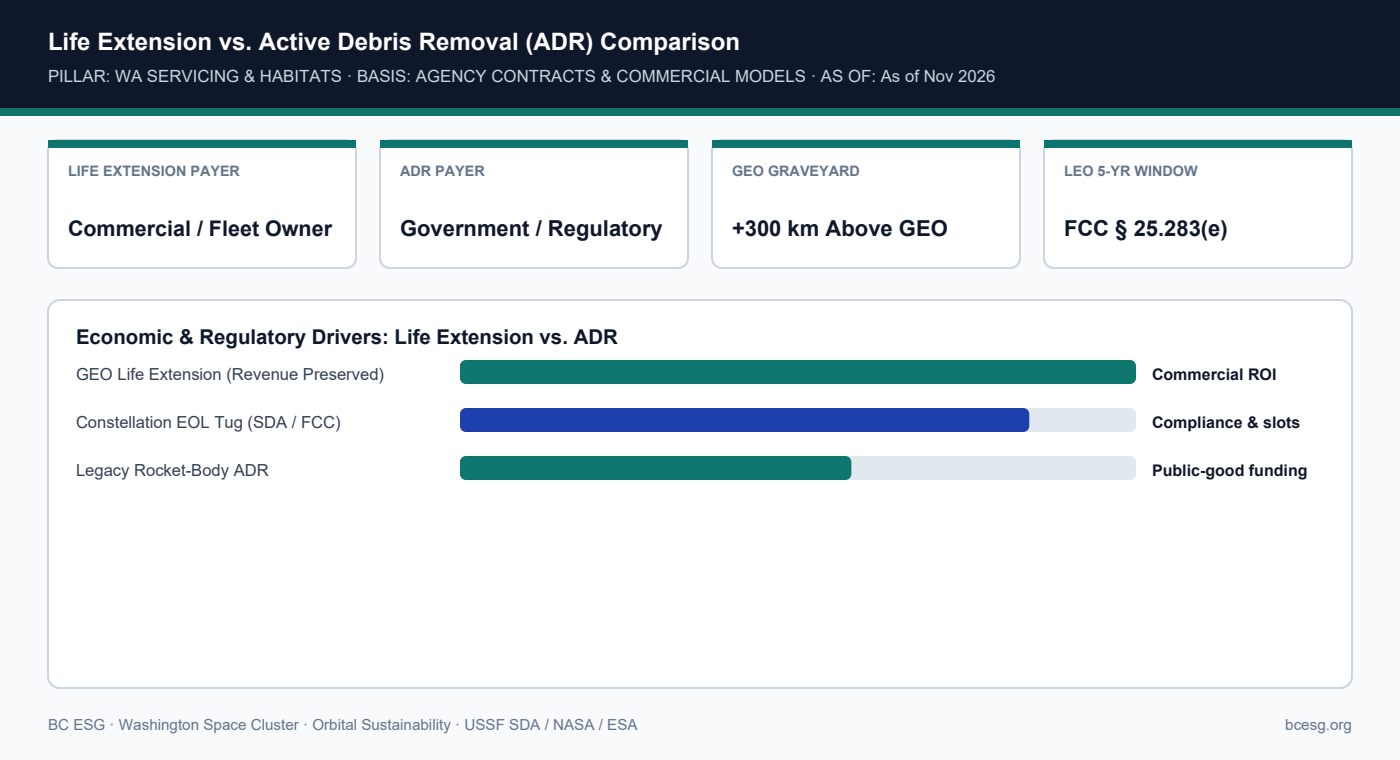
    Life Extension vs. Active Debris Removal (ADR) Comparison
    Life Extension vs. Active Debris Removal (ADR) Comparison

    Documented Instrument & Engineering Record

    • Two distinct business models: Life extension extends revenue on healthy spacecraft whose propellant is nearly exhausted; ADR removes non-functional objects that generate zero revenue for an owner.
    • Why ADR relies on government contracts: Because no private operator earns revenue from removing legacy defunct rocket bodies, ADR is funded primarily by agencies (such as USSF SDA, NASA, or ESA) or triggered by regulatory disposal mandates.
    • Disposal handoff: Under FCC § 25.283(e), an operator that loses propulsion in LEO faces a 5-year disposal clock—creating a commercial market for contracted EOL deorbit tugs.
    • GEO vs. LEO physics: In GEO, servicers provide station-keeping or move clients to a graveyard orbit (~300 km above GEO); in LEO, servicers lower perigee for atmospheric reentry.

    Life Extension vs. Active Debris Removal (ADR) Matrix

    DimensionLife ExtensionActive Debris Removal (ADR)
    Target AssetFuel-depleted but functional satelliteDefunct satellite or spent upper stage
    Primary BuyerCommercial fleet operator (e.g., GEO)Government (SDA, NASA, ESA) / compliance
    Orbital ActionStation-keeping / orbit raisePerigee lowering for reentry / graveyard
    Liability PostureContractual service agreementRequires owner consent + govt coordination

    Mission Designer, Compliance Lead & Founder Takeaways

    • Compliance leads should not count on unproven third-party ADR as a primary FCC ODMP baseline; regulators expect onboard propulsion or low-altitude passive decay first.
    • Servicers like Starfish Space bridge both markets—targeting commercial GEO life extension alongside Space Force SDA LEO disposal contracts.
    • Every servicing vehicle must itself comply with 5-year disposal and passivation rules after completing its final client mission.

    Connected Census Profiles, Segments & Rules

    Primary Sources & Official Records

  • Rendezvous & Proximity Operations (RPO) with Unprepared Satellites: Technical & Licensing Gates

    Rendezvous & Proximity Operations (RPO) with Unprepared Satellites: Technical & Licensing Gates

    Regulatory gates verified against 47 CFR Part 25 and 15 CFR Part 960 as of 2026-11-16.

    ORBITAL SUSTAINABILITY · WA SERVICING & HABITATS · FCC / NOAA / NASA RPO STANDARDS
    RPO with Unprepared Satellites
    Docking with or servicing an uncooperative or unprepared client satellite—the core capability tested by Starfish Space's Otter Pup 2 and Remora—triggers multi-agency RPO disclosures, non-interference RF rules, and NOAA imaging-of-space-objects review.
    Primary Authority / Source: FCC / NOAA / NASA  |  As-Of / Horizon: Active Nov 2026
    ORBITAL SUSTAINABILITY · PDF & MARKDOWN TWIN
    RPO with Unprepared Satellites — Reference Brief
    Download the 2-page printable reference PDF or read the clean Markdown twin for AI and briefing workflows.
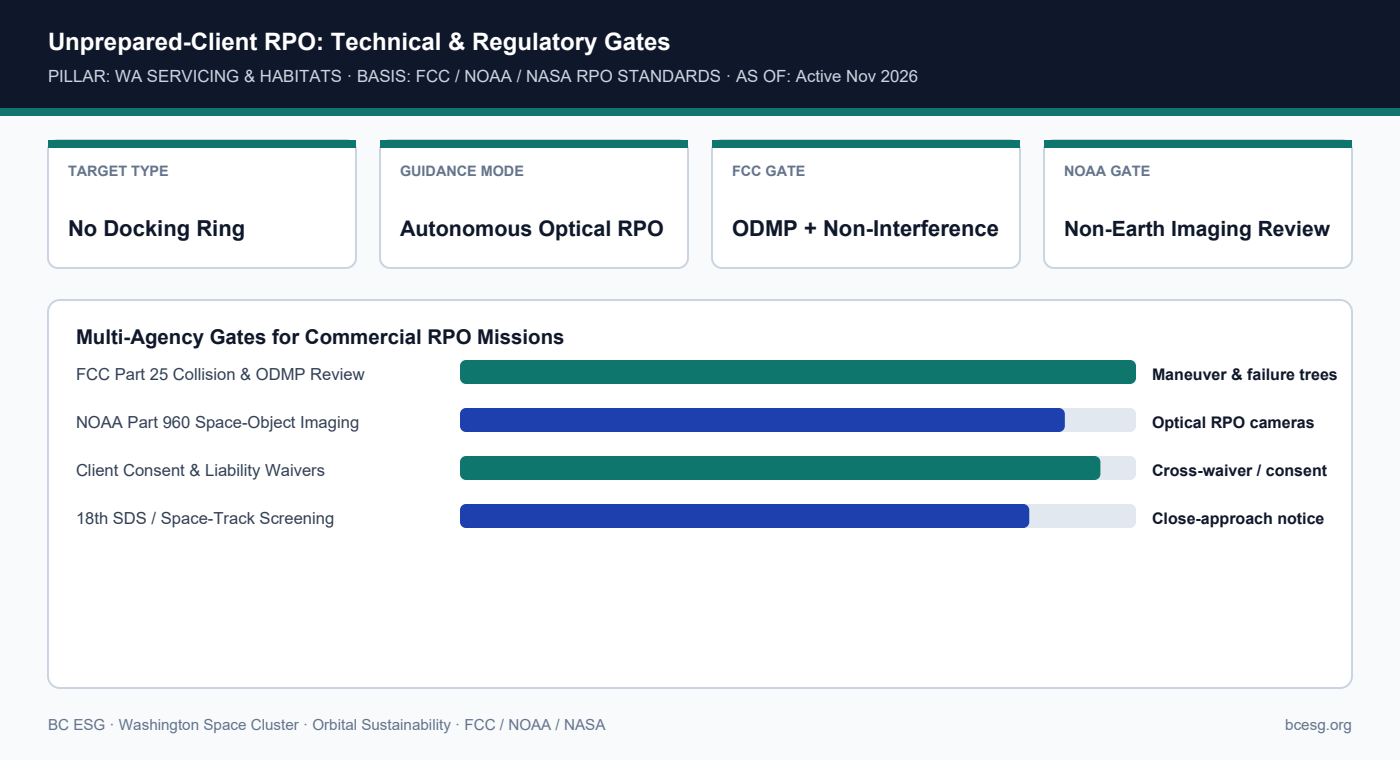
    Unprepared-Client RPO: Technical & Regulatory Gates
    Unprepared-Client RPO: Technical & Regulatory Gates

    Documented Instrument & Engineering Record

    • Why unprepared clients matter: Nearly all legacy LEO and GEO satellites launched before 2024 lack standardized grappling fixtures, fiducial markers, or refueling ports.
    • Technical risk: Tumbling rates, plume impingement from servicer thrusters, and optical sensor glare complicate close-range capture.
    • FCC licensing gate: RPO operators must disclose approach trajectories, abort/safe-mode corridors, and combined-stack disposal plans in their FCC Part 25 or Part 5 ODMP.
    • NOAA Part 960 intersection: Optical cameras used for RPO navigation can trigger NOAA remote-sensing review when imaging other artificial space objects.

    RPO Licensing & Engineering Gate Matrix

    GateGoverning AuthorityRequired Proof
    Safe-Approach TrajectoryFCC Part 25 / Part 5Passive-safe abort ellipse if thrusters fail
    RPO Optical SensorsNOAA 15 CFR Part 960Non-Earth imaging / shutter-control clearance
    Combined-Stack DisposalFCC § 25.283 / NASA ODARPassivation & deorbit math for mated stack
    Third-Party LiabilityCommercial Contract / FAAClient consent & cross-waiver of liability

    Mission Designer, Compliance Lead & Founder Takeaways

    • An RPO servicer cannot legally approach or capture a third-party satellite without explicit operator consent and U.S. government coordination.
    • Designers should model the *combined* servicer-plus-client mass and cross-section for post-capture 5-year deorbit and 1:10,000 casualty risk.
    • Starfish Space's Remora (Dec 2025) proved single-camera closed-loop RPO software, reducing hardware mass for future Otter missions.

    Connected Census Profiles, Segments & Rules

    Primary Sources & Official Records

  • Gravitics (Marysville): StarMax Modules, Axiom & SpaceWERX Contracts, and Station EOL

    Gravitics (Marysville): StarMax Modules, Axiom & SpaceWERX Contracts, and Station EOL

    Contract figures ($125M Axiom, $1.7M SpaceWERX) and Marysville facility (42,000 sq ft) verified as of 2026-11-16; distinguishes ground production from orbital deployment.

    ORBITAL SUSTAINABILITY · WA SERVICING & HABITATS · OPERATOR RELEASES & CONTRACT RECORDS
    Gravitics StarMax & Station EOL
    Marysville-based Gravitics manufactures large-diameter StarMax pressurized space-station modules under a $125M Axiom Space contract and a $1.7M SpaceWERX TacRS contract; commercial orbital habitats carry heavy controlled-reentry obligations at end of life.
    Primary Authority / Source: Gravitics / Axiom / SpaceWERX  |  As-Of / Horizon: As of Nov 2026 (42,000 sq ft Marysville Facility)
    ORBITAL SUSTAINABILITY · PDF & MARKDOWN TWIN
    Gravitics StarMax & Station EOL — Reference Brief
    Download the 2-page printable reference PDF or read the clean Markdown twin for AI and briefing workflows.
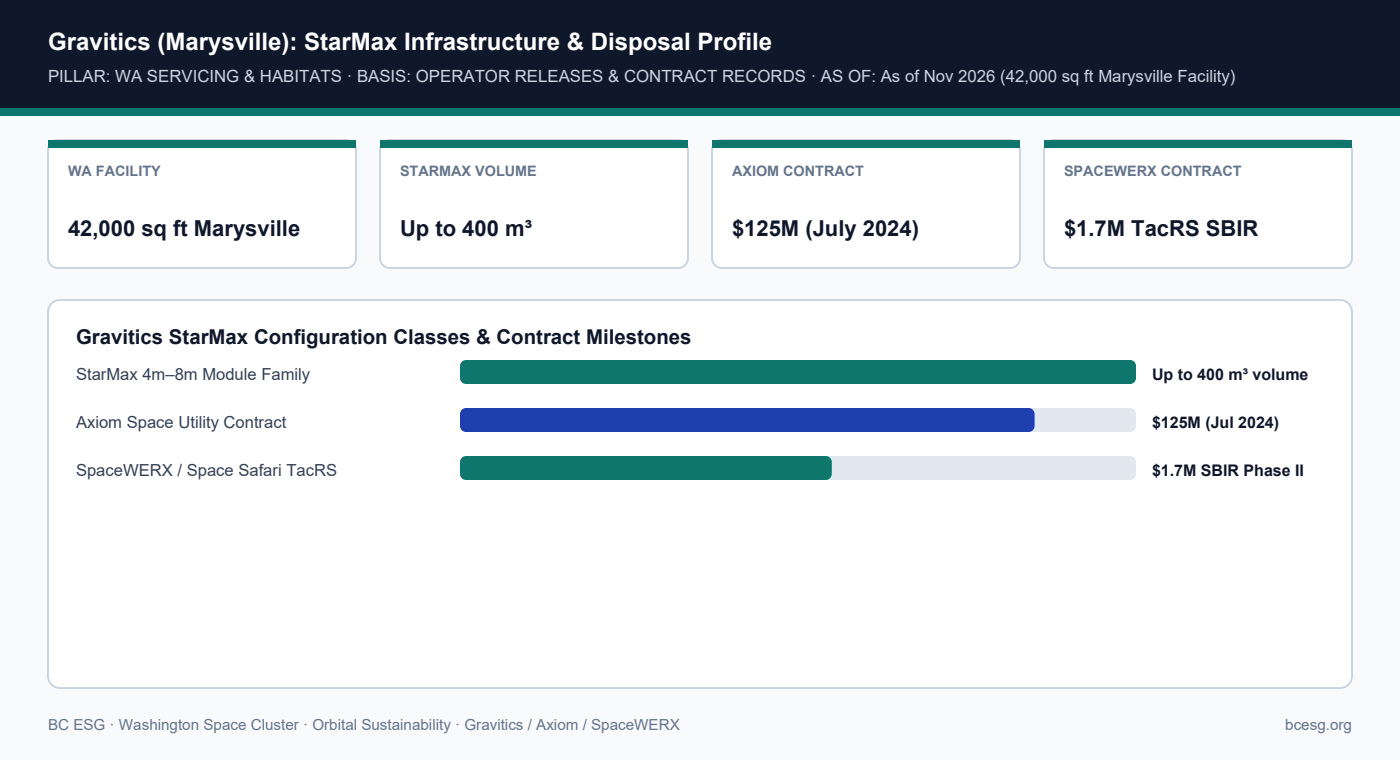
    Gravitics (Marysville): StarMax Infrastructure & Disposal Profile
    Gravitics (Marysville): StarMax Infrastructure & Disposal Profile

    Documented Instrument & Engineering Record

    • Manufacturing footprint: Gravitics operates a 42,000 sq ft development and production facility at Cascade Industrial Center in Marysville, WA (4150 152nd St NE).
    • Contracted programs (roadmap hardware, not yet in orbit): Gravitics holds a $125M contract with Axiom Space (July 2024) for commercial station module utility infrastructure and a $1.7M SpaceWERX SBIR Phase II contract for Tactically Responsive Space (TacRS) orbital platforms.
    • Orbital sustainability implication: Large pressurized modules (4m, 6m, and 8m class, up to 400 m³) far exceed the 1:10,000 uncontrolled reentry casualty threshold due to dense structural rings, hatches, and pressure vessels.
    • Controlled deorbit requirement: Any commercial station or heavy orbital platform using StarMax-class structures must plan controlled propulsive reentry (such as an attached deorbit tug) into SPOUA.

    Gravitics Programs & Orbital End-of-Life Implications

    Program / AssetStatus (Nov 2026)Orbital Disposal Requirement
    Marysville Cascade FacilityOperational (42,000 sq ft)Ground structural & integration prototyping
    Axiom Space Module ContractContracted ($125M, roadmap)Requires controlled station deorbit vehicle at EOL
    SpaceWERX TacRS PlatformContracted ($1.7M, roadmap)DoD/NASA ODAR & controlled/demisable disposal

    Mission Designer, Compliance Lead & Founder Takeaways

    • Commercial space stations replacing the ISS inherit the same controlled-reentry engineering burden as legacy station programs.
    • Pressurized module designers must plan docking/berthing interfaces not only for visiting crew/cargo vehicles but also for end-of-life deorbit tugs.
    • Gravitics' Marysville hardware remains in ground development/production rather than on-orbit operation as of November 2026.

    Connected Census Profiles, Segments & Rules

    Primary Sources & Official Records

  • Starfish Space (Tukwila): Otter & Otter Pup 2 / Remora Demonstrated RPO vs. Roadmap

    Starfish Space (Tukwila): Otter & Otter Pup 2 / Remora Demonstrated RPO vs. Roadmap

    Distinguishes demonstrated 2025 missions (Otter Pup 2, Remora) from 2026–2027 planned full-scale Otter missions as of 2026-11-16.

    ORBITAL SUSTAINABILITY · WA SERVICING & HABITATS · OPERATOR RELEASES & AGENCY CONTRACTS
    Starfish Space Otter Servicing Record
    Tukwila-based Starfish Space demonstrated autonomous rendezvous and proximity operations (RPO) on Otter Pup 2 (launched June 23, 2025) and Remora (December 2025) and raised $100M+ Series B in April 2026—while its full-scale Otter commercial/SDA/NASA servicing missions remain 2026–2027 roadmap deployments.
    Primary Authority / Source: Starfish Space / NASA / USSF SDA  |  As-Of / Horizon: As of Nov 2026 (Otter Pup 2 Jun 2025; Remora Dec 2025)
    ORBITAL SUSTAINABILITY · PDF & MARKDOWN TWIN
    Starfish Space Otter Servicing Record — Reference Brief
    Download the 2-page printable reference PDF or read the clean Markdown twin for AI and briefing workflows.
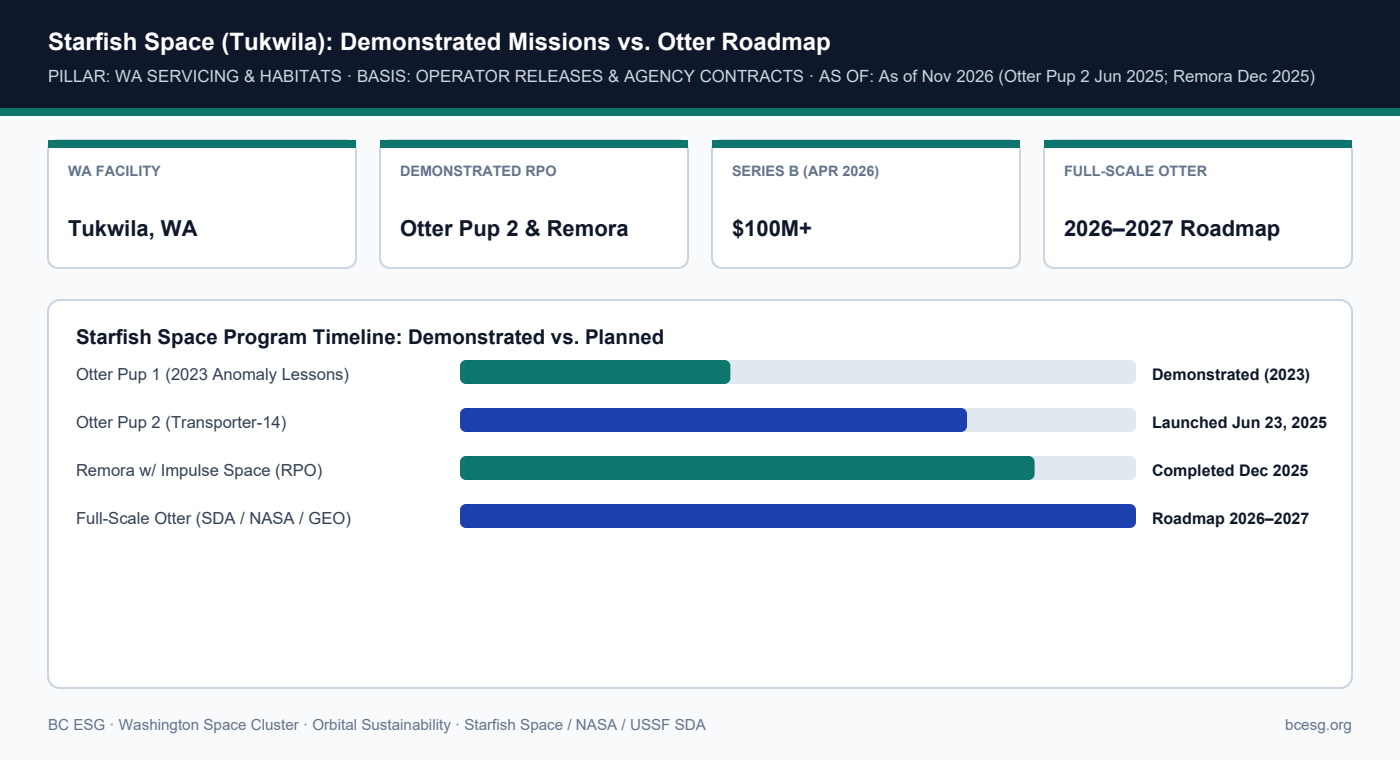
    Starfish Space (Tukwila): Demonstrated Missions vs. Otter Roadmap
    Starfish Space (Tukwila): Demonstrated Missions vs. Otter Roadmap

    Documented Instrument & Engineering Record

    • Demonstrated record (not roadmap): Otter Pup 2 launched June 23, 2025 aboard SpaceX Transporter-14 to attempt docking with an unprepared D-Orbit ION satellite; in December 2025, Starfish and Impulse Space completed the Remora autonomous single-camera RPO mission in LEO.
    • Roadmap boundary (planned, not yet accomplished): Full-scale Otter servicing vehicles—supporting U.S. Space Force Space Development Agency (SDA) end-of-life constellation disposal, NASA, and commercial GEO operators (SES/Intelsat)—are contracted roadmap missions slated for 2026–2027.
    • Capture mechanism: Starfish's Nautilus capture mechanism targets unprepared client satellites without requiring pre-installed docking rings or refueling ports.
    • WA footprint: Headquartered and manufacturing in Tukwila, WA (665 Andover Park W), backed by a $100M+ Series B announced in April 2026.

    Starfish Space: Demonstrated Flight Record vs. Contracted Roadmap

    Program / MissionStatus (Nov 2026)Mission Scope
    Otter Pup 1 (2023)Demonstrated (with anomalies)Initial RPO & docking pathfinder
    Otter Pup 2 (Jun 2025)Demonstrated (Launched)LEO RPO & unprepared D-Orbit ION docking test
    Remora (Dec 2025)Demonstrated (Completed)Autonomous closed-loop RPO w/ Impulse Space
    Full-Scale Otter (SDA/NASA/SES)Planned Roadmap (2026–2027)End-of-life disposal & GEO life extension

    Mission Designer, Compliance Lead & Founder Takeaways

    • Compliance teams evaluating Starfish Space for backup deorbit coverage must distinguish demonstrated RPO software from yet-to-fly full-scale Otter vehicles.
    • FCC 5-year disposal rules create direct commercial demand for third-party tug/disposal contracts when a constellation satellite loses propulsion before EOL.
    • Link servicing vendor contracts carefully to FCC ODMP contingency plans—a servicing agreement does not automatically waive primary spacecraft passivation.

    Connected Census Profiles, Segments & Rules

    Primary Sources & Official Records

  • NOAA 15 CFR Part 960 Remote-Sensing Licensing & FCC Debris Plan Handoff

    NOAA 15 CFR Part 960 Remote-Sensing Licensing & FCC Debris Plan Handoff

    Verified against 15 CFR Part 960 (eCFR) and NOAA CRSRA guidance as of 2026-11-16.

    ORBITAL SUSTAINABILITY · DISPOSAL REGIME · FEDERAL REGULATION (15 CFR PART 960)
    NOAA Part 960 & FCC Debris Handoff
    NOAA's 15 CFR Part 960 governs private Earth-observation satellites like Tukwila-based BlackSky; to avoid duplicate technical reviews, NOAA relies on FCC (or other authorized agency) orbital debris oversight while retaining general license conditions.
    Primary Authority / Source: NOAA CRSRA / Dept. of Commerce  |  As-Of / Horizon: Active Nov 2026 (Streamlined FCC Reliance)
    ORBITAL SUSTAINABILITY · PDF & MARKDOWN TWIN
    NOAA Part 960 & FCC Debris Handoff — Reference Brief
    Download the 2-page printable reference PDF or read the clean Markdown twin for AI and briefing workflows.
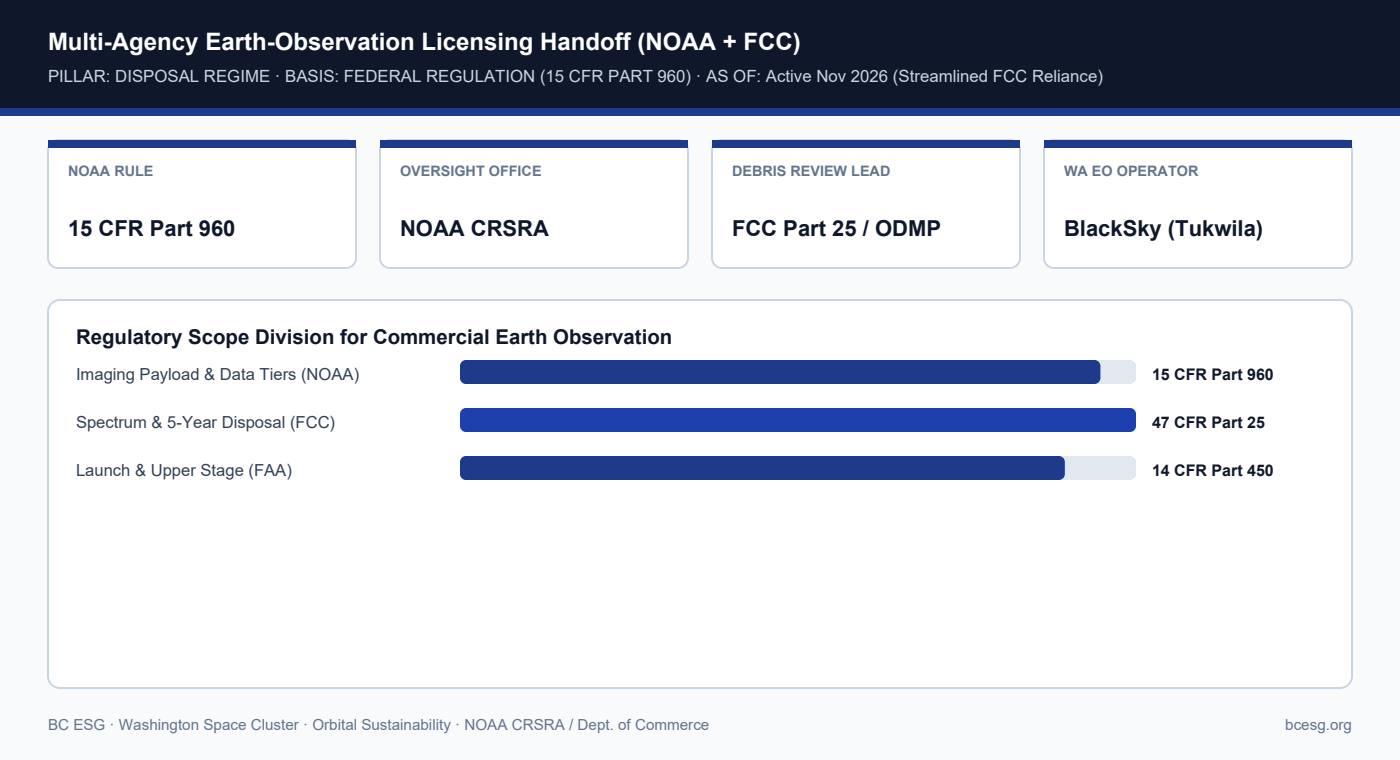
    Multi-Agency Earth-Observation Licensing Handoff (NOAA + FCC)
    Multi-Agency Earth-Observation Licensing Handoff (NOAA + FCC)

    Documented Instrument & Engineering Record

    • What NOAA licenses: 15 CFR Part 960 regulates private space-based remote-sensing systems—focusing on imaging capabilities, shutter control, and national-security data tiers.
    • Eliminating duplicate debris reviews: Because commercial remote-sensing satellites also require FCC spectrum licenses, NOAA streamlined Part 960 to rely on FCC (or equivalent U.S. agency) orbital debris plan reviews rather than running a parallel technical ODMP assessment.
    • Retained statutory backstop: NOAA still includes standard post-mission disposal compliance conditions in Part 960 licenses, so an FCC violation or unapproved orbit change can trigger multi-agency scrutiny.
    • WA applicability: Directly governs BlackSky's Tukwila-operated optical imaging constellation and any WA Earth-observation payloads.

    15 CFR Part 960 vs. 47 CFR Part 25 Compliance Mapping

    Compliance AreaNOAA Part 960 RoleFCC Part 25 Role
    5-Year LEO DeorbitDefers technical review to FCCPrimary technical & enforcement lead
    Imaging / Shutter ControlPrimary regulator (Tier 1–3)Not regulated
    RF Downlink SpectrumNot regulatedPrimary regulator
    License Condition LinkRequires lawful disposal complianceEnforces ODMP & § 25.283(e)

    Mission Designer, Compliance Lead & Founder Takeaways

    • EO startups cannot skip FCC orbital debris disclosures by citing a NOAA remote-sensing license—NOAA expects the FCC ODMP to carry the technical proof.
    • Changes to operational altitude or constellation replenishment schedules require coordinated updates across both FCC and NOAA filings.
    • Compliance leads should maintain one unified configuration-controlled Orbital Debris & End-of-Mission dossier for both agencies.

    Connected Census Profiles, Segments & Rules

    Primary Sources & Official Records

  • FAA 14 CFR Part 450 Upper-Stage Disposal & Launch-License Debris Conditions

    FAA 14 CFR Part 450 Upper-Stage Disposal & Launch-License Debris Conditions

    Verified against 14 CFR Part 450 (eCFR) and Batch 5 #1966 transition dates as of 2026-11-16.

    ORBITAL SUSTAINABILITY · DISPOSAL REGIME · FEDERAL REGULATION (14 CFR PART 450)
    FAA Part 450 Upper-Stage Disposal
    With FAA's 5-year transition to 14 CFR Part 450 completed on March 9, 2026, all U.S. commercial launch and reentry licenses govern upper-stage orbital debris mitigation, collision avoidance at launch, and stage passivation under unified Part 450 safety rules.
    Primary Authority / Source: FAA AST / eCFR  |  As-Of / Horizon: Mandatory Cutoff March 9, 2026 (Active Nov 2026)
    ORBITAL SUSTAINABILITY · PDF & MARKDOWN TWIN
    FAA Part 450 Upper-Stage Disposal — Reference Brief
    Download the 2-page printable reference PDF or read the clean Markdown twin for AI and briefing workflows.
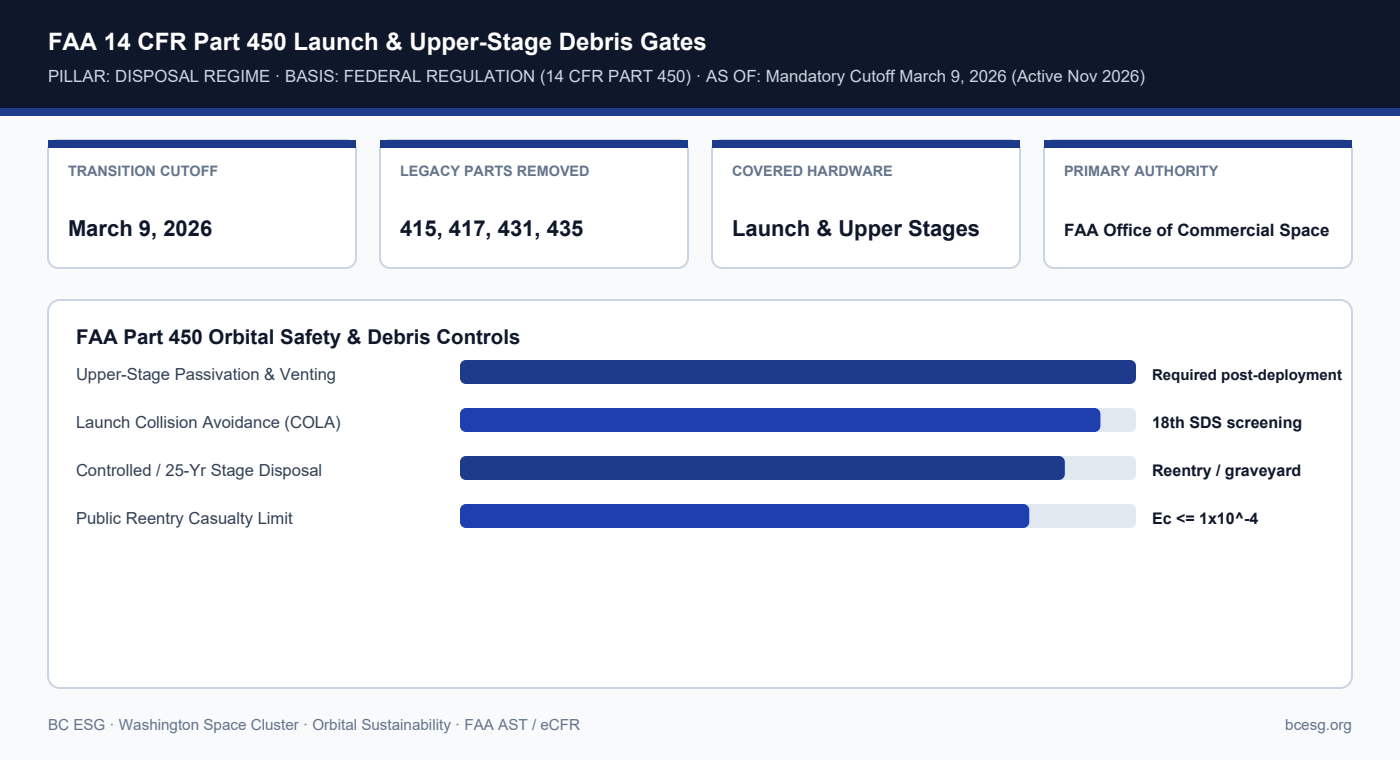
    FAA 14 CFR Part 450 Launch & Upper-Stage Debris Gates
    FAA 14 CFR Part 450 Launch & Upper-Stage Debris Gates

    Documented Instrument & Engineering Record

    • Unified licensing regime: As of March 9–10, 2026, legacy Parts 415, 417, 431, and 435 were sunsetted into 14 CFR Part 450 for all commercial orbital launches.
    • Upper-stage focus: While FCC regulates satellite payloads, FAA Part 450 regulates the launch vehicle and orbital upper stage—requiring collision avoidance (COLA) screening during ascent/deployment and post-deployment stage disposal.
    • Reusable vs. expendable stages: WA launch developers (Blue Origin New Glenn, Stoke Space Nova) design reusable or rapidly deorbited upper stages that eliminate long-lived spent rocket bodies in LEO.
    • Angle split with Batch 5: Batch 5 Post #1966 documents that Part 450 is LIVE; this brief isolates the upper-stage disposal and COLA obligations inside Part 450.

    FAA Part 450 vs. FCC Part 25 Jurisdiction Split

    Hardware ElementGoverning AgencyPrimary Regulation
    Launch Vehicle & Upper StageFAA (AST)14 CFR Part 450
    Payload RF & Satellite DisposalFCC (Space Bureau)47 CFR Part 25 (§ 25.283)
    Remote-Sensing Payload DataNOAA (CRSRA)15 CFR Part 960
    NASA-Contracted PayloadsNASA SMANASA-STD-8719.14C (Contract)

    Mission Designer, Compliance Lead & Founder Takeaways

    • Spent rocket bodies represent a disproportionate share of total orbital mass (>17,000 tonnes total tracked mass per ESA 2026 Report).
    • WA launch teams operating out of Florida/Vandenberg (Blue Origin, Stoke Space) still engineer upper-stage passivation valves and reentry guidance in Kent and Redmond.
    • Rideshare payload integrators must verify that the launch provider's Part 450 license covers deployment separation and COLA windows.

    Connected Census Profiles, Segments & Rules

    Primary Sources & Official Records

  • Reentry Casualty Risk (< 1:10,000 / 15 J): Design-for-Demise vs. Controlled Ocean Reentry

    Reentry Casualty Risk (< 1:10,000 / 15 J): Design-for-Demise vs. Controlled Ocean Reentry

    Thresholds (< 1:10,000 Ec, > 15 J kinetic energy) verified against NASA-STD-8719.14C and NASA ODPO guidance as of 2026-11-16.

    ORBITAL SUSTAINABILITY · DISPOSAL REGIME · NASA-STD-8719.14C / FCC PART 25 / ODMSP
    Reentry Casualty Risk & Demisability
    Uncontrolled atmospheric reentry is permitted only if predicted human casualty expectation (Ec) across all surviving fragments exceeding 15 joules remains below 1 in 10,000 (0.0001); otherwise, operators must execute a controlled reentry over uninhabited ocean.
    Primary Authority / Source: NASA ODPO / FCC  |  As-Of / Horizon: Active Nov 2026 (15 J Kinetic Energy Gate)
    ORBITAL SUSTAINABILITY · PDF & MARKDOWN TWIN
    Reentry Casualty Risk & Demisability — Reference Brief
    Download the 2-page printable reference PDF or read the clean Markdown twin for AI and briefing workflows.
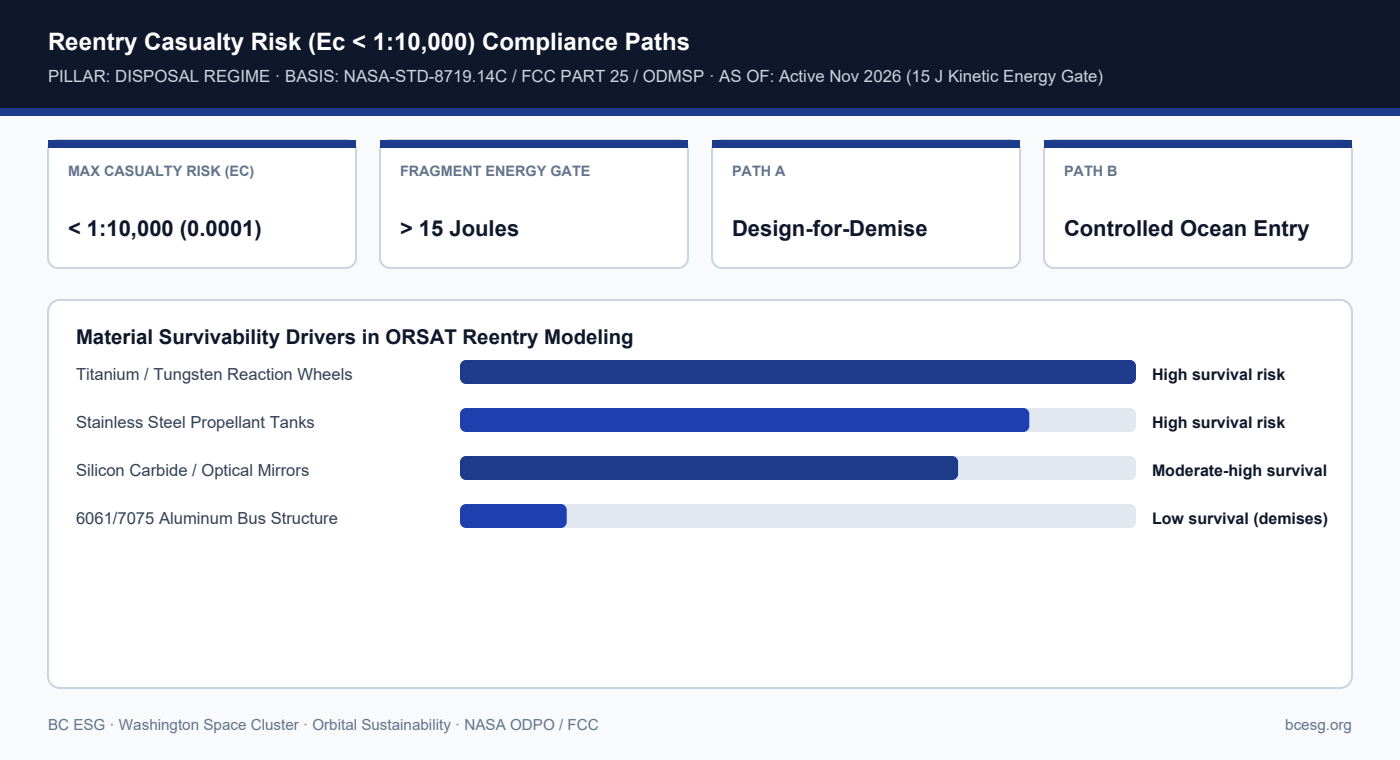
    Reentry Casualty Risk (Ec < 1:10,000) Compliance Paths
    Reentry Casualty Risk (Ec < 1:10,000) Compliance Paths

    Documented Instrument & Engineering Record

    • The 15-joule threshold: Under NASA-STD-8719.14C and U.S. Government ODMSP, any surviving piece striking Earth with kinetic energy > 15 joules contributes to the human casualty area.
    • Why aluminum demises and titanium survives: Aluminum alloys melt around ~660 °C during peak aerothermal heating, whereas titanium (~1,668 °C), stainless steel (~1,400–1,500 °C), and tungsten balance weights frequently survive to ground impact.
    • Two compliance paths: Designers either substitute demisable materials (Design-for-Demise) or budget enough delta-v for a targeted deorbit burn into the South Pacific Ocean Uninhabited Area (SPOUA).
    • Constellation multiplier: When a single constellation deploys thousands of satellites, regulators scrutinize both per-satellite Ec and aggregate fleet casualty risk.

    Design-for-Demise vs. Controlled Reentry Tradeoffs

    Compliance StrategyEngineering MechanismPrimary Tradeoff
    Design-for-DemiseReplace Ti/SS with Al/composite; thin wallsHigher material/thermal engineering cost
    Controlled Ocean ReentryTargeted perigee burn into SPOUARequires high-thrust prop + large EOL delta-v
    ORSAT High-Fidelity Run3D thermal-structural ablation modelingReplaces conservative DAS sphere assumptions

    Mission Designer, Compliance Lead & Founder Takeaways

    • Never assume a small CubeSat or SmallSat automatically passes 1:10,000; a single dense titanium star-tracker baffle or steel flywheel can fail DAS.
    • WA satellite manufacturers (SpaceX Redmond, Amazon Leo, BlackSky) publish demisability commitments in FCC ODMP filings.
    • Running ORSAT early in preliminary design avoids last-minute ballast or propellant penalties before launch licensing.

    Connected Census Profiles, Segments & Rules

    Primary Sources & Official Records

  • Spacecraft & Upper-Stage Passivation: Propellant Venting, Battery Isolation & 1:1,000 Risk

    Spacecraft & Upper-Stage Passivation: Propellant Venting, Battery Isolation & 1:1,000 Risk

    Breakup count (>660) and 2024 propulsion spike (>3,000 fragments) cited from ESA 2026 Space Environment Report (data through end of 2025).

    ORBITAL SUSTAINABILITY · DISPOSAL REGIME · FCC / NASA-STD-8719.14C / ODMSP
    Spacecraft & Upper-Stage Passivation
    Passivation removes all stored internal energy—residual propellants, pressurants, batteries, and momentum wheels—at end of mission to keep accidental breakup probability below 0.001 (1 in 1,000) across more than 660 historical fragmentation events recorded through end of 2025.
    Primary Authority / Source: NASA ODPO / FCC  |  As-Of / Horizon: Active Nov 2026 (ESA 2026 Report: >660 Historical Breakups)
    ORBITAL SUSTAINABILITY · PDF & MARKDOWN TWIN
    Spacecraft & Upper-Stage Passivation — Reference Brief
    Download the 2-page printable reference PDF or read the clean Markdown twin for AI and briefing workflows.
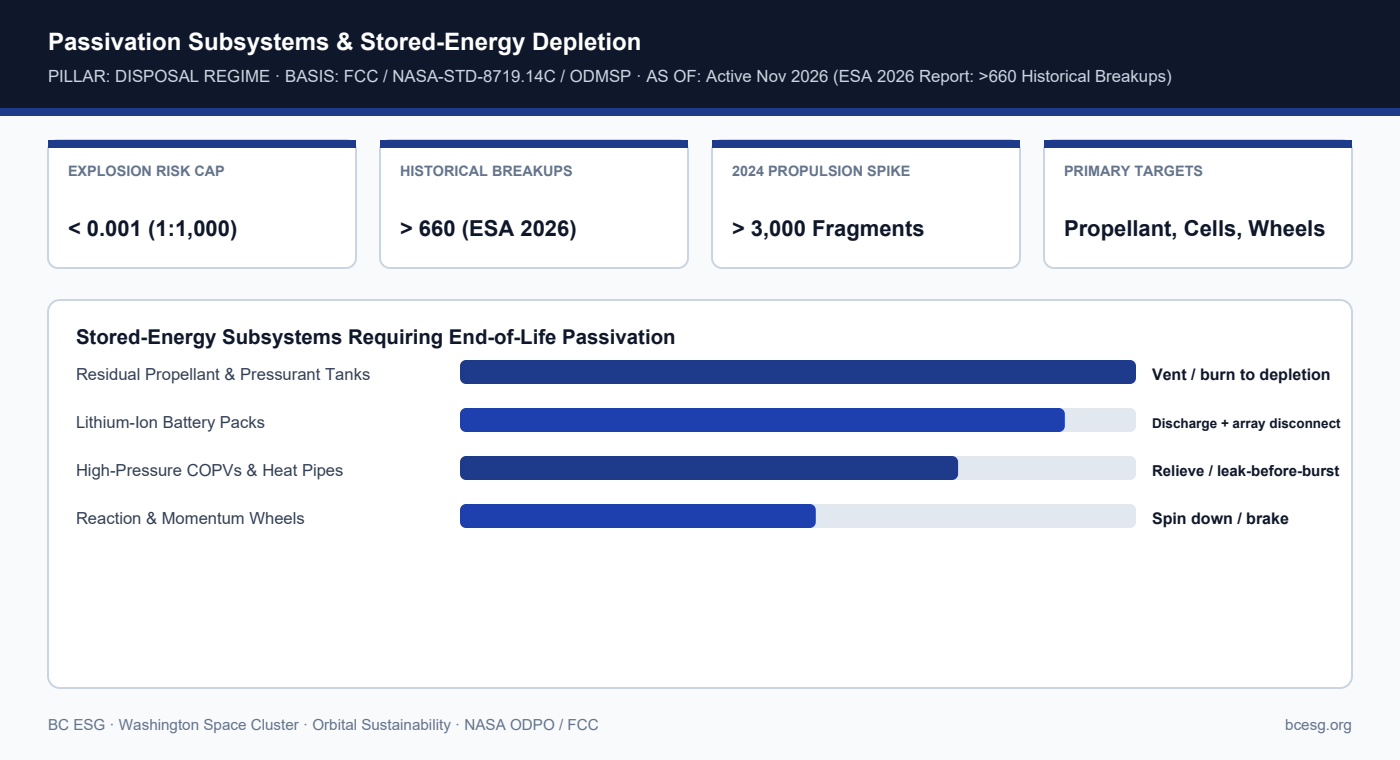
    Passivation Subsystems & Stored-Energy Depletion
    Passivation Subsystems & Stored-Energy Depletion

    Documented Instrument & Engineering Record

    • Why passivation is enforced: ESA's 2026 Space Environment Report (data through end of 2025) documents more than 660 historical breakups, explosions, and fragmentation events—including a 2024 spike of >3,000 tracked fragments driven by propulsion-related breakups.
    • Propulsion passivation: Operators must burn or vent residual fuel, oxidizer, and pressurant gases (e.g., helium, nitrogen, krypton) to prevent tank over-pressurization from solar heating.
    • Electrical passivation: Batteries must be discharged and permanently isolated from solar arrays (disconnect relays or bleed resistors) so internal cell shorts cannot trigger thermal runaway.
    • Kinetic & thermal stores: Reaction wheels must be spun down and pressurized heat pipes or cryocoolers accounted for in the ODAR.

    Passivation Engineering Checklist by Subsystem

    SubsystemStored Energy HazardRequired EOL Action
    Liquid / Cold-Gas PropulsionHypergolic/pressurant tank ruptureDepletion burn + latch-open vent valves
    Electric Propulsion (Hall/Ion)High-pressure xenon/krypton tankBleed residual gas through thruster/valves
    Power / BatteriesThermal runaway & cell explosionFull discharge + permanent charge-path open
    ADCS Momentum WheelsRotor burst on structural fatigueActive spin-down before bus shutdown

    Mission Designer, Compliance Lead & Founder Takeaways

    • Designing latch-open pyro or solenoid vent valves adds minimal mass early in CDR but is nearly impossible to retrofit after integration.
    • Upper-stage propulsion firms in WA (Blue Origin, Stoke Space, Aerojet Rocketdyne Redmond) must verify passivation sequences under both FAA Part 450 and NASA ODAR deliverables.
    • Passivation sequencing matters: telemetry must confirm disposal burn completion *before* permanent battery disconnect cuts communications.

    Connected Census Profiles, Segments & Rules

    Primary Sources & Official Records

  • NASA ODAR & EOMP Practice (NASA-STD-8719.14C): Contract Deliverable vs. Regulation

    NASA ODAR & EOMP Practice (NASA-STD-8719.14C): Contract Deliverable vs. Regulation

    Primary-source check against NASA-STD-8719.14 and NPR 8715.6B as of 2026-11-16; distinct from Batch 5 status verdict #1963.

    ORBITAL SUSTAINABILITY · DISPOSAL REGIME · AGENCY TECHNICAL STANDARD (CONTRACT DELIVERABLE)
    NASA ODAR & EOMP Contract Deliverable
    Unlike FCC 47 CFR § 25.283(e), NASA-STD-8719.14C and NPR 8715.6B are not federal regulations—they are agency technical standards enforced as binding contract deliverables (ODAR and EOMP) on NASA missions and rideshare payloads.
    Primary Authority / Source: NASA ODPO / Standards  |  As-Of / Horizon: NASA-STD-8719.14C & NPR 8715.6B (Active Nov 2026)
    ORBITAL SUSTAINABILITY · PDF & MARKDOWN TWIN
    NASA ODAR & EOMP Contract Deliverable — Reference Brief
    Download the 2-page printable reference PDF or read the clean Markdown twin for AI and briefing workflows.
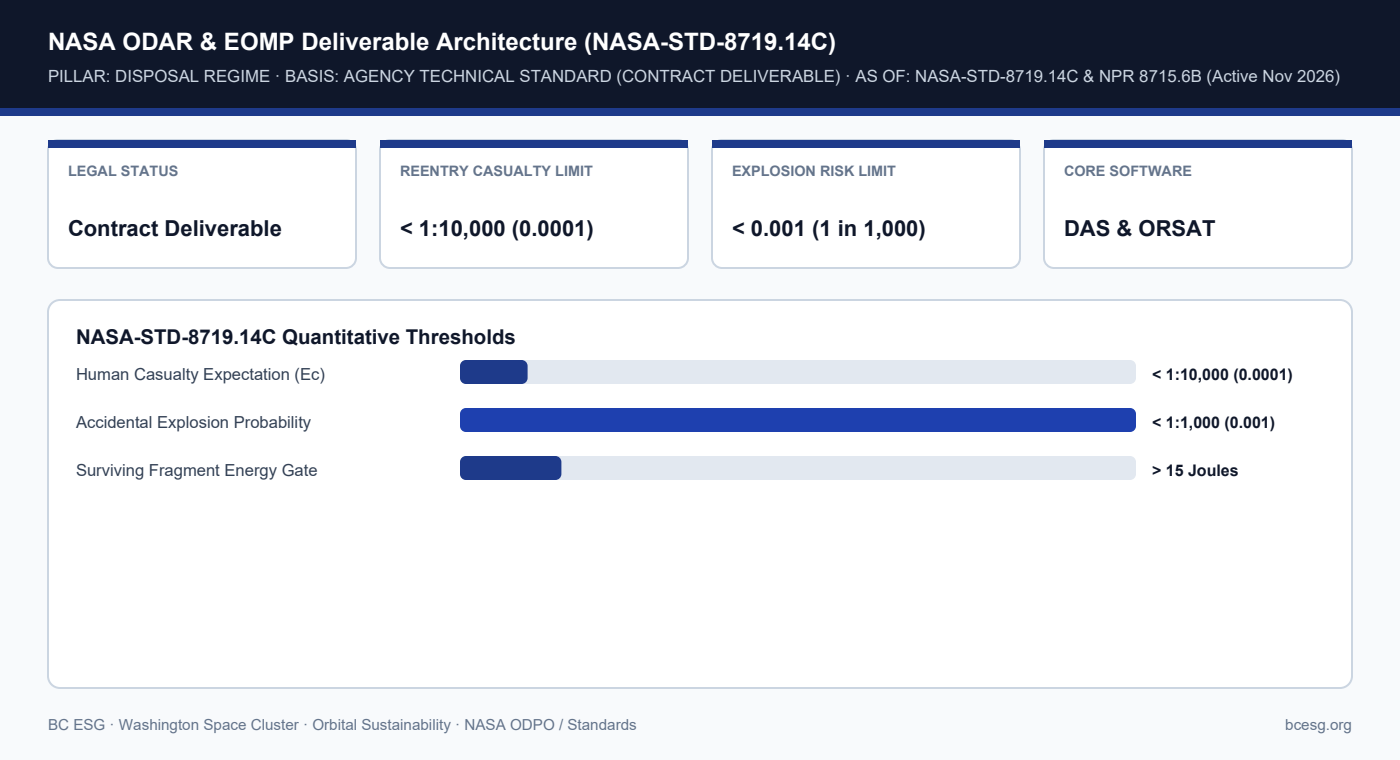
    NASA ODAR & EOMP Deliverable Architecture (NASA-STD-8719.14C)
    NASA ODAR & EOMP Deliverable Architecture (NASA-STD-8719.14C)

    Documented Instrument & Engineering Record

    • Contract vs. regulation: NASA-STD-8719.14C binds missions through NASA procurement contracts, Space Act Agreements, and launch-integration requirements—not general civil rulemaking.
    • Two required documents: The Orbital Debris Assessment Report (ODAR) is submitted at Preliminary Design Review (PDR) and updated at Critical Design Review (CDR) / Flight Readiness Review (FRR), paired with an End of Mission Plan (EOMP).
    • Standard analytical tools: Mission teams run NASA's Debris Assessment Software (DAS) for orbital lifetime and collision probability, and ORSAT (Object Reentry Survival Analysis Tool) when DAS flags casualty risk near or above 1:10,000.
    • Angle split with Batch 5: Batch 5 Post #1963 confirms NASA ODAR is LIVE; this brief specifies the PDR/CDR deliverable workflow and DAS/ORSAT engineering inputs.

    NASA ODAR Deliverable Milestones & Software Gates

    Milestone / ArtifactRequirement SourceTechnical Deliverable
    Preliminary ODARNPR 8715.6B / PDRInitial orbital lifetime, passivation & casualty estimate
    Final ODARNPR 8715.6B / CDR-FRRVerified DAS/ORSAT run with as-built component masses
    End of Mission Plan (EOMP)NASA-STD-8719.14CStep-by-step passivation, venting & deorbit execution
    Reentry Casualty GateRequirement 4.7-1Total Ec < 0.0001 (1:10,000) across >15 J fragments
    Explosion Probability GateRequirement 4.4-1Accidental explosion probability < 0.001

    Mission Designer, Compliance Lead & Founder Takeaways

    • WA suppliers building payloads or hosted instruments for NASA missions must supply material/mass breakdowns (titanium, stainless steel, reaction wheels) for ORSAT survivability runs.
    • Contract deliverables cannot be waived by commercial licensing alone; NASA Safety and Mission Assurance (SMA) signs off separately from FCC.
    • Program managers should freeze ODAR component lists before CDR to avoid late-stage demisability redesigns.

    Connected Census Profiles, Segments & Rules

    Primary Sources & Official Records

  • FCC 5-Year Post-Mission Disposal Rule (47 CFR § 25.283(e)): Mechanics & Spacecraft Requirements

    FCC 5-Year Post-Mission Disposal Rule (47 CFR § 25.283(e)): Mechanics & Spacecraft Requirements

    Primary-source check against 47 CFR § 25.283(e) (eCFR) as of 2026-11-16; distinct from Batch 5 status verdict #1960.

    ORBITAL SUSTAINABILITY · DISPOSAL REGIME · FEDERAL REGULATION (47 CFR § 25.283(E))
    FCC 5-Year Disposal Rule Mechanics

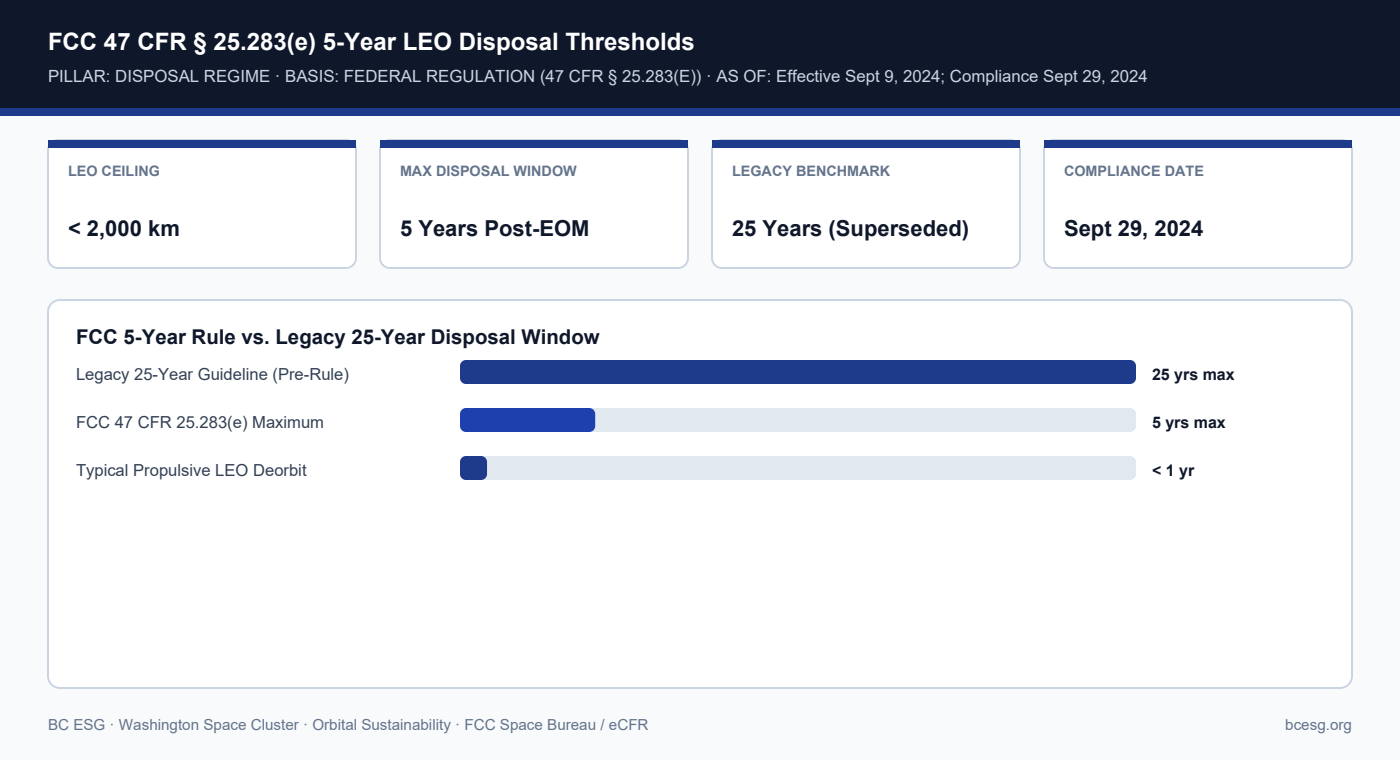
    Under 47 CFR § 25.283(e), space stations ending missions in or passing through Low Earth Orbit below 2,000 km must complete atmospheric reentry as soon as practicable and no later than 5 years after end of mission—replacing the legacy 25-year guideline.
    Primary Authority / Source: FCC Space Bureau / eCFR  |  As-Of / Horizon: Effective Sept 9, 2024; Compliance Sept 29, 2024
    ORBITAL SUSTAINABILITY · PDF & MARKDOWN TWIN
    FCC 5-Year Disposal Rule Mechanics — Reference Brief
    Download the 2-page printable reference PDF or read the clean Markdown twin for AI and briefing workflows.
    FCC 47 CFR § 25.283(e) 5-Year LEO Disposal Thresholds
    FCC 47 CFR § 25.283(e) 5-Year LEO Disposal Thresholds

    Documented Instrument & Engineering Record

    • Altitude scope: Applies to all U.S.-licensed satellites (Part 25) and non-U.S. satellites seeking U.S. market access whose missions end in or pass through LEO below 2,000 km.
    • End-of-mission (EOM) trigger: For spacecraft with propulsion and collision avoidance, EOM occurs when the satellite can no longer conduct collision-avoidance maneuvers; for non-maneuverable spacecraft, EOM is completion of the primary mission.
    • Grandfathering boundary: Satellites already in orbit prior to the September 29, 2024 compliance date (and certain grandfathered authorizations) remain under prior license terms unless modified.
    • Angle split with Batch 5: Batch 5 Post #1960 establishes that the rule is LIVE; this brief details the engineering triggers, EOM definition, and waiver/licensing mechanics required of mission designers.

    47 CFR § 25.283(e) Instrument Parameters

    ParameterInstrument RequirementEngineering Impact
    Altitude ScopeLEO region below 2,000 kmCovers nearly all WA constellation & EO orbits
    Disposal DeadlineAs soon as practicable; <= 5 years post-EOMForces propulsion or <=500 km deployment
    EOM Trigger (Propulsive)Loss of collision-avoidance capabilityRequires reserved EOL propellant before depletion
    EOM Trigger (Non-Propulsive)Completion of primary missionPassive drag must decay orbit within 5 years
    Jurisdictional ReachU.S. Part 25 + non-U.S. market accessBinds foreign operators serving U.S. customers

    Mission Designer, Compliance Lead & Founder Takeaways

    • Mission designers cannot treat 5 years as a passive-drag guarantee above ~500–600 km; solar-cycle minima can push unpropelled decay past 5 years.
    • Compliance leads must align FCC Orbital Debris Mitigation Plan (ODMP) disclosures with propellant-reserve telemetry and EOM triggers.
    • WA constellation operators (SpaceX Redmond, Amazon Leo, BlackSky) and servicing providers (Starfish Space) design directly around this 5-year ceiling.

    Connected Census Profiles, Segments & Rules

    Primary Sources & Official Records

BC ESG

ESG Strategy, Sustainability Intelligence, and Business Continuity for Forward-Thinking Organizations

© 2026 BC ESG — Business Continuity, ESG & Sustainability Intelligence