
Thresholds (< 1:10,000 Ec, > 15 J kinetic energy) verified against NASA-STD-8719.14C and NASA ODPO guidance as of 2026-11-16.
ORBITAL SUSTAINABILITY · DISPOSAL REGIME · NASA-STD-8719.14C / FCC PART 25 / ODMSP
Reentry Casualty Risk & Demisability
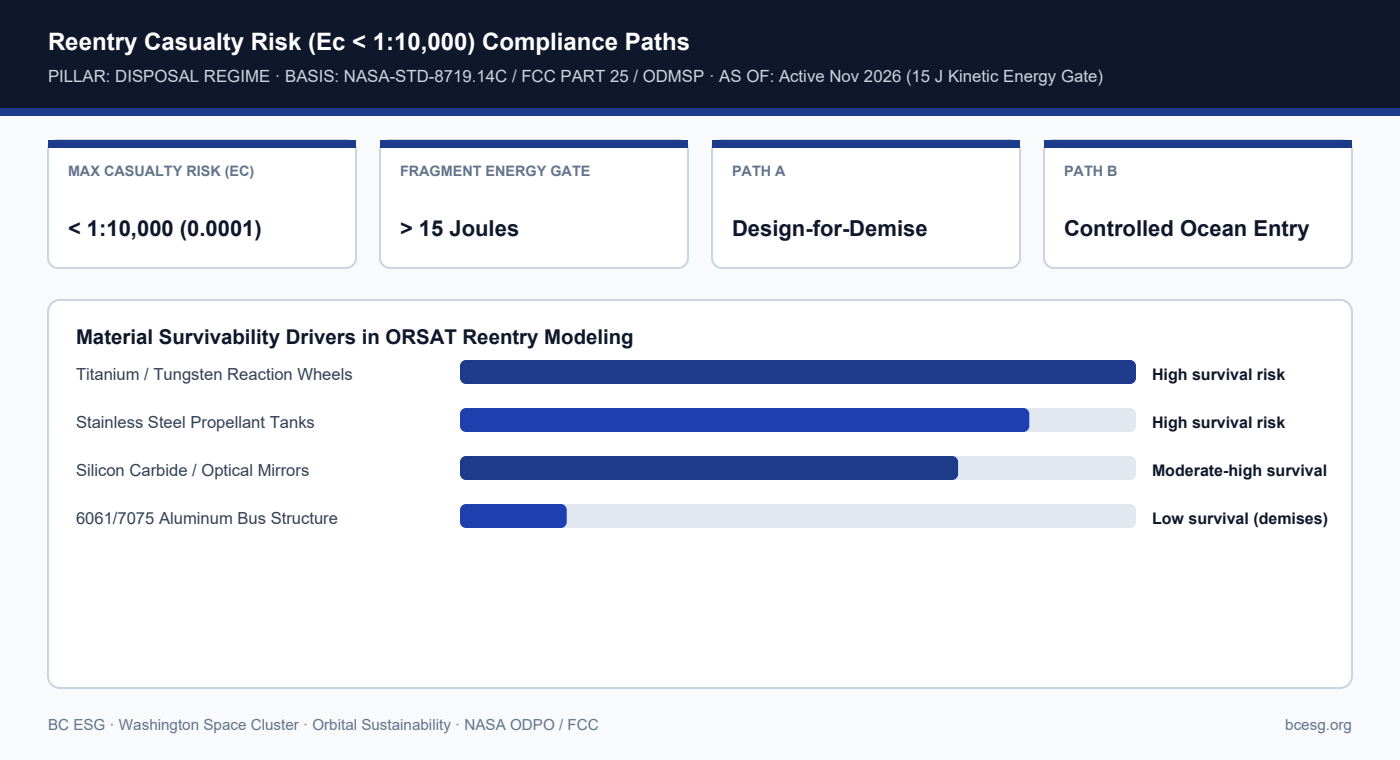
Uncontrolled atmospheric reentry is permitted only if predicted human casualty expectation (Ec) across all surviving fragments exceeding 15 joules remains below 1 in 10,000 (0.0001); otherwise, operators must execute a controlled reentry over uninhabited ocean.
Primary Authority / Source: NASA ODPO / FCC | As-Of / Horizon: Active Nov 2026 (15 J Kinetic Energy Gate)
Documented Instrument & Engineering Record
- The 15-joule threshold: Under NASA-STD-8719.14C and U.S. Government ODMSP, any surviving piece striking Earth with kinetic energy > 15 joules contributes to the human casualty area.
- Why aluminum demises and titanium survives: Aluminum alloys melt around ~660 °C during peak aerothermal heating, whereas titanium (~1,668 °C), stainless steel (~1,400–1,500 °C), and tungsten balance weights frequently survive to ground impact.
- Two compliance paths: Designers either substitute demisable materials (Design-for-Demise) or budget enough delta-v for a targeted deorbit burn into the South Pacific Ocean Uninhabited Area (SPOUA).
- Constellation multiplier: When a single constellation deploys thousands of satellites, regulators scrutinize both per-satellite Ec and aggregate fleet casualty risk.
Design-for-Demise vs. Controlled Reentry Tradeoffs
| Compliance Strategy | Engineering Mechanism | Primary Tradeoff |
|---|---|---|
| Design-for-Demise | Replace Ti/SS with Al/composite; thin walls | Higher material/thermal engineering cost |
| Controlled Ocean Reentry | Targeted perigee burn into SPOUA | Requires high-thrust prop + large EOL delta-v |
| ORSAT High-Fidelity Run | 3D thermal-structural ablation modeling | Replaces conservative DAS sphere assumptions |
Mission Designer, Compliance Lead & Founder Takeaways
- Never assume a small CubeSat or SmallSat automatically passes 1:10,000; a single dense titanium star-tracker baffle or steel flywheel can fail DAS.
- WA satellite manufacturers (SpaceX Redmond, Amazon Leo, BlackSky) publish demisability commitments in FCC ODMP filings.
- Running ORSAT early in preliminary design avoids last-minute ballast or propellant penalties before launch licensing.
Connected Census Profiles, Segments & Rules
- SpaceX Redmond Census Profile
- Amazon Leo (Redmond) Census Profile
- NASA ODAR Contract Deliverable Guide