Category: Commercial Real Estate

ESG strategy, Scope 3 supply chain disclosure, and sustainability reporting for commercial real estate owners, REITs, and institutional property investors.

  • Boston BERDO 2.0 Compliance Guide: 2025–2050 Emissions Limits, ACPs & May 15 Filing

    Boston BERDO 2.0 Compliance Guide: 2025–2050 Emissions Limits, ACPs & May 15 Filing

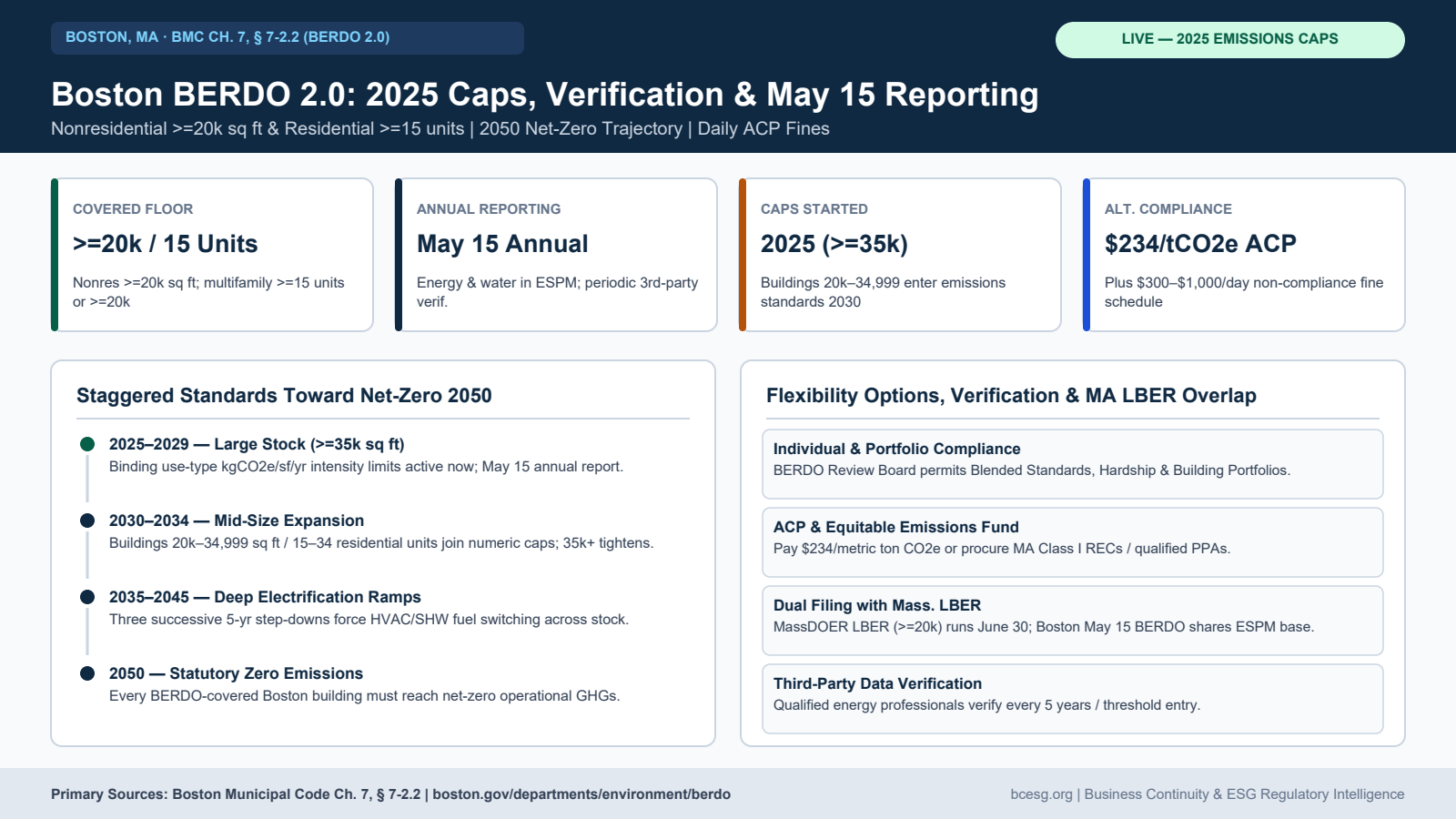
    Short answer: Enacted under Boston Municipal Code Chapter 7, § 7-2.2, Boston’s Building Emissions Reduction and Disclosure Ordinance (BERDO 2.0) is one of the tightest active municipal building decarbonization laws in the United States. Large commercial and multifamily properties (>=35,000 sq ft, or residential properties with >=35 units) entered binding 5-year GHG intensity caps on January 1, 2025, requiring active emissions compliance alongside annual May 15 reporting and periodic third-party data verification.

    Mid-tier buildings (20,000–34,999 sq ft or 15–34 units) already owe annual May 15 energy/water disclosure and step into emissions caps in 2030, progressing uniformly toward net-zero emissions in 2050. Because Massachusetts simultaneously enforces statewide LBER reporting (225 CMR 27.00) — and neighboring Cambridge BEUDO enforces its own net-zero timeline — regional owners should harmonize utility metering across both jurisdictions.

    Statutory Status at a Glance
    • Covered Thresholds: Non-residential >=20,000 sq ft; residential >=15 units or >=20,000 sq ft; or multiple buildings on the same parcel totaling >=20,000 sq ft (or >=15 units).
    • Two-Wave Emissions Caps: >=35,000 sq ft started emissions limits Jan 1, 2025 (with first emissions-year reports covered in 2026); 20,000–34,999 sq ft start emissions caps in 2030.
    • May 15 Annual Deadline & Third-Party Verification: Whole-building energy and water use due annually May 15 via ENERGY STAR Portfolio Manager, paired with third-party qualified verifier attestation every five years (plus first-year baseline verification).
    • Alternative Compliance Payments (ACP) vs. Fines: Excess emissions above occupancy-weighted CO2e limits may be retired at $234 per MTCO2e (deposited into Boston’s Equitable Emissions Investment Fund), whereas failing to comply with emissions standards draws statutory daily fines ($1,000/day for >=35k sf; $300/day for 20k–35k sf).
    Print-First Compliance Brief

    Download the Boston BERDO 2.0 Compliance Reference

    2-page Print-First PDF covering BERDO 2.0 emissions thresholds, third-party verification cadence, $234/tCO2e Alternative Compliance Payments, and MA LBER data alignment.

    Blended Emissions Limits, Class I RECs & Alternative Compliance Payments

    Boston calculates asset limits using 5-year primary-use CO2e intensity factors (kgCO2e/sq ft/yr) blended proportionally across mixed uses inside a parcel (for instance, office vs. multifamily vs. laboratory/healthcare allocations). Where physical fuel switching or heat-pump retrofits lag the 2025–2029 schedule, BERDO 2.0 allows owners to apply eligible Clean Energy purchases — specifically bundled Massachusetts Class I RECs or qualifying Power Purchase Agreements — to electricity emissions.

    Owners facing stubborn fossil-heating loads or phased lease rollovers can apply to the BERDO Review Board for a Blended Emissions Standard (pooling multi-building portfolios), a Hardship Compliance Plan, or an Individual Compliance Schedule modifying interim reduction trajectories — or retire remaining shortfalls via $234/MTCO2e Alternative Compliance Payments.

    • Lab & Healthcare Tiers: High-process facilities receive higher starting EUI/GHG allowances than standard commercial offices, though still stepping to zero by 2050.
    • Mandatory Verification Gate: Unlike simple benchmarking cities, BERDO 2.0 prohibits unverified self-reporting during emissions-cap transition years.
    Building TierAnnual ReportingEmissions Caps StartCompliance Relief & Daily Non-Filing Fines
    Large (>=35k sf or >=35 units)May 15 (PM + 3rd-party verify cycle)Jan 1, 2025 (2025–2029 period)$234/MTCO2e ACP; $1,000/day emissions violation
    Small/Mid (20k–34,999 sf / 15–34 units)May 15 annual energy & waterJan 1, 2030 (2030–2034 period)$234/MTCO2e ACP; $300/day violation (~2030+)
    Multi-Building Parcels>=20k sf combined -> follows >=20k/35k tierMatched to aggregate tierBlended Emissions Standard / Individual Schedule option
    Compliance overview of Boston BERDO 2.0 thresholds (>=20,000 sq ft / >=15 residential units), 2025 vs 2030 cap phases, May 15 verification deadline, and $234/tCO2e Alternative Compliance Payments.
    Boston BERDO 2.0 compliance timeline under Boston Municipal Code Ch. 7, § 7-2.2: benchmarking, third-party verification, 5-year emissions caps, and ACP pricing.

    Coordinating Boston BERDO 2.0 With Massachusetts LBER (225 CMR 27.00)

    Massachusetts’s statewide Large Building Energy Reporting (LBER) program (225 CMR 27.00, >=20,000 sq ft) relies largely on utility-pushed data delivered to DOER on a June 30 cycle, whereas Boston BERDO places strict affirmative legal responsibility directly on building owners every May 15. Confirm whether Eversource and National Grid automated meters align seamlessly across both systems to avoid mismatched square footage or unattributed tenant meters.

    • Utility Data Authorization: Verify whole-building aggregated data consent with Eversource and National Grid ahead of April so tenant-level privacy thresholds do not block May 15 submissions.
    • 2030 Cohort Pre-Audit: Owners of 20,000–34,999 sq ft buildings have four years to use annual BERDO disclosures to cost out 2030 compliance before caps lock in.

    Compliance Execution Checklist

    StepOwner / TeamAuditable Deliverable
    1. Parcel Use & Tier AuditCompliance / LegalConfirm primary occupancy classification and >=35k vs 20k–34,999 sq ft cohort.
    2. 3rd-Party Verifier Sign-OffPE / CEM / Qualified VerifierComplete BERDO data verification checklist ahead of the May 15 filing deadline.
    3. ACP vs REC EconomicsTreasury / SustainabilityCompare MA Class I REC cost against $234/MTCO2e ACP exposure per asset.
    4. MA LBER ReconciliationProperty OperationsCross-check DOER June 30 utility-reported LBER dataset against BERDO May 15 numbers.
    Field & Print Package

    Keep This Boston, MA Compliance Checklist Handy

    Download the formatted 2-page PDF reference brief or pull the structured Markdown edition for internal compliance documentation.

    Frequently Asked Questions

    When did Boston BERDO 2.0 emissions caps actually start?

    Emissions standards took effect January 1, 2025 for buildings >=35,000 sq ft (or residential buildings >=35 units), while smaller covered buildings (20,000–34,999 sq ft) begin active emissions limits in 2030.

    What is Boston BERDO's Alternative Compliance Payment rate?

    Excess CO2e emissions can be settled via Alternative Compliance Payments set at $234 per metric ton of CO2e (MTCO2e), which feed Boston's Equitable Emissions Investment Fund, rather than paying noncompliance fines.

    Does reporting under Boston BERDO exempt a building from Massachusetts statewide LBER?

    Massachusetts LBER (225 CMR 27.00) coordinates municipal reporting for utilities, but building owners must still verify Boston-specific BERDO May 15 disclosures, third-party verifications, and emissions-compliance schedules directly with the City.

    Primary Authorities & Official Resources

    Informational notice: This guide summarizes enacted statutes, regulations, or pending legislative records from the primary authorities linked above as of November 14, 2026. It is not legal, accounting, or licensed engineering advice.
  • Minnesota Building Benchmarking (§ 216C.331): Phase 2 Active & Twin Cities Consolidation

    Minnesota Building Benchmarking (§ 216C.331): Phase 2 Active & Twin Cities Consolidation

    Short answer: Minnesota’s statewide Large Building Energy Benchmarking Program (Minn. Stat. § 216C.331) reached full Phase 2 coverage on June 1, 2026, requiring commercial and multifamily buildings (5+ units) of ≥50,000 gross sq ft to submit annual energy data to the Minnesota Department of Commerce by June 1.

    Equally important for Twin Cities property managers is what happened locally: both St. Paul (Energize Saint Paul) and St. Louis Park discontinued their standalone municipal benchmarking mandates into state law, while Edina narrowed locally to 25,000–49,999 sq ft and Minneapolis continues co-enforcing ≥50,000 sq ft locally.

    Statutory Status at a Glance
    • Governing Authority: Minn. Stat. § 216C.331.
    • Administering Agency: Minnesota Department of Commerce — Large Building Energy Benchmarking Program.
    • Covered Threshold & Schedule: ≥100,000 sq ft launched June 1, 2025 (Phase 1); ≥50,000 sq ft active June 1, 2026 (Phase 2); recurring June 1 annually.
    • Municipal Consolidations: St. Paul and St. Louis Park retired separate municipal programs into § 216C.331; Edina shifted ≥50k buildings to state law and kept 25k–49,999 sq ft locally.
    • Post-2026 Policy Trajectory (Inferred): Minnesota’s November 2026 House shift restoring a unified DFL trifecta increases legislative durability for state benchmarking enforcement and future building-decarbonization bills.
    Print-First Compliance Brief

    Navigate Minnesota § 216C.331 After St. Paul & St. Louis Park Consolidated Into State Law

    2-page quick card covering Minnesota’s June 1 Phase 2 (>=50k sq ft) schedule, Twin Cities ordinance retirements, Edina’s 25k-49k carve-out, and MN 2026 election posture.

    Statewide Phased Rollout: From 100k (2025) to >=50k Active Now (2026+)

    Minn. Stat. § 216C.331 covers private commercial buildings and multifamily residential buildings with five or more dwelling units across Minnesota’s core metropolitan counties and covered jurisdictions as specified in statute. Phase 1 swept in properties ≥100,000 sq ft for the June 1, 2025 cycle; Phase 2 pulled every qualifying building 50,000 to 99,999 sq ft into active annual June 1 compliance in 2026.

    Because Minnesota winters create high space-heating fuel intensity, accurate Portfolio Manager natural gas and district steam normalization—backed by automated Xcel Energy and CenterPoint utility data feeds—is essential before public score release.

    Jurisdiction / LayerCurrent Floor & LawActive 2026–2027 Status
    Minnesota State (§ 216C.331)Commercial & MF (5+ units) >=50,000 sq ftACTIVE NOW — June 1 annual to MN Commerce
    St. Paul, MNFormer >=50k Energize Saint PaulDISCONTINUED locally — file via MN § 216C.331
    St. Louis Park, MNFormer >=25k Ord. 2576-19DISCONTINUED Dec 31, 2024 — >=50k files with state
    Edina, MNAmended Efficient Buildings Ord.Active locally ONLY for 25,000–49,999 sq ft (June 1)
    Minneapolis, MNCode Ch. 47 § 47.190 (>=50k)Active municipal energy + water filing due June 1
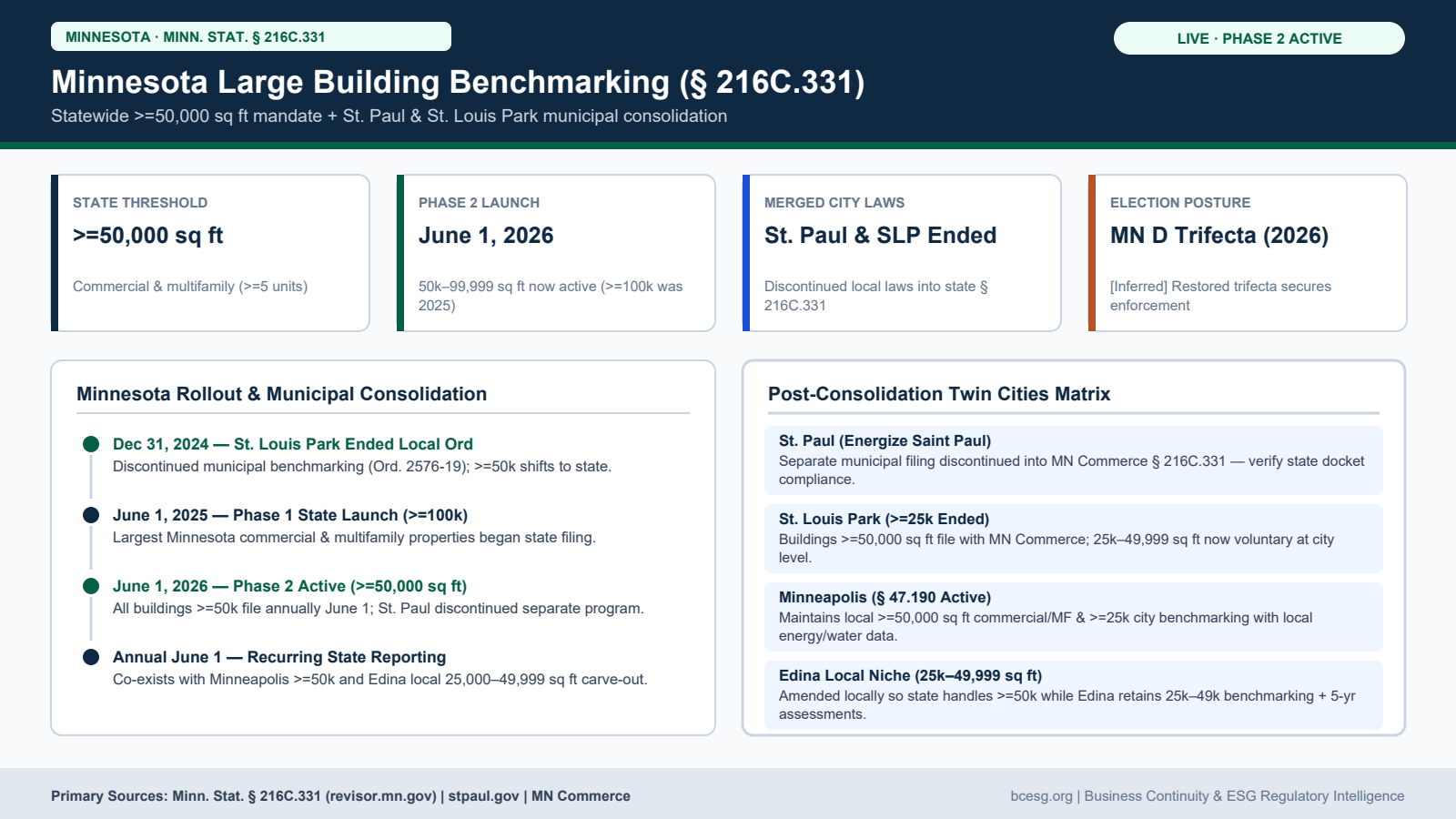
    Minnesota § 216C.331 building benchmarking infographic showing Phase 1 >=100k (2025), Phase 2 >=50k (2026), St. Paul and St. Louis Park local discontinuation, and Minneapolis/Edina overlap.
    Minnesota § 216C.331 Phase 1–2 thresholds and Twin Cities post-consolidation ordinance landscape (St. Paul, St. Louis Park, Minneapolis, Edina).

    Twin Cities Consolidation Matrix: St. Paul, St. Louis Park, Edina & Minneapolis

    Compliance consultants using outdated 2023–2024 checklists routinely tell Twin Cities owners to submit four separate city reports. That is no longer accurate after Minnesota implemented § 216C.331:

    Read alongside our California AB 802 and Massachusetts LBER guides, Minnesota illustrates how state statutes increasingly absorb local ordinances above 50,000 sq ft—leaving smaller municipal niches like Edina’s 25k–49k tier active locally.

    • St. Paul (Energize Saint Paul — Discontinued Locally): Replaced by statewide MN Commerce § 216C.331 reporting for ≥50,000 sq ft assets.
    • St. Louis Park (Discontinued End of 2024): Former ≥25,000 sq ft municipal mandate ended December 31, 2024; properties ≥50,000 sq ft file with MN Commerce while 25k–49k moved to voluntary sustainability programs.
    • Edina (Amended Local Niche 25,000–49,999 sq ft): Defers ≥50,000 sq ft assets to state § 216C.331 while enforcing local June 1 energy/water benchmarking and 5-year energy assessments on 25,000–49,999 sq ft properties.
    • Minneapolis (Ch. 47 § 47.190 Active): Continues local energy and water benchmarking due June 1 alongside state § 216C.331 (≥50,000 sq ft private; ≥25k city).

    Compliance Execution Checklist

    StepOwner / TeamAuditable Deliverable
    1. Jurisdiction MapAsset MgmtTag each MN asset >=25k sq ft as State-Only (incl. St. Paul / >=50k SLP), Dual Mpls+State, or Edina 25k-49k.
    2. Utility ConnectProperty OpsConnect Xcel Energy / CenterPoint automated whole-building Portfolio Manager feeds before April.
    3. File by June 1Compliance LeadSubmit state § 216C.331 (and Minneapolis/Edina where applicable) by June 1 annually.
    4. 2027 Policy WatchESG LeadTrack restored MN trifecta committee activity for potential corporate disclosure or BPS bills.
    Field & Print Package

    Keep This Minnesota Compliance Checklist Handy

    Download the formatted 2-page PDF reference brief or pull the structured Markdown edition for internal compliance documentation.

    Frequently Asked Questions

    Do buildings in St. Paul or St. Louis Park still file separate city benchmarking reports?

    No. Both St. Paul (Energize Saint Paul) and St. Louis Park (effective end of 2024) discontinued their separate municipal benchmarking mandates, consolidating >=50,000 sq ft properties into Minnesota's statewide § 216C.331 program.

    What changed in Edina after Minnesota passed § 216C.331?

    Edina amended its Efficient Buildings Ordinance so buildings >=50,000 sq ft report to the state while Edina retains local June 1 energy and water benchmarking plus 5-year energy assessments specifically for 25,000–49,999 sq ft buildings.

    Does Minnesota § 216C.331 cover residential apartments?

    Yes. Multifamily residential buildings with five or more units and >=50,000 gross sq ft are covered alongside commercial properties.

    Primary Authorities & Official Resources

    Informational notice: This guide summarizes enacted statutes, regulations, or pending legislative records from the primary authorities linked above as of November 14, 2026. It is not legal, accounting, or licensed engineering advice.
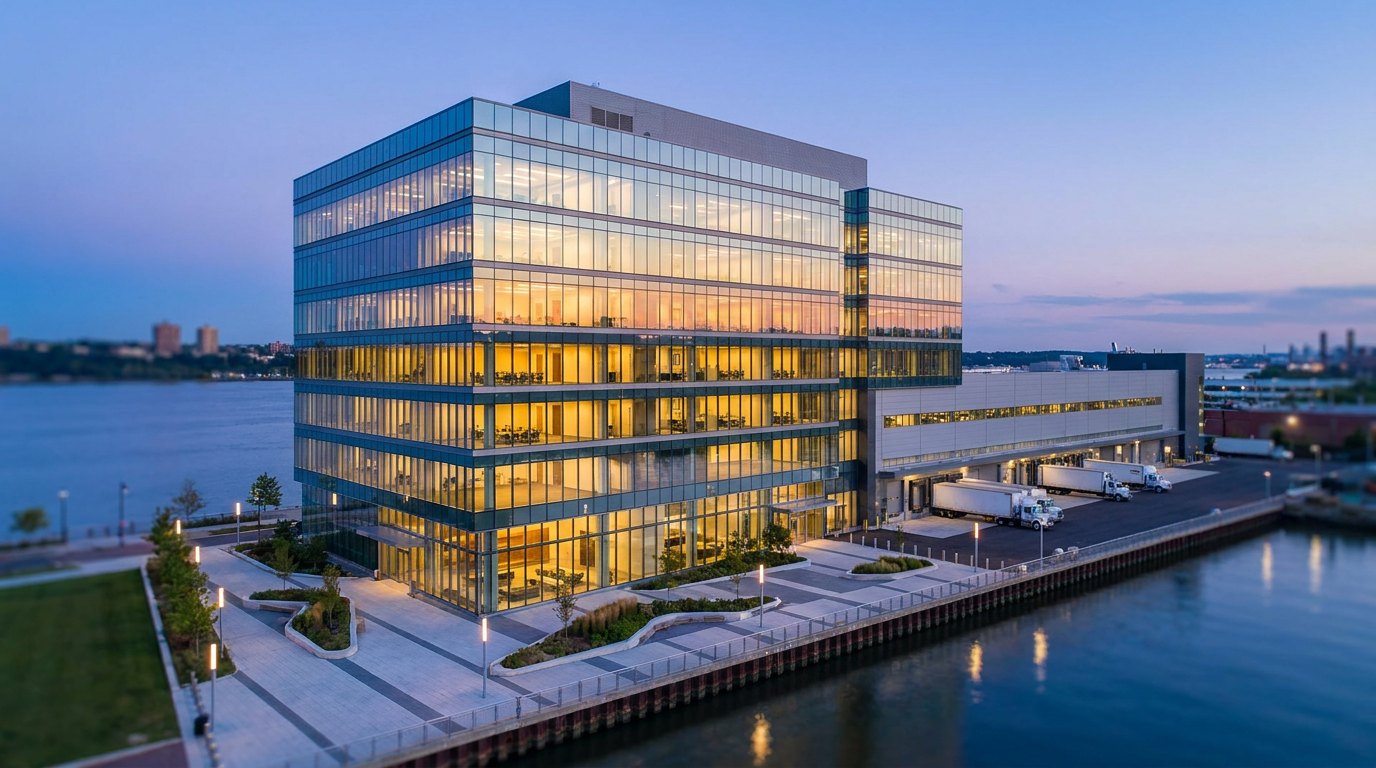
  • New Jersey Clean Energy Act Benchmarking (N.J.S.A. 48:3-87.10): Class 4A/4C & July 1 Guide

    New Jersey Clean Energy Act Benchmarking (N.J.S.A. 48:3-87.10): Class 4A/4C & July 1 Guide

    Short answer: Under New Jersey’s Clean Energy Act (P.L. 2018, c. 17; N.J.S.A. 48:3-87.10), owners of commercial (Class 4A) and multifamily residential (Class 4C, 5+ units) buildings exceeding 25,000 gross sq ft must benchmark and submit whole-building energy and water data annually by July 1 using ENERGY STAR Portfolio Manager and a DOE Unique Building Identifier (UBID).

    For corporate logistics, pharma, and multifamily portfolios operating across the Northeast corridor, New Jersey avoids the municipal patchwork seen in Massachusetts and New York City—one statewide NJBPU standard governs every municipality from Newark and Jersey City down to Camden.

    Statutory Status at a Glance
    • Governing Authority: Clean Energy Act of 2018 (P.L. 2018, c. 17; N.J.S.A. 48:3-87.10) & NJBPU Benchmarking Order.
    • Administering Agency: New Jersey Board of Public Utilities (NJBPU).
    • Covered Tax Classes: MOD-IV Class 4A commercial (office, industrial/warehouse, retail) & Class 4C residential (5+ units) >25,000 gross sq ft.
    • Annual Recurring Deadline: July 1 (following initial October 1, 2023 cycle launch).
    • Distinct Requirements: Mandatory whole-building water data alongside energy, plus U.S. DOE UBID assignment inside Portfolio Manager.
    Print-First Compliance Brief

    Standardize New Jersey >25,000 sq ft Class 4A & 4C Benchmarking Before July 1

    2-page quick card covering NJBPU MOD-IV tax class screening, water reporting, Unique Building Identifier (UBID) rules, and NJ S679 linkage.

    MOD-IV Property Class Screening & the Water + UBID Mandate

    NJBPU determines building applicability using municipal tax-assessor MOD-IV records rather than owner self-reporting. Warehouse and industrial complexes in Middlesex, Hudson, Bergen, and Burlington counties taxed under Class 4A—and apartment complexes of 5+ units taxed under Class 4C—enter scope whenever gross floor area exceeds 25,000 sq ft.

    Two compliance details routinely trigger NJBPU rejection notices: omitting water utility meters (New Jersey explicitly pairs water benchmarking with energy under N.J.S.A. 48:3-87.10) and leaving the Unique Building Identifier (UBID) custom ID field blank inside Portfolio Manager.

    • Regulated Utility Data Tools: NJ electric and gas utilities provide automated or portal-based aggregated whole-building usage under BPU privacy/aggregation guidelines (4/5 rule thresholds).
    • Uniform Statewide Scope: New Jersey imposes no separate city-level EUI or GHG performance cap ordinances today, though NJBPU’s public benchmarking scores increasingly surface in municipal green-building and lender underwriting reviews.
    Program DimensionNew Jersey CEA RuleCompliance Requirement
    Statutory ThresholdN.J.S.A. 48:3-87.10MOD-IV Class 4A commercial & Class 4C (5+ units) >25,000 sq ft
    Covered UtilitiesNJBPU Order / Portfolio MgrWhole-building electric, gas/thermal fuel AND water consumption
    Property IdentifierCustom Field in ESPMMandatory DOE Unique Building Identifier (UBID) + NJ tax block/lot
    Annual Filing SchedulePost-2023 Recurring CadenceJuly 1 annually via NJBPU ENERGY STAR Portfolio Manager link
    New Jersey Clean Energy Act Energy and Water Benchmarking Program summary showing >25,000 sq ft Class 4A/4C threshold, annual July 1 deadline, UBID requirement, and NJ S679 legislative bridge.
    New Jersey Clean Energy Act Energy & Water Benchmarking Program rules under N.J.S.A. 48:3-87.10 and NJBPU oversight.

    Strategic Link: Portfolio Manager Baselines & Pending NJ S679 Disclosure

    While New Jersey’s benchmarking law carries no statewide EUI penalty cap today, facility energy data feeds directly into corporate GHG reporting—particularly if New Jersey advances NJ S679 (pending corporate climate disclosure legislation amended in 2026 to cover Scope 1 and Scope 2 emissions for firms >$1B revenue).

    Compare New Jersey’s July 1 schedule against Maryland’s June 1 verified BEPS deadline and NYC’s May 1 LL84 deadline to keep Mid-Atlantic property managers aligned on one quarterly utility audit cycle.

    Compliance Execution Checklist

    StepOwner / TeamAuditable Deliverable
    1. MOD-IV LookupTax / Asset LeadVerify parcel Class (4A/4C) and >25,000 sq ft status on municipal MOD-IV tax records & BPU list.
    2. UBID AssignmentEnergy AnalystGenerate/confirm building UBID and map NJ municipal Block/Lot numbers inside Portfolio Manager.
    3. Utility + Water SyncProperty OpsPull 12-month aggregated electric/gas data plus municipal water bills ahead of June 1.
    4. Submit July 1Compliance LeadSubmit via NJBPU reporting link and retain confirmation receipt for ESG/NJ S679 audits.
    Field & Print Package

    Keep This New Jersey Compliance Checklist Handy

    Download the formatted 2-page PDF reference brief or pull the structured Markdown edition for internal compliance documentation.

    Frequently Asked Questions

    Are industrial warehouses subject to New Jersey's benchmarking law?

    Yes. Industrial, warehouse, logistics, retail, and office buildings taxed under New Jersey MOD-IV Class 4A that exceed 25,000 gross sq ft are covered by NJBPU benchmarking.

    Does New Jersey require water consumption reporting as well as electricity and gas?

    Yes. N.J.S.A. 48:3-87.10 requires annual whole-building water benchmarking in addition to electric and natural gas/heating energy usage.

    What is a UBID and why does NJBPU require it?

    A Unique Building Identifier (UBID) is a standardized geographic footprint code maintained by the U.S. DOE so NJBPU can match Portfolio Manager submissions cleanly against municipal MOD-IV parcel records.

    Primary Authorities & Official Resources

    Informational notice: This guide summarizes enacted statutes, regulations, or pending legislative records from the primary authorities linked above as of November 14, 2026. It is not legal, accounting, or licensed engineering advice.
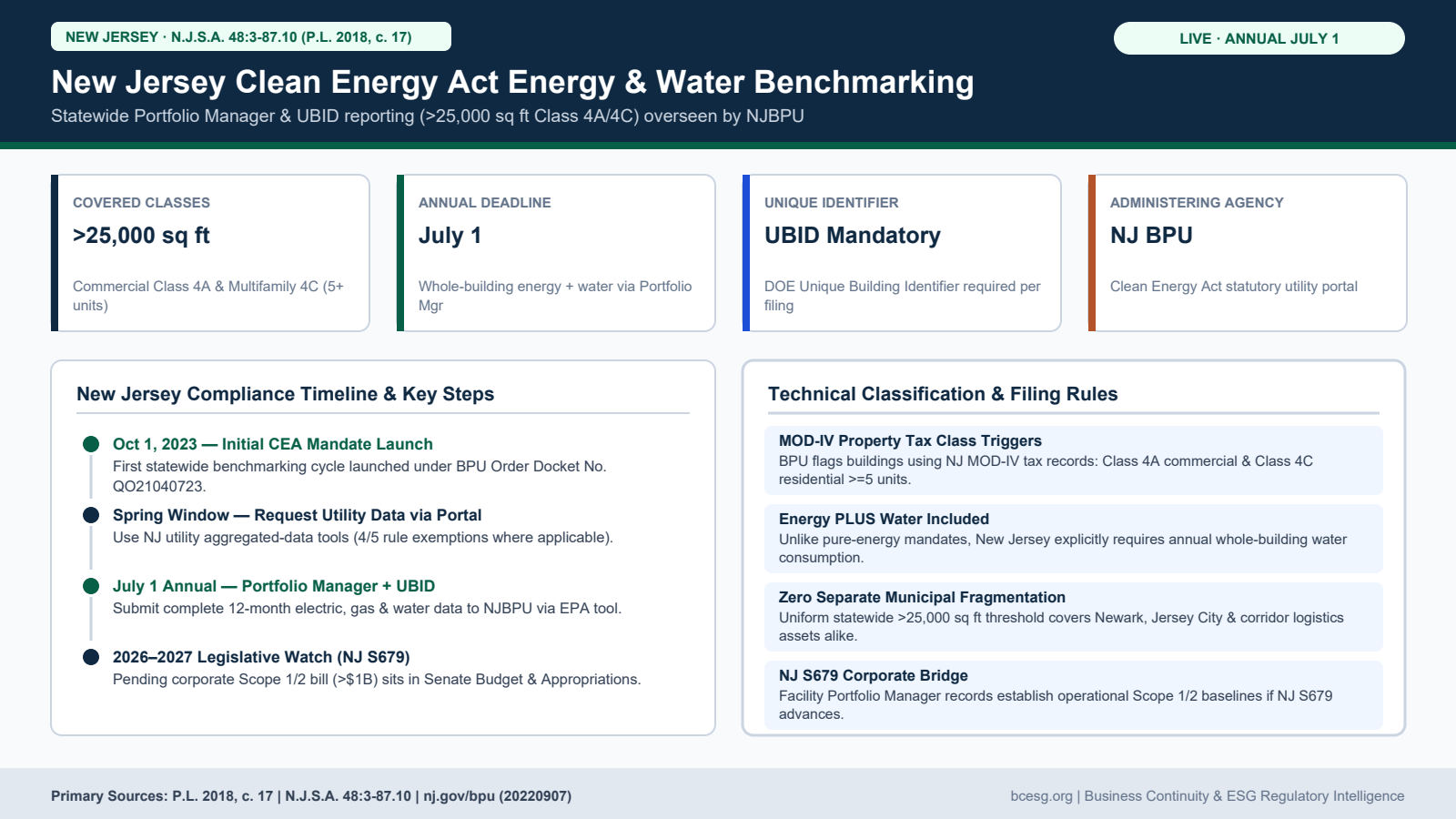
  • Massachusetts Large Building Energy Reporting (LBER / 225 CMR 27.00): Thresholds & June 30 Rules

    Massachusetts Large Building Energy Reporting (LBER / 225 CMR 27.00): Thresholds & June 30 Rules

    Short answer: Massachusetts enforces one of the nation’s broadest statewide building energy-reporting thresholds under the Climate Act of 2022 (M.G.L. c. 25A § 20) and Department of Energy Resources regulation 225 CMR 27.00 (MA DOER LBER). Covered commercial, institutional, industrial, and multifamily buildings ≥20,000 gross sq ft must track and reconcile annual whole-building energy consumption with DOER by June 30.

    For Greater Boston owners, statewide LBER serves as the reporting baseline underneath strict local decarbonization ordinances: Boston BERDO 2.0 (≥20k sq ft / 15+ units), Cambridge BEUDO (≥25k sq ft / ≥50 units), Newton BERDO (≥20k), and Lexington BEU-D (>25k) all enforce independent municipal spring filings and active emissions limits.

    Statutory Status at a Glance
    • Governing Authority: M.G.L. c. 25A § 20 (2022 Climate Act) & 225 CMR 27.00.
    • Administering Agency: Massachusetts Department of Energy Resources (DOER).
    • Covered Threshold: Commercial, industrial, institutional, and multifamily buildings ≥20,000 gross sq ft statewide.
    • 4-Step Annual Calendar: March 15 (exemptions) → May 30 (utilities upload metered electric/gas/steam) → June 30 (owner reporting) → August 31 (verification/corrections).
    • Performance vs. Reporting Split: Statewide LBER is reporting-only today; municipal Boston BERDO 2.0 and Cambridge BEUDO impose binding GHG limits starting 2025–2026.
    Print-First Compliance Brief

    Align Massachusetts >=20,000 sq ft LBER Filing With Local BERDO & BEUDO Caps

    2-page quick card charting DOER’s 4 annual milestones (Mar 15, May 30, Jun 30, Aug 31) alongside Boston, Cambridge, Newton, and Lexington.

    Inside DOER's Four-Date LBER Reporting Architecture

    Unlike state benchmarking programs that leave owners chasing tenant meter consent, 225 CMR 27.00 places a direct statutory data-delivery duty on Massachusetts electric, gas, and steam distribution utilities. By May 30 each year, utilities submit aggregated consumption records for covered premises directly into the DOER system.

    Property owners remain legally responsible for verifying parcel coverage, submitting delivered-fuel bills (fuel oil, propane, biomass), claiming vacancies or industrial exemptions by March 15, completing owner submissions by June 30, and resolving any utility anomalies prior to August 31.

    • Industrial & Lab Coverage: Because M.G.L. c. 25A § 20 includes industrial buildings ≥20,000 sq ft, Route 128 life-science labs, cold storage, and suburban manufacturing plants are swept in alongside office towers.
    • Parcel vs. Condominium Boundaries: Multiple buildings sharing single parcels require careful gross-floor-area verification against municipal assessor records before the March 15 exemption cutoff.
    DOER Milestone DateResponsible PartyAction Under 225 CMR 27.00
    March 15Building OwnerSubmit boundary, vacancy, or statutory exemption requests to DOER
    May 30Utilities (Electric/Gas/Steam)Upload aggregated whole-building energy usage for covered >=20k properties
    June 30Building OwnerComplete owner energy submission (incl. delivered oil/propane & property metadata)
    August 31Owner & DOER VerificationFinalize discrepancy corrections before public DOER dataset publication
    Massachusetts Large Building Energy Reporting (LBER / 225 CMR 27.00) infographic showing >=20,000 sq ft threshold, March 15-August 31 DOER calendar, and local Boston BERDO / Cambridge BEUDO caps.
    Massachusetts LBER (M.G.L. c. 25A § 20 & 225 CMR 27.00) four-milestone annual reporting calendar and local GHG cap interaction.

    Synchronizing Statewide LBER With Boston BERDO 2.0 & Neighboring States

    Inside Boston and Cambridge, owners run two distinct calendars out of the same Portfolio Manager dataset: Cambridge BEUDO filings land on May 1 and Boston BERDO 2.0 filings land on May 15—more than six weeks before Massachusetts DOER’s June 30 owner deadline. Ensuring third-party data verification covers both local emissions compliance and DOER records eliminates mid-summer rework.

    Northeast regional managers should track Massachusetts alongside New Jersey’s July 1 benchmarking (>25k sq ft) and NYC’s May 1 LL84/LL97 stack.

    Compliance Execution Checklist

    StepOwner / TeamAuditable Deliverable
    1. DOER List AuditAsset MgmtCheck DOER covered-building list for every MA commercial/industrial/MF parcel >=20,000 sq ft.
    2. Mar 15 ExemptionsCompliance LeadFile any demolition, under-threshold, or vacancy exemption documentation prior to March 15.
    3. Utility MatchFacilities /OpsConfirm May 30 utility uploads capture all meters and compile delivered heating oil/propane invoices.
    4. Local Overlay SyncSustainabilityAlign May 1 (Cambridge) / May 15 (Boston) filings with June 30 MA LBER owner certification.
    Field & Print Package

    Keep This Massachusetts Compliance Checklist Handy

    Download the formatted 2-page PDF reference brief or pull the structured Markdown edition for internal compliance documentation.

    Frequently Asked Questions

    Are industrial warehouses and life-science labs covered by Massachusetts LBER?

    Yes. M.G.L. c. 25A § 20 and 225 CMR 27.00 explicitly include commercial, institutional, industrial, and multifamily buildings of 20,000 gross sq ft or more.

    Does Massachusetts LBER impose carbon emissions fines like Boston BERDO 2.0?

    Statewide LBER is an annual energy reporting mandate overseen by DOER and does not currently levy numeric carbon-cap penalties, whereas Boston BERDO 2.0 and Cambridge BEUDO impose binding emissions limits and Alternative Compliance Payments locally.

    When must a building owner submit LBER reports to DOER?

    Owner reports are due June 30 annually, following March 15 exemption filings and May 30 utility uploads, with verification/corrections closing August 31.

    Primary Authorities & Official Resources

    Informational notice: This guide summarizes enacted statutes, regulations, or pending legislative records from the primary authorities linked above as of November 14, 2026. It is not legal, accounting, or licensed engineering advice.

  • California Building Energy Benchmarking (AB 802): June 1 Filing, Penalties & SB 253 Bridge

    California Building Energy Benchmarking (AB 802): June 1 Filing, Penalties & SB 253 Bridge

    Short answer: California’s statewide AB 802 Building Energy Benchmarking Program (Cal. Pub. Res. Code § 25402.10; 20 CCR §§ 1680–1684) requires owners of commercial and multifamily buildings over 50,000 gross sq ft with 17 or more active utility accounts to report whole-building energy use via ENERGY STAR Portfolio Manager every June 1.

    Even for corporations focused on California’s broader corporate rules—such as SB 253 Scope 1–3 GHG reporting—AB 802 is the operational data engine: its mandatory utility aggregation rule unlocks tenant-metered whole-building electricity and gas figures that feed directly into corporate Scope 2 inventories and local municipal audits across seven California cities.

    Statutory Status at a Glance
    • Governing Authority: Cal. Pub. Res. Code § 25402.10 (AB 802) & CEC Regulations 20 CCR §§ 1680–1684.
    • Administering Agency: California Energy Commission (CEC).
    • Covered Threshold: Commercial buildings (>50,000 sq ft, any account count above utility aggregation rules—generally >50k w/ 0/17+ rules per CEC account triggers) and multifamily buildings (>50,000 sq ft with ≥17 active residential/commercial utility accounts).
    • Deadline & Penalty: Annual June 1 filing; civil penalties of $500–$2,000 per day after 30-day uncured violation notice.
    • Local Exemptions: CEC recognizes approved local programs (LA EBEWE, SF EBO, San Jose BPO, San Diego) so owners avoid redundant state reporting while complying locally.
    Print-First Compliance Brief

    Connect California AB 802 Meter Data to Municipal Audits & SB 253 Scope 2

    2-page quick card detailing CEC June 1 reporting, utility aggregated data requests (4-week rule), local exemptions (LA, SF, SJ, SD), and civil fines.

    Threshold Nuances: The 17-Utility-Account Rule & Utility Data Rights

    AB 802 pairs two legal triggers that separate multi-tenant assets from single-user campuses: a building must exceed 50,000 gross sq ft and fall within CEC’s active utility account rules (notably 17+ active utility accounts for multifamily residential, or covered commercial configurations with no residential/non-residential exceptions).

    Crucially, AB 802 empowers owners against recalcitrant tenants: utilities must provide aggregated whole-building energy usage within four weeks of request, automatically bypassing individual tenant written authorization when a building contains at least 3 commercial accounts or 5+ residential accounts.

    • Public Transparency: CEC publishes benchmarked Energy Use Intensity (EUI) and ENERGY STAR scores on a public database for disclosable buildings.
    • 30-Day Cure Notice: Before imposing daily fines ($500–$2,000/day), CEC issues a formal written warning granting 30 days to cure missing submissions.
    Program ElementAB 802 Rule CitationOwner Requirement & Enforcement
    Covered Size & AccountsCal. Pub. Res. Code § 25402.10>50,000 gross sq ft commercial & multifamily (>=17 active utility accts)
    Utility Aggregation20 CCR § 1682 / Utility MandateUtilities deliver 12-mo aggregated data within 4 weeks (3 com / 5 res thresh)
    Annual CEC Deadline20 CCR § 1683Annual June 1 ENERGY STAR Portfolio Manager submission
    Civil Penalty ScheduleCal. Pub. Res. Code § 25402.10(f)$500–$2,000/day after 30-day uncured CEC notice
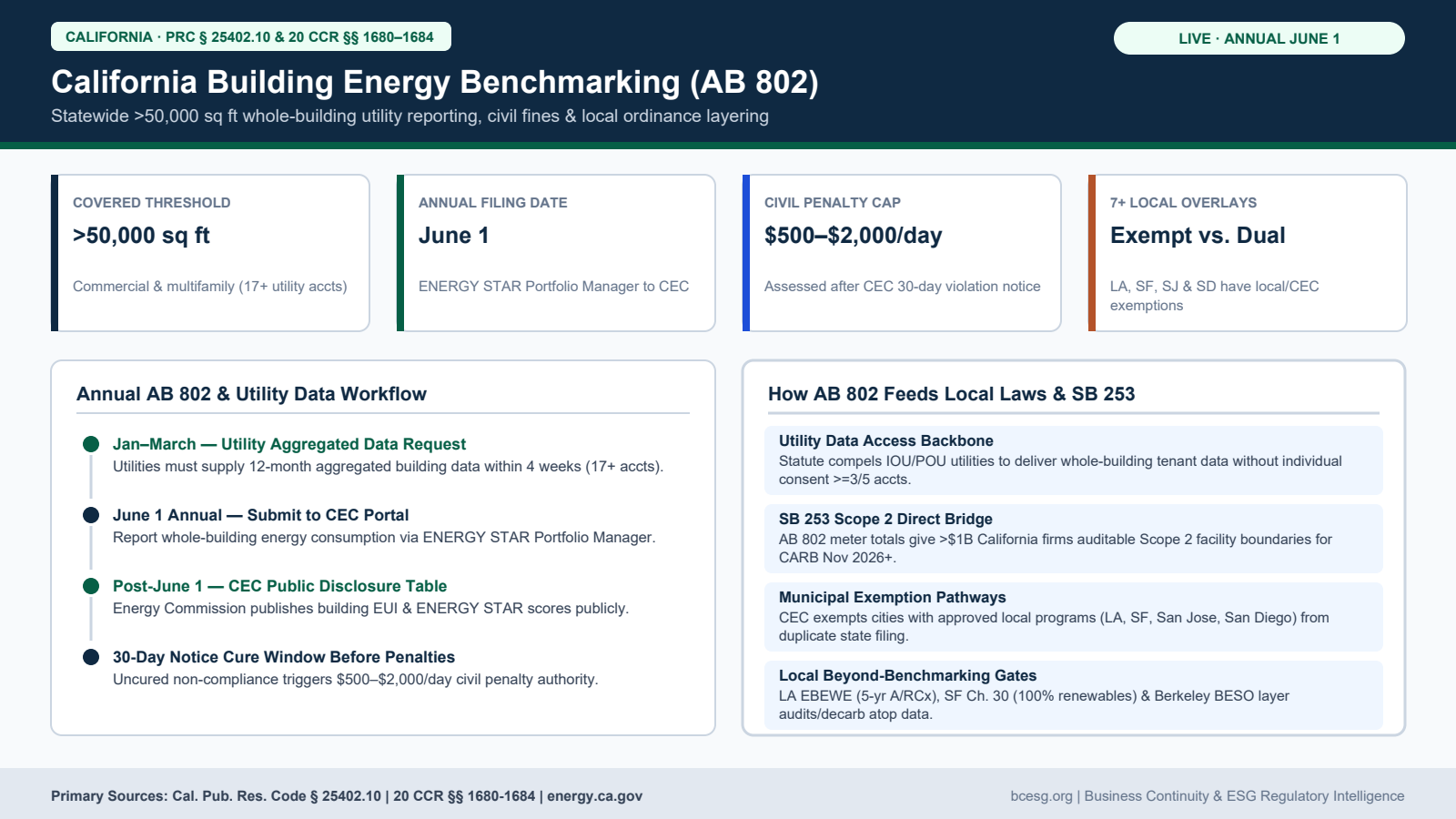
    California AB 802 building energy benchmarking visual summary showing >50,000 sq ft threshold, June 1 CEC deadline, $500-$2,000/day penalty window, and links to SB 253 and local cities.
    California AB 802 statewide benchmarking duties, utility data access rules, civil penalty range, and municipal exemption map under 20 CCR §§ 1680–1684.

    Bridge to California Local Ordinances & SB 253 Scope 2 Inventories

    California does not enforce a single statewide Building Performance Standard cap yet—local cities carry the performance and audit teeth. While CEC exempts properties already reporting under approved local ordinances (Los Angeles EBEWE, San Francisco EBO, San Jose BPO, and San Diego), owners inside those cities face much lower square-footage floors (10,000–20,000 sq ft) and five-year retro-commissioning or renewable electricity obligations.

    Meanwhile, large corporations (>$1B revenue) subject to California SB 253 Scope 1 and Scope 2 disclosures rely on AB 802 utility aggregates to reconcile leased-building operational boundaries without double counting.

    Compliance Execution Checklist

    StepOwner / TeamAuditable Deliverable
    1. Local vs. CEC CheckPortfolio LeadVerify if building sits in a CEC-exempt approved city (LA, SF, San Jose, San Diego) vs. direct CEC filing.
    2. Request Utility FeedsProperty OpsRequest aggregated 12-month data from IOU/POU utilities in Feb/Mar (allow 4+ weeks SLA).
    3. File by June 1Asset MgmtRun Portfolio Manager data quality checker and submit via annual CEC reporting link before June 1.
    4. Reconcile SB 253Corporate ESGMap Portfolio Manager meter boundaries to corporate SB 253 Scope 2 & Cat 13 disclosures.
    Field & Print Package

    Keep This California Compliance Checklist Handy

    Download the formatted 2-page PDF reference brief or pull the structured Markdown edition for internal compliance documentation.

    Frequently Asked Questions

    Do buildings in Los Angeles or San Francisco have to file twice for AB 802 and local ordinances?

    No, provided the property complies fully with a CEC-approved local benchmarking program (including LA EBEWE, San Francisco EBO, San Jose BPO, and San Diego), CEC exempts the building from duplicate state submission—though local filing deadlines (such as May 1 in SF/SJ) differ from June 1.

    Why does AB 802 matter for California SB 253 Scope 2 compliance?

    AB 802's statutory whole-building utility aggregation gives corporate tenants and building owners auditable electricity and gas totals across multi-tenant assets needed for Scope 2 and Scope 3 Category 13 GHG inventories.

    What is the penalty for ignoring a California Energy Commission AB 802 notice?

    After issuing a 30-day written notice of violation, the CEC may assess administrative civil penalties ranging from $500 to $2,000 per day until compliance is demonstrated.

    Primary Authorities & Official Resources

    Informational notice: This guide summarizes enacted statutes, regulations, or pending legislative records from the primary authorities linked above as of November 14, 2026. It is not legal, accounting, or licensed engineering advice.
  • Oregon Statewide Building Performance Standard (HB 3409 & OAR 330-300): Tier 1 & Tier 2 Guide

    Oregon Statewide Building Performance Standard (HB 3409 & OAR 330-300): Tier 1 & Tier 2 Guide

    Short answer: Oregon adopted a statewide two-tier Building Performance Standard under HB 3409 (codified at ORS 469.275 et seq.) and finalized operational rules in Oregon Department of Energy (ODOE) OAR Chapter 330, Division 300. Modeled directly on Washington’s Clean Buildings architecture, Oregon requires Tier 1 nonresidential buildings (≥35,000 sq ft) to hit Energy Use Intensity targets or investment criteria starting June 1, 2028, while Tier 2 commercial and institutional/multifamily properties begin mandatory reporting, EMP, and O&M compliance on July 1, 2028.

    Crucial rule-citation note: ODOE’s binding BPS rules live in OAR 330-300 (not OAR 330-135), and statewide compliance runs separately from Portland’s local energy reporting and 2050 carbon step-down ordinance track.

    Statutory Status at a Glance
    • Governing Authority: HB 3409 (2023), ORS 469.275 et seq., and ODOE Administrative Rules OAR 330-300.
    • Administering Agency: Oregon Department of Energy (ODOE).
    • Tier 1 (≥35,000 sq ft Nonresidential/Hotels/Motels): EUI target (or LCCA investment criteria) + EMP + O&M due June 1, 2028 (≥200k), June 1, 2029 (90k–200k), and June 1, 2030 (35k–90k).
    • Tier 2 (20k–35k Com & ≥35k MF/Hospitals/Schools/Care): Reporting + EMP + O&M due July 1, 2028 (no numeric Tier 1 EUIt cap in Cycle 1).
    • Incentives Window: ODOE Early Adopter Incentive funds support early Tier 1 & Tier 2 compliance preparation prior to 2028 enforcement.
    Print-First Compliance Brief

    Map Oregon HB 3409 Tier 1 & Tier 2 Compliance Under OAR 330-300

    2-page quick card distinguishing Oregon’s statewide OAR 330-300 rules (2028–2030 Tier 1/2 dates) from Portland City Code Ch. 17.104.

    Tier 1 vs. Tier 2 Classification Under OAR 330-300

    Understanding where an Oregon asset lands between Tier 1 and Tier 2 determines whether the owner faces capital retrofit obligations (or an LCCA investment audit) versus operational governance and energy reporting. Unlike Washington’s >50,000 sq ft Tier 1 floor, Oregon pulls nonresidential buildings down to 35,000 sq ft inside Tier 1.

    Conversely, Oregon places multifamily housing, hospitals, K-12 schools, universities, and senior care buildings ≥35,000 sq ft into Tier 2 alongside smaller commercial buildings (20,000–34,999 sq ft)—requiring benchmarking, an Energy Management Plan, and an O&M program without immediate EUIt caps.

    • ASHRAE Standard 100 Adaptation: ODOE builds EUIt benchmarks by building activity type and climate zone, requiring a qualified Energy Manager to sign EMP and O&M documentation.
    • 5-Year Recurring Cycles: After initial 2028–2030 filings, covered Tier 1 & Tier 2 buildings re-verify compliance every five years.
    Oregon BPS TierBuilding Types & Square FootageFirst Compliance Date & Core Duties
    Tier 1 — LargestNonresidential, hotels, motels >=200,000 sq ftJune 1, 2028 — EUIt / LCCA + EMP + O&M
    Tier 1 — MidNonresidential, hotels, motels 90,000–199,999 sq ftJune 1, 2029 — EUIt / LCCA + EMP + O&M
    Tier 1 — BaseNonresidential, hotels, motels 35,000–89,999 sq ftJune 1, 2030 — EUIt / LCCA + EMP + O&M
    Tier 2 — Com & Inst/MFCommercial 20k–35k sq ft; MF/hospitals/schools >=35kJuly 1, 2028 — Energy reporting + EMP + O&M
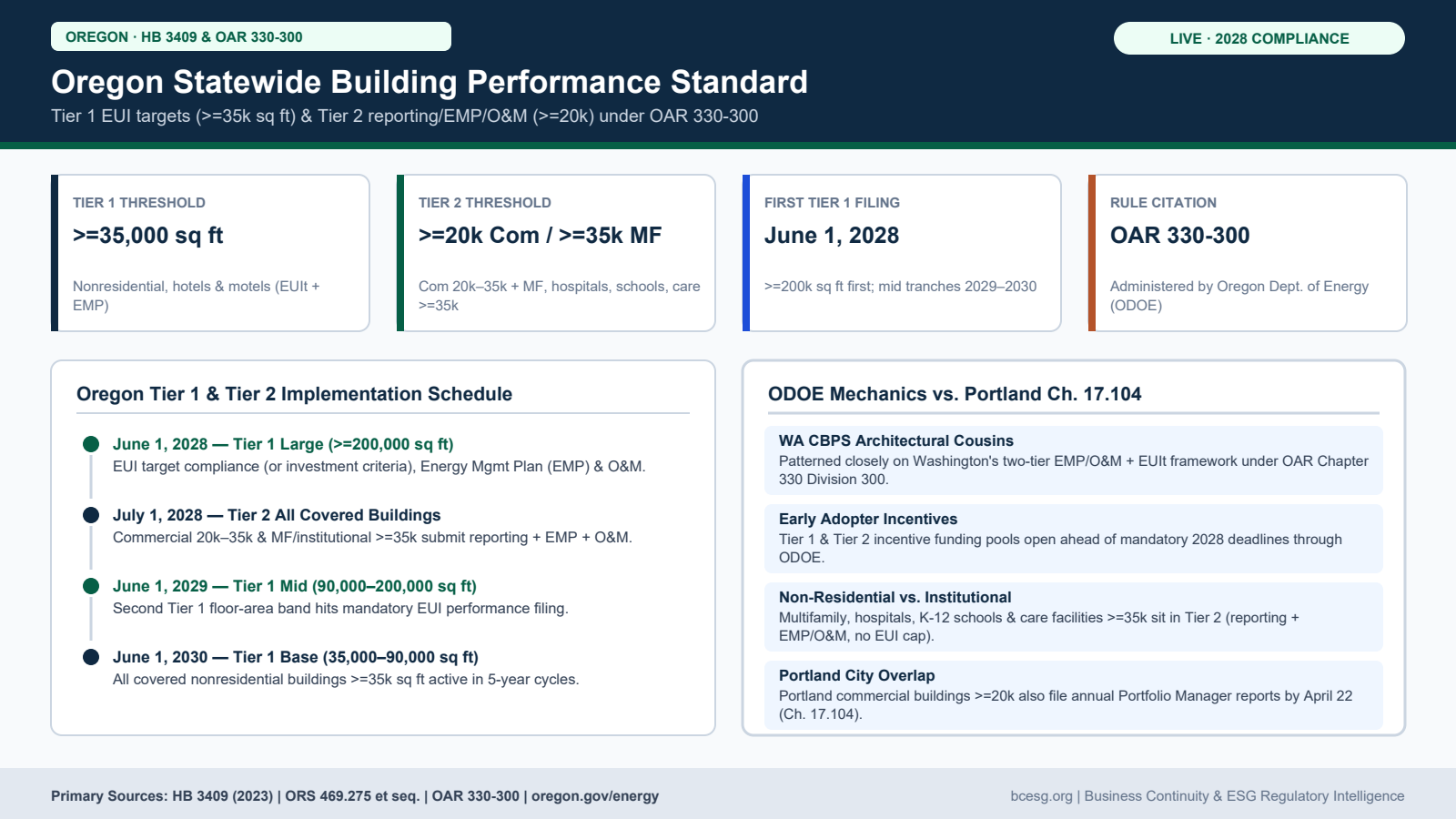
    Oregon Statewide Building Performance Standard (HB 3409 / OAR 330-300) summary showing Tier 1 >=35,000 sq ft EUI targets, Tier 2 >=20,000 sq ft reporting/EMP/O&M, 2028-2030 dates, and Portland Ch. 17.104 distinction.
    Oregon Statewide Building Performance Standard (HB 3409 / OAR 330-300) compliance schedule and Portland dual-reporting structure.

    Pacific Northwest Portfolio Alignment: Oregon, Washington & Portland

    For commercial real estate portfolios spanning I-5 from Seattle to Portland, Oregon’s OAR 330-300 deliberately tracks Washington’s CBPS (WAC 194-50)—allowing engineering teams to reuse Energy Management Plan templates and O&M manuals with Oregon-specific EUIt tables.

    Inside Portland city limits, owners must also track Portland City Code Chapter 17.104 (annual April 22 energy reporting for commercial buildings ≥20,000 sq ft) alongside the city’s 2050 building carbon step-down policy. Waiting until 2028 leaves insufficient time for a mandatory 12-month metered O&M baseline.

    Compliance Execution Checklist

    StepOwner / TeamAuditable Deliverable
    1. Tier VerificationAsset MgmtClassify each OR property >=20,000 sq ft under Tier 1 (>=35k nonres) vs Tier 2 under OAR 330-300.
    2. Incentive ScreenFinance / ESGCheck ODOE Early Adopter Incentive eligibility before 2028 funding windows close.
    3. EMP & O&M BuildOperationsStand up written EMP and 12 months of logged preventive O&M records at least 18 months pre-deadline.
    4. Portland SyncCompliance LeadPair statewide ODOE preparation with Portland April 22 Ch. 17.104 annual Portfolio Manager filings.
    Field & Print Package

    Keep This Oregon Compliance Checklist Handy

    Download the formatted 2-page PDF reference brief or pull the structured Markdown edition for internal compliance documentation.

    Frequently Asked Questions

    Where are Oregon's binding BPS rules codified?

    Oregon Department of Energy (ODOE) implements HB 3409 (ORS 469.275 et seq.) inside Oregon Administrative Rules Chapter 330, Division 300 (OAR 330-300).

    Are Oregon multifamily buildings subject to numeric Tier 1 EUI caps?

    No. Multifamily residential buildings of 35,000 sq ft or larger fall under Tier 2, requiring energy use reporting, an Energy Management Plan (EMP), and an O&M program starting July 1, 2028.

    Does complying with Portland Ch. 17.104 satisfy Oregon HB 3409?

    No. Portland City Code Chapter 17.104 governs annual April 22 commercial energy reporting in Portland, whereas OAR 330-300 enforces statewide Tier 1 EUIt targets and Tier 2 EMP/O&M governance through ODOE.

    Primary Authorities & Official Resources

    Informational notice: This guide summarizes enacted statutes, regulations, or pending legislative records from the primary authorities linked above as of November 14, 2026. It is not legal, accounting, or licensed engineering advice.
  • Maryland BEPS (COMAR 26.28 & HB 49): June 1 Verification, Fees & Montgomery County Carve-Out

    Maryland BEPS (COMAR 26.28 & HB 49): June 1 Verification, Fees & Montgomery County Carve-Out

    Short answer: Maryland’s statewide Building Energy Performance Standards (MDE BEPS / COMAR 26.28) moved from initial grace benchmarking into verified, fee-backed execution on June 1, 2026. Owners of commercial, multifamily, and state buildings ≥35,000 gross sq ft must file CY2025 energy data backed by third-party data verification and a $100 annual reporting fee—on the path toward 2030 interim and 2040 net-zero direct emissions caps.

    Just as critical for DMV-area portfolios: House Bill 49 (2025) resolved the state-versus-county overlap by exempting buildings complying with Montgomery County’s BEPS ordinance from filing duplicate state reports—while neighboring Washington, D.C. BEPS drops its Cycle 2 threshold to 25,000 sq ft on January 1, 2027.

    Statutory Status at a Glance
    • Governing Authority: Md. Code Envir. § 2-1602 (Climate Solutions Now Act of 2022), amended by HB 49 (2025); COMAR 26.28.
    • Administering Agency: Maryland Department of the Environment (MDE) Clean Buildings Program.
    • Covered Threshold: Commercial, multifamily, and state-owned buildings ≥35,000 gross sq ft (excluding parking garages).
    • Annual Verification & Fee: June 1 annual Portfolio Manager filing; CY2025 milestone (June 1, 2026) introduced mandatory third-party verification + $100 fee.
    • Direct GHG Trajectory: Interim 2030–2034 targets leading to net-zero direct (Scope 1) on-site emissions in 2040.
    Print-First Compliance Brief

    Prepare Maryland >=35,000 sq ft Buildings for Third-Party Verification & Direct GHG Caps

    2-page quick card mapping MDE COMAR 26.28 verification rules, HB 49 fee reforms, Montgomery County exemption boundaries, and DC BEPS portfolio coordination.

    What HB 49 Changed for Owners, Fees, and Local Carve-Outs

    When MDE first promulgated COMAR 26.28, building owners challenged both the initial EUI compliance friction and duplicate state/county compliance burdens in Montgomery County. The 2025 passage of HB 49 streamlined administration without delaying decarbonization.

    First, HB 49 clarified that buildings covered by and compliant with Montgomery County BEPS (≥25,000 sq ft) need not submit duplicative filings under MDE’s state program. Second, HB 49 formalized the $100 annual benchmarking fee schedule and adjusted EUI vs. direct GHG alternative-compliance fee structures to align with achievable electrification cycles.

    • Direct vs. Site EUI Lens: Maryland uniquely targets net direct (on-site fossil fuel) greenhouse gas emissions rather than electricity-heavy total emissions caps—accelerating heat-pump water heating and HVAC electrification.
    • Accredited Verifiers Required: Starting with CY2025 reports and recurring every five years (as well as interim compliance milestones), an accredited third-party verifier must attest to meter boundaries and square footage.
    Milestone / ProvisionApplicabilityStatutory Deadline & Rule
    Initial CY2024 Benchmarking>=35,000 sq ft commercial/MF/stateSept 1, 2025 (initial grace deadline completed)
    CY2025 Verified FilingNon-exempt buildings >=35,000 sq ftJune 1, 2026 + mandatory 3rd-party verifier + $100 fee
    Montgomery County ExemptionMontgomery County BEPS >=25k buildingsExempt from duplicate MDE state filing per HB 49 (2025)
    2030 & 2040 Direct GHG CapsInterim 2030–2034 -> Final 204020% net direct GHG cut (2030+) -> Net-zero direct 2040
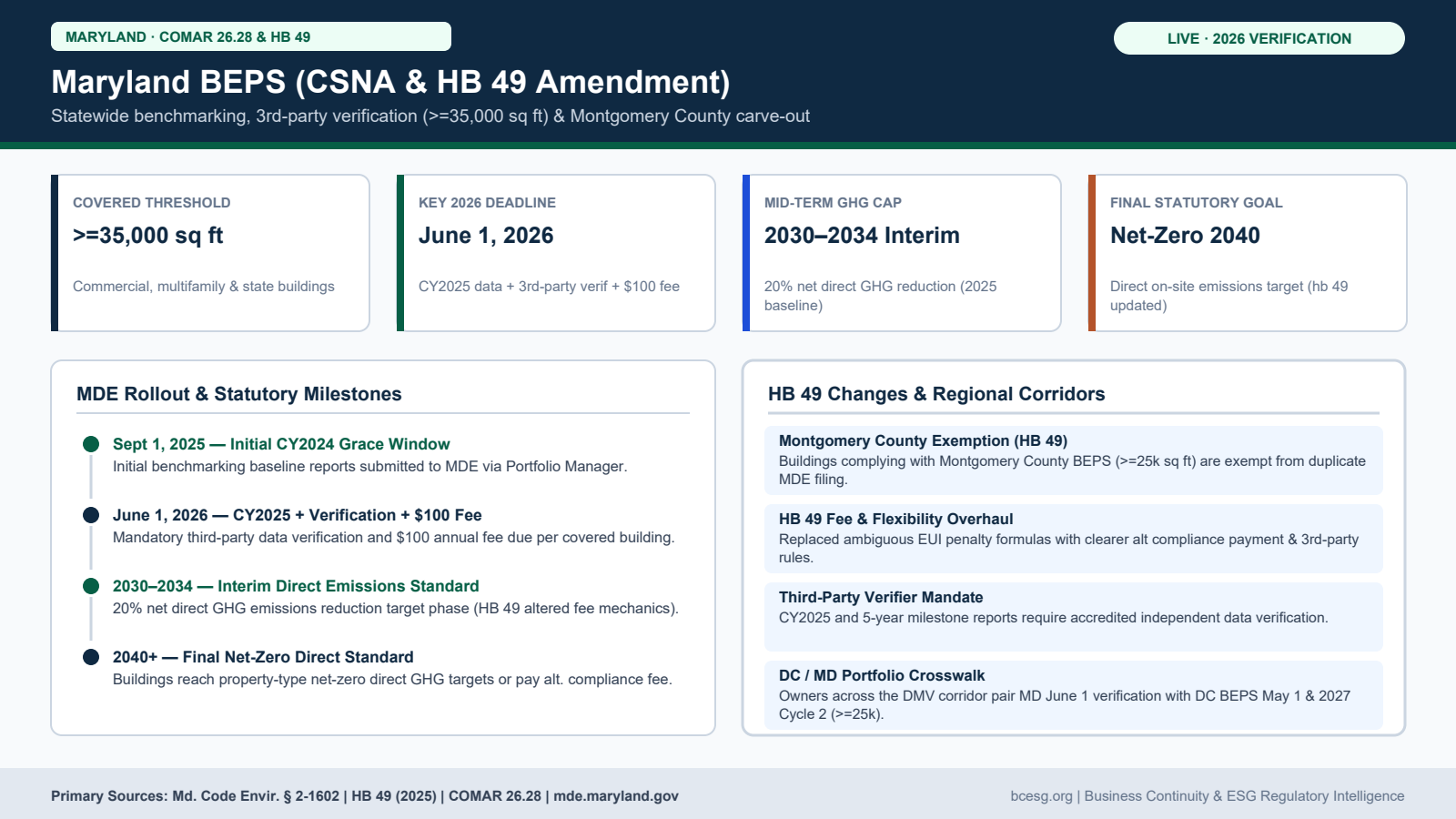
    Maryland BEPS statutory breakdown showing >=35,000 sq ft scope, June 1, 2026 third-party verification and $100 fee deadline, 2030/2040 direct GHG targets, and Montgomery County HB 49 exemption.
    Maryland Building Energy Performance Standards (BEPS) compliance roadmap under Md. Code Envir. § 2-1602, HB 49 (2025), and COMAR 26.28.

    Synchronizing Maryland (≥35k) With D.C. BEPS (≥25k) and Regional Law

    Real estate operators across the Baltimore–Washington corridor manage overlapping calendars: Washington D.C. closes BEPS Cycle 1 (≥50k sq ft) on December 31, 2026 and drops into Cycle 2 (≥25,000 sq ft) on January 1, 2027, with annual D.C. benchmarking due May 1. One month later, Maryland owners face their June 1 MDE filing deadline.

    Read alongside our D.C. BEPS Cycle 1 & Cycle 2 pathway guide and New Jersey CEA benchmarking guide, Mid-Atlantic asset teams can consolidate ENERGY STAR Portfolio Manager utility feeds and third-party verifier engagements into one spring assurance window.

    Compliance Execution Checklist

    StepOwner / TeamAuditable Deliverable
    1. Exemption CheckCompliance LeadConfirm whether assets sit in Montgomery County BEPS carve-out or <35k sq ft exclusion (excl. parking).
    2. Retain VerifierFacilities / PEContract an MDE-recognized third-party data verifier ahead of spring utility reconciliation.
    3. File & Remit $100Property OpsSubmit verified CY data in Portfolio Manager + pay $100 annual fee to MDE by June 1.
    4. Electrification PlanCapEx EngineeringModel on-site gas equipment replacements ahead of 2030 direct GHG targets and 2040 net-zero rules.
    Field & Print Package

    Keep This Maryland Compliance Checklist Handy

    Download the formatted 2-page PDF reference brief or pull the structured Markdown edition for internal compliance documentation.

    Frequently Asked Questions

    What buildings are exempt under HB 49's Montgomery County provision?

    Buildings located in Montgomery County that comply with Montgomery County's local Building Energy Performance Standards (>=25,000 sq ft) are exempt from filing duplicate statewide reports with MDE under HB 49 (2025).

    When is Maryland BEPS third-party verification required?

    First required with CY2025 data due June 1, 2026 (alongside the $100 annual fee), and at subsequent 5-year compliance verification milestones under COMAR 26.28.

    Does Maryland BEPS regulate electricity emissions or only on-site gas?

    Maryland's interim 2030 and 2040 statutory standards focus specifically on direct on-site greenhouse gas emissions (Scope 1 combustion), though whole-building electric and fuel consumption are both benchmarked annually.

    Primary Authorities & Official Resources

    Informational notice: This guide summarizes enacted statutes, regulations, or pending legislative records from the primary authorities linked above as of November 14, 2026. It is not legal, accounting, or licensed engineering advice.
  • Building Performance Colorado (BPC) & HB 25-1269: Benchmarking, 2030 Targets & EPCA Litigation

    Building Performance Colorado (BPC) & HB 25-1269: Benchmarking, 2030 Targets & EPCA Litigation

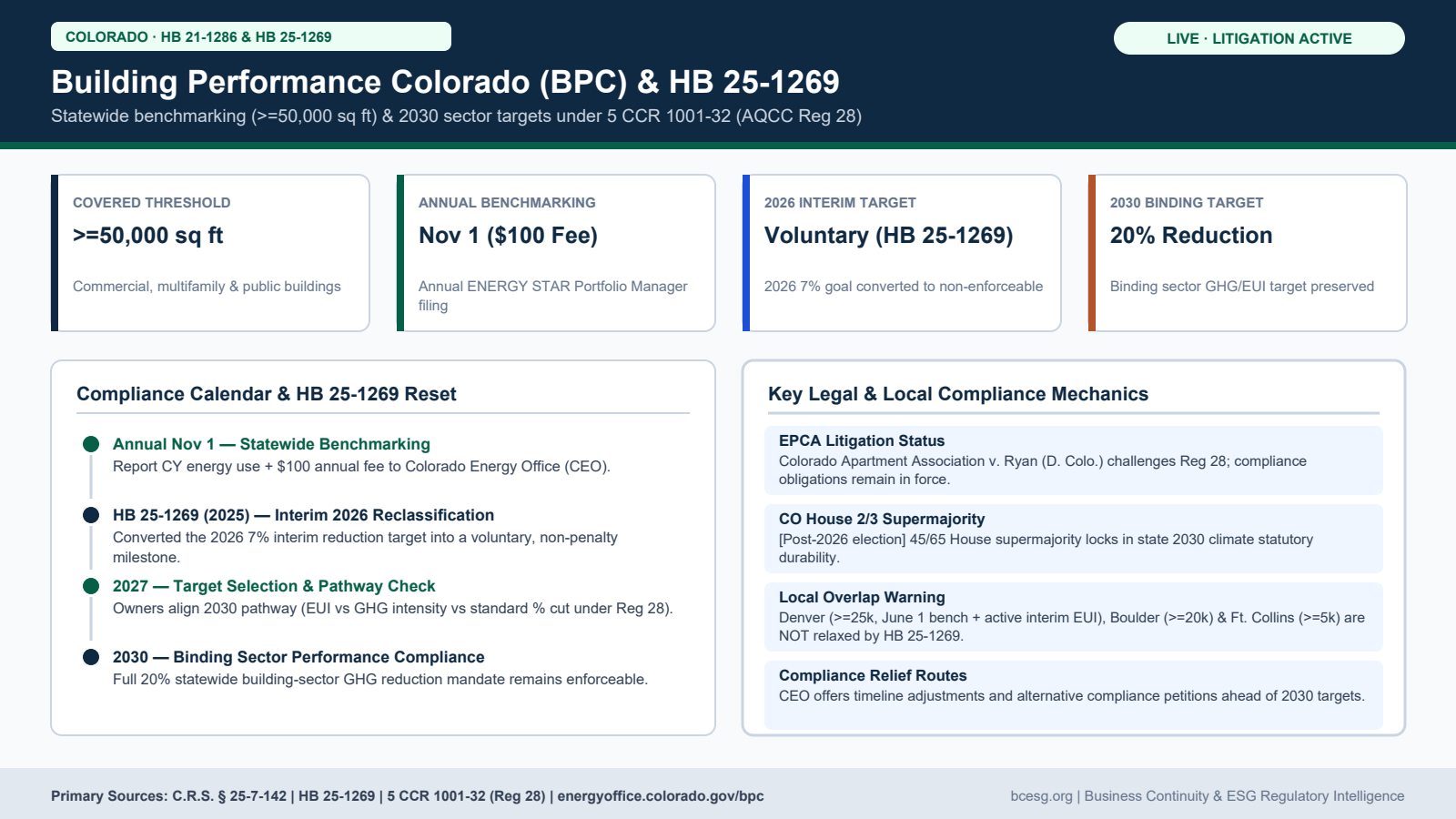
    Short answer: Colorado’s statewide building performance statute remains live and binding for 2030—even though HB 25-1269 removed mandatory penalties around the interim 2026 milestone. Under Building Performance Colorado (BPC) and HB 25-1269, covered owners of commercial, multifamily, and public buildings of 50,000 gross sq ft or more must continue annual November 1 benchmarking ($100 fee) and remain legally on track for the 2030 20% sector emissions/EUI target.

    Two structural traps catch Colorado asset managers off guard: mistaking HB 25-1269’s voluntary 2026 state target for a pause on municipal Energize Denver interim caps, and assuming pending federal EPCA litigation excuses annual state reporting.

    Statutory Status at a Glance
    • Governing Authority: C.R.S. § 25-7-142 (HB 21-1286), HB 25-1269 (2025), and AQCC Regulation 28 (5 CCR 1001-32).
    • Administering Agencies: Colorado Energy Office (CEO) & CDPHE Air Quality Control Commission.
    • Covered Threshold: Commercial, multifamily, and public buildings ≥50,000 gross sq ft statewide.
    • Annual Benchmarking: Due every November 1 via Portfolio Manager with a $100 annual compliance fee.
    • 2026 vs. 2030 Split & Litigation: 2026 7% state target is now voluntary/non-penalty (HB 25-1269); 2030 20% target stays binding; Colorado Apartment Association v. Ryan (D. Colo.) EPCA challenge active without stay.
    Print-First Compliance Brief

    Navigate Colorado BPC, HB 25-1269 Relief, and Energize Denver Overlap

    2-page quick card distinguishing Colorado’s voluntary 2026 goal from binding 2030 targets, annual Nov 1 filing ($100 fee), and EPCA litigation status.

    What HB 25-1269 Changed—and What Stayed Binding

    Under the original HB 21-1286 and Regulation 28 schedule, buildings ≥50,000 sq ft faced an intermediate 7% sector-wide reduction milestone in 2026 ahead of the 20% reduction target in 2030. Recognizing post-pandemic grid mix and capital lead times, the General Assembly enacted HB 25-1269 in 2025.

    HB 25-1269 expressly converted the 2026 7% interim goal into a non-enforceable voluntary goal, relieving owners from state interim civil penalties in 2026–2027. However, HB 25-1269 left the November 1 annual benchmarking obligation intact and preserved full statutory authority for the 2030 20% sector emissions/EUI reduction requirement.

    • Compliance Pathway Flexibility: Building owners select between hitting a property-type Energy Use Intensity (EUI) target, an operational Greenhouse Gas Intensity (GHGI) target, or a standardized percentage EUI/GHG reduction pathway under Regulation 28.
    • 2026 Election Trajectory Context (Inferred): Following the November 2026 Colorado House shift to a 45/65 two-thirds majority, legislative repeal risk against the 2030 BPC statutory mandate is low, signaling long-run regulatory continuity for decarbonization planning.
    Obligation LayerScope & CitationCurrent Deadlines & Enforceability
    Annual BenchmarkingC.R.S. § 25-7-142 (>=50k sq ft)Annual Nov 1 Portfolio Manager report + $100 fee (Live/Mandatory)
    2026 Interim Target (7%)HB 25-1269 (amending Reg 28)Converted to non-enforceable voluntary target (No 2026 state fine)
    2030 Binding Target (20%)5 CCR 1001-32 (AQCC Reg 28)Mandatory 2030 EUI / GHGI / % reduction compliance preserved
    EPCA Preemption SuitColorado Apt. Assoc. v. Ryan (D. Colo.)Litigation active; no injunction staying BPC filings or 2030 roadmap
    Summary diagram of Building Performance Colorado (BPC) >=50,000 sq ft November 1 benchmarking, HB 25-1269 voluntary 2026 interim target reset, 2030 binding reduction, and EPCA litigation posture.
    Building Performance Colorado (BPC) statutory calendar under C.R.S. § 25-7-142, HB 25-1269 (2025), and 5 CCR 1001-32 (AQCC Reg 28).

    Don't Confuse State Relief With Energize Denver or Local Rules

    Colorado owners frequently apply statewide HB 25-1269 logic across Denver, Boulder, Fort Collins, and Aspen portfolios—creating unexpected local noncompliance. Local ordinances operate on independent home-rule statutory authority and lower square-footage triggers.

    Owners managing multi-state western real estate should cross-check Colorado’s 50,000 sq ft floor against Washington CBPS (>20,000 sq ft Tier 2) and California AB 802 (>50,000 sq ft June 1 benchmarking) to harmonize Portfolio Manager data requests across utilities.

    • Denver (Energize Denver, DRMC Ch. 4): Covers buildings ≥25,000 sq ft with June 1 annual benchmarking and separate interim/final EUI caps—NOT converted to voluntary by state HB 25-1269.
    • Boulder & Fort Collins: Boulder mandates ≥20,000 sq ft annual benchmarking plus 10-year audits/RCx and LED retrofits; Fort Collins BEWS requires annual June 1 benchmarking down to 5,000 sq ft.

    Litigation Posture: Colorado Apartment Association v. Ryan

    Industry groups filed Colorado Apartment Association v. Ryan in U.S. District Court (D. Colo.) arguing federal Energy Policy and Conservation Act (EPCA) preemption against state building energy caps. Because no court injunction currently suspends BPC benchmarking or Regulation 28’s 2030 planning obligations, owners should treat litigation as background legal risk rather than a filing excuse—similar to how NYC Local Law 97 compliance proceeded to Court of Appeals resolution while deadlines ran.

    Compliance Execution Checklist

    StepOwner / TeamAuditable Deliverable
    1. Annual Nov 1 FilingProperty MgrFile whole-building Portfolio Manager data + remit $100 fee to Colorado Energy Office before Nov 1.
    2. Pathway AuditEnergy EngineerSelect optimal 2030 Reg 28 pathway (EUI vs. GHGI vs. standard %) and verify meter accuracy.
    3. Municipal SeparationPortfolio LeadSegregate Denver (>=25k), Boulder (>=20k), Ft. Collins (>=5k), and Aspen schedules from state BPC rules.
    4. CapEx & PetitionsAsset FinanceDocument equipment end-of-life windows and file CEO timeline adjustments early if hardship applies.
    Field & Print Package

    Keep This Colorado Compliance Checklist Handy

    Download the formatted 2-page PDF reference brief or pull the structured Markdown edition for internal compliance documentation.

    Frequently Asked Questions

    Did HB 25-1269 repeal Building Performance Colorado?

    No. HB 25-1269 converted only the interim 2026 7% reduction goal into a non-enforceable voluntary milestone. Annual November 1 benchmarking ($100 fee) and the 2030 binding 20% sector reduction target under AQCC Regulation 28 remain in force.

    When is annual Colorado BPC benchmarking due?

    Every November 1 for buildings of 50,000 gross sq ft or more, accompanied by a $100 annual fee paid to the Colorado Energy Office.

    Does HB 25-1269 relax Energize Denver deadlines for my Denver building?

    No. Energize Denver is a separate municipal ordinance (covering buildings >=25,000 sq ft with June 1 annual benchmarking and local EUI targets) unaffected by Colorado's state interim adjustment.

    Primary Authorities & Official Resources

    Informational notice: This guide summarizes enacted statutes, regulations, or pending legislative records from the primary authorities linked above as of November 14, 2026. It is not legal, accounting, or licensed engineering advice.
  • Washington Clean Buildings Performance Standard (CBPS): Tier 1 & Tier 2 Compliance Guide

    Washington Clean Buildings Performance Standard (CBPS): Tier 1 & Tier 2 Compliance Guide

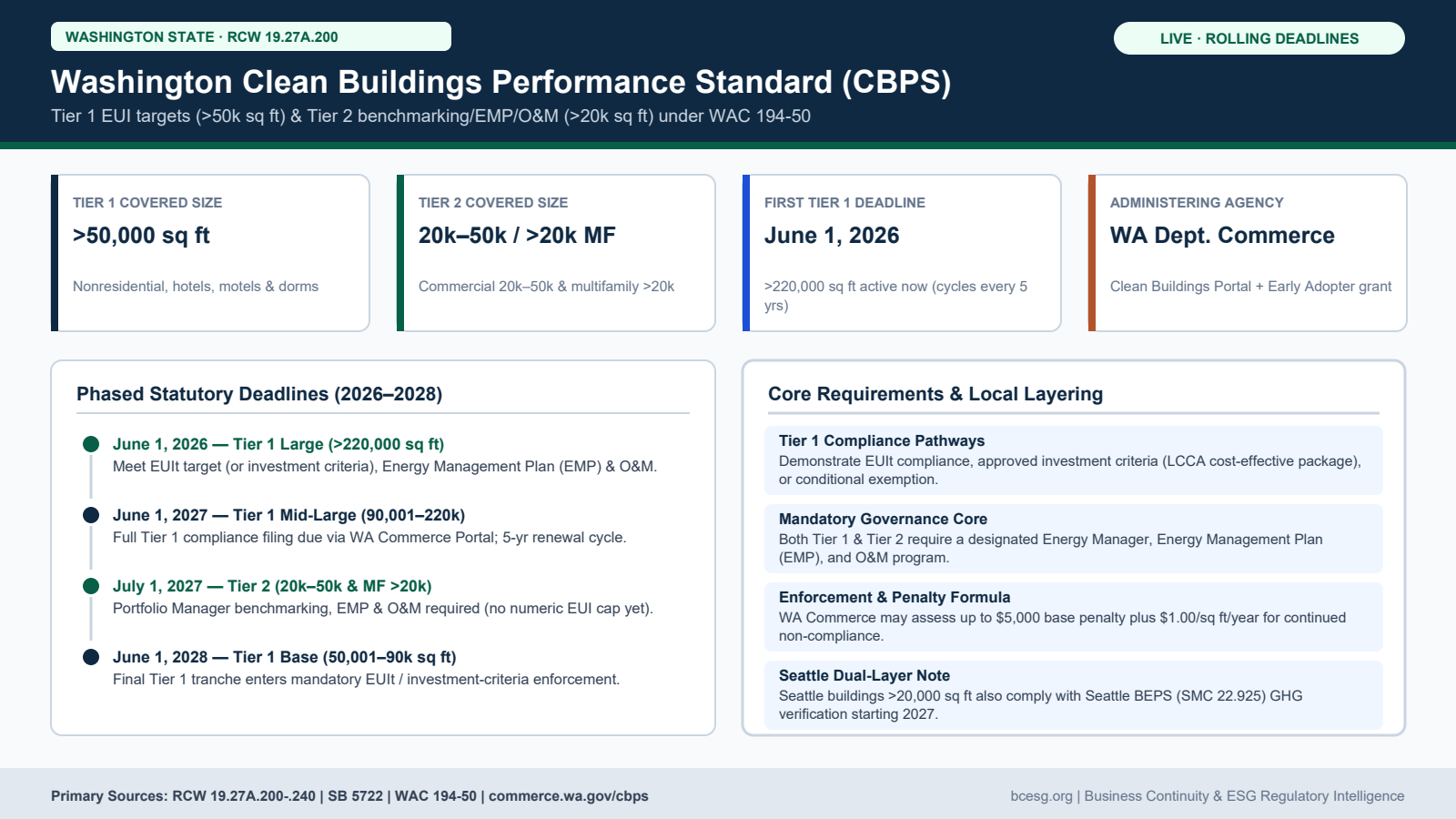
    Short answer: Washington’s Clean Buildings Performance Standard (CBPS) is already in active statutory enforcement for the state’s largest nonresidential buildings. Under RCW 19.27A.200–.240 and Washington Department of Commerce rules (WAC 194-50), Tier 1 buildings over 220,000 sq ft faced their initial June 1, 2026 compliance date, followed by staggered 2027 and 2028 deadlines extending down to 20,000 sq ft commercial and multifamily properties.

    Unlike pure benchmarking laws that stop at energy score disclosure, Washington CBPS pairs mandatory governance—a designated Energy Manager, a living Energy Management Plan (EMP), and an Operations & Maintenance (O&M) program—with enforceable Energy Use Intensity targets (EUIt) or Life Cycle Cost Analysis (LCCA) investment packages for Tier 1 properties.

    Statutory Status at a Glance
    • Governing Authority: RCW 19.27A.200–.240 (HB 1257 of 2019; expanded by SB 5722 of 2022) & WAC 194-50.
    • Administering Agency: Washington Department of Commerce Clean Buildings Program.
    • Tier 1 Deadlines: June 1, 2026 (>220,000 sq ft); June 1, 2027 (90,001–220,000 sq ft); June 1, 2028 (50,001–90,000 sq ft).
    • Tier 2 Deadline: July 1, 2027 for commercial 20,000–50,000 sq ft and all multifamily residential >20,000 sq ft (benchmarking + EMP + O&M).
    • Maximum Penalty: Up to $5,000 base fine plus $1.00 per square foot of gross floor area per year of continued Tier 1 non-compliance (Tier 2 carries separate benchmarking/reporting enforcement).
    Print-First Compliance Brief

    Operationalize Washington CBPS Compliance Across Tier 1 & Tier 2 Assets

    Field-ready 2-page PDF reference covering WA Commerce EUIt pathways, EMP/O&M governance, June 2026–2028 deadlines, and Tier 2 multifamily duties.

    Tier 1 vs. Tier 2 Coverage and Phased Deadlines (2026–2028)

    Following the 2022 passage of SB 5722, Washington divided covered stock into two statutory tiers using conditioned vs. gross floor area excluding parking garages. Every covered building sits on a recurring 5-year compliance cycle anchored to its size band.

    Owners with multi-building campuses should verify whether campus-level or individual-building metering governs their Commerce Clean Buildings Portal account, as single-campus utility feeds alter EUIt baseline normalization.

    • Tier 1 (Nonresidential, Hotels, Motels & Dormitories >50,000 sq ft): Must benchmark weather-normalized EUI, adopt an EMP and O&M program, and either meet the assigned property-type EUIt or execute all cost-effective measures identified via an ASHRAE Standard 100 / LCCA investment audit.
    • Tier 2 (Commercial 20,000–50,000 sq ft & Multifamily >20,000 sq ft): Currently requires Portfolio Manager benchmarking, an Energy Management Plan, and an O&M manual by July 1, 2027—without a numeric Tier 1 EUIt cap in this initial cycle.
    Building CategorySize & Property ScopeStatutory Duty & Next Deadlines
    Tier 1 — LargestNonresidential, hotels, motels, dorms >220,000 sq ftEUIt / LCCA + EMP + O&M due June 1, 2026 (active; 5-yr cycle)
    Tier 1 — Mid-LargeNonresidential, hotels, motels, dorms 90,001–220,000 sq ftEUIt / LCCA + EMP + O&M due June 1, 2027
    Tier 1 — BaseNonresidential, hotels, motels, dorms 50,001–90,000 sq ftEUIt / LCCA + EMP + O&M due June 1, 2028
    Tier 2 — Small / MFCommercial 20,000–50,000 sq ft & Multifamily >20,000 sq ftBenchmarking + EMP + O&M due July 1, 2027 (no EUI cap yet)
    Visual compliance summary of Washington Clean Buildings Performance Standard (CBPS) Tier 1 >50,000 sq ft and Tier 2 >=20,000 sq ft deadlines, pathways, and penalty formulas.
    Washington Clean Buildings Performance Standard (CBPS) Tier 1 and Tier 2 deadlines, governance core, and statutory enforcement formula under RCW 19.27A.200–.240 and WAC 194-50.

    Compliance Pathways, EMP Governance, and Conditional Exemptions

    Washington’s Department of Commerce evaluates Tier 1 submissions through three operational doors inside the Clean Buildings Portal. Selecting the wrong pathway late in the cycle creates avoidable audit risk because LCCA engineering studies and O&M logs require at least 12 months of documented execution prior to filing.

    If a building operates in Seattle (>20,000 sq ft), remember that compliance with statewide CBPS does not exempt the asset from Seattle’s Building Emissions Performance Standard (SMC 22.925), which adds municipal GHG intensity (GHGI) reporting and verification beginning in 2027. Portfolios crossing the Columbia River should also align schedules with Oregon’s HB 3409 BPS, which mirrors Washington’s Tier 1/Tier 2 architecture.

    • EUIt Compliance Path: Demonstrate weather-normalized EUI at or below the Commerce target for your occupancy mix.
    • Investment Criteria Path (LCCA): When achieving EUIt is technically or economically infeasible, submit a qualified Energy Audit and Life Cycle Cost Analysis proving every package meeting statutory ROI criteria was installed.
    • Conditional Exemptions: Covers low occupancy (<50% physical occupancy during measurement year), agricultural/industrial process loads exceeding 50% of energy use, pending demolition permits, or severe financial hardship verified with Commerce prior to deadline.

    Penalties and Financial Risk Comparison Across Jurisdictions

    Failure to document an EMP, O&M program, or EUIt compliance under WAC 194-50 triggers formal notices prior to fine assessment. Because maximum statutory fines compound up to $5,000 plus $1.00/sq ft annually, a 150,000 sq ft non-compliant office tower faces up to $155,000 per year in civil exposure before accounting for capital catch-up costs.

    Compared against east-coast carbon caps such as NYC Local Law 97 ($268/tCO2e) or Washington D.C. BEPS, Washington’s investment criteria safety valve protects capital-constrained owners—provided documentation begins early enough to run a full 12-month metered O&M cycle.

    Compliance Execution Checklist

    StepOwner / TeamAuditable Deliverable
    1. Portal ClaimingAsset MgmtVerify WA Commerce Clean Buildings Portal building ID, square footage (excl. garage), and Tier 1/2 tiering.
    2. EMP & O&M SetupChief EngineerAppoint qualified Energy Manager and launch written EMP + 12-month documented O&M preventive logs.
    3. Pathway AuditPE / ASHRAE AuditorRun Portfolio Manager EUI gap check; initiate ASHRAE Level 2 / LCCA study immediately if above EUIt.
    4. Exemption / FilingCompliance LeadSubmit conditional exemptions or Early Adopter Incentive claims ahead of June 1 / July 1 statutory dates.
    Field & Print Package

    Keep This Washington State Compliance Checklist Handy

    Download the formatted 2-page PDF reference brief or pull the structured Markdown edition for internal compliance documentation.

    Frequently Asked Questions

    Do multifamily apartment buildings have to meet EUIt energy caps under Washington CBPS?

    Not under the current statutory cycle. Multifamily residential buildings greater than 20,000 sq ft fall under Tier 2, which requires ENERGY STAR Portfolio Manager benchmarking, an Energy Management Plan (EMP), and an O&M program by July 1, 2027, rather than numeric Tier 1 EUIt limits.

    What happens if a Tier 1 building misses its June 1, 2026 compliance date?

    The Washington Department of Commerce issues violation notices with mitigation windows before imposing statutory penalties up to $5,000 base plus $1.00 per square foot per year of continued non-compliance under WAC 194-50.

    Does complying with Washington CBPS satisfy Seattle BEPS?

    No. Covered Seattle buildings greater than 20,000 sq ft must comply with both statewide WA CBPS and Seattle's municipal Building Emissions Performance Standard (SMC 22.925), which introduces GHG emissions verification starting in 2027.

    Primary Authorities & Official Resources

    Informational notice: This guide summarizes enacted statutes, regulations, or pending legislative records from the primary authorities linked above as of November 14, 2026. It is not legal, accounting, or licensed engineering advice.
  • Portland Building Compliance: Live Ch. 17.104 (April 22), OR HB 3409 & 2050 Carbon Proposal

    Portland Building Compliance: Live Ch. 17.104 (April 22), OR HB 3409 & 2050 Carbon Proposal

    Updated: November 14, 2026 — Refreshed to reflect current statutory cycles, verification rules, and post-election regulatory posture.

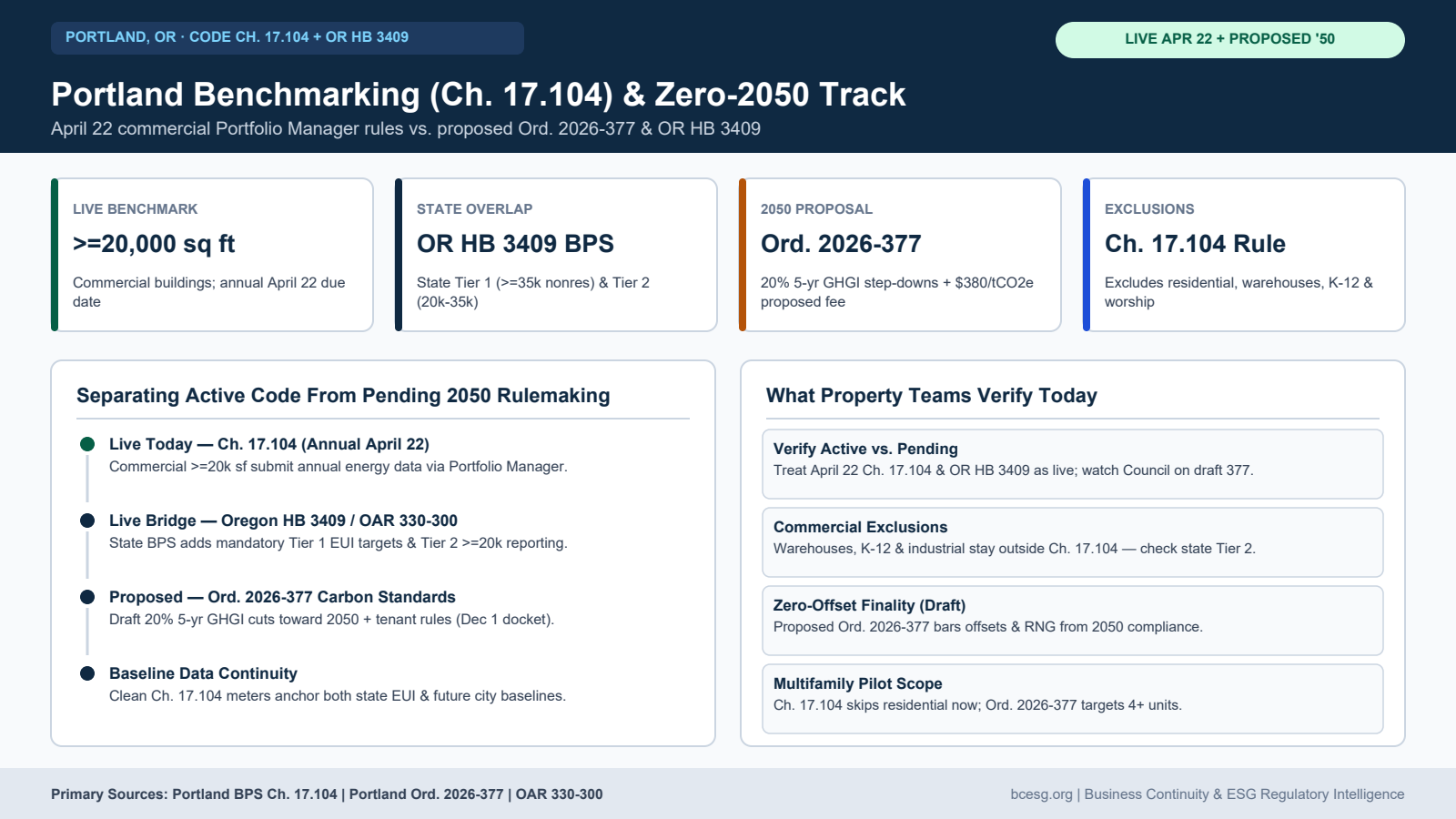
    Short answer: Portland building compliance involves two distinct legal layers today — plus one closely watched legislative proposal. On the active, enforceable ledger, Portland City Code Chapter 17.104 (administered since 2015 by Portland’s Bureau of Planning & Sustainability) requires annual April 22 ENERGY STAR Portfolio Manager benchmarking for covered commercial buildings >=20,000 sq ft, operating alongside Oregon’s active statewide HB 3409 / OAR 330-300 Building Performance Standard.

    Meanwhile, Ordinance 2026-377 (Climate and Health Standards for Buildings Code) — continued to City Council’s Housing and Permitting Committee December 1 docket — remains a proposal, not enacted law. It would replace Ch. 17.104 with 20% five-year GHGI reductions reaching zero in 2050 (without offsets or RNG), expand annual June 1, 2028 reporting to residential 4+ unit buildings >=20,000 sq ft, and attach a $380/MTCO2e carbon impact fee. Building owners should comply with active April 22 Ch. 17.104 and Oregon HB 3409 duties today while monitoring Council adoption.

    Statutory Status at a Glance
    • Live City Law (Ch. 17.104 — April 22): Commercial buildings >=20,000 sq ft report energy use annually by April 22 via Portfolio Manager; excludes residential, warehouses, K-12, industrial, and places of worship.
    • Live State Law (OR HB 3409 / OAR 330-300): Covers non-residential Tier 1 >=35,000 sq ft under ODOE EUI targets and pulls commercial/institutional/multifamily >=20,000 sq ft (and warehouses/hotels excluded locally) into Tier 2 state reporting.
    • Proposed Ord. 2026-377 (Pending): Draft 20% 5-year GHGI step-downs starting 2030 toward net-zero 2050, no offsets/RNG, $380/tCO2e ratcheting fee, non-passthrough protection, regulated affordable housing exemption, and tenant heat/ventilation disclosures from 2028.
    • Clean Baseline Continuity: Accurate April 22 Portfolio Manager submissions under live Ch. 17.104 preserve verified baseline EUI records required for Oregon HB 3409 and any enacted city carbon step-down.
    Print-First Compliance Brief

    Download the Portland Ch. 17.104 + 2050 Proposal Reference

    2-page Print-First PDF separating active Portland Ch. 17.104 April 22 duties and Oregon HB 3409 rules from proposed Ord. 2026-377.

    Reconciling Live April 22 Reporting, Oregon HB 3409 & Draft Ord. 2026-377

    A warehouse or multifamily asset manager inside Portland can fall into an unexpected blind spot if checking only city code: while Portland Ch. 17.104 currently excludes multifamily residential and warehouse structures, Oregon statewide HB 3409 explicitly captures >=35,000 sq ft non-residential Tier 1 assets (including covered warehouse/storage classifications depending on ODOE grouping) and extends Tier 2 benchmarking/O&M reporting to multifamily and institutional buildings >=20,000 sq ft starting in 2028.

    If Council adopts draft Ordinance 2026-377, Portland’s local scope expands from purely commercial reporting into binding 5-year emissions intensity step-downs accompanied by tenant protections — bar cost passthroughs, relocation tenant impact plans, and Jan/June 2028 climate-and-health disclosures.

    • Do Not Confuse Proposals With Active Penalties: Zero $380/tCO2e fines apply today — active enforcement governs annual April 22 Ch. 17.104 filings and statewide ODOE HB 3409 timelines.
    • Track Both Council & ODOE Calendars: Maintain PGE / NW Natural Portfolio Manager utility aggregation uninterrupted across city April 22 and state cycles.
    Instrument & StatusCovered BuildingsDeadlines / TargetsCore Obligation
    Portland Ch. 17.104 (LIVE)Commercial >=20,000 sf (no res/whse/K-12)Annual April 22Portfolio Manager energy reporting
    Oregon HB 3409 / OAR 330-300 (LIVE)Tier 1 nonres >=35k sf; Tier 2 >=20k/multi2028 Tier 1 EUI / Tier 2 dataODOE EUI targets & O&M / benchmarking
    Portland Ord. 2026-377 (PROPOSED)Comm + res >=4 units (>=20k sf)Draft 2028 Rpt -> 2030–2050 20% cuts$380/tCO2e fee (pending Council decision)
    Compliance architecture distinguishing Portland's live Chapter 17.104 April 22 commercial benchmarking from proposed Ordinance 2026-377 and statewide Oregon HB 3409 BPS.
    Portland compliance landscape: active annual April 22 reporting under Ch. 17.104, statewide Oregon HB 3409 Tier 1/2 BPS rules, and proposed Ord. 2026-377.

    Compliance Execution Checklist

    StepOwner / TeamAuditable Deliverable
    1. April 22 Ch. 17.104 FilingProperty OpsSubmit annual PGE/NW Natural energy data in Portfolio Manager for >=20k comm.
    2. HB 3409 State Cross-CheckOregon Compliance LeadConfirm whether asset triggers ODOE Tier 1 (>=35k) EUI or Tier 2 (>=20k) rules.
    3. Watch Dec 1 Ord. 2026-377Legal / SustainabilityMonitor Portland City Council markup for $380/tCO2e fee & 2028 multifamily rules.
    Field & Print Package

    Keep This Portland, OR Compliance Checklist Handy

    Download the formatted 2-page PDF reference brief or pull the structured Markdown edition for internal compliance documentation.

    Frequently Asked Questions

    What Portland building energy law is actually enforceable right now?

    Portland City Code Chapter 17.104 (annual April 22 ENERGY STAR Portfolio Manager reporting for commercial buildings >=20,000 sq ft) and Oregon's statewide HB 3409 / OAR 330-300 Building Performance Standard are live today. Ordinance 2026-377 (zero-by-2050 GHGI step-downs) remains a pending proposal.

    Are Portland multifamily apartment buildings required to benchmark today?

    Under existing Ch. 17.104, residential buildings are excluded from Portland city reporting, though multifamily assets >=35k/20k fall into Oregon's statewide HB 3409 Tier 2 cohort (starting 2028) and proposed Ord. 2026-377 would cover >=4-unit buildings >=20,000 sq ft.

    Primary Authorities & Official Resources

    Informational notice: This guide summarizes enacted statutes, regulations, or pending legislative records from the primary authorities linked above as of November 14, 2026. It is not legal, accounting, or licensed engineering advice.

  • My D.C. Building Missed the BEPS Standard. What Pathways (and 2027 Cycle 2 Rules) Apply Now?

    My D.C. Building Missed the BEPS Standard. What Pathways (and 2027 Cycle 2 Rules) Apply Now?

    Updated: November 14, 2026 — Refreshed to reflect current statutory cycles, verification rules, and post-election regulatory posture.

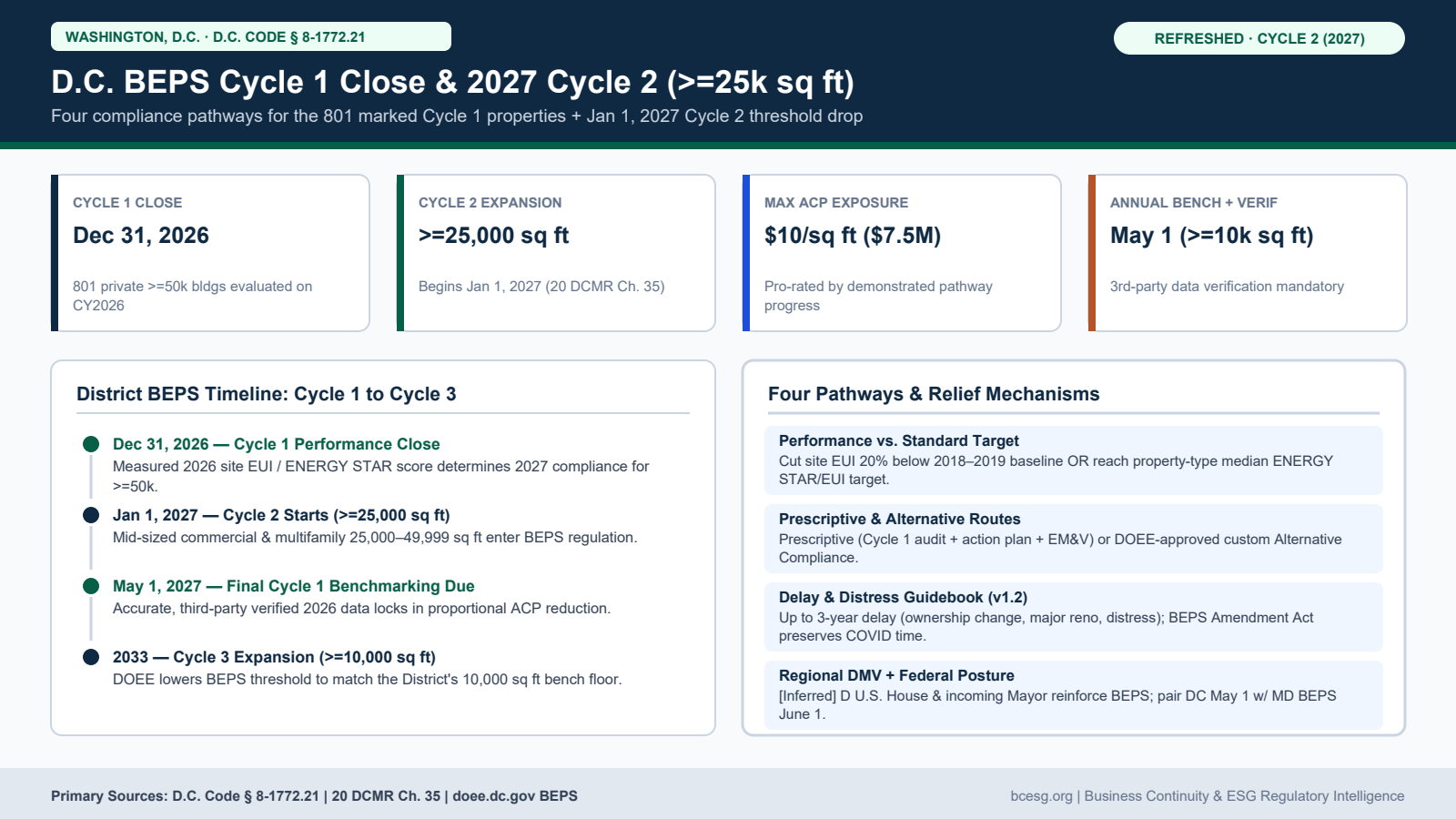
    Short answer: The District’s own Building Energy Performance layer, updated in October 2026, marks 801 properties as not meeting the Building Energy Performance Standard against 1,038 marked as meeting it—and Cycle 1 closes on December 31, 2026. Immediately on its heels, Cycle 2 opens January 1, 2027, dropping the private-building BEPS threshold down to 25,000 gross sq ft under D.C. Code § 8-1772.21 and 20 DCMR Chapter 35.

    Missing the original Cycle 1 median standard was never the end of compliance: a marked building entered an approved DOEE pathway. Today, the urgent questions are confirming which Cycle 1 pathway closes out your CY2026 measurement year cleanly—and preparing 25,000–49,999 sq ft properties for Cycle 2 enforcement in 2027.

    Statutory Status at a Glance
    • Governing Authority: D.C. Code § 8-1772.21 (CleanEnergy DC Omnibus Amendment Act) & 20 DCMR Ch. 35.
    • Administering Agency: D.C. Department of Energy & Environment (DOEE).
    • Cycle 1 Close (≥50k Private): December 31, 2026 (CY2026 benchmarking evaluated in 2027; final Cycle 1 benchmarking due May 1, 2027).
    • Cycle 2 Expansion (≥25k Private): Begins January 1, 2027 (with Cycle 3 dropping to ≥10,000 sq ft in 2033); benchmarking + 3rd-party verification runs annually May 1 (≥10k sq ft).
    • Post-2026 Political Trajectory (Inferred): Incoming Mayor Janeese Lewis George and a Democratic U.S. House lower Congressional Home Rule preemption risk over DC BEPS enforcement entering Cycle 2.
    Print-First Compliance Brief

    Close D.C. BEPS Cycle 1 Cleanly & Prep >=25,000 sq ft Assets for Cycle 2 (2027)

    2-page quick card summarizing all 4 DOEE pathways, Cycle 1 close (Dec 31, 2026), Jan 1, 2027 >=25k expansion, v1.2 financial distress relief, and ACP math.

    What 'Missed' Means—and the Four Cycle 1 Pathways Explained

    For Cycle 1, DOEE set each property type’s standard at no lower than the local District median from 2019 benchmarking data (for example, an ENERGY STAR score of 71 for offices, 66 for multifamily housing, 54 for hotels, 50 for hospitals, or 36 for K-12 schools, or source EUI where scores do not apply). Putting the bar at the median placed roughly half of large buildings into Cycle 1 compliance pathways based on each building’s own 2019 record.

    Even though compliant buildings cut median weather-normalized EUI by 11.2% between 2019 and 2024, individual buildings that missed entered one of four DOEE Cycle 1 compliance pathways:

    • 1. Performance Pathway (20% Cut): Demonstrate a 20% reduction in site EUI in 2026 versus the building’s 2018–2019 baseline average.
    • 2. Standard Target Pathway (Hit Median in 2026): Reach the District’s property-type standard on measured 2026 data (available where the standard meets or beats national median).
    • 3. Prescriptive Pathway (4 Documented Phases — Cycle 1 Only): Complete Phase 1 Audit, Phase 2 signed Action Plan + O&M program, Phase 3 implementation permits/records, and Phase 4 EM&V verification.
    • 4. Alternative Compliance Pathway (Custom Plan): Execute a DOEE-approved deep energy retrofit or custom trajectory yielding comparable energy savings.
    Cycle / RequirementCovered Building FloorKey Dates & Statutory Caps
    Cycle 1 (Active Close)Private >=50,000 sq ft (DC >=10k)Measured through Dec 31, 2026; final CY2026 bench May 1, 2027
    Cycle 2 ExpansionPrivate >=25,000 sq ft (adds 25k–49k)Starts Jan 1, 2027 under D.C. Code § 8-1772.21 / 20 DCMR Ch. 35
    Cycle 3 ExpansionPrivate >=10,000 sq ftScheduled 2033 alignment with District bench threshold
    Annual Bench & VerifAll buildings >=10,000 sq ftAnnual May 1 Portfolio Manager report + 3rd-party data verification
    Maximum ACP PenaltyNon-compliant GFAUp to $10/sq ft capped at $7.5M (prorated by verified progress)
    Washington D.C. BEPS compliance roadmap showing Dec 31, 2026 Cycle 1 close, Jan 1, 2027 Cycle 2 >=25,000 sq ft start, four compliance pathways, and $10/sq ft ACP cap.
    Washington, D.C. BEPS Cycle 1 (2021–2026) through Cycle 2 (>=25,000 sq ft starting Jan 1, 2027) pathways and penalty rules under D.C. Code § 8-1772.21.

    January 1, 2027: Cycle 2 (>=25,000 sq ft) & Regional Maryland Coordination

    As Cycle 1 closes December 31, 2026, DOEE shifts immediately into BEPS Cycle 2 on January 1, 2027, extending mandatory performance standards to private commercial and multifamily buildings between 25,000 and 49,999 sq ft (with Cycle 3 hitting ≥10,000 sq ft in 2033). Remember that annual D.C. benchmarking and third-party verification already apply down to 10,000 sq ft every May 1.

    For owners holding assets across the Potomac or Western/Eastern Avenue, synchronize D.C.’s May 1 deadline with Maryland BEPS (June 1, ≥35,000 sq ft & Montgomery County ≥25k carve-out). Keep applying disciplined sequencing from our Retrofit Priority Stack and treat verified benchmarking as your legal prerequisite—because incomplete 2026 filings strip proportional ACP progress credits.

    Delays, Financial Distress Relief (v1.2), and Maximum $10/sq ft Penalties

    Under DOEE’s August 2026 BEPS Compliance and Enforcement Guidebook (v1.2) and the BEPS Amendment Act of 2024, owners with genuine grounds—change of ownership, major renovation, pending demolition, or verified financial distress—can secure up to a three-year compliance delay without losing credit for the prior COVID extension. Delays are paused financing, not erasers: buildings re-enter the next cycle without resetting future targets.

    Otherwise, non-compliant buildings face an Alternative Compliance Payment capped at $10 per gross sq ft (up to $7,500,000 per building), prorated downward strictly according to verified energy savings achieved—a financial calculation identical to our business continuity and insurance analysis for LL97.

    Compliance Execution Checklist

    StepOwner / TeamAuditable Deliverable
    1. Open Data StatusAsset MgmtCheck building standing in DOEE Building Energy Performance disclosure (Meets / Pathway / Missing).
    2. Close Cycle 1 DocsEnergy / PEFinalize Prescriptive Phase 3–4 EM&V reports or CY2026 meter tracking before Dec 31, 2026.
    3. Prep 25k Cycle 2Portfolio LeadFlag all DC properties 25,000–49,999 sq ft entering Cycle 2 standards on Jan 1, 2027.
    4. May 1 Verified FileCompliance LeadSubmit third-party verified CY2026 benchmarking by May 1, 2027 to preserve proportional ACP relief.
    Field & Print Package

    Keep This Washington, D.C. Compliance Checklist Handy

    Download the formatted 2-page PDF reference brief or pull the structured Markdown edition for internal compliance documentation.

    Frequently Asked Questions

    When does D.C. BEPS Cycle 2 begin and what building sizes does it cover?

    Cycle 2 begins January 1, 2027 and expands mandatory BEPS compliance to privately owned buildings of 25,000 gross sq ft or larger (down from Cycle 1's 50,000 sq ft threshold).

    How is the D.C. BEPS Alternative Compliance Payment calculated if my building only falls slightly short?

    The maximum penalty is $10 per sq ft of gross floor area (capped at $7,500,000 per building), but DOEE scales the actual payment down in proportion to verified progress achieved toward the building's pathway target—provided final CY2026 benchmarking data is accurate, complete, and timely.

    What threshold triggers annual benchmarking and third-party verification in Washington, D.C.?

    Annual May 1 benchmarking and periodic third-party data verification apply to covered private and District-owned buildings of 10,000 gross sq ft or larger.

    Can my D.C. building still get a delay for financial distress or renovation?

    Yes. Under DOEE's Compliance and Enforcement Guidebook v1.2 and the BEPS Amendment Act of 2024, qualifying owners can apply for up to a 3-year compliance delay for ownership changes, major renovations, pending demolition, or verified financial distress without losing prior COVID timeline relief.

    Primary Authorities & Official Resources

    Informational notice: This guide summarizes enacted statutes, regulations, or pending legislative records from the primary authorities linked above as of November 14, 2026. It is not legal, accounting, or licensed engineering advice.
  • NYC Local Law 97 Enforcement: $268/tCO2e Penalties, Late-Filing Fines & Mitigation (2026)

    NYC Local Law 97 Enforcement: $268/tCO2e Penalties, Late-Filing Fines & Mitigation (2026)

    Updated: November 14, 2026 — Refreshed to reflect current statutory cycles, verification rules, and post-election regulatory posture.

    Short answer: With New York City’s Cycle 1 (2024–2029) reporting windows past May 1, June 30, and August 29 and preemption challenges rejected by the New York Court of Appeals in Glen Oaks Village Owners, Inc. v. City of New York, NYC Local Law 97 (Admin. Code §§ 28-320 & 28-321) is in full active DOB enforcement. For unfiled or delinquent covered properties (>25,000 sq ft single building, or >50,000 sq ft across multiple buildings on one tax lot), the immediate cash risk is not the carbon cap itself — it is the compounding $0.50 per square foot per month non-filing penalty running retroactively to May 1.

    Once DOB receives a certified Registered Design Professional (RDP) report, monthly late fees stop accruing and evaluation shifts to the underlying occupancy-group cap (e.g., 0.00758 tCO2e/sq ft for Business Group B offices in 2024–2029) and whether the owner qualified for mitigated penalties under 1 RCNY § 103-14(i)(2). Pair this operational manual with our NYC LL84, LL88, LL97 & LL33 Calendar Guide and LL84 Benchmarking Prerequisite Walkthrough.

    Statutory Status at a Glance
    • Covered Thresholds: Single buildings >25,000 gross sq ft; 2+ buildings on the same tax lot >50,000 sq ft; or 2+ condo buildings governed by the same board >50,000 sq ft.
    • Two Legal Tracks: Article 320 (market-rate commercial, institutional, and residential <=35% rent-regulated) faces annual carbon caps and $268/tCO2e fines; Article 321 (affordable/rent-regulated >35% or NYCHA/HUD-assisted) follows the one-time 13 Prescriptive Energy Conservation Measures (PECMs) or 2030 cap demonstration ($10,000 flat non-compliance fine).
    • Penalty Asymmetry: An unfiled 60,000 sq ft Group B office at 21% over cap incurs ~$25,514/year for emissions vs. $30,000/month ($120,000 over 4 months) simply for remaining unfiled past May 1.
    • Good-Faith Mitigation Gate: Under 1 RCNY § 103-14(i)(2), owners invoking a Decarbonization Plan must hold submitted LL84 benchmarking and LL88 lighting/submetering attestations on file and hit the May 1, 2028 DOB permit/approval milestone.
    • 2030 Cliff Prep: Cycle 2 (2030–2034) drops commercial Group B office intensity caps roughly 40% (~0.00453 tCO2e/sq ft), shifting electrification economics well ahead of 2029.
    Print-First Compliance Brief

    Download the NYC Local Law 97 Enforcement & Mitigation Reference

    2-page Print-First PDF covering DOB’s $0.50/sq ft/month vs. $268/tCO2e penalty math, Article 320 vs. Article 321 rules, and 1 RCNY § 103-14(i)(2) good-faith mitigation.

    Late-Filing Mathematics vs. $268/tCO2e Carbon Caps & Criminal Misstatement Risk

    Building owners who miss annual May 1 reporting (or approved June 30 / August 29 extension windows) often confuse carbon-overage liability with administrative filing delinquency. Under NYC Admin. Code § 28-320.6, the $0.50/sq ft/month failure-to-file penalty is statutory, accumulates continuously from May 1 until DOB accepts a certified filing, and cannot be waived simply because actual emissions sat below the occupancy cap.

    Equally critical is filing accuracy. Under Admin. Code § 28-320.6.4, knowingly submitting a false LL97 report or fraudulent Registered Design Professional attestation is a misdemeanor carrying fines up to $500,000. Owners resolving delinquent filings must reconcile Portfolio Manager meter boundaries, co-gen/steam coefficients, and space-type square footage directly against DOB property records.

    • Filing First Stops the Bleed: Even if final emissions confirm an overage at $268/tCO2e, submitting the certified filing halts the monthly $0.50/sq ft clock immediately.
    • Extension Mechanics (1 RCNY § 103-14): Standard extensions run only through timely May 1/June 30 administrative requests; once an un-extended deadline passes, DOB treats the parcel as delinquent.
    • Renewable Energy Credits (RECs) & Deductions: Only NYSERDA Tier 4 NYC-deliverable RECs (credited strictly against electricity emissions) qualify — general out-of-state voluntary RECs do not offset LL97 overages.
    Track & CitationCovered Building ScopePrimary Compliance MetricMaximum Statutory Penalty
    Article 320 (2024–2029)Commercial, condo & residential <=35% rent-regulated >25k sfOccupancy GHG limit (e.g., 0.00758 tCO2e/sf Group B)$268/tCO2e excess + $0.50/sf/mo unfiled
    Article 320 Mitigation (1 RCNY § 103-14)Unmet Cycle 1 Art. 320 w/ LL84 + LL88 + Decarb PlanNo RECs; May 1, 2028 DOB permit proof + 2030 workReduced DOB mitigated penalty scale
    Article 321 (Affordable)>35% rent-regulated, NYCHA, Mitchell-Lama >25k sfOne-time 13 Prescriptive ECMs OR meet 2030 limit$10,000 flat violation (not $268/tCO2e)
    Cycle 2 (2030–2034)All Art. 320 covered parcels >25k sfSteepened limits (~0.00453 tCO2e/sf Group B office)$268/tCO2e + stricter false-filing rules
    Infographic comparing NYC Local Law 97 $0.50/sq ft/month late-filing penalties against $268/tCO2e emissions fines, Article 320 vs 321 pathways, and 1 RCNY 103-14(i)(2) mitigation.
    NYC Local Law 97 enforcement posture under Admin. Code §§ 28-320 and 28-321: late-filing exposure vs. excess emissions penalties and good-faith decarbonization plan prerequisites.

    Article 320 Good-Faith Mitigation, Article 321 PECMs & The 2028/2030 Horizon

    For Article 320 buildings unable to meet 2024–2029 limits economically on day one, 1 RCNY § 103-14(i)(2) offers mitigated penalties — provided the owner filed LL84 benchmarking on time, completed LL88 lighting and submetering attestations, and submitted a stamped Decarbonization Plan demonstrating net-zero 2050 alignment with no REC offsets allowed inside that mitigation period.

    Meanwhile, Article 321 qualifying properties (buildings with >35% rent-regulated units, Mitchell-Lama, or HDFC cooperatives) operate on an entirely separate track: demonstrating compliance either with the 2030 emissions limit or installing all 13 applicable Prescriptive Energy Conservation Measures (pipe insulation, steam traps, low-flow fixtures, weatherization, etc.), where missed filings draw a $10,000 flat violation rather than $268/tCO2e.

    • Decarbonization Plan Lock-In: Choosing good-faith mitigation waives REC compliance through 2029 and legally commits the asset to securing DOB-approved work permits by May 1, 2028.
    • State-Local Portfolio Note: New York’s executive-order state benchmarking covers state-owned assets only — private NYC landlords follow LL97 and LL84 as their exclusive statutory baseline.

    Compliance Execution Checklist

    StepOwner / TeamAuditable Deliverable
    1. Prerequisite Gate CheckProperty / ComplianceVerify LL84 Portfolio Manager acceptance and LL88 attestation on DOB NOW.
    2. Art. 320 vs 321 ConfirmLegal / Tax Lot CounselPull DHCR/HPD rent-regulation counts or tax-lot square footage from DOF records.
    3. RDP Emissions AuditRegistered Design Prof.Audit ConEd/National Grid intervals + BBL mapping; file via BEAM/DOB NOW.
    4. 2028/2030 CapEx PlanEngineering / Asset MgmtQuantify Cycle 2 40% intensity cliff and lock May 1, 2028 permit schedule if mitigated.
    Field & Print Package

    Keep This New York City, NY Compliance Checklist Handy

    Download the formatted 2-page PDF reference brief or pull the structured Markdown edition for internal compliance documentation.

    Frequently Asked Questions

    How do NYC Local Law 97 late-filing fines compare to the $268/tCO2e emissions penalty?

    Under NYC Admin. Code § 28-320.6, failing to file an LL97 report incurs $0.50 per gross square foot per month starting May 1. For a 60,000 sq ft office moderately above cap, four months unfiled costs $120,000 — nearly five times a full year's $25,514 overage penalty.

    What does an Article 320 Good-Faith Effort mitigation plan require?

    Under 1 RCNY § 103-14(i)(2), owners must demonstrate on-time LL84 benchmarking, LL88 lighting/submetering attestation, and an RDP-stamped Decarbonization Plan with DOB-approved construction applications by May 1, 2028.

    Is Local Law 97 still facing preemption litigation?

    No. In Glen Oaks Village Owners, Inc. v. City of New York (2025), the New York Court of Appeals ruled in the City's favor, confirming New York State's CLCPA did not preempt NYC's local emissions caps.

    Primary Authorities & Official Resources

    Informational notice: This guide summarizes enacted statutes, regulations, or pending legislative records from the primary authorities linked above as of November 14, 2026. It is not legal, accounting, or licensed engineering advice.
BC ESG

ESG Strategy, Sustainability Intelligence, and Business Continuity for Forward-Thinking Organizations

© 2026 BC ESG — Business Continuity, ESG & Sustainability Intelligence