Category: Commercial Real Estate

ESG strategy, Scope 3 supply chain disclosure, and sustainability reporting for commercial real estate owners, REITs, and institutional property investors.

  • Retrofit Priority Stack for Existing Buildings: BPS Deadlines and Section 179D

    Retrofit Priority Stack for Existing Buildings: BPS Deadlines and Section 179D

    Updated October 26, 2026. By Will Tygart.

    Do the work in this order unless the engineer of record says otherwise. The expensive mistake in an existing building is a plant replacement that never got metering, envelope, or controls first. Deadlines below were checked against the cited agency pages on October 26, 2026. Where a source did not support a figure, the figure is not in this page.

    The five-stage stack

    1. Stage 1. Metering hygiene and the envelope. Get intervals into ENERGY STAR Portfolio Manager that you would sign. Confirm the meter list, the gross floor area, and the use types. Commission the air barrier and close the leaks you can reach before you size new equipment. In New York City, LL84 benchmarking is the LL97 prerequisite. A cap you cannot measure is a cap you will miss.
    2. Stage 2. Operational tuning before capital. Use an ASHRAE Level II audit to separate controls from equipment. Schedules, setbacks, static-pressure resets, and sensor calibration belong here, while the existing plant is still the plant. The point is a measured drop in energy use before anyone buys a chiller.
    3. Stage 3. Envelope and heat recovery at the moment you are already opening the building. Glazing film, roof insulation at membrane replacement, and a dedicated outdoor-air system with energy recovery. Do this when the roof or the air handler is already in the capital plan, not as a surprise project after the new plant is ordered.
    4. Stage 4. Central plant, after the load is real. Heat-pump cascades, variable refrigerant flow, and thermal storage are sized to the load that remains after stages 1 through 3. Replacing a boiler against last year’s peak, with the envelope still open, oversizes the electric service and the machine.
    5. Stage 5. On-site solar and storage, against the residual. Photovoltaics and batteries address what is left, including demand charges. They do not excuse an unmetered building, and off-site certificates are not a substitute for the on-site work when a law is counting the building’s own energy or emissions. Document claims with the same care as the meter data.

    Resilience sits beside the stack, not instead of it. Backup power and heat resilience are in the property-management continuity playbook. After a flood or freeze, restoration work can blow an emissions cap; that path is the Restoration Carbon Protocol guide for New York property managers.

    Multi-jurisdiction deadlines

    Dates are compliance or reporting dates from the cited source. A date that has already passed is written that way.

    Program What is due Source checked October 26, 2026
    New York City Local Law 97, Article 320 Annual emissions limits are in effect for covered buildings. The civil penalty for exceeding a year’s limit is the excess metric tons of CO2e multiplied by $268. A late annual report is a different penalty: gross floor area times $0.50 per month. Limits tighten again in 2030. This page does not state a percentage cut for 2030. 1 RCNY 103-14(g) and (h); NYC DOB violations page
    New York City Local Law 97, Article 321 Covered buildings on this path file a compliance report and either install the prescriptive measures or meet the 2030 emissions limit. The Department of Buildings states a $10,000 penalty for a late report and a $10,000 penalty for failing to demonstrate a pathway. NYC DOB violations page
    Washington Clean Buildings, Tier 1 WAC 194-50-150 sets the first reporting dates: more than 220,000 gross square feet, June 1, 2026 (that date has passed); more than 90,000 and less than 220,001, June 1, 2027; more than 50,000 and less than 90,001, June 1, 2028. Commerce states the maximum penalty as $5,000 plus $1.50 per square foot of gross floor area. An extension can be requested up to six months before or after the compliance date. A building with an approved extension is not penalized if it complies inside that extension. Owners of the June 1, 2026 cohort who have not finished should be in the portal now, not waiting on a future deadline. WAC 194-50-150; Commerce Tier 1 compliance
    Boston BERDO Residential buildings with 15 or more units, and nonresidential buildings of 20,000 square feet or more, report annual energy and water use. The standing deadline on the City’s BERDO page is May 15. Emissions standards start in 2025 or 2030 depending on the building, on a path to net-zero in 2050. For the 2026 cycle the City extended reporting, and third-party verification where it applied, to August 15, 2026. That extended date has passed. boston.gov BERDO; City extension notice, April 15, 2026
    Energize Denver, 25,000 square feet and larger Annual benchmarking is due June 1 for the prior calendar year. The rules dated August 27, 2026 still state performance targets in calendar years 2025, 2027, and 2030 unless a timeline extension or alternate compliance option is approved. The City’s September 1, 2026 technical guidance and performance page describe an opt-in that moves the interim target to 2028, drops the later interim year, and moves the final target from 2030 to 2032. Confirm which timeline the building actually elected. Rules, August 27, 2026; Large-building technical guidance, September 1, 2026
    Energize Denver, 5,000 to 24,999 square feet Compliance dates in the September 1, 2026 small-building guidance: December 31, 2026 for 20,000 to 24,999 square feet; December 31, 2027 for 15,000 to 19,999; December 31, 2028 for 10,000 to 14,999; December 31, 2029 for 5,000 to 9,999. Small-building technical guidance, September 1, 2026

    New York owners should run the $268-per-ton calculator and the 2030 cap scenarios before a plant decision. A building that is inside the current limit can still be a 2030 problem at the same energy use. Boards should tie the stack to a resolution and a reserve study. The co-op and condo playbook and the good-faith strategies cover the building that is already over the cap.

    Section 179D amounts for taxable years beginning in 2026

    These are the Internal Revenue Service figures for the energy efficient commercial buildings deduction. They are not the 2023 maximums, and they are not a quote for a specific building.

    Certified reduction in total annual energy and power cost Section 179D(b)(2) base amount Section 179D(b)(3) increased amount (prevailing wage and apprenticeship)
    25 percent $0.59 per square foot $2.97 per square foot
    Each percentage point above 25 percent plus $0.02, not above $1.19 plus $0.12, not above $5.94

    Revenue Procedure 2025-32, section 4.25, is the source of that formula for taxable years beginning in 2026. The Instructions for Form 7205 (revised December 2025) state the same base path in words: for tax years beginning in 2026, $0.59 per square foot at 25 percent energy savings, increasing by 2 cents per percentage point, up to $1.19 per square foot at 55 percent savings. The same instructions’ maximum table lists $5.94 as the full (increased) amount and $1.19 as the partial amount for tax years beginning on or after January 1, 2026.

    The deduction ends for later construction starts. The same Form 7205 instructions, and section 2.11 of Revenue Procedure 2025-32, state that Public Law 119-21 terminated section 179D for property the construction of which begins after June 30, 2026. A project that started construction on or before that date can still be inside the deduction if the other statutory conditions are met. A project whose construction begins after that date is outside section 179D. Confirm the construction-start date with tax counsel before anyone underwrites these dollars.

    The $5.36 and $1.07 per square foot figures are the Form 7205 maximums for tax years beginning on or after January 1, 2023. They are not the 2026 amounts. Sources: Revenue Procedure 2025-32 and Instructions for Form 7205 (December 2025).

    Disclaimer: This guide is prepared for commercial facility directors, building engineers, and asset managers for strategic capital planning. It does not replace site-specific ASHRAE Level I/II/III energy audits, mechanical engineering designs, or stamped compliance filings by a licensed Professional Engineer (PE) or Registered Architect (RA).


  • Tenant Communication Playbook: Emissions Programs and Resilience Events

    Tenant Communication Playbook: Emissions Programs and Resilience Events

    Last verified: August 22, 2026. By Will Tygart.

    You cannot decarbonize or recover a multi-tenant asset with landlord-only emails. Data access, retrofit disruption, and emergency instructions all require a communication system.

    Message types

    1. Data-sharing request — meters, after-hours use, submeter access
    2. Retrofit notice — timeline, noise, access, benefits
    3. Emergency / continuity — where to go, who decides re-entry (PM continuity playbook)
    4. ESG program update — honest, non-greenwash progress
    5. Lease cycle — green-lease clauses in plain language

    Cadence

    CadenceContent
    AnnualProgram goals, results, next works
    Project-based30 / 14 / 7 / 1-day retrofit notices
    IncidentImmediate + all-clear
    Quarterly (investor / GRESB season)Engagement log for GRESB levers

    Template — data request (short)

    Subject: Building energy data partnership — [Building]

    Body: purpose · what data · how used · privacy · deadline · PM contact · optional incentive

    Template — incident

    What happened · safety status · what tenants should do · what not to do · next update time · hotline

    NYC buildings: keep filing-season noise out of incident messages. LL97 belongs in the annual / quarterly packet, not the all-clear.

    Related: vendor ESG checklist · DR framework.

    Related reading: disaster recovery for CRE portfolios, LL97 data to continuity and insurance, and lender and investor evidence pack. Sister hubs: Restoration Intel, Healthcare Facility Hub, Continuity Hub, Risk Coverage Hub, and Tygart Media.

  • Lender and Investor Evidence Pack: Climate plus Continuity

    Lender and Investor Evidence Pack: Climate plus Continuity

    Last verified: August 22, 2026. By Will Tygart. Use for renewal meetings, credit packages, and equity DD — one index, many artifacts.

    Lenders do not want your 80-page sustainability report. They want coverage quality, material risks, what you funded, and what you need from them.

    Pack structure (folders)

    1. Entity overview — ownership, GFA, geographies, hold period
    2. Climate metrics — energy/GHG methods, 3-year trend if available
    3. Physical risk — screening summary by asset
    4. Transition / regulatory — LL97 status plus 2030 scenarios for NYC assets
    5. Continuity — BCP summary, last test date, vendor list (PM playbook)
    6. Insurance — schedules, claims-history summary; deeper carrier framing at riskcoveragehub.com
    7. CapEx — approved + planned resilience / decarbonization projects
    8. Governance — who owns ESG / continuity KPIs
    9. Disclosure excerpts — using the templates

    Minimum viable pack (two weeks)

    • Asset register + energy data coverage %
    • Top 10 assets by value with climate / LL97 flags
    • Incident log, last 24 months
    • Named RACI
    • One-page board snapshot

    Meeting script (10 minutes)

    1. Coverage quality
    2. Material risks
    3. What we funded
    4. What we need from the capital partner

    NYC assets: drop in the LL97 ↔ continuity ↔ insurance packet so the renewal file and the DOB file stop living on different drives.

    Related reading: tenant communication playbook, GRESB scoring levers, and IFRS S1/S2 disclosure checklist. Sister hubs: Restoration Intel, Healthcare Facility Hub, Continuity Hub, Risk Coverage Hub, and Tygart Media.

  • Mid-Market ESG Disclosure Templates (GRI / ISSB-Aligned)

    Mid-Market ESG Disclosure Templates (GRI / ISSB-Aligned)

    Last verified: August 22, 2026. By Will Tygart. A copy-ready skeleton for CRE operators — not a 200-page enterprise report.

    Copy each section into the board or investor pack. Replace the brackets. Link evidence in an appendix (use the lender evidence pack as the index).

    Template A — one-page board ESG snapshot

    1. Scope: entities, geographies, % GFA covered
    2. Material topics (max 6): e.g. energy/GHG, physical climate, safety, tenants, vendors, governance
    3. KPIs this period: EUI, emissions (method noted), incidents, filing status (LL97 if NYC)
    4. Top 3 risks / opportunities
    5. Decisions needed from the board
    6. Next-quarter milestones

    Template B — climate section (ISSB S2-style headings)

    • Governance of climate risks
    • Strategy: physical + transition impacts on the portfolio
    • Risk-management process
    • Metrics and targets (intensity, absolute if available, 2030 pathway)
    • CapEx alignment note

    The longer ISSB implementation walkthrough already lives at ISSB IFRS S1 and S2: implementation guide. This page is the operator skeleton, not a second pillar.

    Template C — controls and data

    MetricDefinitionSource systemOwnerAssurance
    Energyintensity / totalESPM / utilitynone / limited
    GHGmethod + factors
    Water
    Safety
    NYC LL97 (if applicable)filed / grace / extension / over capBEAM / ESPMRDP-certified file

    Template D — what we are not claiming

    Write the non-claims in the same pack. No net-zero sentence without a pathway. No “GRESB leader” language without the score and year. This is how you reduce greenwash risk without a law firm rewriting the PDF.

    Related: GRESB scoring levers · ratings compared.

    Related reading: IFRS S1 and S2 disclosure checklist, lender and investor evidence pack, and GRESB scoring levers. Sister hubs: Restoration Intel, Healthcare Facility Hub, Continuity Hub, Risk Coverage Hub, and Tygart Media.

  • GRESB for Property Managers: Scoring Levers That Actually Move

    GRESB for Property Managers: Scoring Levers That Actually Move

    Last verified: August 22, 2026. By Will Tygart. GRESB indicators evolve yearly. Re-check current GRESB Guides before final scoring claims.

    This is for mid-market owners and PM firms under investor pressure to “do GRESB” without a 20-person ESG department. GRESB is an investor-driven benchmark. It rewards structured data, coverage, performance, and management practices — not slogans.

    Levers that actually move

    1. Data coverage and quality (usually the highest ROI)

    • Increase the share of the portfolio with actual energy / water / waste data
    • Fix ESPM / meter mapping before writing narrative
    • Document estimation methods when actuals are impossible

    2. Performance trends (not one heroic year)

    Show multi-year intensity direction. Tie CapEx to measurable outcomes. NYC assets should run 2030 LL97 scenarios so the story is not only last year’s file.

    3. Tenant engagement

    Data-sharing clauses and an outreach cadence. Green-lease elements that are enforceable, not decorative. See the tenant communication playbook.

    4. Management and governance evidence

    Named accountability. Policies that match practice. Board packets using the mid-market disclosure templates.

    5. Risk processes

    Physical climate-risk screening documented at portfolio level — not a paragraph in the sustainability PDF.

    What not to waste months on

    • Perfect website copy before data coverage
    • Chasing every indicator equally
    • Outsourcing a score without internal data owners

    90-day readiness sprint

    DaysFocus
    1–30Asset list, data gaps, ownership RACI
    31–60Close the top gap quartile; tenant outreach wave
    61–90Evidence binder + disclosure templates

    Related on this site: ESG ratings compared · CRE ESG programs · vendor ESG checklist.

    Related reading: mid-market ESG disclosure templates, vendor ESG checklist, and tenant communication playbook. Sister hubs: Restoration Intel, Healthcare Facility Hub, Continuity Hub, Risk Coverage Hub, and Tygart Media.

  • Building Code & ESG Regulatory Watch: NYC LL97 Deadlines, CA SB 253 Scopes & CRE Enforcement — Tuesday, August 25, 2026

    Building Code & ESG Regulatory Watch: NYC LL97 Deadlines, CA SB 253 Scopes & CRE Enforcement — Tuesday, August 25, 2026

    Executive Regulatory Briefing for Commercial Real Estate (CRE) Owners, Property Asset Managers, and Facility Directors: Situational intelligence covering municipal carbon caps, state-level climate disclosure mandates, and building safety enforcement.


    Executive Regulatory Alert & Immediate Compliance Hotspots

    As commercial property portfolios advance through the 2024-2029 regulatory cycle, municipal building authorities and environmental regulatory agencies are accelerating statutory enforcement. In New York City, commercial and residential properties exceeding 25,000 gross square feet face immediate statutory reporting obligations under Local Law 97 with strict carbon penalty liabilities assessed at $268 per metric ton of CO2e over assigned emission limits.

    Regulatory Mandate Breakdown & Penalty Matrix

    Regulation / Law Jurisdiction & Authority Covered Building Classes Penalty Exposure
    NYC Local Law 97 New York City (NYC DOB) Commercial/Resi > 25k sq ft $268 / metric ton CO2e over statutory cap
    California SB 253 / SB 261 California (CARB) Revenue > $1B (SB 253) / > $500M (SB 261) Up to $500,000 annually for reporting omissions
    EPA NESHAP Commercial Asbestos Federal (US EPA) Commercial renovations/demolitions $40,000+ per day per unnotified ACM violation
    OSHA Indoor/Outdoor Heat Standard Federal (OSHA NEP) Mechanical rooms, facilities, roof crews Up to $161,323 for willful safety violations

    Operational Timelines & Filing Windows

    • NYC Local Law 97 Annual Certification: Registered Design Professional (PE/RA) certified emissions filings due annually on May 1. Buildings utilizing Article 321 prescriptive energy conservation pathways must verify completed capital milestones.
    • California Climate Corporate Data Rollout: Covered national enterprises operating in California must formalize Scope 1 & Scope 2 operational boundaries ahead of mandated third-party assurance deadlines.
    • Federal EPA 10-Day Pre-Renovation Rule: Required written notification to state/federal EPA offices prior to disturbing commercial insulation, floor tile mastic, or fireproofing exceeding statutory square footage thresholds.

    Facility Director & Asset Manager Tactical Checklist

    • 1. Comprehensive ASHRAE Level II Energy Audits: Commission detailed energy audits across all portfolio assets exceeding 50,000 sq ft to identify high-draw chillers, uninsulated steam lines, and legacy pneumatic controls.
    • 2. Building Management System (BMS) Calibration & Submetering: Install tenant-level electrical submetering and interval data loggers to segregate plug-load consumption and enforce green lease cost-sharing provisions.
    • 3. Electrification & Heat Pump Retrofit Planning: Begin engineering assessments for variable refrigerant flow (VRF) and air-source heat pump conversions to displace fossil-fuel boiler loads ahead of the stringent 2030 Phase 2 carbon cap drop.
    • 4. Facility Vendor Pre-Qualification: Ensure all mechanical, roofing, and remediation trade contractors hold verified EPA abatement credentials and documented OSHA workplace heat safety programs.

    Official Citations & Regulatory References

    Official regulatory portals and filing resources:

    Related reading: Local Law 97 Article 320 vs 321, LL84 benchmarking as the LL97 prerequisite, and why LL97 still runs after the SEC climate rescission. Sister hubs: Restoration Intel, Healthcare Facility Hub, Continuity Hub, Risk Coverage Hub, and Tygart Media.

    Regulatory & Compliance Disclaimer: This briefing is provided for informational and operational planning purposes for Commercial Real Estate (CRE) owners, asset managers, facility directors, and sustainability professionals. It does not constitute formal legal counsel, licensed engineering certification, or certified carbon accounting. Always verify jurisdictional compliance requirements with the respective municipal code authority (e.g., NYC DOB, CARB, EPA, OSHA) and consult a registered professional engineer (PE) or qualified environmental compliance attorney before executing capital retrofit decisions.

  • Disaster Recovery for Commercial Real Estate Portfolios

    Disaster Recovery for Commercial Real Estate Portfolios

    Last verified: August 22, 2026. By Will Tygart. Built-environment disaster recovery — not a generic IT encyclopedia.

    “Disaster recovery planning” is one of the most competitive information spaces on the web. BCESG’s job is not to out-general Wikipedia. This page is for portfolio operators: multi-BIN realities, tenants, life safety, vendors, insurance, and — in NYC — the link to performance-law evidence files.

    If you need the broader program-standards walkthrough, start with our existing complete DR framework. If you need ISO-centric BIA tooling, use continuityhub.org and come back here for CRE packaging.

    Why specialize for commercial real estate

    A server-room runbook does not restore a 400,000-square-foot mixed-use asset. CRE recovery has to keep people alive, keep the building legal to occupy, keep tenants informed, and keep claims and compliance files intact. In New York, that last bucket includes ENERGY STAR Portfolio Manager access and Local Law 97 artifacts — credentials that often live in one person’s laptop.

    CRE DR stack (six layers)

    1. Life safety and emergency action — evacuate, account, coordinate with responders
    2. Building systems recovery — power, water, HVAC, elevators, fire/life safety, BMS
    3. Tenant operations — communications, access, partial occupancy strategies
    4. Vendor network — pre-positioned restoration, shoring, board-up, temporary power
    5. Data and documents — drawings, insurance policies, LL97 / ESPM access, contracts
    6. Capital and claims — documentation that survives adjusters and boards

    RTO thinking for buildings

    FunctionQuestion to answer before the event
    Fire / life safetyWhat must be restored before any re-entry?
    Vertical transportationWhich banks first for partial operations?
    Heat / cool in extreme weatherWhat is the tenant risk window?
    Broadband / access controlHybrid work makes this a CRE issue, not an IT footnote
    ESPM / compliance portalsWho has credentials if the PM lead is offline?

    Playbook you can steal

    Before

    • Vendor MSA and after-hours numbers tested quarterly
    • Credential vault for utilities plus DOB / ESPM / BEAM
    • Photo baseline of critical equipment
    • Insurance schedule mapped to BINs

    During

    • Single incident commander per asset
    • Timestamped log (who decided what)
    • Tenant message templates
    • Separation of life-safety tasks from property-conservation tasks

    After

    • Claims package with photos, logs, and invoices
    • Lessons learned into CapEx
    • Emissions / energy impact notes for compliance files
    • Update the property-management BC playbook with what actually broke

    Relationship to the older “complete DR framework” article

    The existing site guide remains useful as a broad framework. This page is the CRE portfolio specialization and should be the start-here URL if you operate buildings. Do not treat the two as competing pillars — they stack.

    Related on BCESG

    Positioning note: generic “disaster recovery planning” queries are a classic-search sink. This page stays in the built-environment operator lane on purpose.

    Related reading: LL97 data to continuity and insurance, tenant communication playbook, and lender evidence pack. Sister hubs: Restoration Intel, Healthcare Facility Hub, Continuity Hub, Risk Coverage Hub, and Tygart Media.

  • IFRS S1 and S2 Disclosure Checklist

    IFRS S1 and S2 Disclosure Checklist

    Last verified: August 22, 2026. By Will Tygart. Walk the board pack once. Answer Yes / Partial / No / N/A. Attach evidence in the same folder as energy and LL97 files. This is a working questionnaire for built-environment organizations, not the official ISSB text. Confirm numbering against IFRS Foundation materials.

    People are asking Copilot for a list they can fill in. The ISSB implementation guide is the parent. This page is the child checklist.

    S1 — General sustainability-related financial disclosures

    #QuestionY / P / N / NAEvidence pointer
    S1-1Has the board (or delegated committee) stated how it oversees sustainability-related risks and opportunities?
    S1-2Is management’s role in assessing and managing those risks documented, including which roles and how often they report?
    S1-3Have we described the sustainability-related risks and opportunities that could reasonably affect cash flow, access to finance, or cost of capital over short, medium, and long term?
    S1-4Have we described the current and anticipated effects on business model and value chain (including tenants, vendors, and locations)?
    S1-5Have we described the effects on strategy and decision-making, including transition plans if we have one?
    S1-6Have we described the effects on financial position, performance, and cash flows for the reporting period, and the anticipated effects?
    S1-7Have we described the resilience of our strategy to those risks, including the inputs used?
    S1-8Have we described the processes to identify, assess, prioritize, and monitor sustainability-related risks and how they integrate with overall risk management?
    S1-9Have we disclosed the metrics used, including those required by an ISSB thematic standard and any internally defined metrics?
    S1-10Have we disclosed the targets, the period, the base period, milestones, and performance against them?
    S1-11Have we applied the same reporting entity as the financial statements and explained judgments, uncertainties, and errors?

    S2 — Climate-related disclosures (on top of S1)

    #QuestionY / P / N / NAEvidence pointer
    S2-1Governance of climate risks and opportunities is explicit (board + management), not only “ESG” in general?
    S2-2Physical risks (acute and chronic) are identified at asset or portfolio level, not only as a paragraph?
    S2-3Transition risks (policy, market, technology, reputation) are identified, including stranded-asset logic for the building stock?
    S2-4Climate-related opportunities (efficiency, tenant demand, finance) are described with time horizons?
    S2-5Effects on business model, value chain, and financials are described for climate specifically?
    S2-6Climate resilience / scenario analysis is described (which scenarios, which portfolios, which decisions it changed)?
    S2-7Risk-management process for climate is described and linked to enterprise risk management?
    S2-8Scope 1, Scope 2, and (if material) Scope 3 greenhouse gas emissions are disclosed with method, consolidation, and period?
    S2-9The measurement approach, inputs, and changes from last period are disclosed?
    S2-10Climate-related targets (including GHG) state the metric, period, base year, absolute vs intensity, and planned use of carbon credits if any?
    S2-11Industry-based metrics relevant to real estate (energy intensity, vacancy, certified space, etc.) are considered?

    CRE-specific evidence that usually fills the blanks

    • ENERGY STAR Portfolio Manager exports and LL84 filings
    • Physical-risk screens by ZIP / flood / heat / wind
    • CapEx plan that names efficiency vs resilience jobs
    • Board minutes that show climate or LL97 as an agenda item
    • Vendor / tenant requirements that affect Scope 3
    • Continuity test logs (so resilience is not only a narrative)

    What this is not: legal advice. Not a claim that S1 has a counted official list of “30+ core disclosures.” Before you treat a row as gospel, walk the current IFRS Foundation HTML of S1 and S2.

    Related: mid-market templates · ESG frameworks hub · climate-risk guide.

    Related reading: mid-market disclosure templates, lender evidence pack, and SEC climate rescission vs LL97. Sister hubs: Restoration Intel, Healthcare Facility Hub, Continuity Hub, Risk Coverage Hub, and Tygart Media.

  • NYC LL84, LL88, LL87 & LL33 Compliance Stack: Unified Calendar & Deadlines (2026)

    NYC LL84, LL88, LL87 & LL33 Compliance Stack: Unified Calendar & Deadlines (2026)

    Updated: November 14, 2026 — Refreshed to reflect current statutory cycles, verification rules, and post-election regulatory posture.

    Short answer: New York City property managers do not face four isolated rules — Local Laws 84/133 (Benchmarking), LL87 (10-year Audits & RCx), LL88 (Lighting & Submetering), and LL33/95 (Energy Letter Grades) operate as an interconnected compliance data stack administered by the NYC Department of Buildings (DOB). Most critically, timely LL84 submissions and LL88 attestations act as legal gatekeepers for mitigated penalties under NYC Local Law 97.

    Separating them creates recurring surprises: quarterly late fines on May 1 LL84 benchmarking automatically sabotage October LL33/95 building grades (triggering a public ‘F’ grade for unsubmitted properties and a $1,250 fine), while overlooking a tax-block-digit December 31 LL87 audit due date blocks access to DOB decarbonization relief. See also our dedicated LL84 Prerequisite Technical Walkthrough.

    Statutory Status at a Glance
    • LL84 / LL133 Benchmarking (May 1 Annual): Whole-building electricity, gas, fuel oil, steam, and water consumption for >=25,000 sq ft properties via ENERGY STAR Portfolio Manager; quarterly non-filing fines ($500/qtr up to $2,000/yr).
    • LL33 / LL95 Energy Letter Grades (Oct 1–31 Annual): Owners download DOB NOW Energy Efficiency Labels starting October 1 and display A–D/N/F grades at every public entrance within 30 days ($1,250 penalty).
    • LL88 Lighting & Submetering (Active Jan 1, 2025+): Mandates NYC Energy Conservation Code-compliant lighting across non-residential buildings >25,000 sq ft and residential common areas, plus electrical submeters for non-residential tenant spaces >5,000 sq ft.
    • LL87 Audits & Retro-Commissioning (Dec 31 10-Yr Rotation): Buildings >50,000 sq ft submit Energy Efficiency Reports (EER) by December 31 in the year matching the final digit of their NYC Tax Block number (e.g., Block ending in 6 -> Dec 31, 2026).
    Print-First Compliance Brief

    Download the NYC Four-Law Building Compliance Calendar

    2-page Print-First PDF syncing LL84 benchmarking, LL33/95 grade posting, LL88 submetering/LEDs, and LL87 10-year EER audits into one annual calendar.

    Why Benchmarking, Lighting & Audit Filings Gate LL97 Penalty Relief

    Even though DOB administers separate violation numbers for LL84 ($500 quarterly benchmarking fine), LL88 ($1,500 initial + monthly non-submetering penalties), and LL87 ($3,000 initial + $5,000/yr late EER fines), their operational interconnection is tight. DOB’s Good-Faith Effort criteria under 1 RCNY § 103-14(i)(2) explicitly verify that an owner submitted timely LL84 benchmarking data and valid LL88 attestations before granting mitigated LL97 penalties.

    Meanwhile, LL84 utility feeds populate both your LL33 lobby letter grade and the exact meter inventory imported by your Registered Design Professional for annual LL97 emissions filings — meaning meter omissions fixed once in Portfolio Manager protect four filings simultaneously.

    • Con Edison & National Grid Aggregation: Request automated whole-building utility uploads at least 45 days before May 1 to prevent estimated billing gaps that trigger DOB data flags.
    • Tenant Submeter Exception Check (LL88): Non-residential leases executed strictly below 5,000 sq ft on single-tenant floors remain exempt from individual submetering unless aggregated on the same floor above 5,000 sq ft.
    • LL33 Score Cutoffs: Grade A (>=85 ENERGY STAR), B (70–84), C (55–69), D (1–54), N (exempt/unscorable property types), F (failed to submit LL84 benchmarking).
    Local Law & CitationThreshold & CoverageDeadline / CadenceStatutory Violation Exposure
    LL84 / LL133 (§ 28-309)Single bldgs >=25k sf; multi-bldg tax lots >=100k sfAnnual May 1 (ENERGY STAR PM)$500/quarter ($2,000/yr cap) + triggers F grade
    LL33 / LL95 (§ 28-309.12)Covered LL84 buildings >=25k sfDownload Oct 1; post by Oct 31$1,250 annual non-posting DOB fine
    LL88 (§§ 28-310, 28-311)Nonres >25k sf lighting; tenant spaces >5k sf submetersCompliance active Jan 1, 2025+$1,500 initial + per-submeter fines + blocks LL97 relief
    LL87 (§ 28-308)Buildings >50k sf (or multi-bldg lots >100k sf)Dec 31 on 10-yr Tax Block last digit$3,000 year 1; $5,000 each subsequent yr late
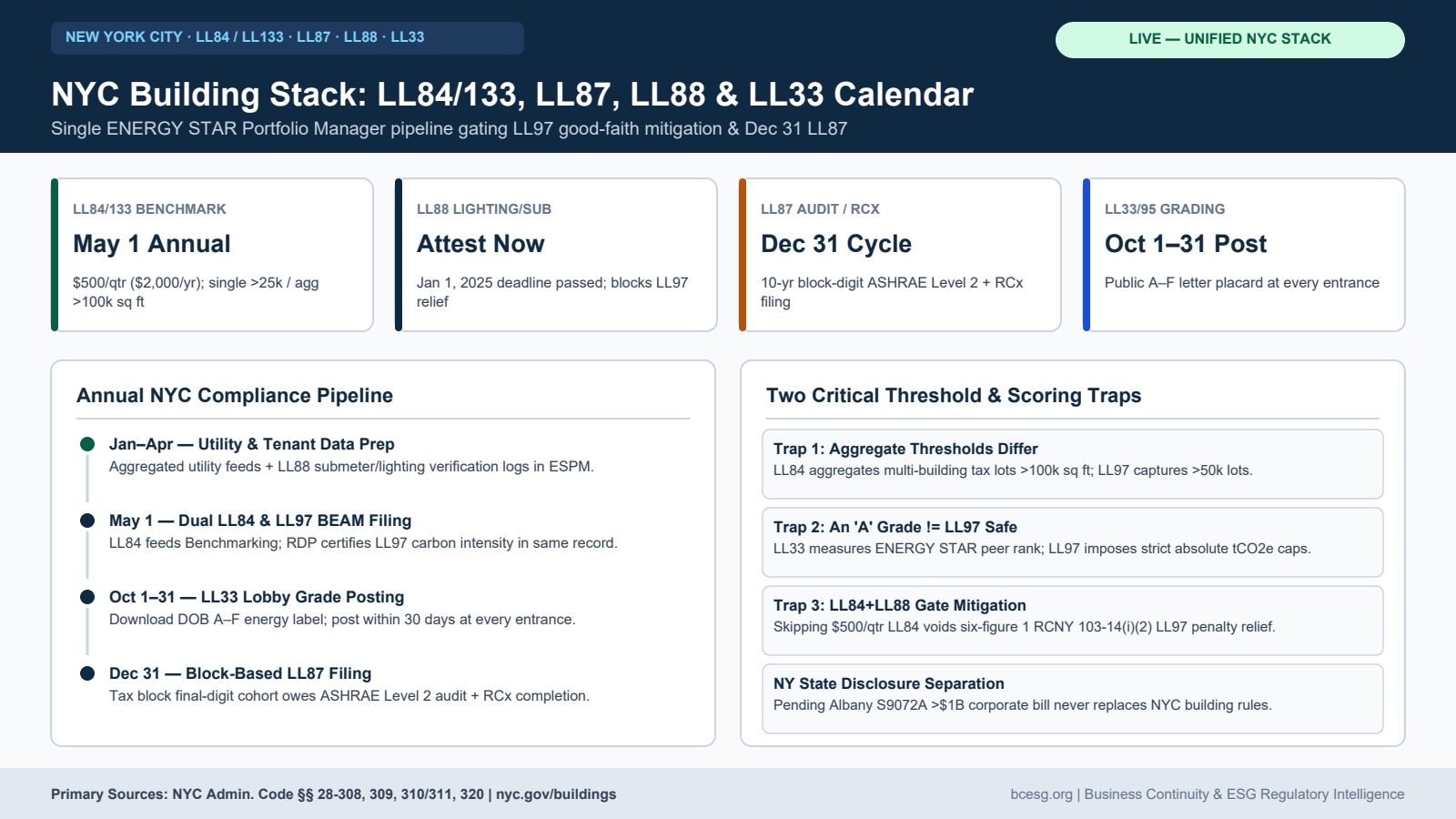
    Calendar diagram linking NYC Local Law 84 benchmarking (May 1), Local Law 33/95 energy letter grades (Oct 31), Local Law 88 lighting/submetering attestations, and Local Law 87 10-year audit/RCx rotations.
    How NYC DOB integrates LL84/133 benchmarking, LL33/95 letter grades, LL88 lighting/submetering, and LL87 10-year audits into a prerequisite stack for LL97 mitigation.

    Sequencing One 12-Month NYC Building Compliance Calendar

    Rather than scrambling around four disconnected dates, commercial and multifamily asset teams should align accounting and engineering reviews into four quarterly gates covering utility verification, May 1 Portfolio Manager uploads, October lobby label posting, and December 31 LL87 rotation checks.

    • Q1 (Jan–Mar): Verify ConEd/National Grid whole-building feeds and check whether the NYC Tax Block final digit triggers a December 31 LL87 Energy Efficiency Report.
    • Q2 (May 1): Submit annual LL84/133 Portfolio Manager benchmarking + LL97/LL88 attestations in DOB NOW.
    • Q4 (Oct 1–31 & Dec 31): Download and post LL33 letter grades at all entrances by October 31; file due-year LL87 EERs by December 31 ($3,000–$5,000 avoided).

    Compliance Execution Checklist

    StepOwner / TeamAuditable Deliverable
    1. Utility Meter AuditProperty ManagerReconcile ConEd/National Grid whole-building CSV accounts in Portfolio Manager.
    2. May 1 Joint WindowCompliance / RDPFile LL84 benchmarking alongside LL88 and LL97 filings before May 1.
    3. Oct 31 Lobby GradeBuilding OperationsPrint DOB NOW Energy Efficiency Label and post in public lobby + photo proof.
    4. Block-Digit LL87 CheckEngineering LeadVerify NYC Tax Block final digit against upcoming Dec 31 EER audit cohort.
    Field & Print Package

    Keep This New York City, NY Compliance Checklist Handy

    Download the formatted 2-page PDF reference brief or pull the structured Markdown edition for internal compliance documentation.

    Frequently Asked Questions

    Which NYC buildings owe LL84 benchmarking vs. LL87 energy audits?

    LL84/133 benchmarking applies annually starting at >=25,000 sq ft, whereas LL87 10-year Energy Efficiency Reports (audits and retro-commissioning) apply at >50,000 sq ft (or multi-building lots >100,000 sq ft) on a Tax Block last-digit schedule.

    What happens if I miss LL84 benchmarking before October LL33 grade issuance?

    NYC DOB issues an automatic 'F' Energy Efficiency Grade in October, triggers $500 quarterly benchmarking fines, and renders your building ineligible for 1 RCNY § 103-14(i)(2) LL97 penalty mitigation.

    How is my Local Law 87 due date determined?

    Your 10-year LL87 EER deadline falls on December 31 of the calendar year whose last digit matches the final digit of your NYC Tax Block number (e.g., Tax Block 1206 is due December 31, 2026).

    Primary Authorities & Official Resources

    Informational notice: This guide summarizes enacted statutes, regulations, or pending legislative records from the primary authorities linked above as of November 14, 2026. It is not legal, accounting, or licensed engineering advice.

BC ESG

ESG Strategy, Sustainability Intelligence, and Business Continuity for Forward-Thinking Organizations

© 2026 BC ESG — Business Continuity, ESG & Sustainability Intelligence