Blog

  • Founder & CEO Duty: Prime Contract Acceptance, Insurance & No-Code Boundaries

    Founder & CEO Duty: Prime Contract Acceptance, Insurance & No-Code Boundaries

    FOUNDER / CEO20–500-Person WA Space Company Desk Brief
    Top Live Mandate: Prime Contract Terms, Insurance & Export/Cyber Clauses  |  Dead Rule to Ignore: FAR Case 2021-015 & DoD GHG Class Deviations  |  Next Hard Date: Continuous (At Contract Signature & Renewal)
    Desk Priority: Founders must separate primes with formal supplier ESG codes (Boeing, Amazon Leo, L3Harris) from no-code primes (SpaceX, Blue Origin) while sizing aerospace product liability insurance and rejecting dead GHG clauses.
    ROLE DESK BRIEF · PDF & MARKDOWN TWIN
    Founder: Prime Contracts & Liability
    Download the formatted 2-page role desk brief (PDF) or read the single-source Markdown twin for Founder: Prime Contracts & Liability.
    Founder Duty: Prime Contract Acceptance & Liability Gates

    1. What Arrives on This Desk (Live Asks & Rules)

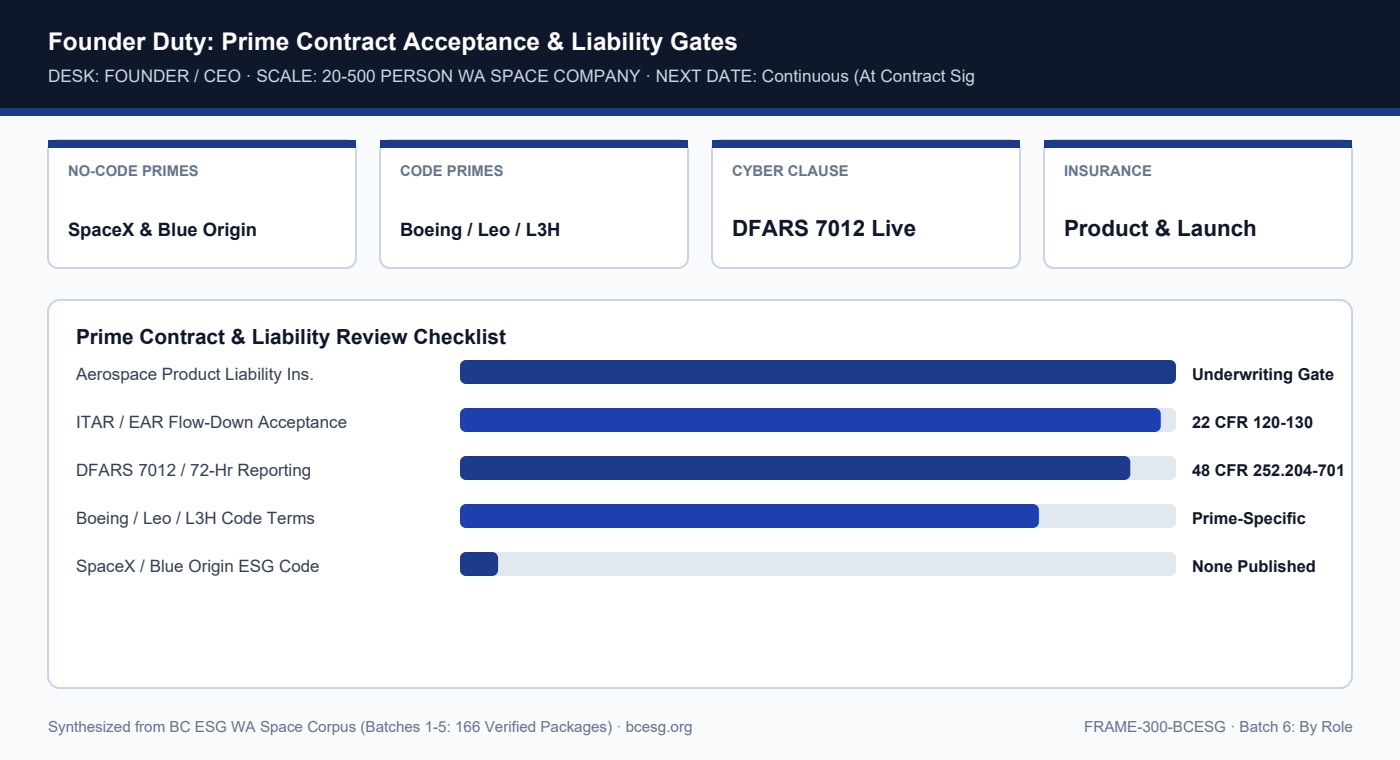
    When a commercial or defense prime sends a master supply agreement to a Launch or Satellite Manufacturing supplier in Washington, the Founder/CEO evaluates two distinct contract postures. SpaceX and Blue Origin publish no standalone supplier ESG code—their expectations ride inside technical specifications, ITAR flow-downs, and workmanship/quality clauses.

    By contrast, Boeing, Amazon Leo, and L3Harris, Lockheed Martin, and Northrop Grumman issue formal supplier codes and portal onboarding requirements (Prime Onboarding Portals). Simultaneously, prime contracts require Aerospace Product Liability Insurance and active DFARS 252.204-7012 cyber representations.

    2. What Is Dead or Enjoined and Can Be Ignored

    If a prime's boilerplate still references proposed federal GHG disclosure or SBTi validation under FAR Case 2021-015, flag it as withdrawn (90 FR 2663, Jan 13, 2025). On DoD subcontracts, DoD Class Deviation 2025-O0004 (Mar 7, 2025) actively prohibits FAR 52.223-22 and 52.223-19.

    3. What Carries a Date (Deadlines & Instruments)

    Key contract-gate instruments and dates verified in Batches 4 and 5:

    Contract GateStatusEffective / Cutoff DateInstrument
    SpaceX / Blue Origin Supplier ESG CodeNONEVerified Nov 2026No standalone code published
    DFARS 252.204-7012 (NIST 800-171)LIVEActive (72-hr incident report)48 CFR 252.204-7012
    CMMC 2.0 Phase 1 vs. Phase 2PARTIALPhase 1 Nov 10, 2025 / Phase 2 Paused Jul 202632 CFR Part 170 / DFARS 7021
    FAR Case 2021-015 GHG ClauseDEADWithdrawn Jan 13, 202590 FR 2663
    Aerospace Product Liability CoverageLIVEContractual / Annual RenewalPrime MSA & Launch Underwriting

    4. Internal Handoffs (Who Hands What to Whom)

    Before executing a prime MSA, the Founder/CEO routes technical, legal, and financial clauses to four desks:

    HandoffScope PassedTarget Role
    CEO -> Procurement LeadPrime portal onboarding & flow-down matrixProcurement Lead Desk Brief
    CEO -> Finance LeadProduct liability limits & indemnity capsFinance: CCA, CBAM & Insurance
    CEO -> Compliance LeadDFARS 7012 / CMMC / prime code attestationsCompliance: DFARS 7012 & CMMC
    CEO -> Quality ManagerAS9100D / AS9102 / Nadcap contract gatesQuality Manager Desk Brief

    Corpus Anchors: Asks, Rules, Segments & Sibling Roles

  • Founder & CEO Desk Brief: What Actually Lands on the Executive Desk at a WA Space Company

    Founder & CEO Desk Brief: What Actually Lands on the Executive Desk at a WA Space Company

    FOUNDER / CEO20–500-Person WA Space Company Desk Brief
    Top Live Mandate: Prime Contract Gates, ITAR/EAR & WA Aerospace B&O Tax  |  Dead Rule to Ignore: FAR 2021-015, DoD 2025-O0004, SEC Climate, CA SB 261  |  Next Hard Date: Dec 31, 2026 (WA Aero 0.484% B&O End & CCA Period 1)
    Desk Priority: At a 20–500-person Washington space company, the CEO desk filters out dead federal climate mandates while signing off on prime contract terms, export-control governance, launch/product insurance, and WA tax/siting capital decisions.
    ROLE DESK BRIEF · PDF & MARKDOWN TWIN
    Founder & CEO Desk Brief
    Download the formatted 2-page role desk brief (PDF) or read the single-source Markdown twin for Founder & CEO Desk Brief.
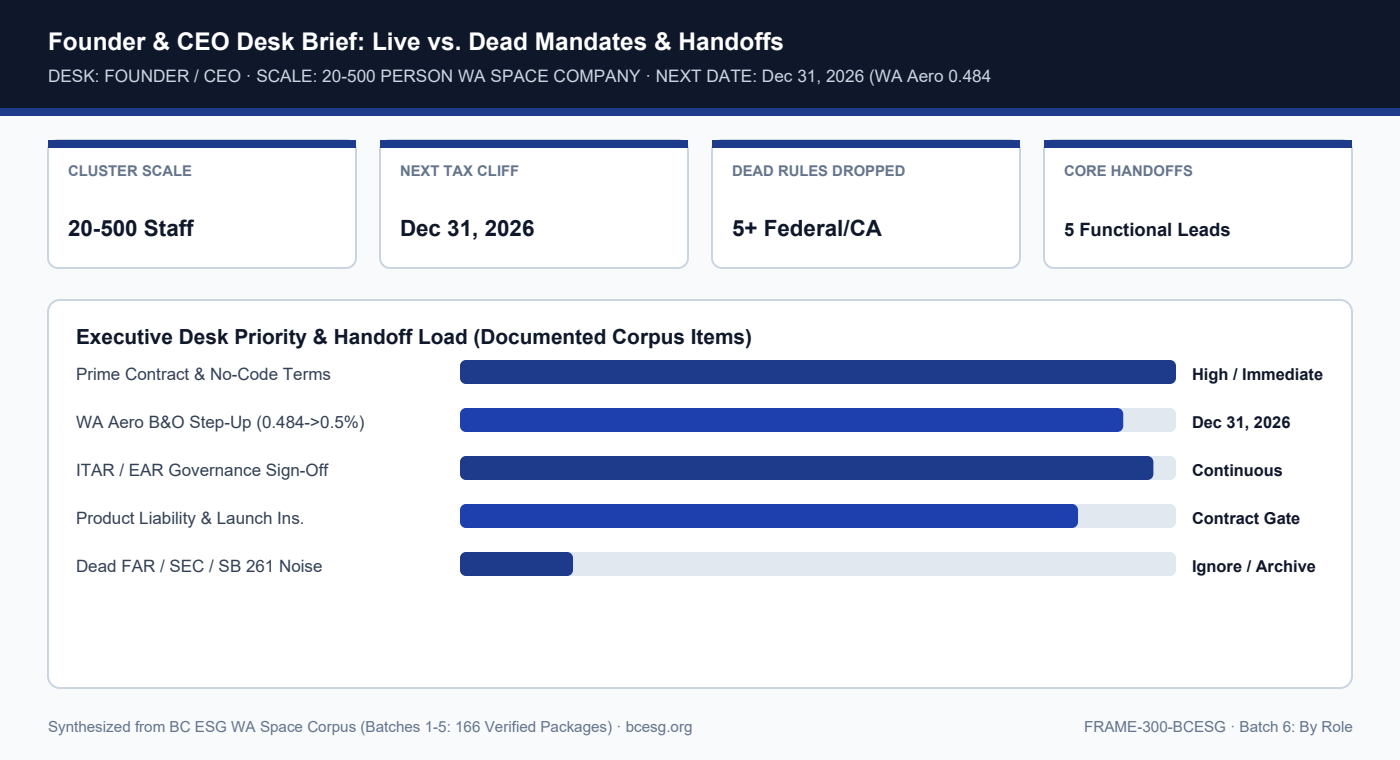
    Founder & CEO Desk Brief: Live vs. Dead Mandates & Handoffs

    1. What Arrives on This Desk (Live Asks & Rules)

    Across the 67 core WA space companies documented in the BC ESG census, executive teams operate at 20–500-person scale rather than prime-contractor headcount. What actually reaches the Founder/CEO desk is governed by commercial contract acceptance, statutory tax/siting commitments, and board-level risk governance (see also Board ESG Oversight and Board Oversight & Executive Compensation).

    Specifically, founders sign off on prime customer onboarding and terms—distinguishing SpaceX & Blue Origin (no standalone supplier ESG code) from Boeing, Amazon Leo, and L3Harris/Lockheed/Northrop codes—as well as Aerospace Product Liability Insurance, ITAR registration/governance, and WA Aerospace Tax Preferences.

    2. What Is Dead or Enjoined and Can Be Ignored

    Do not allocate executive budget or board time to withdrawn federal climate mandates. FAR Case 2021-015 was formally withdrawn on January 13, 2025 (90 FR 2663), DoD Class Deviation 2025-O0004 prohibits FAR GHG solicitation clauses, and the claimed federal Scope 3 mandate is dead.

    Similarly, the SEC Climate Disclosure Rule (89 FR 21668) was abandoned by the SEC on March 27, 2025 (with full rescission proposed May 29, 2026), California SB 261 remains enjoined by the Ninth Circuit (Nov 18, 2025), and OMB M-22-18 blanket software attestations were rescinded in January 2026.

    3. What Carries a Date (Deadlines & Instruments)

    Every statutory date on the executive calendar comes directly from verified Batch 4 and Batch 5 instruments:

    Obligation / RuleStatusHard DatePrimary Instrument
    WA Aerospace B&O Rate (0.484%)LIVEDec 31, 2026 end (0.5% Jan 1, 2027)RCW 82.04.260(11)
    WA CCA Period 1 CloseLIVEDec 31, 2026RCW 70A.65 / WAC 173-446
    FAA Part 450 Transition CutoffLIVEMar 9, 2026 (mandatory)14 CFR Part 450 (85 FR 79566)
    CA SB 253 Scope 1+2 (>$1B CA)LIVENov 10, 2026 (customer flow-down)Cal. H&S Code § 38532
    CA SB 253 Scope 3PARTIALJan 9, 2026 Oral Arg. / 2027 Target9th Cir. No. 25-5327
    FAR Case 2021-015 / SEC / SB 261DEAD / ENJOINEDWithdrawn / Enjoined90 FR 2663 / 9th Cir. Nov 18, 2025

    4. Internal Handoffs (Who Hands What to Whom)

    At a 20–500-person company, the Founder/CEO routes execution immediately to functional leads while retaining final contract and capital sign-off:

    Handoff DirectionTriggering Document / GateReceiving Role
    CEO -> Compliance LeadCustomer ESG portal / SB 253 / DFARS 7012Compliance Lead Desk Brief
    CEO -> Export-Control OfficerForeign-person hiring, customer CAD, TAA/MLAExport-Control Desk Brief
    CEO -> Finance Lead0.484%->0.5% B&O step-up, CCA, product liabilityFinance Lead Desk Brief
    CEO -> Facilities / EHSNew lease/expansion in Kent Valley or RedmondFacilities / EHS Desk Brief
    CEO -> Program ManagerFAA Part 450 / FCC 5-yr deorbit / NASA ODARProgram Manager Desk Brief

    Corpus Anchors: Asks, Rules, Segments & Sibling Roles

  • ISSB IFRS S1 & S2 Global Baseline: LIVE in ~20 Jurisdictions — Dec 2025 S2 Amendments Effective Jan 2027

    ISSB IFRS S1 & S2 Global Baseline: LIVE in ~20 Jurisdictions — Dec 2025 S2 Amendments Effective Jan 2027

    PARTIALISSB Sustainability & Climate Disclosure Standards (IFRS S1 & IFRS S2)
    Deciding Instrument: IFRS S1 / IFRS S2 (2023) & Dec 2025 Targeted S2 Amendments  |  Date: 2025–2026 (Active in ~20 Jurisdictions; S2 Amendments Jan 2027)
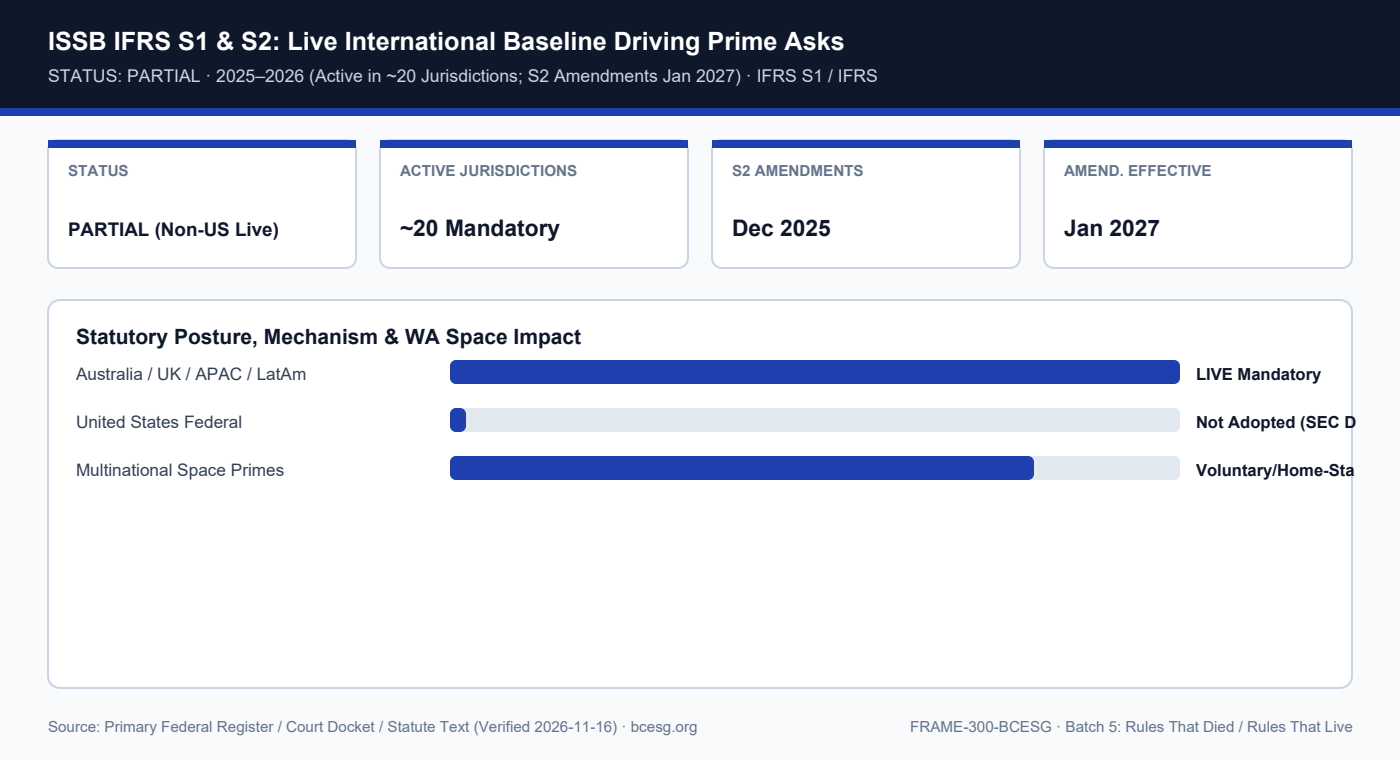
    Verdict & Proof: ISSB IFRS S1 and S2 are LIVE as mandatory domestic law in nearly 20 non-U.S. jurisdictions (including Australia, UK SRS, Singapore, Hong Kong, and Brazil), with targeted IFRS S2 Scope 3 relief amendments issued December 2025 taking effect January 2027. U.S. suppliers encounter ISSB via multinational prime buyers.
    RULE STATUS BRIEF · PDF & MARKDOWN TWIN
    ISSB IFRS S1/S2 (LIVE)
    Download the formatted 2-page rule-status brief (PDF) or read the single-source Markdown twin for ISSB IFRS S1/S2 (LIVE).
    ISSB IFRS S1 & S2: Live International Baseline Driving Prime Asks

    Where ISSB Lives vs. Where It Doesn't

    Nearly 40 jurisdictions have moved to adopt or align with ISSB IFRS S1 and S2 by 2026, with mandatory reporting live in ~20 markets (Australia AASB S2, UK SRS, Singapore, Hong Kong, Brazil). In December 2025, the ISSB issued targeted amendments to IFRS S2 (effective January 2027) easing Scope 3 GHG bottlenecks.

    In the United States, ISSB is not federal law. However, Washington space suppliers selling to UK, Australian, Japanese, or European aerospace primes still receive ISSB-formatted carbon and climate-risk data requests.

    • Not U.S. federal law (SEC climate rule is dead).
    • Mandatory for parent companies listed in UK, Australia, Singapore, Hong Kong, and Brazil.
    • December 2025 IFRS S2 amendments ease Scope 3 Category 15/measurement friction starting Jan 2027.
    JurisdictionISSB AlignmentStatus (Nov 16, 2026)
    United Kingdom / Australia / SingaporeUK SRS / AASB S2 / SGXLIVE — Mandatory phased rollout
    United States (Federal)None (SEC 89 FR 21668 rescinded)NOT ADOPTED

    Related BC ESG Guides & Verified Primary Sources

  • EU CBAM Definitive Period (Regulation (EU) 2025/2083): LIVE — Financial Liability Active Since Jan 1, 2026

    EU CBAM Definitive Period (Regulation (EU) 2025/2083): LIVE — Financial Liability Active Since Jan 1, 2026

    LIVEEU Carbon Border Adjustment Mechanism (CBAM, Regulation (EU) 2023/956 & 2025/2083)
    Deciding Instrument: Regulation (EU) 2025/2083 (in force Oct 20, 2025) & Definitive Period (Jan 1, 2026)  |  Date: January 1, 2026 (Definitive Period Start) / September 30, 2027 (First Surrender)
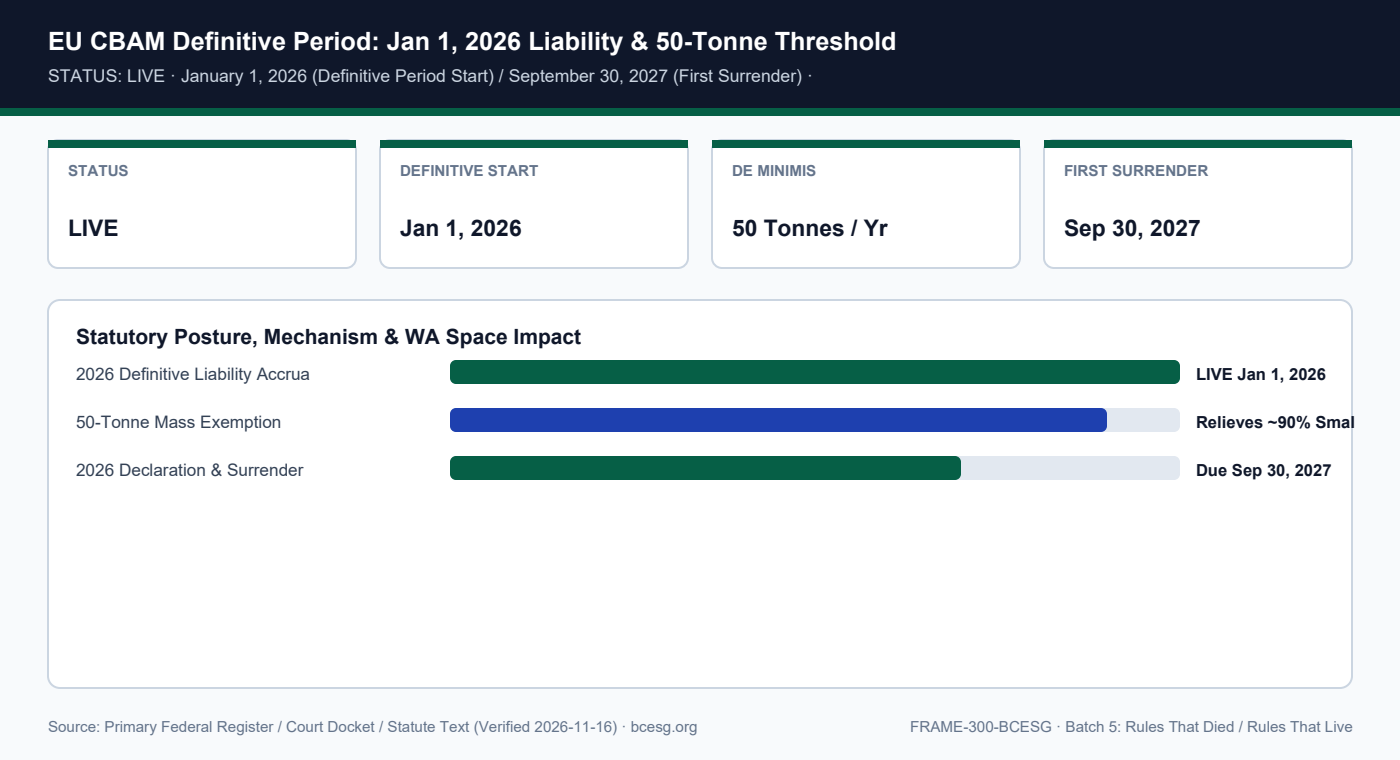
    Verdict & Proof: The EU Carbon Border Adjustment Mechanism (CBAM) definitive period is LIVE as of January 1, 2026. Under Omnibus Regulation (EU) 2025/2083, importers exceeding 50 tonnes/year of covered goods (steel, aluminum, etc.) accrue financial carbon liability on 2026 EU imports, with first certificate surrender due September 30, 2027.
    RULE STATUS BRIEF · PDF & MARKDOWN TWIN
    EU CBAM Definitive (LIVE)
    Download the formatted 2-page rule-status brief (PDF) or read the single-source Markdown twin for EU CBAM Definitive (LIVE).
    EU CBAM Definitive Period: Jan 1, 2026 Liability & 50-Tonne Threshold

    Who Owes What by When: Steel & Aluminum Exports to EU Primes

    On January 1, 2026, EU CBAM transitioned from its 2023–2025 transitional phase into its definitive financial period. Regulation (EU) 2025/2083 replaced the €150 consignment rule with a 50-tonne annual net mass de minimis exemption per importer.

    Washington specialty-metals, aluminum-extrusion, and fastener suppliers shipping >=50 tonnes/year into EU aerospace customers (or feeding EU-bound prime assemblies) face embedded-emissions data requests for 2026 shipments ahead of the September 30, 2027 certificate surrender.

    • Financial liability accrues on covered imports from January 1, 2026.
    • Importers below 50 tonnes/year (excluding electricity/hydrogen) are exempt.
    • First annual declaration and certificate surrender due September 30, 2027.
    CBAM MilestoneDateRule
    Omnibus Simplification (2025/2083)Oct 20, 2025Set 50-tonne annual de minimis threshold
    Definitive Period StartJan 1, 2026Embedded carbon liability begins accruing
    First Annual Surrender (2026 Imports)Sep 30, 2027Authorized declarants surrender CBAM certificates

    Related BC ESG Guides & Verified Primary Sources

  • WA Ecology Dangerous Waste & PSCAA Air Permits (WAC 173-303 / PSCAA Reg I): LIVE — Active Shop-Floor Gate

    WA Ecology Dangerous Waste & PSCAA Air Permits (WAC 173-303 / PSCAA Reg I): LIVE — Active Shop-Floor Gate

    LIVEWA Ecology Dangerous Waste (WAC 173-303) & Puget Sound Clean Air Agency (PSCAA Reg I)
    Deciding Instrument: WAC 173-303 (RCW 70A.300) & PSCAA Regulation I  |  Date: Continuous (Active State & Regional Permitting)
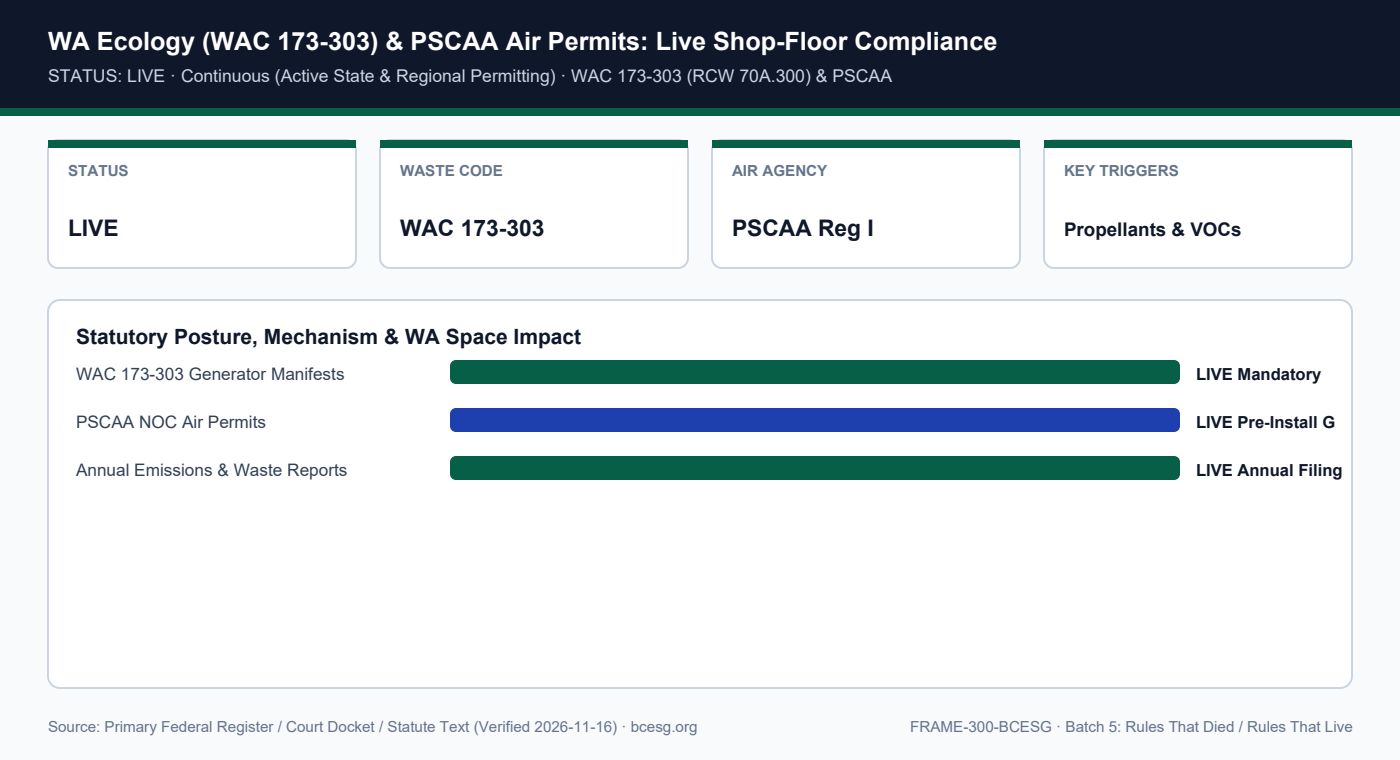
    Verdict & Proof: WA Ecology Dangerous Waste rules (WAC 173-303) and Puget Sound Clean Air Agency (PSCAA) air permits are LIVE and strictly enforced on space-cluster shop floors. Propellant handling, hydrazine/HTP storage, composite curing VOCs, and solvent degreasing require active generator IDs, manifests, and Notice of Construction (NOC) permits.
    RULE STATUS BRIEF · PDF & MARKDOWN TWIN
    WA Waste & PSCAA Air (LIVE)
    Download the formatted 2-page rule-status brief (PDF) or read the single-source Markdown twin for WA Waste & PSCAA Air (LIVE).
    WA Ecology (WAC 173-303) & PSCAA Air Permits: Live Shop-Floor Compliance

    Who Owes What by When: Propellants, Composites & Solvent Baths

    Washington space manufacturers in King, Snohomish, and Pierce counties face dual state/regional environmental permitting regardless of federal climate rollbacks. Under WAC 173-303, facilities generating spent solvents, heavy-metal plating waste, lithium batteries, or energetic propellant residues must hold EPA/Ecology Site IDs, maintain 90/180-day accumulation limits, and file annual Dangerous Waste reports.

    Under PSCAA Regulation I, installing paint booths, composite curing ovens, chemical milling lines, or thruster test rigs requires a Notice of Construction (NOC) Order of Approval before equipment installation.

    • PSCAA NOC approval is required prior to installing VOC/HAP-emitting equipment.
    • WAC 173-303 enforces strict container labeling, inspection logs, and manifests.
    • Batch 4 covered how primes audit these permits; this brief confirms their live statutory authority.
    Permit / RuleAgencyTrigger
    Dangerous Waste Generator ID & ManifestsWA Dept. of Ecology (WAC 173-303)Hazardous/propellant/solvent waste generation
    Notice of Construction (NOC)PSCAA (King/Pierce/Snohomish/Kitsap)New paint booth, composite oven, or test stand

    Related BC ESG Guides & Verified Primary Sources

  • WA Aerospace Tax Preferences (RCW 82.04.260): LIVE — 0.484% Rate Through Dec 31, 2026; 0.357% Suspended

    WA Aerospace Tax Preferences (RCW 82.04.260): LIVE — 0.484% Rate Through Dec 31, 2026; 0.357% Suspended

    LIVEWashington Aerospace B&O Tax Preferences & Apprentice Reporting (RCW 82.04.260)
    Deciding Instrument: RCW 82.04.260(11) & RCW 49.04.220 (Apprentice Utilization)  |  Date: December 31, 2026 (0.484% End) / June 30, 2040 (R&D & FAR 145 Sunset)
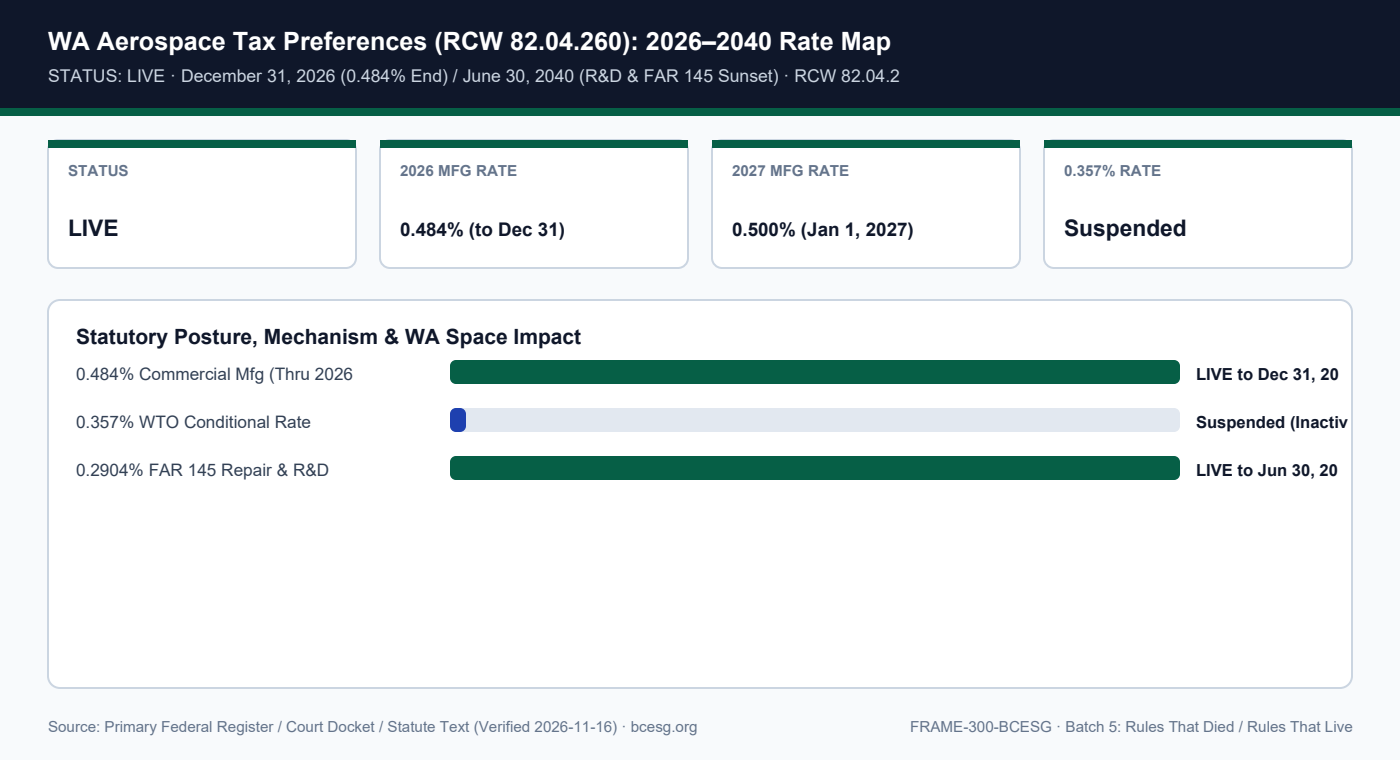
    Verdict & Proof: Washington's aerospace tax regime (RCW 82.04.260) is LIVE with a critical year-end rate shift: the 0.484% commercial-airplane manufacturing B&O rate runs through December 31, 2026 (stepping to 0.5% on Jan 1, 2027), the 0.357% rate remains conditionally suspended, and FAR 145 repair (0.2904%) and aerospace R&D preferences run through June 30, 2040.
    RULE STATUS BRIEF · PDF & MARKDOWN TWIN
    WA Aerospace Tax Rules (LIVE)
    Download the formatted 2-page rule-status brief (PDF) or read the single-source Markdown twin for WA Aerospace Tax Rules (LIVE).
    WA Aerospace Tax Preferences (RCW 82.04.260): 2026–2040 Rate Map

    Who Owes What by When: B&O Rates & Annual Tax Performance Reports

    Under RCW 82.04.260(11), qualifying commercial airplane and component manufacturers pay a 0.484% B&O rate through December 31, 2026, transitioning to 0.5% on January 1, 2027. The lower 0.357% rate enacted under ESB 6690 remains conditionally suspended pending international trade triggers.

    Meanwhile, aerospace non-manufacturing product development (0.9% B&O / R&D credits) and FAR Part 145 repair stations (0.2904%) remain active through June 30, 2040. Qualifying firms must file annual DOR Tax Performance Reports and L&I Apprentice Utilization Rate disclosures (RCW 49.04.220).

    • 0.484% -> 0.5% B&O transition on January 1, 2027.
    • 0.357% preferential rate is NOT active.
    • Annual DOR Tax Performance Report required to retain preferences.
    PreferenceRateStatus & Sunset
    Commercial Airplane/Component Mfg0.484% -> 0.5% (Jan 1, 2027)LIVE (Annual DOR report required)
    Conditional WTO Mfg Rate0.357%SUSPENDED — Trigger not met
    FAR Part 145 Repair / R&D Credits0.2904% / 0.9%LIVE through June 30, 2040

    Related BC ESG Guides & Verified Primary Sources

  • WA HB 1282 Buy Clean, Buy Fair Act (RCW 39.116): LIVE — Mandatory EPD Reporting Since Jul 1, 2025

    WA HB 1282 Buy Clean, Buy Fair Act (RCW 39.116): LIVE — Mandatory EPD Reporting Since Jul 1, 2025

    LIVEWashington Buy Clean, Buy Fair Act (HB 1282, codified at RCW 39.116)
    Deciding Instrument: RCW Chapter 39.116 (HB 1282)  |  Date: July 1, 2025 (Mandatory Reporting Effective)
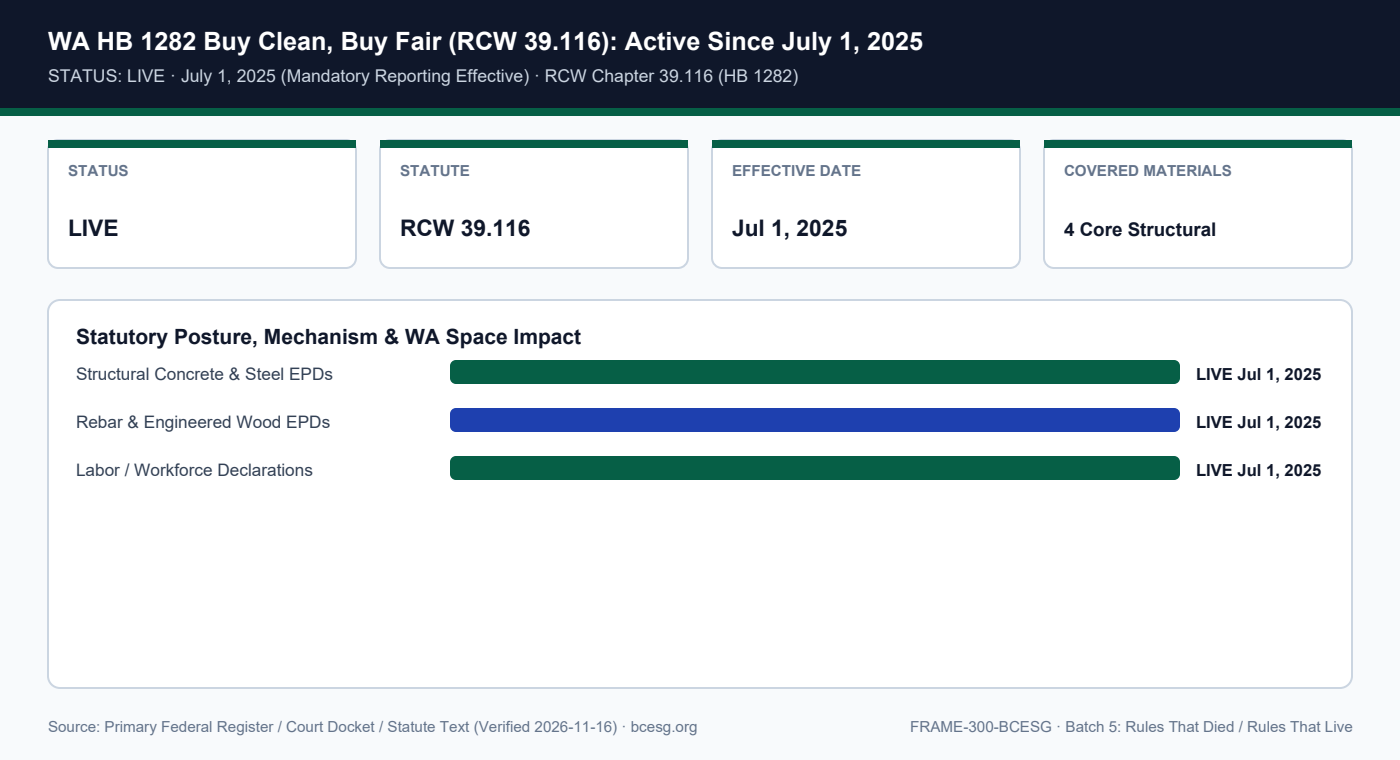
    Verdict & Proof: Washington's Buy Clean, Buy Fair Act (HB 1282, RCW 39.116) is LIVE. Since July 1, 2025, contractors on covered state-funded public building projects must submit third-party-verified Environmental Product Declarations (EPDs) and labor/origin data for structural concrete, rebar, structural steel, and engineered wood.
    RULE STATUS BRIEF · PDF & MARKDOWN TWIN
    WA HB 1282 Buy Clean (LIVE)
    Download the formatted 2-page rule-status brief (PDF) or read the single-source Markdown twin for WA HB 1282 Buy Clean (LIVE).
    WA HB 1282 Buy Clean, Buy Fair (RCW 39.116): Active Since July 1, 2025

    Who Owes What by When: State Public Works vs. Private Space Facilities

    Codified at RCW 39.116, HB 1282 went live on July 1, 2025 for eligible state-funded public building and higher-education construction projects. Contractors must report quantities, facility origins, supplier codes of conduct, and third-party-verified EPDs into the Department of Commerce Buy Clean, Buy Fair Reporting Database.

    Private aerospace factories in Kent or Redmond are not directly subject to RCW 39.116 unless built with covered state public-works funding, but WA structural steel and concrete suppliers serving both public and space-facility builds now standardize EPD delivery.

    • Effective July 1, 2025 for covered state public building projects.
    • Covers structural concrete, reinforcing steel, structural steel, and engineered wood.
    • Establishes state-level EPD precedent across Washington's construction supply chain.
    Covered MaterialRequired DocumentationStatus
    Structural ConcreteProduct-specific EPD + origin + labor dataLIVE (since Jul 1, 2025)
    Structural Steel & RebarProduct-specific EPD + origin + labor dataLIVE (since Jul 1, 2025)
    Engineered WoodProduct-specific EPD + origin + labor dataLIVE (since Jul 1, 2025)

    Related BC ESG Guides & Verified Primary Sources

  • WA Clean Fuel Standard (RCW 70A.535): LIVE — 7% Carbon Intensity Cut Active in 2026

    WA Clean Fuel Standard (RCW 70A.535): LIVE — 7% Carbon Intensity Cut Active in 2026

    LIVEWashington Clean Fuel Standard (CFS, RCW 70A.535 & WAC 173-424)
    Deciding Instrument: RCW 70A.535 & WA Ecology WAC 173-424 (Late-2025 Rule Updates)  |  Date: 2026 (7% CI Reduction Target Active)
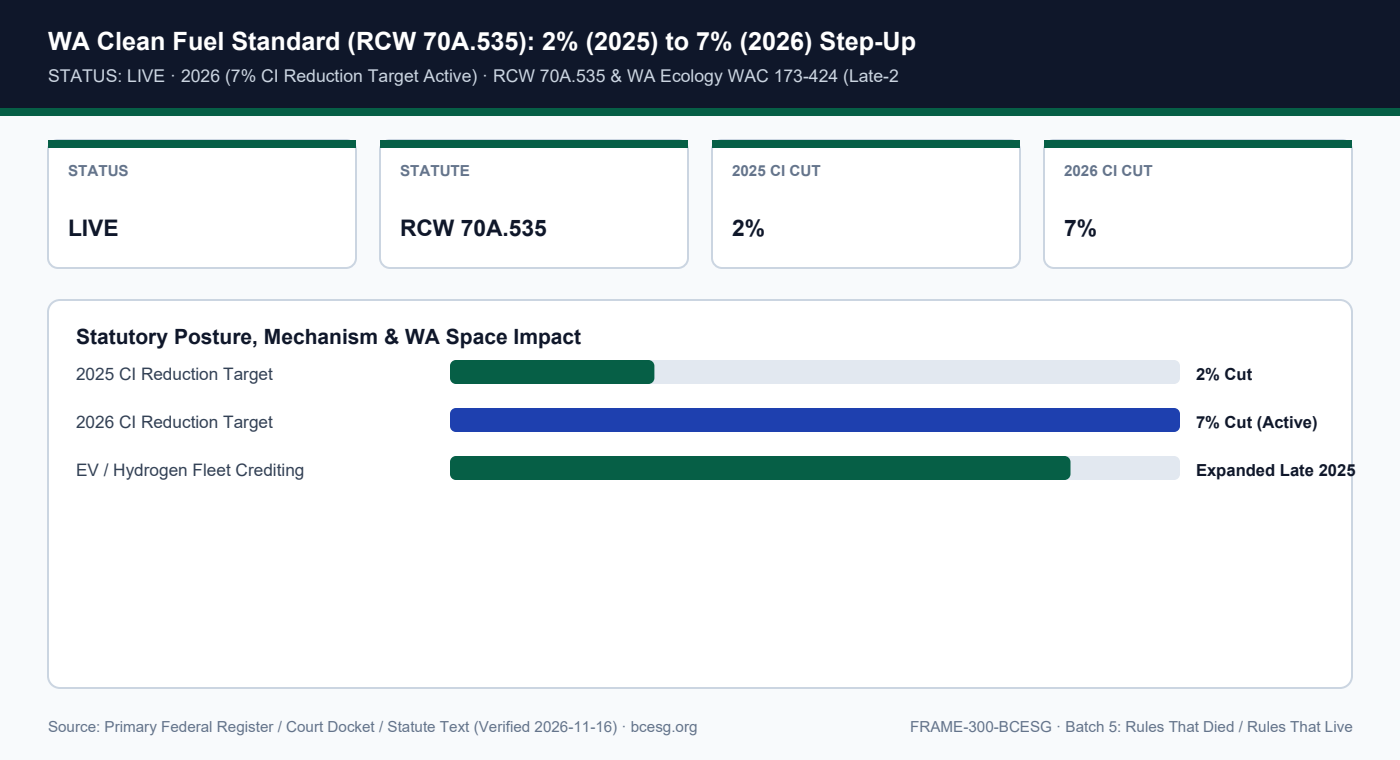
    Verdict & Proof: Washington's Clean Fuel Standard (RCW 70A.535) is LIVE and tightening. Following the 2023–2024 pilot period and a 2% carbon intensity (CI) reduction in 2025, the mandatory transportation-fuel CI reduction stepped up to 7% in 2026 under updated Ecology rules (WAC 173-424).
    RULE STATUS BRIEF · PDF & MARKDOWN TWIN
    WA Clean Fuel Standard (LIVE)
    Download the formatted 2-page rule-status brief (PDF) or read the single-source Markdown twin for WA Clean Fuel Standard (LIVE).
    WA Clean Fuel Standard (RCW 70A.535): 2% (2025) to 7% (2026) Step-Up

    Who Owes What by When: Fuel Suppliers & Fleet Electrification

    Under RCW 70A.535 and WAC 173-424, fuel producers and importers must reduce the lifecycle carbon intensity of gasoline and diesel sold in Washington—stepping from 2% in 2025 to 7% in 2026—or purchase CFS credits. Ecology's late-2025 rule updates (implementing HB 1409) added third-party verification and expanded crediting for heavy-duty EV charging and hydrogen infrastructure.

    For Kent Valley and Seattle aerospace logistics, CFS drives diesel/jet-ground-support fuel surcharges while creating credit-generation opportunities for electrified yard tractors and hydrogen refueling.

    • 7% carbon intensity reduction active across 2026.
    • Direct reporting/compliance falls on fuel suppliers; logistics fleets feel price pass-throughs.
    • Expanded EV/hydrogen infrastructure crediting under late-2025 rules.
    YearWA CFS Carbon Intensity ReductionStatus
    2023–20240.5%–1.0% initial rampCompleted
    20252.0% reductionCompleted
    20267.0% reduction (HB 1409 / WAC 173-424)LIVE — Active

    Relation to Rocket Propellants

    Orbital rocket propellants (RP-1, liquid methane, LOX) are not highway transportation fuels, but ground-fleet drayage between Kent, Port of Seattle/Tacoma, and Moses Lake is directly exposed.

    Related BC ESG Guides & Verified Primary Sources

  • WA Climate Commitment Act (RCW 70A.65): LIVE — First Compliance Period Closes Dec 31, 2026

    WA Climate Commitment Act (RCW 70A.65): LIVE — First Compliance Period Closes Dec 31, 2026

    LIVEWashington Climate Commitment Act (CCA, RCW 70A.65 & WAC 173-446)
    Deciding Instrument: RCW 70A.65 & Laws of 2026, c. 251 (WAC 173-446)  |  Date: December 31, 2026 (First Compliance Period Close)
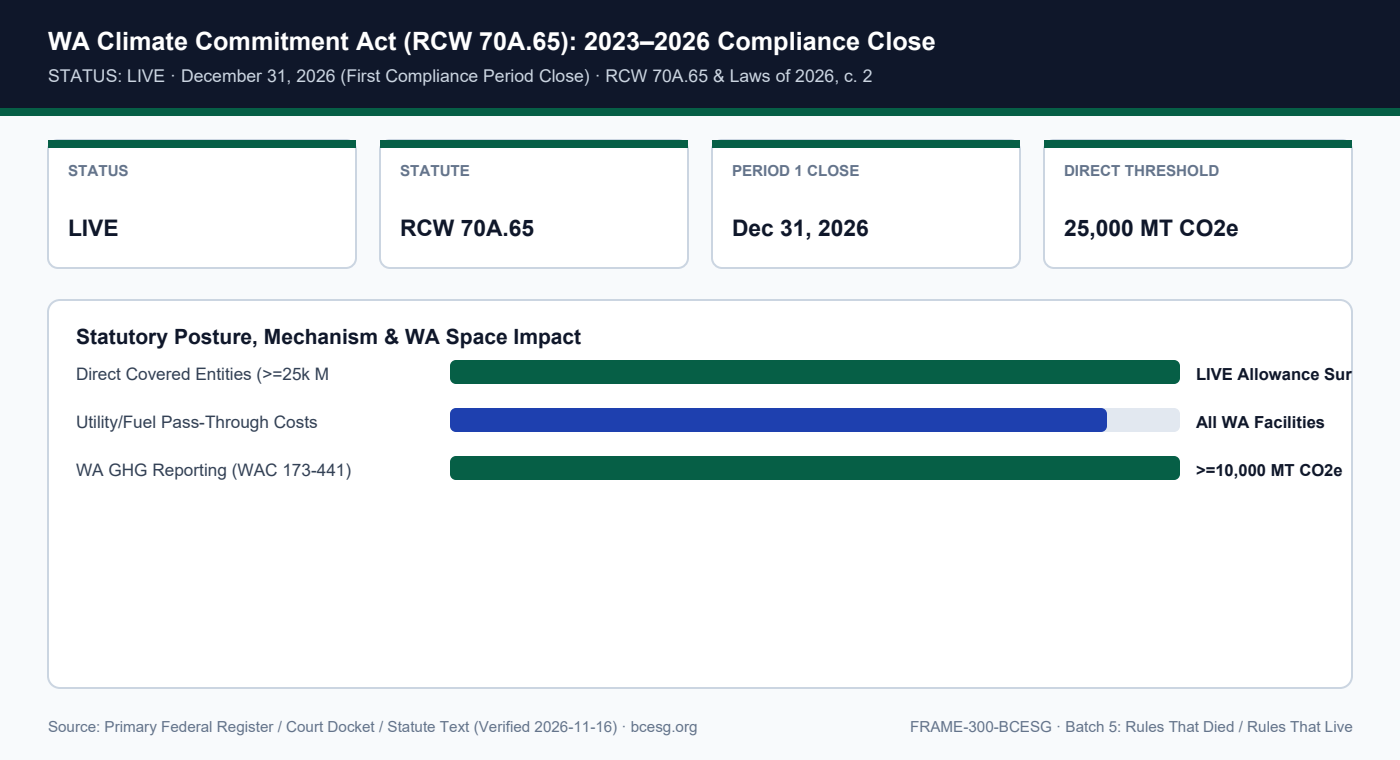
    Verdict & Proof: Washington's Climate Commitment Act (RCW 70A.65) is LIVE. The program's first four-year compliance period (2023–2026) closes on December 31, 2026, with covered emitters (>=25,000 MT CO2e/yr) and fuel/utility suppliers required to surrender compliance instruments.
    RULE STATUS BRIEF · PDF & MARKDOWN TWIN
    WA CCA Cap-and-Invest (LIVE)
    Download the formatted 2-page rule-status brief (PDF) or read the single-source Markdown twin for WA CCA Cap-and-Invest (LIVE).
    WA Climate Commitment Act (RCW 70A.65): 2023–2026 Compliance Close

    Who Owes What by When: Direct Emitters vs. Pass-Through Costs

    Enacted under RCW 70A.65 and upheld by Washington voters in November 2024, the CCA caps emissions across industrial facilities (>=25,000 MT CO2e/yr), natural gas utilities, electric utilities, and fuel suppliers. The first compliance period (2023–2026) ends December 31, 2026, with Laws of 2026, c. 251 refining market-fairness provisions.

    Even when a Washington space supplier emits below 10,000 MT CO2e/yr (WAC 173-441 reporting) and 25,000 MT CO2e/yr (CCA compliance), it pays CCA allowance costs embedded in PSE natural gas bills, industrial diesel, and process heating.

    • First 4-year compliance period ends December 31, 2026.
    • Direct reporting starts at 10,000 MT CO2e/yr under WAC 173-441.
    • Indirect cost pass-throughs affect every Kent, Tukwila, and Redmond plant.
    CCA TierThresholdStatus (Nov 16, 2026)
    WAC 173-441 Reporting>=10,000 MT CO2e/yrLIVE — Annual Ecology filing
    CCA Allowance Compliance>=25,000 MT CO2e/yrLIVE — Period 1 closes Dec 31, 2026
    Utility / Fuel Pass-ThroughAll commercial customersLIVE — Reflected in gas/fuel pricing

    Independent of Federal EPA Repeals

    Because the CCA is a Washington state statute, EPA's proposed 40 CFR Part 98 rollback does not pause or alter CCA reporting or allowance surrender.

    Related BC ESG Guides & Verified Primary Sources

  • King County Floodplain & Green River Levee Rules (KCC 21A.24): LIVE — Zero-Rise & 3-Ft Freeboard

    King County Floodplain & Green River Levee Rules (KCC 21A.24): LIVE — Zero-Rise & 3-Ft Freeboard

    LIVEKing County Critical Areas Flood Hazard & Green River Levee Rules (KCC Chapter 21A.24)
    Deciding Instrument: King County Code Chapter 21A.24 (21A.24.230–.270) & Municipal Flood Ordinances  |  Date: Active (Enforced at Every Building/Site Permit)
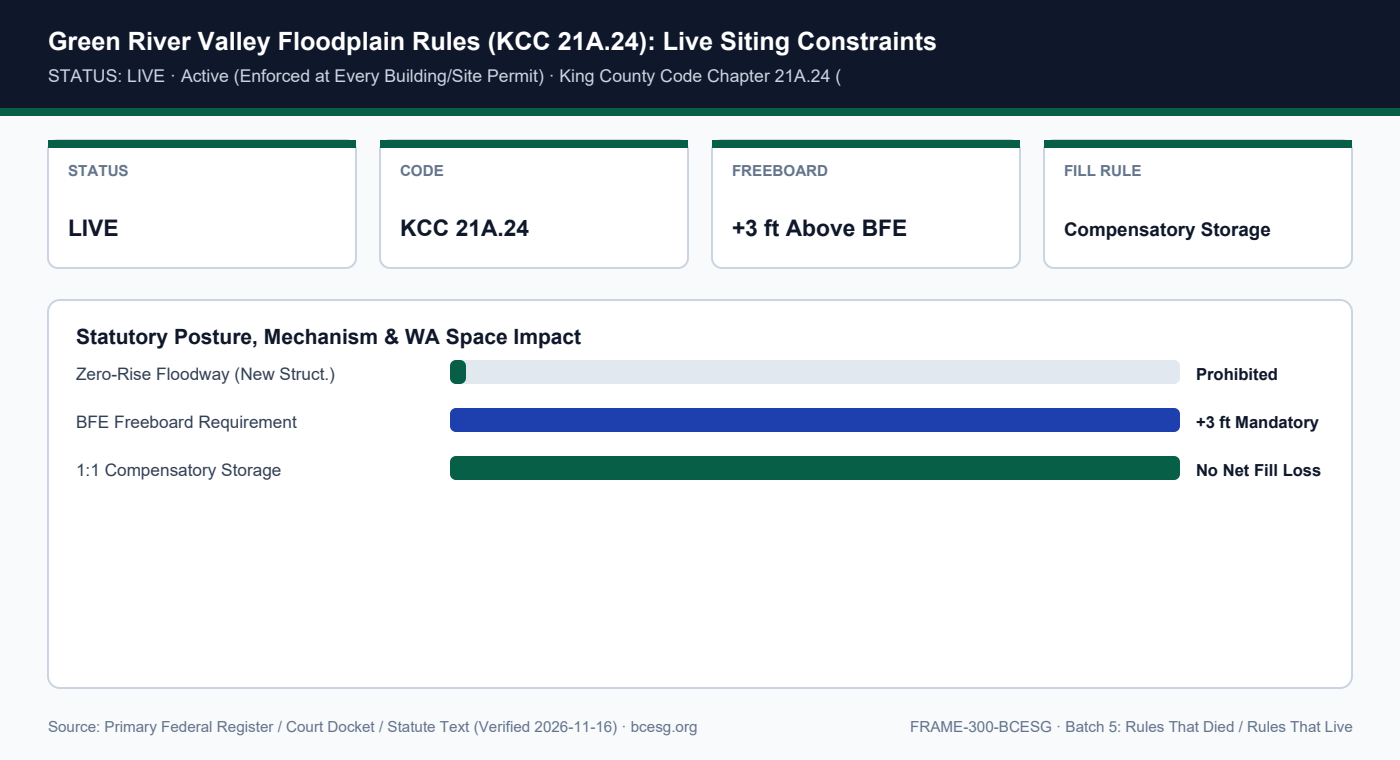
    Verdict & Proof: King County Code Chapter 21A.24 floodplain and Green River levee-driven land-use rules are LIVE. Valley facilities in Kent and Tukwila face Zero-Rise Floodway prohibitions, Channel Migration Zone setbacks, 3-foot Base Flood Elevation (BFE) freeboard, and 1:1 compensatory flood storage.
    RULE STATUS BRIEF · PDF & MARKDOWN TWIN
    King County Floodplain (LIVE)
    Download the formatted 2-page rule-status brief (PDF) or read the single-source Markdown twin for King County Floodplain (LIVE).
    Green River Valley Floodplain Rules (KCC 21A.24): Live Siting Constraints

    Who Owes What by When: Kent & Tukwila Green River Corridor

    The Green River corridor running through Kent and Tukwila hosts major Washington space facilities (including Blue Origin, Stoke Space, Cowboy Space, BlackSky, and Starfish Space). Under KCC 21A.24.230–.270 and coordinated Kent/Tukwila municipal critical-area codes, new structures are barred in FEMA/Zero-Rise Floodways, and Channel Migration Zones (CMZs) restrict bankside expansion.

    Permitted construction or substantial improvement in the Flood Fringe requires elevating the lowest floor at least 3 feet above the 100-year Base Flood Elevation (BFE), providing 1:1 compensatory storage for any fill, protecting King County Flood Control District levee access/setbacks, and restricting hazardous material storage.

    • Zero-Rise Floodway: 0.0-foot modeled rise in 100-year flood elevation.
    • Elevation: +3 feet above Base Flood Elevation (BFE) for new/substantially improved structures.
    • Compensatory Storage: any floodplain fill must be offset by equivalent nearby excavation.
    Flood Hazard RuleStandardImpact on Valley Space Facilities
    Zero-Rise FloodwayNo new structures; 0.0 ft riseBlocks expansion into active floodway
    Lowest Floor ElevationBFE + 3 feet minimumDrives slab/dock elevation & floodproofing
    Compensatory Storage1:1 volume replacementRequires detention/excavation for yard fill
    Hazardous MaterialsRestricted in flood hazard areasAffects propellant, solvent & battery storage

    Levee-Protected Parcels Are Not Exempt

    Even parcels behind Green River levees (Disconnected Migration Areas) frequently remain mapped in FEMA Special Flood Hazard Areas or face levee-setback and overtopping standards.

    Related BC ESG Guides & Verified Primary Sources

  • Washington SEPA (RCW 43.21C / WAC 197-11): LIVE — Active State Environmental Gate for Industrial Siting

    Washington SEPA (RCW 43.21C / WAC 197-11): LIVE — Active State Environmental Gate for Industrial Siting

    LIVEWashington State Environmental Policy Act (SEPA, RCW 43.21C & WAC 197-11)
    Deciding Instrument: RCW 43.21C & WAC 197-11 (2025–2026 GMA Safe Harbors Narrowed to Housing/Transit)  |  Date: Active (Continuous State Permitting Gate)
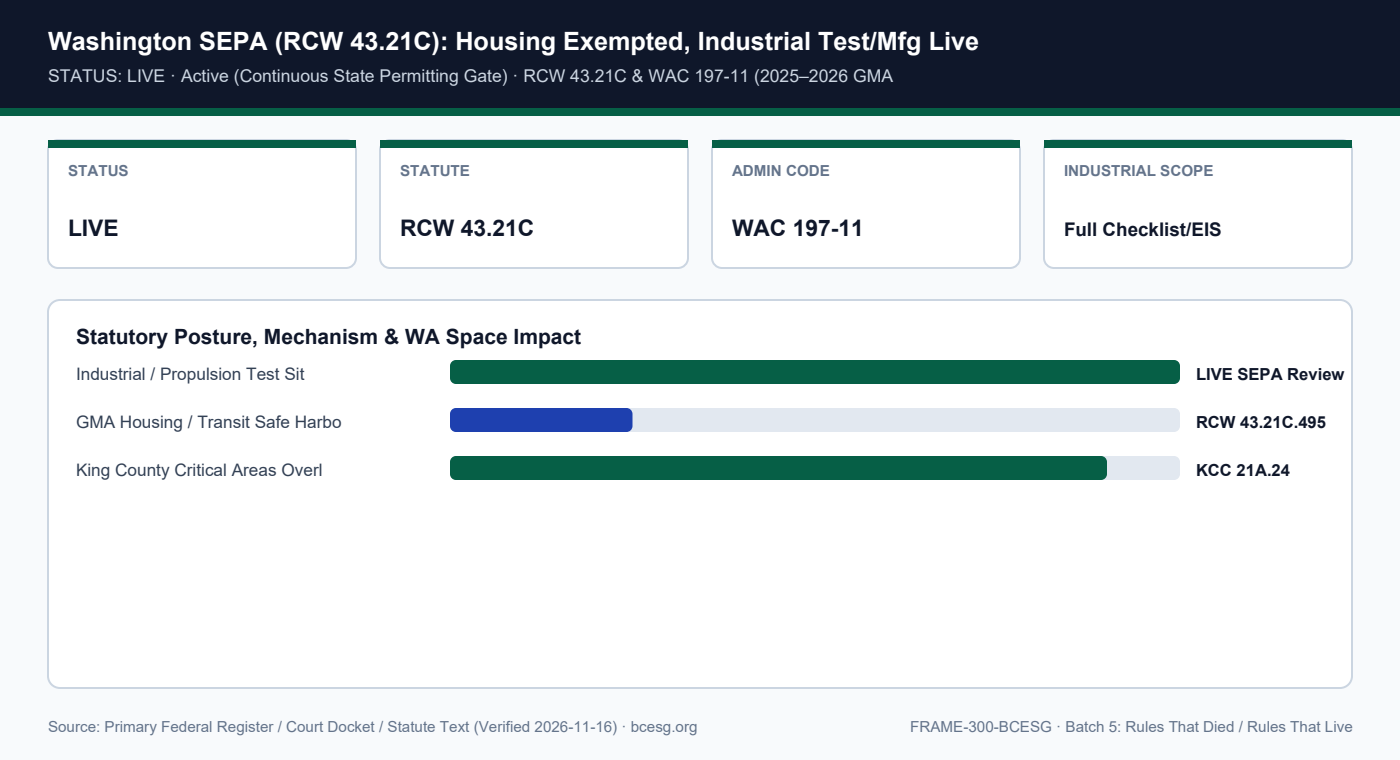
    Verdict & Proof: Washington SEPA (RCW 43.21C) is LIVE for aerospace manufacturing, propulsion test stands, and industrial expansions. While 2025–2026 legislative safe harbors (RCW 43.21C.495 / .229) shielded qualifying housing and transit projects from SEPA appeals, industrial space facilities still require SEPA checklists, DNS/MDNS, or EIS review.
    RULE STATUS BRIEF · PDF & MARKDOWN TWIN
    WA SEPA (LIVE)
    Download the formatted 2-page rule-status brief (PDF) or read the single-source Markdown twin for WA SEPA (LIVE).
    Washington SEPA (RCW 43.21C): Housing Exempted, Industrial Test/Mfg Live

    Who Owes What by When: Triggered at Local Permit Application

    Whenever a Washington space company applies for a non-exempt grading permit, conditional use permit, shoreline permit, or major industrial building permit in Kent, Tukwila, Redmond, Bothell, Marysville, or Moses Lake, the lead local agency conducts a SEPA threshold determination under RCW 43.21C and WAC 197-11.

    Recent statutory appeal safe harbors (RCW 43.21C.495 and 43.21C.229) apply to urban housing, middle housing, and transit-oriented development—not to rocket test stands, chemical storage, or heavy manufacturing.

    • Requires SEPA Environmental Checklist at permit intake.
    • Outcomes: Determination of Nonsignificance (DNS), Mitigated DNS (MDNS), or full EIS.
    • Interlocks directly with King County Critical Areas and PSCAA air permits.
    SEPA DocumentTriggerStatus
    SEPA Environmental ChecklistNon-exempt industrial/land-use permitLIVE — Required at application
    DNS / MDNSNo significant adverse impact (with/without mitigation)LIVE — Subject to comment/appeal
    Environmental Impact Statement (EIS)Probable significant adverse impactLIVE — Full study required

    NEPA vs. SEPA

    SEPA is a state-law gate independent of federal NEPA; streamlining federal NEPA for FAA launch licenses does not waive SEPA for Washington ground facilities.

    Related BC ESG Guides & Verified Primary Sources

  • Seattle BEPS (SMC 22.925 / Ord. 126973): LIVE — 2027 GHG Verification & 2031 Emissions Caps

    Seattle BEPS (SMC 22.925 / Ord. 126973): LIVE — 2027 GHG Verification & 2031 Emissions Caps

    LIVESeattle Building Emissions Performance Standard (BEPS, SMC § 22.925 / Ordinance 126973)
    Deciding Instrument: Seattle Municipal Code § 22.925 (Ordinance 126973)  |  Date: October 1, 2027 (First Verification) / October 1, 2031 (First GHGI Cap)
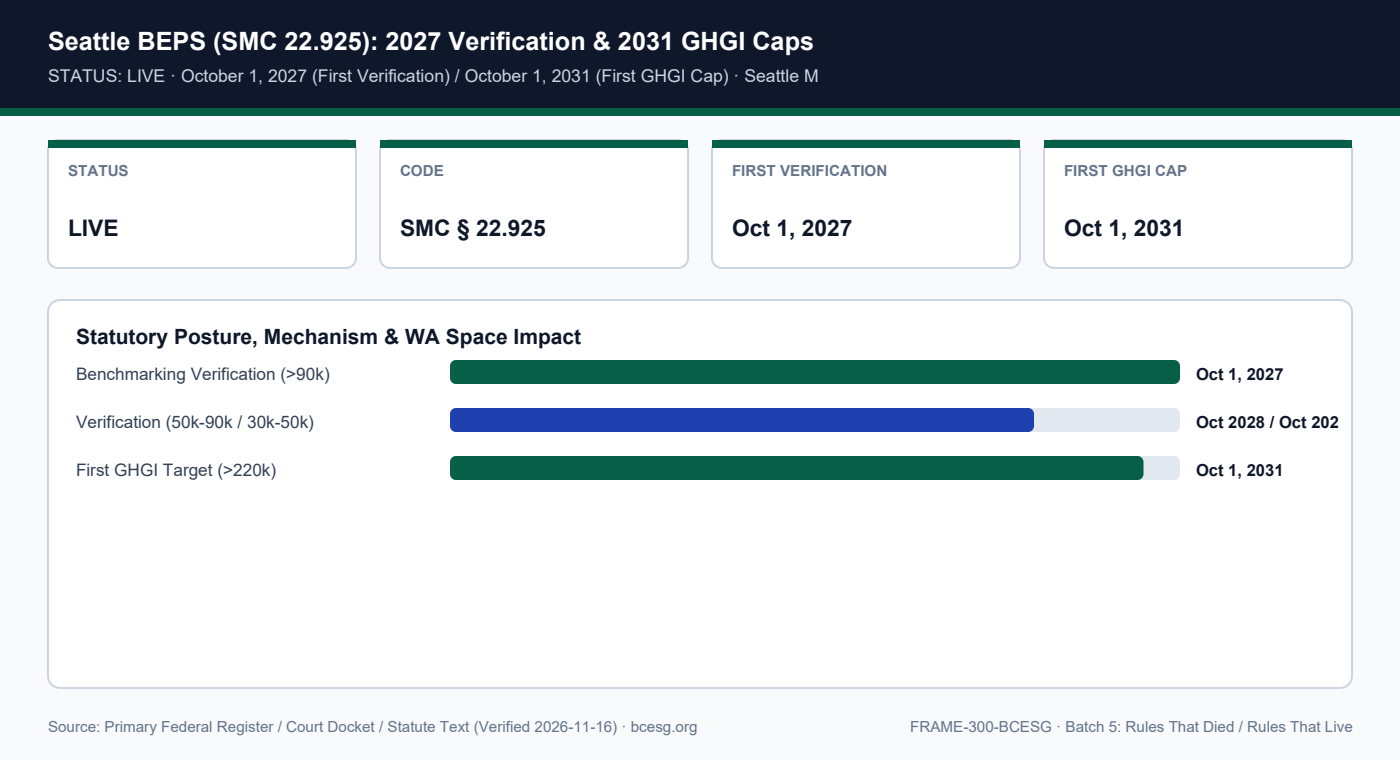
    Verdict & Proof: Seattle BEPS (SMC § 22.925) is LIVE. Nonresidential and multifamily buildings >20,000 sq ft inside Seattle city limits face Qualified Person GHG verification starting October 1, 2027 (>90,000 sq ft) and binding Greenhouse Gas Intensity (GHGI) targets starting October 1, 2031 (>220,000 sq ft).
    RULE STATUS BRIEF · PDF & MARKDOWN TWIN
    Seattle BEPS (LIVE)
    Download the formatted 2-page rule-status brief (PDF) or read the single-source Markdown twin for Seattle BEPS (LIVE).
    Seattle BEPS (SMC 22.925): 2027 Verification & 2031 GHGI Caps

    Who Owes What by When: Seattle City-Limits Facilities

    Seattle BEPS layers carbon-intensity caps directly on top of WA CBPS for buildings >20,000 sq ft inside Seattle (affecting Georgetown, SoDo, and Harbor Island aerospace offices and test labs). Initial Qualified Person benchmarking verification and GHG reports are due October 1, 2027 for buildings >90,000 sq ft (phasing through October 1, 2030 for 20,001–30,000 sq ft).

    Binding GHGI reduction targets begin October 1, 2031 for buildings >220,000 sq ft and phase through October 1, 2035.

    • Oct 1, 2027: GHG verification due for >90,000 sq ft buildings.
    • Oct 1, 2031: First GHGI target compliance for >220,000 sq ft.
    • Covers natural gas, steam, and electric emissions intensity.
    Building Size (Seattle)GHG Verification DueFirst GHGI Target Due
    >220,000 sq ftOct 1, 2027Oct 1, 2031
    90,001–220,000 sq ftOct 1, 2027Oct 1, 2032
    50,001–90,000 sq ftOct 1, 2028Oct 1, 2033
    30,001–50,000 sq ftOct 1, 2029Oct 1, 2034

    Landlord-Tenant Split

    Even where a space company is a NNN tenant rather than building owner, Seattle landlords pass verification audit fees and utility-submetering obligations into lease renewals.

    Related BC ESG Guides & Verified Primary Sources

BC ESG

ESG Strategy, Sustainability Intelligence, and Business Continuity for Forward-Thinking Organizations

© 2026 BC ESG — Business Continuity, ESG & Sustainability Intelligence