Who Owes What by When: Fuel Suppliers & Fleet Electrification
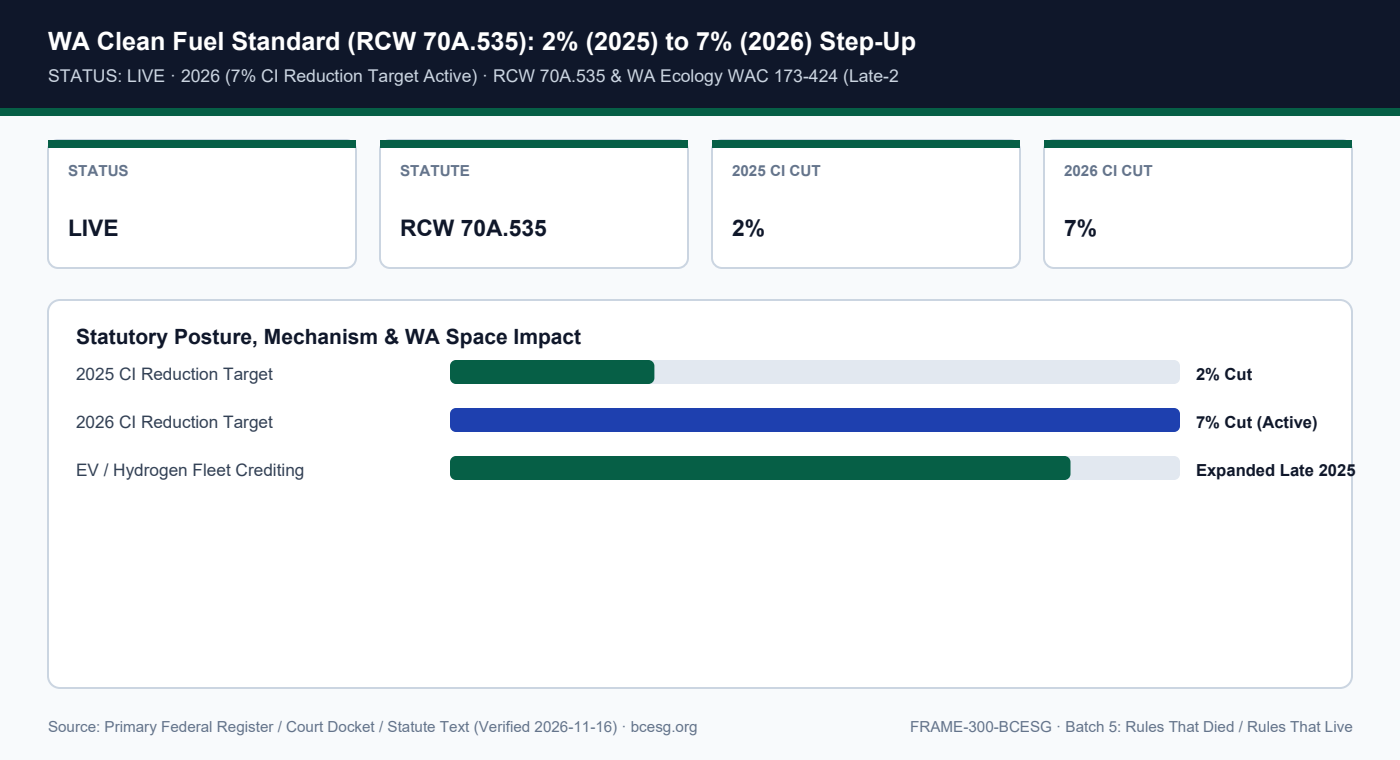
Under RCW 70A.535 and WAC 173-424, fuel producers and importers must reduce the lifecycle carbon intensity of gasoline and diesel sold in Washington—stepping from 2% in 2025 to 7% in 2026—or purchase CFS credits. Ecology's late-2025 rule updates (implementing HB 1409) added third-party verification and expanded crediting for heavy-duty EV charging and hydrogen infrastructure.
For Kent Valley and Seattle aerospace logistics, CFS drives diesel/jet-ground-support fuel surcharges while creating credit-generation opportunities for electrified yard tractors and hydrogen refueling.
- 7% carbon intensity reduction active across 2026.
- Direct reporting/compliance falls on fuel suppliers; logistics fleets feel price pass-throughs.
- Expanded EV/hydrogen infrastructure crediting under late-2025 rules.
| Year | WA CFS Carbon Intensity Reduction | Status |
|---|---|---|
| 2023–2024 | 0.5%–1.0% initial ramp | Completed |
| 2025 | 2.0% reduction | Completed |
| 2026 | 7.0% reduction (HB 1409 / WAC 173-424) | LIVE — Active |
Relation to Rocket Propellants
Orbital rocket propellants (RP-1, liquid methane, LOX) are not highway transportation fuels, but ground-fleet drayage between Kent, Port of Seattle/Tacoma, and Moses Lake is directly exposed.