Blog

  • WA Clean Buildings Performance Standard (RCW 19.27A.210 / WAC 194-50): LIVE — Tier 1 Live Since Jun 1, 2026

    WA Clean Buildings Performance Standard (RCW 19.27A.210 / WAC 194-50): LIVE — Tier 1 Live Since Jun 1, 2026

    LIVEWashington Clean Buildings Performance Standard (CBPS, RCW 19.27A.200–.240 & WAC 194-50)
    Deciding Instrument: RCW 19.27A.210 & WA Dept. of Commerce WAC 194-50  |  Date: June 1, 2026 (Tier 1 >220k) / July 1, 2027 (Tier 2)
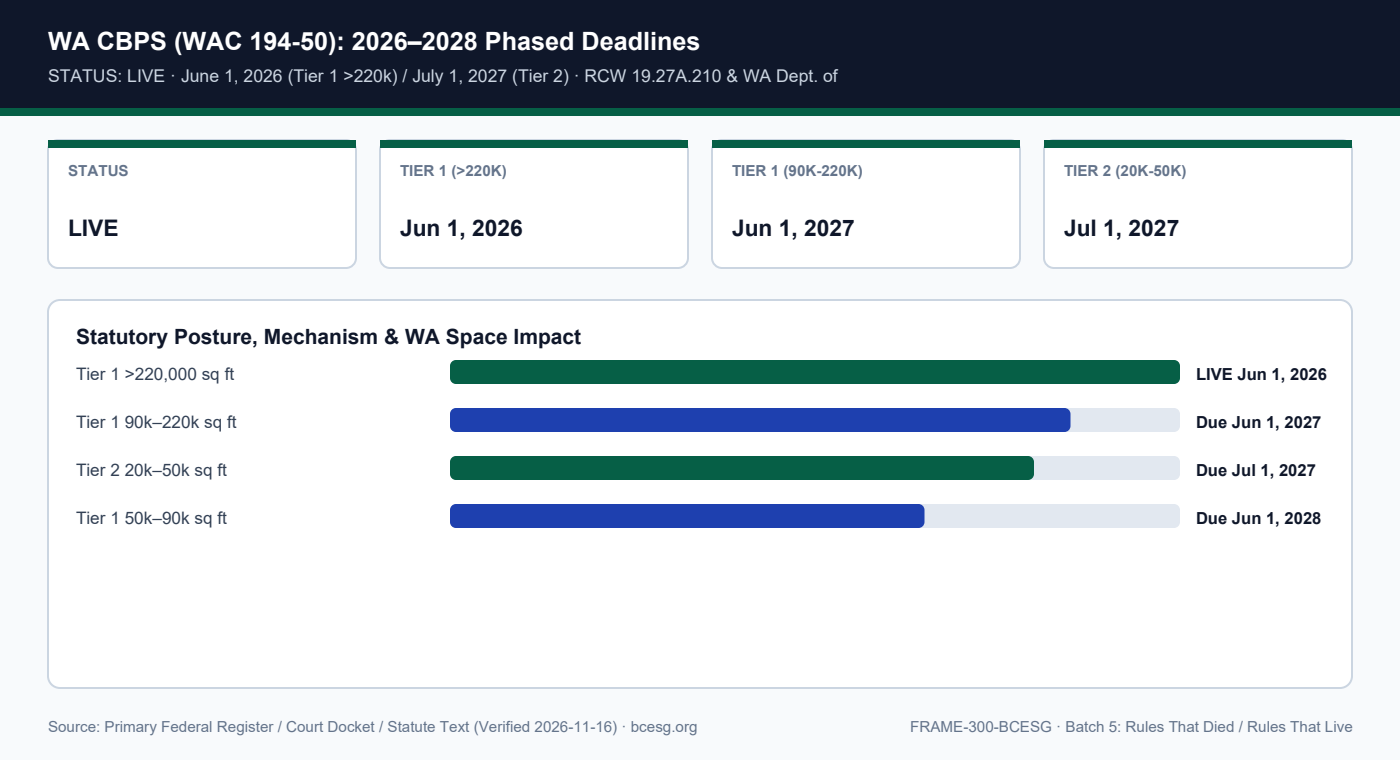
    Verdict & Proof: Washington's Clean Buildings Performance Standard (CBPS) is LIVE and in active enforcement. Tier 1 buildings >220,000 sq ft hit their first compliance deadline on June 1, 2026, followed by 90,001–220,000 sq ft on June 1, 2027, Tier 2 (20,000–50,000 sq ft) on July 1, 2027, and 50,001–90,000 sq ft on June 1, 2028.
    RULE STATUS BRIEF · PDF & MARKDOWN TWIN
    WA CBPS Standard (LIVE)
    Download the formatted 2-page rule-status brief (PDF) or read the single-source Markdown twin for WA CBPS Standard (LIVE).
    WA CBPS (WAC 194-50): 2026–2028 Phased Deadlines

    Who Owes What by When: Kent, Tukwila, Redmond & Bothell Facilities

    WA CBPS applies to commercial and industrial-adjacent buildings over 20,000 sq ft statewide (including Kent Valley and Eastside aerospace campuses). Tier 1 (>50,000 sq ft nonresidential) requires meeting Energy Use Intensity targets (EUIt) or completing an Investment Criteria energy audit, plus establishing an Operations & Maintenance (O&M) program 12 months before the compliance date.

    Tier 2 (20,000–50,000 sq ft commercial) requires Energy Management Plans, O&M programs, and ENERGY STAR Portfolio Manager benchmarking by July 1, 2027. Compliance renews every 5 years.

    • June 1, 2026: Tier 1 >220,000 sq ft (already passed; active enforcement).
    • June 1, 2027: Tier 1 90,001–220,000 sq ft.
    • July 1, 2027: Tier 2 20,000–50,000 sq ft.
    CBPS Tier & SizeCompliance DeadlineCore Requirement
    Tier 1 (>220,000 sq ft)June 1, 2026EUIt / Investment Criteria + EMP + O&M
    Tier 1 (90,001–220,000 sq ft)June 1, 2027EUIt / Investment Criteria + EMP + O&M
    Tier 2 (20,000–50,000 sq ft)July 1, 2027EMP + O&M + Portfolio Manager benchmarking
    Tier 1 (50,001–90,000 sq ft)June 1, 2028EUIt / Investment Criteria + EMP + O&M

    Industrial Process-Load Carve-Out & Tenant Data

    Aerospace machine shops and cleanrooms can sub-meter industrial process loads (autoclaves, CNCs, vacuum chambers) out of the building's EUIt calculation, but landlords still demand tenant utility and square-footage data.

    Related BC ESG Guides & Verified Primary Sources

  • EPA TSCA Section 8(a)(7) PFAS Reporting (40 CFR Part 705): LIVE — Submission Window Pushed to Jan 31, 2027

    EPA TSCA Section 8(a)(7) PFAS Reporting (40 CFR Part 705): LIVE — Submission Window Pushed to Jan 31, 2027

    LIVEEPA TSCA Section 8(a)(7) PFAS Reporting and Recordkeeping Rule (40 CFR Part 705)
    Deciding Instrument: 40 CFR Part 705 (TSCA § 8(a)(7) Reporting Window Revised to Jan 31, 2027)  |  Date: January 31, 2027 (Window Open) / July 31, 2027 (Standard Due)
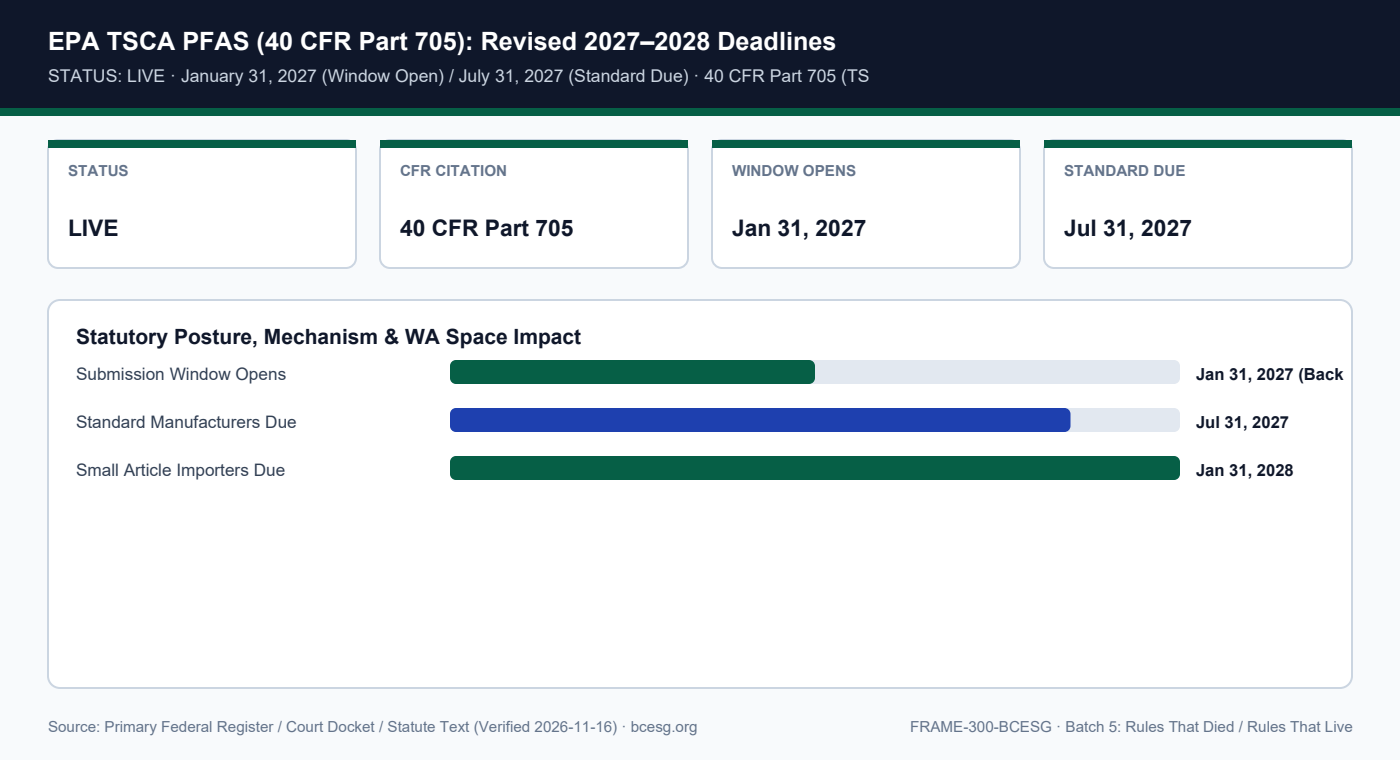
    Verdict & Proof: EPA's TSCA Section 8(a)(7) PFAS reporting rule (40 CFR Part 705) is LIVE with a revised 2027 submission schedule. The data submission window opens January 31, 2027 (or 60 days after a forthcoming substantive update rule, whichever is earlier), with standard reports due July 31, 2027 and small article importers due January 31, 2028.
    RULE STATUS BRIEF · PDF & MARKDOWN TWIN
    EPA TSCA PFAS Part 705 (LIVE)
    Download the formatted 2-page rule-status brief (PDF) or read the single-source Markdown twin for EPA TSCA PFAS Part 705 (LIVE).
    EPA TSCA PFAS (40 CFR Part 705): Revised 2027–2028 Deadlines

    Who Owes What by When: 2011–2022 PFAS Lookback

    Under TSCA Section 8(a)(7) (40 CFR Part 705), any entity that manufactured or imported PFAS (including fluoropolymers, PTFE/Viton seals, and PFAS-containing articles) for commercial purposes between 2011 and 2022 must file a one-time electronic report in EPA CDX.

    EPA revised the submission start date to January 31, 2027 (or 60 days post-effective date of a forthcoming final rule, whichever is earlier), setting a 6-month window (due July 31, 2027) for standard manufacturers and a 12-month window (due January 31, 2028) for small manufacturers reporting exclusively as article importers.

    • Covers fluoropolymers, O-rings, thermal coatings, and imported aerospace sub-assemblies.
    • Standard window: Jan 31, 2027 – Jul 31, 2027.
    • Small article-importer window: Jan 31, 2027 – Jan 31, 2028.
    Filer CategoryWindow OpenSubmission Deadline
    Standard Manufacturers / ImportersJan 31, 2027 (or earlier rule trigger)July 31, 2027
    Small Manufacturers (Article Importers Only)Jan 31, 2027 (or earlier rule trigger)January 31, 2028

    Why WA Space Suppliers Care

    Even domestic-only machine shops face customer PFAS questionnaires from primes who imported fluoropolymer-bearing sub-assemblies during 2011–2022.

    Related BC ESG Guides & Verified Primary Sources

  • DFARS 252.204-7012 & NIST SP 800-171: LIVE — Mandatory CUI Safeguarding Regardless of CMMC Pause

    DFARS 252.204-7012 & NIST SP 800-171: LIVE — Mandatory CUI Safeguarding Regardless of CMMC Pause

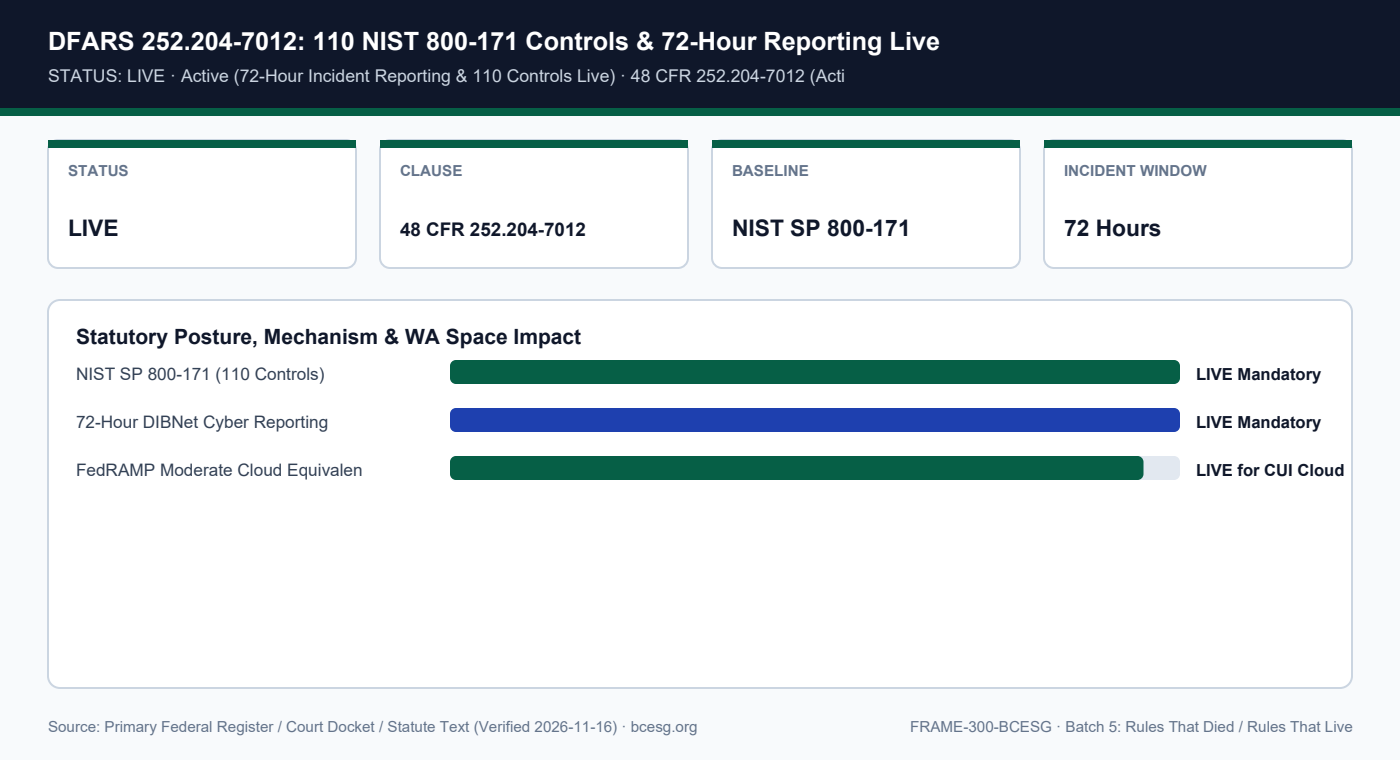
    LIVEDFARS 252.204-7012 Safeguarding Covered Defense Information & Cyber Incident Reporting
    Deciding Instrument: 48 CFR 252.204-7012 (Active DoD Acquisition Clause)  |  Date: Active (72-Hour Incident Reporting & 110 Controls Live)
    Verdict & Proof: DFARS 252.204-7012 is LIVE and fully enforceable. DoD's July 2026 pause on CMMC Phase 2 C3PAO transitions did not suspend DFARS 7012, NIST SP 800-171 (110 controls), or 72-hour cyber incident reporting.
    RULE STATUS BRIEF · PDF & MARKDOWN TWIN
    DFARS 7012 / NIST 800-171 (LIVE)
    Download the formatted 2-page rule-status brief (PDF) or read the single-source Markdown twin for DFARS 7012 / NIST 800-171 (LIVE).
    DFARS 252.204-7012: 110 NIST 800-171 Controls & 72-Hour Reporting Live

    Who Owes What by When: Continuous CUI Protection

    Every Washington space supplier holding a DoD prime or subcontract containing DFARS 252.204-7012 must implement NIST SP 800-171 across all systems processing Covered Defense Information (CDI/CUI), use FedRAMP Moderate-equivalent cloud services, and report cyber incidents to DoD within 72 hours.

    Unlike CMMC Phase 2's paused C3PAO transition, DFARS 7012 has been continuously binding since 2017 and is actively audited via False Claims Act and DCMA DIBCAC reviews.

    • 110 NIST SP 800-171 security controls + System Security Plan (SSP) + POA&M.
    • 72-hour cyber incident reporting to DoD DIBNet.
    • Mandatory flow-down to subcontractors handling CUI.
    ObligationCitationStatus
    Adequate Security (NIST SP 800-171)48 CFR 252.204-7012(b)LIVE — Mandatory upon award
    72-Hour Cyber Incident Reporting48 CFR 252.204-7012(c)LIVE — Mandatory within 72h
    Cloud FedRAMP Moderate Equiv.48 CFR 252.204-7012(b)(2)(ii)(D)LIVE — Mandatory for external cloud

    Batch 4 vs. Batch 5 Scope

    Batch 4 detailed how primes verify DFARS 7012/SPRS scores in supplier onboarding; this Batch 5 brief establishes 7012's live legal status independent of the CMMC Phase 2 pause.

    Related BC ESG Guides & Verified Primary Sources

  • EAR Spacecraft & Dual-Use Controls (15 CFR Part 774 / ECCN 9A515): LIVE — Unbroken BIS Enforcement

    EAR Spacecraft & Dual-Use Controls (15 CFR Part 774 / ECCN 9A515): LIVE — Unbroken BIS Enforcement

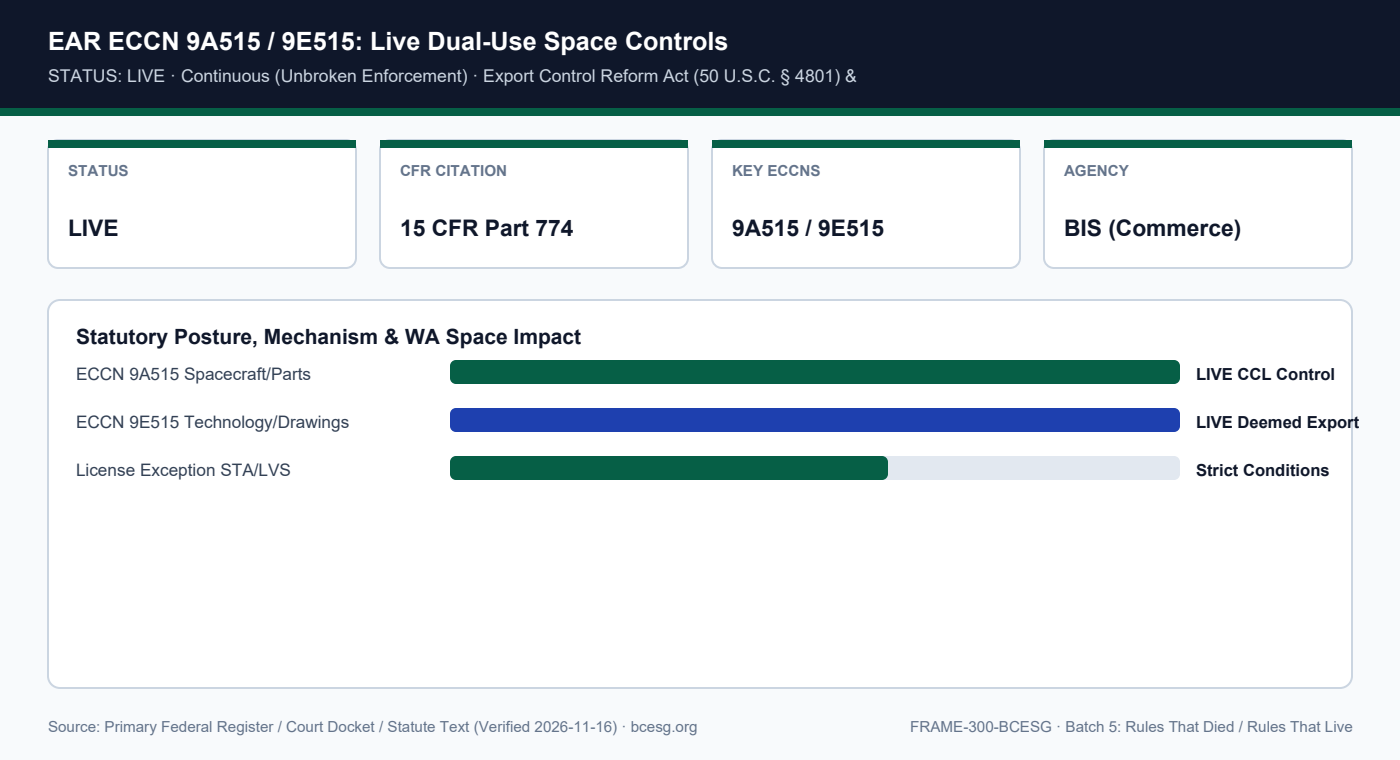
    LIVEExport Administration Regulations (EAR, 15 CFR Parts 730–774) — ECCN 9A515 / 9E515
    Deciding Instrument: Export Control Reform Act (50 U.S.C. § 4801) & 15 CFR Part 774 (CCL)  |  Date: Continuous (Unbroken Enforcement)
    Verdict & Proof: EAR dual-use space controls (15 CFR Parts 730–774, ECCN 9A515/9E515) are LIVE. Commercial satellites, ground-system electronics, and spacecraft components moved off the USML remain tightly controlled by BIS under the Commerce Control List with zero pause.
    RULE STATUS BRIEF · PDF & MARKDOWN TWIN
    EAR ECCN 9A515 (LIVE)
    Download the formatted 2-page rule-status brief (PDF) or read the single-source Markdown twin for EAR ECCN 9A515 (LIVE).
    EAR ECCN 9A515 / 9E515: Live Dual-Use Space Controls

    Who Owes What by When: ECCN Classification & Deemed Exports

    Even when a commercial satellite component or ground-station transceiver is not ITAR-controlled, it is typically controlled under BIS Export Administration Regulations (15 CFR Parts 730–774), most commonly ECCN 9A515 (spacecraft and related commodities) and 9E515 (technology).

    Washington suppliers must maintain documented jurisdiction/classification determinations (CJ or self-classification) and screen foreign-national access and export destinations continuously.

    • Applies to commercial constellations, optical payloads, and ground-segment hardware.
    • ECCN 9E515 technology transfers to foreign nationals require license/exception analysis.
    • Zero administrative pause or rollback under 2025–2026 deregulatory orders.
    ECCNScopeStatus
    9A515Commercial spacecraft, buses, & specially designed partsLIVE — BIS CCL control
    9D515 / 9E515Software & technology for 9A515 itemsLIVE — Deemed export rules apply
    EAR99Low-tier commercial off-the-shelf itemsLIVE — End-user/sanctions screening

    Batch 4 vs. Batch 5 Scope

    Batch 4 covered customer ECCN 9A515 classification asks; this Batch 5 brief confirms the statutory and regulatory status of 15 CFR Part 774.

    Related BC ESG Guides & Verified Primary Sources

  • ITAR (22 CFR Parts 120–130): LIVE — The Compliance Regime That Never Paused

    ITAR (22 CFR Parts 120–130): LIVE — The Compliance Regime That Never Paused

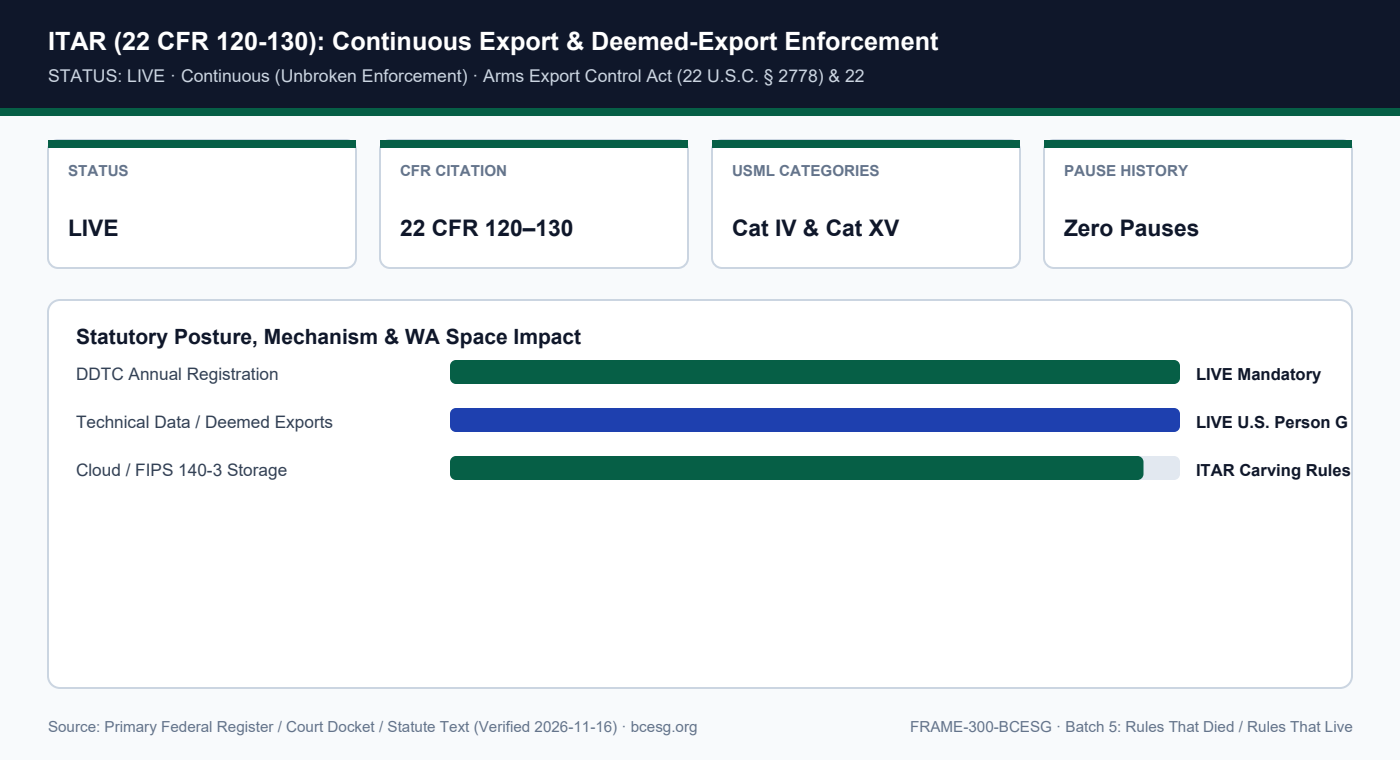
    LIVEInternational Traffic in Arms Regulations (ITAR, 22 CFR Parts 120–130)
    Deciding Instrument: Arms Export Control Act (22 U.S.C. § 2778) & 22 CFR Parts 120–130  |  Date: Continuous (Unbroken Enforcement)
    Verdict & Proof: ITAR (22 CFR Parts 120–130) is LIVE and unbroken. Regardless of federal climate-rule withdrawals, DDTC registration, USML Category IV (launch vehicles) and Category XV (spacecraft) technical-data controls, and U.S. Person access restrictions remain strictly enforced across every Washington space supplier.
    RULE STATUS BRIEF · PDF & MARKDOWN TWIN
    ITAR 22 CFR 120-130 (LIVE)
    Download the formatted 2-page rule-status brief (PDF) or read the single-source Markdown twin for ITAR 22 CFR 120-130 (LIVE).
    ITAR (22 CFR 120-130): Continuous Export & Deemed-Export Enforcement

    Who Owes What by When: Continuous DDTC & Prime Flow-Downs

    While federal climate and ESG rules were withdrawn or enjoined in 2025–2026, ITAR (22 CFR Parts 120–130) never paused. Any Washington manufacturer, machine shop, propulsion tester, or software vendor touching USML Category IV (launch vehicles/rockets) or Category XV (spacecraft/associated equipment) defense articles or technical data must maintain active DDTC registration and strict U.S. Person access controls.

    Deemed exports—allowing a non-U.S. person in Kent, Redmond, or Seattle to view a CAD drawing or test report—carry civil and criminal penalties under the Arms Export Control Act.

    • Mandatory DDTC registration for manufacturers and exporters of USML articles.
    • Strict U.S. Person gating on shop floors, ERP/MES systems, and cloud enclaves.
    • Applies to commercial space suppliers even without a direct DoD contract.
    ITAR ControlGoverning SectionStatus
    Manufacturer / Exporter Registration22 CFR Part 122LIVE — Annual DDTC renewal
    USML Cat IV & Cat XV Articles22 CFR § 121.1LIVE — License/TAA required for export
    Technical Data & Deemed Exports22 CFR § 120.50 / § 120.33LIVE — U.S. Person access only

    Batch 4 vs. Batch 5 Scope

    Batch 4 detailed how primes flow ITAR clauses into POs; this Batch 5 brief documents ITAR's unbroken statutory standing under 22 U.S.C. § 2778 and 22 CFR Parts 120–130.

    Related BC ESG Guides & Verified Primary Sources

  • NEPA as Applied to Launch Licensing (42 U.S.C. § 4321): LIVE — Statutory Gate Amid 2026 Waiver Proposals

    NEPA as Applied to Launch Licensing (42 U.S.C. § 4321): LIVE — Statutory Gate Amid 2026 Waiver Proposals

    LIVENational Environmental Policy Act (NEPA) Review for FAA Commercial Space Licensing
    Deciding Instrument: 42 U.S.C. § 4321 et seq. & FAA Order 1050.1F (2026 Streamlining Proposals Pending)  |  Date: Active (2026 Rulemaking Proposals Pending)
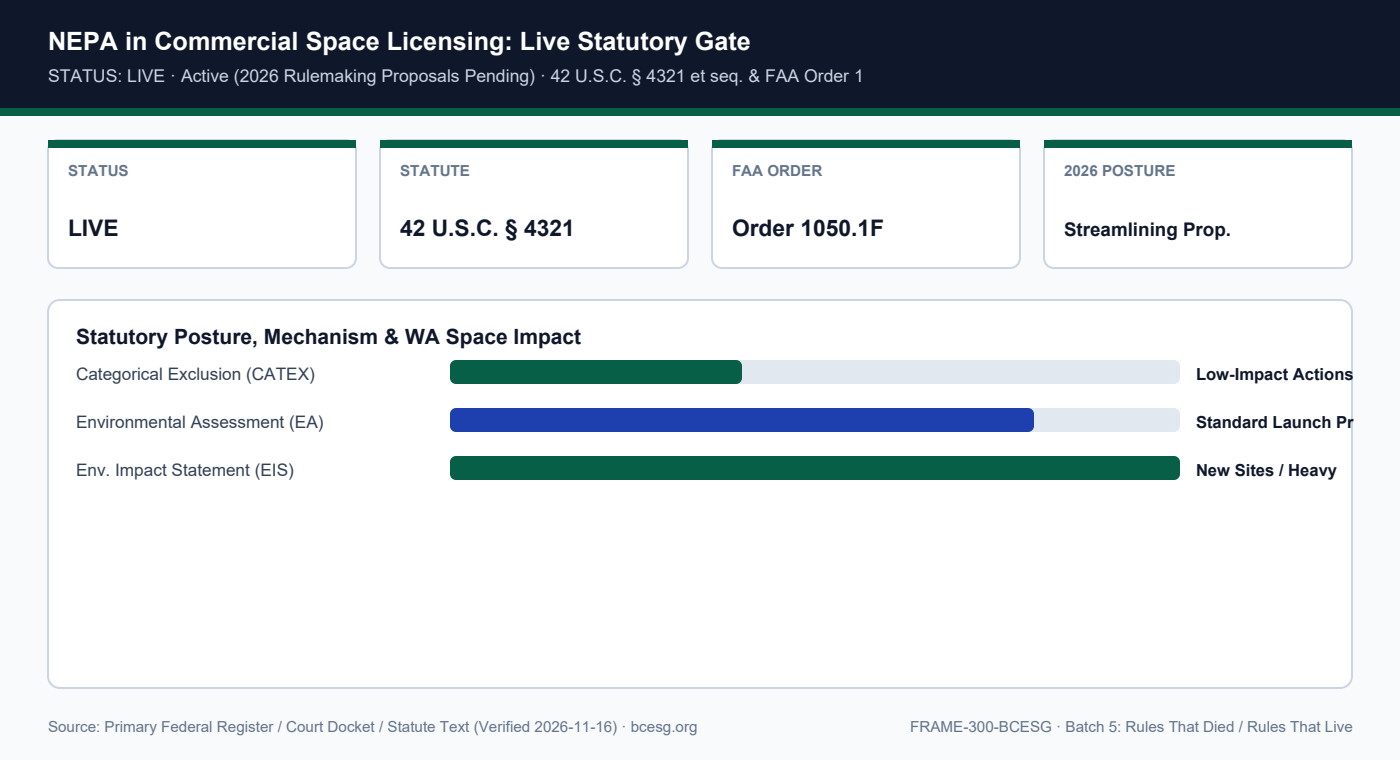
    Verdict & Proof: NEPA review for commercial launch and launch-site licensing is LIVE. Under 42 U.S.C. § 4321 and FAA Order 1050.1F, issuing an FAA Part 450 license or launch-site operator license remains a major federal action requiring an EA, EIS, or Categorical Exclusion—even as mid-2026 FAA proposals seek statutory streamlining.
    RULE STATUS BRIEF · PDF & MARKDOWN TWIN
    NEPA Launch Licensing (LIVE)
    Download the formatted 2-page rule-status brief (PDF) or read the single-source Markdown twin for NEPA Launch Licensing (LIVE).
    NEPA in Commercial Space Licensing: Live Statutory Gate

    Who Owes What by When: Parallel Safety & Environmental Tracks

    Obtaining an FAA Part 450 Vehicle Operator License or Part 420 Launch Site Operator License triggers federal NEPA compliance under 42 U.S.C. § 4321 and FAA Order 1050.1F. Applicants must fund and supply technical data for a Categorical Exclusion (CATEX), Environmental Assessment (EA), or Environmental Impact Statement (EIS) covering noise, sonic booms, water quality, endangered species, and hazardous propellants.

    While mid-2026 executive-directed FAA proposals aim to truncate review timelines and create targeted waiver pathways, NEPA remains an active statutory prerequisite for launch licensing.

    • Applies to FAA Part 450 launch licenses and Part 420 spaceport licenses.
    • Covers acoustic/sonic boom footprints, propellant spills, and biological consultations.
    • Separate from Washington State SEPA (RCW 43.21C) for in-state ground test stands.
    NEPA PathwayTriggerStatus (Nov 16, 2026)
    CATEXRoutine / de minimis federal actionLIVE (FAA Order 1050.1F)
    Environmental Assessment (EA)New vehicle or cadence increaseLIVE (Required before license)
    EISMajor new launch site / heavy-lift impactLIVE (Multi-year review)

    Washington Angle: Ground Test vs. Downrange Launch

    Washington space companies testing engines in Kent, Redmond, or Moses Lake trigger state/local SEPA, while their orbital launches from Cape Canaveral, Vandenberg, or Wallops trigger federal FAA NEPA.

    Related BC ESG Guides & Verified Primary Sources

  • FAA Part 450 Launch & Reentry Licensing (14 CFR Part 450): LIVE — Mandatory After Mar 9, 2026 Cutoff

    FAA Part 450 Launch & Reentry Licensing (14 CFR Part 450): LIVE — Mandatory After Mar 9, 2026 Cutoff

    LIVEFAA Streamlined Launch and Reentry License Requirements (14 CFR Part 450)
    Deciding Instrument: 14 CFR Part 450 (85 FR 79566; 5-Year Transition Ended Mar 9, 2026)  |  Date: March 9, 2026 (Mandatory Cutoff)
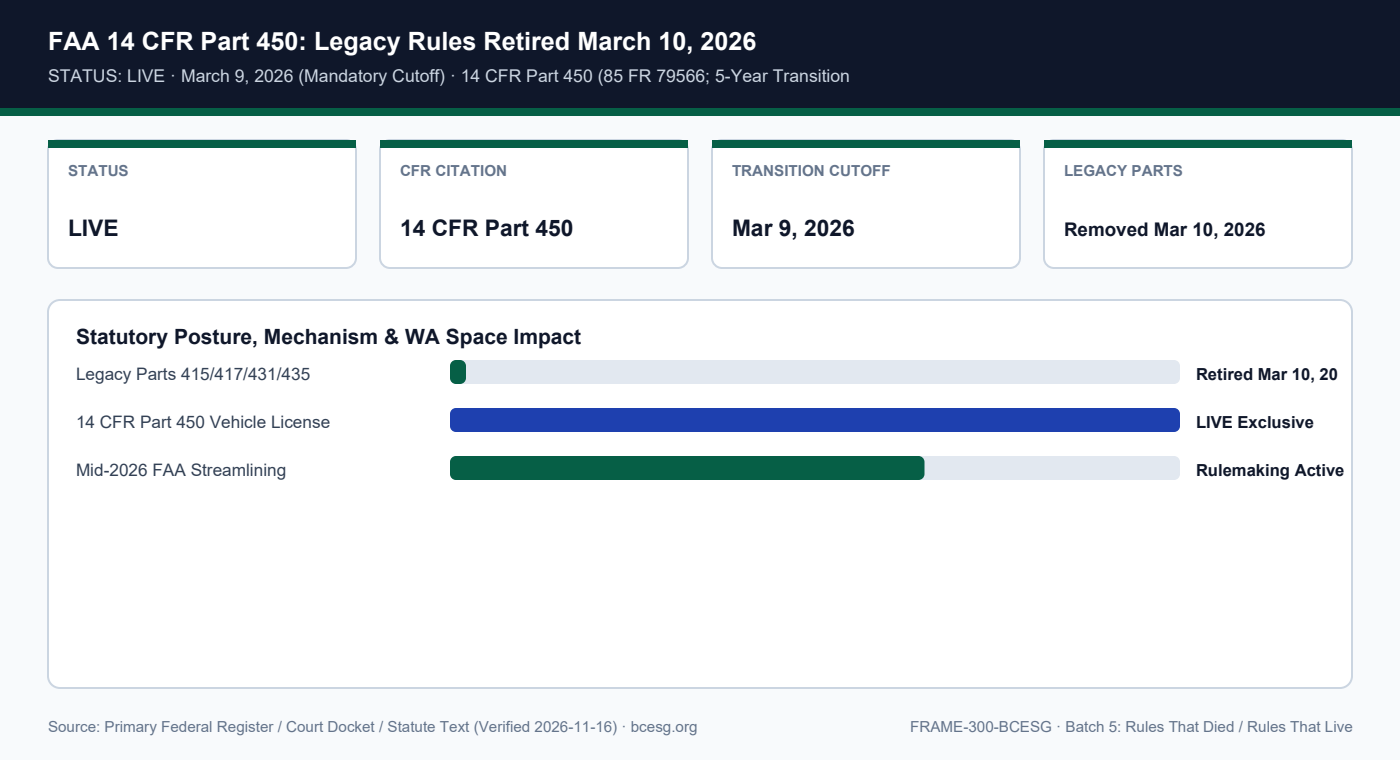
    Verdict & Proof: FAA 14 CFR Part 450 is LIVE and exclusive. The 5-year transition period expired on March 9, 2026, and legacy Parts 415, 417, 431, and 435 were removed from the Code of Federal Regulations on March 10, 2026. All U.S. commercial launch and reentry operators must hold a Part 450 Vehicle Operator License.
    RULE STATUS BRIEF · PDF & MARKDOWN TWIN
    FAA Part 450 Licensing (LIVE)
    Download the formatted 2-page rule-status brief (PDF) or read the single-source Markdown twin for FAA Part 450 Licensing (LIVE).
    FAA 14 CFR Part 450: Legacy Rules Retired March 10, 2026

    Who Owes What by When: Exclusive Part 450 Regime

    When 14 CFR Part 450 took effect in March 2021, the FAA granted a 5-year grace period for legacy launch and reentry licenses issued under Parts 415, 417, 431, and 435. That grace period expired on March 9, 2026, and the legacy parts were removed from the CFR on March 10, 2026.

    Today, every commercial launch and reentry operator—including Washington launch developers such as Blue Origin (Kent), Stoke Space (Kent/Moses Lake), and Cowboy Space (Kent)—must obtain and maintain a performance-based Part 450 Vehicle Operator License covering flight safety analysis, ground hazard analysis, and system safety.

    • Legacy Parts 415, 417, 431, and 435 are dead and deleted from Title 14 CFR.
    • Part 450 is the sole active federal commercial launch/reentry licensing framework.
    • FAA advanced mid-2026 modernization proposals to streamline Part 450 analytical burdens.
    FAA Licensing PartPrior RoleStatus After March 10, 2026
    14 CFR Parts 415, 417, 431, 435Legacy expendable/reusable launch licensesDEAD — Expired Mar 9 & removed Mar 10, 2026
    14 CFR Part 450Consolidated Vehicle Operator LicenseLIVE — Mandatory for all commercial launches

    Supply-Chain Flow-Downs for WA Launch Suppliers

    Part 450's flight safety and critical-software verification rules flow directly into supplier test data packs, flight-termination hardware, and propellant system qualification.

    Related BC ESG Guides & Verified Primary Sources

  • NASA ODAR & Orbital Debris Mitigation (NPR 8715.6B / NASA-STD-8719.14C): LIVE — Mandatory Contract Deliverables

    NASA ODAR & Orbital Debris Mitigation (NPR 8715.6B / NASA-STD-8719.14C): LIVE — Mandatory Contract Deliverables

    LIVENASA Orbital Debris Assessment Report (ODAR) & Mitigation Standards (NPR 8715.6B / NASA-STD-8719.14C)
    Deciding Instrument: NASA Procedural Requirements NPR 8715.6B & NASA-STD-8719.14C  |  Date: Active (Current Contract Deliverable Baseline)
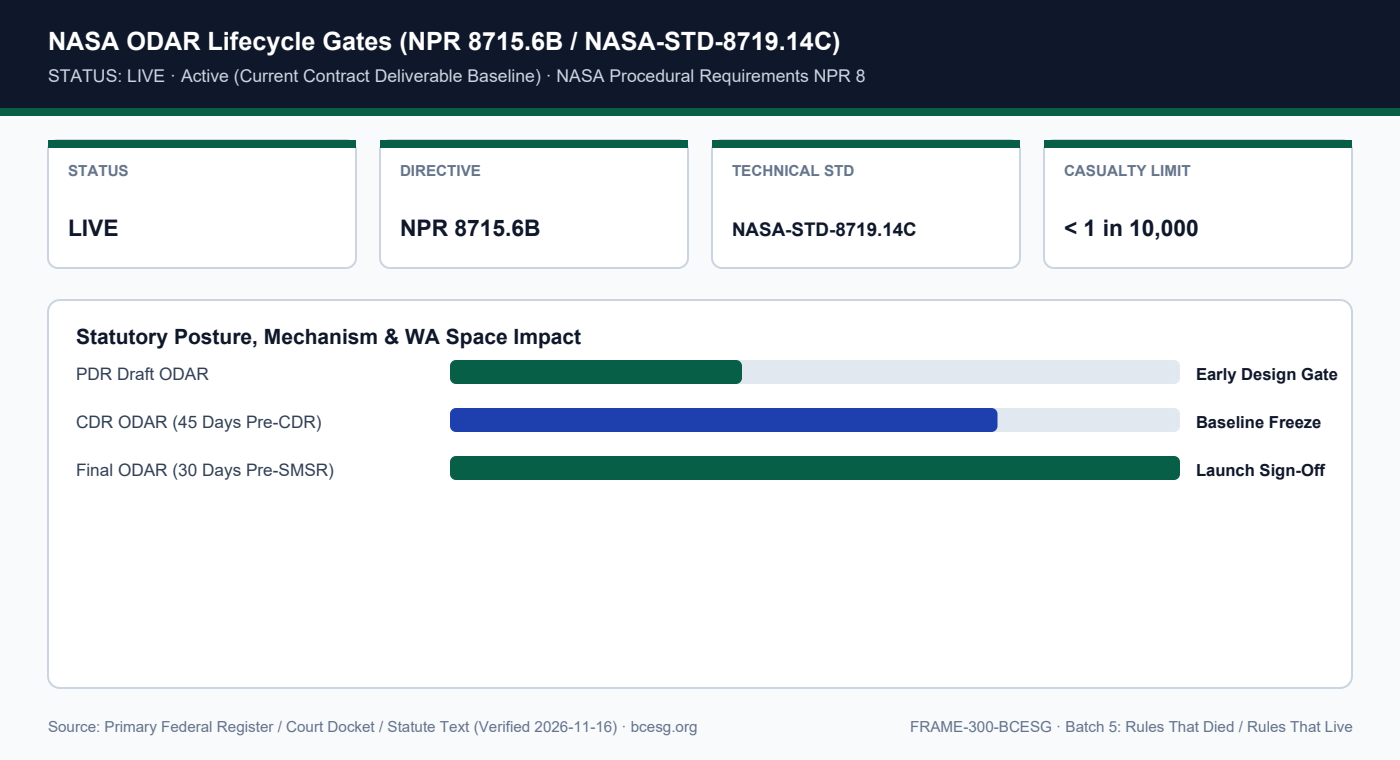
    Verdict & Proof: NASA's Orbital Debris Assessment Report (ODAR) and mitigation standards (NPR 8715.6B / NASA-STD-8719.14C) are LIVE as binding contract deliverables for NASA-sponsored spacecraft, payloads, and launch services—requiring PDR, CDR (45 days pre-CDR), and Final (30 days pre-SMSR) submissions.
    RULE STATUS BRIEF · PDF & MARKDOWN TWIN
    NASA ODAR Standard (LIVE)
    Download the formatted 2-page rule-status brief (PDF) or read the single-source Markdown twin for NASA ODAR Standard (LIVE).
    NASA ODAR Lifecycle Gates (NPR 8715.6B / NASA-STD-8719.14C)

    Who Owes What by When: ODAR Milestones & 7 Technical Gates

    Every commercial contractor building hardware, payloads, or launch vehicles under a NASA contract, Space Act Agreement, or ISS integration order must comply with NPR 8715.6B and format its Orbital Debris Assessment Report (ODAR) under Appendix A of NASA-STD-8719.14C.

    Sequential deliverables are tied to mission reviews: a Draft ODAR at Preliminary Design Review (PDR), an updated CDR ODAR typically 45 days before Critical Design Review, and a Final ODAR 30 days before the Safety and Mission Success Review (SMSR).

    • Human casualty risk expectation (Ec) on reentry must be < 1 in 10,000 (0.0001).
    • End-of-mission passivation (depleting propellant, venting tanks, de-energizing batteries) is mandatory.
    • Uses NASA ORDEM orbital debris and MEM meteoroid models; FAA/FCC licenses govern when those agencies hold primary jurisdiction.
    ODAR GateTimingRequired Deliverable
    Draft ODARPDRInitial debris, passivation & reentry risk screening
    CDR ODAR45 days prior to CDRUpdated baseline config & nonconformance waivers
    Final ODAR30 days prior to SMSRFinal sign-off package for NASA OSMA / ODPO

    Relevance to Washington Space Operators

    Washington firms holding NASA SBIR, CLPS, ISS, or commercial LEO contracts (e.g., Blue Origin, Starfish Space, Gravitics, Portal Space Systems) must flow passivation, demisability, and material-melting data down to component suppliers.

    Related BC ESG Guides & Verified Primary Sources

  • FCC 5-Year Post-Mission Disposal Rule (47 CFR § 25.283(e)): LIVE — Effective Sept 9, 2024 (89 FR 65217)

    FCC 5-Year Post-Mission Disposal Rule (47 CFR § 25.283(e)): LIVE — Effective Sept 9, 2024 (89 FR 65217)

    LIVEFCC 5-Year Post-Mission Orbital Debris Disposal Rule (47 CFR § 25.283(e))
    Deciding Instrument: 89 FR 65217 (FCC 22-74 Second Report and Order; 47 CFR § 25.283(e))  |  Date: September 9, 2024 (Effective) / September 29, 2024 (Compliance)
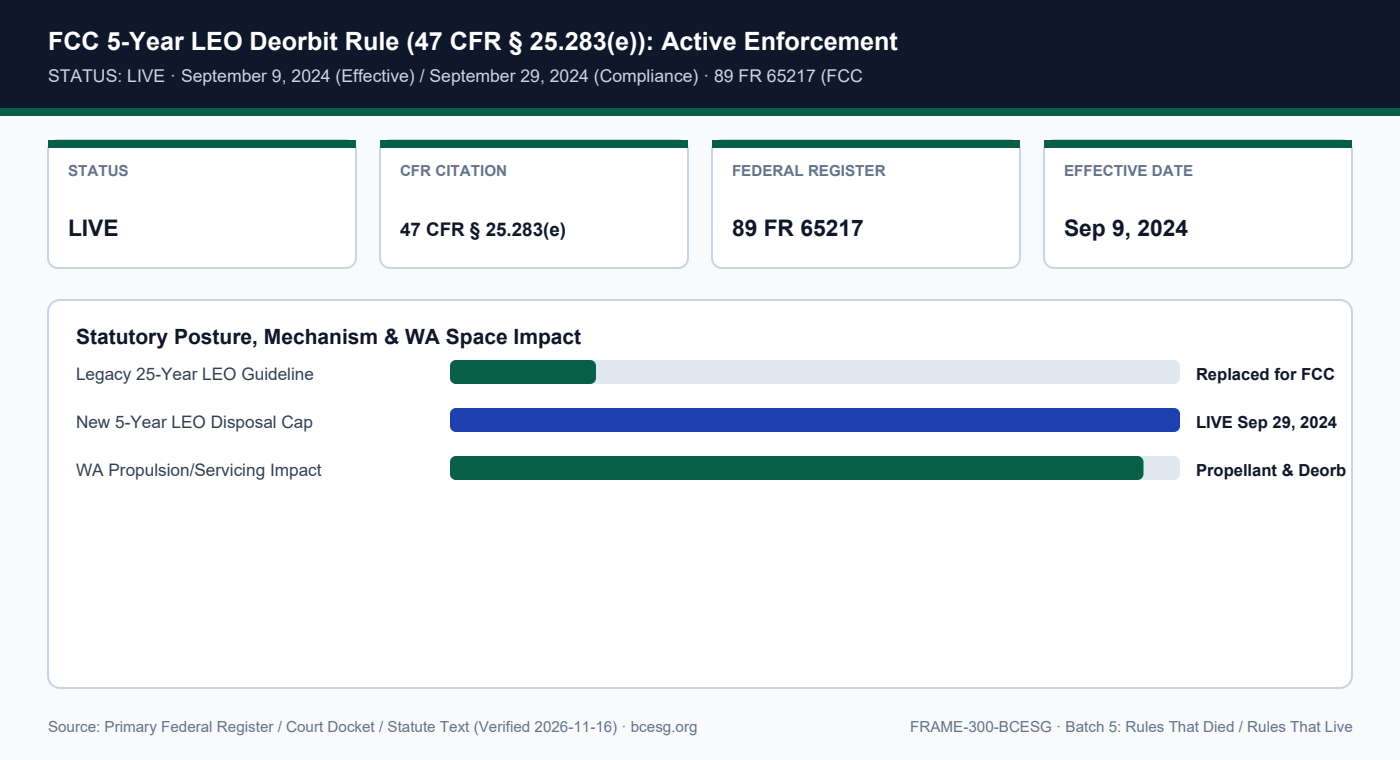
    Verdict & Proof: The FCC 5-year post-mission disposal rule is LIVE. Published August 9, 2024 (89 FR 65217) and codified at 47 CFR § 25.283(e), it took effect September 9, 2024 (compliance date September 29, 2024), replacing the legacy 25-year LEO disposal guideline for FCC-licensed space stations.
    RULE STATUS BRIEF · PDF & MARKDOWN TWIN
    FCC 5-Year Deorbit (LIVE)
    Download the formatted 2-page rule-status brief (PDF) or read the single-source Markdown twin for FCC 5-Year Deorbit (LIVE).
    FCC 5-Year LEO Deorbit Rule (47 CFR § 25.283(e)): Active Enforcement

    Who Owes What by When: 5-Year LEO Disposal & Application Disclosures

    Under 47 CFR § 25.283(e) (89 FR 65217, Aug 9, 2024; implementing FCC 22-74), operators of non-geostationary satellites passing through or operating in LEO (<2,000 km) must dispose of spacecraft via atmospheric reentry as soon as practicable and no later than 5 years after end of mission.

    The rule took effect September 9, 2024, with operational compliance beginning September 29, 2024 (subject to limited grandfathering for pre-existing licensed constellations). Satellite builders in Washington (Amazon Leo, BlackSky, Starfish Space, Gravitics, Portal Space Systems) must embed 5-year deorbit propellant budgets, drag devices, or servicing interfaces into FCC Part 25 / Part 5 / Part 97 applications.

    • Codified at 47 CFR § 25.283(e) (plus §§ 5.64, 25.114, 97.207).
    • 5-year maximum post-mission disposal window in LEO.
    • Directly drives Washington propulsion, thruster, and on-orbit servicing demand.
    ParameterLegacy GuidelineCurrent FCC Rule (47 CFR § 25.283(e))
    Max LEO Post-Mission Lifetime25 years5 years (as soon as practicable)
    Effective / Compliance DatePre-2024 guidanceSep 9, 2024 / Sep 29, 2024 (89 FR 65217)
    Covered LicensesPart 25 / 5 / 97All new FCC-licensed LEO space stations

    Batch 4 vs. Batch 5 Scope

    While Batch 4 covered how satellite primes flow 5-year deorbit requirements down to component and propulsion suppliers, this Batch 5 brief establishes the underlying FCC statutory mandate and effective dates.

    Related BC ESG Guides & Verified Primary Sources

  • CA SB 253 Scope 1+2 (Health & Safety Code § 38532): LIVE — First Reports Due Nov 10, 2026

    CA SB 253 Scope 1+2 (Health & Safety Code § 38532): LIVE — First Reports Due Nov 10, 2026

    LIVECalifornia SB 253 Scope 1 and Scope 2 Emissions Reporting (Cal. Health & Safety Code § 38532)
    Deciding Instrument: Cal. Health & Safety Code § 38532 & 9th Cir. Injunction Denial (No. 25-5327)  |  Date: November 10, 2026 (Initial Scope 1+2 Deadline)
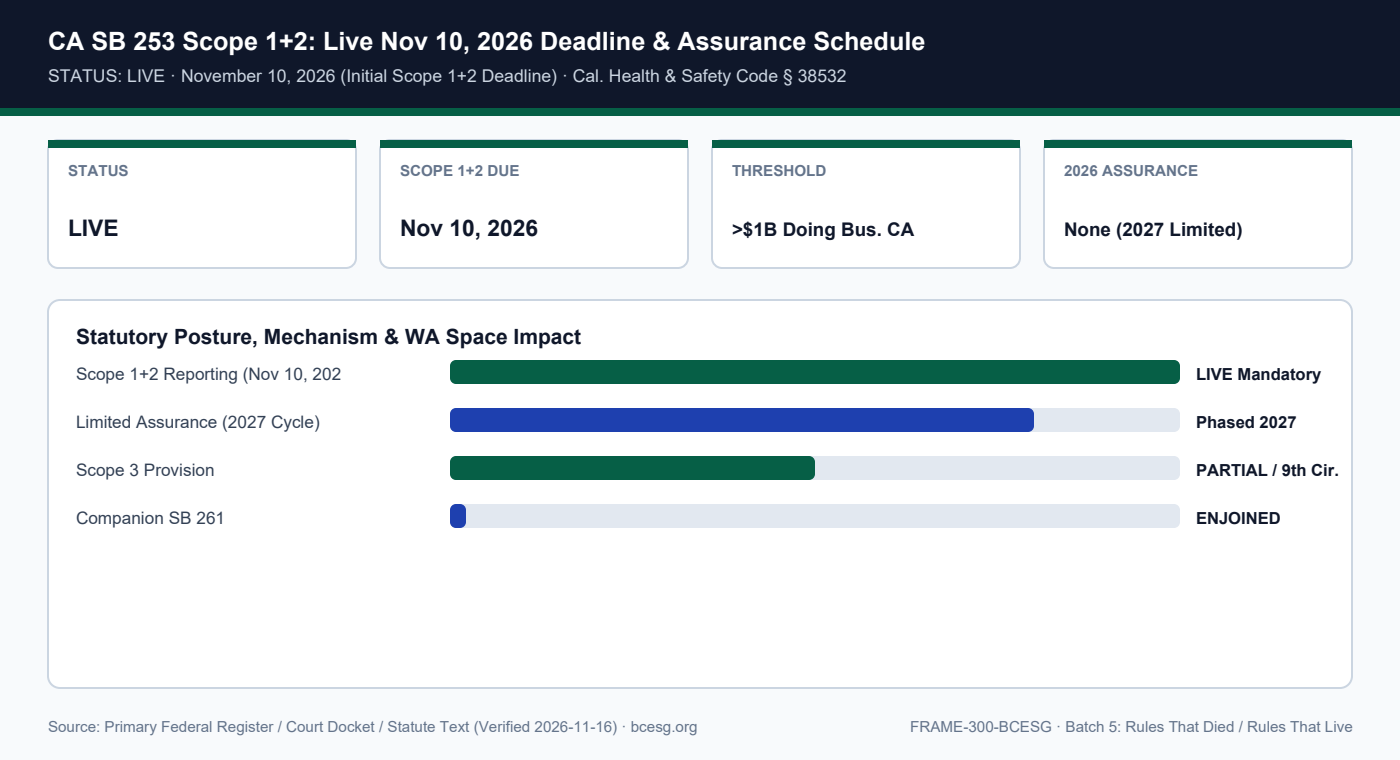
    Verdict & Proof: CA SB 253 Scope 1+2 is LIVE. The Ninth Circuit declined to enjoin SB 253 (No. 25-5327), and CARB's adjusted initial Scope 1+2 reporting deadline fell on November 10, 2026 for US entities with >$1B annual revenue doing business in California (no assurance required in 2026; limited assurance starts 2027).
    RULE STATUS BRIEF · PDF & MARKDOWN TWIN
    CA SB 253 Scope 1+2 (LIVE)
    Download the formatted 2-page rule-status brief (PDF) or read the single-source Markdown twin for CA SB 253 Scope 1+2 (LIVE).
    CA SB 253 Scope 1+2: Live Nov 10, 2026 Deadline & Assurance Schedule

    Who Owes What by When: >$1B CA-Nexus Entities & Nov 10, 2026

    Unlike companion SB 261 (which the Ninth Circuit enjoined on November 18, 2025), SB 253 survived preliminary injunction review. CARB adjusted the original August 10, 2026 filing date to November 10, 2026 for initial prior-fiscal-year Scope 1 (direct) and Scope 2 (purchased electricity/heat) emissions.

    Third-party assurance is not required for the 2026 initial cycle; limited assurance begins in 2027, escalating to reasonable assurance in 2030.

    • Covered entities: US-formed corporations/partnerships with >$1B total annual revenue doing business in California.
    • Initial Scope 1+2 deadline: November 10, 2026.
    • Scope 3 remains contested in the Ninth Circuit and unfinalized for 2027.
    CycleRequirementDeadline / Assurance
    2026 Initial FilingScope 1 + Scope 2 emissionsNov 10, 2026 (no third-party assurance)
    2027 CycleScope 1 + Scope 2 + Limited Assurance2027 (Scope 3 pending 9th Cir. & CARB)
    2030 CycleReasonable Assurance on Scope 1+2Statutory target 2030

    Impact on Washington Space Cluster Suppliers

    While most mid-market Washington aerospace suppliers fall under the $1B revenue threshold, California-headquartered or CA-nexus primes (e.g., SpaceX, Northrop, Lockheed, Rocket Lab, K2 Space) are directly covered and increasingly request utility and energy intensity data from suppliers.

    Related BC ESG Guides & Verified Primary Sources

  • CMMC 2.0 (32 CFR Part 170 / DFARS 252.204-7021): PARTIAL — Phase 1 Live; Phase 2 C3PAO Transition Paused July 2026

    CMMC 2.0 (32 CFR Part 170 / DFARS 252.204-7021): PARTIAL — Phase 1 Live; Phase 2 C3PAO Transition Paused July 2026

    PARTIALCybersecurity Maturity Model Certification (CMMC) 2.0 (32 CFR Part 170 & 48 CFR 252.204-7021)
    Deciding Instrument: 32 CFR Part 170, DFARS 252.204-7021 (Nov 10, 2025) & DoD July 2026 Phase 2 Pause  |  Date: November 10, 2025 / July 2026
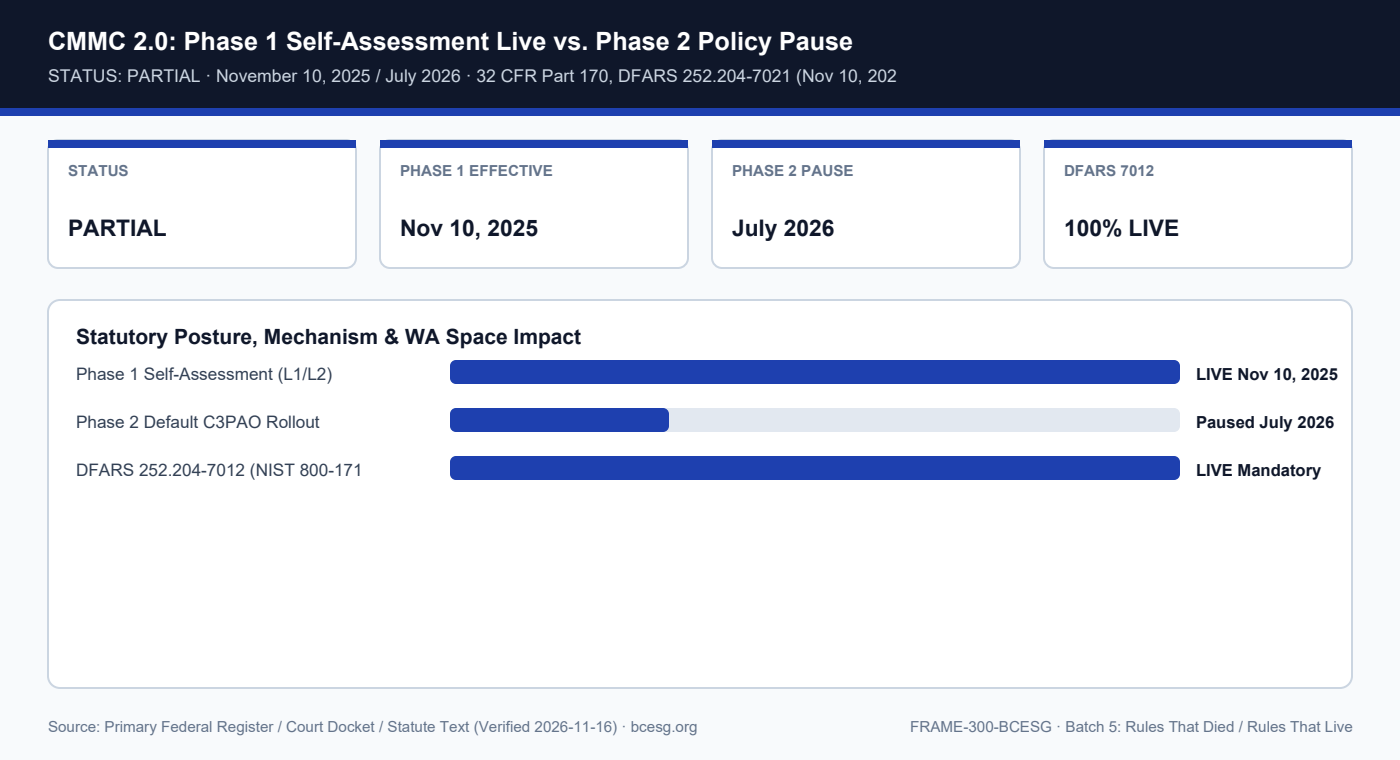
    Verdict & Proof: CMMC 2.0 is PARTIAL. Phase 1 self-assessment requirements took effect November 10, 2025 under DFARS 252.204-7021, but in July 2026 DoD instituted a policy pause on the Phase 2 mandatory C3PAO transition originally slated for November 10, 2026.
    RULE STATUS BRIEF · PDF & MARKDOWN TWIN
    CMMC 2.0 Rollout (PARTIAL)
    Download the formatted 2-page rule-status brief (PDF) or read the single-source Markdown twin for CMMC 2.0 Rollout (PARTIAL).
    CMMC 2.0: Phase 1 Self-Assessment Live vs. Phase 2 Policy Pause

    Phased Posture: Phase 1 Active vs. July 2026 Phase 2 Pause

    CMMC 2.0's program rule (32 CFR Part 170) took effect December 2024, and the DFARS acquisition rule (252.204-7021) took effect November 10, 2025, launching Phase 1 (Level 1 and Level 2 self-assessments in SPRS, plus selective C3PAO certifications at contracting-officer discretion).

    In July 2026, DoD instituted a policy pause on transitioning to Phase 2 (originally scheduled to make third-party C3PAO certification the default on November 10, 2026) pending internal program review. The underlying CFR text remains on the books, and Phase 1 self-assessments plus selective C3PAO clauses remain active.

    • Phase 1 SPRS self-assessments (Level 1 / Level 2) remain enforceable.
    • Phase 2 default C3PAO expansion is paused under DoD's July 2026 policy directive.
    • DFARS 252.204-7012 (NIST SP 800-171) never paused and remains strictly mandatory.
    CMMC / DFARS ElementEffective / Action DateStatus (Nov 16, 2026)
    32 CFR Part 170 & DFARS 252.204-7021Dec 2024 / Nov 10, 2025LIVE (Phase 1 Self-Assessment)
    Phase 2 Default C3PAO TransitionOriginally Nov 10, 2026PAUSED (July 2026 DoD policy pause)
    DFARS 252.204-7012 (NIST 800-171)Active since 2017LIVE — Mandatory for all CUI

    What WA Space Suppliers Owe Today

    Every Washington space supplier handling Federal Contract Information (FCI) or Controlled Unclassified Information (CUI) must maintain current NIST SP 800-171 implementation and SPRS scores under DFARS 252.204-7012 and Phase 1, regardless of the Phase 2 C3PAO transition pause.

    Related BC ESG Guides & Verified Primary Sources

  • EU CSRD Omnibus I (Directive (EU) 2026/470): PARTIAL — Scope Cut ~90% to >1,000 Employees & >€450M

    EU CSRD Omnibus I (Directive (EU) 2026/470): PARTIAL — Scope Cut ~90% to >1,000 Employees & >€450M

    PARTIALEU Corporate Sustainability Reporting Directive (CSRD) as Amended by Omnibus I
    Deciding Instrument: Directive (EU) 2026/470 (OJ L, Feb 26, 2026; in force Mar 18, 2026)  |  Date: March 18, 2026
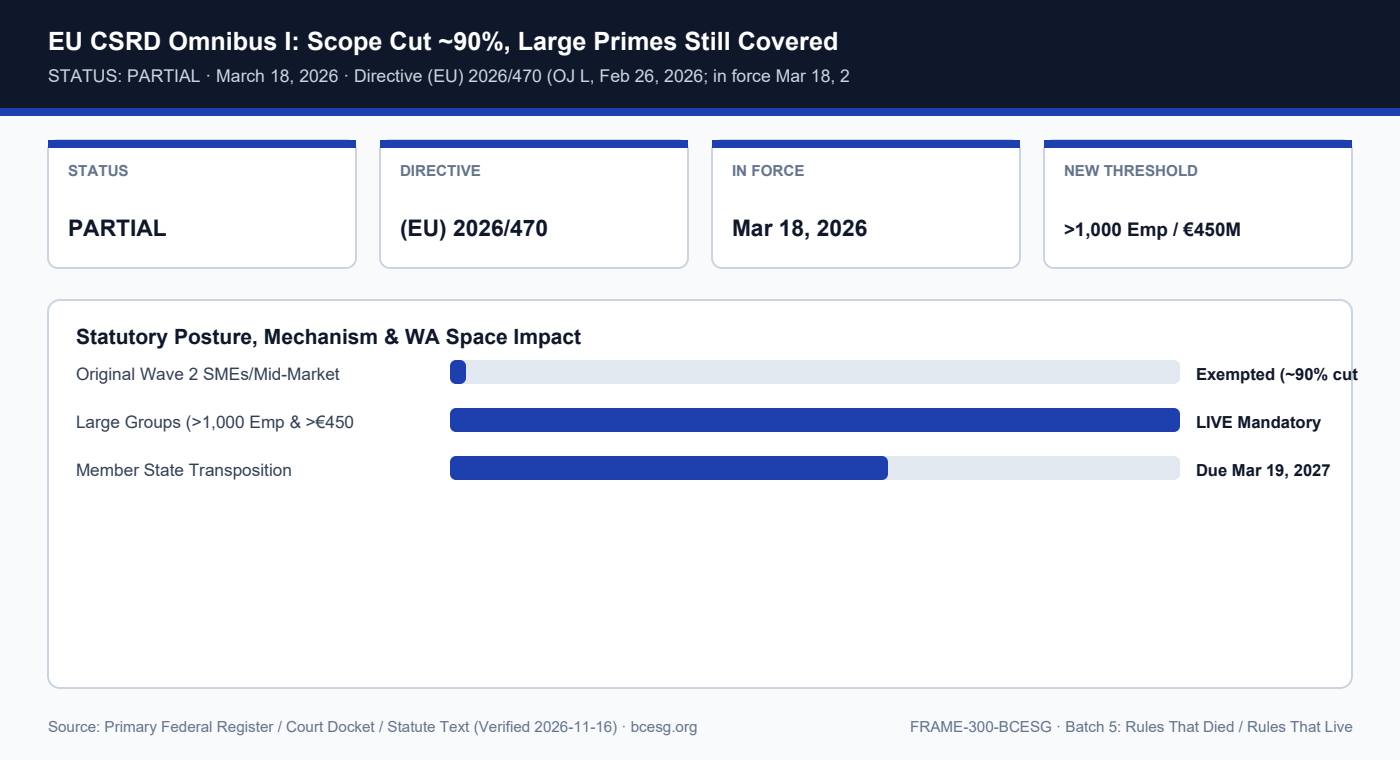
    Verdict & Proof: EU CSRD is PARTIAL / NARROWED. Omnibus I (Directive (EU) 2026/470), in force March 18, 2026, raised mandatory reporting thresholds to >1,000 employees and >€450M net turnover—removing roughly 90% of originally scoped firms while keeping large EU/multinational buyers covered.
    RULE STATUS BRIEF · PDF & MARKDOWN TWIN
    EU CSRD Omnibus (PARTIAL)
    Download the formatted 2-page rule-status brief (PDF) or read the single-source Markdown twin for EU CSRD Omnibus (PARTIAL).
    EU CSRD Omnibus I: Scope Cut ~90%, Large Primes Still Covered

    Mechanism of Narrowing: Directive (EU) 2026/470

    Published in the EU Official Journal on February 26, 2026 and entering into force on March 18, 2026, the EU Omnibus I Directive (Directive (EU) 2026/470) overhauled the original CSRD (2022/2464). It raised the mandatory threshold to companies with more than 1,000 employees and net annual turnover exceeding €450 million, excluding roughly 90% of companies previously in Wave 2/3.

    Member States have until March 19, 2027 to transpose Omnibus I and may exempt newly excluded companies from 2025/2026 filings.

    • Mid-market WA space suppliers with EU subsidiaries below 1,000 employees / €450M are out of direct CSRD scope.
    • Global aerospace primes exceeding the >1,000-employee / >€450M bar remain in scope and still request supplier data.
    • Separate EU CBAM financial liability began January 1, 2026.
    CSRD TierPre-Omnibus ScopePost-Omnibus I ((EU) 2026/470)
    Mid-Market EU Subsidiaries (250–999 emp)Mandatory Wave 2 (FY25/26)DEAD / Exempted under Omnibus I
    Large Groups (>1,000 emp & >€450M)MandatoryLIVE — Reporting continues
    Non-EU Parent Ultimate Threshold€150M EU turnoverRaised & narrowed under Omnibus I

    What Remains Live for WA Space Suppliers

    Direct CSRD filing is dead for mid-market WA space firms, but indirect Scope 3 and product-substance asks from Airbus, Thales, ESA-prime contractors, and US multinationals meeting the €450M EU threshold remain live.

    Related BC ESG Guides & Verified Primary Sources

BC ESG

ESG Strategy, Sustainability Intelligence, and Business Continuity for Forward-Thinking Organizations

© 2026 BC ESG — Business Continuity, ESG & Sustainability Intelligence