Who Owes What by When: Parallel Safety & Environmental Tracks
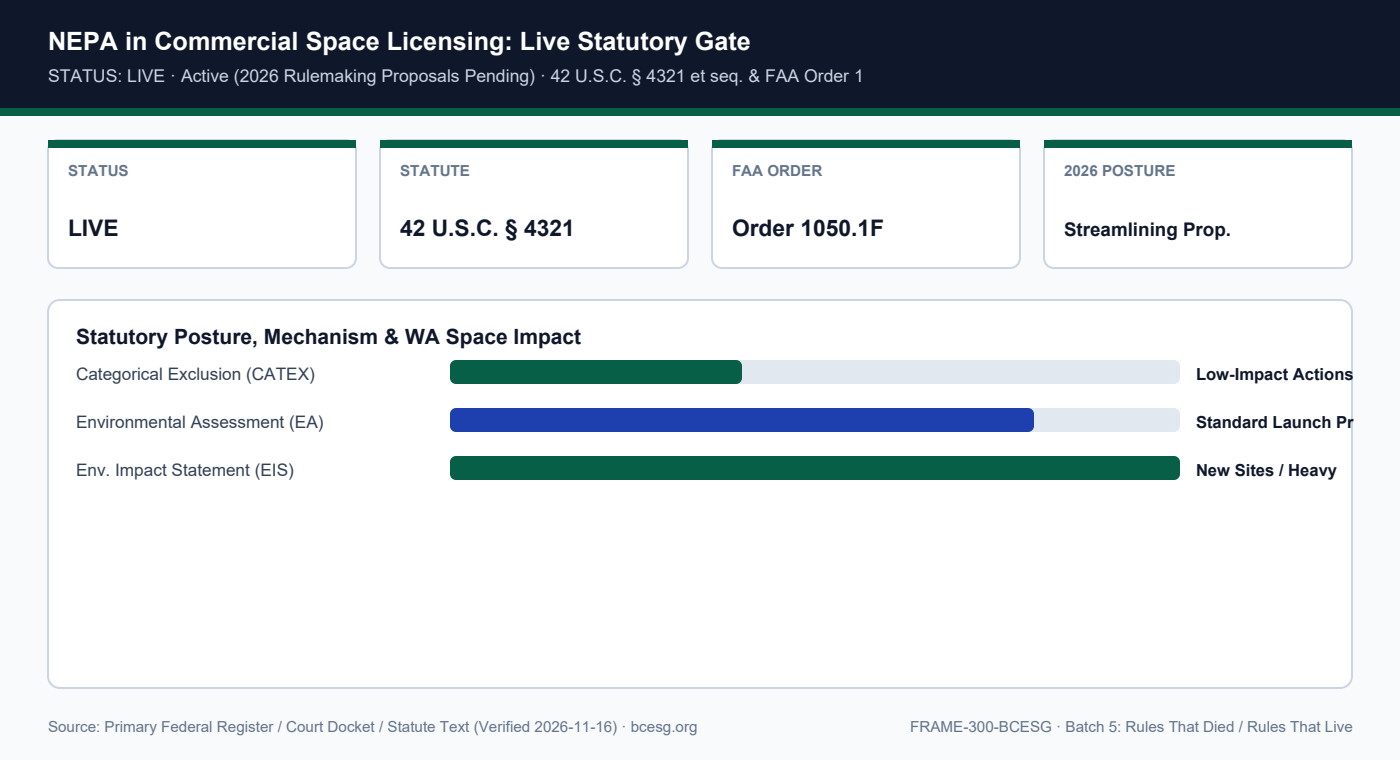
Obtaining an FAA Part 450 Vehicle Operator License or Part 420 Launch Site Operator License triggers federal NEPA compliance under 42 U.S.C. § 4321 and FAA Order 1050.1F. Applicants must fund and supply technical data for a Categorical Exclusion (CATEX), Environmental Assessment (EA), or Environmental Impact Statement (EIS) covering noise, sonic booms, water quality, endangered species, and hazardous propellants.
While mid-2026 executive-directed FAA proposals aim to truncate review timelines and create targeted waiver pathways, NEPA remains an active statutory prerequisite for launch licensing.
- Applies to FAA Part 450 launch licenses and Part 420 spaceport licenses.
- Covers acoustic/sonic boom footprints, propellant spills, and biological consultations.
- Separate from Washington State SEPA (RCW 43.21C) for in-state ground test stands.
| NEPA Pathway | Trigger | Status (Nov 16, 2026) |
|---|---|---|
| CATEX | Routine / de minimis federal action | LIVE (FAA Order 1050.1F) |
| Environmental Assessment (EA) | New vehicle or cadence increase | LIVE (Required before license) |
| EIS | Major new launch site / heavy-lift impact | LIVE (Multi-year review) |
Washington Angle: Ground Test vs. Downrange Launch
Washington space companies testing engines in Kent, Redmond, or Moses Lake trigger state/local SEPA, while their orbital launches from Cape Canaveral, Vandenberg, or Wallops trigger federal FAA NEPA.