Tag: Facility Manager

  • Los Angeles EBEWE Guide: June 1 Benchmarking & 5-Year Audits/RCx (Ord. 184674)

    Los Angeles EBEWE Guide: June 1 Benchmarking & 5-Year Audits/RCx (Ord. 184674)

    Short answer: Under Los Angeles Municipal Code Division 97 (Ord. 184674 — EBEWE), owners of private commercial and multifamily buildings >=20,000 sq ft owe two intertwined filings to the LA Department of Building and Safety (LADBS): annual June 1 benchmarking of whole-building energy and water usage, plus a repeating 5-year Energy and Water Audit & Retro-Commissioning (A/RCx) cycle assigned by the final digit of the property’s County Assessor ID Number (AIN).

    Many portfolio teams mistakenly treat California’s statewide June 1 disclosure law (California AB 802, which starts at >50,000 sq ft and requires benchmarking only) as sufficient in Los Angeles. It is not: LA enforces a 20,000 sq ft threshold, requires water benchmarking, mandates LADBS portal submissions and processing fees, and enforces 5-year technical audits and retro-commissioning on a rolling 10-digit Assessor ID calendar.

    Statutory Status at a Glance
    • Covered Thresholds: Private commercial & multifamily buildings >=20,000 sq ft; City-owned facilities >=7,500 sq ft.
    • June 1 Annual Benchmarking: Whole-building electricity, gas, and LADWP water data uploaded to ENERGY STAR Portfolio Manager and submitted directly to LADBS EBEWE alongside a city administrative filing.
    • Assessor-ID 5-Year A/RCx Rotation: Each property’s County AIN ending digit (0–9) determines its repeating five-year window for ASHRAE Level II energy audits, water audits, and building retro-commissioning.
    • Audit Exemptions: Earning ENERGY STAR >=75 (for energy exemption), Water Score / conservation criteria, or verifiable 15% EUI reduction over 5 years waives expensive field audits when filed cleanly inside your cycle window.
    Print-First Compliance Brief

    Download the Los Angeles EBEWE & Audit Cycle Guide

    2-page Print-First PDF organizing LA’s >=20k sq ft June 1 benchmarking, Assessor-ID 5-year energy/water audit/RCx schedule, and CA AB 802 overlap.

    Synchronizing LADWP Meter Feeds, AIN Digits & California AB 802

    Because Los Angeles Department of Water and Power (LADWP) serves both electricity and municipal water across most of the City (alongside SoCalGas for natural gas), owners should enable automated Portfolio Manager utility web services before April so a single clean June 1 Portfolio Manager sync feeds both LADBS EBEWE and CEC AB 802.

    Do not wait until the final year of your 5-year A/RCx window to inspect ENERGY STAR scores: maintaining a score >=75 requires multi-month operational tuning and clean space-use attributes inside Portfolio Manager well ahead of filing exemptions.

    • Check Both Energy & Water Triggers: Remember that EBEWE covers water efficiency audits/RCx separately from energy exemptions — verify both tracks prior to submitting to LADBS.
    • Verify AIN Digit Calendar: Confirm parcel-level Assessor ID last digits across multi-parcel retail strips or campus assets.
    EBEWE TrackCovered ScopeSchedule / TriggerExemptions & Portal
    Annual BenchmarkingPrivate >=20k sf; City >=7.5k sfAnnual June 1 (PM + LADBS fee)LADWP/SoCalGas auto-sync; feeds AB 802
    5-Yr Energy & Water A/RCxPrivate >=20k sfRepeating 5-yr cycle via AIN digitESTAR >=75, LEED, or 15% verified drop
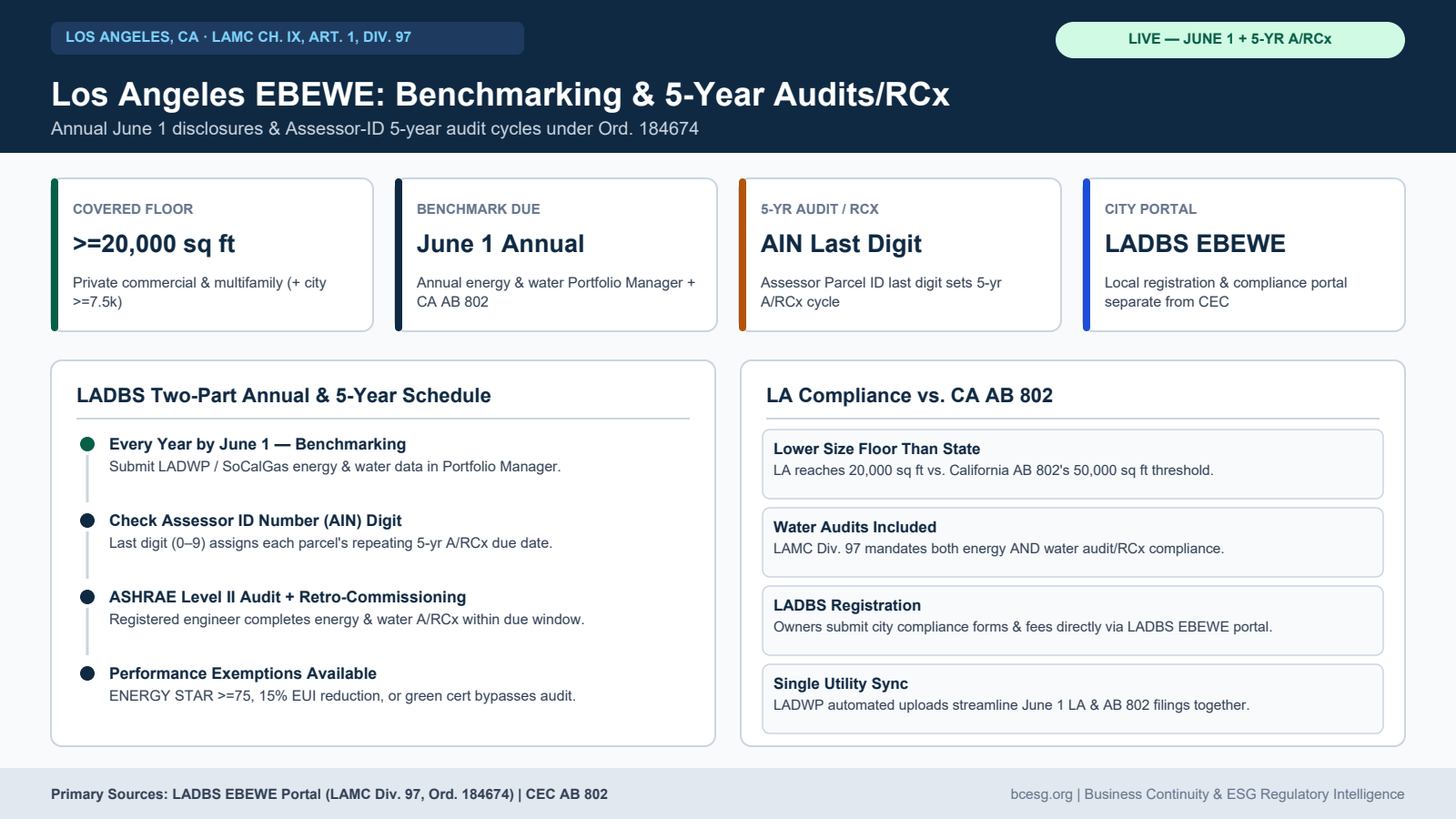
    Diagram showing Los Angeles EBEWE LAMC Div. 97 rules: >=20,000 sq ft June 1 benchmarking, Assessor Parcel ID 5-year audit/RCx rotation, and ENERGY STAR >=75 exemptions.
    Los Angeles EBEWE (LAMC Div. 97 / Ord. 184674): annual June 1 disclosures plus Assessor-ID 5-year energy and water audit/retro-commissioning cycles.

    Compliance Execution Checklist

    StepOwner / TeamAuditable Deliverable
    1. AIN Digit & Tier AuditAsset OperationsPull LA County Assessor ID last digit for every building >=20,000 sq ft.
    2. June 1 LADBS + AB 802Property ManagerUpload LADWP/SoCalGas electric, gas & water data and pay LADBS registration.
    3. A/RCx vs. ExemptionQualified PE / CEMVerify ENERGY STAR >=75 exemption or launch Level II A/RCx ahead of cycle end.
    Field & Print Package

    Keep This Los Angeles, CA Compliance Checklist Handy

    Download the formatted 2-page PDF reference brief or pull the structured Markdown edition for internal compliance documentation.

    Frequently Asked Questions

    How does Los Angeles EBEWE differ from California AB 802?

    California AB 802 mandates annual benchmarking only at >50,000 sq ft, whereas LA EBEWE applies starting at >=20,000 sq ft, requires water benchmarking and LADBS portal registration, and adds repeating 5-year energy/water audits and retro-commissioning.

    How do I know when my 5-year LA EBEWE audit/RCx is due?

    LADBS schedules five-year Audit & Retro-Commissioning due dates based on the final digit (0–9) of each covered property's Los Angeles County Assessor Identification Number (AIN).

    Primary Authorities & Official Resources

    Informational notice: This guide summarizes enacted statutes, regulations, or pending legislative records from the primary authorities linked above as of November 14, 2026. It is not legal, accounting, or licensed engineering advice.
  • Atlanta CBEEO & Orlando BEWES: Sunbelt Benchmarking & Audit Guide (2026)

    Atlanta CBEEO & Orlando BEWES: Sunbelt Benchmarking & Audit Guide (2026)

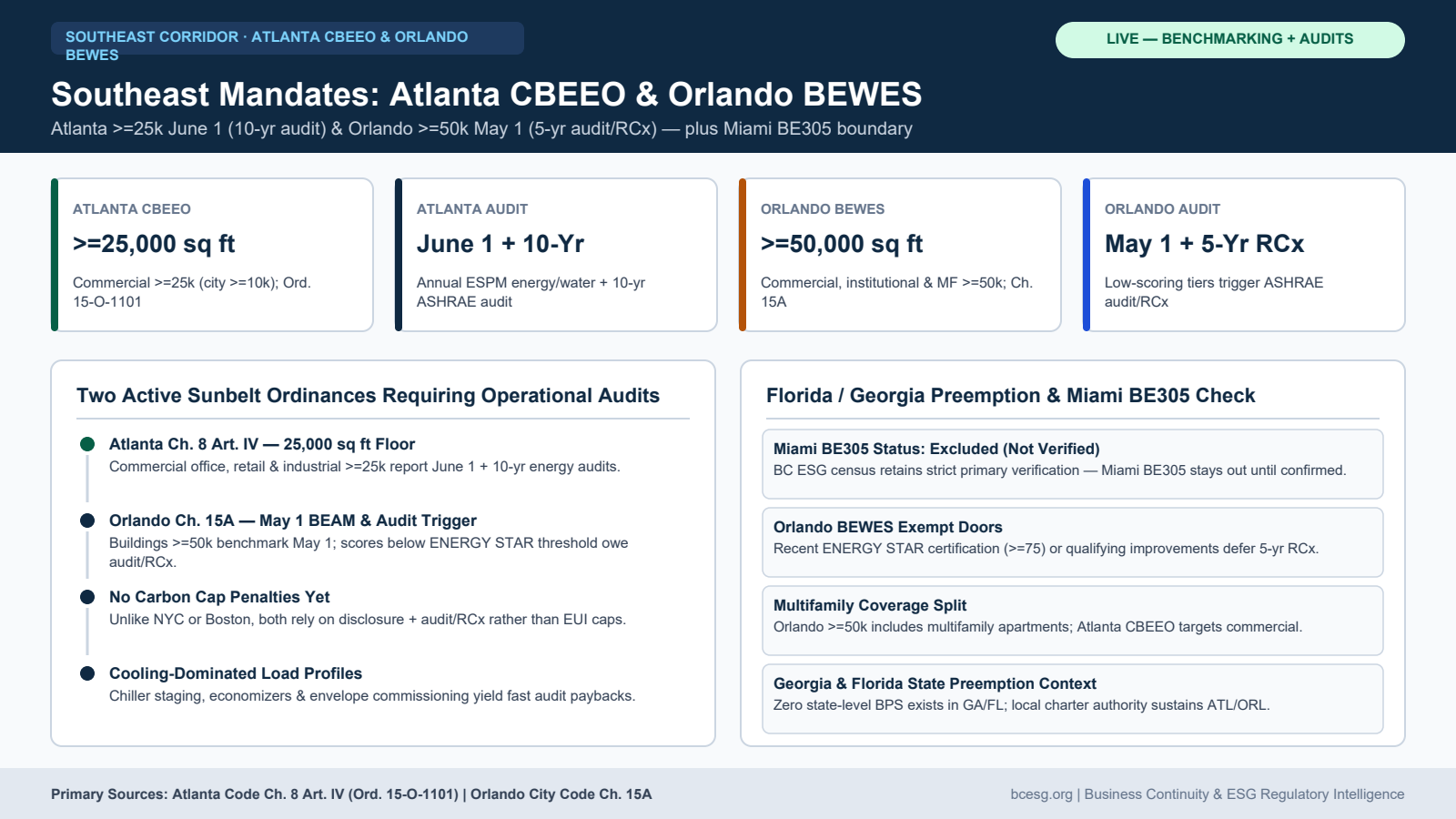
    Short answer: Real estate compliance in the Southeast is concentrated inside two verified municipal ordinances carrying both annual disclosure and periodic audit obligations: Atlanta’s Commercial Buildings Energy Efficiency Ordinance (CBEEO, City Code Ch. 8, Art. IV) due every June 1 (>=25,000 sq ft commercial), and Orlando’s Building Energy and Water Efficiency Strategy (BEWES, City Code Ch. 15A) due every May 1 (>=50,000 sq ft commercial, institutional, and multifamily).

    Neither ordinance imposes coastal carbon-tax caps like NYC LL97, yet neither stops at passive benchmarking: Atlanta mandates repeating 10-year ASHRAE energy audits or retro-commissioning, while Orlando triggers 5-year audit/RCx requirements specifically when low ENERGY STAR scores fall beneath city thresholds. Note that other Sunbelt proposals outside our primary-source verified threshold — including Miami’s BE305 — remain excluded from live mandatory status pending verification.

    Statutory Status at a Glance
    • Atlanta CBEEO (Ch. 8, Art. IV — June 1): Applies to commercial buildings >=25,000 sq ft under the Mayor’s Office of Resilience; mandates annual Portfolio Manager energy/water submissions plus 10-year energy audit / RCx cycles.
    • Orlando BEWES (Ch. 15A — May 1): Applies to commercial, institutional, and multifamily properties >=50,000 sq ft under Orlando Green Works via Portfolio Manager / BEAM, triggering 5-year audits/RCx for properties scoring below benchmarks unless exempted.
    • Audit Escape Hatches: High ENERGY STAR ratings, recent LEED certifications, or verified energy improvements commonly satisfy periodic audit mandates without full field expenses — check property-level exemptions prior to due years.
    • Zero State Law Overlay: Because Georgia and Florida carry no statewide private benchmarking mandates, municipal compliance begins and ends with Atlanta and Orlando city limits in this regional census.
    Print-First Compliance Brief

    Download the Atlanta & Orlando Sunbelt Compliance Guide

    2-page Print-First PDF detailing Atlanta CBEEO (>=25k sf, June 1) and Orlando BEWES (>=50k sf, May 1) benchmarking and audit/retro-commissioning rules.

    Managing Audit Triggers Across Two Sunbelt Utility Markets

    Whereas Atlanta reaches smaller commercial buildings starting at 25,000 sq ft regardless of current ENERGY STAR performance on a 10-year rotation, Orlando’s 50,000 sq ft BEWES ordinance covers multifamily properties alongside offices and ties 5-year ASHRAE audits/retro-commissioning directly to low benchmarking performance — creating a direct operational incentive to cure metering anomalies or poor ENERGY STAR inputs before score issuance.

    Utility data integration with Georgia Power and OUC (Orlando Utilities Commission) should start by March ahead of Orlando’s May 1 deadline so portfolio managers catch missing tenant accounts well ahead of Atlanta’s June 1 close.

    • Commercial vs. Multifamily Split: Atlanta CBEEO excludes purely residential multifamily properties; Orlando BEWES covers multifamily buildings >=50,000 sq ft.
    • Verify Exclusion vs. Live Scope: Keep Miami BE305 flagged as unverified/excluded rather than bundling speculative local proposals into Sunbelt capital plans.
    Ordinance & CodeCovered ScopeAnnual FilingAudit / RCx Mandate
    Atlanta CBEEO (Ch. 8 Art. IV)Commercial >=25,000 sq ftJune 1 (ENERGY STAR PM)Mandatory 10-year energy audit / RCx cycle
    Orlando BEWES (Ch. 15A)Commercial, inst & multifamily >=50,000 sq ftMay 1 (PM / BEAM)5-year audit/RCx triggered for low-scoring assets
    Comparison of Atlanta CBEEO (Code Ch. 8 Art. IV, >=25k sq ft June 1 + 10-yr audit) and Orlando BEWES (Ch. 15A, >=50k sq ft May 1 + 5-yr audit triggers).
    Sunbelt commercial building ordinances: Atlanta CBEEO's >=25k sq ft 10-year audit rule vs. Orlando BEWES's >=50k sq ft 5-year low-score audit trigger.

    Compliance Execution Checklist

    StepOwner / TeamAuditable Deliverable
    1. March OUC / GA Power PullProperty OpsRequest aggregated whole-building utility accounts before May 1 / June 1 deadlines.
    2. Score & Audit TriageEnergy EngineeringCheck Orlando BEWES scores against audit exemptions and verify Atlanta 10-yr due dates.
    3. Municipal ConfirmationsCompliance RecordsArchive BEAM / City of Atlanta submission confirmations per parcel ID.
    Field & Print Package

    Keep This Atlanta, GA & Orlando, FL Compliance Checklist Handy

    Download the formatted 2-page PDF reference brief or pull the structured Markdown edition for internal compliance documentation.

    Frequently Asked Questions

    Do Atlanta CBEEO and Orlando BEWES cover multifamily residential buildings?

    Orlando BEWES (Ch. 15A) covers multifamily buildings >=50,000 sq ft alongside commercial properties, whereas Atlanta CBEEO (Ch. 8, Art. IV) applies to commercial buildings >=25,000 sq ft only.

    Does Orlando BEWES require an energy audit for every covered building?

    No. Orlando triggers 5-year audit/retro-commissioning duties primarily for low-scoring properties falling below BEWES performance benchmarks, while high-performing or LEED/ENERGY STAR certified assets qualify for exemptions.

    Primary Authorities & Official Resources

    Informational notice: This guide summarizes enacted statutes, regulations, or pending legislative records from the primary authorities linked above as of November 14, 2026. It is not legal, accounting, or licensed engineering advice.

  • Pittsburgh & Columbus Building Energy Benchmarking Guide: Shared June 1 Deadline

    Pittsburgh & Columbus Building Energy Benchmarking Guide: Shared June 1 Deadline

    Short answer: Regional Midwest and Appalachian real estate portfolios share a convenient calendar anchor on June 1: both Pittsburgh (Code Ch. 633) and Columbus (City Code Ch. 4118) enforce active >=50,000 sq ft whole-building energy and water benchmarking via EPA’s ENERGY STAR Portfolio Manager on the exact same date.

    The operational trap lies in residential coverage: Pittsburgh Ch. 633 applies exclusively to non-residential buildings >=50,000 sq ft (skipping purely residential apartments), whereas Columbus Ch. 4118 covers both commercial and multifamily buildings >=50,000 sq ft. Compare Pittsburgh’s light-touch transparency reporting with statewide peer Philadelphia’s June 30 benchmarking + 5-year BEPP tune-up rules.

    Statutory Status at a Glance
    • Pittsburgh, PA (Ch. 633 — Non-Residential >=50k sq ft): Administered by Pittsburgh Dept. of City Planning; annual June 1 whole-building electricity, fuel, and water reporting for private non-residential parcels >=50,000 sq ft.
    • Columbus, OH (Ch. 4118 — Commercial & Multifamily >=50k sq ft): Administered by Columbus Dept. of Building and Zoning Services; annual June 1 energy/water benchmarking covering commercial, institutional, and apartment properties >=50,000 sq ft.
    • Shared Utility Setup: Duquesne Light, Peoples Gas, and PWSA (Pittsburgh) vs. AEP Ohio, Columbia Gas, and Columbus Public Utilities operate different multi-tenant whole-building data workflows requiring early spring requests.
    • Disclosure Only: Neither city currently mandates energy audits, retro-commissioning, or building emissions caps.
    Print-First Compliance Brief

    Download the Pittsburgh & Columbus June 1 Benchmarking Sheet

    2-page Print-First PDF contrasting Pittsburgh Ch. 633 (non-residential only) and Columbus Ch. 4118 (commercial + multifamily) for shared June 1 filings.

    Executing Unified June 1 Filings Across PA & OH Portfolios

    For REITs and regional property managers with both Ohio Valley offices and Columbus multifamily complexes, treating June 1 as a single utility-aggregation sprint eliminates late data exceptions. Request whole-building aggregate meters in April, double-check gross floor area excluding parking garages per ENERGY STAR guidance, and retain confirmation screenshots from each municipal submission template.

    Because Ohio prohibits no municipal benchmarking despite lacking a state-level building statute, Columbus remains Ohio’s sole active local benchmarking jurisdiction while Pennsylvania separates Philadelphia’s active RCx law from Pittsburgh’s benchmarking-only ordinance.

    • Verify Mixed-Use Triggers in Pittsburgh: Mixed-use assets containing >=50,000 sq ft of non-residential floor area remain subject to Ch. 633 even with residential upper floors.
    • Columbus 25k City Exception: Municipal Columbus properties enter benchmarking down at 25,000 sq ft, whereas private commercial and multifamily buildings start at 50,000 sq ft.
    City & CodeCovered Private ThresholdAnnual Due DateMultifamily Included?
    Pittsburgh, PA (Ch. 633)Non-residential >=50,000 sq ftJune 1 (Energy & water PM)NO — commercial/non-residential only
    Columbus, OH (Ch. 4118)Commercial & multifamily >=50,000 sq ftJune 1 (Energy & water PM)YES — private multifamily >=50k covered
    Side-by-side comparison of Pittsburgh Ch. 633 (Non-residential >=50,000 sq ft) and Columbus Ch. 4118 (Commercial & multifamily >=50,000 sq ft) June 1 Portfolio Manager rules.
    Rust Belt / Appalachian gateway benchmarking: shared June 1 ENERGY STAR Portfolio Manager due dates with critical multifamily vs. non-residential coverage differences.

    Compliance Execution Checklist

    StepOwner / TeamAuditable Deliverable
    1. April Meter PullProperty OpsGather Duquesne/PWSA (Pittsburgh) and AEP/Columbia Gas (Columbus) aggregate feeds.
    2. Portfolio ClassificationAsset ManagementSeparate Pittsburgh non-residential >=50k sf from exempt multifamily parcels.
    3. June 1 Municipal ShareCompliance LeadSubmit City-specific Portfolio Manager reporting links and archive compliance receipts.
    Field & Print Package

    Keep This Pittsburgh, PA & Columbus, OH Compliance Checklist Handy

    Download the formatted 2-page PDF reference brief or pull the structured Markdown edition for internal compliance documentation.

    Frequently Asked Questions

    Do multifamily apartment buildings >=50,000 sq ft have to file benchmarking in Pittsburgh?

    No. Pittsburgh Code Ch. 633 applies strictly to non-residential buildings >=50,000 sq ft, unlike Columbus Ch. 4118 which explicitly covers both commercial and multifamily properties >=50,000 sq ft.

    Are energy and water utilities both included in Pittsburgh and Columbus benchmarking?

    Yes. Both cities require whole-building electricity, heating fuels, and water consumption submitted through ENERGY STAR Portfolio Manager by June 1 annually.

    Primary Authorities & Official Resources

    Informational notice: This guide summarizes enacted statutes, regulations, or pending legislative records from the primary authorities linked above as of November 14, 2026. It is not legal, accounting, or licensed engineering advice.
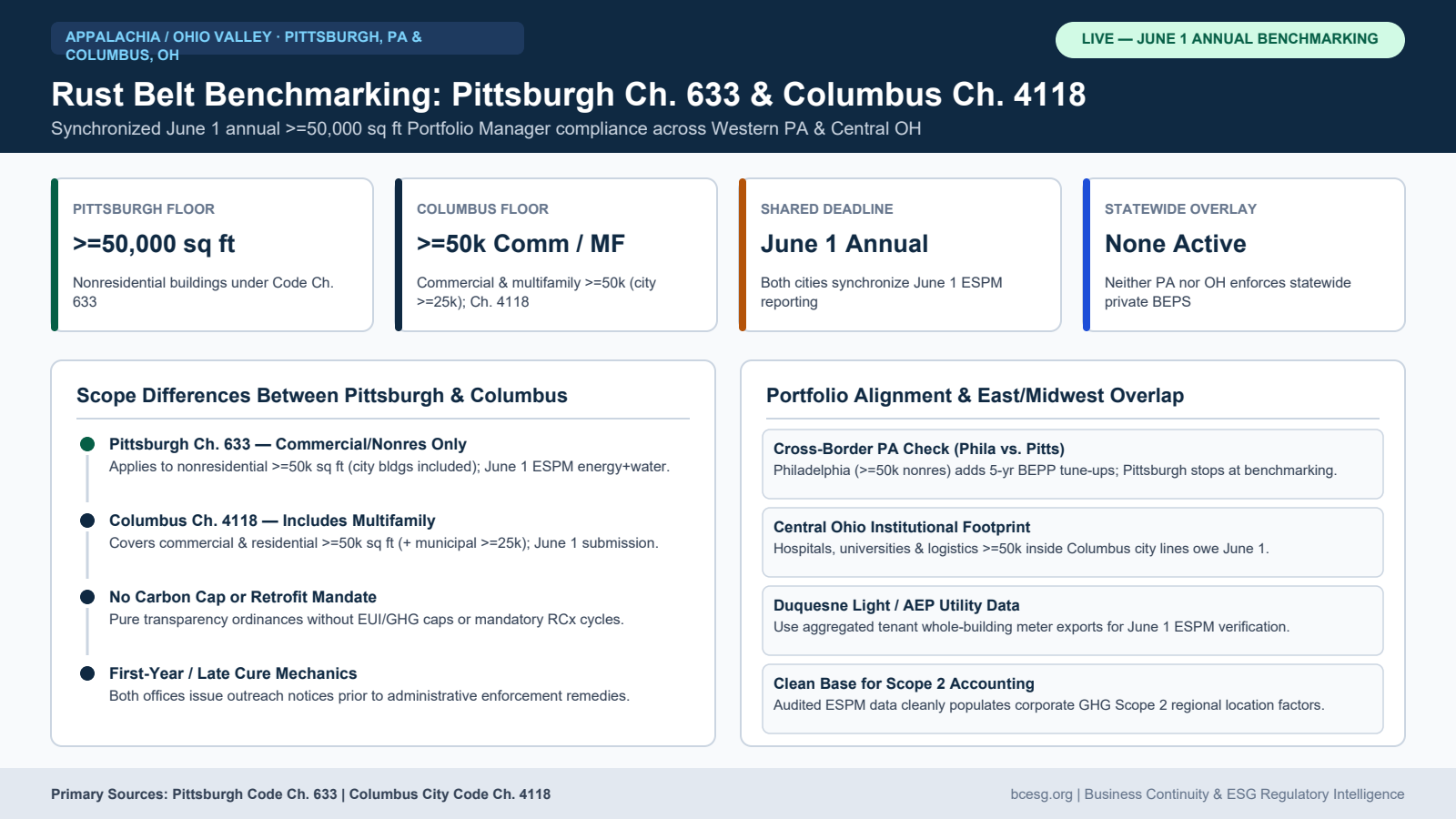
  • Philadelphia BEPP Guide: 5-Year Tune-Ups (NOT a Carbon Cap) & June 30 Benchmarking

    Philadelphia BEPP Guide: 5-Year Tune-Ups (NOT a Carbon Cap) & June 30 Benchmarking

    Short answer: Multi-market compliance teams routinely misread Philadelphia as another numeric emissions-cap city like New York or Washington, DC. In reality, Philadelphia’s Building Energy Performance Program (BEPP, Phila. Code § 9-3403 / Ord. 190600) is a mandatory 5-year operational tune-up (retro-commissioning) requirement — not a numeric EUI cap or carbon price — running alongside annual June 30 benchmarking under Phila. Code § 9-3402.

    Just as important is coverage separation: commercial and multifamily buildings >=50,000 sq ft must file annual June 30 Portfolio Manager benchmarking, whereas only non-residential buildings >=50,000 sq ft fall under 5-year BEPP tune-up cycles (multifamily is excluded from BEPP). Compare this tune-up architecture against numeric cap statutes like NYC LL97, DC BEPS, or regional peer Pittsburgh Benchmarking.

    Statutory Status at a Glance
    • Code § 9-3402 (Annual Benchmarking — June 30): Commercial and multifamily properties >=50,000 sq ft (plus municipal properties >=10,000 sq ft) report via ENERGY STAR Portfolio Manager + $100 annual administrative fee.
    • Code § 9-3403 (BEPP 5-Year Tune-Ups — Sept 30 / Oct Cycles): Non-residential buildings >=50,000 sq ft (staggered across 200k+, 100k–200k, 70k–100k, and 50k–70k sq ft cohorts entering repeating 5-year cycles) must engage a Qualified Tune-Up Specialist.
    • High-Performance Exemptions: Buildings earning ENERGY STAR score >=75, LEED O+M Gold or Platinum, Net-Zero Energy certification, recent major energy code renovation, or 15% site-EUI reduction file a simple exemption instead of a field tune-up.
    • Penalties & 180-Day Repairs: Specialists inspect base-building HVAC, lighting controls, domestic hot water, and envelope seals; low/no-cost operational corrections must be completed within 180 days/prior to submission, or owners risk $2,000 initial + $500/day after 30 days.
    Print-First Compliance Brief

    Download the Philadelphia BEPP & Benchmarking Compliance Guide

    2-page Print-First PDF separating Philadelphia’s June 30 benchmarking (§ 9-3402) from its 5-year BEPP non-residential tune-up mandate (§ 9-3403).

    Inside a Qualifying BEPP Tune-Up vs. High-Performance Exemption Doors

    Under Philadelphia Office of Sustainability rules, a BEPP submission must be signed by a Qualified Tune-Up Specialist holding eligible PE, CEM, CEA, BEAP, or certified commissioning credentials. The scope focuses on practical operational waste — failed economizers, simultaneous heating and cooling, misaligned occupancy schedules, defective steam traps, or malfunctioning lighting sensors — rather than forcing full capital boiler replacement.

    Wait too late to review your June 30 Portfolio Manager scores, however, and you miss the easiest compliance exit: properties reaching an ENERGY STAR rating of 75 or higher on their benchmarking submission can file an exemption application, bypassing field RCx expense entirely for that five-year cycle.

    • Multifamily Clarification: Purely residential multifamily towers >=50,000 sq ft still pay the $100 annual fee and file June 30 benchmarking under § 9-3402, but do NOT owe § 9-3403 BEPP tune-ups.
    • Mixed-Use Space Allocation: Buildings containing >=50,000 sq ft of strictly non-residential floor area fall inside BEPP even when sitting beneath residential floors.
    Provision & CitationCovered ThresholdDeadline / CadenceCompliance Standard & Penalty
    Benchmarking (§ 9-3402)Commercial & multifamily >=50k sf (+ city >=10k)Annual June 30 (+ $100 fee)ENERGY STAR PM filing; $300 initial + $100/day
    BEPP Tune-Up (§ 9-3403)Non-residential >=50k sf ONLY (no multifamily)5-year repeating cohort cycles (Sept 30)RCx tune-up OR ESTAR >=75 exempt; $2,000 + $500/day
    Compliance architecture of Philadelphia Code §§ 9-3402 and 9-3403 explaining 5-year HVAC/lighting/envelope RCx tune-ups, June 30 benchmarking, ENERGY STAR >=75 exemptions, and why BEPP is NOT a carbon cap.
    Philadelphia's dual building mandate under Code §§ 9-3402 & 9-3403: June 30 benchmarking plus 5-year RCx tune-ups — distinct from numeric GHG/EUI cap BEPS laws.

    Compliance Execution Checklist

    StepOwner / TeamAuditable Deliverable
    1. June 30 Portfolio MgrProperty OpsSubmit PECO/PGW/PWD energy + water data and $100 fee; check ENERGY STAR score.
    2. Cohort & Exemption CheckSustainability / Asset MgrVerify 5-year BEPP cycle date and evaluate ESTAR >=75 / LEED Gold exemption.
    3. Specialist Tune-UpQualified PE / CEM / RCxComplete HVAC/lighting audit, execute operational corrections, and file BEPP report.
    Field & Print Package

    Keep This Philadelphia, PA Compliance Checklist Handy

    Download the formatted 2-page PDF reference brief or pull the structured Markdown edition for internal compliance documentation.

    Frequently Asked Questions

    Does Philadelphia BEPP impose a fine if a building exceeds an EUI or GHG emissions limit?

    No. Unlike NYC LL97 or Boston BERDO, Philadelphia Code § 9-3403 is a 5-year retro-commissioning (tune-up) mandate requiring inspection and correction of HVAC, lighting, water, and envelope operations — fines ($2,000 + $500/day) apply only for failing to complete or file the tune-up/exemption.

    Do multifamily apartment buildings have to comply with Philadelphia BEPP?

    Multifamily buildings >=50,000 sq ft must complete annual June 30 energy/water benchmarking under Phila. Code § 9-3402, but they are excluded from § 9-3403 5-year BEPP tune-ups unless non-residential space alone meets coverage thresholds.

    Primary Authorities & Official Resources

    Informational notice: This guide summarizes enacted statutes, regulations, or pending legislative records from the primary authorities linked above as of November 14, 2026. It is not legal, accounting, or licensed engineering advice.

  • Portland, ME & Providence, RI Building Energy Benchmarking Guide (May Deadlines)

    Portland, ME & Providence, RI Building Energy Benchmarking Guide (May Deadlines)

    Short answer: Outside Massachusetts, two coastal New England hubs carry active private-sector building energy benchmarking ordinances with back-to-back May deadlines: Portland, Maine (City Code Ch. 6, Art. X) due annually on May 1, and Providence, Rhode Island (Code Ch. 5, Art. X, ORD-2023-35) due annually on May 15.

    Both ordinances use EPA’s ENERGY STAR Portfolio Manager down to a 20,000 sq ft floor — and neither is superseded by state law, because Maine lacks any private benchmarking statute while Rhode Island’s state statute covers public state properties only. Portfolio owners operating across northern and southern New England should bundle May 1/15 submissions cleanly alongside Massachusetts LBER and Boston BERDO 2.0.

    Statutory Status at a Glance
    • Portland, ME (Code Ch. 6, Art. X — May 1): Private buildings >=20,000 sq ft (single-tenant active, multi-tenant phased) and municipal properties >=5,000 sq ft report whole-building energy and water use to the City Sustainability Office.
    • Providence, RI BERO (ORD-2023-35 — May 15): Commercial and multifamily buildings >=50,000 sq ft started May 15, 2025; the second wave covering >=20,000 sq ft joined live May 15, 2026.
    • Rhode Island Public-Only Distinction: R.I. Gen. Laws § 42-140-3.1 governs state agencies only, so commercial owners owe filings only inside Providence.
    • Transparency Scope: Neither Portland ME nor Providence RI currently attaches $268/tCO2e emissions caps — compliance focuses on accurate Portfolio Manager submissions and public disclosure.
    Print-First Compliance Brief

    Download the Portland ME & Providence RI Benchmarking Sheet

    2-page Print-First PDF covering Portland ME Ch. 6 Art. X (May 1) and Providence RI BERO Ch. 5 Art. X (May 15) Portfolio Manager requirements.

    Managing May 1 (Portland ME) & May 15 (Providence RI) in One Spring Cycle

    Because Central Maine Power / Unitil and Rhode Island Energy each handle multi-tenant aggregated meter requests on varying 2-to-4-week turnaround schedules, property teams managing assets in both cities should initiate utility data pulls by March 15 to clear Portland’s May 1 cutoff first, followed by Providence’s May 15 submission.

    Providence’s >=20,000 sq ft second cohort expanded city coverage markedly in 2026, pulling mid-sized commercial offices, mill-converted mixed-use properties, and smaller apartment complexes into public Portfolio Manager disclosure.

    • Verify Covered Property IDs: Confirm city-assigned building IDs on Portland’s Sustainability portal and Providence’s Office of Sustainability directory before sharing PM properties.
    • Water Requirement Check: Portland Ch. 6 Art. X includes water benchmarking alongside electricity and heating fuels.
    City & CitationThresholdAnnual DeadlineAdministering Agency & Scope
    Portland, ME (Ch. 6 Art. X)Private >=20k sf; municipal >=5k sfMay 1 annualPortland Sustainability Office (Energy & water PM)
    Providence, RI (Ch. 5 Art. X / ORD-2023-35)>=50k (2025); >=20k (2026+) comm & multiMay 15 annualProvidence Office of Sustainability (Energy PM + public)
    Regional comparison of Portland ME Energy Benchmarking (Code Ch. 6 Art. X, >=20k sq ft May 1) and Providence RI BERO (Code Ch. 5 Art. X, >=50k 2025 / >=20k 2026 May 15).
    Coastal New England city benchmarking outside Massachusetts: Portland ME (May 1) and Providence RI's >=20,000 sq ft phase-in (May 15).

    Compliance Execution Checklist

    StepOwner / TeamAuditable Deliverable
    1. March Utility PullProperty OpsRequest aggregated CMP/Unitil/RI Energy whole-building data by mid-March.
    2. May 1 & May 15 UploadsCompliance LeadShare Portfolio Manager reports to Portland (May 1) and Providence (May 15) templates.
    3. Archive ConfirmationsAsset RecordsStore automated receipt emails and building IDs ahead of public municipal tables.
    Field & Print Package

    Keep This Portland, ME & Providence, RI Compliance Checklist Handy

    Download the formatted 2-page PDF reference brief or pull the structured Markdown edition for internal compliance documentation.

    Frequently Asked Questions

    When did Providence RI's >=20,000 sq ft reporting requirement take effect?

    Under Providence ORD-2023-35 (Code Ch. 5, Art. X), buildings >=50,000 sq ft began May 15, 2025, and buildings >=20,000 sq ft entered active reporting on May 15, 2026.

    Does Portland Maine require water reporting alongside energy benchmarking?

    Yes. Under Portland City Code Ch. 6, Art. X, covered buildings >=20,000 sq ft submit both energy and water consumption via ENERGY STAR Portfolio Manager by May 1 annually.

    Primary Authorities & Official Resources

    Informational notice: This guide summarizes enacted statutes, regulations, or pending legislative records from the primary authorities linked above as of November 14, 2026. It is not legal, accounting, or licensed engineering advice.
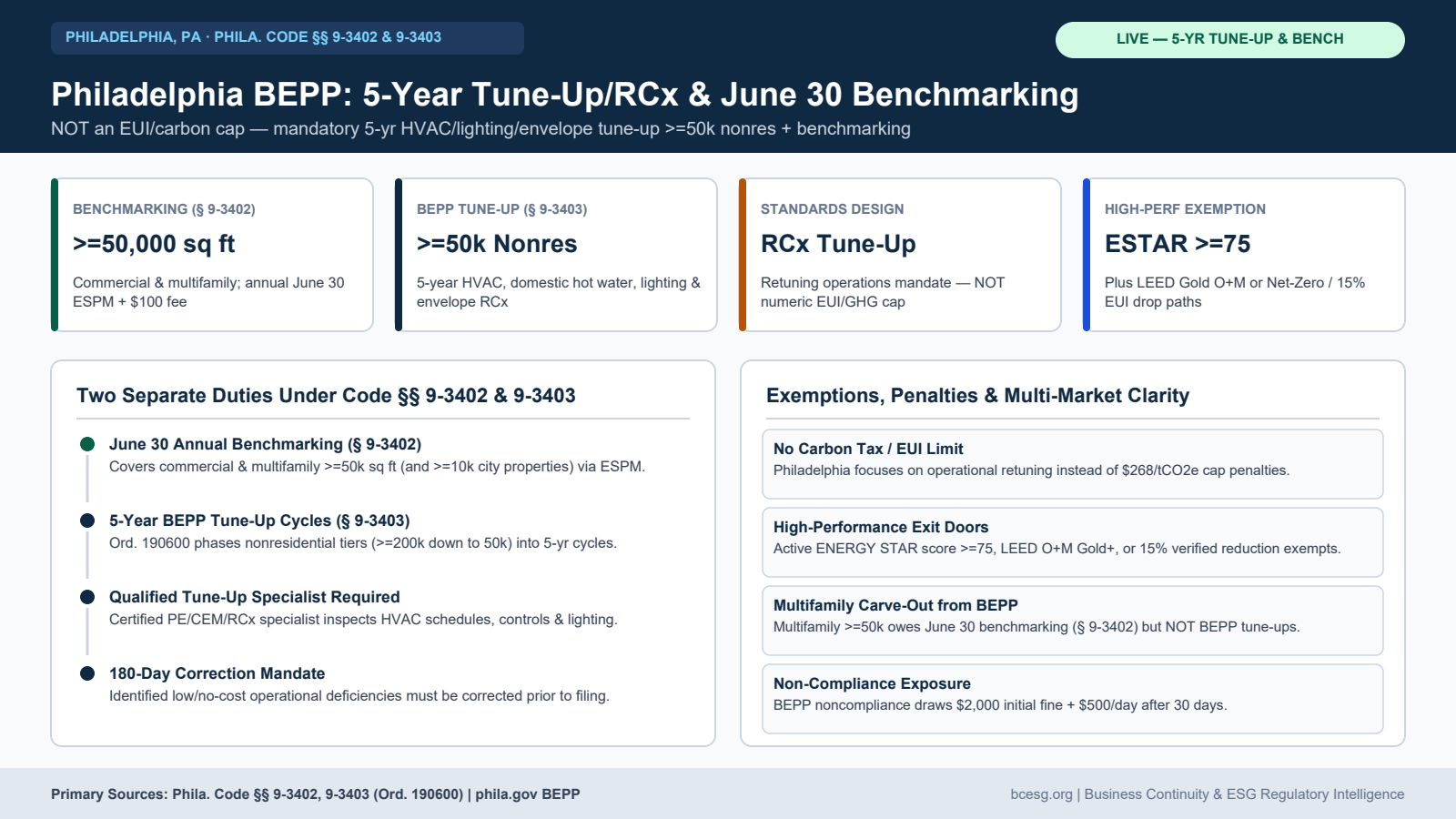
  • Newton BERDO & Lexington BEU-D: MetroWest MA Building Compliance Guide (2026)

    Newton BERDO & Lexington BEU-D: MetroWest MA Building Compliance Guide (2026)

    Short answer: Greater Boston building compliance extends well outside downtown cores along the Route 128 / I-95 corridor. Both Newton (BERDO, Revised Ordinances Ch. 29) and Lexington (BEU-D General Bylaw) enforce independent local ordinances governing commercial, institutional, and multifamily real estate — creating critical distinctions between Newton’s full emissions-reduction trajectory and Lexington’s disclosure-plus-assessment model.

    Although Massachusetts LBER (225 CMR 27.00) requires statewide benchmarking at >=20,000 sq ft without emissions limits, Newton and Lexington enforce autonomous municipal deadlines, local advisory review mechanisms, and (in Newton’s case) enforceable emissions targets matching the pattern established in Boston BERDO 2.0.

    Statutory Status at a Glance
    • Newton BERDO (Ch. 29 — >=20,000 sq ft): Covers commercial, institutional, and large residential buildings >=20,000 sq ft; phased 2025–2026 reporting and third-party verification scaling into emissions caps stepping down to net-zero 2050.
    • Lexington BEU-D (>25,000 sq ft): Covers commercial and residential buildings >25,000 sq ft plus municipal facilities under the Town’s 2022 General Bylaw via annual Portfolio Manager energy/water filings and periodic energy assessments.
    • Administering Agencies: Newton Climate & Energy Team / BERDO Advisory Commission vs. Town of Lexington Sustainability Department.
    • Regional Contrast: Newton imposes enforceable declining GHG caps modeled on Boston BERDO; Lexington centers on annual transparency disclosure and building energy assessment cycles.
    Print-First Compliance Brief

    Download the MetroWest MA Building Compliance Comparison

    2-page Print-First PDF contrasting Newton BERDO’s 20,000 sq ft emissions caps with Lexington BEU-D’s >25,000 sq ft disclosure & assessment schedule.

    Two Neighboring Towns, Two Different Legal Mechanics

    Portfolio managers running Greater Boston suburban assets frequently misclassify Lexington BEU-D as an emissions-cap ordinance identical to Newton BERDO or Boston BERDO 2.0. Lexington’s 2022 bylaw mandates annual ENERGY STAR Portfolio Manager submissions and periodic building energy assessments to inform capital retrofits, without enforcing statutory CO2e dollar-per-ton caps or Alternative Compliance Payments.

    Newton BERDO (Revised Ordinances Ch. 29), by contrast, combines annual reporting and data verification with binding multi-year emissions targets ramping from initial cohorts in 2025–2026 through 2050. Commercial landlords operating across both towns should verify municipal assessment roll square footage and track whether campus parcels contain aggregate buildings crossing Newton’s 20,000 sq ft floor.

    • Newton 2025–2026 On-Ramp: Confirm tier placement and whether multi-building lots trigger Newton’s aggregate >=20,000 sq ft definition.
    • Lexington Phased Assessments: Track due years for periodic energy assessments alongside annual Portfolio Manager uploads.
    Ordinance & CitationThresholdCore MandateEmissions Caps?
    Newton BERDO (Ch. 29)Commercial, institutional & large res >=20,000 sq ftAnnual disclosure + 2025–2026 phased verificationYES — declining caps to net-zero 2050
    Lexington BEU-D (2022 Bylaw)Commercial & res >25,000 sq ft + municipalAnnual Portfolio Manager + energy assessmentsNO — disclosure & assessment mandate
    MA Statewide LBER (225 CMR 27.00)Statewide buildings >=20,000 sq ftJune 30 utility-led annual energy disclosureNO — statewide transparency only
    Side-by-side comparison of Newton BERDO (Revised Ordinances Ch. 29, >=20,000 sq ft emissions caps) and Lexington BEU-D (>25,000 sq ft benchmarking & assessments).
    MetroWest Massachusetts building rules: Newton BERDO's >=20,000 sq ft emissions trajectory vs. Lexington BEU-D's >25,000 sq ft disclosure and assessment mandates.

    Compliance Execution Checklist

    StepOwner / TeamAuditable Deliverable
    1. Jurisdictional MappingAsset ManagementTag every Route 128 parcel by municipality (Newton vs Lexington vs MA-only).
    2. Utility Data AccessProperty OpsEnable Eversource/National Grid whole-building meters for PM & town portals.
    3. Newton Verification PrepSustainability / PESchedule third-party verification and 2026–2030 emissions forecast for Newton assets.
    Field & Print Package

    Keep This Newton & Lexington, MA Compliance Checklist Handy

    Download the formatted 2-page PDF reference brief or pull the structured Markdown edition for internal compliance documentation.

    Frequently Asked Questions

    Does Newton BERDO include residential buildings?

    Yes. Newton Revised Ordinances Ch. 29 covers commercial, institutional, and large residential buildings >=20,000 sq ft, administering phased 2025–2026 reporting and emissions targets toward net-zero 2050.

    Does Lexington BEU-D fine building owners for exceeding emissions caps?

    No. Lexington's Building Energy Use Disclosure Bylaw focuses on annual ENERGY STAR Portfolio Manager energy/water disclosure and periodic building energy assessments for buildings >25,000 sq ft, without numeric GHG cap penalties.

    Primary Authorities & Official Resources

    Informational notice: This guide summarizes enacted statutes, regulations, or pending legislative records from the primary authorities linked above as of November 14, 2026. It is not legal, accounting, or licensed engineering advice.

  • Minnesota Building Benchmarking (§ 216C.331): Phase 2 Active & Twin Cities Consolidation

    Minnesota Building Benchmarking (§ 216C.331): Phase 2 Active & Twin Cities Consolidation

    Short answer: Minnesota’s statewide Large Building Energy Benchmarking Program (Minn. Stat. § 216C.331) reached full Phase 2 coverage on June 1, 2026, requiring commercial and multifamily buildings (5+ units) of ≥50,000 gross sq ft to submit annual energy data to the Minnesota Department of Commerce by June 1.

    Equally important for Twin Cities property managers is what happened locally: both St. Paul (Energize Saint Paul) and St. Louis Park discontinued their standalone municipal benchmarking mandates into state law, while Edina narrowed locally to 25,000–49,999 sq ft and Minneapolis continues co-enforcing ≥50,000 sq ft locally.

    Statutory Status at a Glance
    • Governing Authority: Minn. Stat. § 216C.331.
    • Administering Agency: Minnesota Department of Commerce — Large Building Energy Benchmarking Program.
    • Covered Threshold & Schedule: ≥100,000 sq ft launched June 1, 2025 (Phase 1); ≥50,000 sq ft active June 1, 2026 (Phase 2); recurring June 1 annually.
    • Municipal Consolidations: St. Paul and St. Louis Park retired separate municipal programs into § 216C.331; Edina shifted ≥50k buildings to state law and kept 25k–49,999 sq ft locally.
    • Post-2026 Policy Trajectory (Inferred): Minnesota’s November 2026 House shift restoring a unified DFL trifecta increases legislative durability for state benchmarking enforcement and future building-decarbonization bills.
    Print-First Compliance Brief

    Navigate Minnesota § 216C.331 After St. Paul & St. Louis Park Consolidated Into State Law

    2-page quick card covering Minnesota’s June 1 Phase 2 (>=50k sq ft) schedule, Twin Cities ordinance retirements, Edina’s 25k-49k carve-out, and MN 2026 election posture.

    Statewide Phased Rollout: From 100k (2025) to >=50k Active Now (2026+)

    Minn. Stat. § 216C.331 covers private commercial buildings and multifamily residential buildings with five or more dwelling units across Minnesota’s core metropolitan counties and covered jurisdictions as specified in statute. Phase 1 swept in properties ≥100,000 sq ft for the June 1, 2025 cycle; Phase 2 pulled every qualifying building 50,000 to 99,999 sq ft into active annual June 1 compliance in 2026.

    Because Minnesota winters create high space-heating fuel intensity, accurate Portfolio Manager natural gas and district steam normalization—backed by automated Xcel Energy and CenterPoint utility data feeds—is essential before public score release.

    Jurisdiction / LayerCurrent Floor & LawActive 2026–2027 Status
    Minnesota State (§ 216C.331)Commercial & MF (5+ units) >=50,000 sq ftACTIVE NOW — June 1 annual to MN Commerce
    St. Paul, MNFormer >=50k Energize Saint PaulDISCONTINUED locally — file via MN § 216C.331
    St. Louis Park, MNFormer >=25k Ord. 2576-19DISCONTINUED Dec 31, 2024 — >=50k files with state
    Edina, MNAmended Efficient Buildings Ord.Active locally ONLY for 25,000–49,999 sq ft (June 1)
    Minneapolis, MNCode Ch. 47 § 47.190 (>=50k)Active municipal energy + water filing due June 1
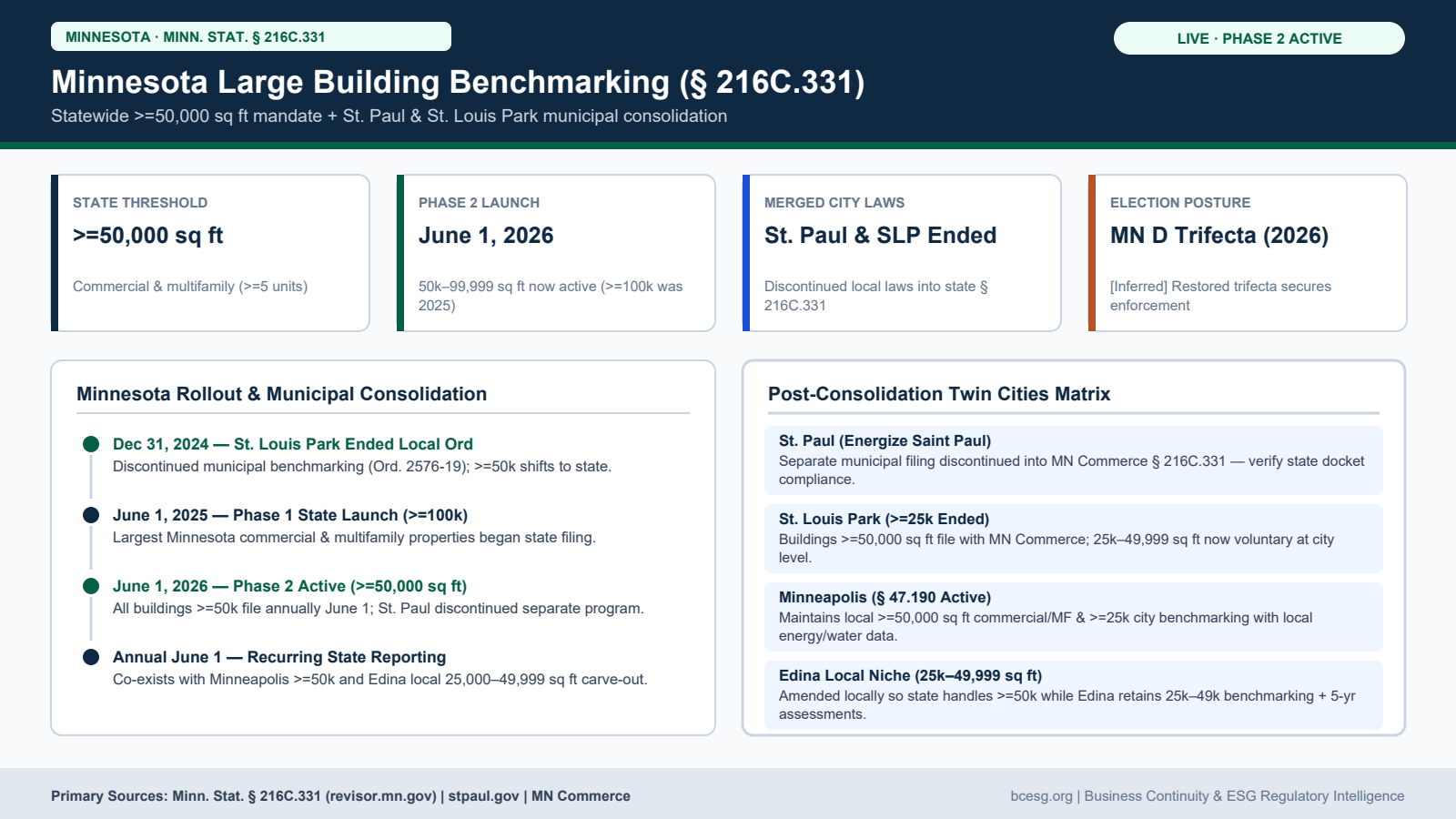
    Minnesota § 216C.331 building benchmarking infographic showing Phase 1 >=100k (2025), Phase 2 >=50k (2026), St. Paul and St. Louis Park local discontinuation, and Minneapolis/Edina overlap.
    Minnesota § 216C.331 Phase 1–2 thresholds and Twin Cities post-consolidation ordinance landscape (St. Paul, St. Louis Park, Minneapolis, Edina).

    Twin Cities Consolidation Matrix: St. Paul, St. Louis Park, Edina & Minneapolis

    Compliance consultants using outdated 2023–2024 checklists routinely tell Twin Cities owners to submit four separate city reports. That is no longer accurate after Minnesota implemented § 216C.331:

    Read alongside our California AB 802 and Massachusetts LBER guides, Minnesota illustrates how state statutes increasingly absorb local ordinances above 50,000 sq ft—leaving smaller municipal niches like Edina’s 25k–49k tier active locally.

    • St. Paul (Energize Saint Paul — Discontinued Locally): Replaced by statewide MN Commerce § 216C.331 reporting for ≥50,000 sq ft assets.
    • St. Louis Park (Discontinued End of 2024): Former ≥25,000 sq ft municipal mandate ended December 31, 2024; properties ≥50,000 sq ft file with MN Commerce while 25k–49k moved to voluntary sustainability programs.
    • Edina (Amended Local Niche 25,000–49,999 sq ft): Defers ≥50,000 sq ft assets to state § 216C.331 while enforcing local June 1 energy/water benchmarking and 5-year energy assessments on 25,000–49,999 sq ft properties.
    • Minneapolis (Ch. 47 § 47.190 Active): Continues local energy and water benchmarking due June 1 alongside state § 216C.331 (≥50,000 sq ft private; ≥25k city).

    Compliance Execution Checklist

    StepOwner / TeamAuditable Deliverable
    1. Jurisdiction MapAsset MgmtTag each MN asset >=25k sq ft as State-Only (incl. St. Paul / >=50k SLP), Dual Mpls+State, or Edina 25k-49k.
    2. Utility ConnectProperty OpsConnect Xcel Energy / CenterPoint automated whole-building Portfolio Manager feeds before April.
    3. File by June 1Compliance LeadSubmit state § 216C.331 (and Minneapolis/Edina where applicable) by June 1 annually.
    4. 2027 Policy WatchESG LeadTrack restored MN trifecta committee activity for potential corporate disclosure or BPS bills.
    Field & Print Package

    Keep This Minnesota Compliance Checklist Handy

    Download the formatted 2-page PDF reference brief or pull the structured Markdown edition for internal compliance documentation.

    Frequently Asked Questions

    Do buildings in St. Paul or St. Louis Park still file separate city benchmarking reports?

    No. Both St. Paul (Energize Saint Paul) and St. Louis Park (effective end of 2024) discontinued their separate municipal benchmarking mandates, consolidating >=50,000 sq ft properties into Minnesota's statewide § 216C.331 program.

    What changed in Edina after Minnesota passed § 216C.331?

    Edina amended its Efficient Buildings Ordinance so buildings >=50,000 sq ft report to the state while Edina retains local June 1 energy and water benchmarking plus 5-year energy assessments specifically for 25,000–49,999 sq ft buildings.

    Does Minnesota § 216C.331 cover residential apartments?

    Yes. Multifamily residential buildings with five or more units and >=50,000 gross sq ft are covered alongside commercial properties.

    Primary Authorities & Official Resources

    Informational notice: This guide summarizes enacted statutes, regulations, or pending legislative records from the primary authorities linked above as of November 14, 2026. It is not legal, accounting, or licensed engineering advice.
  • New Jersey Clean Energy Act Benchmarking (N.J.S.A. 48:3-87.10): Class 4A/4C & July 1 Guide

    New Jersey Clean Energy Act Benchmarking (N.J.S.A. 48:3-87.10): Class 4A/4C & July 1 Guide

    Short answer: Under New Jersey’s Clean Energy Act (P.L. 2018, c. 17; N.J.S.A. 48:3-87.10), owners of commercial (Class 4A) and multifamily residential (Class 4C, 5+ units) buildings exceeding 25,000 gross sq ft must benchmark and submit whole-building energy and water data annually by July 1 using ENERGY STAR Portfolio Manager and a DOE Unique Building Identifier (UBID).

    For corporate logistics, pharma, and multifamily portfolios operating across the Northeast corridor, New Jersey avoids the municipal patchwork seen in Massachusetts and New York City—one statewide NJBPU standard governs every municipality from Newark and Jersey City down to Camden.

    Statutory Status at a Glance
    • Governing Authority: Clean Energy Act of 2018 (P.L. 2018, c. 17; N.J.S.A. 48:3-87.10) & NJBPU Benchmarking Order.
    • Administering Agency: New Jersey Board of Public Utilities (NJBPU).
    • Covered Tax Classes: MOD-IV Class 4A commercial (office, industrial/warehouse, retail) & Class 4C residential (5+ units) >25,000 gross sq ft.
    • Annual Recurring Deadline: July 1 (following initial October 1, 2023 cycle launch).
    • Distinct Requirements: Mandatory whole-building water data alongside energy, plus U.S. DOE UBID assignment inside Portfolio Manager.
    Print-First Compliance Brief

    Standardize New Jersey >25,000 sq ft Class 4A & 4C Benchmarking Before July 1

    2-page quick card covering NJBPU MOD-IV tax class screening, water reporting, Unique Building Identifier (UBID) rules, and NJ S679 linkage.

    MOD-IV Property Class Screening & the Water + UBID Mandate

    NJBPU determines building applicability using municipal tax-assessor MOD-IV records rather than owner self-reporting. Warehouse and industrial complexes in Middlesex, Hudson, Bergen, and Burlington counties taxed under Class 4A—and apartment complexes of 5+ units taxed under Class 4C—enter scope whenever gross floor area exceeds 25,000 sq ft.

    Two compliance details routinely trigger NJBPU rejection notices: omitting water utility meters (New Jersey explicitly pairs water benchmarking with energy under N.J.S.A. 48:3-87.10) and leaving the Unique Building Identifier (UBID) custom ID field blank inside Portfolio Manager.

    • Regulated Utility Data Tools: NJ electric and gas utilities provide automated or portal-based aggregated whole-building usage under BPU privacy/aggregation guidelines (4/5 rule thresholds).
    • Uniform Statewide Scope: New Jersey imposes no separate city-level EUI or GHG performance cap ordinances today, though NJBPU’s public benchmarking scores increasingly surface in municipal green-building and lender underwriting reviews.
    Program DimensionNew Jersey CEA RuleCompliance Requirement
    Statutory ThresholdN.J.S.A. 48:3-87.10MOD-IV Class 4A commercial & Class 4C (5+ units) >25,000 sq ft
    Covered UtilitiesNJBPU Order / Portfolio MgrWhole-building electric, gas/thermal fuel AND water consumption
    Property IdentifierCustom Field in ESPMMandatory DOE Unique Building Identifier (UBID) + NJ tax block/lot
    Annual Filing SchedulePost-2023 Recurring CadenceJuly 1 annually via NJBPU ENERGY STAR Portfolio Manager link
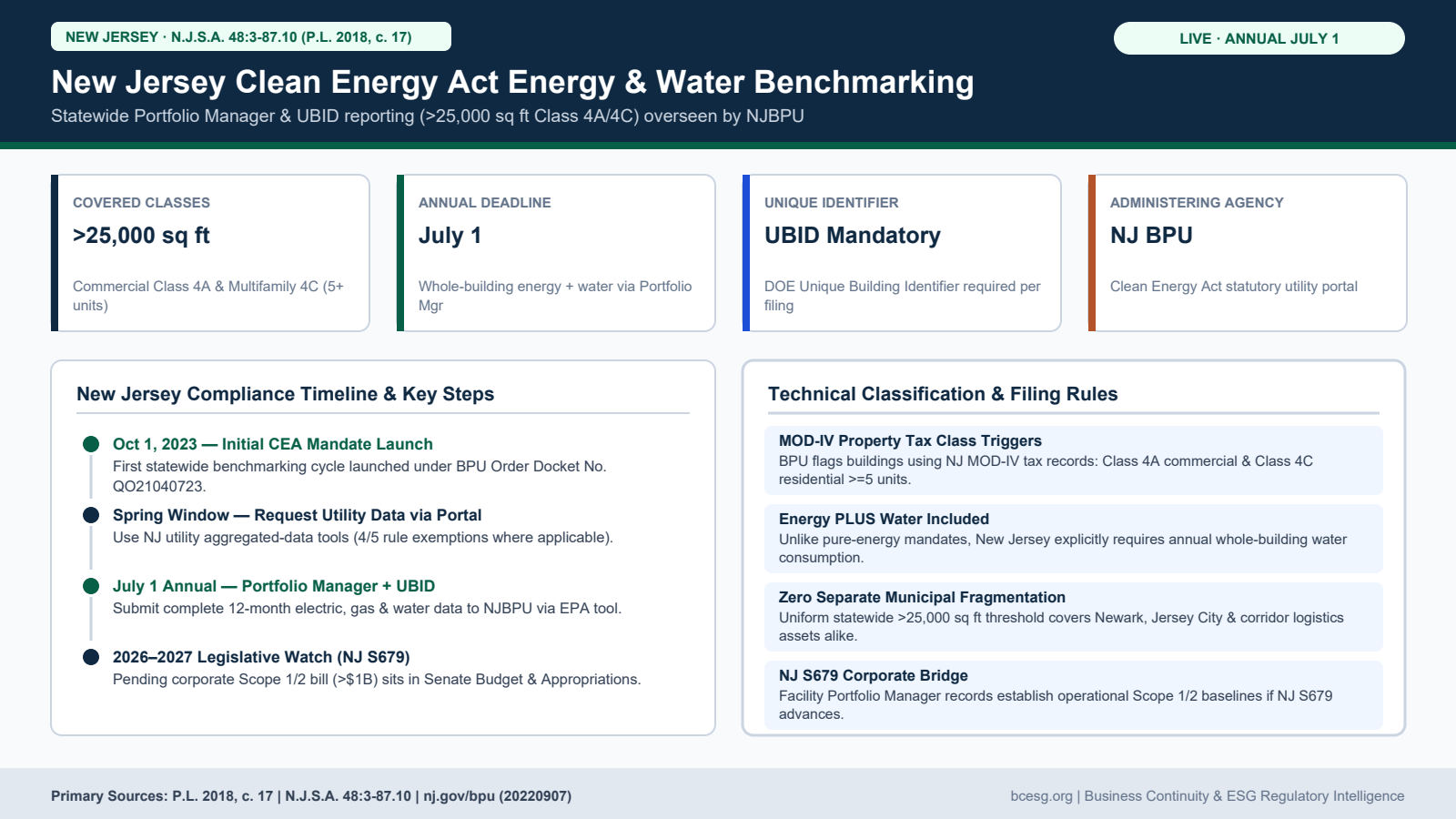
    New Jersey Clean Energy Act Energy and Water Benchmarking Program summary showing >25,000 sq ft Class 4A/4C threshold, annual July 1 deadline, UBID requirement, and NJ S679 legislative bridge.
    New Jersey Clean Energy Act Energy & Water Benchmarking Program rules under N.J.S.A. 48:3-87.10 and NJBPU oversight.

    Strategic Link: Portfolio Manager Baselines & Pending NJ S679 Disclosure

    While New Jersey’s benchmarking law carries no statewide EUI penalty cap today, facility energy data feeds directly into corporate GHG reporting—particularly if New Jersey advances NJ S679 (pending corporate climate disclosure legislation amended in 2026 to cover Scope 1 and Scope 2 emissions for firms >$1B revenue).

    Compare New Jersey’s July 1 schedule against Maryland’s June 1 verified BEPS deadline and NYC’s May 1 LL84 deadline to keep Mid-Atlantic property managers aligned on one quarterly utility audit cycle.

    Compliance Execution Checklist

    StepOwner / TeamAuditable Deliverable
    1. MOD-IV LookupTax / Asset LeadVerify parcel Class (4A/4C) and >25,000 sq ft status on municipal MOD-IV tax records & BPU list.
    2. UBID AssignmentEnergy AnalystGenerate/confirm building UBID and map NJ municipal Block/Lot numbers inside Portfolio Manager.
    3. Utility + Water SyncProperty OpsPull 12-month aggregated electric/gas data plus municipal water bills ahead of June 1.
    4. Submit July 1Compliance LeadSubmit via NJBPU reporting link and retain confirmation receipt for ESG/NJ S679 audits.
    Field & Print Package

    Keep This New Jersey Compliance Checklist Handy

    Download the formatted 2-page PDF reference brief or pull the structured Markdown edition for internal compliance documentation.

    Frequently Asked Questions

    Are industrial warehouses subject to New Jersey's benchmarking law?

    Yes. Industrial, warehouse, logistics, retail, and office buildings taxed under New Jersey MOD-IV Class 4A that exceed 25,000 gross sq ft are covered by NJBPU benchmarking.

    Does New Jersey require water consumption reporting as well as electricity and gas?

    Yes. N.J.S.A. 48:3-87.10 requires annual whole-building water benchmarking in addition to electric and natural gas/heating energy usage.

    What is a UBID and why does NJBPU require it?

    A Unique Building Identifier (UBID) is a standardized geographic footprint code maintained by the U.S. DOE so NJBPU can match Portfolio Manager submissions cleanly against municipal MOD-IV parcel records.

    Primary Authorities & Official Resources

    Informational notice: This guide summarizes enacted statutes, regulations, or pending legislative records from the primary authorities linked above as of November 14, 2026. It is not legal, accounting, or licensed engineering advice.

  • Massachusetts Large Building Energy Reporting (LBER / 225 CMR 27.00): Thresholds & June 30 Rules

    Massachusetts Large Building Energy Reporting (LBER / 225 CMR 27.00): Thresholds & June 30 Rules

    Short answer: Massachusetts enforces one of the nation’s broadest statewide building energy-reporting thresholds under the Climate Act of 2022 (M.G.L. c. 25A § 20) and Department of Energy Resources regulation 225 CMR 27.00 (MA DOER LBER). Covered commercial, institutional, industrial, and multifamily buildings ≥20,000 gross sq ft must track and reconcile annual whole-building energy consumption with DOER by June 30.

    For Greater Boston owners, statewide LBER serves as the reporting baseline underneath strict local decarbonization ordinances: Boston BERDO 2.0 (≥20k sq ft / 15+ units), Cambridge BEUDO (≥25k sq ft / ≥50 units), Newton BERDO (≥20k), and Lexington BEU-D (>25k) all enforce independent municipal spring filings and active emissions limits.

    Statutory Status at a Glance
    • Governing Authority: M.G.L. c. 25A § 20 (2022 Climate Act) & 225 CMR 27.00.
    • Administering Agency: Massachusetts Department of Energy Resources (DOER).
    • Covered Threshold: Commercial, industrial, institutional, and multifamily buildings ≥20,000 gross sq ft statewide.
    • 4-Step Annual Calendar: March 15 (exemptions) → May 30 (utilities upload metered electric/gas/steam) → June 30 (owner reporting) → August 31 (verification/corrections).
    • Performance vs. Reporting Split: Statewide LBER is reporting-only today; municipal Boston BERDO 2.0 and Cambridge BEUDO impose binding GHG limits starting 2025–2026.
    Print-First Compliance Brief

    Align Massachusetts >=20,000 sq ft LBER Filing With Local BERDO & BEUDO Caps

    2-page quick card charting DOER’s 4 annual milestones (Mar 15, May 30, Jun 30, Aug 31) alongside Boston, Cambridge, Newton, and Lexington.

    Inside DOER's Four-Date LBER Reporting Architecture

    Unlike state benchmarking programs that leave owners chasing tenant meter consent, 225 CMR 27.00 places a direct statutory data-delivery duty on Massachusetts electric, gas, and steam distribution utilities. By May 30 each year, utilities submit aggregated consumption records for covered premises directly into the DOER system.

    Property owners remain legally responsible for verifying parcel coverage, submitting delivered-fuel bills (fuel oil, propane, biomass), claiming vacancies or industrial exemptions by March 15, completing owner submissions by June 30, and resolving any utility anomalies prior to August 31.

    • Industrial & Lab Coverage: Because M.G.L. c. 25A § 20 includes industrial buildings ≥20,000 sq ft, Route 128 life-science labs, cold storage, and suburban manufacturing plants are swept in alongside office towers.
    • Parcel vs. Condominium Boundaries: Multiple buildings sharing single parcels require careful gross-floor-area verification against municipal assessor records before the March 15 exemption cutoff.
    DOER Milestone DateResponsible PartyAction Under 225 CMR 27.00
    March 15Building OwnerSubmit boundary, vacancy, or statutory exemption requests to DOER
    May 30Utilities (Electric/Gas/Steam)Upload aggregated whole-building energy usage for covered >=20k properties
    June 30Building OwnerComplete owner energy submission (incl. delivered oil/propane & property metadata)
    August 31Owner & DOER VerificationFinalize discrepancy corrections before public DOER dataset publication
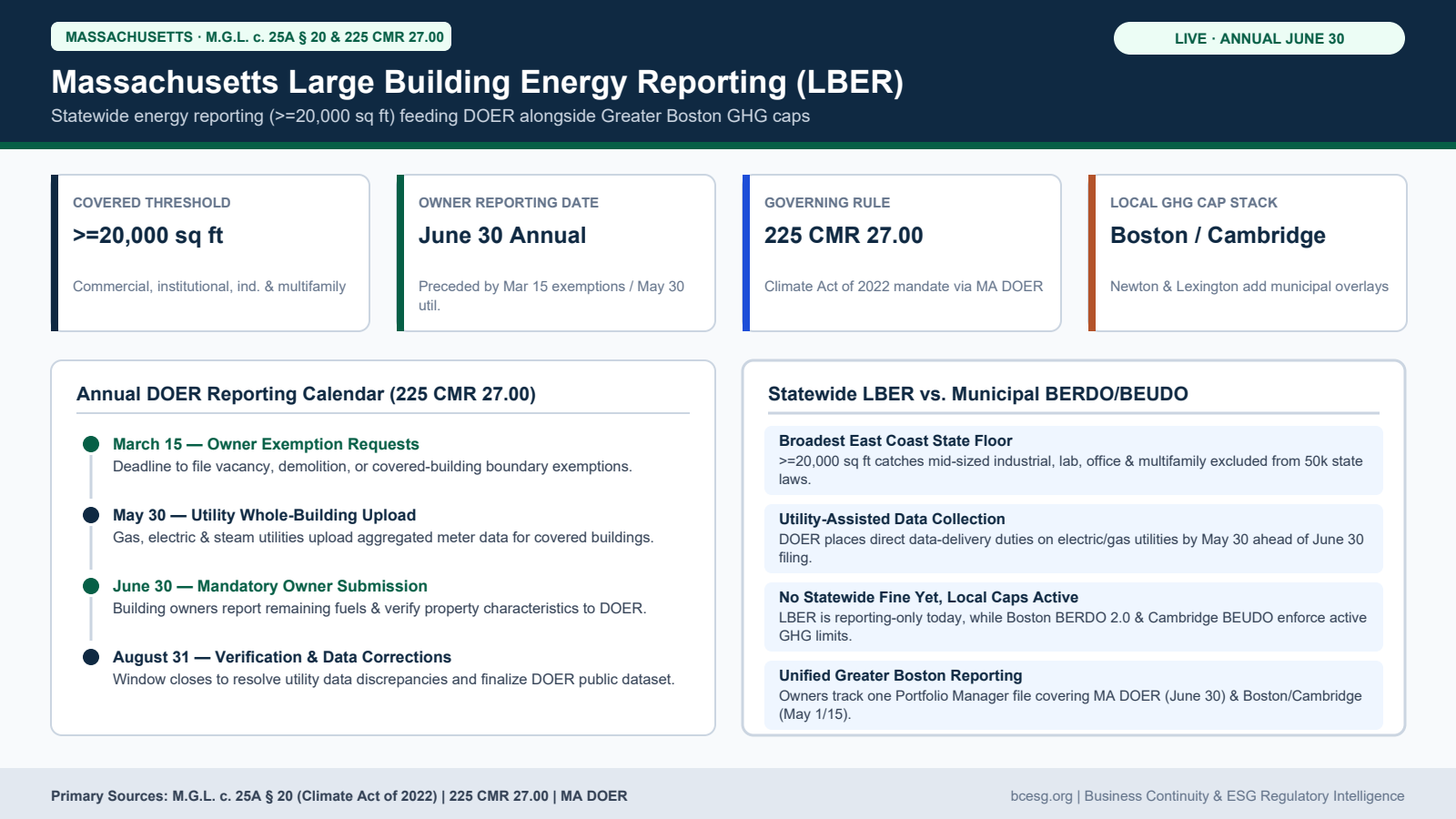
    Massachusetts Large Building Energy Reporting (LBER / 225 CMR 27.00) infographic showing >=20,000 sq ft threshold, March 15-August 31 DOER calendar, and local Boston BERDO / Cambridge BEUDO caps.
    Massachusetts LBER (M.G.L. c. 25A § 20 & 225 CMR 27.00) four-milestone annual reporting calendar and local GHG cap interaction.

    Synchronizing Statewide LBER With Boston BERDO 2.0 & Neighboring States

    Inside Boston and Cambridge, owners run two distinct calendars out of the same Portfolio Manager dataset: Cambridge BEUDO filings land on May 1 and Boston BERDO 2.0 filings land on May 15—more than six weeks before Massachusetts DOER’s June 30 owner deadline. Ensuring third-party data verification covers both local emissions compliance and DOER records eliminates mid-summer rework.

    Northeast regional managers should track Massachusetts alongside New Jersey’s July 1 benchmarking (>25k sq ft) and NYC’s May 1 LL84/LL97 stack.

    Compliance Execution Checklist

    StepOwner / TeamAuditable Deliverable
    1. DOER List AuditAsset MgmtCheck DOER covered-building list for every MA commercial/industrial/MF parcel >=20,000 sq ft.
    2. Mar 15 ExemptionsCompliance LeadFile any demolition, under-threshold, or vacancy exemption documentation prior to March 15.
    3. Utility MatchFacilities /OpsConfirm May 30 utility uploads capture all meters and compile delivered heating oil/propane invoices.
    4. Local Overlay SyncSustainabilityAlign May 1 (Cambridge) / May 15 (Boston) filings with June 30 MA LBER owner certification.
    Field & Print Package

    Keep This Massachusetts Compliance Checklist Handy

    Download the formatted 2-page PDF reference brief or pull the structured Markdown edition for internal compliance documentation.

    Frequently Asked Questions

    Are industrial warehouses and life-science labs covered by Massachusetts LBER?

    Yes. M.G.L. c. 25A § 20 and 225 CMR 27.00 explicitly include commercial, institutional, industrial, and multifamily buildings of 20,000 gross sq ft or more.

    Does Massachusetts LBER impose carbon emissions fines like Boston BERDO 2.0?

    Statewide LBER is an annual energy reporting mandate overseen by DOER and does not currently levy numeric carbon-cap penalties, whereas Boston BERDO 2.0 and Cambridge BEUDO impose binding emissions limits and Alternative Compliance Payments locally.

    When must a building owner submit LBER reports to DOER?

    Owner reports are due June 30 annually, following March 15 exemption filings and May 30 utility uploads, with verification/corrections closing August 31.

    Primary Authorities & Official Resources

    Informational notice: This guide summarizes enacted statutes, regulations, or pending legislative records from the primary authorities linked above as of November 14, 2026. It is not legal, accounting, or licensed engineering advice.
  • California Building Energy Benchmarking (AB 802): June 1 Filing, Penalties & SB 253 Bridge

    California Building Energy Benchmarking (AB 802): June 1 Filing, Penalties & SB 253 Bridge

    Short answer: California’s statewide AB 802 Building Energy Benchmarking Program (Cal. Pub. Res. Code § 25402.10; 20 CCR §§ 1680–1684) requires owners of commercial and multifamily buildings over 50,000 gross sq ft with 17 or more active utility accounts to report whole-building energy use via ENERGY STAR Portfolio Manager every June 1.

    Even for corporations focused on California’s broader corporate rules—such as SB 253 Scope 1–3 GHG reporting—AB 802 is the operational data engine: its mandatory utility aggregation rule unlocks tenant-metered whole-building electricity and gas figures that feed directly into corporate Scope 2 inventories and local municipal audits across seven California cities.

    Statutory Status at a Glance
    • Governing Authority: Cal. Pub. Res. Code § 25402.10 (AB 802) & CEC Regulations 20 CCR §§ 1680–1684.
    • Administering Agency: California Energy Commission (CEC).
    • Covered Threshold: Commercial buildings (>50,000 sq ft, any account count above utility aggregation rules—generally >50k w/ 0/17+ rules per CEC account triggers) and multifamily buildings (>50,000 sq ft with ≥17 active residential/commercial utility accounts).
    • Deadline & Penalty: Annual June 1 filing; civil penalties of $500–$2,000 per day after 30-day uncured violation notice.
    • Local Exemptions: CEC recognizes approved local programs (LA EBEWE, SF EBO, San Jose BPO, San Diego) so owners avoid redundant state reporting while complying locally.
    Print-First Compliance Brief

    Connect California AB 802 Meter Data to Municipal Audits & SB 253 Scope 2

    2-page quick card detailing CEC June 1 reporting, utility aggregated data requests (4-week rule), local exemptions (LA, SF, SJ, SD), and civil fines.

    Threshold Nuances: The 17-Utility-Account Rule & Utility Data Rights

    AB 802 pairs two legal triggers that separate multi-tenant assets from single-user campuses: a building must exceed 50,000 gross sq ft and fall within CEC’s active utility account rules (notably 17+ active utility accounts for multifamily residential, or covered commercial configurations with no residential/non-residential exceptions).

    Crucially, AB 802 empowers owners against recalcitrant tenants: utilities must provide aggregated whole-building energy usage within four weeks of request, automatically bypassing individual tenant written authorization when a building contains at least 3 commercial accounts or 5+ residential accounts.

    • Public Transparency: CEC publishes benchmarked Energy Use Intensity (EUI) and ENERGY STAR scores on a public database for disclosable buildings.
    • 30-Day Cure Notice: Before imposing daily fines ($500–$2,000/day), CEC issues a formal written warning granting 30 days to cure missing submissions.
    Program ElementAB 802 Rule CitationOwner Requirement & Enforcement
    Covered Size & AccountsCal. Pub. Res. Code § 25402.10>50,000 gross sq ft commercial & multifamily (>=17 active utility accts)
    Utility Aggregation20 CCR § 1682 / Utility MandateUtilities deliver 12-mo aggregated data within 4 weeks (3 com / 5 res thresh)
    Annual CEC Deadline20 CCR § 1683Annual June 1 ENERGY STAR Portfolio Manager submission
    Civil Penalty ScheduleCal. Pub. Res. Code § 25402.10(f)$500–$2,000/day after 30-day uncured CEC notice
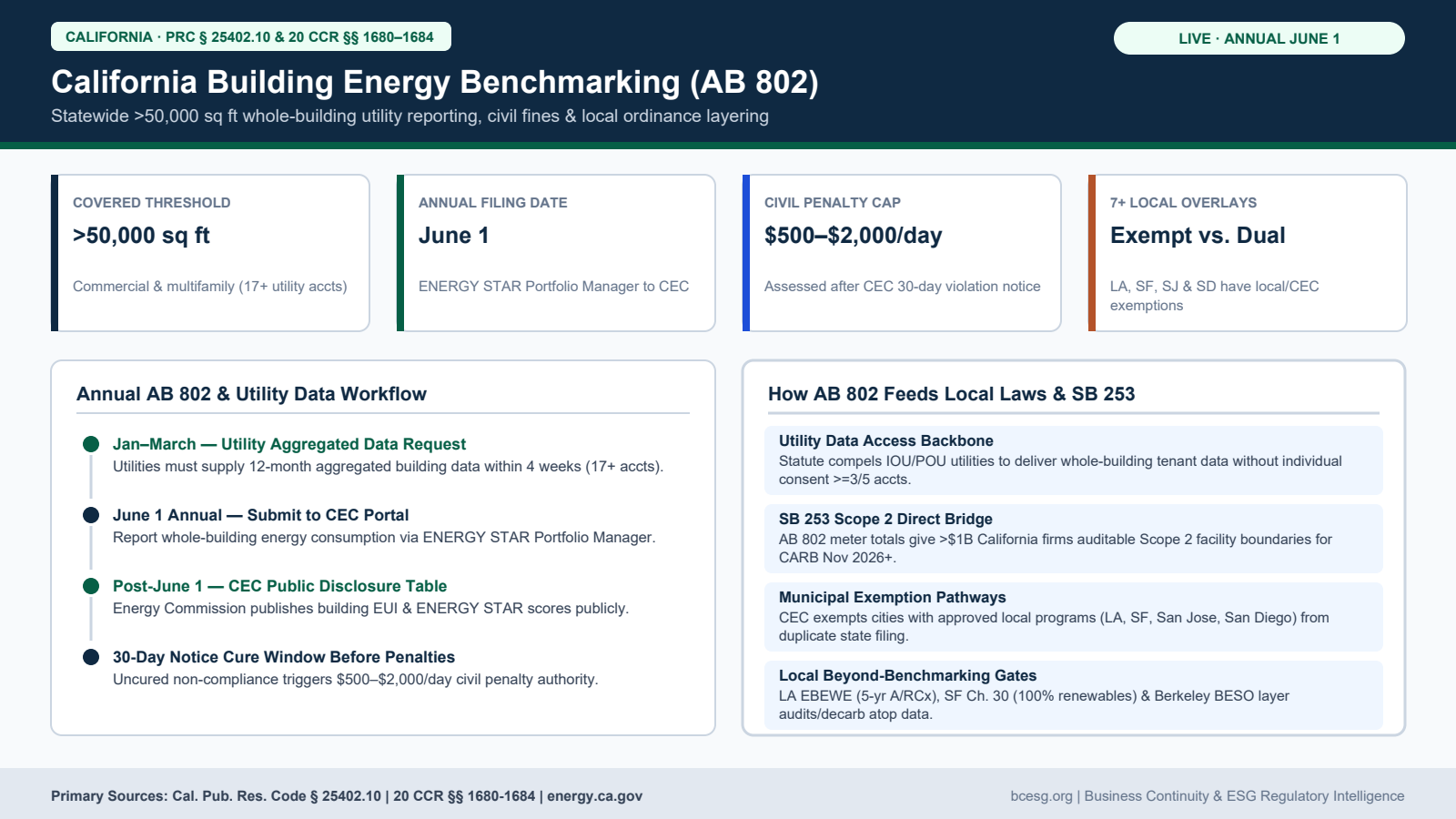
    California AB 802 building energy benchmarking visual summary showing >50,000 sq ft threshold, June 1 CEC deadline, $500-$2,000/day penalty window, and links to SB 253 and local cities.
    California AB 802 statewide benchmarking duties, utility data access rules, civil penalty range, and municipal exemption map under 20 CCR §§ 1680–1684.

    Bridge to California Local Ordinances & SB 253 Scope 2 Inventories

    California does not enforce a single statewide Building Performance Standard cap yet—local cities carry the performance and audit teeth. While CEC exempts properties already reporting under approved local ordinances (Los Angeles EBEWE, San Francisco EBO, San Jose BPO, and San Diego), owners inside those cities face much lower square-footage floors (10,000–20,000 sq ft) and five-year retro-commissioning or renewable electricity obligations.

    Meanwhile, large corporations (>$1B revenue) subject to California SB 253 Scope 1 and Scope 2 disclosures rely on AB 802 utility aggregates to reconcile leased-building operational boundaries without double counting.

    Compliance Execution Checklist

    StepOwner / TeamAuditable Deliverable
    1. Local vs. CEC CheckPortfolio LeadVerify if building sits in a CEC-exempt approved city (LA, SF, San Jose, San Diego) vs. direct CEC filing.
    2. Request Utility FeedsProperty OpsRequest aggregated 12-month data from IOU/POU utilities in Feb/Mar (allow 4+ weeks SLA).
    3. File by June 1Asset MgmtRun Portfolio Manager data quality checker and submit via annual CEC reporting link before June 1.
    4. Reconcile SB 253Corporate ESGMap Portfolio Manager meter boundaries to corporate SB 253 Scope 2 & Cat 13 disclosures.
    Field & Print Package

    Keep This California Compliance Checklist Handy

    Download the formatted 2-page PDF reference brief or pull the structured Markdown edition for internal compliance documentation.

    Frequently Asked Questions

    Do buildings in Los Angeles or San Francisco have to file twice for AB 802 and local ordinances?

    No, provided the property complies fully with a CEC-approved local benchmarking program (including LA EBEWE, San Francisco EBO, San Jose BPO, and San Diego), CEC exempts the building from duplicate state submission—though local filing deadlines (such as May 1 in SF/SJ) differ from June 1.

    Why does AB 802 matter for California SB 253 Scope 2 compliance?

    AB 802's statutory whole-building utility aggregation gives corporate tenants and building owners auditable electricity and gas totals across multi-tenant assets needed for Scope 2 and Scope 3 Category 13 GHG inventories.

    What is the penalty for ignoring a California Energy Commission AB 802 notice?

    After issuing a 30-day written notice of violation, the CEC may assess administrative civil penalties ranging from $500 to $2,000 per day until compliance is demonstrated.

    Primary Authorities & Official Resources

    Informational notice: This guide summarizes enacted statutes, regulations, or pending legislative records from the primary authorities linked above as of November 14, 2026. It is not legal, accounting, or licensed engineering advice.
  • Oregon Statewide Building Performance Standard (HB 3409 & OAR 330-300): Tier 1 & Tier 2 Guide

    Oregon Statewide Building Performance Standard (HB 3409 & OAR 330-300): Tier 1 & Tier 2 Guide

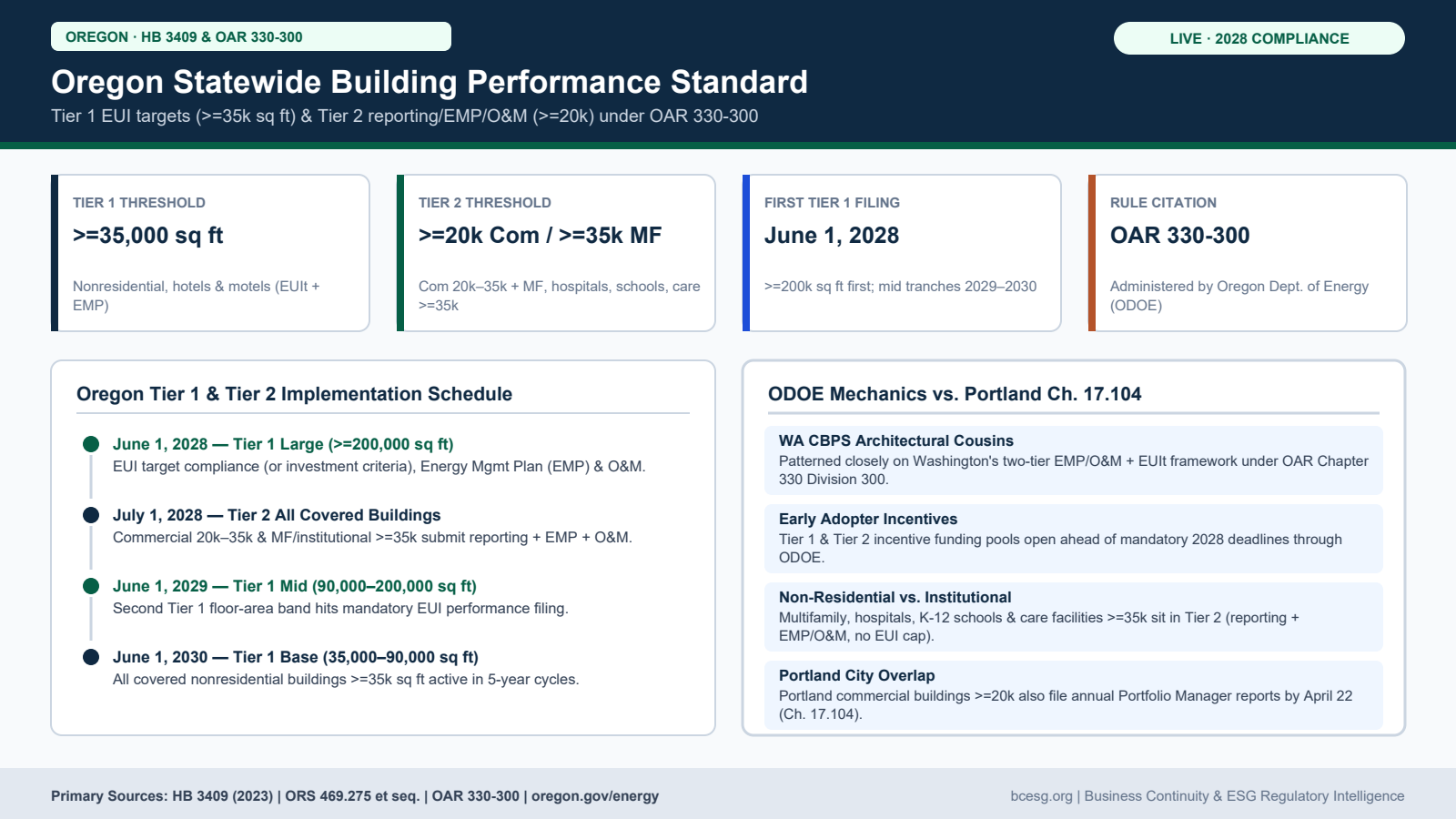
    Short answer: Oregon adopted a statewide two-tier Building Performance Standard under HB 3409 (codified at ORS 469.275 et seq.) and finalized operational rules in Oregon Department of Energy (ODOE) OAR Chapter 330, Division 300. Modeled directly on Washington’s Clean Buildings architecture, Oregon requires Tier 1 nonresidential buildings (≥35,000 sq ft) to hit Energy Use Intensity targets or investment criteria starting June 1, 2028, while Tier 2 commercial and institutional/multifamily properties begin mandatory reporting, EMP, and O&M compliance on July 1, 2028.

    Crucial rule-citation note: ODOE’s binding BPS rules live in OAR 330-300 (not OAR 330-135), and statewide compliance runs separately from Portland’s local energy reporting and 2050 carbon step-down ordinance track.

    Statutory Status at a Glance
    • Governing Authority: HB 3409 (2023), ORS 469.275 et seq., and ODOE Administrative Rules OAR 330-300.
    • Administering Agency: Oregon Department of Energy (ODOE).
    • Tier 1 (≥35,000 sq ft Nonresidential/Hotels/Motels): EUI target (or LCCA investment criteria) + EMP + O&M due June 1, 2028 (≥200k), June 1, 2029 (90k–200k), and June 1, 2030 (35k–90k).
    • Tier 2 (20k–35k Com & ≥35k MF/Hospitals/Schools/Care): Reporting + EMP + O&M due July 1, 2028 (no numeric Tier 1 EUIt cap in Cycle 1).
    • Incentives Window: ODOE Early Adopter Incentive funds support early Tier 1 & Tier 2 compliance preparation prior to 2028 enforcement.
    Print-First Compliance Brief

    Map Oregon HB 3409 Tier 1 & Tier 2 Compliance Under OAR 330-300

    2-page quick card distinguishing Oregon’s statewide OAR 330-300 rules (2028–2030 Tier 1/2 dates) from Portland City Code Ch. 17.104.

    Tier 1 vs. Tier 2 Classification Under OAR 330-300

    Understanding where an Oregon asset lands between Tier 1 and Tier 2 determines whether the owner faces capital retrofit obligations (or an LCCA investment audit) versus operational governance and energy reporting. Unlike Washington’s >50,000 sq ft Tier 1 floor, Oregon pulls nonresidential buildings down to 35,000 sq ft inside Tier 1.

    Conversely, Oregon places multifamily housing, hospitals, K-12 schools, universities, and senior care buildings ≥35,000 sq ft into Tier 2 alongside smaller commercial buildings (20,000–34,999 sq ft)—requiring benchmarking, an Energy Management Plan, and an O&M program without immediate EUIt caps.

    • ASHRAE Standard 100 Adaptation: ODOE builds EUIt benchmarks by building activity type and climate zone, requiring a qualified Energy Manager to sign EMP and O&M documentation.
    • 5-Year Recurring Cycles: After initial 2028–2030 filings, covered Tier 1 & Tier 2 buildings re-verify compliance every five years.
    Oregon BPS TierBuilding Types & Square FootageFirst Compliance Date & Core Duties
    Tier 1 — LargestNonresidential, hotels, motels >=200,000 sq ftJune 1, 2028 — EUIt / LCCA + EMP + O&M
    Tier 1 — MidNonresidential, hotels, motels 90,000–199,999 sq ftJune 1, 2029 — EUIt / LCCA + EMP + O&M
    Tier 1 — BaseNonresidential, hotels, motels 35,000–89,999 sq ftJune 1, 2030 — EUIt / LCCA + EMP + O&M
    Tier 2 — Com & Inst/MFCommercial 20k–35k sq ft; MF/hospitals/schools >=35kJuly 1, 2028 — Energy reporting + EMP + O&M
    Oregon Statewide Building Performance Standard (HB 3409 / OAR 330-300) summary showing Tier 1 >=35,000 sq ft EUI targets, Tier 2 >=20,000 sq ft reporting/EMP/O&M, 2028-2030 dates, and Portland Ch. 17.104 distinction.
    Oregon Statewide Building Performance Standard (HB 3409 / OAR 330-300) compliance schedule and Portland dual-reporting structure.

    Pacific Northwest Portfolio Alignment: Oregon, Washington & Portland

    For commercial real estate portfolios spanning I-5 from Seattle to Portland, Oregon’s OAR 330-300 deliberately tracks Washington’s CBPS (WAC 194-50)—allowing engineering teams to reuse Energy Management Plan templates and O&M manuals with Oregon-specific EUIt tables.

    Inside Portland city limits, owners must also track Portland City Code Chapter 17.104 (annual April 22 energy reporting for commercial buildings ≥20,000 sq ft) alongside the city’s 2050 building carbon step-down policy. Waiting until 2028 leaves insufficient time for a mandatory 12-month metered O&M baseline.

    Compliance Execution Checklist

    StepOwner / TeamAuditable Deliverable
    1. Tier VerificationAsset MgmtClassify each OR property >=20,000 sq ft under Tier 1 (>=35k nonres) vs Tier 2 under OAR 330-300.
    2. Incentive ScreenFinance / ESGCheck ODOE Early Adopter Incentive eligibility before 2028 funding windows close.
    3. EMP & O&M BuildOperationsStand up written EMP and 12 months of logged preventive O&M records at least 18 months pre-deadline.
    4. Portland SyncCompliance LeadPair statewide ODOE preparation with Portland April 22 Ch. 17.104 annual Portfolio Manager filings.
    Field & Print Package

    Keep This Oregon Compliance Checklist Handy

    Download the formatted 2-page PDF reference brief or pull the structured Markdown edition for internal compliance documentation.

    Frequently Asked Questions

    Where are Oregon's binding BPS rules codified?

    Oregon Department of Energy (ODOE) implements HB 3409 (ORS 469.275 et seq.) inside Oregon Administrative Rules Chapter 330, Division 300 (OAR 330-300).

    Are Oregon multifamily buildings subject to numeric Tier 1 EUI caps?

    No. Multifamily residential buildings of 35,000 sq ft or larger fall under Tier 2, requiring energy use reporting, an Energy Management Plan (EMP), and an O&M program starting July 1, 2028.

    Does complying with Portland Ch. 17.104 satisfy Oregon HB 3409?

    No. Portland City Code Chapter 17.104 governs annual April 22 commercial energy reporting in Portland, whereas OAR 330-300 enforces statewide Tier 1 EUIt targets and Tier 2 EMP/O&M governance through ODOE.

    Primary Authorities & Official Resources

    Informational notice: This guide summarizes enacted statutes, regulations, or pending legislative records from the primary authorities linked above as of November 14, 2026. It is not legal, accounting, or licensed engineering advice.
  • Building Performance Colorado (BPC) & HB 25-1269: Benchmarking, 2030 Targets & EPCA Litigation

    Building Performance Colorado (BPC) & HB 25-1269: Benchmarking, 2030 Targets & EPCA Litigation

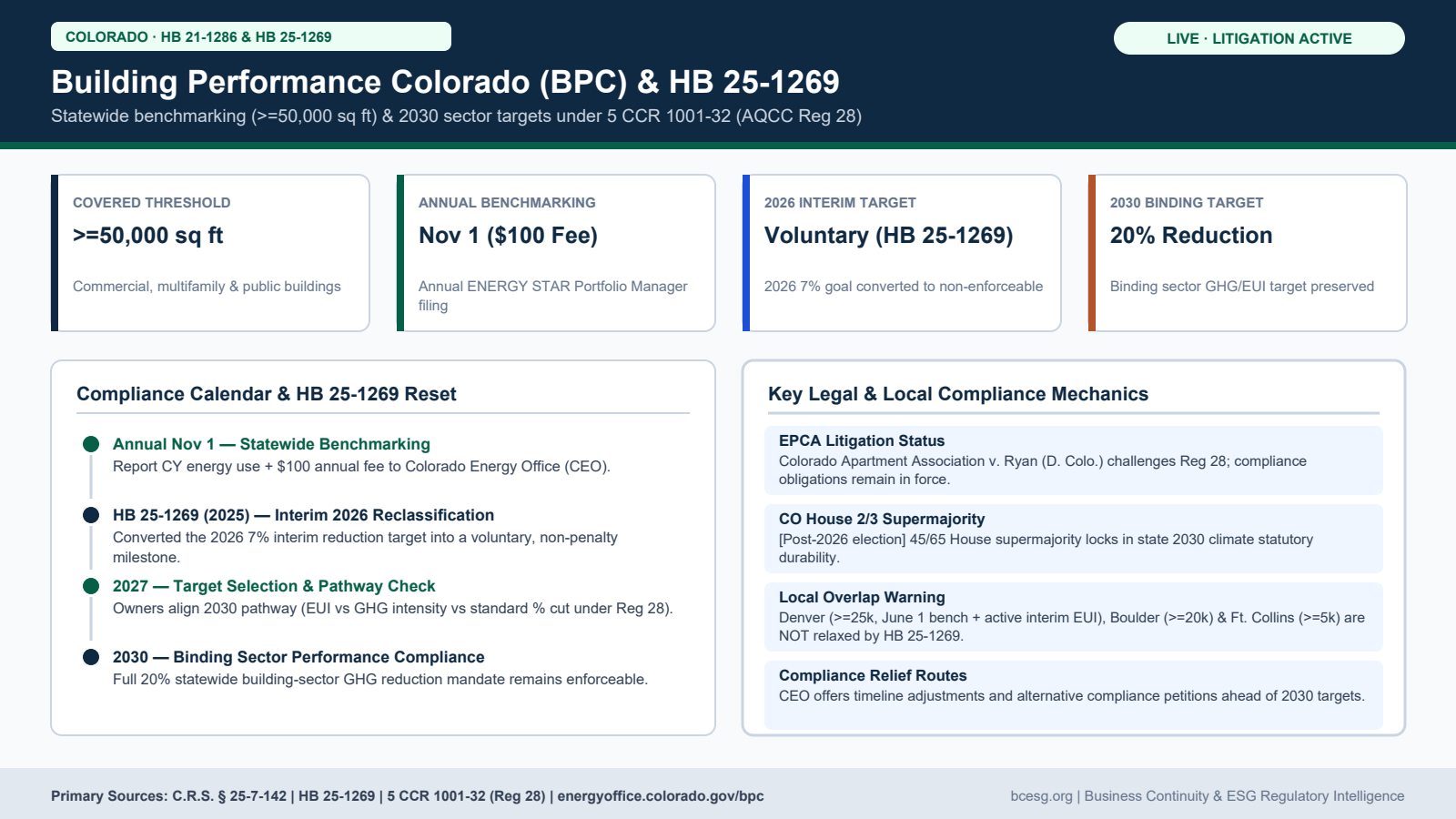
    Short answer: Colorado’s statewide building performance statute remains live and binding for 2030—even though HB 25-1269 removed mandatory penalties around the interim 2026 milestone. Under Building Performance Colorado (BPC) and HB 25-1269, covered owners of commercial, multifamily, and public buildings of 50,000 gross sq ft or more must continue annual November 1 benchmarking ($100 fee) and remain legally on track for the 2030 20% sector emissions/EUI target.

    Two structural traps catch Colorado asset managers off guard: mistaking HB 25-1269’s voluntary 2026 state target for a pause on municipal Energize Denver interim caps, and assuming pending federal EPCA litigation excuses annual state reporting.

    Statutory Status at a Glance
    • Governing Authority: C.R.S. § 25-7-142 (HB 21-1286), HB 25-1269 (2025), and AQCC Regulation 28 (5 CCR 1001-32).
    • Administering Agencies: Colorado Energy Office (CEO) & CDPHE Air Quality Control Commission.
    • Covered Threshold: Commercial, multifamily, and public buildings ≥50,000 gross sq ft statewide.
    • Annual Benchmarking: Due every November 1 via Portfolio Manager with a $100 annual compliance fee.
    • 2026 vs. 2030 Split & Litigation: 2026 7% state target is now voluntary/non-penalty (HB 25-1269); 2030 20% target stays binding; Colorado Apartment Association v. Ryan (D. Colo.) EPCA challenge active without stay.
    Print-First Compliance Brief

    Navigate Colorado BPC, HB 25-1269 Relief, and Energize Denver Overlap

    2-page quick card distinguishing Colorado’s voluntary 2026 goal from binding 2030 targets, annual Nov 1 filing ($100 fee), and EPCA litigation status.

    What HB 25-1269 Changed—and What Stayed Binding

    Under the original HB 21-1286 and Regulation 28 schedule, buildings ≥50,000 sq ft faced an intermediate 7% sector-wide reduction milestone in 2026 ahead of the 20% reduction target in 2030. Recognizing post-pandemic grid mix and capital lead times, the General Assembly enacted HB 25-1269 in 2025.

    HB 25-1269 expressly converted the 2026 7% interim goal into a non-enforceable voluntary goal, relieving owners from state interim civil penalties in 2026–2027. However, HB 25-1269 left the November 1 annual benchmarking obligation intact and preserved full statutory authority for the 2030 20% sector emissions/EUI reduction requirement.

    • Compliance Pathway Flexibility: Building owners select between hitting a property-type Energy Use Intensity (EUI) target, an operational Greenhouse Gas Intensity (GHGI) target, or a standardized percentage EUI/GHG reduction pathway under Regulation 28.
    • 2026 Election Trajectory Context (Inferred): Following the November 2026 Colorado House shift to a 45/65 two-thirds majority, legislative repeal risk against the 2030 BPC statutory mandate is low, signaling long-run regulatory continuity for decarbonization planning.
    Obligation LayerScope & CitationCurrent Deadlines & Enforceability
    Annual BenchmarkingC.R.S. § 25-7-142 (>=50k sq ft)Annual Nov 1 Portfolio Manager report + $100 fee (Live/Mandatory)
    2026 Interim Target (7%)HB 25-1269 (amending Reg 28)Converted to non-enforceable voluntary target (No 2026 state fine)
    2030 Binding Target (20%)5 CCR 1001-32 (AQCC Reg 28)Mandatory 2030 EUI / GHGI / % reduction compliance preserved
    EPCA Preemption SuitColorado Apt. Assoc. v. Ryan (D. Colo.)Litigation active; no injunction staying BPC filings or 2030 roadmap
    Summary diagram of Building Performance Colorado (BPC) >=50,000 sq ft November 1 benchmarking, HB 25-1269 voluntary 2026 interim target reset, 2030 binding reduction, and EPCA litigation posture.
    Building Performance Colorado (BPC) statutory calendar under C.R.S. § 25-7-142, HB 25-1269 (2025), and 5 CCR 1001-32 (AQCC Reg 28).

    Don't Confuse State Relief With Energize Denver or Local Rules

    Colorado owners frequently apply statewide HB 25-1269 logic across Denver, Boulder, Fort Collins, and Aspen portfolios—creating unexpected local noncompliance. Local ordinances operate on independent home-rule statutory authority and lower square-footage triggers.

    Owners managing multi-state western real estate should cross-check Colorado’s 50,000 sq ft floor against Washington CBPS (>20,000 sq ft Tier 2) and California AB 802 (>50,000 sq ft June 1 benchmarking) to harmonize Portfolio Manager data requests across utilities.

    • Denver (Energize Denver, DRMC Ch. 4): Covers buildings ≥25,000 sq ft with June 1 annual benchmarking and separate interim/final EUI caps—NOT converted to voluntary by state HB 25-1269.
    • Boulder & Fort Collins: Boulder mandates ≥20,000 sq ft annual benchmarking plus 10-year audits/RCx and LED retrofits; Fort Collins BEWS requires annual June 1 benchmarking down to 5,000 sq ft.

    Litigation Posture: Colorado Apartment Association v. Ryan

    Industry groups filed Colorado Apartment Association v. Ryan in U.S. District Court (D. Colo.) arguing federal Energy Policy and Conservation Act (EPCA) preemption against state building energy caps. Because no court injunction currently suspends BPC benchmarking or Regulation 28’s 2030 planning obligations, owners should treat litigation as background legal risk rather than a filing excuse—similar to how NYC Local Law 97 compliance proceeded to Court of Appeals resolution while deadlines ran.

    Compliance Execution Checklist

    StepOwner / TeamAuditable Deliverable
    1. Annual Nov 1 FilingProperty MgrFile whole-building Portfolio Manager data + remit $100 fee to Colorado Energy Office before Nov 1.
    2. Pathway AuditEnergy EngineerSelect optimal 2030 Reg 28 pathway (EUI vs. GHGI vs. standard %) and verify meter accuracy.
    3. Municipal SeparationPortfolio LeadSegregate Denver (>=25k), Boulder (>=20k), Ft. Collins (>=5k), and Aspen schedules from state BPC rules.
    4. CapEx & PetitionsAsset FinanceDocument equipment end-of-life windows and file CEO timeline adjustments early if hardship applies.
    Field & Print Package

    Keep This Colorado Compliance Checklist Handy

    Download the formatted 2-page PDF reference brief or pull the structured Markdown edition for internal compliance documentation.

    Frequently Asked Questions

    Did HB 25-1269 repeal Building Performance Colorado?

    No. HB 25-1269 converted only the interim 2026 7% reduction goal into a non-enforceable voluntary milestone. Annual November 1 benchmarking ($100 fee) and the 2030 binding 20% sector reduction target under AQCC Regulation 28 remain in force.

    When is annual Colorado BPC benchmarking due?

    Every November 1 for buildings of 50,000 gross sq ft or more, accompanied by a $100 annual fee paid to the Colorado Energy Office.

    Does HB 25-1269 relax Energize Denver deadlines for my Denver building?

    No. Energize Denver is a separate municipal ordinance (covering buildings >=25,000 sq ft with June 1 annual benchmarking and local EUI targets) unaffected by Colorado's state interim adjustment.

    Primary Authorities & Official Resources

    Informational notice: This guide summarizes enacted statutes, regulations, or pending legislative records from the primary authorities linked above as of November 14, 2026. It is not legal, accounting, or licensed engineering advice.

BC ESG

ESG Strategy, Sustainability Intelligence, and Business Continuity for Forward-Thinking Organizations

© 2026 BC ESG — Business Continuity, ESG & Sustainability Intelligence