Category: Space Cluster Freight & Valley

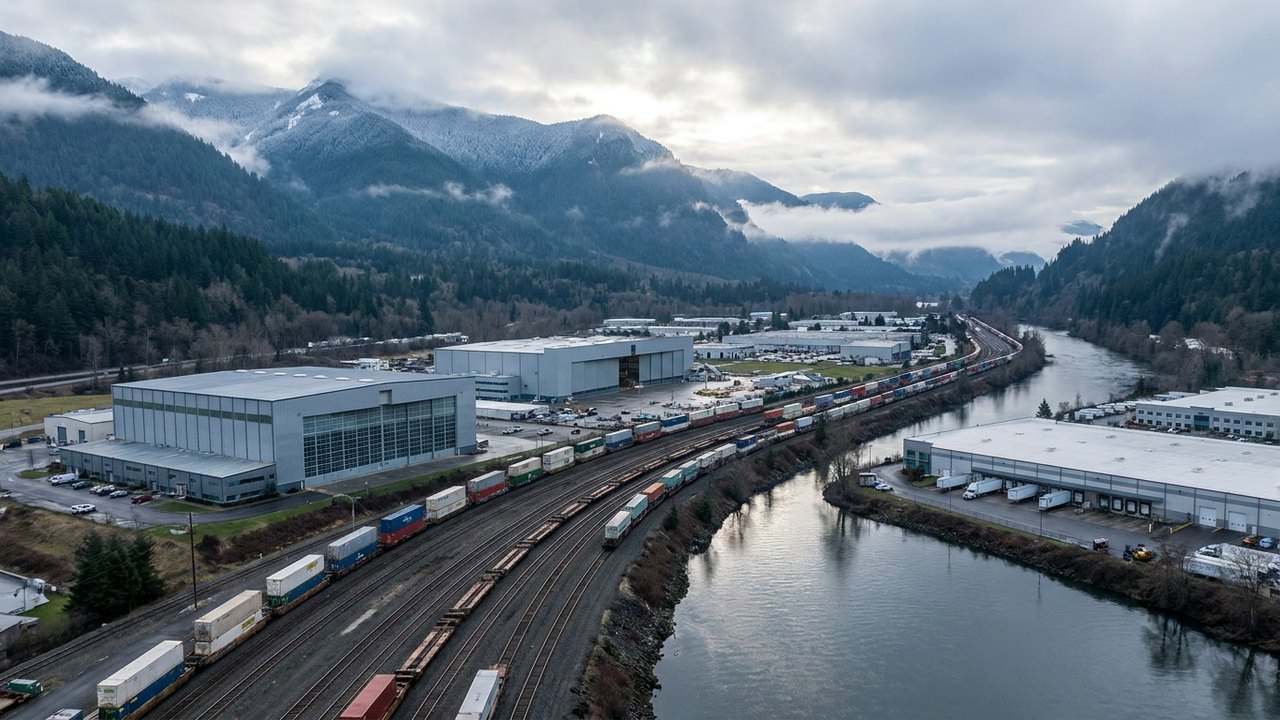
Green River Valley floodplains, SR 167/I-5/I-90/BNSF/NWSA corridors, space-hardware movement precedents, and corridor-closure operational playbooks for Washington’s space cluster.

  • Annual Green River Valley Corridor & Floodplain Continuity Audit Checklist

    Annual Green River Valley Corridor & Floodplain Continuity Audit Checklist

    Synthesizes Batch 7 valley, corridor, hardware, and playbook controls into one annual pre-winter checklist.

    FREIGHT, RAIL & VALLEY · CLOSURE PLAYBOOK · OPERATIONAL PLAYBOOK (ANNUAL AUDIT)
    Annual Valley Continuity Audit Checklist
    A 10-point annual October audit for Kent, Auburn, Renton, and Tukwila space facilities—verifying levee repair status toward 2031, generator fuel, KCC 21A.24 elevation, OSOW curfews, and upland staging.
    Primary Agency / Source: BC ESG Facilities / EHS & Supply-Chain  |  As-Of / Horizon: 2026-11-16 (Run Annually Each October)
    FREIGHT, RAIL & VALLEY · PDF & MARKDOWN TWIN
    Annual Valley Continuity Audit Checklist — Reference Brief
    Download the 2-page printable reference PDF or read the clean Markdown twin for AI and engineering workflows.
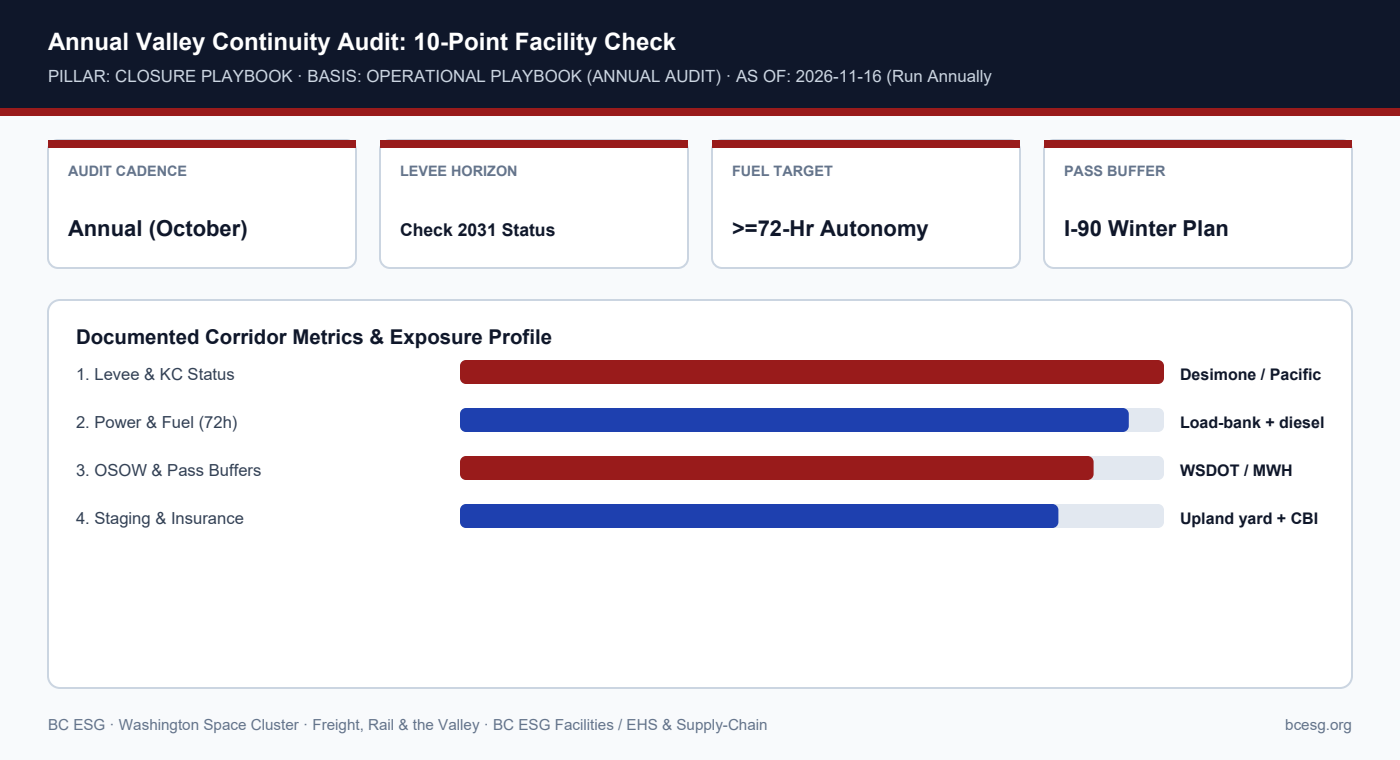
    Annual Valley Continuity Audit: 10-Point Facility Check
    Annual Valley Continuity Audit: 10-Point Facility Check

    Documented Corridor Facts & Continuity Record

    • Run this 10-point continuity audit every October before the November–February Pacific Northwest atmospheric-river season.
    • 1–3 (Valley & Facility): Check King County Desimone (2031 horizon) and Pacific levee updates; verify Elevation Certificates (+3 ft BFE); load-test generators and top off 72-hour diesel.
    • 4–7 (Corridors & Hardware): Confirm WSDOT SR 167 Gateway construction detours; refresh 49 CFR hazmat alternate routes; validate ITAR-compliant upland staging yards; review 15–30d rail alloy buffers.
    • 8–10 (Diversion & Governance): Confirm SEA/BFI Known Shipper status; test force-majeure notice templates; verify Ingress/Egress & flood insurance sublimits.

    Annual October Valley Continuity Audit Scorecard

    #Audit ItemOwnerPass Criterion
    1Levee & Dam Status CheckFacilities / EHSReviewed KC DNRP & USACE updates
    2Generator & 72h Fuel AutonomyFacilities / EHSLoad-tested; >=72h fuel contract
    3KCC 21A.24 & Hazmat ElevationFacilities / EHSDrums & switchgear > BFE + 3ft
    4Upland Staging & Air DiversionSupply-ChainActive SEA/BFI broker + gated yard
    5Insurance & Prime Notice PackFinance / PMCBI/Ingress limits & 24h template

    Operational Exposure & Facility Playbook

    • Store signed October audit scorecards alongside AS9100D business-continuity / risk-management records (Clause 6.1).
    • Re-run a mini-check whenever King County issues a Flood Phase 2 alert.
    • Link this checklist directly to Facilities/EHS (#2061, #2067) and Program Manager (#2079) desk briefs.

    Connected Valley Cities, Segments & Role Briefs

    Primary Sources & Agency References

  • Prime Schedule-Slip & Force-Majeure Documentation Playbook During Corridor Closures

    Prime Schedule-Slip & Force-Majeure Documentation Playbook During Corridor Closures

    Contract governance playbook; legal counsel should review specific prime flow-down clauses.

    FREIGHT, RAIL & VALLEY · CLOSURE PLAYBOOK · OPERATIONAL PLAYBOOK + CONTRACT GOVERNANCE
    Schedule-Slip & Force-Majeure Playbook
    How Program Managers and Finance Leads document dated levee breaches, WSDOT highway closures, and pass bans to protect prime contract milestones and business-interruption insurance claims.
    Primary Agency / Source: Program Management & Finance Governance  |  As-Of / Horizon: 2026-11-16
    FREIGHT, RAIL & VALLEY · PDF & MARKDOWN TWIN
    Schedule-Slip & Force-Majeure Playbook — Reference Brief
    Download the 2-page printable reference PDF or read the clean Markdown twin for AI and engineering workflows.
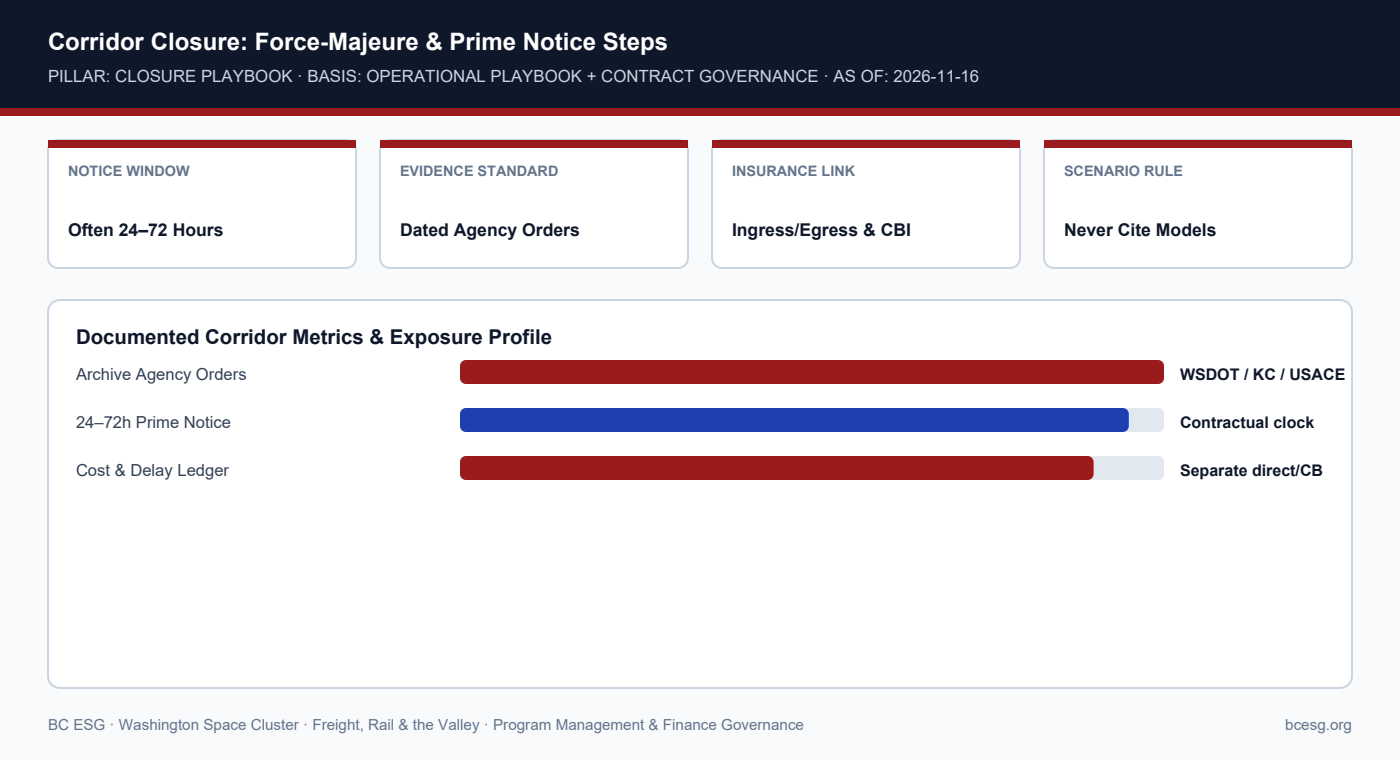
    Corridor Closure: Force-Majeure & Prime Notice Steps
    Corridor Closure: Force-Majeure & Prime Notice Steps

    Documented Corridor Facts & Continuity Record

    • Prime aerospace subcontracts typically require written excusable-delay / force-majeure notice within 24 to 72 hours of a qualifying disruption.
    • Attach primary dated agency receipts: King County evacuation orders, WSDOT SR 167/I-90 closure bulletins, or USACE dam advisories—never modeled planning scenarios.
    • Track extra expedite freight, overtime, and idle-cell hours in a dedicated cost code for Contingent Business Interruption (CBI) or ingress/egress insurance claims.

    Force-Majeure & Insurance Evidence Pack

    Claim / Notice TypeRequired Primary ReceiptOwner
    Excusable Schedule DelayDated WSDOT closure / KC evacuation orderProgram Manager (#2079)
    Ingress / Egress InsuranceTimestamped road-block proof + lost-hour logFinance Lead (#2100)
    Customer Recovery PlanPre-vetted detour / air-diversion scheduleSupply-Chain (#2052)

    Operational Exposure & Facility Playbook

    • Never wait until a missed delivery date to notify a prime buyer; send a factual early-warning notice the day SR 167 or I-90 closes.
    • Verify whether your property policy includes 'Ingress/Egress' and 'Civil Authority' coverage for levee evacuations without physical water entry.
    • Keep all dated WSDOT/King County screenshots in a single WO/incident folder.

    Connected Valley Cities, Segments & Role Briefs

    Primary Sources & Agency References

  • Critical-Hardware Air-Freight Diversion Playbook: Using SEA, BFI, and PAE

    Critical-Hardware Air-Freight Diversion Playbook: Using SEA, BFI, and PAE

    Grounded in Port of Seattle SEA volume (69% of WA air cargo) and BFI/PAE aerospace roles.

    FREIGHT, RAIL & VALLEY · CLOSURE PLAYBOOK · OPERATIONAL PLAYBOOK
    SEA / BFI / PAE Air Diversion Playbook
    When highway or ocean corridors fail, valley space programs divert critical avionics, electronics, and oversized assemblies through Sea-Tac (SEA), Boeing Field (BFI), or Paine Field (PAE)—requiring pre-cleared brokers and last-mile plans.
    Primary Agency / Source: Port of Seattle / King County / Paine Field  |  As-Of / Horizon: 2026-11-16
    FREIGHT, RAIL & VALLEY · PDF & MARKDOWN TWIN
    SEA / BFI / PAE Air Diversion Playbook — Reference Brief
    Download the 2-page printable reference PDF or read the clean Markdown twin for AI and engineering workflows.
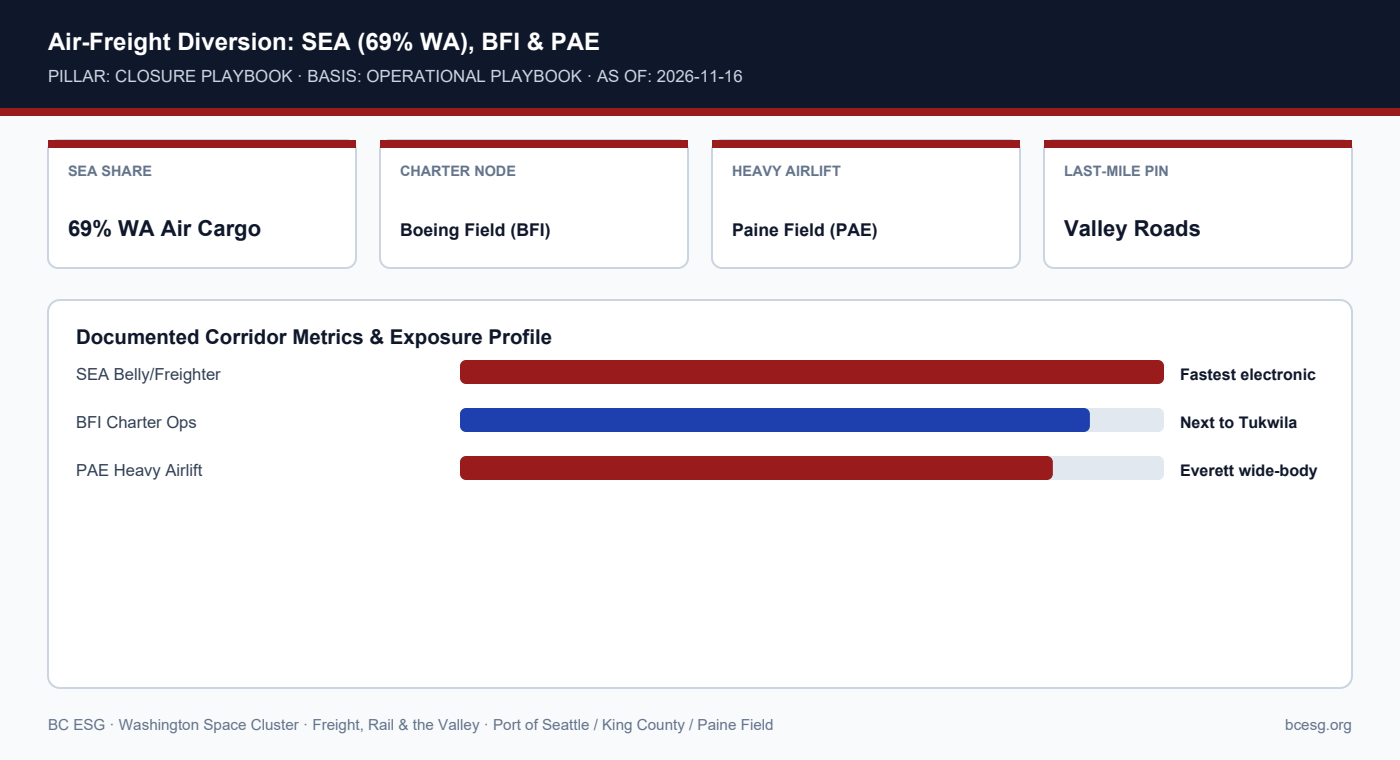
    Air-Freight Diversion: SEA (69% WA), BFI & PAE
    Air-Freight Diversion: SEA (69% WA), BFI & PAE

    Documented Corridor Facts & Continuity Record

    • Sea-Tac (SEA) sits on high ground west of the valley and remains open to freighters even during Green River floods.
    • Boeing Field (BFI) provides immediate charter proximity for Tukwila and Kent facilities, while Paine Field (PAE) supports heavy aerospace airlift north of Seattle.
    • Even when air cargo lands safely at SEA or BFI, last-mile sprinter vans must avoid flooded Tukwila/Kent river crossings.

    Three-Airport Air Diversion Selector

    Cargo TypePrimary AirportLast-Mile Risk to Kent
    Avionics / Boards (<500 lbs)Sea-Tac (SEA)SR 518 / I-5 / SR 167 flood detours
    Urgent Charter / Mid-SizeBoeing Field (BFI)East Marginal Way / Tukwila crossings
    Ultra-Large AerospacePaine Field (PAE)I-5 / I-405 metro transit + OSOW curfews

    Operational Exposure & Facility Playbook

    • Pre-establish Known Shipper / TSA Indirect Air Carrier accounts before an emergency so expedite shipments do not stall at screening.
    • Ensure air-ride sprinter vans with U.S.-person drivers are on call for ITAR-controlled SEA/BFI pickups.
    • Keep shock/tilt loggers on every air-diverted flight unit.

    Connected Valley Cities, Segments & Role Briefs

    Primary Sources & Agency References

  • Port Drayage & NWSA Breakbulk Congestion Playbook for Valley Importers

    Port Drayage & NWSA Breakbulk Congestion Playbook for Valley Importers

    Grounded in NWSA 2025 TEU volume (3,156,598 TEUs) and Tacoma East Blair 1 / Terminal 7 breakbulk records.

    FREIGHT, RAIL & VALLEY · CLOSURE PLAYBOOK · OPERATIONAL PLAYBOOK
    NWSA Port Drayage & Breakbulk Playbook
    How valley space manufacturers manage container demurrage, Tacoma breakbulk heavy-lift windows, and I-5/SR 167 drayage bottlenecks across NWSA's 3.16M-TEU gateway.
    Primary Agency / Source: NWSA / WSDOT  |  As-Of / Horizon: 2026-11-16
    FREIGHT, RAIL & VALLEY · PDF & MARKDOWN TWIN
    NWSA Port Drayage & Breakbulk Playbook — Reference Brief
    Download the 2-page printable reference PDF or read the clean Markdown twin for AI and engineering workflows.
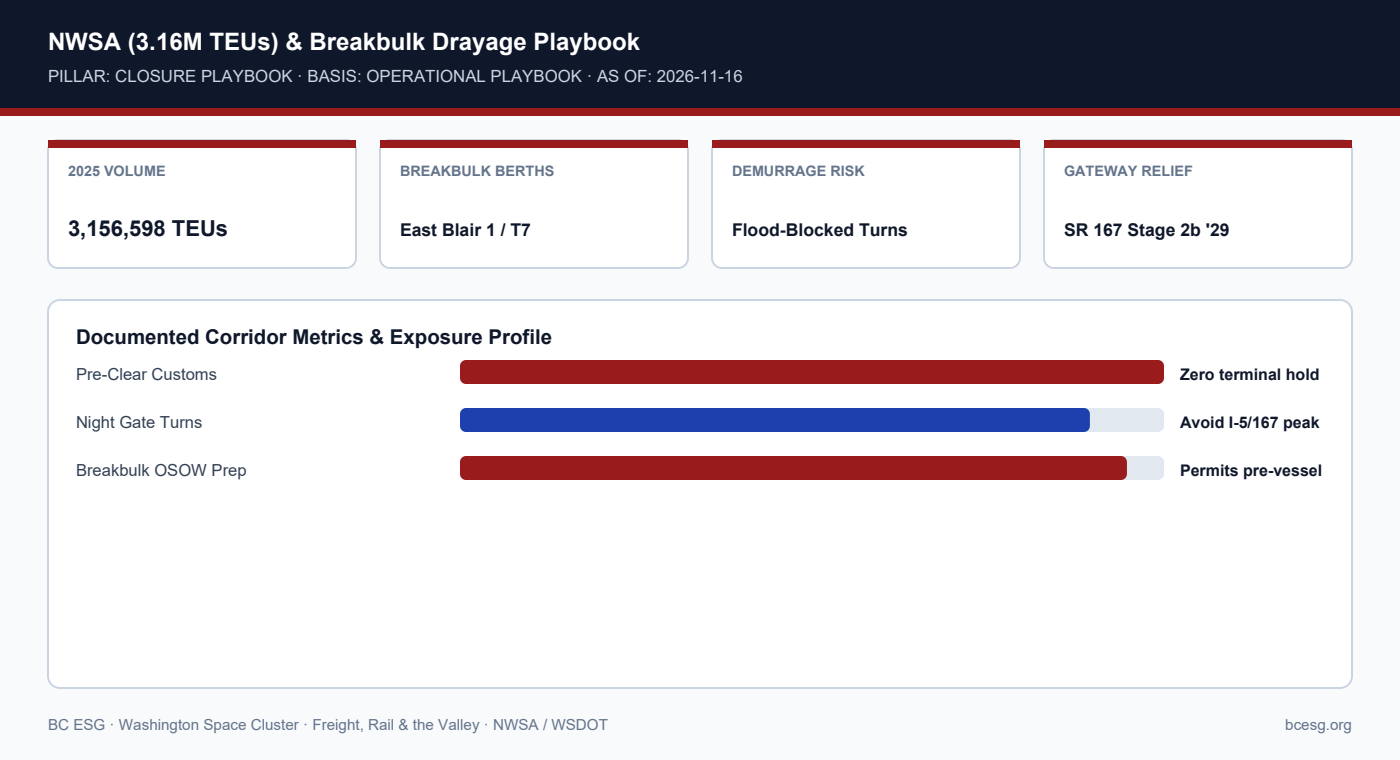
    NWSA (3.16M TEUs) & Breakbulk Drayage Playbook
    NWSA (3.16M TEUs) & Breakbulk Drayage Playbook

    Documented Corridor Facts & Continuity Record

    • Clear customs, ITAR/EAR import licenses, and USDA/EPA TSCA checks 72 hours before vessel berthing at Seattle or Tacoma.
    • For Tacoma breakbulk (East Blair 1 / Terminal 7), secure WSDOT OSOW and superload permits before the ship arrives—port storage fees escalate rapidly.
    • Use night-gate drayage appointments whenever available to bypass peak daytime I-5/Fife congestion until SR 167 Stage 2b opens in 2029.

    NWSA Import Continuity Checklist

    StageBottleneckPlaybook Action
    Pre-Arrival (T-72h)Customs / ITAR holdFile entry & broker release early
    Berth DischargeBreakbulk OSOW permit lagPre-approve WSDOT route before arrival
    Inland DrayageSR 167 flood / I-5 peakBook night gates + upland drop yard

    Operational Exposure & Facility Playbook

    • Maintain an upland drop-yard agreement in Fife or SeaTac so containers can pull off terminal free-time even if a Kent dock is flood-isolated.
    • Track NWSA terminal gate alerts during winter windstorms.
    • Verify container seal integrity on arrival for AS9100D receiving inspection.

    Connected Valley Cities, Segments & Role Briefs

    Primary Sources & Agency References

  • Rail Disruption & Auburn Yard Delay Playbook: Buffering Heavy Raw Stock and Tooling

    Rail Disruption & Auburn Yard Delay Playbook: Buffering Heavy Raw Stock and Tooling

    Operational playbook grounded in shared-trackage and 2014 rail-loss precedents.

    FREIGHT, RAIL & VALLEY · CLOSURE PLAYBOOK · OPERATIONAL PLAYBOOK
    Rail Disruption & Auburn Yard Playbook
    Because BNSF and Union Pacific share the same Green River Valley tracks and Auburn Yard sits on the floodplain, procurement leads need safety-stock buffers and upland transload options for rail-dependent metals and tooling.
    Primary Agency / Source: WSDOT / BNSF / BC ESG Procurement  |  As-Of / Horizon: 2026-11-16
    FREIGHT, RAIL & VALLEY · PDF & MARKDOWN TWIN
    Rail Disruption & Auburn Yard Playbook — Reference Brief
    Download the 2-page printable reference PDF or read the clean Markdown twin for AI and engineering workflows.
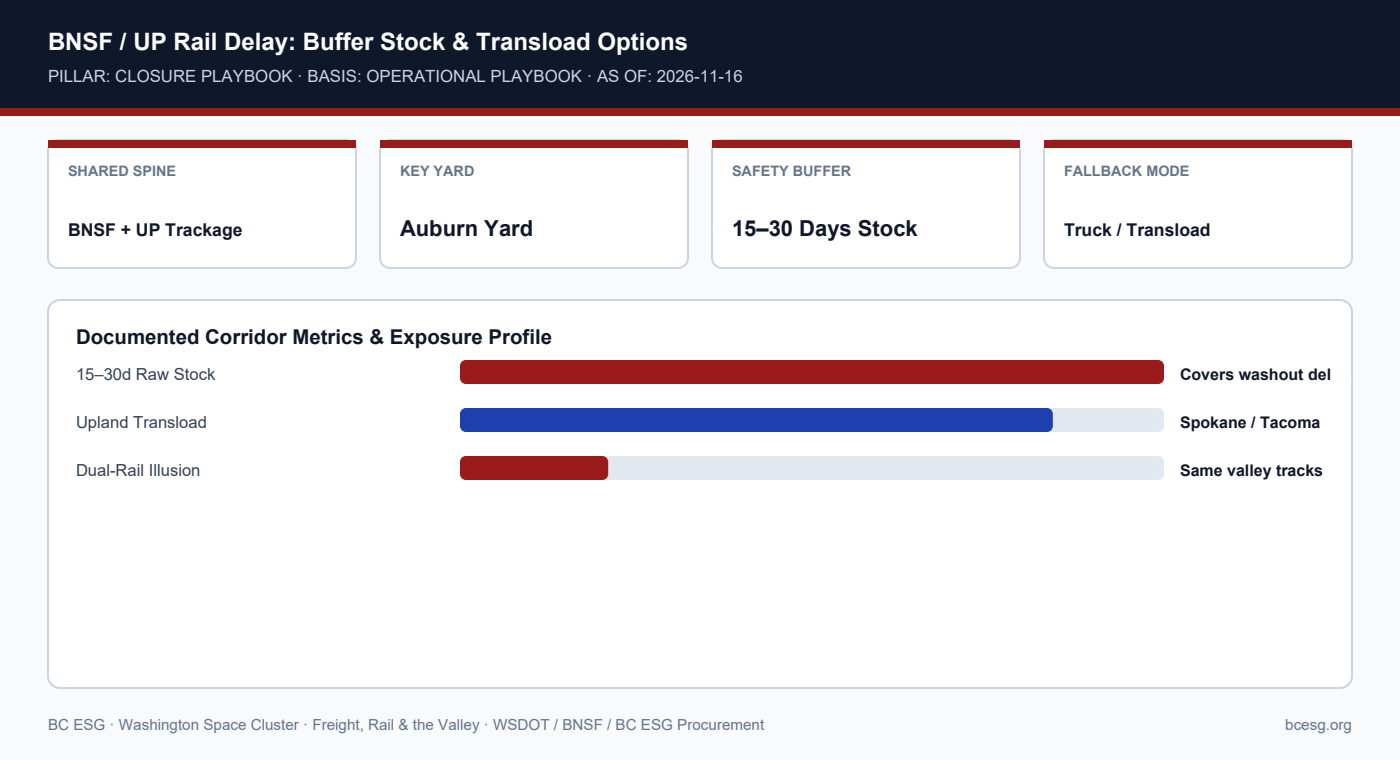
    BNSF / UP Rail Delay: Buffer Stock & Transload Options
    BNSF / UP Rail Delay: Buffer Stock & Transload Options

    Documented Corridor Facts & Continuity Record

    • Verify which tier-1 aluminum/titanium plate, forging, or chemical suppliers rely on BNSF or Union Pacific carload deliveries through Auburn Yard.
    • Maintain 15–30 days of critical-alloy safety stock on site (above flood elevation) to absorb 1–2 week rail washouts or derailment delays.
    • Pre-qualify an upland rail-to-truck transload terminal (e.g., Spokane or Tacoma upland) for emergency flatbed conversion.

    Rail Continuity Controls for Space Procurement

    VulnerabilityWhy Dual-Carrier FailsMitigation
    Valley Mainline WashoutUP runs on BNSF tracks15–30d on-site alloy safety stock
    Trans-Cascade Derailment2014 Clark Fork precedentFull-replacement transit insurance + spare

    Operational Exposure & Facility Playbook

    • Require suppliers to flag any raw-material shipments routed by rail rather than dedicated truck.
    • Audit DFARS 252.225-7009 specialty-metals traceability before buying emergency spot-market replacements.
    • Review rail-siding flood history if your facility uses direct spur delivery.

    Connected Valley Cities, Segments & Role Briefs

    Primary Sources & Agency References

  • Winter Pass Closure & OSOW Staging Playbook: I-90 Snoqualmie and Eastbound Test Hardware

    Winter Pass Closure & OSOW Staging Playbook: I-90 Snoqualmie and Eastbound Test Hardware

    Grounded in WSDOT OSOW pass rules and ITAR physical-custody requirements.

    FREIGHT, RAIL & VALLEY · CLOSURE PLAYBOOK · OPERATIONAL PLAYBOOK
    Winter Pass & OSOW Staging Playbook
    A practical staging playbook for hardware moving between Puget Sound and Moses Lake when WSDOT traction/chain laws automatically ban oversize loads on I-90 Snoqualmie Pass.
    Primary Agency / Source: WSDOT Mountain Passes / CVO  |  As-Of / Horizon: 2026-11-16
    FREIGHT, RAIL & VALLEY · PDF & MARKDOWN TWIN
    Winter Pass & OSOW Staging Playbook — Reference Brief
    Download the 2-page printable reference PDF or read the clean Markdown twin for AI and engineering workflows.
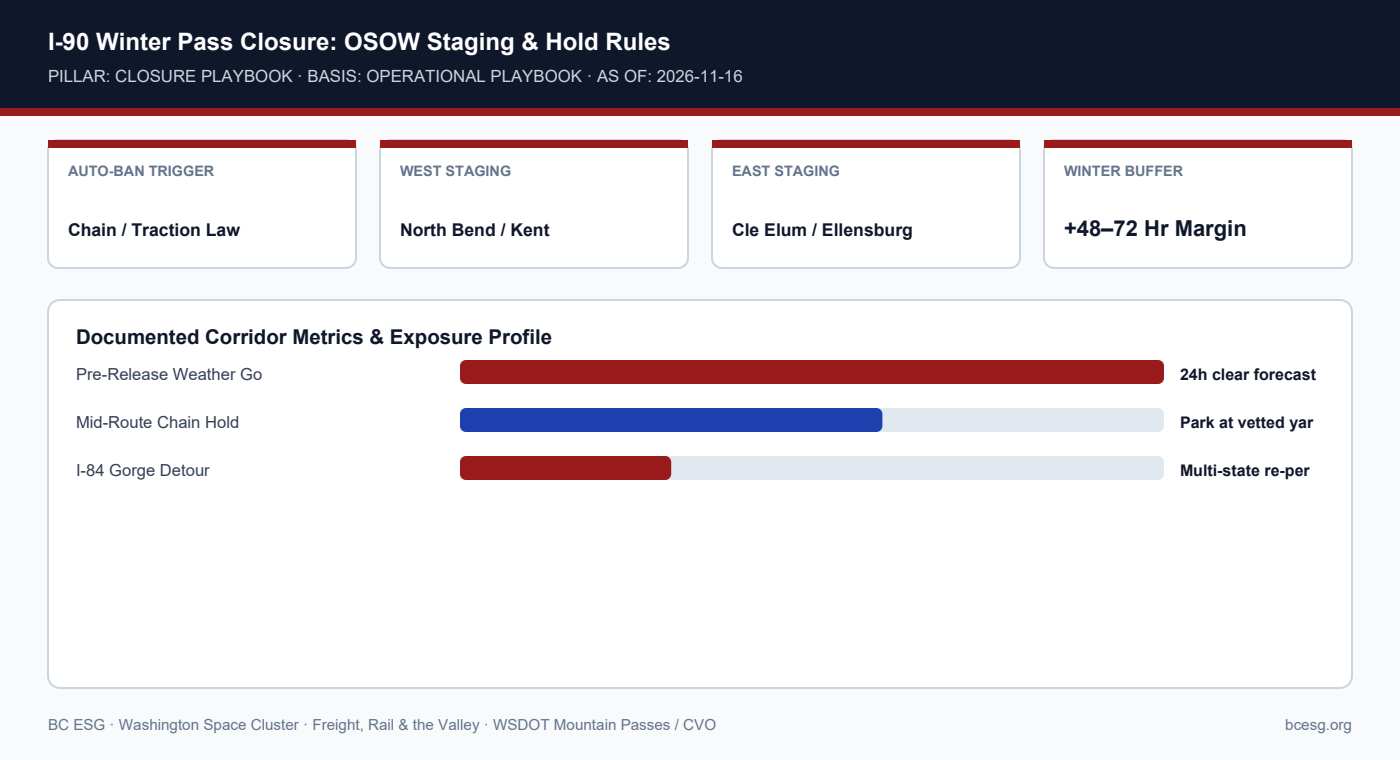
    I-90 Winter Pass Closure: OSOW Staging & Hold Rules
    I-90 Winter Pass Closure: OSOW Staging & Hold Rules

    Documented Corridor Facts & Continuity Record

    • Because WSDOT automatically voids OSOW travel during chain/traction restrictions on Snoqualmie Pass, every winter oversize move needs a pre-vetted staging yard.
    • Do not release an oversize load from Kent if the 24-hour WSDOT pass forecast shows incoming snow levels below 3,000 feet.
    • For ITAR/flight hardware, staging yards must provide gated, badged, or manned-security parking—never unguarded highway pullouts.

    I-90 Winter OSOW Go / No-Go Protocol

    ConditionDecisionAction
    Dry / Wet, No RestrictionsGORelease at 9:00 AM to clear SR 18 curfew
    Traction Tires / Chains ForecastHOLD AT ORIGINKeep hardware inside Kent/Auburn bay
    Unexpected Mid-Transit Chain LawSTAGE SECUREPark at pre-vetted North Bend/Cle Elum yard

    Operational Exposure & Facility Playbook

    • Add a 48–72 hour weather buffer to November–March Moses Lake test schedules.
    • Keep Oregon OSOW contingency contacts on file only if a multi-day I-90 closure justifies re-permitting via I-5/I-84.
    • Verify heated battery/nitrogen-purge support if sensitive payloads sit overnight in freezing temperatures.

    Connected Valley Cities, Segments & Role Briefs

    Primary Sources & Agency References

  • SR 167 Closure Reroute Playbook: Operating When I-5 Saturates

    SR 167 Closure Reroute Playbook: Operating When I-5 Saturates

    Combines Dec 15, 2025 6-mile SR 167 closure precedent with WA EMD Transportation Recovery Annex modeled I-5 saturation.

    FREIGHT, RAIL & VALLEY · CLOSURE PLAYBOOK · OPERATIONAL PLAYBOOK
    SR 167 Closure & I-5 Reroute Playbook
    When SR 167 closes (as on Dec 15, 2025) and I-5 saturates (as modeled in the County Recovery Annex), Kent and Auburn facilities must split traffic between local upland exits, SR 18 east, and off-peak dispatch.
    Primary Agency / Source: WSDOT / WA EMD Recovery Annex  |  As-Of / Horizon: 2026-11-16
    FREIGHT, RAIL & VALLEY · PDF & MARKDOWN TWIN
    SR 167 Closure & I-5 Reroute Playbook — Reference Brief
    Download the 2-page printable reference PDF or read the clean Markdown twin for AI and engineering workflows.
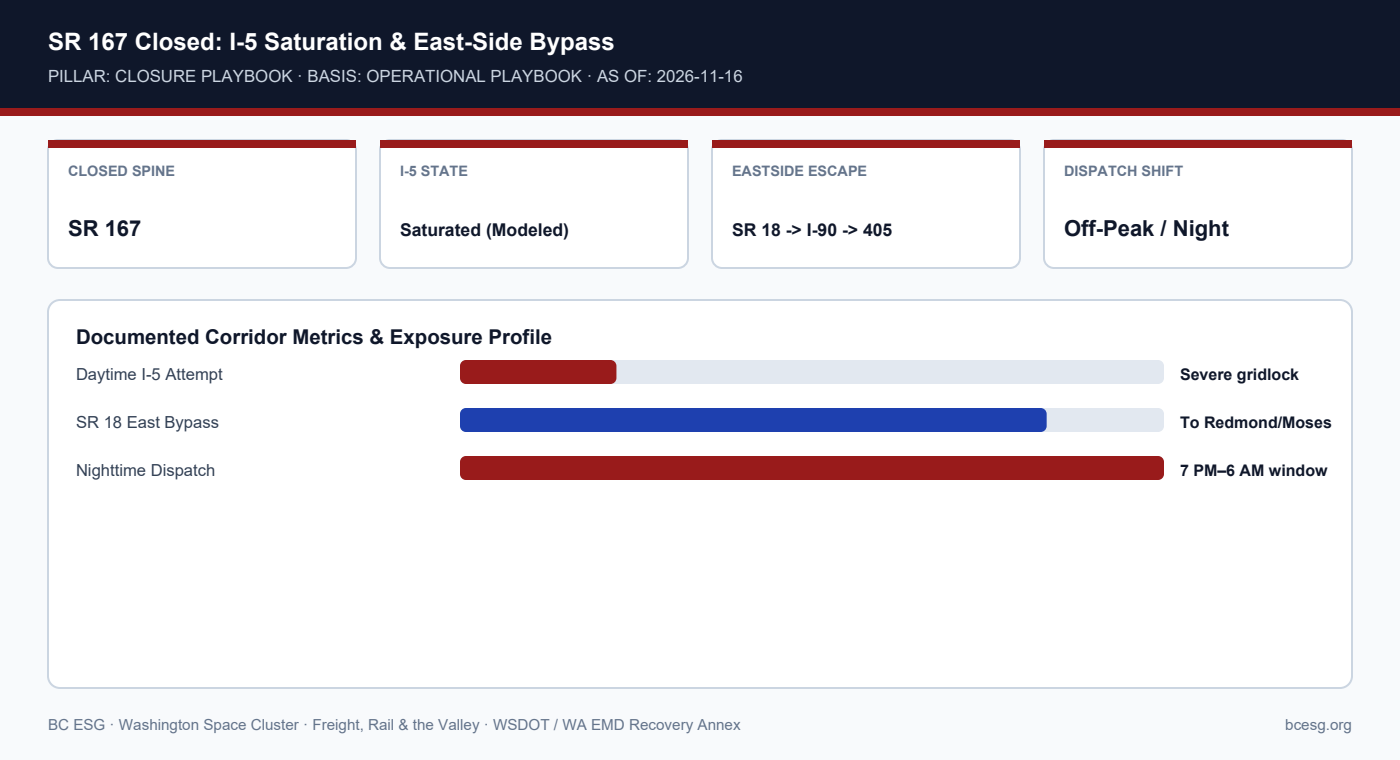
    SR 167 Closed: I-5 Saturation & East-Side Bypass
    SR 167 Closed: I-5 Saturation & East-Side Bypass

    Documented Corridor Facts & Continuity Record

    • Do not send daytime non-urgent box trucks onto I-5 when SR 167 closes; modeled Recovery Annex gridlock turns 20-minute runs into 3-hour stalls.
    • For Eastside deliveries (Kent/Auburn to Redmond/Bothell), route east via SR 18 -> I-90 -> I-405 if Tukwila/Renton SR 167 is shut.
    • Shift standard freight receiving/shipping to 7:00 PM–5:30 AM until SR 167 reopens.

    SR 167 Closure Dispatch Decision Table

    Origin–DestinationPrimary BlockedFallback RouteTiming Rule
    Kent -> Redmond / BothellSR 167 N -> I-405 NSR 18 E -> I-90 W -> I-405 NCheck OSOW curfews
    Kent -> Sea-Tac (SEA)SR 167 N -> I-405 -> 518Local upland arterials / I-5 NVerify Tukwila flood map
    Auburn -> Port of TacomaSR 167 S / I-5SR 18 W -> I-5 S (off-peak)Night window preferred

    Operational Exposure & Facility Playbook

    • Pre-authorize 24-hour receiving dock staffing during declared corridor emergencies.
    • Verify bridge weight limits on any municipal surface-street detour before releasing heavy trucks.
    • Communicate revised ETA windows to prime customers immediately.

    Connected Valley Cities, Segments & Role Briefs

    Primary Sources & Agency References

  • 72-Hour Valley Flood & Levee-Breach Playbook for Green River Space Facilities

    72-Hour Valley Flood & Levee-Breach Playbook for Green River Space Facilities

    Playbook anchored to Dec 15–16, 2025 historical breach sequence and King County Flood Services alert phases.

    FREIGHT, RAIL & VALLEY · CLOSURE PLAYBOOK · OPERATIONAL PLAYBOOK
    72-Hour Valley Flood Playbook
    A three-phase 72-hour playbook built from the Dec 15–16, 2025 Desimone and Pacific breaches—covering Flood Phase alerts, generator top-offs, hazmat elevation, shift release, and dock-isolation protocols.
    Primary Agency / Source: King County Flood Services / BC ESG Ops  |  As-Of / Horizon: 2026-11-16
    FREIGHT, RAIL & VALLEY · PDF & MARKDOWN TWIN
    72-Hour Valley Flood Playbook — Reference Brief
    Download the 2-page printable reference PDF or read the clean Markdown twin for AI and engineering workflows.
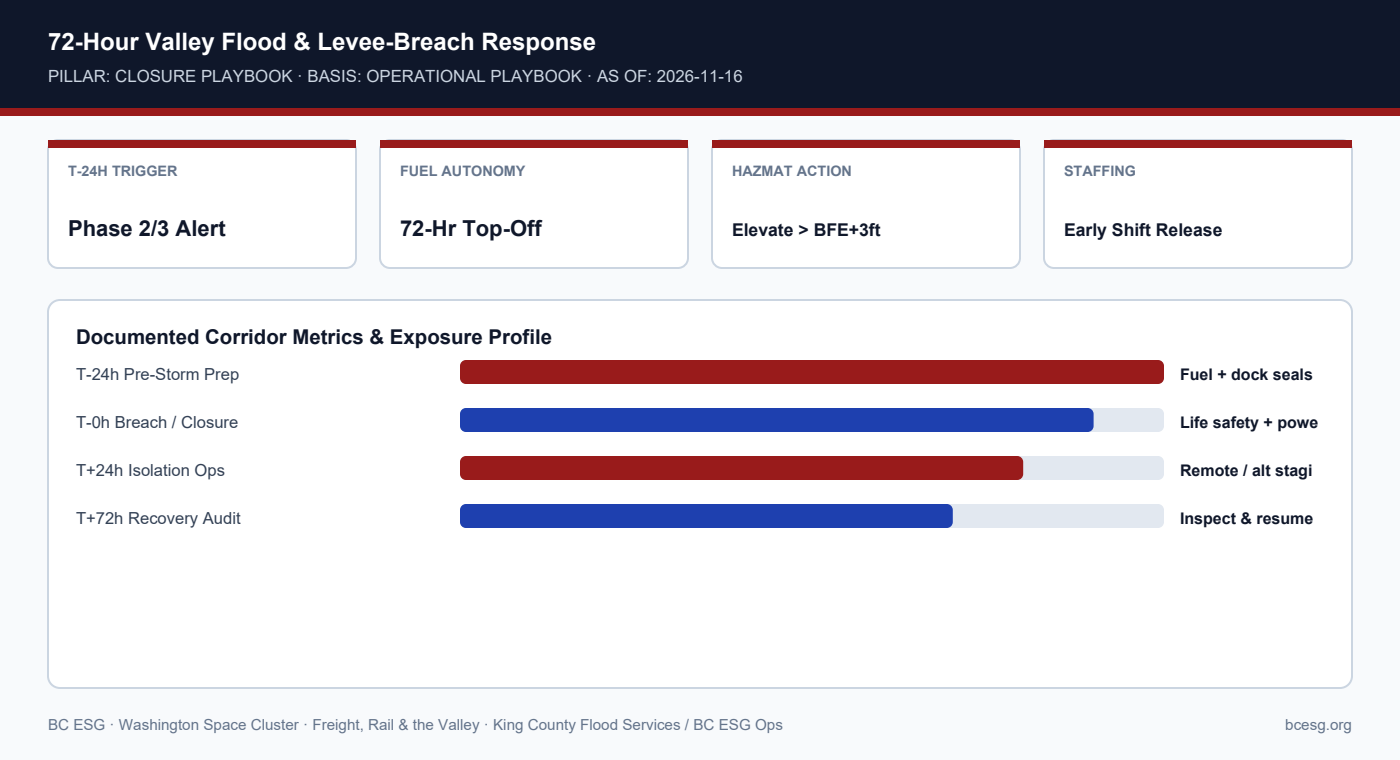
    72-Hour Valley Flood & Levee-Breach Response
    72-Hour Valley Flood & Levee-Breach Response

    Documented Corridor Facts & Continuity Record

    • T-24h (Atmospheric River / Phase 2–3 Alert): Top off backup generator diesel for 72+ hours, stage portable pumps, and move floor-level tooling and WAC 173-303 drums above +3 ft BFE.
    • T-0h (Levee Breach / SR 167 Closure): Account for all personnel, suspend non-essential inbound trucks, and verify UPS/generator transfer before grid sags.
    • T+24h to T+72h: Redirect inbound urgent shipments to pre-designated upland staging outside the valley (SeaTac CFS or Tacoma/Fife upland yards) until evacuation orders lift.

    72-Hour Valley Flood Action Matrix

    WindowTriggerFacilities / EHS ActionLogistics Action
    T-24 HoursKC Flood Phase 2/3Top off diesel; seal dock doors; elevate hazmatAccelerate critical pickups
    T-0 HoursBreach / Evacuation OrderLife-safety muster; verify cleanroom powerHold valley-bound trucks
    T+24–72 HoursSR 167 ClosedDocument outage & inspect perimeterReroute to upland staging

    Operational Exposure & Facility Playbook

    • Assign a single Incident Commander across Facilities/EHS (#2061) and Supply-Chain (#2052) before November.
    • Keep waterproof physical copies of KCC 21A.24 Elevation Certificates and emergency contacts in the security shack.
    • Conduct one tabletop drill each October before atmospheric-river season peaks.

    Connected Valley Cities, Segments & Role Briefs

    Primary Sources & Agency References

  • What Is Not in Our Data: Private Space Logistics Routes, Carrier Contracts, and Non-Public Manifests

    What Is Not in Our Data: Private Space Logistics Routes, Carrier Contracts, and Non-Public Manifests

    Explicit Stop-and-Report transparency page: never reconstruct or guess private company logistics routes.

    FREIGHT, RAIL & VALLEY · SPACE HARDWARE · MISSING / NOT-IN-OUR-DATA BOUNDARY
    Boundary: Private Routes Not in Our Data
    Public agency records document the Green River Valley's levees, SR 167, I-5, BNSF, NWSA, and SEA/BFI/PAE—but individual private space companies' exact truck routes, carrier contracts, and shipment schedules are not in our data.
    Primary Agency / Source: BC ESG Evidence-Only Standard  |  As-Of / Horizon: 2026-11-16
    FREIGHT, RAIL & VALLEY · PDF & MARKDOWN TWIN
    Boundary: Private Routes Not in Our Data — Reference Brief
    Download the 2-page printable reference PDF or read the clean Markdown twin for AI and engineering workflows.
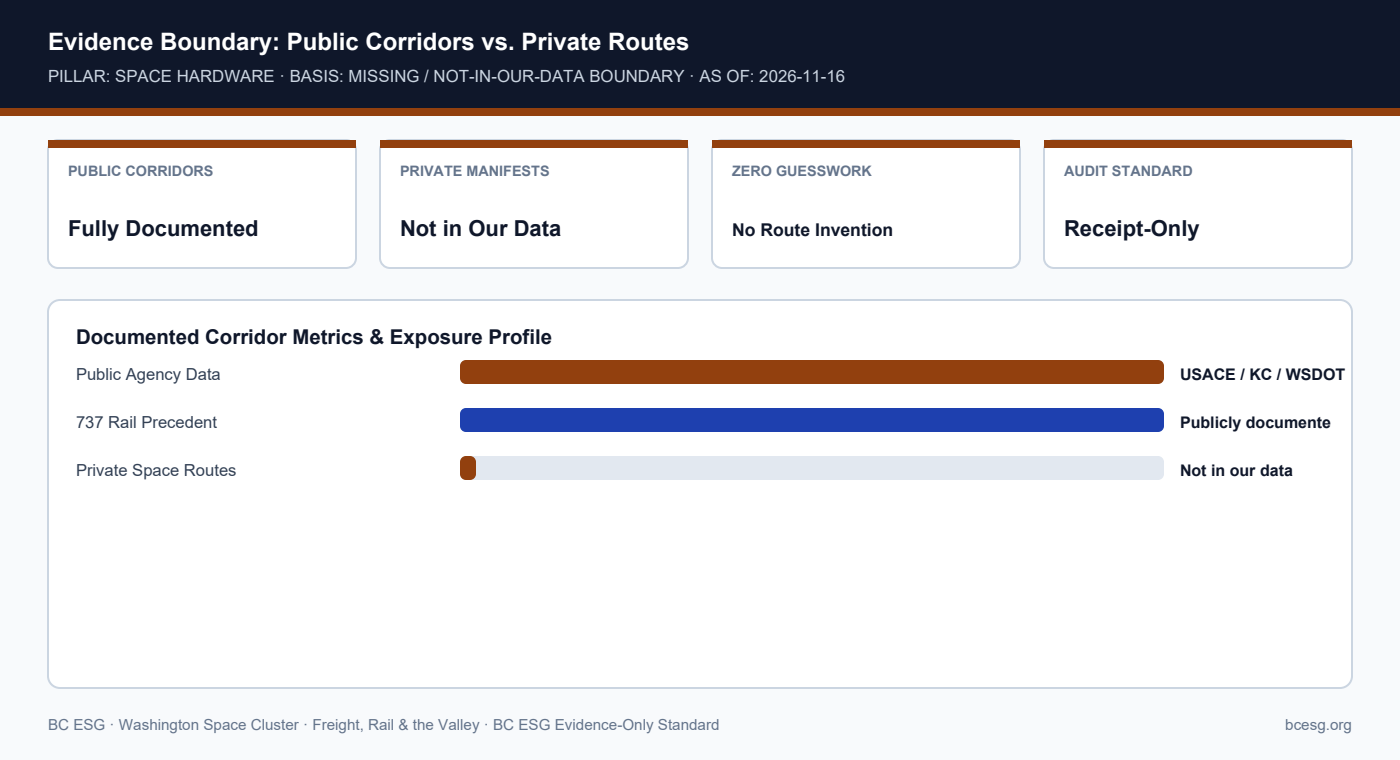
    Evidence Boundary: Public Corridors vs. Private Routes
    Evidence Boundary: Public Corridors vs. Private Routes

    Documented Corridor Facts & Continuity Record

    • Per William's reader-first and evidence-only standard, BC ESG documents only what primary public sources (USACE, King County, WSDOT, BNSF/NWSA, Port of Seattle) actually publish.
    • Public records establish where space facilities sit (Census #1382–#1565) and which shared corridors serve those cities (SR 167, I-5, I-90, BNSF, NWSA, SEA/BFI/PAE).
    • NOT IN OUR DATA: Exact carrier names, private truck schedules, barge/rail manifests, and proprietary routing for Blue Origin, Stoke Space, SpaceX Redmond, Amazon Leo, or any other private operator.

    Publicly Documented vs. Not-In-Our-Data Logistics Boundary

    CategoryStatusWhat We Publish
    Facility Cities & AddressesDocumented (Census)Publicly enumerable locations (Kent, Tukwila, Redmond, etc.)
    Flood, Dam & Levee EventsDocumented (USACE / KC)Dec 2025 breaches, 2009 seepage, 2031 repair horizon
    737 Rail & NWSA/SEA VolumesDocumented (BNSF / NWSA)1,700–1,800 mi rail, 2014 crash, 3.16M TEUs, 69% air
    Private Company Truck RoutesNOT IN OUR DATAExplicitly withheld rather than reconstructed

    Operational Exposure & Facility Playbook

    • Facilities and logistics leads should apply our corridor and flood-exposure baselines against their own confidential carrier routing.
    • When prime customers ask for sub-tier route resilience, disclose the shared valley corridor facts without fabricating private-carrier data.
    • Any future primary-source disclosure (e.g., public NEPA/FAA environmental transport filings) will be added only with dated receipts.

    Connected Valley Cities, Segments & Role Briefs

    Primary Sources & Agency References

  • Shock, Vibration & Cleanroom Integrity in Transit: Protecting Satellites Across Rough Valley Detours

    Shock, Vibration & Cleanroom Integrity in Transit: Protecting Satellites Across Rough Valley Detours

    Engineering transit controls aligned with AS9100D/NASA-STD-8739 quality gates in Batch 4/6; no specific company incident claimed.

    FREIGHT, RAIL & VALLEY · SPACE HARDWARE · ENGINEERING / PROGRAM PRACTICE
    Shock, Vibration & Cleanroom Transit
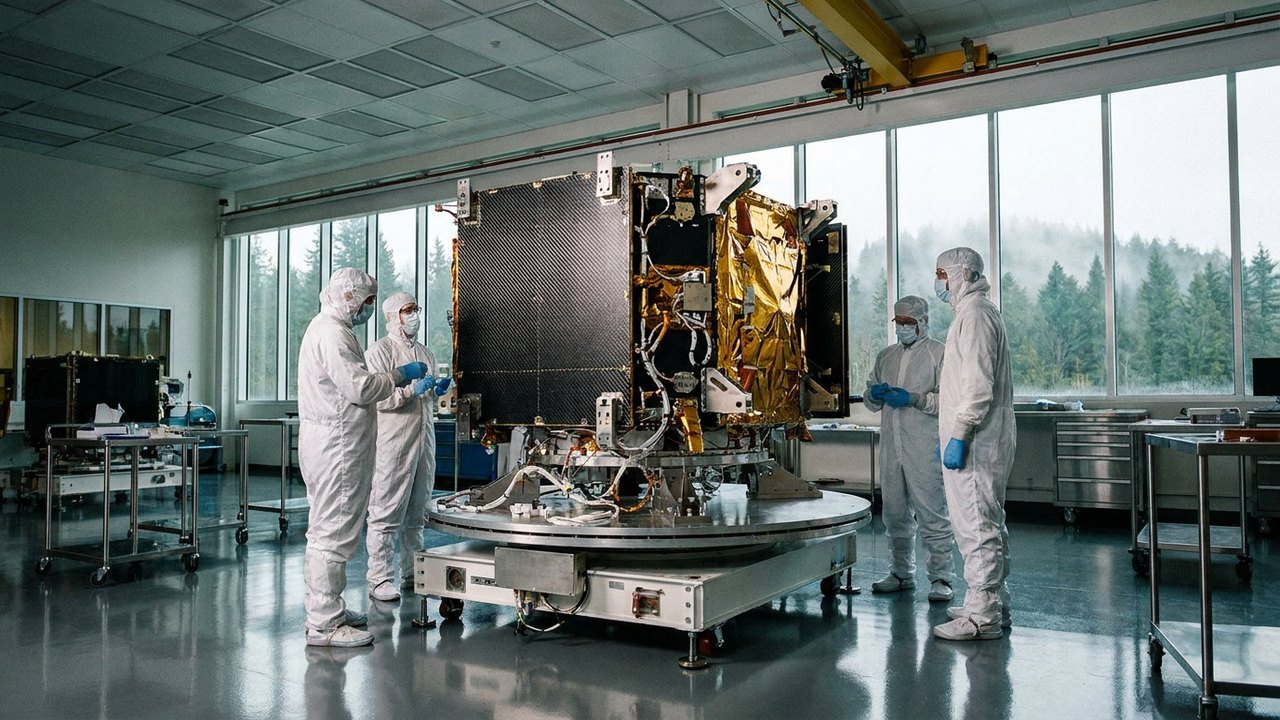
    Diverting delicate satellite buses, optics, or solar arrays off smooth freeways onto rutted valley surface-street detours during SR 167 closures increases shock/vibration and moisture-intrusion risks.
    Primary Agency / Source: BC ESG Segment & Quality Corpus  |  As-Of / Horizon: 2026-11-16
    FREIGHT, RAIL & VALLEY · PDF & MARKDOWN TWIN
    Shock, Vibration & Cleanroom Transit — Reference Brief
    Download the 2-page printable reference PDF or read the clean Markdown twin for AI and engineering workflows.
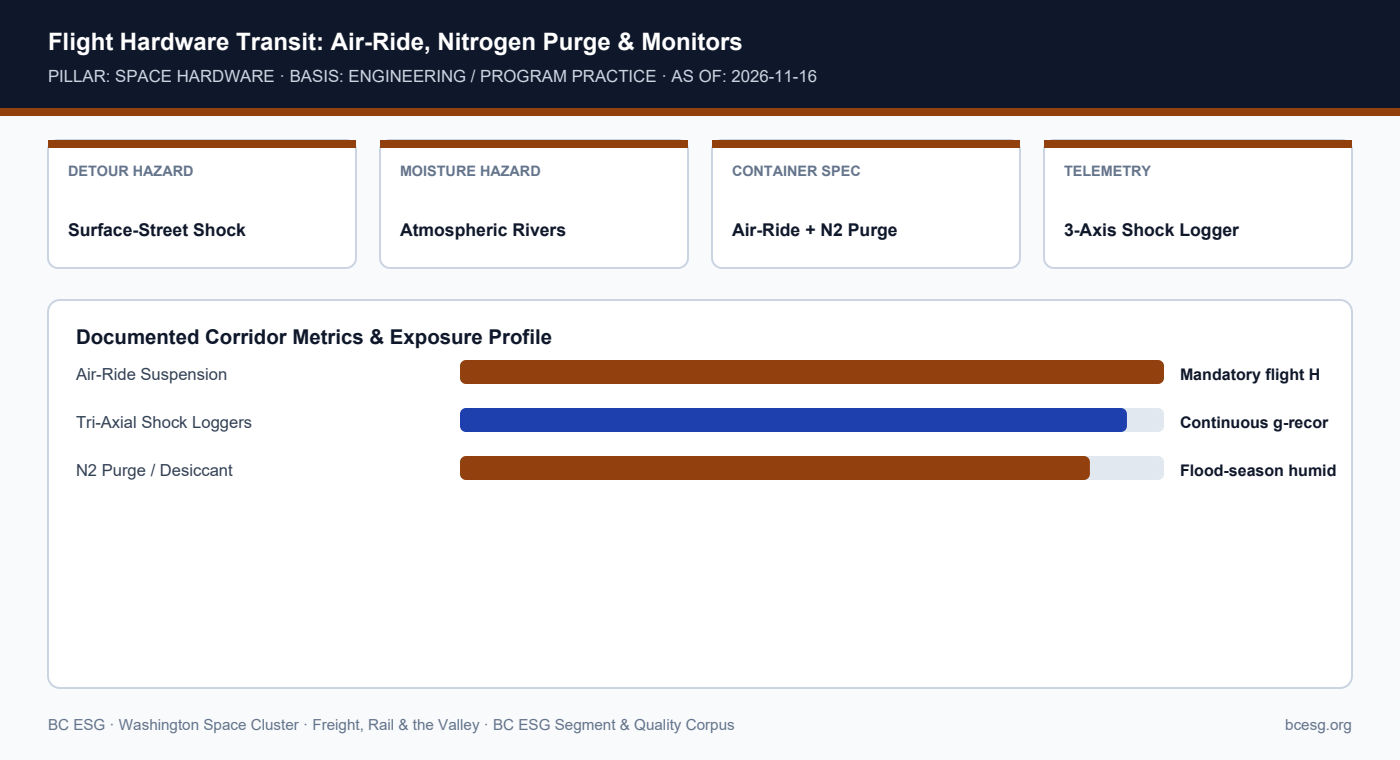
    Flight Hardware Transit: Air-Ride, Nitrogen Purge & Monitors
    Flight Hardware Transit: Air-Ride, Nitrogen Purge & Monitors

    Documented Corridor Facts & Continuity Record

    • Satellite manufacturers in Redmond, Kent, Tukwila, and Bellevue ship precision optics, star trackers, and reaction wheels sensitive to road-shock and humidity.
    • When SR 167 or I-5 closes, emergency detours push trucks onto uneven industrial surface streets with railroad grade crossings.
    • Atmospheric-river flood events also spike ambient relative humidity, stressing unpurged shipping containers.

    Flight-Hardware Transit Protection Matrix

    RiskTriggerContainer / Carrier Control
    Vertical Shock / Grade CrossingsSurface-street flood detoursAir-ride trailer + damped shipping skid
    Humidity / CondensationAtmospheric-river delaysDry N2 purge + sealed barrier bag + RH logger
    Undetected ImpactRough handling / potholeCalibrated 3-axis shock & tilt indicators

    Operational Exposure & Facility Playbook

    • Require continuous GPS-stamped tri-axial shock logging on all flight-hardware moves between Kent, Tukwila, Redmond, and SEA/BFI.
    • Inspect shock indicators at receiving before breaking cleanroom double-bag seals.
    • Avoid shipping unsealed optical assemblies during active flood-watch periods.

    Connected Valley Cities, Segments & Role Briefs

    Primary Sources & Agency References

  • ITAR & EAR Physical Transit Custody: Chain-of-Custody When Trucks Detour or Stage Overnight

    ITAR & EAR Physical Transit Custody: Chain-of-Custody When Trucks Detour or Stage Overnight

    Export-control framework per 22 CFR Subchapter M (ITAR); links to BC ESG Batch 6 Export-Control briefs (#2070, #2073).

    FREIGHT, RAIL & VALLEY · SPACE HARDWARE · FEDERAL REGULATION (22 CFR)
    ITAR/EAR Physical Transit Custody
    When a flood closure on SR 167 or a chain ban on Snoqualmie Pass forces an ITAR-controlled spacecraft or propulsion assembly to stage overnight, physical custody, U.S.-person escort, and bonded-yard security remain mandatory.
    Primary Agency / Source: U.S. Dept. of State DDTC (22 CFR) / BIS  |  As-Of / Horizon: 2026-11-16
    FREIGHT, RAIL & VALLEY · PDF & MARKDOWN TWIN
    ITAR/EAR Physical Transit Custody — Reference Brief
    Download the 2-page printable reference PDF or read the clean Markdown twin for AI and engineering workflows.
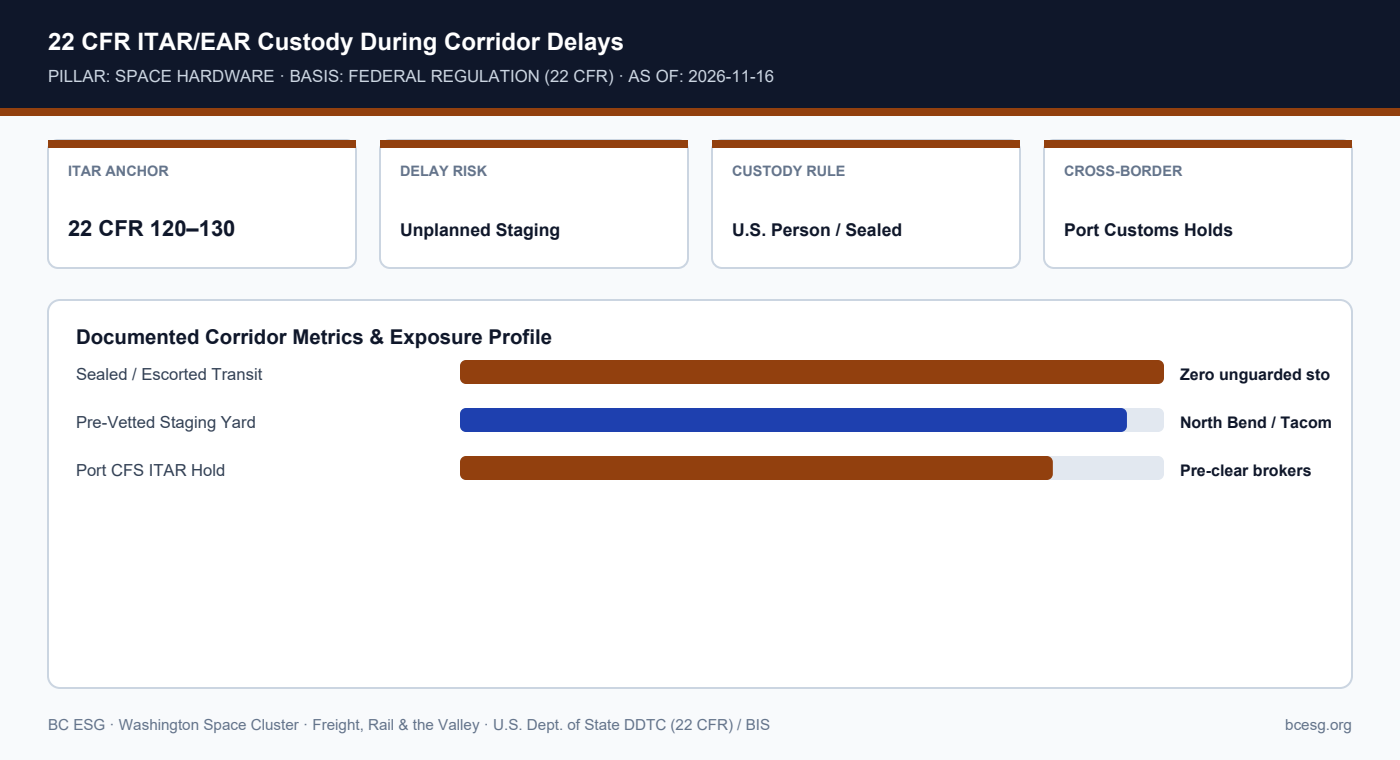
    22 CFR ITAR/EAR Custody During Corridor Delays
    22 CFR ITAR/EAR Custody During Corridor Delays

    Documented Corridor Facts & Continuity Record

    • ITAR (22 CFR Parts 120–130) and EAR 9A515/9E515 controls govern not only digital drawings, but physical custody and export-controlled hardware in transit.
    • If I-90 Snoqualmie Pass closes or SR 167 floods, drivers hauling USML Category IV/XV hardware cannot leave unguarded trailers at public rest stops.
    • Ocean or air imports/exports through NWSA or SEA require pre-cleared customs brokers to prevent unmonitored terminal dwell.

    Transit Disruption ITAR/EAR Custody Checklist

    ScenarioCustody RiskRequired Control
    Snoqualmie Pass HoldUnsecured overnight trailerPre-contracted gated/badged staging yard
    SR 167 Flood RerouteDriver swap / carrier handoffU.S.-person verification + tamper seals
    SEA / NWSA Terminal DwellMisrouted or unguarded freightDesignated ITAR-capable customs broker

    Operational Exposure & Facility Playbook

    • Include flood and mountain-pass staging protocols in every carrier Statement of Work for USML/9A515 hardware.
    • Require dual-driver teams or GPS-monitored sealed vans for high-value flight hardware.
    • Coordinate with Export-Control Officer (#2070) before authorizing emergency third-party cross-docking.

    Connected Valley Cities, Segments & Role Briefs

    Primary Sources & Agency References

  • Cryogenic & Hazardous Propellant Movement: 49 CFR Rules Across Valley Arterials

    Cryogenic & Hazardous Propellant Movement: 49 CFR Rules Across Valley Arterials

    Federal regulatory framework per 49 CFR (eCFR); individual facility delivery schedules are not in our data.

    FREIGHT, RAIL & VALLEY · SPACE HARDWARE · FEDERAL REGULATION (49 CFR)
    Cryo & Propellant 49 CFR Transit
    Propulsion and launch facilities in Kent, Auburn, and Redmond receive liquid oxygen, methane, hydrogen, or specialty propellants governed by 49 CFR PHMSA/FMCSA hazardous-materials routing, placarding, and tunnel restrictions.
    Primary Agency / Source: U.S. DOT PHMSA / FMCSA (49 CFR)  |  As-Of / Horizon: 2026-11-16
    FREIGHT, RAIL & VALLEY · PDF & MARKDOWN TWIN
    Cryo & Propellant 49 CFR Transit — Reference Brief
    Download the 2-page printable reference PDF or read the clean Markdown twin for AI and engineering workflows.
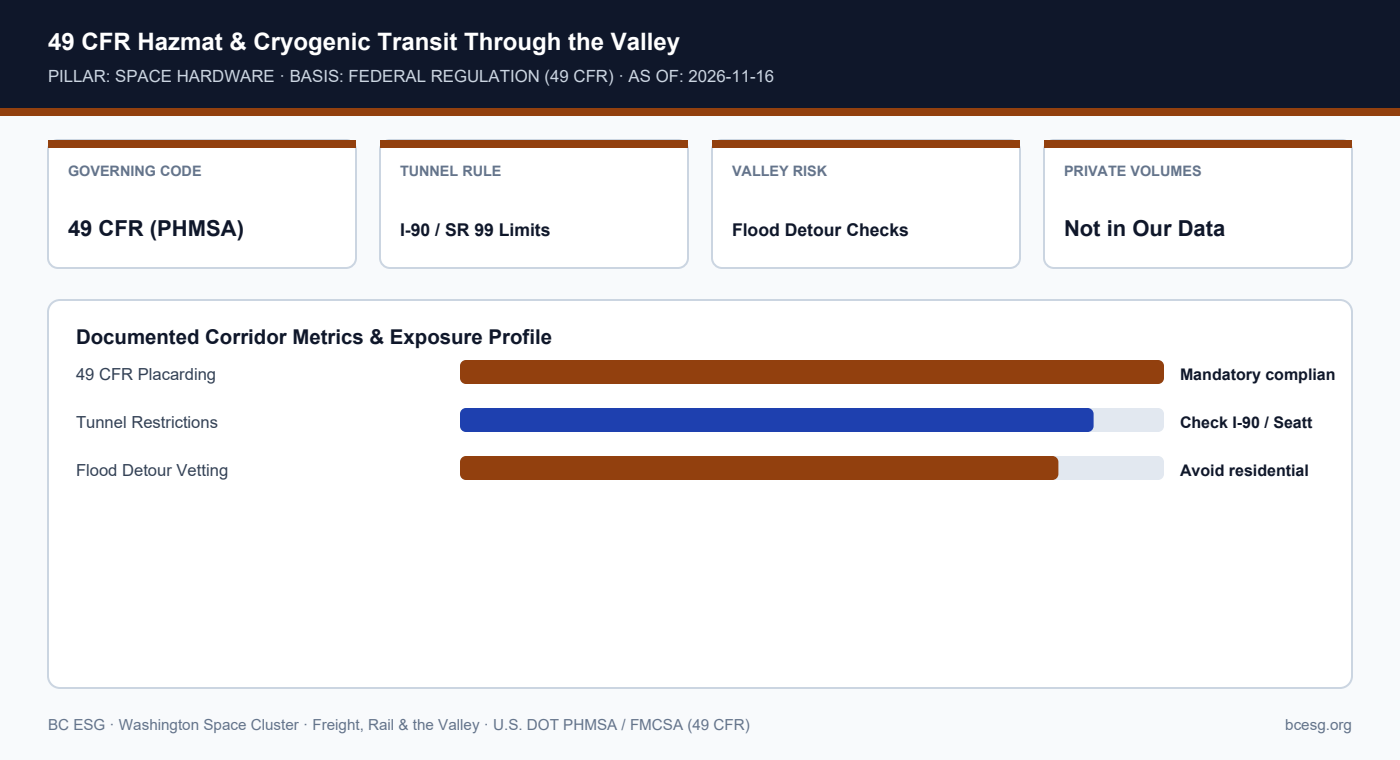
    49 CFR Hazmat & Cryogenic Transit Through the Valley
    49 CFR Hazmat & Cryogenic Transit Through the Valley

    Documented Corridor Facts & Continuity Record

    • Liquid cryogens and hazardous propellants (LOX, LNG/methane, LH2, hydrazine/monopropellants where used) move under 49 CFR Parts 171–180 (PHMSA) and Part 397 (FMCSA).
    • During SR 167 or I-5 flood closures, hazmat carriers cannot simply divert onto arbitrary residential or unrated local streets.
    • Individual space companies' propellant supplier contracts and tanker frequencies are not in our data.

    49 CFR Propellant Transit Continuity Controls

    ControlRegulatory AnchorValley Flood / Detour Action
    Authorized Hazmat Routing49 CFR Part 397Pre-approve non-flooded alternate truck routes
    Cryo Venting / Hold Time49 CFR Parts 173 / 178Account for I-5/I-90 gridlock boil-off margins
    On-Site Storage BufferWAC 173-303 / IFCMaintain safe buffer above BFE + 3ft

    Operational Exposure & Facility Playbook

    • Verify that your gas/cryogen supplier has pre-vetted flood-detour routes that comply with 49 CFR Part 397.
    • Account for boil-off hold times if a tanker is delayed for hours on a saturated I-5 or closed Snoqualmie Pass.
    • Coordinate hazmat receiving windows with EHS (#2061) and local fire-marshal requirements.

    Connected Valley Cities, Segments & Role Briefs

    Primary Sources & Agency References

BC ESG

ESG Strategy, Sustainability Intelligence, and Business Continuity for Forward-Thinking Organizations

© 2026 BC ESG — Business Continuity, ESG & Sustainability Intelligence