Federal regulatory framework per 49 CFR (eCFR); individual facility delivery schedules are not in our data.
FREIGHT, RAIL & VALLEY · SPACE HARDWARE · FEDERAL REGULATION (49 CFR)
Cryo & Propellant 49 CFR Transit
Propulsion and launch facilities in Kent, Auburn, and Redmond receive liquid oxygen, methane, hydrogen, or specialty propellants governed by 49 CFR PHMSA/FMCSA hazardous-materials routing, placarding, and tunnel restrictions.
Primary Agency / Source: U.S. DOT PHMSA / FMCSA (49 CFR) | As-Of / Horizon: 2026-11-16
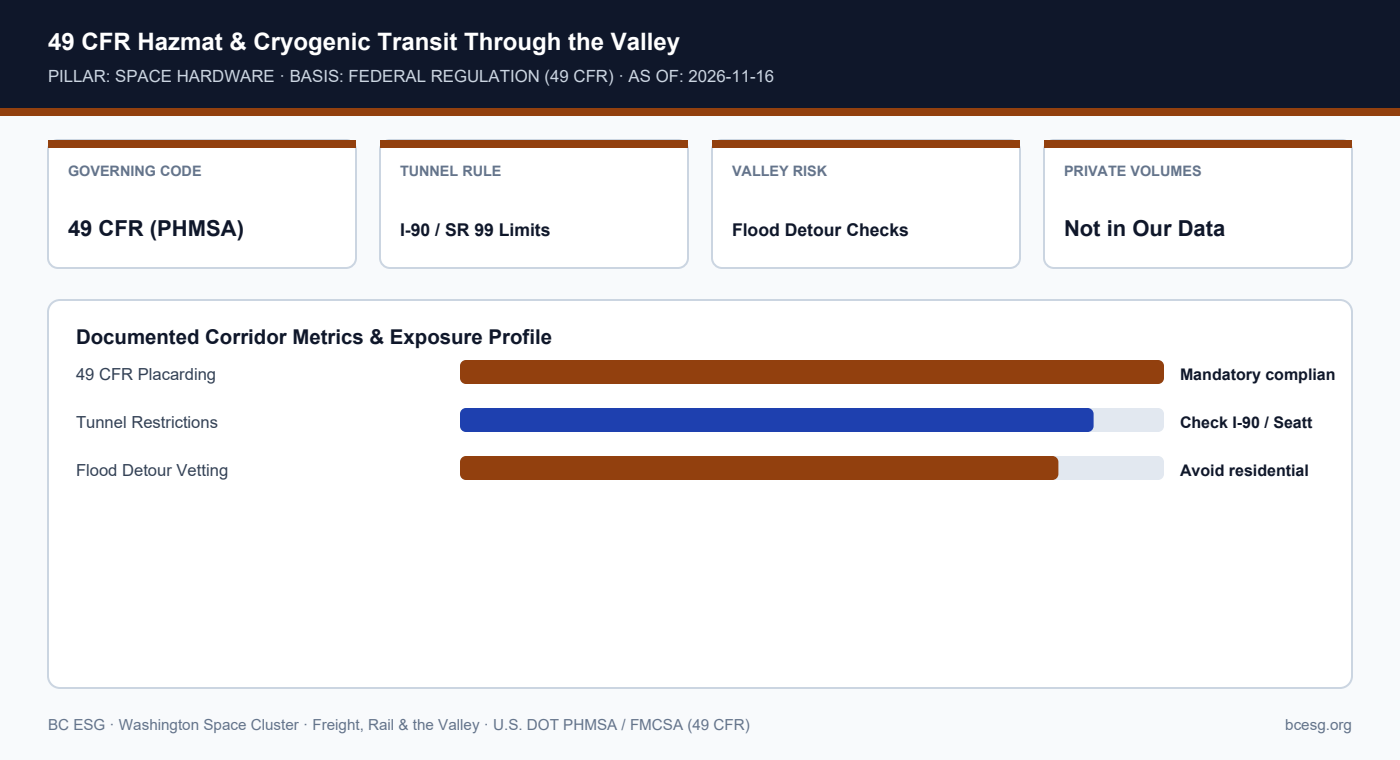
Documented Corridor Facts & Continuity Record
- Liquid cryogens and hazardous propellants (LOX, LNG/methane, LH2, hydrazine/monopropellants where used) move under 49 CFR Parts 171–180 (PHMSA) and Part 397 (FMCSA).
- During SR 167 or I-5 flood closures, hazmat carriers cannot simply divert onto arbitrary residential or unrated local streets.
- Individual space companies' propellant supplier contracts and tanker frequencies are not in our data.
49 CFR Propellant Transit Continuity Controls
| Control | Regulatory Anchor | Valley Flood / Detour Action |
|---|---|---|
| Authorized Hazmat Routing | 49 CFR Part 397 | Pre-approve non-flooded alternate truck routes |
| Cryo Venting / Hold Time | 49 CFR Parts 173 / 178 | Account for I-5/I-90 gridlock boil-off margins |
| On-Site Storage Buffer | WAC 173-303 / IFC | Maintain safe buffer above BFE + 3ft |
Operational Exposure & Facility Playbook
- Verify that your gas/cryogen supplier has pre-vetted flood-detour routes that comply with 49 CFR Part 397.
- Account for boil-off hold times if a tanker is delayed for hours on a saturated I-5 or closed Snoqualmie Pass.
- Coordinate hazmat receiving windows with EHS (#2061) and local fire-marshal requirements.
Connected Valley Cities, Segments & Role Briefs
- WA Space Cluster Hub (#1382)
- Kent WA Space Cluster Profile
- Facilities / EHS Desk Brief
- Facilities: Waste, PSCAA & Floodplain
- Propulsion Continuity Exposure