Tag: ESG compliance

  • Boston BERDO 2.0 Compliance Guide: 2025–2050 Emissions Limits, ACPs & May 15 Filing

    Boston BERDO 2.0 Compliance Guide: 2025–2050 Emissions Limits, ACPs & May 15 Filing

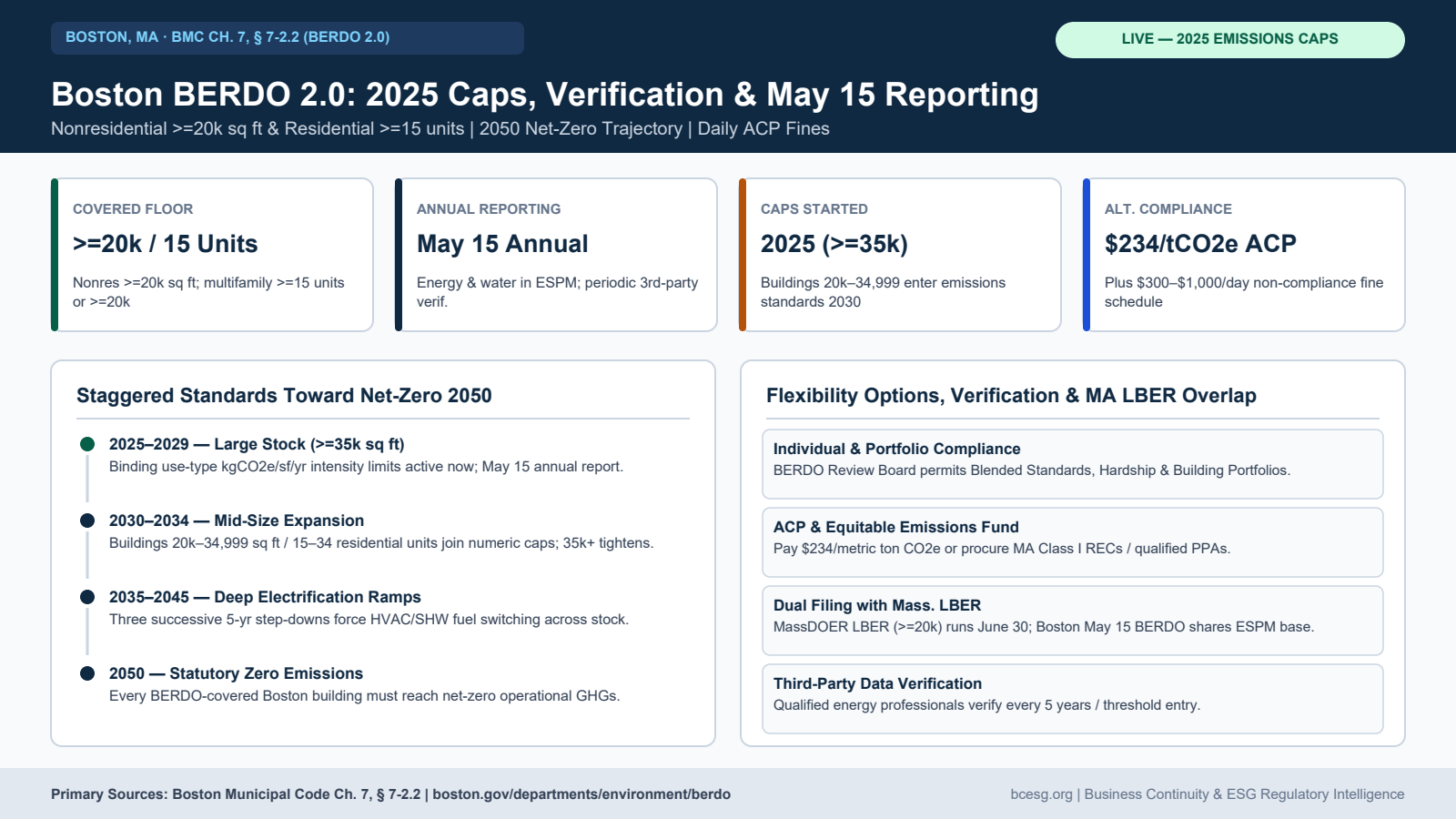
    Short answer: Enacted under Boston Municipal Code Chapter 7, § 7-2.2, Boston’s Building Emissions Reduction and Disclosure Ordinance (BERDO 2.0) is one of the tightest active municipal building decarbonization laws in the United States. Large commercial and multifamily properties (>=35,000 sq ft, or residential properties with >=35 units) entered binding 5-year GHG intensity caps on January 1, 2025, requiring active emissions compliance alongside annual May 15 reporting and periodic third-party data verification.

    Mid-tier buildings (20,000–34,999 sq ft or 15–34 units) already owe annual May 15 energy/water disclosure and step into emissions caps in 2030, progressing uniformly toward net-zero emissions in 2050. Because Massachusetts simultaneously enforces statewide LBER reporting (225 CMR 27.00) — and neighboring Cambridge BEUDO enforces its own net-zero timeline — regional owners should harmonize utility metering across both jurisdictions.

    Statutory Status at a Glance
    • Covered Thresholds: Non-residential >=20,000 sq ft; residential >=15 units or >=20,000 sq ft; or multiple buildings on the same parcel totaling >=20,000 sq ft (or >=15 units).
    • Two-Wave Emissions Caps: >=35,000 sq ft started emissions limits Jan 1, 2025 (with first emissions-year reports covered in 2026); 20,000–34,999 sq ft start emissions caps in 2030.
    • May 15 Annual Deadline & Third-Party Verification: Whole-building energy and water use due annually May 15 via ENERGY STAR Portfolio Manager, paired with third-party qualified verifier attestation every five years (plus first-year baseline verification).
    • Alternative Compliance Payments (ACP) vs. Fines: Excess emissions above occupancy-weighted CO2e limits may be retired at $234 per MTCO2e (deposited into Boston’s Equitable Emissions Investment Fund), whereas failing to comply with emissions standards draws statutory daily fines ($1,000/day for >=35k sf; $300/day for 20k–35k sf).
    Print-First Compliance Brief

    Download the Boston BERDO 2.0 Compliance Reference

    2-page Print-First PDF covering BERDO 2.0 emissions thresholds, third-party verification cadence, $234/tCO2e Alternative Compliance Payments, and MA LBER data alignment.

    Blended Emissions Limits, Class I RECs & Alternative Compliance Payments

    Boston calculates asset limits using 5-year primary-use CO2e intensity factors (kgCO2e/sq ft/yr) blended proportionally across mixed uses inside a parcel (for instance, office vs. multifamily vs. laboratory/healthcare allocations). Where physical fuel switching or heat-pump retrofits lag the 2025–2029 schedule, BERDO 2.0 allows owners to apply eligible Clean Energy purchases — specifically bundled Massachusetts Class I RECs or qualifying Power Purchase Agreements — to electricity emissions.

    Owners facing stubborn fossil-heating loads or phased lease rollovers can apply to the BERDO Review Board for a Blended Emissions Standard (pooling multi-building portfolios), a Hardship Compliance Plan, or an Individual Compliance Schedule modifying interim reduction trajectories — or retire remaining shortfalls via $234/MTCO2e Alternative Compliance Payments.

    • Lab & Healthcare Tiers: High-process facilities receive higher starting EUI/GHG allowances than standard commercial offices, though still stepping to zero by 2050.
    • Mandatory Verification Gate: Unlike simple benchmarking cities, BERDO 2.0 prohibits unverified self-reporting during emissions-cap transition years.
    Building TierAnnual ReportingEmissions Caps StartCompliance Relief & Daily Non-Filing Fines
    Large (>=35k sf or >=35 units)May 15 (PM + 3rd-party verify cycle)Jan 1, 2025 (2025–2029 period)$234/MTCO2e ACP; $1,000/day emissions violation
    Small/Mid (20k–34,999 sf / 15–34 units)May 15 annual energy & waterJan 1, 2030 (2030–2034 period)$234/MTCO2e ACP; $300/day violation (~2030+)
    Multi-Building Parcels>=20k sf combined -> follows >=20k/35k tierMatched to aggregate tierBlended Emissions Standard / Individual Schedule option
    Compliance overview of Boston BERDO 2.0 thresholds (>=20,000 sq ft / >=15 residential units), 2025 vs 2030 cap phases, May 15 verification deadline, and $234/tCO2e Alternative Compliance Payments.
    Boston BERDO 2.0 compliance timeline under Boston Municipal Code Ch. 7, § 7-2.2: benchmarking, third-party verification, 5-year emissions caps, and ACP pricing.

    Coordinating Boston BERDO 2.0 With Massachusetts LBER (225 CMR 27.00)

    Massachusetts’s statewide Large Building Energy Reporting (LBER) program (225 CMR 27.00, >=20,000 sq ft) relies largely on utility-pushed data delivered to DOER on a June 30 cycle, whereas Boston BERDO places strict affirmative legal responsibility directly on building owners every May 15. Confirm whether Eversource and National Grid automated meters align seamlessly across both systems to avoid mismatched square footage or unattributed tenant meters.

    • Utility Data Authorization: Verify whole-building aggregated data consent with Eversource and National Grid ahead of April so tenant-level privacy thresholds do not block May 15 submissions.
    • 2030 Cohort Pre-Audit: Owners of 20,000–34,999 sq ft buildings have four years to use annual BERDO disclosures to cost out 2030 compliance before caps lock in.

    Compliance Execution Checklist

    StepOwner / TeamAuditable Deliverable
    1. Parcel Use & Tier AuditCompliance / LegalConfirm primary occupancy classification and >=35k vs 20k–34,999 sq ft cohort.
    2. 3rd-Party Verifier Sign-OffPE / CEM / Qualified VerifierComplete BERDO data verification checklist ahead of the May 15 filing deadline.
    3. ACP vs REC EconomicsTreasury / SustainabilityCompare MA Class I REC cost against $234/MTCO2e ACP exposure per asset.
    4. MA LBER ReconciliationProperty OperationsCross-check DOER June 30 utility-reported LBER dataset against BERDO May 15 numbers.
    Field & Print Package

    Keep This Boston, MA Compliance Checklist Handy

    Download the formatted 2-page PDF reference brief or pull the structured Markdown edition for internal compliance documentation.

    Frequently Asked Questions

    When did Boston BERDO 2.0 emissions caps actually start?

    Emissions standards took effect January 1, 2025 for buildings >=35,000 sq ft (or residential buildings >=35 units), while smaller covered buildings (20,000–34,999 sq ft) begin active emissions limits in 2030.

    What is Boston BERDO's Alternative Compliance Payment rate?

    Excess CO2e emissions can be settled via Alternative Compliance Payments set at $234 per metric ton of CO2e (MTCO2e), which feed Boston's Equitable Emissions Investment Fund, rather than paying noncompliance fines.

    Does reporting under Boston BERDO exempt a building from Massachusetts statewide LBER?

    Massachusetts LBER (225 CMR 27.00) coordinates municipal reporting for utilities, but building owners must still verify Boston-specific BERDO May 15 disclosures, third-party verifications, and emissions-compliance schedules directly with the City.

    Primary Authorities & Official Resources

    Informational notice: This guide summarizes enacted statutes, regulations, or pending legislative records from the primary authorities linked above as of November 14, 2026. It is not legal, accounting, or licensed engineering advice.

  • NAIC Climate Risk Disclosure Survey: 29-Jurisdiction TCFD Mandate for Insurers (> $100M DWP)

    NAIC Climate Risk Disclosure Survey: 29-Jurisdiction TCFD Mandate for Insurers (> $100M DWP)

    Short answer: While cross-sector state climate laws remain limited outside California, the U.S. insurance industry already operates under a nationwide mandatory climate-risk reporting regime. Administered jointly by the California Department of Insurance (CDI RY2025 Notice, July 7, 2026) and partner regulators across 23 states, Washington, D.C., and 5 U.S. territories, the Task Force on Climate-Related Financial Disclosures (TCFD)-aligned NAIC Survey captured more than 1,800 companies representing over 86% of the U.S. insurance market.

    Unlike California SB 261—from which insurers are expressly exempt—the NAIC Survey has remained continuously active and un-enjoined. Crucially for compliance teams at multi-line carriers (>$1B revenue), neither the NAIC Survey nor SB 261’s insurer exemption waives California SB 253 GHG Scope 1 and 2 emissions obligations for major carriers doing business in California.

    Statutory Status at a Glance
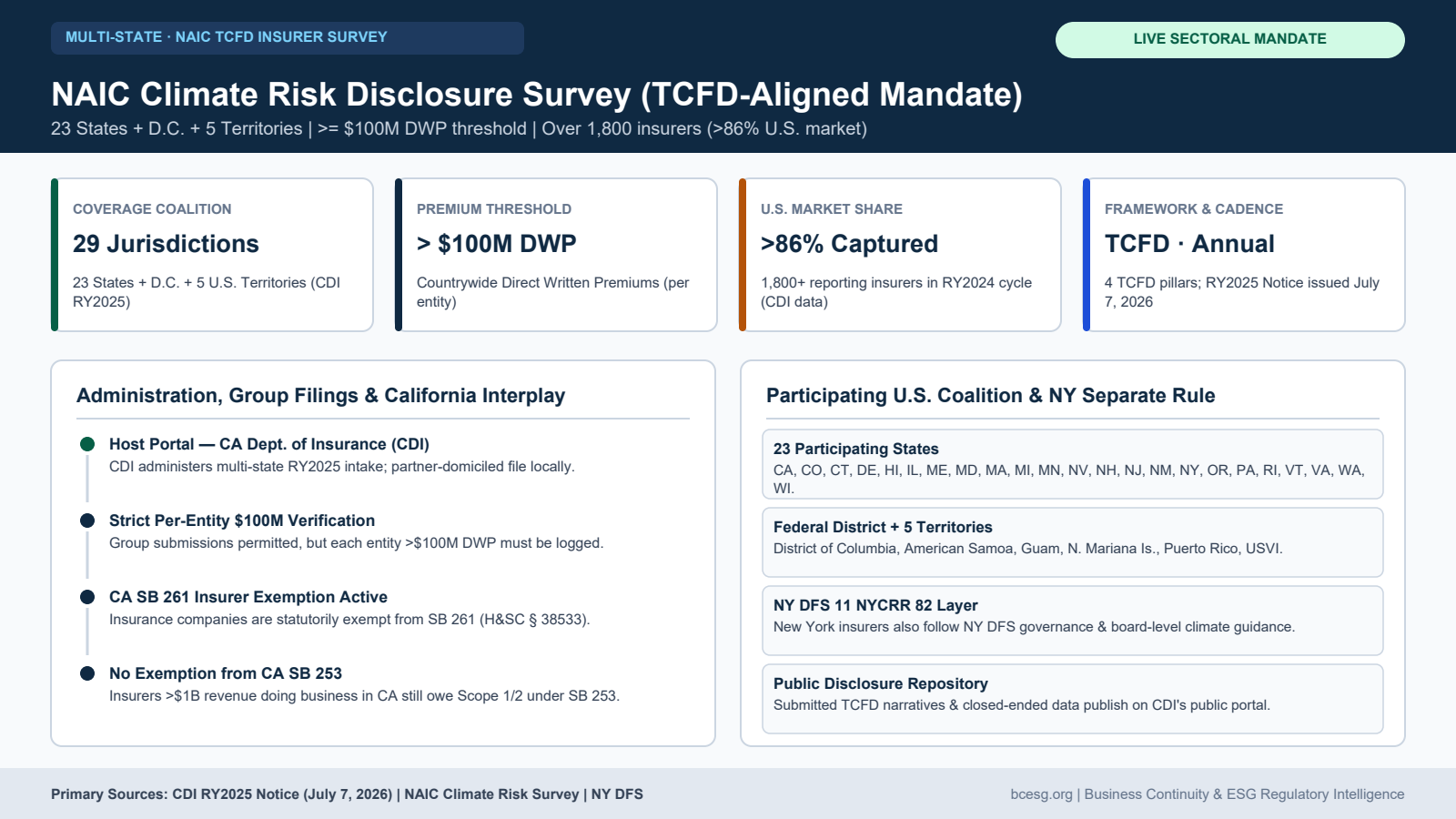
    • Governing Coalition (29 Jurisdictions): CA (host) + CO, CT, DE, DC, HI, IL, ME, MD, MA, MI, MN, NV, NH, NJ, NM, NY, OR, PA, RI, VT, VA, WA, WI + AS, GU, MP, PR, VI.
    • Mandatory Premium Floor: >$100 million in countrywide Direct Written Premiums (DWP) if licensed in any participating jurisdiction.
    • Required Content Architecture: TCFD 4-pillar narrative (Governance, Strategy, Risk Management, Metrics & Targets) submitted via CDI’s portal or partner commissioner portal, plus voluntary closed-ended NAIC questions.
    • Per-Entity Group Rule: Uniform group policy narratives are allowed across affiliates, but CDI strictly requires an individual submission document per licensed legal entity >$100M DWP.
    • New York & California Intersections: NY carriers also adhere to NY DFS 11 NYCRR 82 climate governance; CA SB 261 exempts insurers, whereas CA SB 253 (>$1B) does NOT.
    Print-First Compliance Brief

    Navigate the Multi-State NAIC TCFD Insurer Survey & SB 261 Carve-Out

    2-page Print-First reference covering the 23-state + DC + 5-territory CDI coalition, per-entity $100M DWP verification, NY 11 NYCRR 82, and CA SB 253/261 boundary.

    Who Must File, Reciprocal Portal Routing, and Per-Entity Group Rules

    Under CDI’s Reporting Year 2025 notice (covering calendar 2025 direct written premiums for the August 2026 call), jurisdiction attaches through state licensure combined with countrywide premium volume >$100 million — not in-state premium volume alone. A mid-sized carrier with $120M nationwide DWP and just $5M of business in Oregon or Pennsylvania is fully in scope.

    To prevent duplicate reporting across the 29 participating regulators, CDI allows carriers required to file in another participating partner state or jurisdiction to submit there rather than filing twice. However, CDI specifically audits multi-entity insurance holding companies: even when group-wide policies match identically across subsidiaries, each legal entity individually exceeding $100M DWP must have a corresponding filing tied to its NAIC company code.

    • Public Record Publication: All participating survey narratives and prior-year responses publish openly on CDI’s Climate Risk Disclosure database, creating public comparability across underwriting, investment portfolio carbon risk, and physical catastrophe pricing.
    • Closed-Ended Supplemental Questions: Alongside the narrative TCFD document, CDI requests responses to aligned closed-ended Y/N SurveyMonkey benchmarking items supporting NAIC industry aggregation.
    Coalition / DimensionScope & Participating JurisdictionsKey Rule / Threshold
    Partner States (23)CA, CO, CT, DE, HI, IL, ME, MD, MA, MI, MN, NV, NH, NJ, NM, NY, OR, PA, RI, VT, VA, WA, WILicensed insurer >$100M countrywide DWP triggers annual filing
    District & Territories (6)District of Columbia + American Samoa, Guam, N. Mariana Is., Puerto Rico, USVIPartner filing reciprocity avoids double submission
    CA SB 261 vs. SB 253CA H&SC §§ 38533 (SB 261) & 38532 (SB 253)EXEMPT from SB 261; NOT exempt from SB 253 if >$1B revenue
    New York DFS Layer11 NYCRR 82 / NY Insurance Circular Letter No. 15Board governance & enterprise risk integration alongside NAIC
    Compliance overview of the NAIC Climate Risk Disclosure Survey across 23 states, D.C., and 5 territories for insurers >$100M direct written premium, showing TCFD pillars and CA SB 261 exemption.
    NAIC Climate Risk Disclosure Survey (CDI RY2025 July 7, 2026 Call): 23 partner states + D.C. + 5 territories, >$100M DWP threshold, and interplay with CA SB 253 / SB 261.

    Why State Insurance Regulation Intersects with Cross-Sector Disclosure Laws

    Even in states listed as ‘None Found’ for cross-sector corporate disclosure statutes—such as New York, New Jersey, and Illinois—the NAIC TCFD Survey binds major carriers every single year.

    At the same time, California Health & Safety Code § 38533 expressly carved insurers out of SB 261 precisely to defer to the NAIC/CDI framework—making the NAIC TCFD submission the de facto national insurer financial-risk standard while SB 261 sits in Ninth Circuit litigation.

    Compliance Execution Checklist

    StepOwner / TeamAuditable Deliverable
    1. Legal-Entity DWP ScreenRegulatory / ActuarialFlag every licensed insurance affiliate exceeding $100M countrywide DWP for the reporting year.
    2. Home-State Reciprocity CheckCompliance LeadConfirm whether domiciliary partner state (e.g., NY, PA, IL) collects directly vs. California CDI portal.
    3. 4-Pillar TCFD NarrativeERM / Chief InvestmentUpdate Governance, Strategy, Risk Mgmt & Metrics/Targets plus closed-ended NAIC Y/N supplement.
    4. Separate CA SB 253 GateESG ReportingIf insurer group entities >$1B rev do business in CA, maintain Scope 1 & 2 GHG filings + Dec 10 fee track.
    Field & Print Package

    Keep This Multi-State Coalition (23 States + D.C. + 5 U.S. Territories) Compliance Checklist Handy

    Download the formatted 2-page PDF reference brief or pull the structured Markdown edition for internal compliance documentation.

    Frequently Asked Questions

    How many states enforce the NAIC TCFD Climate Risk Disclosure Survey?

    As of the July 7, 2026 Reporting Year 2025 Notice, California plus 22 partner states (23 states total), the District of Columbia, and 5 U.S. territories (29 U.S. jurisdictions) enforce the TCFD-aligned NAIC Survey.

    Can an insurance holding company file one group PDF for all subsidiaries?

    Uniform group narratives are allowed when affiliate policies and practices match, but CDI requires an individual filing document submitted for each licensed legal entity exceeding $100 million in countrywide DWP.

    Are insurers exempt from California SB 253 as well as SB 261?

    No. Health & Safety Code § 38533 exempts insurance companies from SB 261 (financial risk reporting), but H&SC § 38532 (SB 253 Scope 1/2/3 GHG emissions for >$1B entities) contains no insurer exemption.

    Primary Authorities & Official Resources

    Informational notice: This guide summarizes enacted statutes, regulations, or pending legislative records from the primary authorities linked above as of November 14, 2026. It is not legal, accounting, or licensed engineering advice.

  • Illinois Climate Corporate Accountability Act (HB 3673): Rule 19(a) Status & Live Compliance Check

    Illinois Climate Corporate Accountability Act (HB 3673): Rule 19(a) Status & Live Compliance Check

    Short answer — PENDING BILL, NOT LIVE LAW: Illinois House Bill HB 3673 (the Climate Corporate Accountability Act, 104th General Assembly) remains stalled in the House Rules Committee after its March 21, 2025 re-referral under Rule 19(a). Because HB 3673 was never enacted, the drafted July 1, 2026 rulemaking deadline and January 1, 2027 reporting date printed in the introduced text carry zero legal effect.

    Many national ESG compliance calendars still flag Illinois’ drafted January 1, 2027 date as active. This watch brief clears that confusion while identifying the two regimes that are enforceable in Illinois today: the NAIC TCFD Climate Risk Disclosure Survey for licensed insurers (>=$100M DWP) and municipal building benchmarking in Chicago (>=50,000 sq ft), alongside any Illinois-headquartered enterprise triggering California SB 253 through California revenue nexus.

    Statutory Status at a Glance
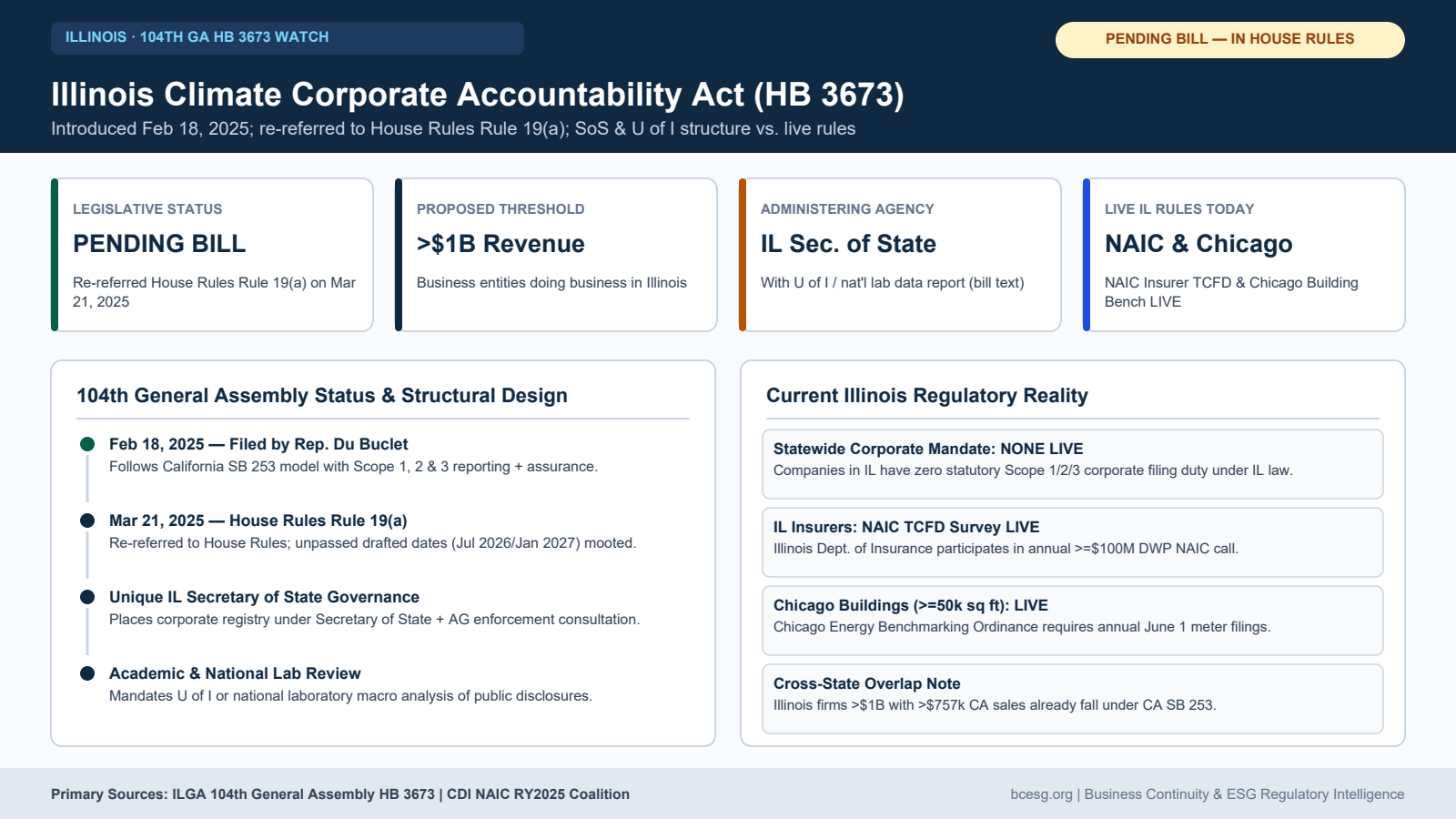
    • Enacted Status: NONE (Re-referred House Rules Rule 19(a) March 21, 2025).
    • Bill Design (>$1B Entities): Modeled on CA SB 253 with Scope 1, Scope 2, and Scope 3 emissions (+180 days post Scope 1/2) plus third-party verification.
    • Distinct Governance Design: Assigns corporate registry oversight to the Illinois Secretary of State (consulting the Attorney General) plus macro-analysis by the University of Illinois or a national laboratory.
    • Unpassed Dates Mooted: Drafted July 1, 2026 rulemaking & Jan 1, 2027 filing text are unpassed bill language — no filing is owed in Springfield.
    • Live Illinois Obligations Today: NAIC TCFD Survey (insurers >=$100M DWP) and Chicago Energy Benchmarking Ordinance (>=50,000 sq ft annual June 1).
    Print-First Compliance Brief

    Verify Illinois HB 3673 Legislative Status & Active Illinois Filings

    2-page Print-First regulatory watch clarifying why HB 3673’s unpassed 2026/2027 dates are not law while separating live Chicago Benchmarking and NAIC duties.

    Why Drafted January 1, 2027 Text in HB 3673 Keeps Tripping Automated Calendars

    When Rep. Kimberly Du Buclet introduced HB 3673 in February 2025, the bill text hard-coded statutory rollout dates — Secretary of State rules by July 1, 2026 and first-year Scope 1/2 disclosures starting January 1, 2027 (with Scope 3 180 days thereafter). Regulatory scrapers frequently index those printed dates without checking subsequent legislative posture.

    In the 104th Illinois General Assembly, however, HB 3673 hit Rule 19(a) re-referral on March 21, 2025 without clearing committee or chamber floor votes. Any future revival in Springfield would require amended statutory deadlines after passage.

    • Distinct Institutional Home: Rather than naming an environmental agency like CARB (CA) or NYSDEC (NY), HB 3673 places the public disclosure platform under the Secretary of State’s corporate division.
    • Research Partner Mandate: Directs an academic institution such as the University of Illinois or a national laboratory to publish aggregate trend analysis from corporate disclosures.
    Measure / MandateApplies ToLegal Status (Nov 14, 2026)Calendar Reality
    IL HB 3673 (104th GA)Entities >$1B doing business in ILPENDING (House Rules Rule 19(a) Mar 2025)Printed Jul 2026 / Jan 2027 dates NOT live law
    NAIC Climate Risk SurveyIL-licensed insurers >=$100M countrywide DWPLIVE Sectoral MandateAnnual TCFD disclosure via CDI / IL DOI portal
    Chicago BenchmarkingCovered Chicago buildings >=50,000 sq ftLIVE Municipal MandateAnnual June 1 Portfolio Manager + 3-yr data verif.
    Legislative status infographic for Illinois 104th General Assembly HB 3673 showing Rule 19(a) referral in House Rules, Secretary of State governance model, and live IL insurance/Chicago rules.
    Illinois 104th General Assembly HB 3673 (Pending Watch — House Rules Rule 19(a)) contrasted against live Illinois NAIC insurer disclosures and Chicago Benchmarking.

    What Companies Operating in Illinois Actually Owe Today

    While Illinois corporations owe zero state-level corporate GHG filings under HB 3673, major Illinois firms frequently sit inside live climate reporting requirements via two adjacent channels: out-of-state nexus (>$757,070 California sales for >$1B entities under California SB 253) or sectoral/city mandates inside Illinois.

    Illinois Department of Insurance partner carriers (>=$100M nationwide DWP) remain bound by the multi-state NAIC TCFD Climate Risk Disclosure Survey, and commercial/multifamily buildings >=50,000 sq ft in Chicago file annual energy disclosures every June 1.

    Compliance Execution Checklist

    StepOwner / TeamAuditable Deliverable
    1. Purge False DeadlineLegal / RiskCorrect any internal tracker showing 'IL Jan 1, 2027 Scope 1/2' — cite 104th GA Rule 19(a) status.
    2. Test CA NexusTax / SustainabilityVerify if IL enterprise >$1B revenue crosses $757k CA sales (triggering live CA SB 253 instead).
    3. Separate City/Insurer DutiesCRE / InsuranceConfirm Chicago >=50k sq ft building benchmarking & IL NAIC >=$100M insurer filings separately.
    4. 105th GA MonitorGov AffairsWatch post-election 2027 Illinois session introductions for successor Climate Corporate bills.
    Field & Print Package

    Keep This Illinois Compliance Checklist Handy

    Download the formatted 2-page PDF reference brief or pull the structured Markdown edition for internal compliance documentation.

    Frequently Asked Questions

    Do companies in Illinois have to report Scope 1 and Scope 2 emissions starting January 1, 2027 under HB 3673?

    No. Although the introduced text of Illinois HB 3673 listed a January 1, 2027 start date, the bill was re-referred to the House Rules Committee under Rule 19(a) on March 21, 2025 and never enacted into law.

    Who would administer Illinois HB 3673 if a future bill passes?

    HB 3673 designated the Illinois Secretary of State (in consultation with the Illinois Attorney General) to adopt rules and contract for a public corporate emissions registry, paired with research analysis by the University of Illinois or a national laboratory.

    Are there any live climate reporting laws in Illinois right now?

    Yes, within specific sectors and cities: Illinois participates in the annual NAIC Climate Risk Disclosure Survey for insurers writing >= $100M countrywide DWP, and the City of Chicago enforces annual June 1 benchmarking for covered buildings >= 50,000 sq ft.

    Primary Authorities & Official Resources

    Informational notice: This guide summarizes enacted statutes, regulations, or pending legislative records from the primary authorities linked above as of November 14, 2026. It is not legal, accounting, or licensed engineering advice.
  • New Jersey Climate Corporate Data Accountability Act (S679): Scope 1/2 Pivot & Pending Watch

    New Jersey Climate Corporate Data Accountability Act (S679): Scope 1/2 Pivot & Pending Watch

    Short answer — PENDING BILL, NOT LIVE LAW: New Jersey Senate Bill S679 (2026–2027 Legislative Session, successor to earlier S4117) remains pending in the Senate Budget & Appropriations Committee and imposes zero current corporate emissions filing obligations.

    Yet S679’s February 12, 2026 committee reprint (679_R1.PDF) marks an important national policy signal: unlike California SB 253 and New York S9072A, New Jersey’s Senate Environment & Energy Committee explicitly removed Scope 3 emissions reporting, narrowing the proposal to Scope 1 and Scope 2 GHG emissions verified by an independent consultant under NJDEP oversight. Meanwhile, New Jersey commercial buildings over 25,000 sq ft do owe active July 1 benchmarking filings under our live New Jersey Clean Energy Act Benchmarking Guide.

    Statutory Status at a Glance
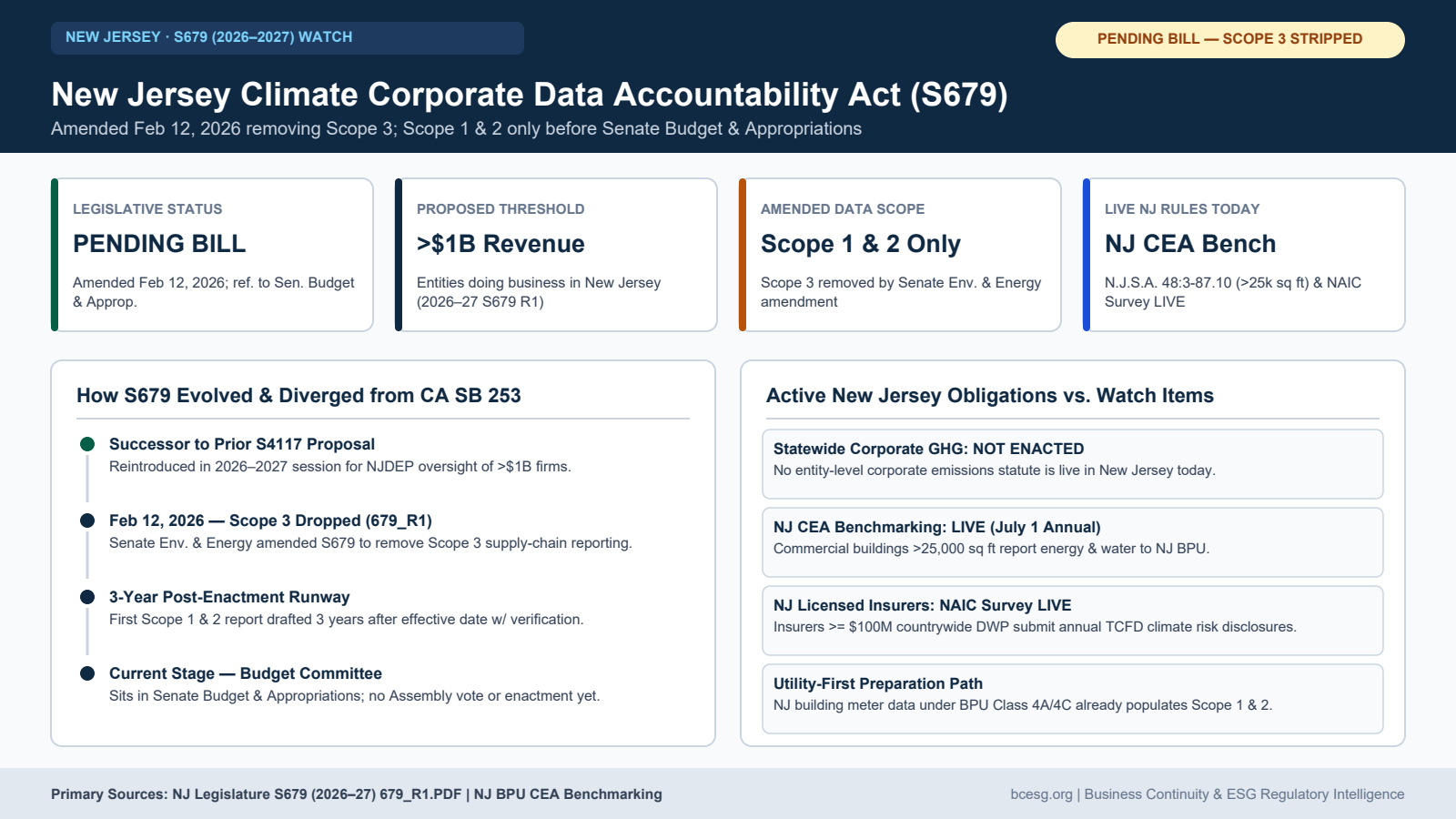
    • Enacted Status: NONE (Pending in Senate Budget & Appropriations). Committee reprint 679_R1 adopted Feb 12, 2026.
    • Proposed Covered Entities: U.S. business entities with >$1 billion in total annual revenue doing business in New Jersey.
    • Proposed Scope (Amended R1): Scope 1 and Scope 2 emissions only (Scope 3 deleted in Feb 2026 amendment) plus independent third-party/consultant verification.
    • Proposed Runway: Drafted to require first reporting 3 years after enactment under New Jersey Department of Environmental Protection (NJDEP) rules.
    • Live NJ Obligations Today: NJ BPU CEA Benchmarking (Class 4A/4C buildings >25k sq ft due July 1) & NAIC TCFD Insurer Survey (>=$100M DWP).
    Print-First Compliance Brief

    Track New Jersey S679's Scope 3 Stripping Amendment & Live NJ Rules

    2-page Print-First watch explaining how Senate Env. & Energy amended S679 to Scope 1 & 2 only (679_R1.PDF) vs. active NJ BPU July 1 benchmarking.

    Why S679 Dropped Scope 3 — And Why That Matters to Corporate Data Teams

    When state climate disclosure bills spread east after California enacted SB 253, Scope 3 value-chain reporting became the single sharpest legislative sticking point for mid-sized industrial, logistics, and life-sciences firms headquartered in New Jersey. By removing Scope 3 in 679_R1, Senate drafters turned S679 into a utility-and-fleet Scope 1 & 2 transparency bill.

    Even if S679 clears Senate Budget & Appropriations and passes both houses in 2027, its 3-year post-enactment lead time plus Scope 1/2 restriction means New Jersey-only companies would rely overwhelmingly on utility electricity and natural gas billing records—the exact meter datasets already standardized by Portfolio Manager under NJ CEA.

    • Compare Against NY & CA: Multinationals with >$1B revenue touching California already fall under full Scope 3 planning for CARB’s 2027 schedule, regardless of whether New Jersey’s bill omits Scope 3.
    • Audit Verification Model: S679 maintains an independent verification requirement over Scope 1 & 2 data prior to public disclosure by NJDEP.
    InstrumentUniverseScope / RequirementLive Status (Nov 14, 2026)
    NJ S679 (679_R1 Reprint)Entities >$1B revenue doing business in NJScope 1 & 2 ONLY (Scope 3 removed) + verification; 3 yrs post-enactmentPENDING in Sen. Budget & Appropriations
    NJ Clean Energy Act (N.J.S.A. 48:3-87.10)Commercial Class 4A/4C buildings >25,000 sq ftAnnual ENERGY STAR Portfolio Manager energy & water (July 1)LIVE & Enforced by NJ BPU
    NAIC Climate Risk SurveyInsurers >=$100M nationwide DWP licensed in NJAnnual 4-pillar TCFD climate financial risk narrativeLIVE Sectoral Mandate
    Visual summary of New Jersey pending S679 Climate Corporate Data Accountability Act showing Feb 12 2026 Senate amendment removing Scope 3 and active NJ CEA building benchmarking.
    New Jersey S679 (2026–2027 Session, 679_R1.PDF) Pending Status: amended to Scope 1 & 2 only in Senate Budget & Appropriations vs. live NJ CEA benchmarking.

    Active New Jersey Compliance Today: CEA Benchmarking & NAIC Insurers

    Corporate real-estate and facility directors often mistake New Jersey’s July 1 benchmarking filings for S679 corporate reporting. Under N.J.S.A. 48:3-87.10, New Jersey Board of Public Utilities (NJBPU) enforces annual July 1 ENERGY STAR Portfolio Manager benchmarking across commercial Class 4A/4C buildings exceeding 25,000 sq ft.

    Similarly, New Jersey participates in the 29-jurisdiction NAIC Climate Risk Disclosure Survey, binding NJ-licensed insurers with >=$100M in countrywide direct written premiums.

    Compliance Execution Checklist

    StepOwner / TeamAuditable Deliverable
    1. Mark S679 PendingCompliance / LegalLog S679 (679_R1) as Watch-Only; exclude from live statutory penalty registers.
    2. Leverage NJ BPU MetersFacilities / EnergyUse active July 1 NJ CEA Portfolio Manager utility exports as clean building blocks for Scope 1 & 2.
    3. Separate CA NexusSustainabilityConfirm whether >$1B corporate parent already owes Scope 1/2/3 via CA SB 253.
    4. Budget Committee TrackGov AffairsTrack Senate Budget & Appropriations scheduling and any Assembly companion amendments.
    Field & Print Package

    Keep This New Jersey Compliance Checklist Handy

    Download the formatted 2-page PDF reference brief or pull the structured Markdown edition for internal compliance documentation.

    Frequently Asked Questions

    Did New Jersey pass its Climate Corporate Data Accountability Act (S679)?

    No. S679 (2026–2027 Session) was amended in the Senate Environment & Energy Committee on February 12, 2026 and referred to the Senate Budget & Appropriations Committee. No cross-sector corporate GHG disclosure law is enacted in New Jersey.

    Does New Jersey S679 still require Scope 3 supply-chain emissions reporting?

    No. Under the February 12, 2026 committee reprint (679_R1.PDF), Scope 3 was removed, narrowing the pending bill to Scope 1 and Scope 2 emissions with independent verification.

    What climate reporting IS mandatory in New Jersey right now?

    Commercial buildings over 25,000 sq ft (Tax Class 4A/4C) must file annual July 1 benchmarking under the NJ Clean Energy Act, and insurers >= $100M countrywide DWP file the annual NAIC TCFD Climate Risk Disclosure Survey.

    Primary Authorities & Official Resources

    Informational notice: This guide summarizes enacted statutes, regulations, or pending legislative records from the primary authorities linked above as of November 14, 2026. It is not legal, accounting, or licensed engineering advice.

  • New York Climate Corporate Data Accountability Act (S9072A / A4282A): Pending Status & Readiness

    New York Climate Corporate Data Accountability Act (S9072A / A4282A): Pending Status & Readiness

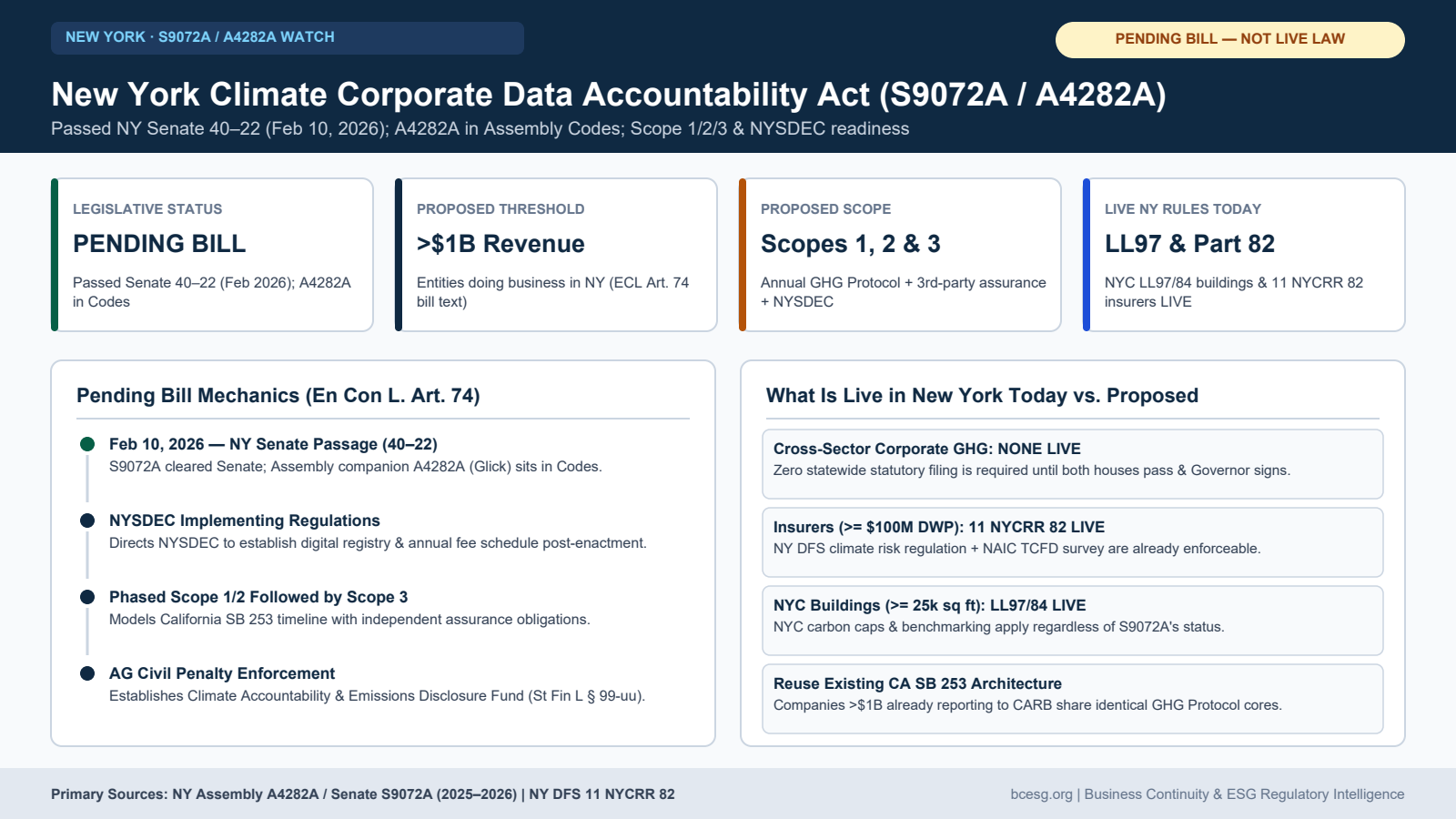
    Short answer — PENDING BILL, NOT LIVE LAW: New York does not have a live statewide cross-sector corporate greenhouse gas disclosure law in effect. Senate Bill S9072A cleared the New York State Senate by a 40–22 margin on February 10, 2026, but identical Assembly companion A4282A remains pending in the Assembly Codes Committee without final passage or gubernatorial signature.

    For general counsel and sustainability teams, the practical governance distinction in New York is sharp: zero filings are due today under ECL Article 74—yet two adjacent New York regimes are already live and actively enforced: 11 NYCRR 82 (NY Department of Financial Services climate-risk governance for insurers alongside the NAIC TCFD Survey) and New York City’s Local Law 97 / Local Law 84 building caps.

    Statutory Status at a Glance
    • Enacted Status: NONE (Pending Legislation). S9072A passed Senate (40–22, Feb 10, 2026); A4282A remains in Assembly Codes.
    • Proposed Covered Entities: U.S. partnerships, corporations, LLCs, or business entities doing business in New York with total annual revenues exceeding $1 billion.
    • Proposed Administering Agency: New York State Department of Environmental Conservation (NYSDEC), backed by Attorney General civil penalty enforcement into State Finance Law § 99-uu.
    • Proposed Emissions Scope: Annual Scope 1, Scope 2, and Scope 3 GHG emissions per GHG Protocol with independent third-party assurance phased across reporting years.
    • What Is Live Today in NY: NYC Local Law 97 & LL84 (buildings >=25k sq ft), NY State benchmarking workflows, and NY DFS climate guidance / 11 NYCRR 82 for insurers.
    Print-First Compliance Brief

    Track New York S9072A / A4282A Without Confusing Pending Bills for Live Law

    2-page Print-First regulatory watch separating pending >$1B cross-sector S9072A/A4282A proposals from live NY insurer (11 NYCRR 82) and NYC LL97/84 mandates.

    Inside S9072A / A4282A: How the Proposed ECL Article 74 Architecture Works

    Drafted as a direct east-coast counterpart to California SB 253, S9072A / A4282A proposes adding Article 74 (§§ 74-0101 and 74-0102) to the New York Environmental Conservation Law alongside a dedicated Climate Accountability and Emissions Disclosure Fund (State Finance Law § 99-uu).

    Unlike New Jersey’s amended S679—where Senate Environment & Energy stripped Scope 3 in February 2026—New York’s Senate-passed text retains full Scope 1, Scope 2, and Scope 3 disclosures plus third-party assurance phased after NYSDEC rulemaking.

    • Consolidated Reporting Alignment: Because both CA SB 253 and NY S9072A rely on the Greenhouse Gas Protocol Corporate Accounting and Reporting Standard and Corporate Value Chain (Scope 3) Standard, multi-state firms >$1B already assembling CARB inventories can reuse identical entity boundaries.
    • Rulemaking Lead Time Guarantee: Even if resurrected in post-election legislative sessions, statutory reporting duties do not begin immediately upon signature; NYSDEC must first adopt implementing regulations, digital registry contracts, and fee schedules.
    Framework / BillTarget UniverseCurrent Status (Nov 14, 2026)Immediate Action
    S9072A / A4282A (ECL Art. 74)U.S. entities >$1B doing business in NYPENDING (Passed Sen. 40–22; A4282A in Codes)Monitor only; map reuse of CA SB 253 Scope 1/2/3 controls
    NY DFS 11 NYCRR 82 & NAICLicensed insurers (>=$100M DWP / NY domestic)LIVE Sectoral MandateMaintain board climate governance & annual TCFD response
    NYC LL97 & LL84Covered NYC buildings >=25,000 sq ftLIVE Municipal Carbon CapFile annual May 1 LL84 & LL97 compliance / mitigation reports
    Legislative status diagram for New York S9072A / A4282A Climate Corporate Data Accountability Act showing Feb 10 2026 Senate passage (40-22), Assembly Codes stall, >$1B scope, and live NY LL97 / Part 82 rules.
    New York S9072A / A4282A (Pending Watch — not live cross-sector law) contrasted with live NY DFS 11 NYCRR 82 insurer rules and NYC Local Law 97/84.

    Separation Check: Live New York Mandates Already Requiring Filings

    Compliance calendars in New York routinely conflate S9072A news headlines with enforceable statutes that already carry financial penalties. Teams operating buildings or insurance carriers in the state must isolate three separate compliance streams.

    First, real-estate owners >=25,000 sq ft inside New York City remain governed by Local Law 84 benchmarking and Local Law 97 carbon-intensity caps regardless of Albany action. Second, NY domestic and licensed insurers >=$100M DWP answer annual TCFD climate risk surveys alongside NY DFS expectations under 11 NYCRR 82.

    • Private Non-Insurer Corporations Outside NYC Real Estate: Zero statutory statewide Scope 1/2/3 filing obligation today unless they also trigger California SB 253 via >$757k California sales.
    • Albany Trigger Watch: Monitor Assembly Codes and 2027 committee reintroduction schedules; post-2026 legislative sessions determine whether S9072A is carried over or refiled with Assembly revenue/assurance revisions.

    Compliance Execution Checklist

    StepOwner / TeamAuditable Deliverable
    1. Calendar HygieneLegal / ComplianceTag S9072A/A4282A strictly as Pending Watch — remove any implied 2026/2027 statutory fine assumptions.
    2. CA SB 253 MappingSustainability LeadDocument whether NY entity already falls under CA SB 253 (> $1B global rev + CA nexus).
    3. NY DFS / LL97 CheckRisk / Real EstateVerify live insurer obligations (11 NYCRR 82) and NYC property LL97/84 filings independently.
    4. Session Carryover WatchGov AffairsTrack Assembly Codes & 2027 committee calendar for amended text or Scope 3 adjustments.
    Field & Print Package

    Keep This New York State Compliance Checklist Handy

    Download the formatted 2-page PDF reference brief or pull the structured Markdown edition for internal compliance documentation.

    Frequently Asked Questions

    Do companies have to file corporate GHG emissions reports with New York State in 2026 or early 2027?

    No. New York's Climate Corporate Data Accountability Act (S9072A / A4282A) passed the Senate in February 2026 but remained pending in Assembly Codes as of November 14, 2026. No cross-sector statewide corporate GHG reporting statute is enacted or in force.

    What does New York S9072A / A4282A require if enacted?

    The bill as passed by the Senate covers entities with annual revenues over $1 billion doing business in New York, phasing in annual Scope 1, Scope 2, and Scope 3 emissions reports under the GHG Protocol with third-party assurance administered by NYSDEC.

    Which climate disclosure rules ARE live in New York today?

    Insurers face live obligations under NY DFS 11 NYCRR 82 and the NAIC TCFD Survey (>= $100M DWP), while covered New York City buildings >= 25,000 sq ft face live annual compliance under Local Law 84 benchmarking and Local Law 97 carbon limits.

    Primary Authorities & Official Resources

    Informational notice: This guide summarizes enacted statutes, regulations, or pending legislative records from the primary authorities linked above as of November 14, 2026. It is not legal, accounting, or licensed engineering advice.
  • Minnesota Building Benchmarking (§ 216C.331): Phase 2 Active & Twin Cities Consolidation

    Minnesota Building Benchmarking (§ 216C.331): Phase 2 Active & Twin Cities Consolidation

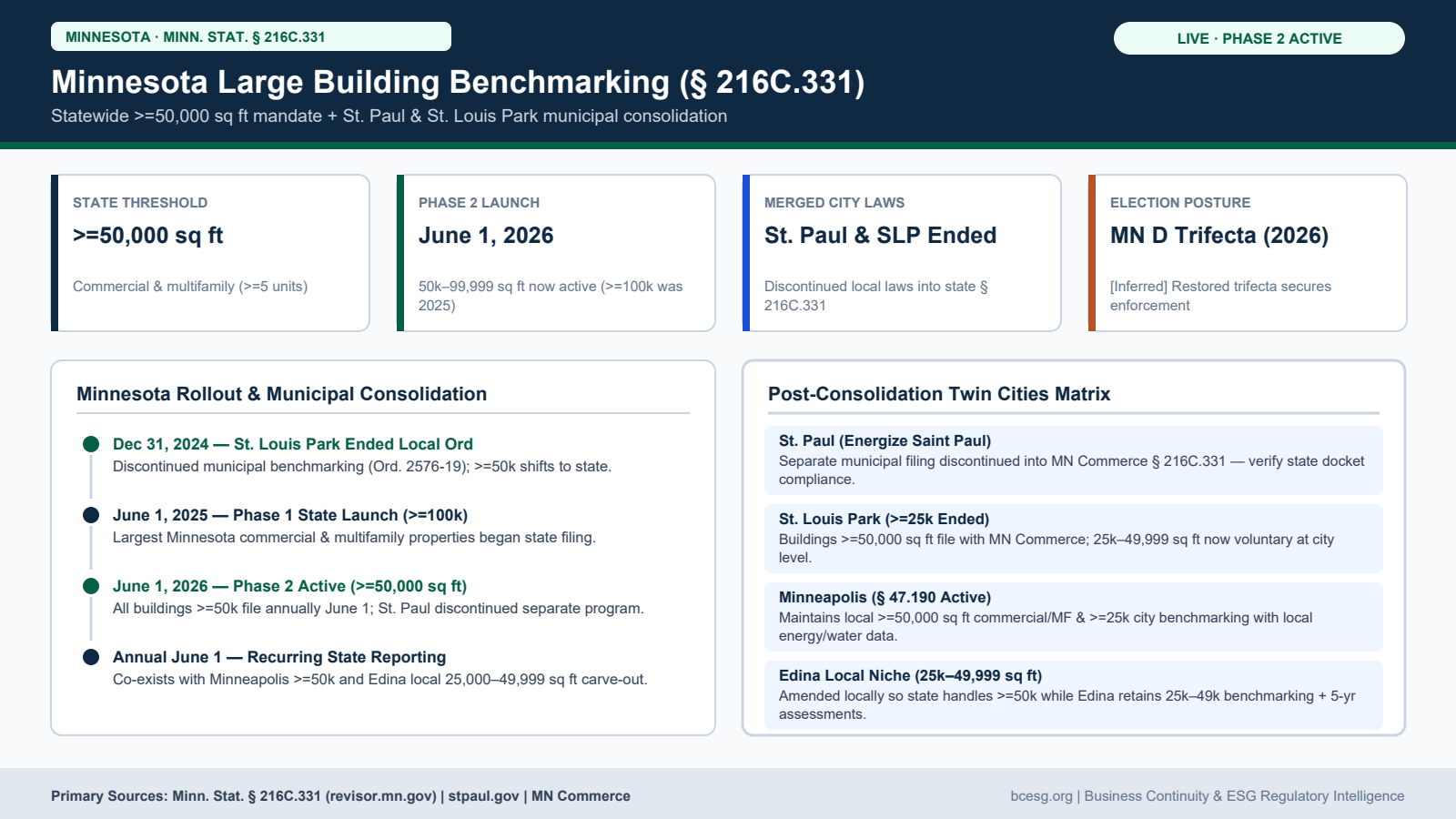
    Short answer: Minnesota’s statewide Large Building Energy Benchmarking Program (Minn. Stat. § 216C.331) reached full Phase 2 coverage on June 1, 2026, requiring commercial and multifamily buildings (5+ units) of ≥50,000 gross sq ft to submit annual energy data to the Minnesota Department of Commerce by June 1.

    Equally important for Twin Cities property managers is what happened locally: both St. Paul (Energize Saint Paul) and St. Louis Park discontinued their standalone municipal benchmarking mandates into state law, while Edina narrowed locally to 25,000–49,999 sq ft and Minneapolis continues co-enforcing ≥50,000 sq ft locally.

    Statutory Status at a Glance
    • Governing Authority: Minn. Stat. § 216C.331.
    • Administering Agency: Minnesota Department of Commerce — Large Building Energy Benchmarking Program.
    • Covered Threshold & Schedule: ≥100,000 sq ft launched June 1, 2025 (Phase 1); ≥50,000 sq ft active June 1, 2026 (Phase 2); recurring June 1 annually.
    • Municipal Consolidations: St. Paul and St. Louis Park retired separate municipal programs into § 216C.331; Edina shifted ≥50k buildings to state law and kept 25k–49,999 sq ft locally.
    • Post-2026 Policy Trajectory (Inferred): Minnesota’s November 2026 House shift restoring a unified DFL trifecta increases legislative durability for state benchmarking enforcement and future building-decarbonization bills.
    Print-First Compliance Brief

    Navigate Minnesota § 216C.331 After St. Paul & St. Louis Park Consolidated Into State Law

    2-page quick card covering Minnesota’s June 1 Phase 2 (>=50k sq ft) schedule, Twin Cities ordinance retirements, Edina’s 25k-49k carve-out, and MN 2026 election posture.

    Statewide Phased Rollout: From 100k (2025) to >=50k Active Now (2026+)

    Minn. Stat. § 216C.331 covers private commercial buildings and multifamily residential buildings with five or more dwelling units across Minnesota’s core metropolitan counties and covered jurisdictions as specified in statute. Phase 1 swept in properties ≥100,000 sq ft for the June 1, 2025 cycle; Phase 2 pulled every qualifying building 50,000 to 99,999 sq ft into active annual June 1 compliance in 2026.

    Because Minnesota winters create high space-heating fuel intensity, accurate Portfolio Manager natural gas and district steam normalization—backed by automated Xcel Energy and CenterPoint utility data feeds—is essential before public score release.

    Jurisdiction / LayerCurrent Floor & LawActive 2026–2027 Status
    Minnesota State (§ 216C.331)Commercial & MF (5+ units) >=50,000 sq ftACTIVE NOW — June 1 annual to MN Commerce
    St. Paul, MNFormer >=50k Energize Saint PaulDISCONTINUED locally — file via MN § 216C.331
    St. Louis Park, MNFormer >=25k Ord. 2576-19DISCONTINUED Dec 31, 2024 — >=50k files with state
    Edina, MNAmended Efficient Buildings Ord.Active locally ONLY for 25,000–49,999 sq ft (June 1)
    Minneapolis, MNCode Ch. 47 § 47.190 (>=50k)Active municipal energy + water filing due June 1
    Minnesota § 216C.331 building benchmarking infographic showing Phase 1 >=100k (2025), Phase 2 >=50k (2026), St. Paul and St. Louis Park local discontinuation, and Minneapolis/Edina overlap.
    Minnesota § 216C.331 Phase 1–2 thresholds and Twin Cities post-consolidation ordinance landscape (St. Paul, St. Louis Park, Minneapolis, Edina).

    Twin Cities Consolidation Matrix: St. Paul, St. Louis Park, Edina & Minneapolis

    Compliance consultants using outdated 2023–2024 checklists routinely tell Twin Cities owners to submit four separate city reports. That is no longer accurate after Minnesota implemented § 216C.331:

    Read alongside our California AB 802 and Massachusetts LBER guides, Minnesota illustrates how state statutes increasingly absorb local ordinances above 50,000 sq ft—leaving smaller municipal niches like Edina’s 25k–49k tier active locally.

    • St. Paul (Energize Saint Paul — Discontinued Locally): Replaced by statewide MN Commerce § 216C.331 reporting for ≥50,000 sq ft assets.
    • St. Louis Park (Discontinued End of 2024): Former ≥25,000 sq ft municipal mandate ended December 31, 2024; properties ≥50,000 sq ft file with MN Commerce while 25k–49k moved to voluntary sustainability programs.
    • Edina (Amended Local Niche 25,000–49,999 sq ft): Defers ≥50,000 sq ft assets to state § 216C.331 while enforcing local June 1 energy/water benchmarking and 5-year energy assessments on 25,000–49,999 sq ft properties.
    • Minneapolis (Ch. 47 § 47.190 Active): Continues local energy and water benchmarking due June 1 alongside state § 216C.331 (≥50,000 sq ft private; ≥25k city).

    Compliance Execution Checklist

    StepOwner / TeamAuditable Deliverable
    1. Jurisdiction MapAsset MgmtTag each MN asset >=25k sq ft as State-Only (incl. St. Paul / >=50k SLP), Dual Mpls+State, or Edina 25k-49k.
    2. Utility ConnectProperty OpsConnect Xcel Energy / CenterPoint automated whole-building Portfolio Manager feeds before April.
    3. File by June 1Compliance LeadSubmit state § 216C.331 (and Minneapolis/Edina where applicable) by June 1 annually.
    4. 2027 Policy WatchESG LeadTrack restored MN trifecta committee activity for potential corporate disclosure or BPS bills.
    Field & Print Package

    Keep This Minnesota Compliance Checklist Handy

    Download the formatted 2-page PDF reference brief or pull the structured Markdown edition for internal compliance documentation.

    Frequently Asked Questions

    Do buildings in St. Paul or St. Louis Park still file separate city benchmarking reports?

    No. Both St. Paul (Energize Saint Paul) and St. Louis Park (effective end of 2024) discontinued their separate municipal benchmarking mandates, consolidating >=50,000 sq ft properties into Minnesota's statewide § 216C.331 program.

    What changed in Edina after Minnesota passed § 216C.331?

    Edina amended its Efficient Buildings Ordinance so buildings >=50,000 sq ft report to the state while Edina retains local June 1 energy and water benchmarking plus 5-year energy assessments specifically for 25,000–49,999 sq ft buildings.

    Does Minnesota § 216C.331 cover residential apartments?

    Yes. Multifamily residential buildings with five or more units and >=50,000 gross sq ft are covered alongside commercial properties.

    Primary Authorities & Official Resources

    Informational notice: This guide summarizes enacted statutes, regulations, or pending legislative records from the primary authorities linked above as of November 14, 2026. It is not legal, accounting, or licensed engineering advice.

  • New Jersey Clean Energy Act Benchmarking (N.J.S.A. 48:3-87.10): Class 4A/4C & July 1 Guide

    New Jersey Clean Energy Act Benchmarking (N.J.S.A. 48:3-87.10): Class 4A/4C & July 1 Guide

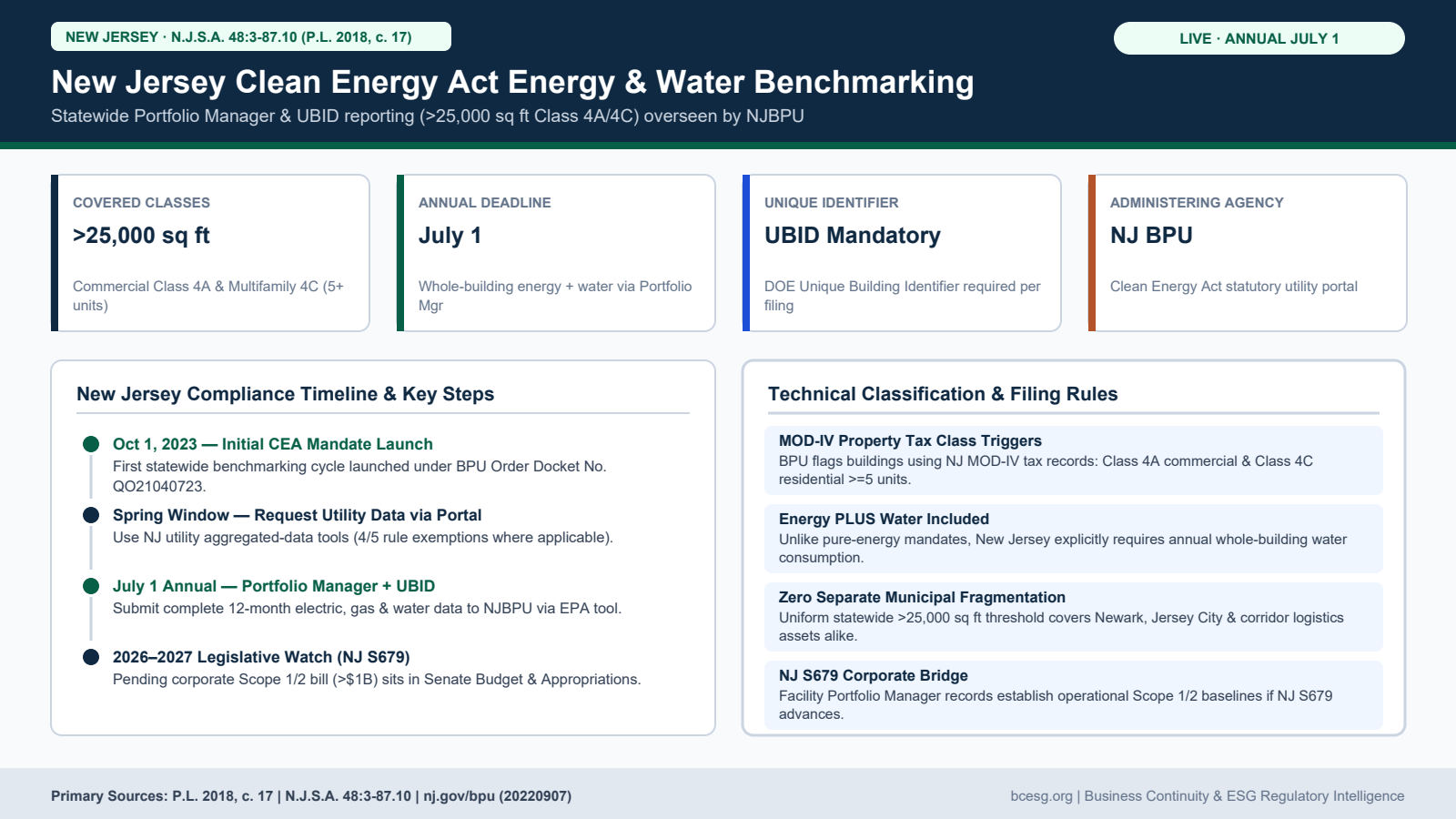
    Short answer: Under New Jersey’s Clean Energy Act (P.L. 2018, c. 17; N.J.S.A. 48:3-87.10), owners of commercial (Class 4A) and multifamily residential (Class 4C, 5+ units) buildings exceeding 25,000 gross sq ft must benchmark and submit whole-building energy and water data annually by July 1 using ENERGY STAR Portfolio Manager and a DOE Unique Building Identifier (UBID).

    For corporate logistics, pharma, and multifamily portfolios operating across the Northeast corridor, New Jersey avoids the municipal patchwork seen in Massachusetts and New York City—one statewide NJBPU standard governs every municipality from Newark and Jersey City down to Camden.

    Statutory Status at a Glance
    • Governing Authority: Clean Energy Act of 2018 (P.L. 2018, c. 17; N.J.S.A. 48:3-87.10) & NJBPU Benchmarking Order.
    • Administering Agency: New Jersey Board of Public Utilities (NJBPU).
    • Covered Tax Classes: MOD-IV Class 4A commercial (office, industrial/warehouse, retail) & Class 4C residential (5+ units) >25,000 gross sq ft.
    • Annual Recurring Deadline: July 1 (following initial October 1, 2023 cycle launch).
    • Distinct Requirements: Mandatory whole-building water data alongside energy, plus U.S. DOE UBID assignment inside Portfolio Manager.
    Print-First Compliance Brief

    Standardize New Jersey >25,000 sq ft Class 4A & 4C Benchmarking Before July 1

    2-page quick card covering NJBPU MOD-IV tax class screening, water reporting, Unique Building Identifier (UBID) rules, and NJ S679 linkage.

    MOD-IV Property Class Screening & the Water + UBID Mandate

    NJBPU determines building applicability using municipal tax-assessor MOD-IV records rather than owner self-reporting. Warehouse and industrial complexes in Middlesex, Hudson, Bergen, and Burlington counties taxed under Class 4A—and apartment complexes of 5+ units taxed under Class 4C—enter scope whenever gross floor area exceeds 25,000 sq ft.

    Two compliance details routinely trigger NJBPU rejection notices: omitting water utility meters (New Jersey explicitly pairs water benchmarking with energy under N.J.S.A. 48:3-87.10) and leaving the Unique Building Identifier (UBID) custom ID field blank inside Portfolio Manager.

    • Regulated Utility Data Tools: NJ electric and gas utilities provide automated or portal-based aggregated whole-building usage under BPU privacy/aggregation guidelines (4/5 rule thresholds).
    • Uniform Statewide Scope: New Jersey imposes no separate city-level EUI or GHG performance cap ordinances today, though NJBPU’s public benchmarking scores increasingly surface in municipal green-building and lender underwriting reviews.
    Program DimensionNew Jersey CEA RuleCompliance Requirement
    Statutory ThresholdN.J.S.A. 48:3-87.10MOD-IV Class 4A commercial & Class 4C (5+ units) >25,000 sq ft
    Covered UtilitiesNJBPU Order / Portfolio MgrWhole-building electric, gas/thermal fuel AND water consumption
    Property IdentifierCustom Field in ESPMMandatory DOE Unique Building Identifier (UBID) + NJ tax block/lot
    Annual Filing SchedulePost-2023 Recurring CadenceJuly 1 annually via NJBPU ENERGY STAR Portfolio Manager link
    New Jersey Clean Energy Act Energy and Water Benchmarking Program summary showing >25,000 sq ft Class 4A/4C threshold, annual July 1 deadline, UBID requirement, and NJ S679 legislative bridge.
    New Jersey Clean Energy Act Energy & Water Benchmarking Program rules under N.J.S.A. 48:3-87.10 and NJBPU oversight.

    Strategic Link: Portfolio Manager Baselines & Pending NJ S679 Disclosure

    While New Jersey’s benchmarking law carries no statewide EUI penalty cap today, facility energy data feeds directly into corporate GHG reporting—particularly if New Jersey advances NJ S679 (pending corporate climate disclosure legislation amended in 2026 to cover Scope 1 and Scope 2 emissions for firms >$1B revenue).

    Compare New Jersey’s July 1 schedule against Maryland’s June 1 verified BEPS deadline and NYC’s May 1 LL84 deadline to keep Mid-Atlantic property managers aligned on one quarterly utility audit cycle.

    Compliance Execution Checklist

    StepOwner / TeamAuditable Deliverable
    1. MOD-IV LookupTax / Asset LeadVerify parcel Class (4A/4C) and >25,000 sq ft status on municipal MOD-IV tax records & BPU list.
    2. UBID AssignmentEnergy AnalystGenerate/confirm building UBID and map NJ municipal Block/Lot numbers inside Portfolio Manager.
    3. Utility + Water SyncProperty OpsPull 12-month aggregated electric/gas data plus municipal water bills ahead of June 1.
    4. Submit July 1Compliance LeadSubmit via NJBPU reporting link and retain confirmation receipt for ESG/NJ S679 audits.
    Field & Print Package

    Keep This New Jersey Compliance Checklist Handy

    Download the formatted 2-page PDF reference brief or pull the structured Markdown edition for internal compliance documentation.

    Frequently Asked Questions

    Are industrial warehouses subject to New Jersey's benchmarking law?

    Yes. Industrial, warehouse, logistics, retail, and office buildings taxed under New Jersey MOD-IV Class 4A that exceed 25,000 gross sq ft are covered by NJBPU benchmarking.

    Does New Jersey require water consumption reporting as well as electricity and gas?

    Yes. N.J.S.A. 48:3-87.10 requires annual whole-building water benchmarking in addition to electric and natural gas/heating energy usage.

    What is a UBID and why does NJBPU require it?

    A Unique Building Identifier (UBID) is a standardized geographic footprint code maintained by the U.S. DOE so NJBPU can match Portfolio Manager submissions cleanly against municipal MOD-IV parcel records.

    Primary Authorities & Official Resources

    Informational notice: This guide summarizes enacted statutes, regulations, or pending legislative records from the primary authorities linked above as of November 14, 2026. It is not legal, accounting, or licensed engineering advice.
  • The Data Center Oversight Act: What Operators Would Have to Put in Public

    The Data Center Oversight Act: What Operators Would Have to Put in Public

    A data center deal usually arrives in a community the same way: a codename, a closed session, and a nondisclosure agreement. A new federal bill proposes to reverse that order. The Data Center Oversight Act, introduced in the House on October 29, 2026 by Rep. Eugene Vindman of Virginia, would make the Energy Information Administration collect — and publicly report — a standard set of facts about every existing and proposed data center in the country. For developers and host communities alike, the practical question is simple: exactly what becomes public? Here is the checklist, as written.

    What is being proposed

    The Act would require the Energy Information Administration (EIA), within the Department of Energy, to collect and publicly report comprehensive information on both existing data centers and proposed developments. Operators submit the information; EIA publishes it.

    Status: this is an introduced bill, not law. It was introduced October 29, 2026, and has the long committee road in front of it. But disclosure bills like this one also move the market before they move Congress — the checklist below is already a fair preview of what host communities, journalists, and competitors will ask for in 2027 whether or not the bill passes.

    The disclosure checklist

    Under the Act, operators would have to report:

    • Ownership — who actually owns the facility.
    • Energy usage — expected or actual electricity consumption.
    • Water usage — expected or actual water consumption.
    • Ratepayer costs — the costs of serving the facility that may be passed on to utility ratepayers.
    • Nondisclosure agreements — whether the facility’s owners have signed NDAs with government officials.
    • Union labor — whether union labor was used in construction.
    • Sensitive proximity — whether the facility sits within 1,000 feet of a school, a national park, a hospital, or a home.

    Read the list as a community would. Energy and water are the resource questions every county hearing now runs on. The ratepayer-cost item goes at the subsidy argument directly: not what the facility pays, but what its presence costs everyone else on the grid. And the proximity item converts the most emotional local question — how close is this thing to where people live, learn, and recover — into a yes/no federal data point.

    The NDA item is the sharp edge

    Most of the checklist asks for numbers. The nondisclosure item asks for a fact about secrecy itself: not the contents of any agreement — the Act does not reach those — but whether one exists between the developer and government officials.

    That single yes/no changes local politics. Today, a resident who asks why a project was negotiated in private can be told nothing at all. Under the Act, the existence of the NDA is itself a disclosed, federally reported fact. Developers who treat confidentiality as the default opening move would be making that choice in public.

    What does getting it wrong cost?

    Entities that fail to report, submit incomplete information, or provide misleading information face penalties of up to $1 million per day.

    The structure matters as much as the number. The penalty covers three distinct failures — silence, incompleteness, and inaccuracy — and it runs per day, which means a disclosure problem is not a fine you budget for; it is a clock that runs until the filing is right. At that scale, disclosure stops being a communications task and becomes a compliance function with records, owners, and review — the same treatment environmental and financial reporting already get.

    This bill does not arrive alone

    The Oversight Act is Vindman’s third data-center measure of 2026. In October he introduced the Make Data Centers Pay Act, aimed at shielding households and small businesses from electricity costs driven by data-center demand. In August, the Smart Data Center Policy Act took up development near neighborhoods, schools, and parks. Read together, the three bills mark the shape of the federal argument: who pays, where it goes, and — with this Act — who has to say so, in public, in advance.

    The state and local layer is moving the same direction. Water and energy disclosure fights now attach to individual projects, and the physical-risk questions communities ask — water scarcity chief among them — have become standard diligence, not activism.

    What a developer or a host community should do now

    You do not need the bill to pass to use the checklist. For a developer, it is a pre-announcement inventory: for any live or proposed site, could you answer all seven items today, accurately, from records? Ownership structures, utility-service cost allocations, and construction-labor facts are easy to state early and hard to reconstruct under a per-day clock. For a host community, the checklist is the term sheet for your own questions — ask for these seven items in the first public session, while the answers are still cheap.

    The industry’s growth is not the controversy anymore. The controversy is whether the facts arrive before the concrete does. This bill’s answer is a form, filed with the EIA, where anyone can read it.

    Informational only — this article summarizes the Data Center Oversight Act as introduced on October 29, 2026, per the sponsor’s published summary and contemporary reporting; it is not legal advice, and a bill’s text and prospects can change. Sources: Office of Rep. Eugene Vindman (Oct 29, 2026); Nextgov/FCW, “Tech bills of the week” (Oct 30, 2026).

  • Portland Building Compliance: Live Ch. 17.104 (April 22), OR HB 3409 & 2050 Carbon Proposal

    Portland Building Compliance: Live Ch. 17.104 (April 22), OR HB 3409 & 2050 Carbon Proposal

    Updated: November 14, 2026 — Refreshed to reflect current statutory cycles, verification rules, and post-election regulatory posture.

    Short answer: Portland building compliance involves two distinct legal layers today — plus one closely watched legislative proposal. On the active, enforceable ledger, Portland City Code Chapter 17.104 (administered since 2015 by Portland’s Bureau of Planning & Sustainability) requires annual April 22 ENERGY STAR Portfolio Manager benchmarking for covered commercial buildings >=20,000 sq ft, operating alongside Oregon’s active statewide HB 3409 / OAR 330-300 Building Performance Standard.

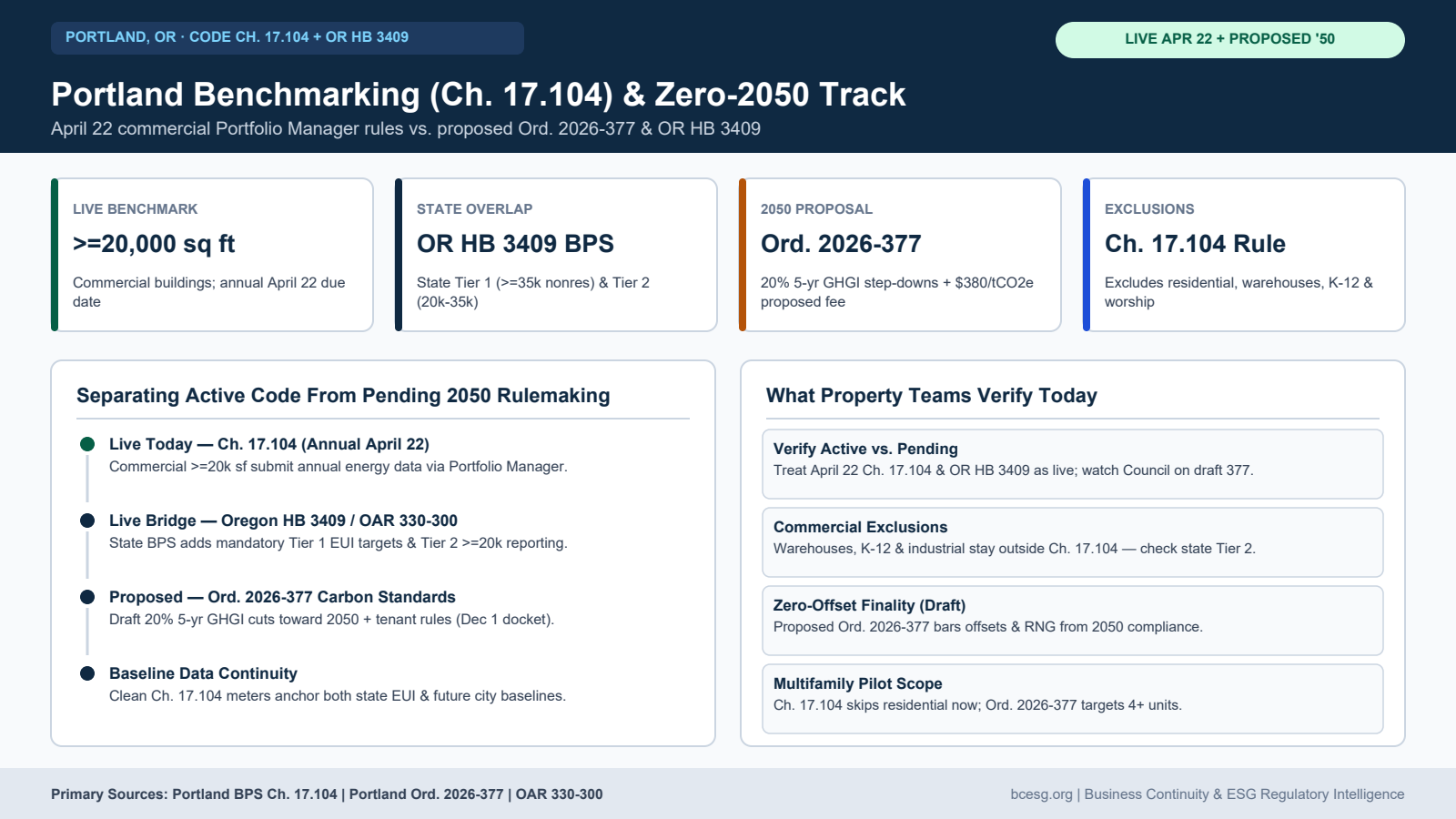
    Meanwhile, Ordinance 2026-377 (Climate and Health Standards for Buildings Code) — continued to City Council’s Housing and Permitting Committee December 1 docket — remains a proposal, not enacted law. It would replace Ch. 17.104 with 20% five-year GHGI reductions reaching zero in 2050 (without offsets or RNG), expand annual June 1, 2028 reporting to residential 4+ unit buildings >=20,000 sq ft, and attach a $380/MTCO2e carbon impact fee. Building owners should comply with active April 22 Ch. 17.104 and Oregon HB 3409 duties today while monitoring Council adoption.

    Statutory Status at a Glance
    • Live City Law (Ch. 17.104 — April 22): Commercial buildings >=20,000 sq ft report energy use annually by April 22 via Portfolio Manager; excludes residential, warehouses, K-12, industrial, and places of worship.
    • Live State Law (OR HB 3409 / OAR 330-300): Covers non-residential Tier 1 >=35,000 sq ft under ODOE EUI targets and pulls commercial/institutional/multifamily >=20,000 sq ft (and warehouses/hotels excluded locally) into Tier 2 state reporting.
    • Proposed Ord. 2026-377 (Pending): Draft 20% 5-year GHGI step-downs starting 2030 toward net-zero 2050, no offsets/RNG, $380/tCO2e ratcheting fee, non-passthrough protection, regulated affordable housing exemption, and tenant heat/ventilation disclosures from 2028.
    • Clean Baseline Continuity: Accurate April 22 Portfolio Manager submissions under live Ch. 17.104 preserve verified baseline EUI records required for Oregon HB 3409 and any enacted city carbon step-down.
    Print-First Compliance Brief

    Download the Portland Ch. 17.104 + 2050 Proposal Reference

    2-page Print-First PDF separating active Portland Ch. 17.104 April 22 duties and Oregon HB 3409 rules from proposed Ord. 2026-377.

    Reconciling Live April 22 Reporting, Oregon HB 3409 & Draft Ord. 2026-377

    A warehouse or multifamily asset manager inside Portland can fall into an unexpected blind spot if checking only city code: while Portland Ch. 17.104 currently excludes multifamily residential and warehouse structures, Oregon statewide HB 3409 explicitly captures >=35,000 sq ft non-residential Tier 1 assets (including covered warehouse/storage classifications depending on ODOE grouping) and extends Tier 2 benchmarking/O&M reporting to multifamily and institutional buildings >=20,000 sq ft starting in 2028.

    If Council adopts draft Ordinance 2026-377, Portland’s local scope expands from purely commercial reporting into binding 5-year emissions intensity step-downs accompanied by tenant protections — bar cost passthroughs, relocation tenant impact plans, and Jan/June 2028 climate-and-health disclosures.

    • Do Not Confuse Proposals With Active Penalties: Zero $380/tCO2e fines apply today — active enforcement governs annual April 22 Ch. 17.104 filings and statewide ODOE HB 3409 timelines.
    • Track Both Council & ODOE Calendars: Maintain PGE / NW Natural Portfolio Manager utility aggregation uninterrupted across city April 22 and state cycles.
    Instrument & StatusCovered BuildingsDeadlines / TargetsCore Obligation
    Portland Ch. 17.104 (LIVE)Commercial >=20,000 sf (no res/whse/K-12)Annual April 22Portfolio Manager energy reporting
    Oregon HB 3409 / OAR 330-300 (LIVE)Tier 1 nonres >=35k sf; Tier 2 >=20k/multi2028 Tier 1 EUI / Tier 2 dataODOE EUI targets & O&M / benchmarking
    Portland Ord. 2026-377 (PROPOSED)Comm + res >=4 units (>=20k sf)Draft 2028 Rpt -> 2030–2050 20% cuts$380/tCO2e fee (pending Council decision)
    Compliance architecture distinguishing Portland's live Chapter 17.104 April 22 commercial benchmarking from proposed Ordinance 2026-377 and statewide Oregon HB 3409 BPS.
    Portland compliance landscape: active annual April 22 reporting under Ch. 17.104, statewide Oregon HB 3409 Tier 1/2 BPS rules, and proposed Ord. 2026-377.

    Compliance Execution Checklist

    StepOwner / TeamAuditable Deliverable
    1. April 22 Ch. 17.104 FilingProperty OpsSubmit annual PGE/NW Natural energy data in Portfolio Manager for >=20k comm.
    2. HB 3409 State Cross-CheckOregon Compliance LeadConfirm whether asset triggers ODOE Tier 1 (>=35k) EUI or Tier 2 (>=20k) rules.
    3. Watch Dec 1 Ord. 2026-377Legal / SustainabilityMonitor Portland City Council markup for $380/tCO2e fee & 2028 multifamily rules.
    Field & Print Package

    Keep This Portland, OR Compliance Checklist Handy

    Download the formatted 2-page PDF reference brief or pull the structured Markdown edition for internal compliance documentation.

    Frequently Asked Questions

    What Portland building energy law is actually enforceable right now?

    Portland City Code Chapter 17.104 (annual April 22 ENERGY STAR Portfolio Manager reporting for commercial buildings >=20,000 sq ft) and Oregon's statewide HB 3409 / OAR 330-300 Building Performance Standard are live today. Ordinance 2026-377 (zero-by-2050 GHGI step-downs) remains a pending proposal.

    Are Portland multifamily apartment buildings required to benchmark today?

    Under existing Ch. 17.104, residential buildings are excluded from Portland city reporting, though multifamily assets >=35k/20k fall into Oregon's statewide HB 3409 Tier 2 cohort (starting 2028) and proposed Ord. 2026-377 would cover >=4-unit buildings >=20,000 sq ft.

    Primary Authorities & Official Resources

    Informational notice: This guide summarizes enacted statutes, regulations, or pending legislative records from the primary authorities linked above as of November 14, 2026. It is not legal, accounting, or licensed engineering advice.

  • The 2026 Regulatory Convergence: Why ESG, Climate, AI, and Operational Standards Are Merging Into One

    The 2026 Regulatory Convergence: Why ESG, Climate, AI, and Operational Standards Are Merging Into One

    Updated October 6, 2026.

    If your 2026 compliance calendar spans climate disclosure, AI governance, and sector rules, regulatory convergence is the strategy question — this guide explains how ESG teams can lead integrated governance.

    CSRD. DORA. EU AI Act. California SB 253. ISO 22301. In 2026, these aren’t separate compliance programs — they’re converging into a single organizational accountability framework. What was once siloed governance has become interconnected. What required separate teams now demands integration.

    The Convergence Reality

    For years, ESG practitioners have navigated multiple reporting frameworks: GRI, SASB, TCFD, CSRD. But that experience was unique to sustainability teams. In 2026, every sector is discovering what we’ve known: compliance is no longer compartmentalized.

    CSRD establishes mandatory climate disclosure for companies with >1,000 employees AND >€450M turnover. But California’s climate laws maintain stricter scope. That creates a patchwork. The response isn’t two parallel programs — it’s one integrated framework that satisfies both.

    DORA (Digital Operational Resilience Act) mandates operational resilience standards for financial services. It covers ICT risk, penetration testing, third-party oversight. But DORA doesn’t exist in isolation. It intersects with:

    • ISO 22301 (Business Continuity) — now amended to incorporate climate scenarios explicitly
    • NIS2 Directive (EU cybersecurity for expanded sectors) — overlaps with DORA for financial entities
    • NAIC model laws (insurance regulatory updates for climate, cyber, AI) — cascade into operations

    Then add the EU AI Act. Full implementation phase 2026, risk-tiered governance, affects insurance/healthcare/critical infrastructure. An AI underwriting algorithm isn’t just a tech tool — it triggers regulatory obligations across three frameworks simultaneously.

    Why This Matters: Convergence Isn’t Optional

    Organizations that treat CSRD, DORA, ISO 22301, and NIS2 as separate projects will:

    • Duplicate audit work and spend 3x on compliance
    • Create governance silos (ESG, IT, Legal, Operations all reporting separately)
    • Miss cross-framework opportunities (e.g., climate scenarios required by CSRD can satisfy ISO 22301 amendments)
    • Fail audit integration (auditors expect a single accountability narrative)

    The organizations that win in 2026 are building ONE integrated framework with multiple external reporting endpoints.

    The Integrated Framework Structure

    Layer 1: Core Accountability
    Single governance structure: board ESG committee oversees CSRD (climate/social/governance disclosure), DORA (operational resilience), and AI governance (EU AI Act). No separate “cyber committee” unless operationally necessary.

    Layer 2: Risk Assessment
    One risk register (not five). Assign each risk to the frameworks that reference it:

    • Climate scenario risk → CSRD disclosure + ISO 22301 amendment
    • Third-party ICT risk → DORA mandatory assessment + NIS2 scope
    • AI algorithm bias → EU AI Act risk-tiering + NAIC guidance on underwriting

    Layer 3: Control and Monitoring
    One continuous monitoring system feeds multiple reports. Compliance data collected once, mapped to multiple frameworks’ reporting structures.

    Layer 4: External Reporting
    Different content for different audiences (CSRD report, DORA reporting, NIS2 notifications, state-level filings), but all sourced from the same underlying control framework.

    Cross-Sector Convergence Signals

    Restoration Industry: IICRC standard updates (S500/S520/S700 under periodic review) are being layered with state contractor licensing AND insurance carrier compliance mandates. Contractors face synchronized tightening across three independent regulatory tracks.

    Insurance Sector: Carriers are writing simultaneous guidance on climate risk disclosure (CSRD + NAIC), AI underwriting oversight (EU AI Act + state DOI actions), and cyber insurance standards (DORA + NIS2). The regulatory burden cuts across underwriting, claims, investments, and governance.

    Business Continuity: Organizations are subject to DORA (financial services), CISA/CIRCIA (critical infrastructure), ISO 22301 (everyone with >100 employees), and NIS2 (digital operations across EU). Overlapping scope creates audit consolidation opportunities.

    Healthcare: Facilities face simultaneous CMS CoP updates, Joint Commission Environment of Care revisions, NFPA 101/99 amendments, FGI Guidelines 2026 edition, and emerging ESG disclosure requirements. The only practical response is integrated facility management across all regulatory domains.

    The Meta-Trend: Compliance Is No Longer Siloed

    Compliance now cuts across:

    • Legal: CSRD legal entity scope, contract risk for third parties (DORA), algorithmic governance (EU AI Act)
    • Operations: Resilience controls (DORA, ISO 22301), third-party management (NIS2), facilities compliance (healthcare/restoration)
    • Sustainability: Climate scenarios (CSRD + ISO 22301), ESG disclosure (CSRD), and increasingly, governance of AI/operations intersecting ESG scope
    • IT: Penetration testing (DORA), ICT risk (NIS2), AI governance (EU AI Act), cybersecurity (NAIC)
    • Facilities: Environmental compliance, emergency response, climate resilience — all now within scope of DORA/ISO 22301

    Organizations that silently accept this fragmentation will continue burning resources. Those that integrate frameworks will emerge as regulatory leaders.

    Starting Your Integration in 2026

    1. Map Your Regulatory Scope
    Start with ESG Regulatory Frameworks — identify which frameworks apply to your organization by business model, geography, and sector.

    2. Audit Your Governance Structure
    Visit Governance in ESG: Complete Guide 2026 — ensure your board and committees can address convergence, not fragments.

    3. Establish a Single Risk Register
    Use Global ESG Regulatory Convergence as your starting point for mapping how compliance domains overlap.

    4. Build Integrated Reporting
    Map each compliance requirement to your core data sources. CSRD climate scenarios feed ISO 22301. DORA operational controls feed NIS2. One data source, multiple endpoints.

    Conclusion

    In 2026, regulatory convergence is the defining competitive advantage. Organizations that treat CSRD, DORA, EU AI Act, ISO 22301, and sector-specific standards as one integrated accountability system will reduce cost, improve governance, and lead their sectors. Those that don’t will fragment further, burning resources and audit time.

    The frameworks are converging whether you plan for it or not. The question is whether you’ll lead the integration or chase the fragments.

    Related reading: cross-sector compliance leadership, ESG ratings comparison, and the Restoration Carbon Protocol. Sister hubs: Restoration Intel, Healthcare Facility Hub, Continuity Hub, Risk Coverage Hub, and Tygart Media.

BC ESG

ESG Strategy, Sustainability Intelligence, and Business Continuity for Forward-Thinking Organizations

© 2026 BC ESG — Business Continuity, ESG & Sustainability Intelligence