Category: Space Cluster Segments

Segment-level analysis across launch, satellite manufacturing, propulsion, in-space servicing, orbital data centers, components, and ground systems.

  • Software Continuity: Distributed Puget Sound/Island Nodes & Cloud/Cyber SPOFs

    Software Continuity: Distributed Puget Sound/Island Nodes & Cloud/Cyber SPOFs

    BC ESG · Washington Space Cluster Segments (November 16, 2026)
    Sourced Baseline: Low physical flood/freight exposure across distributed offices; primary continuity single points are cloud GovCloud availability, HSM/KMS key custody, and 72-hr cyber containment.
    TAKEAWAY BRIEF · PDF & MARKDOWN TWIN
    Software Continuity & Cyber/Cloud SPOFs
    Download the formatted 2-page briefing sheet (PDF) or read the single-source Markdown twin for Software Continuity & Cyber/Cloud SPOFs.
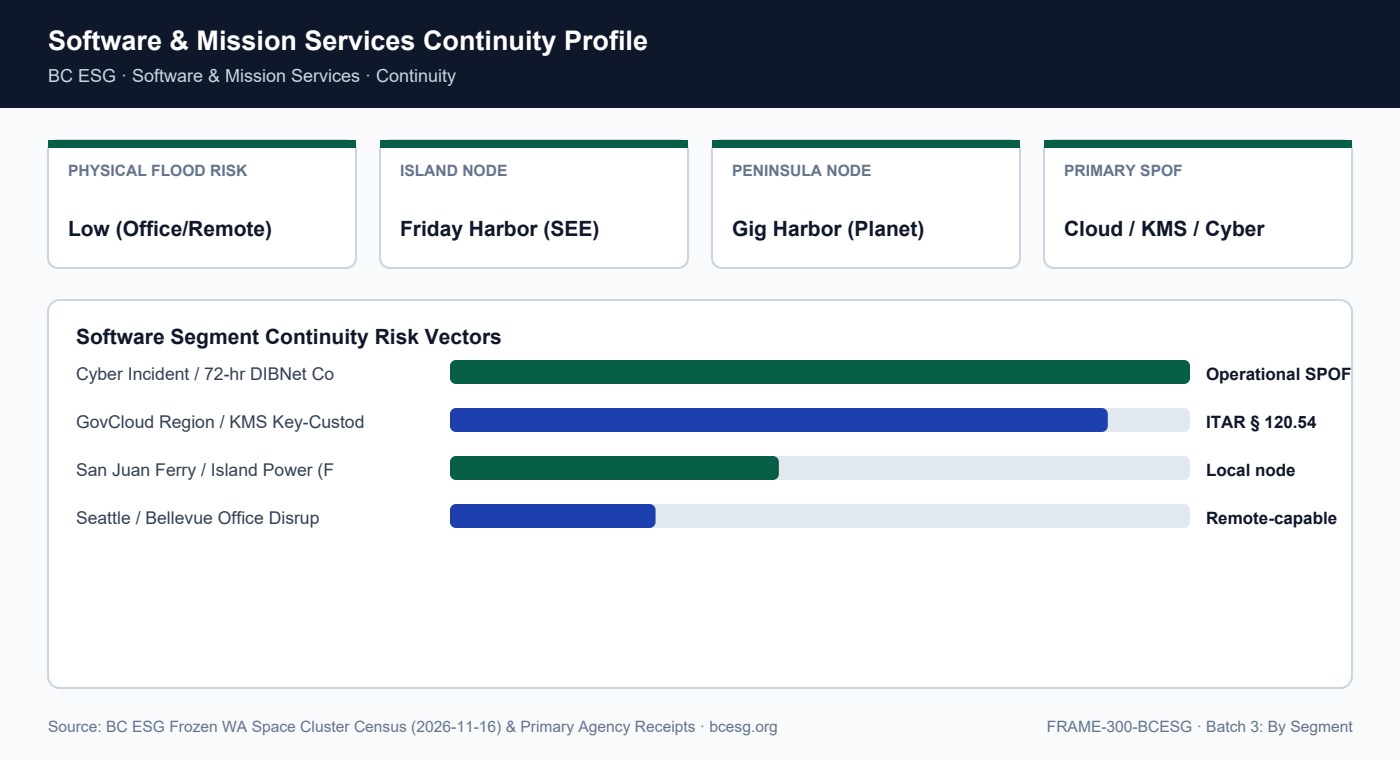
    Software & Mission Services Continuity Profile

    Why Physical Floodplains Matter Less Than Cloud & Key-Custody Continuity

    Unlike hardware factories in Kent or Sedro-Woolley, Washington's 9 software and mission-services firms can shift engineering operations remotely during Puget Sound storms, ferry disruptions (affecting SEE in Friday Harbor or Planet Enterprises in Gig Harbor), or urban seismic events.

    Their real continuity single points of failure are FedRAMP Moderate / GovCloud region availability, customer-controlled KMS/HSM key custody (required to preserve the ITAR § 120.54 encryption carve-out), and 72-hour cyber-incident containment under DFARS 252.204-7012 without losing access to mission-planning or C2 pipelines.

    Continuity VectorAffected FirmsMechanismResilience Control
    FedRAMP / GovCloud OutageIntegrate, M42, GodelMission SaaS & C2 downtimeMulti-AZ / cross-region GovCloud failover
    KMS / HSM Key Custody LossITAR-controlled softwareDecryption outage or compliance breachSplit-custody FIPS 140-3 HSM backups
    San Juan / Peninsula PowerSEE (Friday Harbor), Planet (Gig Harbor)Ferry/subsea cable & grid outageSeattle dual-office & cellular/SATCOM backup

    Related BC ESG Guides & Verified Primary Sources

  • Software Compliance: CMMC 2.0 (32 CFR 170), DFARS 7012, ITAR Encryption & SBOM

    Software Compliance: CMMC 2.0 (32 CFR 170), DFARS 7012, ITAR Encryption & SBOM

    BC ESG · Washington Space Cluster Segments (November 16, 2026)
    Sourced Baseline: Binding DoD/export surface: 32 CFR Part 170 (CMMC 2.0), DFARS 252.204-7012 (72-hr DIBNet + FedRAMP Mod), ITAR § 120.54 / EAR § 734.18 encryption carve-outs, and EO 14028 SBOM.
    TAKEAWAY BRIEF · PDF & MARKDOWN TWIN
    Software Compliance: CMMC, DFARS & ITAR
    Download the formatted 2-page briefing sheet (PDF) or read the single-source Markdown twin for Software Compliance: CMMC, DFARS & ITAR.
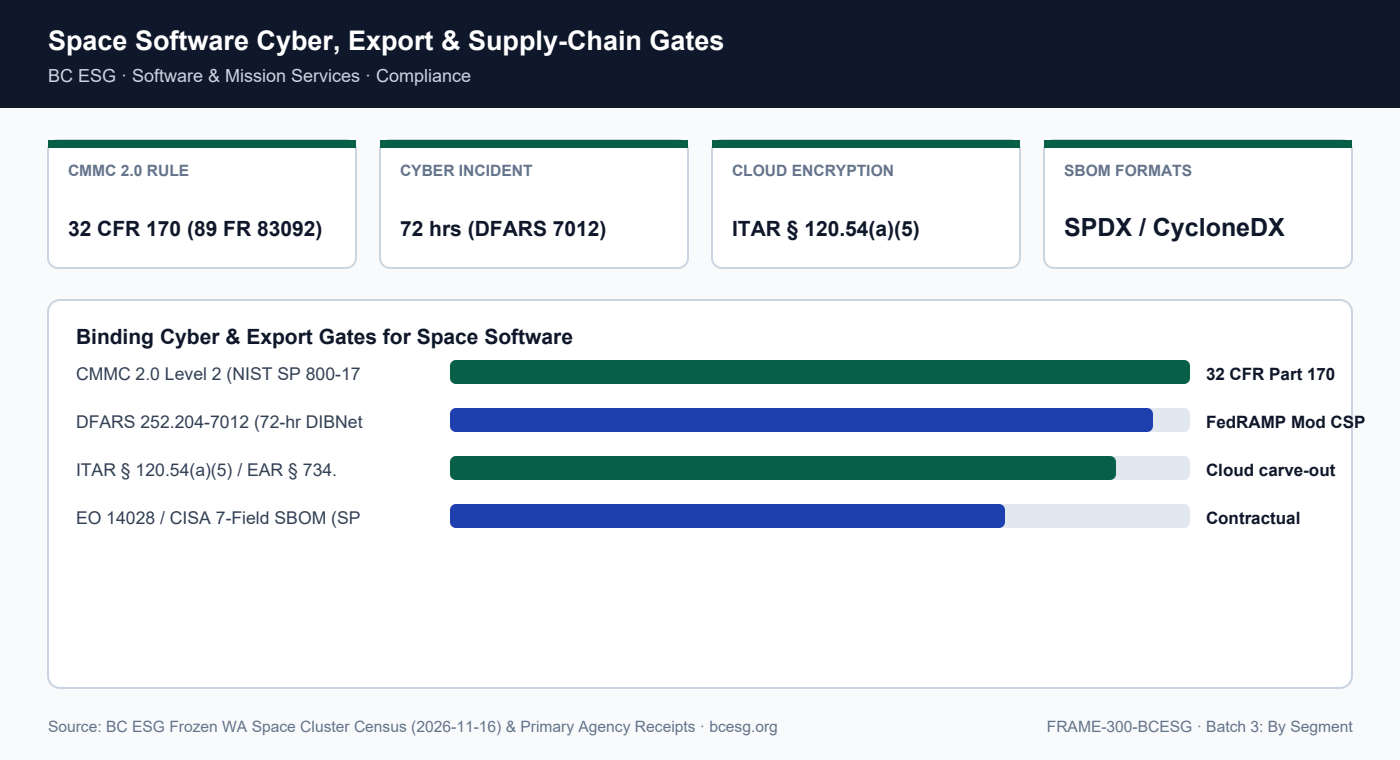
    Space Software Cyber, Export & Supply-Chain Gates

    Cybersecurity & Export Safe Harbors Replace Smokestack Permits

    For Washington's 9 software and mission-services firms, environmental air/water permits are irrelevant—their binding compliance surface is cybersecurity and export-controlled data custody. Under 32 CFR Part 170 (89 FR 83092, CMMC 2.0), contractors handling Controlled Unclassified Information (CUI) must satisfy all 110 controls of NIST SP 800-171 Rev 2 (with SPRS affirmations and C3PAO triennial assessments).

    Under DFARS 252.204-7012, cyber incidents affecting Covered Defense Information must be reported to DIBNet within 72 hours with 90-day image/pcap preservation and FedRAMP Moderate equivalent cloud hosting. For cloud-hosted mission SaaS, ITAR 22 CFR § 120.54(a)(5) and EAR 15 CFR § 734.18(a)(5) provide the cloud encryption carve-out—requiring end-to-end FIPS 140-2/140-3 encryption with keys inaccessible to third-party/non-US cloud admins.

    Rule / StandardCitationTriggerMandatory Control
    CMMC 2.032 CFR Part 170 (89 FR 83092)FCI / CUI in DoD contractsNIST SP 800-171 (110 controls) + SPRS/C3PAO
    DFARS Cyber Reporting48 CFR § 252.204-7012Covered Defense Information (CDI)72-hr DIBNet report, 90-day forensics, FedRAMP Mod
    ITAR/EAR Cloud Safe Harbor22 CFR § 120.54; 15 CFR § 734.18Cloud storage/transit of tech dataE2EE FIPS 140-2/3, customer-held keys, no D:5
    Software Bill of MaterialsEO 14028 / CISA NTIAFederal software procurement7-field SPDX or CycloneDX + KEV tracking

    Related BC ESG Guides & Verified Primary Sources

    Related Supplier Asks (Batch 4)

  • Astrodynamics, Spectrum Engineering, Edge AI & Mission SaaS in WA

    Astrodynamics, Spectrum Engineering, Edge AI & Mission SaaS in WA

    BC ESG · Washington Space Cluster Segments (November 16, 2026)
    Sourced Baseline: Low physical plant footprint, high technical specialization across mission SaaS, crypto C2, payload AI, astrodynamics, space weather, and FCC/ITU spectrum engineering.
    TAKEAWAY BRIEF · PDF & MARKDOWN TWIN
    Astrodynamics, Edge AI & Mission SaaS
    Download the formatted 2-page briefing sheet (PDF) or read the single-source Markdown twin for Astrodynamics, Edge AI & Mission SaaS.
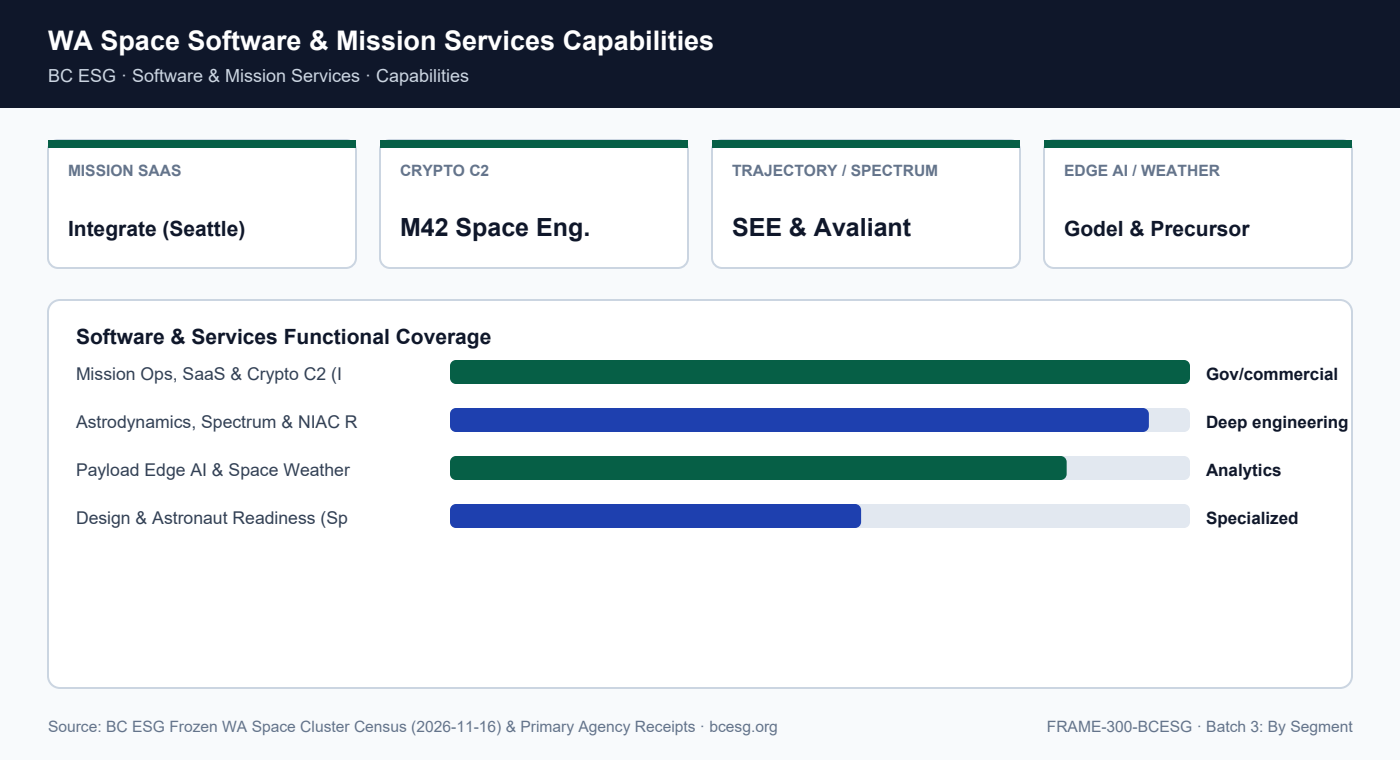
    WA Space Software & Mission Services Capabilities

    Software-Defined Mission Layer Without Heavy Factory Overhead

    Unlike hardware builders, Washington's software and mission-services firms operate lean engineering offices across Seattle, Bellevue, Friday Harbor, and Gig Harbor. Integrate builds mission and hardware-management SaaS; M42 Space Engineering builds cryptographic trust and C2 for national-security space; Godel Space builds payload edge AI.

    On the mission-engineering side, Space Exploration Engineering (SEE) executes trajectory design and astrodynamics, Avaliant handles constellation FCC/ITU spectrum engineering and LDPC, Precursor SPC models space weather, Planet Enterprises conducts NASA NIAC mission R&D, and The Space Age / Orbite provide design and readiness services.

    DomainOperatorsCore Deliverable
    Mission SaaS & Crypto C2Integrate, M42 Space EngineeringProgram management, CUI/ITAR workflows, crypto C2
    Payload AI & Space WeatherGodel Space, Precursor SPCOnboard inference, solar/geomagnetic forecasting
    Astrodynamics, Spectrum & R&DSEE, Avaliant, Planet EnterprisesTrajectories, FCC/ITU filings, NASA NIAC concepts
    Design & Crew ReadinessThe Space Age, OrbiteSpace architecture design & astronaut training

    Related BC ESG Guides & Verified Primary Sources

  • Washington Space Software & Mission Services: Overview & Census Roster

    Washington Space Software & Mission Services: Overview & Census Roster

    BC ESG · Washington Space Cluster Segments (November 16, 2026)
    Sourced Baseline: 9 core Software & Mission Services firms sit inside Census Ground Systems / Software (Integrate #1550 + 8 specialized firms in Grouped #1565); 0 companies re-homed.
    TAKEAWAY BRIEF · PDF & MARKDOWN TWIN
    Software & Mission Services Overview
    Download the formatted 2-page briefing sheet (PDF) or read the single-source Markdown twin for Software & Mission Services Overview.
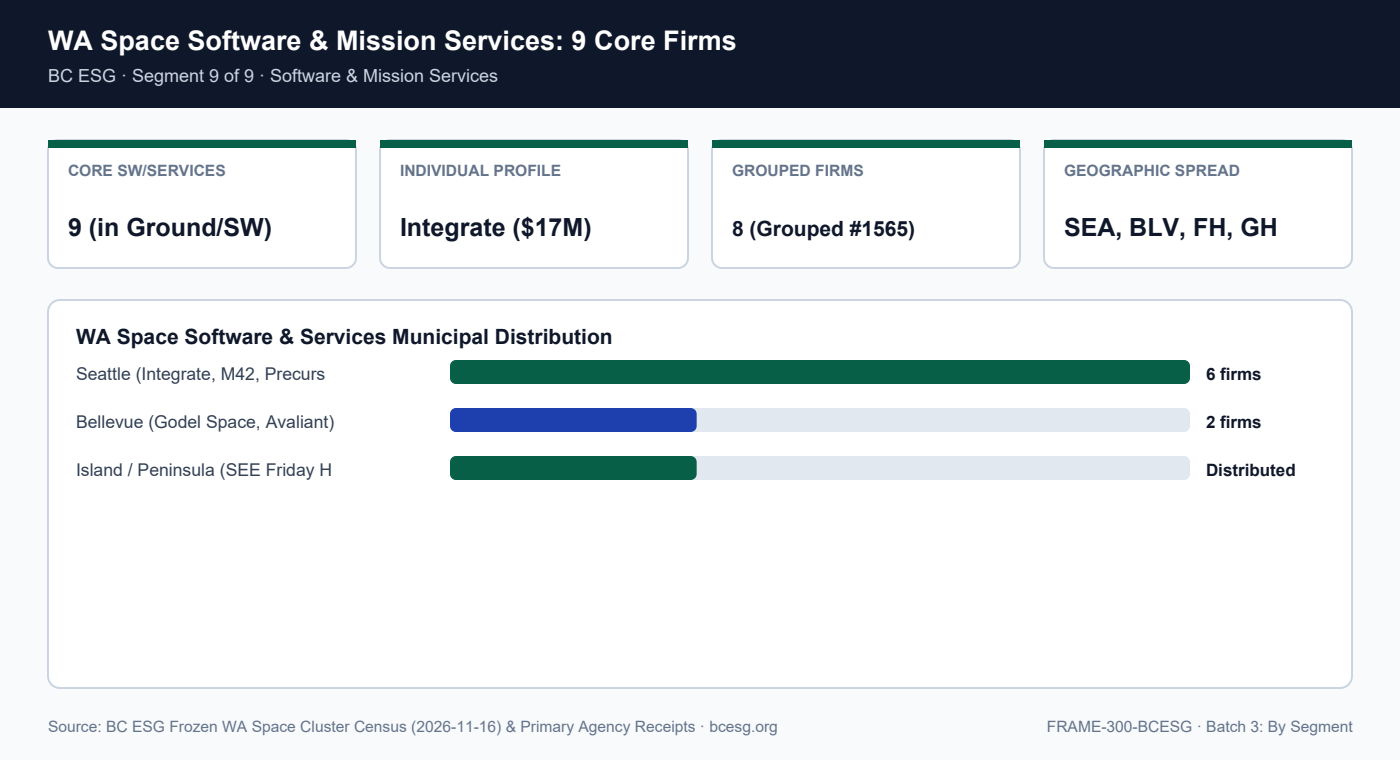
    WA Space Software & Mission Services: 9 Core Firms

    Census Mapping & What Software and Mission Services Deliver

    Within the frozen Census CSV's 14-company Ground Systems / Software category, 9 core operators (WA-SPC-059 through WA-SPC-067) deliver mission software, cryptographic C2, astrodynamics, spectrum engineering, space-weather analytics, and training rather than physical RF dishes.

    Integrate (Seattle, $17M Feb 2026 reported) holds an individual Census profile, while eight specialized or thinner-record firms (Godel Space, M42 Space Engineering, Precursor SPC, Space Exploration Engineering, Avaliant, Planet Enterprises, The Space Age, and Orbite) are covered in Grouped #1565.

    CompanyWA LocationCensus PlacementSpecialtyCensus Profile
    IntegrateSeattle, WACore (Ground Systems / Software)SaaS for space mission & hardware management ($17M Feb 2026)Profile #1550
    Godel SpaceBellevue, WACore (Ground Systems / Software)Edge-AI software for satellite payloadsGrouped #1565
    M42 Space Engineering (Messier 42)Seattle, WACore (Ground Systems / Software)Cryptographic trust & C2 for national-security spaceGrouped #1565
    Precursor SPCSeattle, WACore (Ground Systems / Software)Space weather tracking & predictionGrouped #1565
    Space Exploration Engineering (SEE)Seattle & Friday Harbor, WACore (Ground Systems / Software)Astrodynamics, trajectory design & mission planningGrouped #1565
    AvaliantBellevue, WACore (Ground Systems / Software)Space systems eng., FCC/ITU spectrum & LDPCGrouped #1565
    Planet EnterprisesGig Harbor, WACore (Ground Systems / Software)Space mission design & NASA NIAC R&DGrouped #1565
    The Space AgeSeattle, WACore (Ground Systems / Software)Multidisciplinary space design & engineeringGrouped #1565
    OrbiteSeattle, WACore (Ground Systems / Software)Commercial astronaut training & readinessGrouped #1565

    Related BC ESG Guides & Verified Primary Sources

  • Supplier Continuity: Skagit River Floodway, Paine Field & Wenatchee/Sequim Nodes

    Supplier Continuity: Skagit River Floodway, Paine Field & Wenatchee/Sequim Nodes

    BC ESG · Washington Space Cluster Segments (November 16, 2026)
    Sourced Baseline: Suppliers span four distinct geographies: Skagit River floodway (Janicki), Paine Field/Snohomish (Electroimpact, Karman, Crane, OPR), Wenatchee/Sequim (PacAero), and South King/Pierce.
    TAKEAWAY BRIEF · PDF & MARKDOWN TWIN
    Supplier Continuity & Geographic Nodes
    Download the formatted 2-page briefing sheet (PDF) or read the single-source Markdown twin for Supplier Continuity & Geographic Nodes.
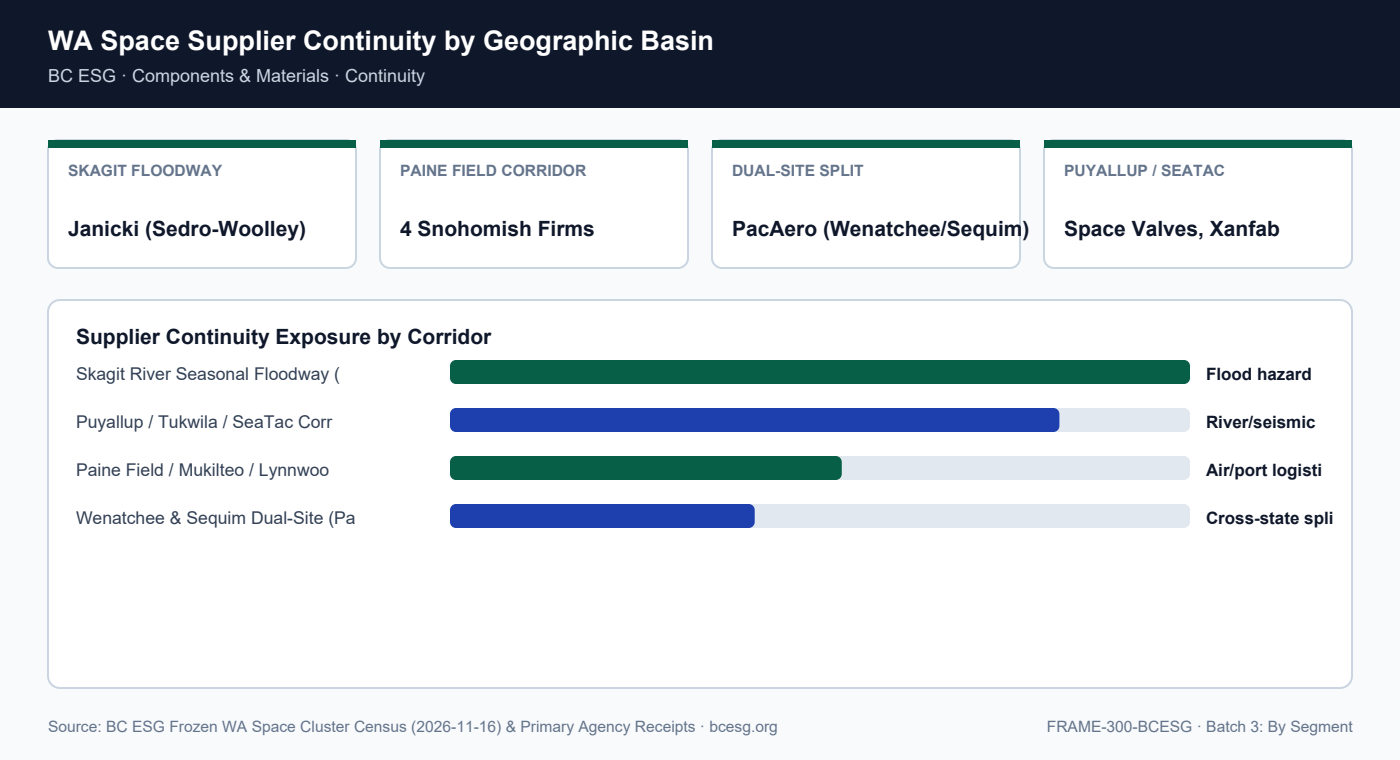
    WA Space Supplier Continuity by Geographic Basin

    Why Component Continuity Extends Far Outside Kent Valley

    Unlike launch primes, Washington's component suppliers span four separate watersheds and transport corridors. Janicki Industries in Sedro-Woolley/Hamilton borders the Skagit River floodway, where severe seasonal flooding drives elevation and multi-building mitigation under the Skagit County Hazard Mitigation Plan.

    Snohomish County suppliers (Electroimpact, Karman, Crane, Off Planet Research) cluster around Paine Field outside riverine floodplains, while PacAero splits production across Wenatchee (Chelan County) and Sequim (Clallam County)—creating built-in geographic redundancy across the Cascades and Olympic Peninsula.

    CorridorSuppliersPrimary HazardBuffer / Redundancy
    Skagit River (Sedro-Woolley)Janicki IndustriesSeasonal Skagit River floodingMulti-facility campus & elevation
    Paine Field (Mukilteo/Lynnwood/Everett)Electroimpact, Karman, Crane, OPRI-5/SR-525 freight; PSCAA air opsElevated terrace; Paine Field cargo
    Wenatchee & SequimPacAeroMountain pass winter closures (US-2/I-90)Two separate WA plants
    Puyallup / SeaTac / TukwilaSpace Valves, Xanfab, Rad TeamPuyallup/Duwamish seismic & floodSEA airport proximity

    Related BC ESG Guides & Verified Primary Sources

  • Supplier Compliance: AS9100D, Nadcap, DFARS Specialty Metals & TSCA PFAS

    Supplier Compliance: AS9100D, Nadcap, DFARS Specialty Metals & TSCA PFAS

    BC ESG · Washington Space Cluster Segments (November 16, 2026)
    Sourced Baseline: Binding flow-downs & environmental rules: DFARS 252.225-7009 specialty metals, EPA NESHAP Subpart GG (Cr6+/VOC), TSCA PFAS Part 705, and WA WAC 173-303 prepreg/solvent waste.
    TAKEAWAY BRIEF · PDF & MARKDOWN TWIN
    Supplier Compliance: AS9100, DFARS & PFAS
    Download the formatted 2-page briefing sheet (PDF) or read the single-source Markdown twin for Supplier Compliance: AS9100, DFARS & PFAS.
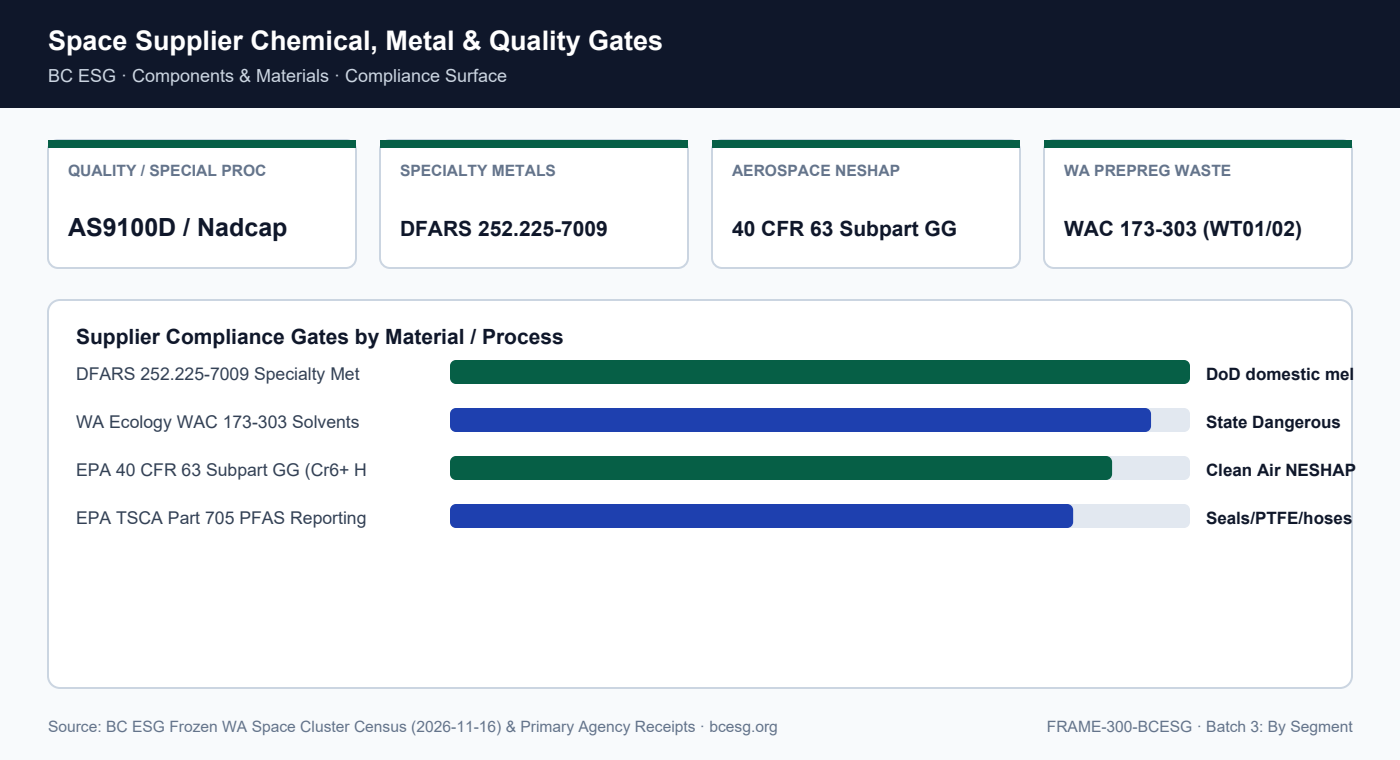
    Space Supplier Chemical, Metal & Quality Gates

    Where Supplier ESG & Compliance Actually Bites on the Shop Floor

    Tier-2 space suppliers face concrete material-level compliance: AS9100D quality systems and Nadcap special-process accreditations (chemical processing AC7108, NDT AC7114, composites AC7118), plus DFARS 252.225-7009 (10 U.S.C. § 4863), which mandates domestic or qualifying-country melting for titanium, specialty steels, and nickel/cobalt alloys.

    On the environmental side, EPA 40 CFR Part 63 Subpart GG mandates HEPA or 3-stage dry particulate filtration for hexavalent chromium primers; EPA TSCA 40 CFR Part 705 requires retroactive reporting on imported/manufactured PFAS articles (seals, PTFE wire, hoses); and Washington WAC 173-303 regulates spent cleaning solvents (F001–F005) and uncured composite prepreg scrap as State-only Dangerous Waste requiring exothermic-safe drum vents.

    MandateCitationShop-Floor TriggerRequirement
    AS9100D & NadcapSAE AS9100D / PRI NadcapMachining, NDT, plating, compositesQMS & special-process accreditation
    DFARS Specialty Metals48 CFR § 252.225-7009Titanium, Inconel, alloy steelsUS/qualifying-country melt (<=2% min rule)
    Aerospace NESHAP40 CFR Part 63 Subpart GGCr6+ primers, cadmium, VOC coatingsHEPA/3-stage filters & shift pressure logs
    TSCA PFAS & WA Waste40 CFR Part 705; WAC 173-303PTFE/seals; MEK/acetone; prepregPFAS reporting; F-listed & WT01/02 manifests

    Related BC ESG Guides & Verified Primary Sources

    Related Supplier Asks (Batch 4)

  • Valves, Hermetic Seals, Composites, AFP Robotics & Radiation Testing in WA

    Valves, Hermetic Seals, Composites, AFP Robotics & Radiation Testing in WA

    BC ESG · Washington Space Cluster Segments (November 16, 2026)
    Sourced Baseline: Spanning Sedro-Woolley composites (Janicki), Mukilteo AFP/energetics (Electroimpact, Karman), Lynnwood RF/power (Crane), and Tukwila/Everett qualification labs.
    TAKEAWAY BRIEF · PDF & MARKDOWN TWIN
    Special Processes, Composites & Testing
    Download the formatted 2-page briefing sheet (PDF) or read the single-source Markdown twin for Special Processes, Composites & Testing.
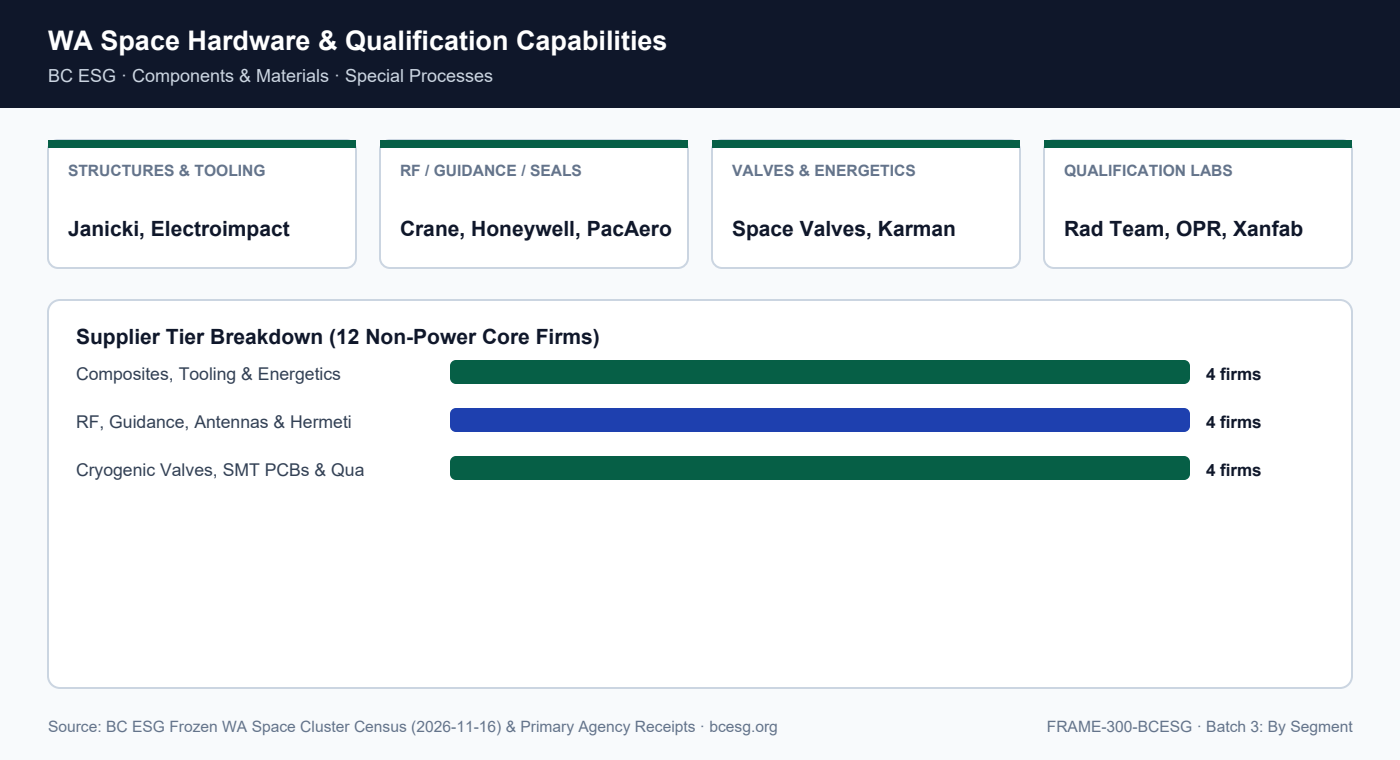
    WA Space Hardware & Qualification Capabilities

    Tier-2 Hardware & Qualification Backbone

    Washington's prime launch and satellite builders rely on an in-state Tier-2 backbone: Janicki Industries (Sedro-Woolley) and Electroimpact (Mukilteo) supply large-scale composite structures and automated fiber placement (AFP) robotics; Karman Space & Defense (Mukilteo) supplies structures and energetics; and Space Valves (Puyallup) builds AS9100 cryogenic valves.

    In electronics and qualification, Crane Aerospace (Lynnwood), Honeywell Aerospace (Redmond), PacAero (Wenatchee/Sequim), Kymeta (Redmond), and Xanfab (SeaTac) cover RF, IMUs, hermetic seals, antennas, and space PCBs—backed by The Radiation Team and Off Planet Research.

    CapabilityOperatorsCitiesRole in Value Chain
    Composites & AFP ToolingJanicki, Electroimpact, SiennaSedro-Woolley, Mukilteo, WoodinvilleAutoclave structures, AFP robots, materials
    Avionics, RF & HermeticsCrane, Honeywell, PacAero, Kymeta, XanfabLynnwood, Redmond, Wenatchee, SeaTacIMUs, RF passives, hermetic seals, SMT PCBs
    Fluid & EnergeticsSpace Valves, Karman (Systima)Puyallup, MukilteoCryogenic valves, pyrotechnics, structures
    Environmental TestingThe Radiation Team, Off Planet ResearchTukwila/Renton, EverettRadiation hardening & lunar regolith simulants

    Related BC ESG Guides & Verified Primary Sources

  • Washington Space Components, Materials & Suppliers: Overview & Roster

    Washington Space Components, Materials & Suppliers: Overview & Roster

    BC ESG · Washington Space Cluster Segments (November 16, 2026)
    Sourced Baseline: 17 core companies in Census Components & Suppliers (12 hardware/materials/testing + 5 power specialists covered in Power Systems); 3 adjacent general-aerospace plants segregated.
    TAKEAWAY BRIEF · PDF & MARKDOWN TWIN
    Components & Materials Overview
    Download the formatted 2-page briefing sheet (PDF) or read the single-source Markdown twin for Components & Materials Overview.
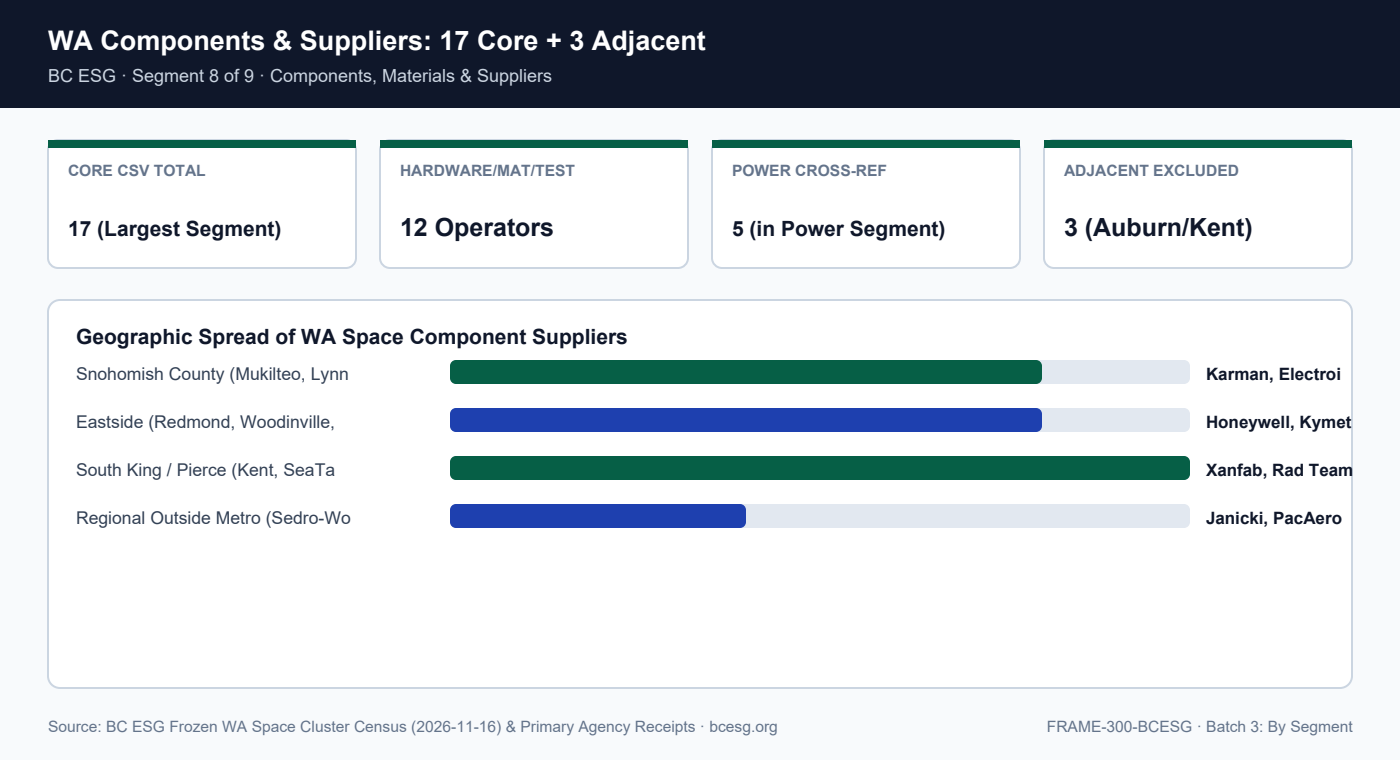
    WA Components & Suppliers: 17 Core + 3 Adjacent

    What Washington's Largest Space Segment Makes

    Components & Suppliers is the largest bucket in the frozen Census CSV with 17 core operators (WA-SPC-037 through WA-SPC-053). Twelve focus on hardware, materials, and qualification testing—from Janicki Industries composite tooling in Sedro-Woolley and Electroimpact AFP robotics in Mukilteo to Space Valves cryogenic valves in Puyallup and PacAero hermetic seals in Wenatchee and Sequim.

    Five dedicated space-power firms (WA-SPC-047..050, 053) also sit inside this Census bucket and are detailed in the Power Systems Segment Overview. Three general-aerospace plants—Tessera, Orion Industries, and Exotic Metals Forming—remain strictly segregated as adjacent.

    CompanyWA FacilityCensus ClassPrimary FocusCensus Profile
    Space ValvesPuyallup, WA (4227 S Meridian)CoreAS9100 cryogenic & pneumatic valvesProfile #1496
    Karman Space & Defense (Systima)Mukilteo, WACoreStructures, pyrotechnics, energeticsProfile #1499
    Crane Aerospace & ElectronicsLynnwood, WACore (Dual: Power)Space-qualified power & microwave/RFProfile #1502
    Honeywell Aerospace (Redmond)Redmond, WACore (NASDAQ: HON)Space/defense IMUs, guidanceProfile #1505
    Pacific Aerospace & Electronics (PacAero)Wenatchee & Sequim, WACoreHermetic seals & RF connectorsProfile #1508
    Janicki IndustriesSedro-Woolley, WACorePrecision composite structures & toolingProfile #1511
    ElectroimpactMukilteo, WACoreAutomated tooling & AFP composite robotsProfile #1514
    KymetaRedmond, WACore (Secondary: SATCOM)Flat-panel steered satellite antennasProfile #1517
    XanfabSeaTac, WACoreHigh-mix SMT PCB assembly & lead formingProfile #1520
    Sienna TechnologiesWoodinville, WACoreSpecialized space-grade materialsGrouped #1562
    Off Planet ResearchEverett, WACoreLunar regolith simulants & testbedsProfile #1532
    The Radiation TeamTukwila / Renton, WACoreSpace radiation reliability & hardeningProfile #1535
    5 Space-Power Specialists (Cross-Ref)Kent, Issaquah, SeattleCore (Power Systems)PowerLight, JX Crystals, WiBotic, Zeno, PulseSee Power Systems
    Tessera, Orion, Exotic Metals (Adjacent)Auburn / Kent, WAAdjacent (Excluded from 67)General aerospace CNC/sheet-metal/exhaustAdjacent #1460

    Related BC ESG Guides & Verified Primary Sources

  • Orbital Compute Continuity: Redmond/Woodinville, Kent & Launch-Cadence Risks

    Orbital Compute Continuity: Redmond/Woodinville, Kent & Launch-Cadence Risks

    BC ESG · Washington Space Cluster Segments (November 16, 2026)
    Sourced Baseline: Cowboy Space (~290k sq ft Kent) sits in the Green River corridor; Starcloud sits in Redmond/Woodinville; all 3 depend on external launch cadence and radiation-tolerant supply.
    TAKEAWAY BRIEF · PDF & MARKDOWN TWIN
    Orbital Compute Continuity & Risks
    Download the formatted 2-page briefing sheet (PDF) or read the single-source Markdown twin for Orbital Compute Continuity & Risks.
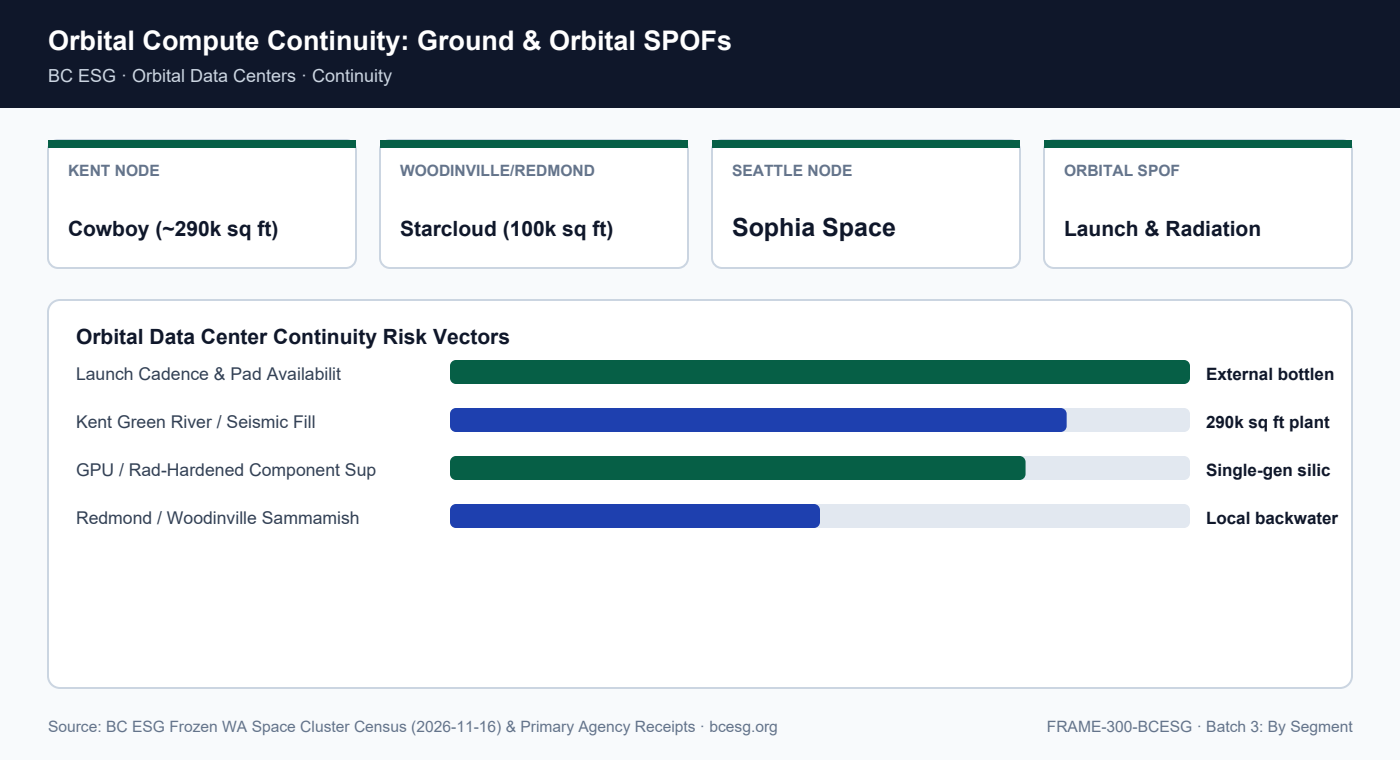
    Orbital Compute Continuity: Ground & Orbital SPOFs

    Ground Assembly Geography Meets Orbital Launch Dependency

    Even though orbital compute aims to bypass terrestrial grid queues, its assembly lines remain exposed to Puget Sound corridors: Cowboy Space (~290,000 sq ft in Kent) sits in the Lower Green River valley, while Starcloud splits between Redmond and Woodinville in the Sammamish basin.

    Beyond facility geography, the segment's defining single point of failure is launch cadence and radiation-tolerant GPU/radiator supply: hardware cannot be serviced easily on orbit, making launch delays or single-event-upset (SEU) failures irreversible without replacement launches.

    Node / VectorOperator(s)Continuity RiskImpact
    Kent Valley (~290k sq ft)Cowboy SpaceGreen River floodplain & liquefactionRocket & compute assembly pause
    Redmond / WoodinvilleStarcloudSammamish corridor / I-405Starcloud-3/4 integration delay
    Launch & Silicon SupplyAll 3 operatorsOut-of-state launch slots & GPU lead timesConstellation deployment slip

    Related BC ESG Guides & Verified Primary Sources

  • Orbital Compute Compliance: WA CETA/CCA Divergence & FCC/ITU Gates

    Orbital Compute Compliance: WA CETA/CCA Divergence & FCC/ITU Gates

    BC ESG · Washington Space Cluster Segments (November 16, 2026)
    Sourced Baseline: Zero binding orbital-compute ESG or carbon rules exist today; terrestrial WA data centers face CETA (RCW 19.405) and CCA (RCW 70A.65), while orbital nodes face FCC Part 25 & ITU.
    TAKEAWAY BRIEF · PDF & MARKDOWN TWIN
    Orbital Compute Compliance & CETA/CCA
    Download the formatted 2-page briefing sheet (PDF) or read the single-source Markdown twin for Orbital Compute Compliance & CETA/CCA.
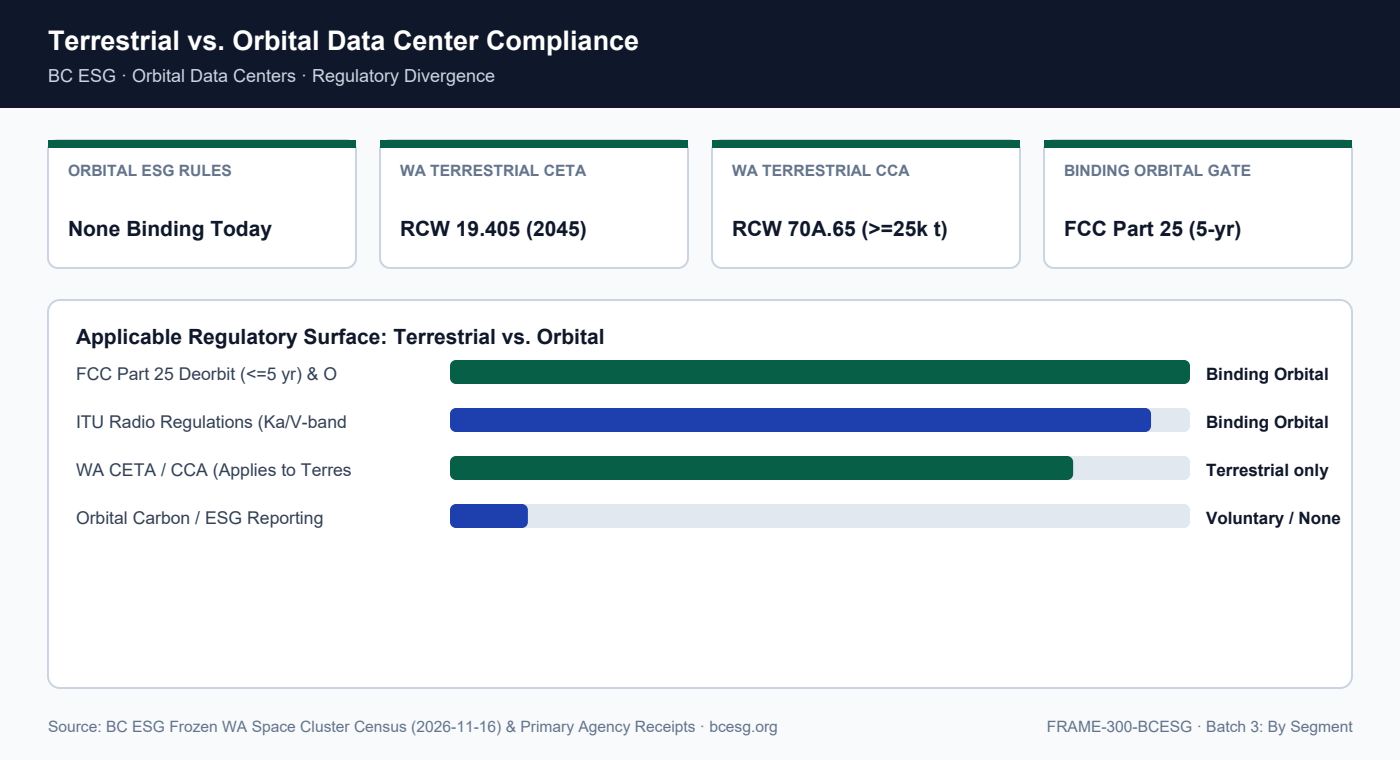
    Terrestrial vs. Orbital Data Center Compliance

    No Binding Orbital-Compute ESG Rules—Only FCC, ITU, and Terrestrial Manufacturing Permits

    Terrestrial data centers in Washington face tightening clean-energy and carbon mandates under the Clean Energy Transformation Act (CETA, RCW 19.405)—requiring 100% zero-emission retail electricity by 2045—and the Climate Commitment Act (CCA, RCW 70A.65) for facilities emitting >= 25,000 metric tons CO2e/year.

    Orbital compute platforms operate outside state utility and EPA carbon-cap jurisdiction: no binding orbital-compute ESG or carbon-accounting standard exists today. Any sustainability claims made for space-based compute are voluntary/claimed unless verified against full launch-lifecycle emissions. Binding gates remain FCC 47 CFR Part 25 (including the 5-year LEO deorbit rule), ITU spectrum coordination, NOAA 15 CFR Part 960 (if imaging sensors are carried), and local WA industrial permits for Kent/Woodinville assembly.

    Rule / StatuteApplies ToBinding StatusKey Threshold
    FCC 47 CFR Part 25 (§ 25.283)Orbital compute satellitesBinding (Federal)5-year LEO post-mission deorbit
    ITU Radio RegulationsHigh-bandwidth downlinks / ISLsBinding (Intl/FCC)API / CR / MIFR coordination
    WA CETA (RCW 19.405) & CCA (RCW 70A.65)Terrestrial WA data centers / utilitiesBinding (Terrestrial)2045 100% clean; 25k t CO2e cap
    Orbital Compute Carbon / ESGSpace-based AI workloadsNone / VoluntaryNo binding federal or state standard

    Related BC ESG Guides & Verified Primary Sources

    Related Supplier Asks (Batch 4)

  • Orbital GPU Compute & Launch-Integrated Architectures in WA (Thin-Record)

    Orbital GPU Compute & Launch-Integrated Architectures in WA (Thin-Record)

    BC ESG · Washington Space Cluster Segments (November 16, 2026)
    Sourced Baseline: THIN-RECORD TREATMENT: Starcloud demonstrated an H100 payload on Starcloud-1; Cowboy Space pursues Big Iron upper-stage compute; Sophia Space public specs remain sparse.
    TAKEAWAY BRIEF · PDF & MARKDOWN TWIN
    Orbital Compute Architectures (Thin-Record)
    Download the formatted 2-page briefing sheet (PDF) or read the single-source Markdown twin for Orbital Compute Architectures (Thin-Record).
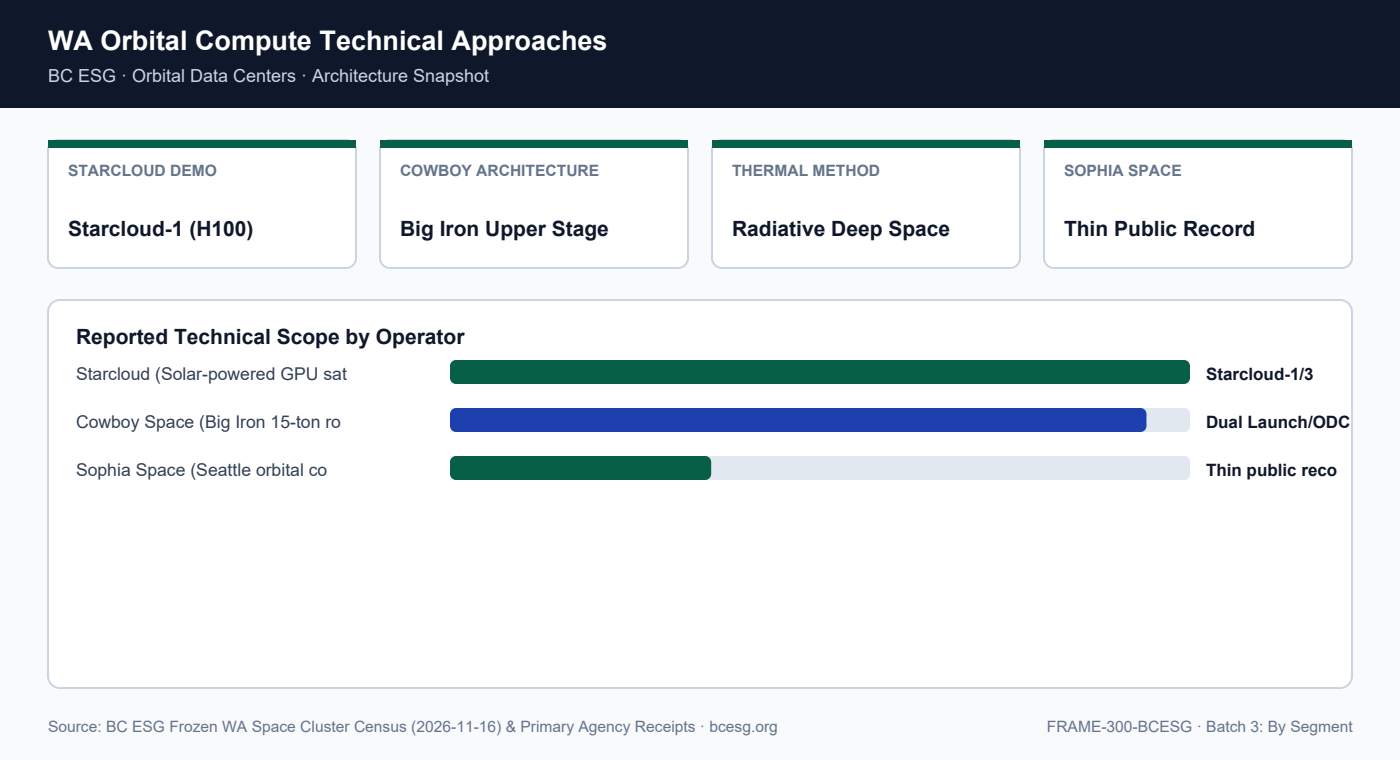
    WA Orbital Compute Technical Approaches

    Two Divergent Hardware Paths (Plus One Thin-Record Startup)

    Starcloud focuses on dedicated solar-powered orbital AI compute clusters using radiative thermal dissipation into deep space, following its late-2025 Starcloud-1 demonstration carrying an NVIDIA H100 GPU and scaling assembly in Woodinville.

    Cowboy Space (formerly Aetherflux) pairs orbital compute with vertical launch integration—developing its Big Iron vehicle whose upper stage is designed to remain on orbit as a compute node with deployable radiators rather than being discarded. Sophia Space (Seattle, $10M reported Feb 2026) has minimal public hardware specifications and is kept concise here.

    OperatorCompute ConceptPower / ThermalPublic Maturity
    StarcloudDedicated orbital GPU clustersSolar PV + deep-space radiatorsStarcloud-1 demo; Woodinville line
    Cowboy SpaceBig Iron rocket upper-stage computeSolar / laser beaming R&D + radiatorsKent facility build-out; FCC filings
    Sophia SpaceOrbital compute architectureUndisclosed in public filingsEarly-stage ($10M reported)

    Related BC ESG Guides & Verified Primary Sources

  • Washington Orbital Data Centers & Compute: Overview & Roster (Thin-Record Segment)

    Washington Orbital Data Centers & Compute: Overview & Roster (Thin-Record Segment)

    BC ESG · Washington Space Cluster Segments (November 16, 2026)
    Sourced Baseline: THIN-RECORD SEGMENT: Only 3 core companies in the frozen Census CSV (Starcloud, Cowboy Space [dual Launch], Sophia Space); pre-revenue/early-stage R&D; 0 padding.
    TAKEAWAY BRIEF · PDF & MARKDOWN TWIN
    Orbital Data Centers Overview (Thin-Record)
    Download the formatted 2-page briefing sheet (PDF) or read the single-source Markdown twin for Orbital Data Centers Overview (Thin-Record).
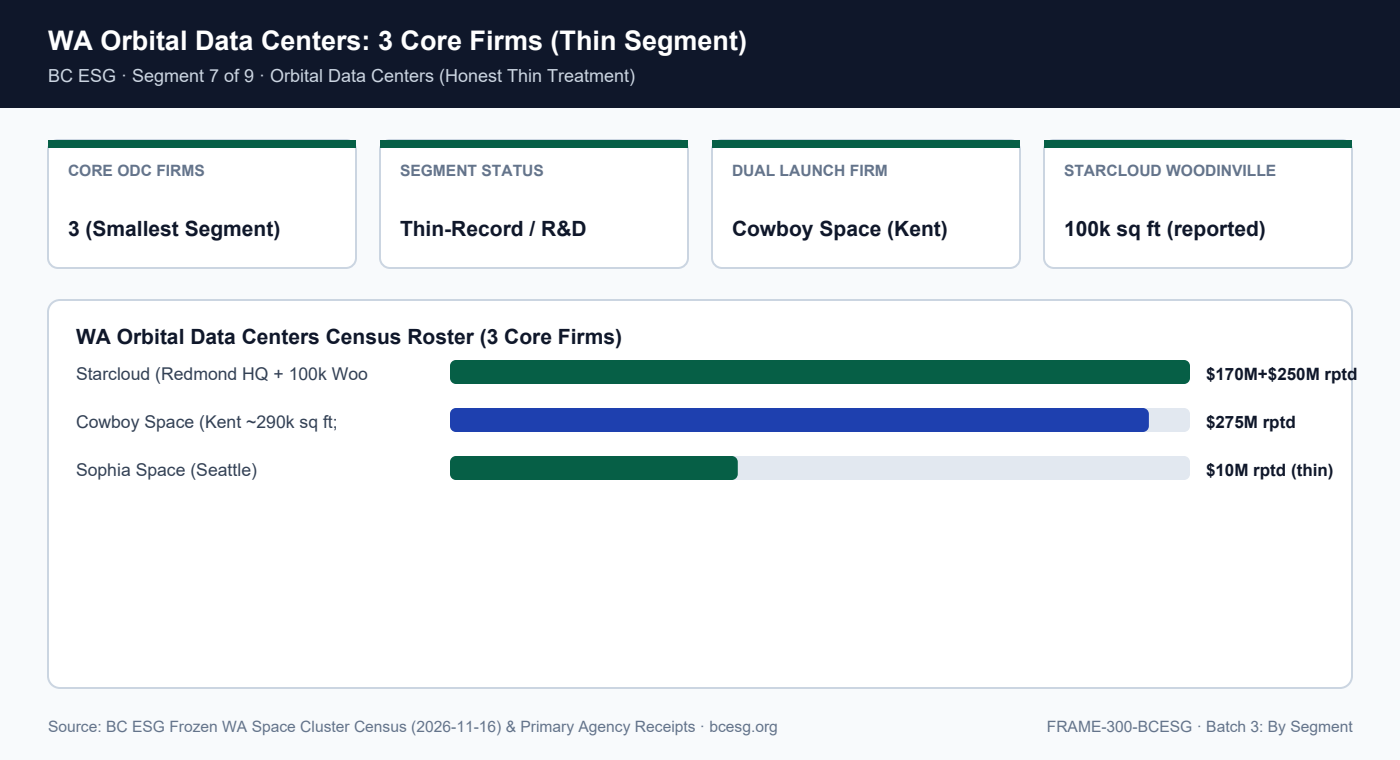
    WA Orbital Data Centers: 3 Core Firms (Thin Segment)

    Thin-Record Notice & What Washington's Orbital Compute Segment Builds

    Honest Thin-Record Disclosure: Orbital Data Centers & Compute is the smallest segment in the frozen Census CSV, with just 3 core operators (WA-SPC-034 through WA-SPC-036). All three are early-stage or pre-commercial-scale R&D ventures without public ESG filings or multi-year operating histories; this package intentionally provides a concise, sourced baseline without padding.

    The segment comprises Starcloud (Redmond HQ + reported 100,000 sq ft Woodinville production facility), Cowboy Space (Kent ~290,000 sq ft facility; dual-noted with Launch as secondary for its Big Iron rocket), and Sophia Space (Seattle).

    CompanyWA FacilityCensus ClassPrimary FocusCensus Profile
    Starcloud (formerly Lumen Orbit)Redmond, WA (2517 152nd Ave NE) / Woodinville (100k sq ft)CoreOrbital GPU data centers (Starcloud-1/3/4)Profile #1450
    Cowboy Space (formerly Aetherflux)Kent, WA (~290,000 sq ft)Core (Dual: Orbital Data Centers + Launch)Orbital data centers & Big Iron rocketProfile #1424
    Sophia SpaceSeattle, WACoreOrbital compute & data center architecture ($10M Feb 2026)Grouped #1556

    Related BC ESG Guides & Verified Primary Sources

BC ESG

ESG Strategy, Sustainability Intelligence, and Business Continuity for Forward-Thinking Organizations

© 2026 BC ESG — Business Continuity, ESG & Sustainability Intelligence