Category: Space Cluster Segments

Segment-level analysis across launch, satellite manufacturing, propulsion, in-space servicing, orbital data centers, components, and ground systems.

  • Propulsion Continuity: Redmond Campus, Bellevue Office & Off-Site Test Stands

    Propulsion Continuity: Redmond Campus, Bellevue Office & Off-Site Test Stands

    BC ESG · Washington Space Cluster Segments (November 16, 2026)
    Sourced Baseline: Aerojet Redmond (11411 139th Pl NE) is a national S-405 catalyst single point; Agile depends on OK/CO test stands; 5 startups sit in Kent/Seattle/Kirkland.
    TAKEAWAY BRIEF · PDF & MARKDOWN TWIN
    Propulsion Continuity & Single Points
    Download the formatted 2-page briefing sheet (PDF) or read the single-source Markdown twin for Propulsion Continuity & Single Points.
    Propulsion Segment Continuity & Single Points of Failure

    Single Points of Failure Beyond Local Floodplains

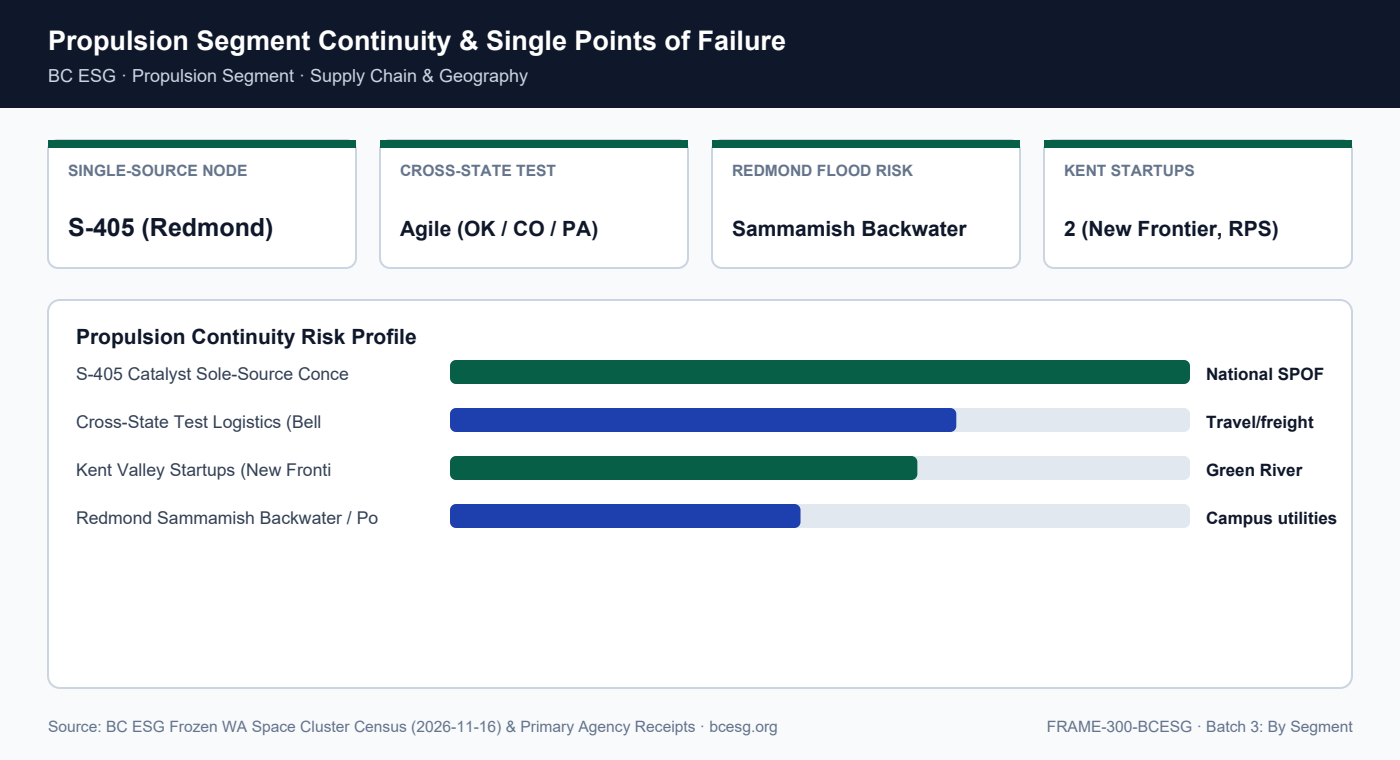
    Propulsion continuity in Washington centers on supply-chain specialization as much as geography. Because Aerojet Rocketdyne in Redmond is the sole-source manufacturer of S-405 hydrazine catalyst, any prolonged utility, hazardous-waste permitting, or seismic disruption at 11411 139th Pl NE ripples across national NASA and DoD satellite schedules.

    Meanwhile, Agile Space Industries insulates Bellevue from hot-fire permitting risk by running test stands in Tulsa, OK and Durango, CO—trading local environmental exposure for cross-state test-campaign logistics.

    Continuity VectorOperator(s)Geographic NodeImpact
    S-405 Sole-Source ProductionAerojet Rocketdyne (L3Harris)Redmond, WANational spacecraft thruster bottleneck
    Out-of-State Test DependencyAgile Space IndustriesBellevue <-> OK/CO/PASchedule sensitivity to inter-site shipping
    Green River / SODO ExposureNew Frontier, RPS, Juno, ReachKent / SeattleEarly-stage lab & tooling interruption

    Related BC ESG Guides & Verified Primary Sources

  • Propulsion Compliance: EPA TRI, RCRA P068 Hydrazine & Methalox Air Permits

    Propulsion Compliance: EPA TRI, RCRA P068 Hydrazine & Methalox Air Permits

    BC ESG · Washington Space Cluster Segments (November 16, 2026)
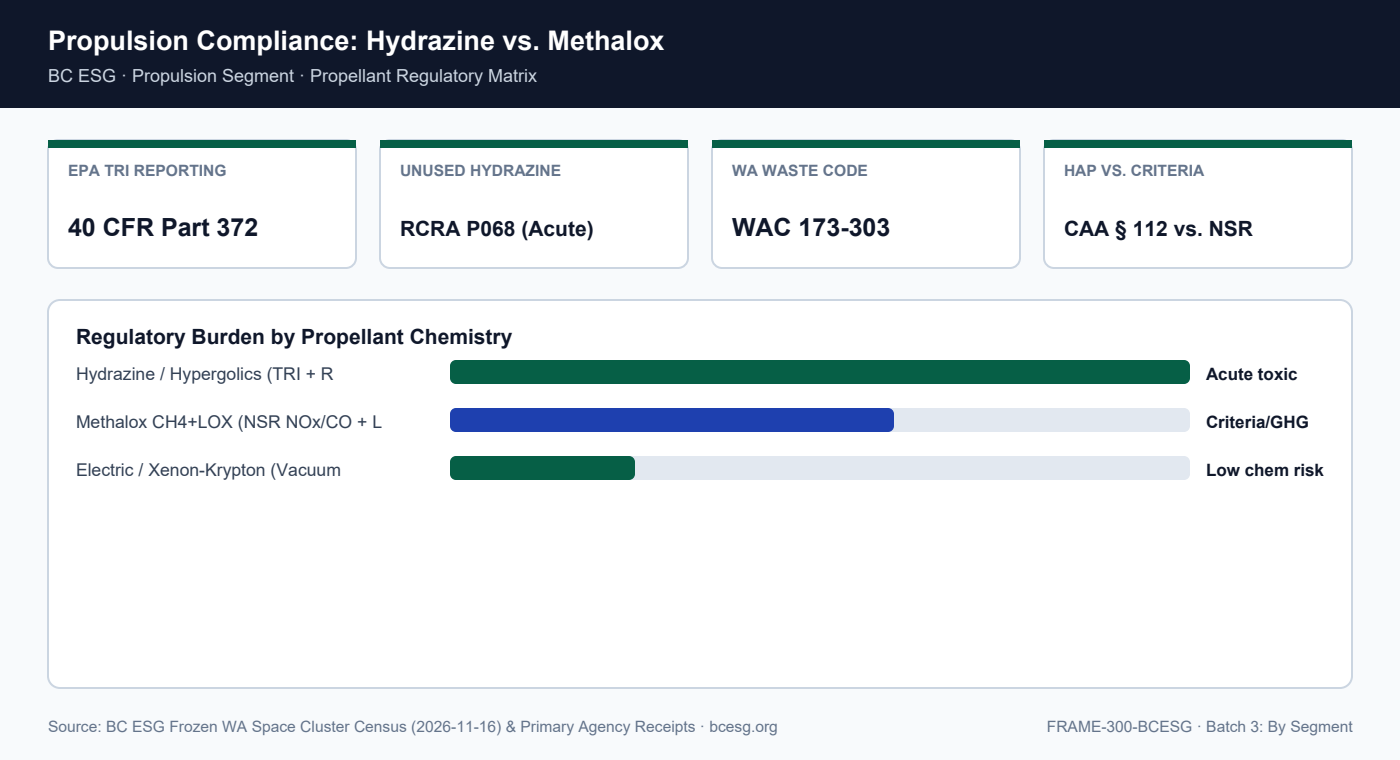
    Sourced Baseline: Hydrazine triggers EPA TRI (40 CFR 372), RCRA acute P068 / WAC 173-303, and CAA § 112 HAP scrubbers; methalox triggers NSR criteria pollutants and 40 CFR 98 GHG reporting.
    TAKEAWAY BRIEF · PDF & MARKDOWN TWIN
    Propulsion Compliance: TRI, RCRA & Air
    Download the formatted 2-page briefing sheet (PDF) or read the single-source Markdown twin for Propulsion Compliance: TRI, RCRA & Air.
    Propulsion Compliance: Hydrazine vs. Methalox

    Why Propellant Chemistry Dictates the Entire Compliance Surface

    In propulsion, environmental compliance is strictly governed by propellant chemistry. Hydrazine and hypergolic propellants ($ ext{N}_2 ext{H}_4$, MMH, $ ext{N}_2 ext{O}_4$) are Clean Air Act Section 112 Hazardous Air Pollutants (HAPs) requiring closed-loop chemical vapor scrubbers, fence-line monitoring, EPA Toxics Release Inventory (TRI) reporting under 40 CFR Part 372, and acute hazardous waste management (RCRA P068 / WAC 173-303).

    By contrast, methalox ($ ext{CH}_4$ + LOX) systems—used by launch-adjacent propulsion programs—produce predominantly $ ext{CO}_2$ and water vapor with trace CO and thermal $ ext{NO}_x$, shifting permitting to Clean Air Act New Source Review (NSR), methane Leak Detection and Repair (LDAR), and 40 CFR Part 98 GHG reporting.

    Rule / StatutePropellant TriggerBinding RequirementPrimary Source
    EPCRA § 313 / EPA TRI (40 CFR 372)Hydrazine, nitric/ammonia streams, solventsAnnual toxic release & off-site transfer reportingEPA TRI Program
    RCRA P068 / WAC 173-303Unused or spent hydrazineAcute hazardous waste storage, manifest & disposalWA Ecology Dangerous Waste
    Clean Air Act § 112 (HAP) vs. NSRHypergolics vs. MethaloxClosed-loop vapor scrubbers vs. flares/LDAREPA Clean Air Act

    Related BC ESG Guides & Verified Primary Sources

    Related Supplier Asks (Batch 4)

  • Chemical, Electric & Rotating Detonation Propulsion Operations in WA

    Chemical, Electric & Rotating Detonation Propulsion Operations in WA

    BC ESG · Washington Space Cluster Segments (November 16, 2026)
    Sourced Baseline: Aerojet Rocketdyne Redmond produces MR-series hydrazine thrusters, S-405 catalyst, and electric thrusters; 5 startups are early-stage R&D with thin public records.
    TAKEAWAY BRIEF · PDF & MARKDOWN TWIN
    Chemical, Electric & RDE Propulsion
    Download the formatted 2-page briefing sheet (PDF) or read the single-source Markdown twin for Chemical, Electric & RDE Propulsion.
    Propulsion Modalities Across WA Operators

    Flight-Heritage Production vs. Early-Stage Engine R&D

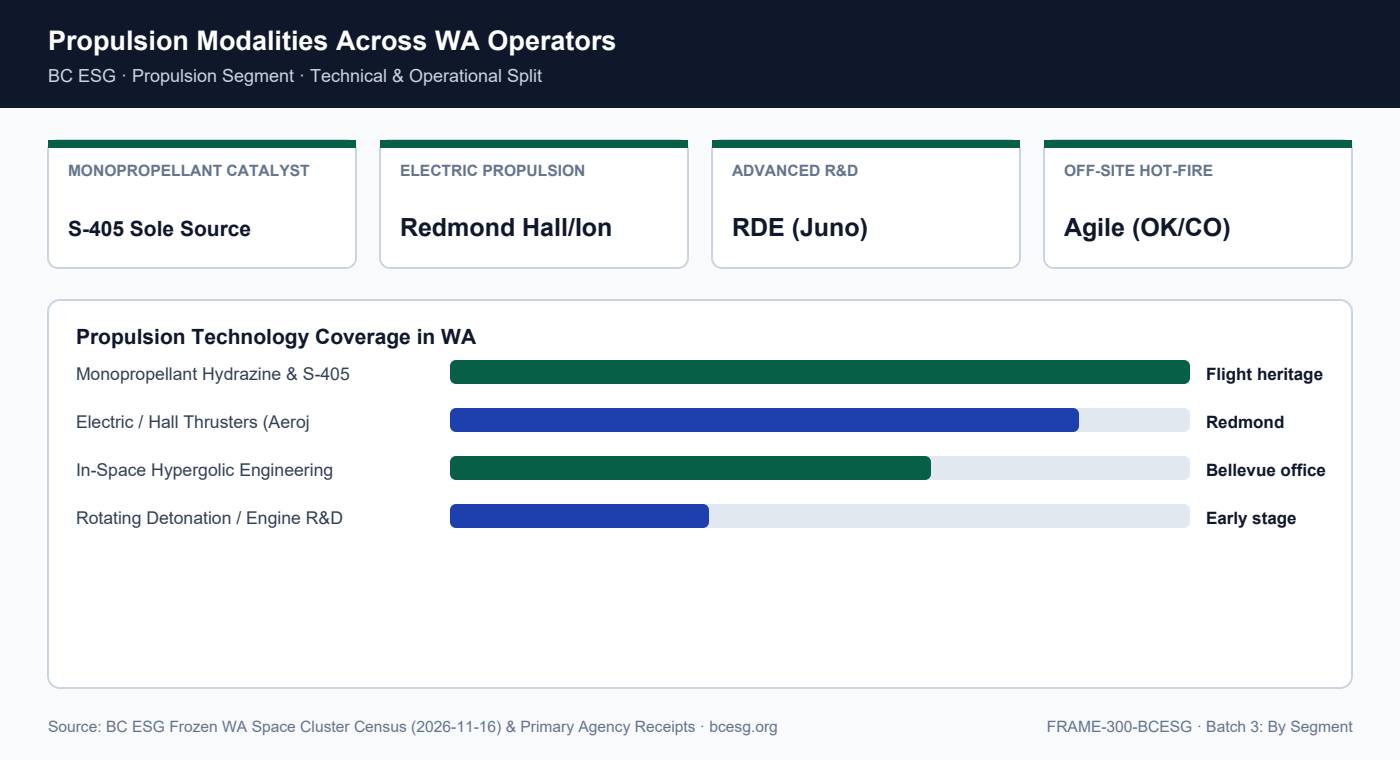
    Washington's propulsion capability spans two distinct tiers. At the heritage tier, Aerojet Rocketdyne in Redmond has manufactured thousands of monopropellant hydrazine thrusters (MR-106, MR-107, MR-111) and electric thrusters for NASA, DoD, and commercial constellations, alongside sole-source S-405 catalyst manufacturing.

    At the emerging tier, Agile Space Industries designs in-space chemical thrusters from Bellevue while keeping 3D additive printing in Pennsylvania and hot-fire stands in Tulsa, OK and Durango, CO. Meanwhile, Juno Propulsion (rotating detonation engines) and four peers remain early-stage R&D ventures with limited public test data.

    ModalityWA Operator(s)Where Hot-Fire OccursMaturity
    Monopropellant Hydrazine & S-405Aerojet Rocketdyne (L3Harris)Redmond, WA / customer sitesFlight-proven production
    Electric / Hall PropulsionAerojet Rocketdyne (L3Harris)Redmond vacuum chambersFlight-proven production
    In-Space Hypergolic ThrustersAgile Space IndustriesTulsa, OK & Durango, COCommercial development
    RDE & Rocket Engine R&DJuno, GHKN, New Frontier, Reach, RPSUndisclosed / off-siteEarly-stage R&D (thin record)

    Related BC ESG Guides & Verified Primary Sources

  • Washington Space Propulsion Segment: Overview & Census Roster

    Washington Space Propulsion Segment: Overview & Census Roster

    BC ESG · Washington Space Cluster Segments (November 16, 2026)
    Sourced Baseline: 7 core Propulsion operators in the frozen Census CSV; 5 thinner-record startups honestly grouped in #1553; 0 companies re-homed.
    TAKEAWAY BRIEF · PDF & MARKDOWN TWIN
    Propulsion Segment Overview & Roster
    Download the formatted 2-page briefing sheet (PDF) or read the single-source Markdown twin for Propulsion Segment Overview & Roster.
    WA Space Propulsion Segment: 7 Core Operators

    What the Washington Propulsion Segment Makes and Does

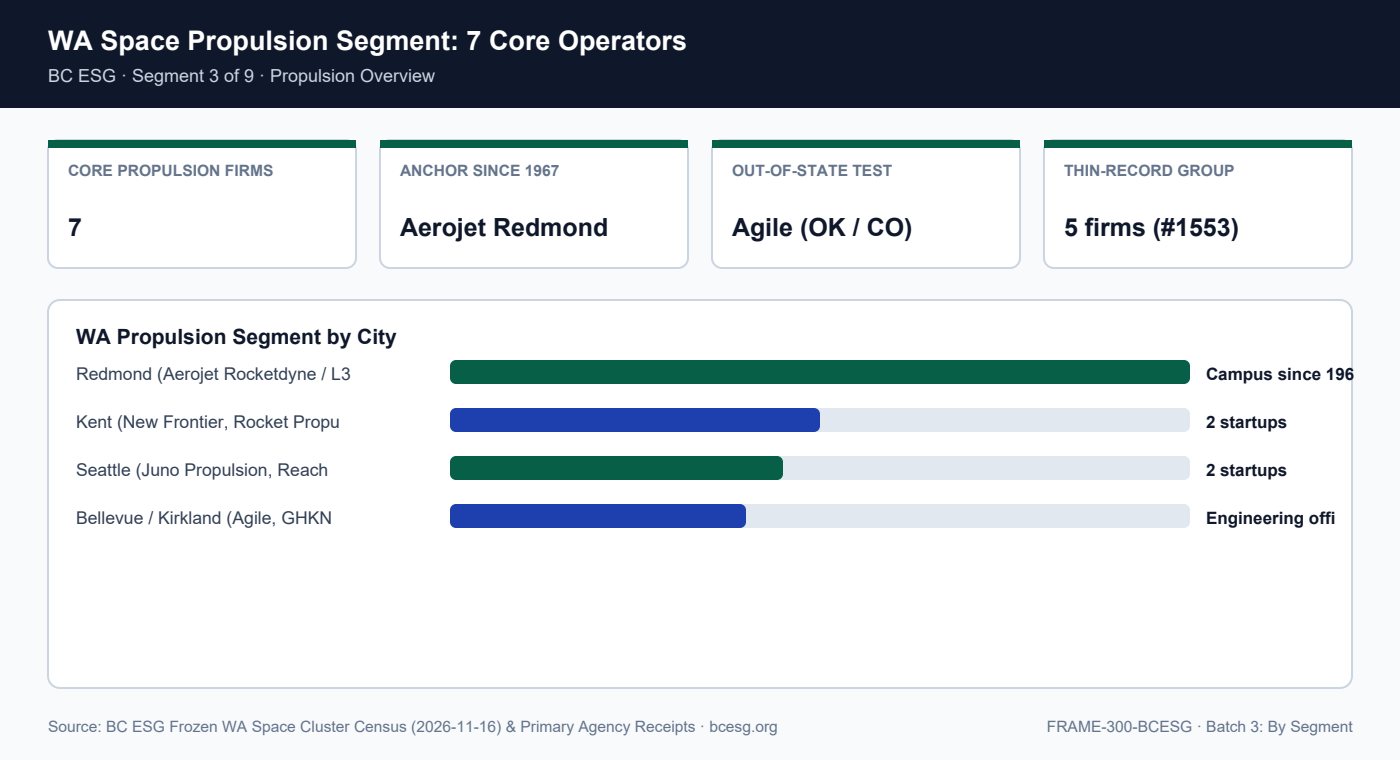
    The Propulsion segment in the frozen Census CSV contains 7 core companies (WA-SPC-019 through WA-SPC-025). The anchor is Aerojet Rocketdyne (L3Harris, NYSE: LHX) at 11411 139th Pl NE in Redmond, operating since 1967 as a premier U.S. center for spacecraft chemical (monopropellant hydrazine MR-series) and electric propulsion, and sole-source producer of the S-405 iridium-alumina hydrazine catalyst.

    Six smaller operators complement the anchor: Agile Space Industries in Bellevue (in-space chemical propulsion engineering), plus five thinner-record R&D firms (GHKN Engineering, Juno Propulsion, New Frontier Aerospace, Reach Space Technologies, and Rocket Propulsion Systems) documented in the Launch & Propulsion Core Group.

    CompanyWA FacilityCensus ClassPrimary FocusCensus Profile
    Aerojet Rocketdyne (L3Harris)Redmond, WA (11411 139th Pl NE)Core (NYSE: LHX)Monopropellant hydrazine, electric thrusters, S-405 catalystProfile #1447
    Agile Space IndustriesBellevue, WA (Sunset North, ~5,500 sq ft)CoreIn-space chemical propulsion engineering (test stands OK/CO)Profile #1490
    GHKN EngineeringKirkland, WACoreRocket engine developmentGrouped #1553
    Juno PropulsionSeattle, WACoreRotating detonation engines (RDE)Grouped #1553
    New Frontier AerospaceKent, WACoreRocket engines & reusable orbital transferGrouped #1553
    Reach Space TechnologiesSeattle, WACoreRocket propulsion componentsGrouped #1553
    Rocket Propulsion SystemsKent, WACoreRocket engine R&DGrouped #1553

    Related BC ESG Guides & Verified Primary Sources

  • Satellite Manufacturing Continuity: Eastside vs. Tukwila/Bothell Nodes

    Satellite Manufacturing Continuity: Eastside vs. Tukwila/Bothell Nodes

    BC ESG · Washington Space Cluster Segments (November 16, 2026)
    Sourced Baseline: Redmond/Kirkland sit on Sammamish basin / I-405 corridors (no deep dam-breach risk); Tukwila sits on Lower Duwamish high-liquefaction fill; Bothell sits on North Creek.
    TAKEAWAY BRIEF · PDF & MARKDOWN TWIN
    Satellite Continuity & Corridor Exposure
    Download the formatted 2-page briefing sheet (PDF) or read the single-source Markdown twin for Satellite Continuity & Corridor Exposure.
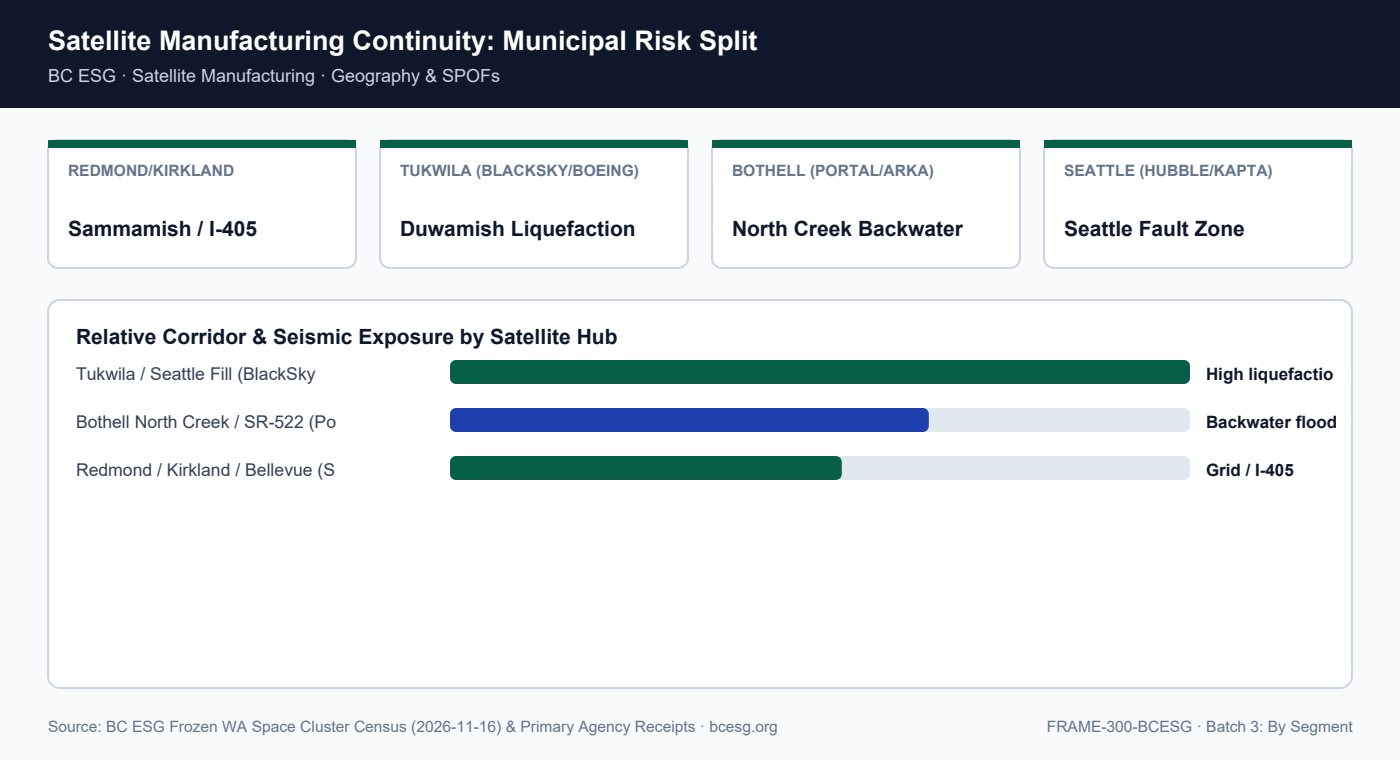
    Satellite Manufacturing Continuity: Municipal Risk Split

    Distinct Hazard Profiles Across Four Metro Sub-Corridors

    Satellite manufacturing does not share a single uniform floodplain. On the Eastside, SpaceX Starlink and Amazon Leo operate in Redmond and Kirkland along the Sammamish River corridor—facing localized 100-year backwatering and I-405/SR-520 commute/freight bottlenecks without deep-impoundment dam-breach exposure.

    By contrast, BlackSky (12501 E Marginal Wy S, Tukwila) and Boeing (Tukwila/Kent) sit in the Lower Duwamish / Green River corridor on historical alluvial fill with elevated liquefaction susceptibility, while Portal Space Systems and ARKA sit in Bothell's North Creek / Sammamish confluence.

    Sub-CorridorSatellite FirmsPrimary HazardSingle Point of Failure
    Redmond / KirklandSpaceX, Amazon Leo, EclipseI-405 congestion, power feeder loadCleanroom HV/clean power
    BellevueK2 Space, XploreKelsey Creek / I-405-I-90Engineering workforce & lab power
    BothellPortal Space Systems, ARKANorth Creek bidirectional backwaterSR-522 / I-405 access
    Tukwila / SeattleBlackSky, Boeing, Hubble, KaptaDuwamish/SODO liquefactionCleanroom floor & Boeing Field freight

    Related BC ESG Guides & Verified Primary Sources

  • Satellite Manufacturing Compliance: 5-Year Deorbit, ITU & Conflict Minerals

    Satellite Manufacturing Compliance: 5-Year Deorbit, ITU & Conflict Minerals

    BC ESG · Washington Space Cluster Segments (November 16, 2026)
    Sourced Baseline: Binding FCC 5-year LEO deorbit rule (effective Sep 9, 2024; 89 FR 65207), ITU Art 9/11 filings, and SEC Form SD (17 CFR § 240.13p-1) for public primes.
    TAKEAWAY BRIEF · PDF & MARKDOWN TWIN
    Satellite Disclosure & Deorbit Compliance
    Download the formatted 2-page briefing sheet (PDF) or read the single-source Markdown twin for Satellite Disclosure & Deorbit Compliance.
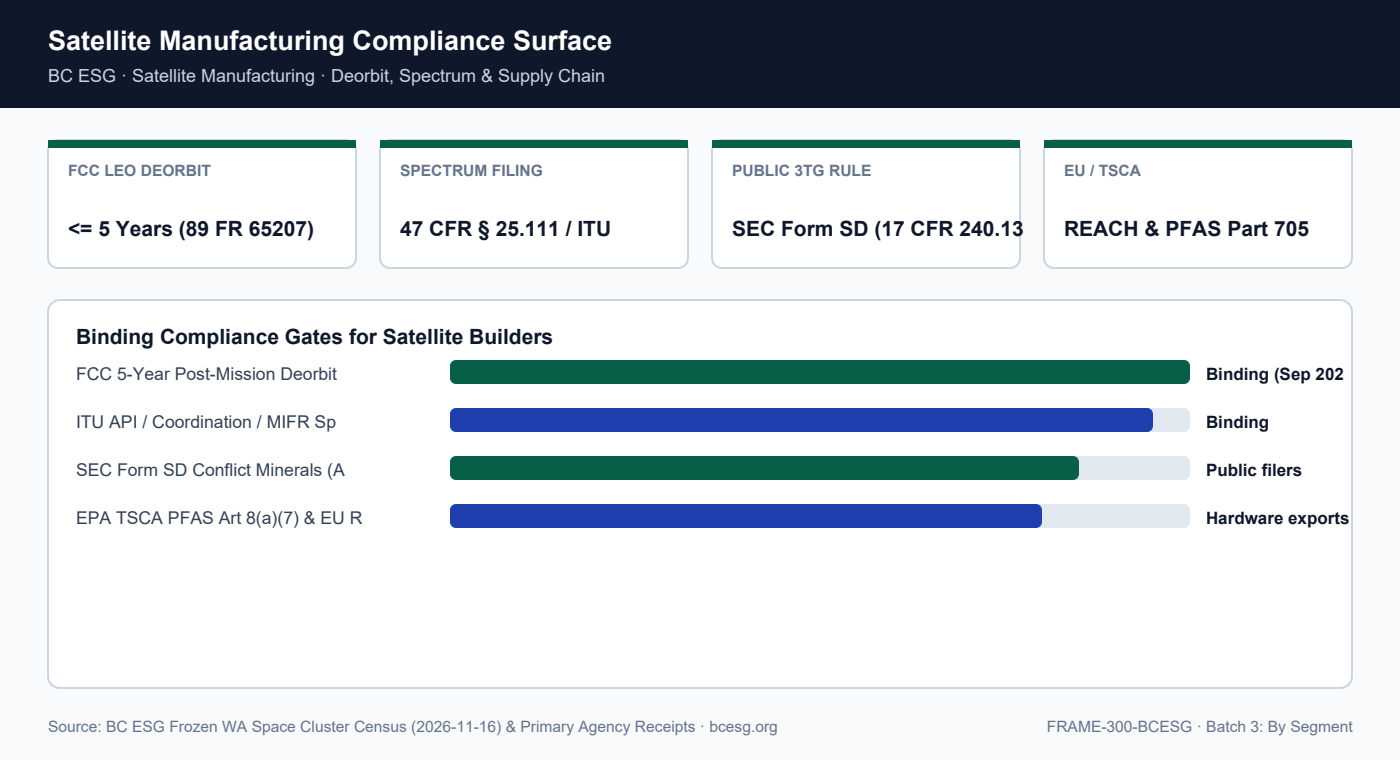
    Satellite Manufacturing Compliance Surface

    Orbital Debris & Spectrum Licensing (47 CFR Part 25)

    Under 47 CFR §§ 25.114 and 25.283 (effective September 9, 2024, 89 FR 65207), U.S.-licensed NGSO constellations and foreign operators seeking U.S. market access must complete post-mission disposal for LEO satellites at or below 2,000 km within 5 years—replacing the legacy 25-year NASA guideline.

    Simultaneously, 47 CFR § 25.111 requires U.S. satellite operators to submit technical spectrum filings through the FCC to the ITU Radiocommunication Bureau (Advance Publication Information, Coordination Request, and MIFR Notification), carrying mandatory ITU cost-recovery obligations.

    • SEC Form SD Conflict Minerals (17 CFR § 240.13p-1): Binding on public parents (Amazon, Boeing, BlackSky, and ARKA parent CACI) for Tin, Tantalum, Tungsten, and Gold (3TG) in satellite PCBs, connectors, and solar cell metallization.
    • EPA TSCA PFAS (40 CFR Part 705) & EU REACH: Affect fluoropolymer wire jacketing (PTFE), perfluorinated lubricants, and thermal control fluids across exported or EU-partnered satellite buses.
    MandateCitationWho It BindsOperational Impact
    5-Year LEO Deorbit47 CFR §§ 25.114, 25.283 (89 FR 65207)All US-licensed LEO constellationsPropellant margin, drag devices, reliability
    ITU Spectrum Coordination47 CFR § 25.111 / ITU Radio RegsSatellite operatorsAPI -> CR -> MIFR filing & cost recovery
    Conflict Minerals (3TG)17 CFR § 240.13p-1 (Form SD)Public filers (AMZN, BA, BKSY, CACI)Annual May 31 OECD due diligence
    TSCA PFAS & EU REACH40 CFR Part 705 / EC 1907/2006Importers & EU-integrated hardwarePTFE wire, lubricants, SVHC tracking

    Related BC ESG Guides & Verified Primary Sources

    Related Supplier Asks (Batch 4)

  • High-Rate Constellation Assembly & Engineering Hubs in Washington

    High-Rate Constellation Assembly & Engineering Hubs in Washington

    BC ESG · Washington Space Cluster Segments (November 16, 2026)
    Sourced Baseline: Starlink (314k–363k+ reported sq ft) and Amazon Leo (575k sq ft across Redmond/Kirkland/Everett) anchor high-rate assembly; K2 Space operates a Bellevue SW/autonomy hub.
    TAKEAWAY BRIEF · PDF & MARKDOWN TWIN
    Constellation Assembly & Engineering Hubs
    Download the formatted 2-page briefing sheet (PDF) or read the single-source Markdown twin for Constellation Assembly & Engineering Hubs.
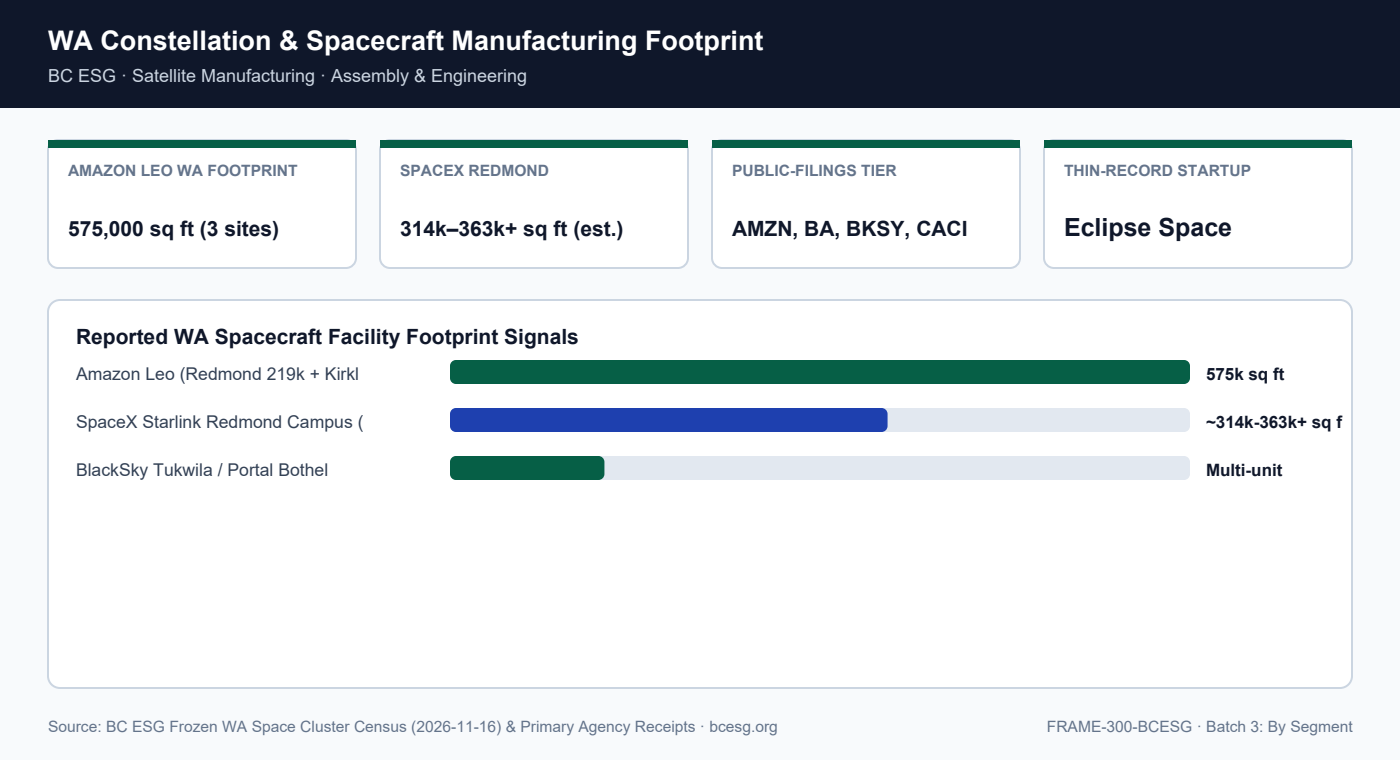
    WA Constellation & Spacecraft Manufacturing Footprint

    Serial Constellation Lines vs. Specialized Bus Builders

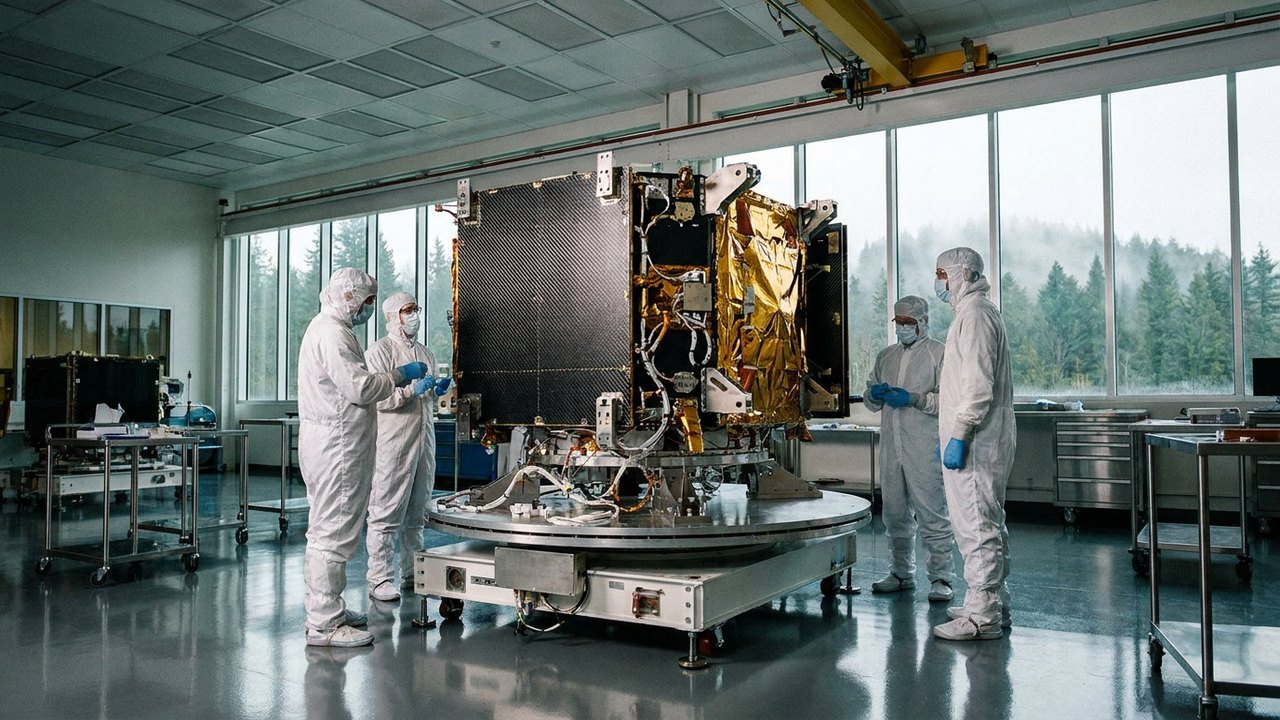
    High-rate satellite production in Washington is concentrated on the Eastside. Amazon Leo operates a 219,000 sq ft Redmond R&D headquarters, a 172,000 sq ft Kirkland satellite manufacturing plant, and a 184,000 sq ft Everett logistics hub. SpaceX operates its primary Starlink R&D and manufacturing campus in Redmond/Woodinville.

    In South King County and Bothell, BlackSky operates its Seattle South (12501 E Marginal Wy S, Tukwila) facility, Portal Space Systems develops maneuverable Supernova buses in Bothell, and ARKA (acquired by CACI) builds spacecraft subsystems in Bothell.

    • Software-only WA node: K2 Space keeps primary spacecraft manufacturing in Torrance, CA while operating a dedicated flight-software and autonomy hub in Bellevue.
    • Honest thin-record note: Eclipse Space (Redmond) has minimal public facility disclosures and is covered concisely in the Satellite & Compute Core Group.
    TierOperatorsProduction ModelWA Footprint
    Mega-ConstellationSpaceX (Starlink), Amazon LeoHigh-rate serial assemblyRedmond, Kirkland, Woodinville, Everett
    Defense / EO PrimeBoeing, BlackSky, ARKA (CACI)Mission-specific & smallsat linesTukwila, Kent, Bothell
    Venture Bus / PayloadPortal, Hubble, Kapta, Xplore, K2, EclipseCustom buses, radar, IoT, flight SWBothell, Seattle, Bellevue, Redmond

    Related BC ESG Guides & Verified Primary Sources

  • Washington Satellite Manufacturing Segment: Overview & Census Roster

    Washington Satellite Manufacturing Segment: Overview & Census Roster

    BC ESG · Washington Space Cluster Segments (November 16, 2026)
    Sourced Baseline: 11 core Satellite Manufacturing companies verified in the frozen Census CSV (Redmond, Kirkland, Tukwila, Bothell, Bellevue, Seattle, Kent); 0 companies re-homed.
    TAKEAWAY BRIEF · PDF & MARKDOWN TWIN
    Satellite Manufacturing Overview & Roster
    Download the formatted 2-page briefing sheet (PDF) or read the single-source Markdown twin for Satellite Manufacturing Overview & Roster.
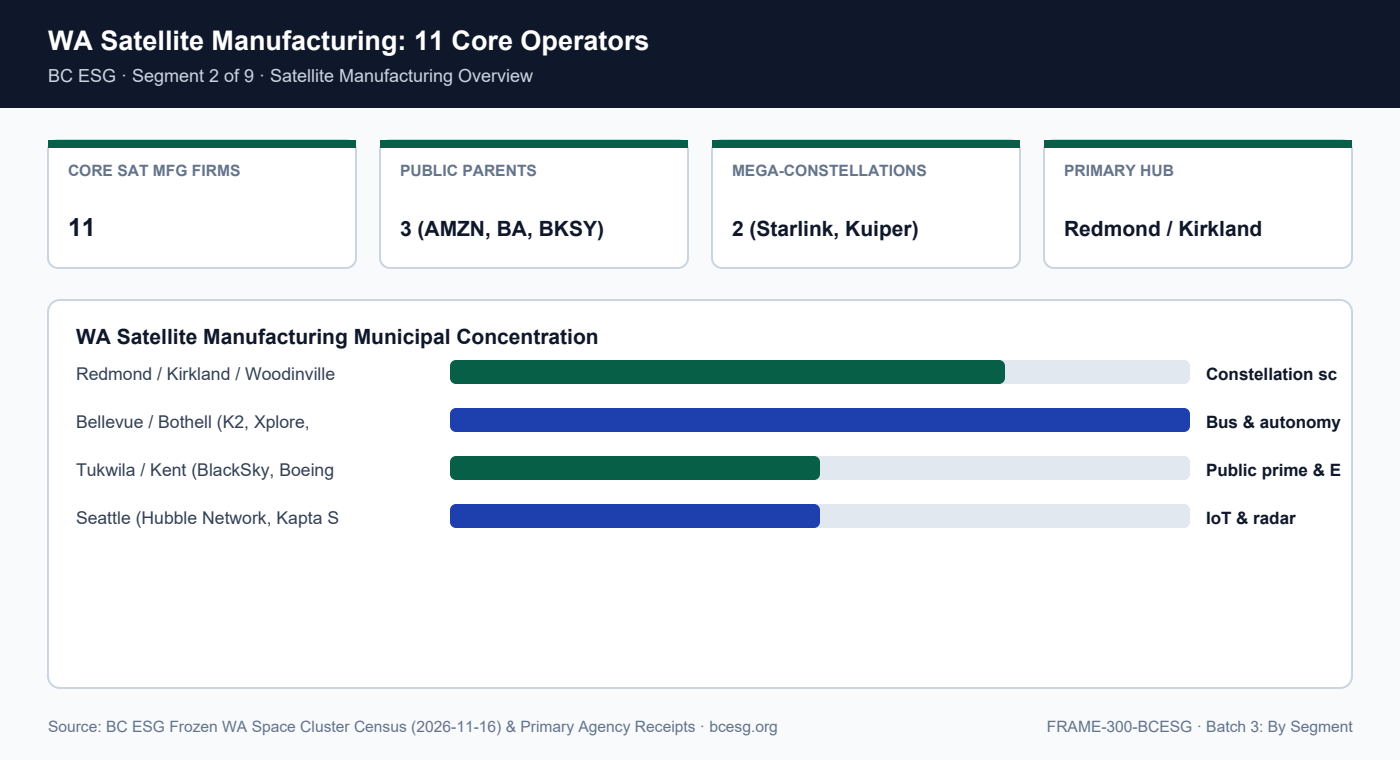
    WA Satellite Manufacturing: 11 Core Operators

    What Washington's Satellite Manufacturing Segment Builds

    Satellite Manufacturing is Washington's highest-volume orbital hardware segment, comprising 11 core operators (WA-SPC-008 through WA-SPC-018) in the frozen Census CSV. Choose Washington and PSRC report that the state produces an estimated 60% of commercial LEO satellites globally, anchored by SpaceX Starlink in Redmond and Amazon Leo in Redmond/Kirkland.

    Alongside high-rate broadband constellations, the segment includes public Earth-observation and defense builders (BlackSky NYSE: BKSY in Tukwila; Boeing Defense, Space & Security NYSE: BA in Tukwila/Kent) and venture-backed bus, IoT, and radar developers (Portal Space Systems, K2 Space, Hubble Network, Kapta Space, Xplore).

    CompanyWA FacilityCensus ClassPrimary FocusCensus Profile
    SpaceX (Starlink)Redmond, WA / Woodinville, WACoreHigh-volume Starlink R&D & manufacturingProfile #1418
    Amazon Leo (Project Kuiper)Redmond, WA / Kirkland, WACoreLEO broadband HQ & mass productionProfile #1421
    BlackSkyTukwila, WA (12501 E Marginal Wy S)Core (NYSE: BKSY)Geospatial satellites & LeoStellaProfile #1438
    Portal Space SystemsBothell, WA (22118 20th Ave SE)CoreManeuverable Supernova spacecraftProfile #1430
    K2 SpaceBellevue, WA (engineering hub)CoreFlight SW & autonomy (CA mfg)Profile #1435
    ARKA (ex-Tethers Unlimited)Bothell, WACore (CACI $2.6B acq)Spacecraft subsystems & roboticsProfile #1475
    Eclipse SpaceRedmond, WACoreTurnkey customer constellationsGrouped #1556
    Hubble NetworkSeattle, WACoreBluetooth-to-satellite IoTProfile #1478
    Kapta SpaceSeattle, WACoreSpaceborne radar satellitesProfile #1481
    XploreBellevue, WACoreCommercial spacecraft & hosted payloadsProfile #1484
    Boeing Defense, Space & SecurityTukwila, WA / Kent, WACore (NYSE: BA)Defense/space satellites & SLS/StarlinerProfile #1487

    Related BC ESG Guides & Verified Primary Sources

  • Launch Segment Continuity: Kent-Renton Valley & Moses Lake Split

    Launch Segment Continuity: Kent-Renton Valley & Moses Lake Split

    BC ESG · Washington Space Cluster Segments (November 16, 2026)
    Sourced Baseline: Kent/Renton manufacturing concentrates in the Green/Cedar River industrial corridor; Moses Lake test operations sit outside coastal floodplains but depend on I-90/rail transport.
    TAKEAWAY BRIEF · PDF & MARKDOWN TWIN
    Launch Continuity & Corridor Exposure
    Download the formatted 2-page briefing sheet (PDF) or read the single-source Markdown twin for Launch Continuity & Corridor Exposure.
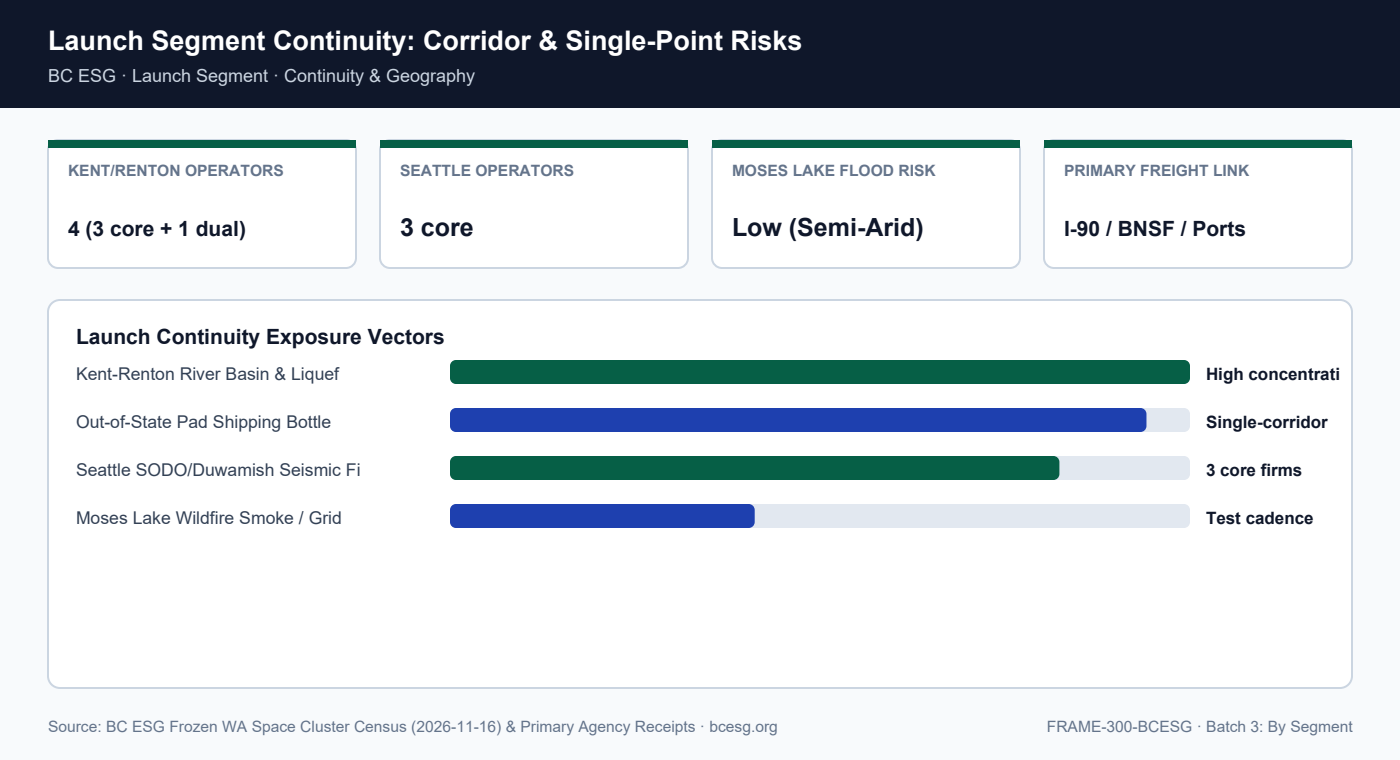
    Launch Segment Continuity: Corridor & Single-Point Risks

    Why Launch Continuity Splits Between Valley Manufacturing and Out-of-State Pads

    Launch vehicle manufacturing in Washington exhibits high geographic concentration: Blue Origin, Stoke Space, Relativity Space, and Radian Aerospace all operate in the Kent-Renton industrial basin managed under King County DNRP flood and drainage frameworks.

    Because orbital launches occur out of state (Cape Canaveral, Vandenberg, Wallops), any disruption to I-90, I-5, BNSF/UP rail, or Port of Seattle-Tacoma heavy-haul corridors creates an immediate integration bottleneck even when launch pads remain undamaged.

    • Moses Lake resilience buffer: Stoke Space's Grant County International Airport test site sits in semi-arid terrain outside 100-year coastal floodplains, providing geographic separation from Puget Sound seismic and riverine hazards.
    • Seattle SODO/Industrial District: Firefly Aerospace, Wave Motion Launch, and SpaceLaunch operate engineering and integration teams in Seattle's high-liquefaction industrial belt.
    Exposure VectorAffected Launch NodesPrimary MechanismMitigation / Buffer
    Lower Green / Cedar River & Seismic FillBlue Origin, Stoke, Relativity, RadianHeavy tooling & cleanroom downtimeUpper-floor avionics, Moses Lake split
    I-90 / Rail Stage TransportBlue Origin, Stoke SpaceStage delivery to Cape / VandenbergMulti-modal barge/road routing
    Seattle SODO LiquefactionFirefly, Wave Motion, SpaceLaunchOffice/integration disruptionCloud-hosted mission ops

    Related BC ESG Guides & Verified Primary Sources

  • Launch Segment Disclosure & Compliance: FAA Part 450, NEPA & WA Permits

    Launch Segment Disclosure & Compliance: FAA Part 450, NEPA & WA Permits

    BC ESG · Washington Space Cluster Segments (November 16, 2026)
    Sourced Baseline: Binding federal/state gates (14 CFR § 450.47 NEPA, RCW 90.48 ISGP, PSCAA Reg I Art 6); voluntary Scope 3 / ESG reporting labeled voluntary; stayed SEC Climate Rule noted as non-binding.
    TAKEAWAY BRIEF · PDF & MARKDOWN TWIN
    Launch Disclosure & FAA/NEPA Compliance
    Download the formatted 2-page briefing sheet (PDF) or read the single-source Markdown twin for Launch Disclosure & FAA/NEPA Compliance.
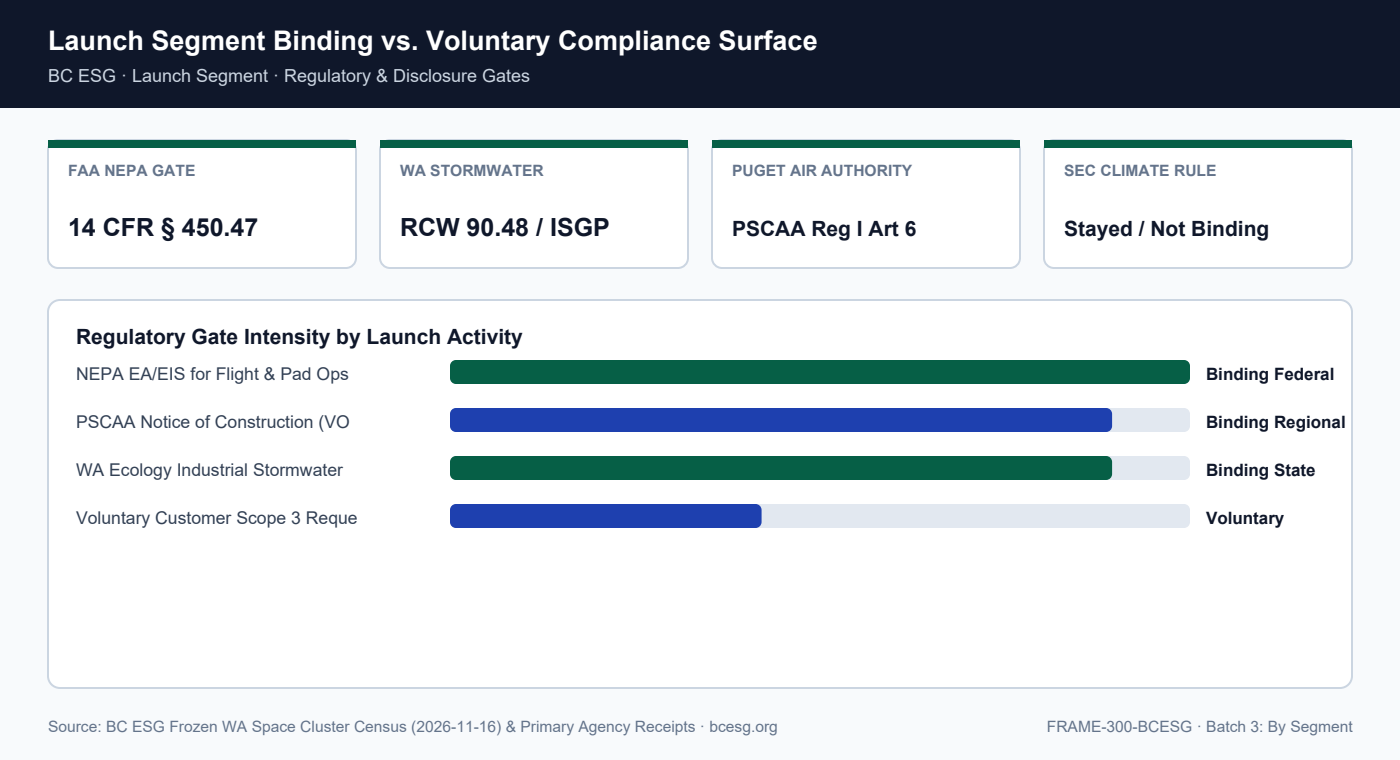
    Launch Segment Binding vs. Voluntary Compliance Surface

    Binding Federal & Washington Environmental Gates

    Launch operators face concrete, enforceable permitting gates tied directly to manufacturing coatings, stormwater runoff, and flight-test environmental review—not generic corporate ESG questionnaires.

    Under 14 CFR § 450.47, FAA Office of Commercial Space Transportation (AST) launch and reentry licenses require NEPA documentation (Categorical Exclusion, Environmental Assessment/FONSI, or third-party-funded Environmental Impact Statement) covering acoustic footprints, airspace, and propellant exhaust.

    • WA Ecology Industrial Stormwater General Permit (ISGP, RCW 90.48 / WAC 173-226): Covers aerospace manufacturing and integration yards in King and Grant counties, requiring SWPPPs, secondary fuel/propellant containment, and quarterly monitoring for copper, zinc, turbidity, and pH.
    • PSCAA Regulation I, Article 6: Requires Notice of Construction Orders of Approval in King, Pierce, and Snohomish counties for aerospace surface coating, composite autoclave outgassing, VOCs, and HAP controls.
    Authority / RuleBinding StatusTriggering Launch ActivityPrimary Receipt
    FAA 14 CFR § 450.47 (NEPA)Binding (Federal)Launch/reentry license EA, FONSI, or EISeCFR 14 CFR § 450.47
    WA Ecology ISGP (RCW 90.48)Binding (State)Industrial stormwater, copper/zinc/pH runoffWA Ecology ISGP
    PSCAA Reg I Art 6Binding (Regional)Coatings, autoclaves, VOC/HAP air sourcesPSCAA Permits & Regs
    Customer Scope 3 / ESGVoluntary (Contractual)Launch-mass emissions disclosures to OEMsBC ESG Scope 3 Guide

    Voluntary vs. Stayed Disclosure Rules

    Private launch companies in the Census (Blue Origin, Stoke Space, Radian Aerospace) are not subject to SEC public-filer rules, and the SEC Climate Disclosure Rule remains stayed. Customer Scope 3 carbon requests from commercial satellite buyers are voluntary commercial asks unless written into contract.

    Related BC ESG Guides & Verified Primary Sources

    Related Supplier Asks (Batch 4)

  • Launch Segment Production & Moses Lake Test Infrastructure

    Launch Segment Production & Moses Lake Test Infrastructure

    BC ESG · Washington Space Cluster Segments (November 16, 2026)
    Sourced Baseline: Kent/Renton manufacturing campuses (Blue Origin, Stoke Space 168k sq ft, Relativity, Radian) pair with Moses Lake (MWH) Runway 14L/32R and Class D airspace.
    TAKEAWAY BRIEF · PDF & MARKDOWN TWIN
    Launch Production & Test Infrastructure
    Download the formatted 2-page briefing sheet (PDF) or read the single-source Markdown twin for Launch Production & Test Infrastructure.
    Launch Production vs. Flight Test Split in Washington

    Two-Region Architecture: Puget Sound Build, Columbia Basin Test

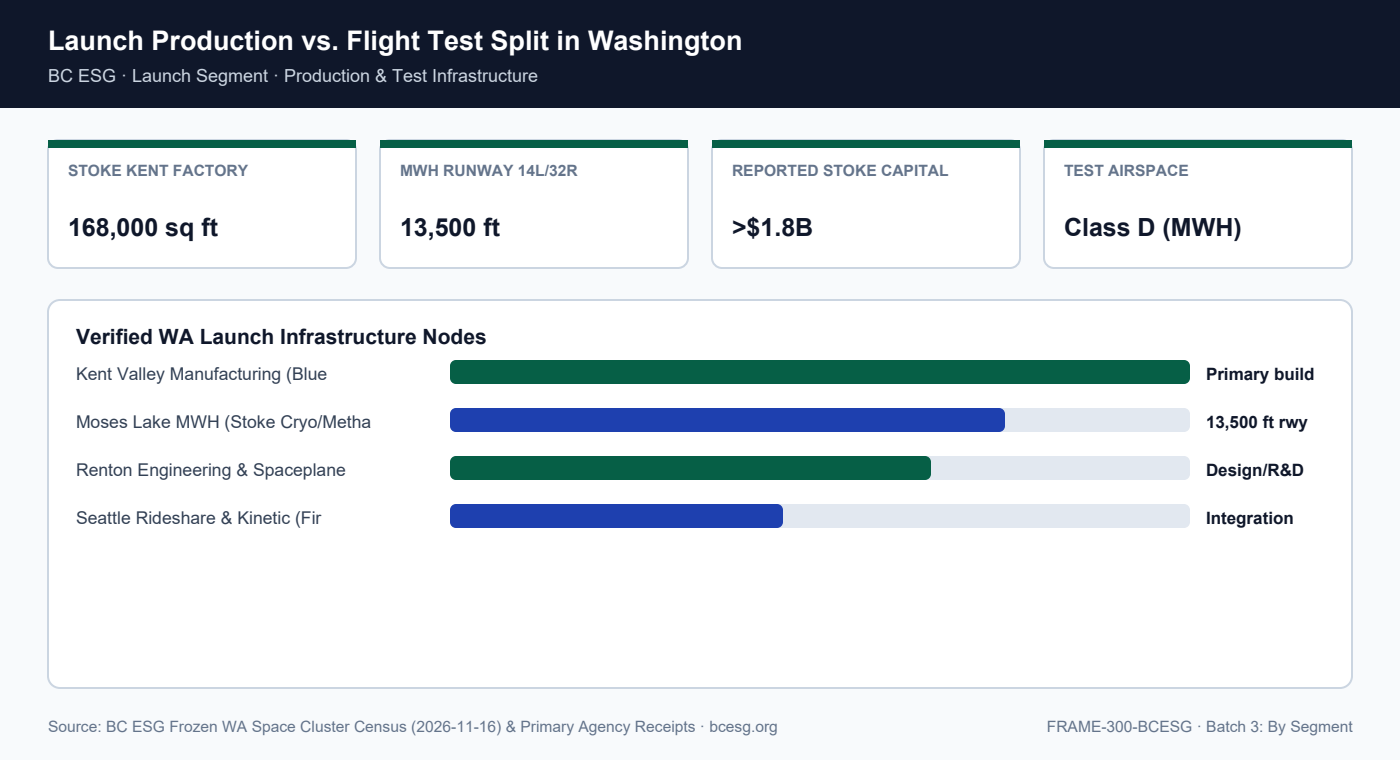
    Launch hardware in Washington splits cleanly across the Cascades. Heavy fabrication, avionics integration, and propulsion assembly cluster in the Kent-Renton corridor (Blue Origin, Stoke Space, Relativity Space, Radian Aerospace), while high-energy cryogenic hot-fire and vertical flight demonstrations move east to Grant County International Airport (MWH) in Moses Lake.

    MWH provides a 13,500-foot primary runway (14L/32R), uncongested Class D airspace, and semi-arid buffer terrain—enabling Stoke Space to conduct methalox/cryogenic static-fire and low-altitude test operations outside dense King County residential zones.

    • Stoke Space: Operates a 168,000 sq ft headquarters and factory at 21009 59th Pl S in Kent alongside its dedicated Moses Lake test facility (reported >$1.8B raised across 2025–2026 rounds).
    • Firefly Aerospace & SpaceLaunch: Operate lean mission-management and rideshare integration teams in Seattle rather than large local manufacturing floors.
    NodeOperatorsPrimary ActivityConstraint / Advantage
    Kent ValleyBlue Origin, Stoke Space, RelativityVehicle assembly, propulsion, HQPort/rail access; Green River valley floor
    RentonBlue Origin, Radian AerospaceEngineering campus, spaceplane R&DCedar River / Boeing Renton corridor
    SeattleFirefly, Wave Motion, SpaceLaunchRideshare integration, kinetic R&DSODO / Industrial District seismic fill
    Moses Lake (MWH)Stoke Space (and historic Blue Origin)Cryo/methalox hot-fire & flight tests13,500 ft runway; semi-arid low flood risk

    Thin-Record Operators in Launch

    Public facility square footage and test cadence for Wave Motion Launch and SpaceLaunch are limited in public filings; both are treated concisely in the Launch & Propulsion Core Group without speculative capacity estimates.

    Related BC ESG Guides & Verified Primary Sources

  • Washington Space Launch Segment: Overview & Census Roster

    Washington Space Launch Segment: Overview & Census Roster

    BC ESG · Washington Space Cluster Segments (November 16, 2026)
    Sourced Baseline: 7 core Launch operators in the frozen Census CSV (plus Cowboy Space dual-noted from Orbital Data Centers); 0 companies re-homed; all operations verified as of 2026-11-16.
    TAKEAWAY BRIEF · PDF & MARKDOWN TWIN
    Launch Segment Overview & Roster
    Download the formatted 2-page briefing sheet (PDF) or read the single-source Markdown twin for Launch Segment Overview & Roster.
    WA Space Launch Segment: 7 Core + 1 Dual Operator

    What the Washington Launch Segment Makes and Does

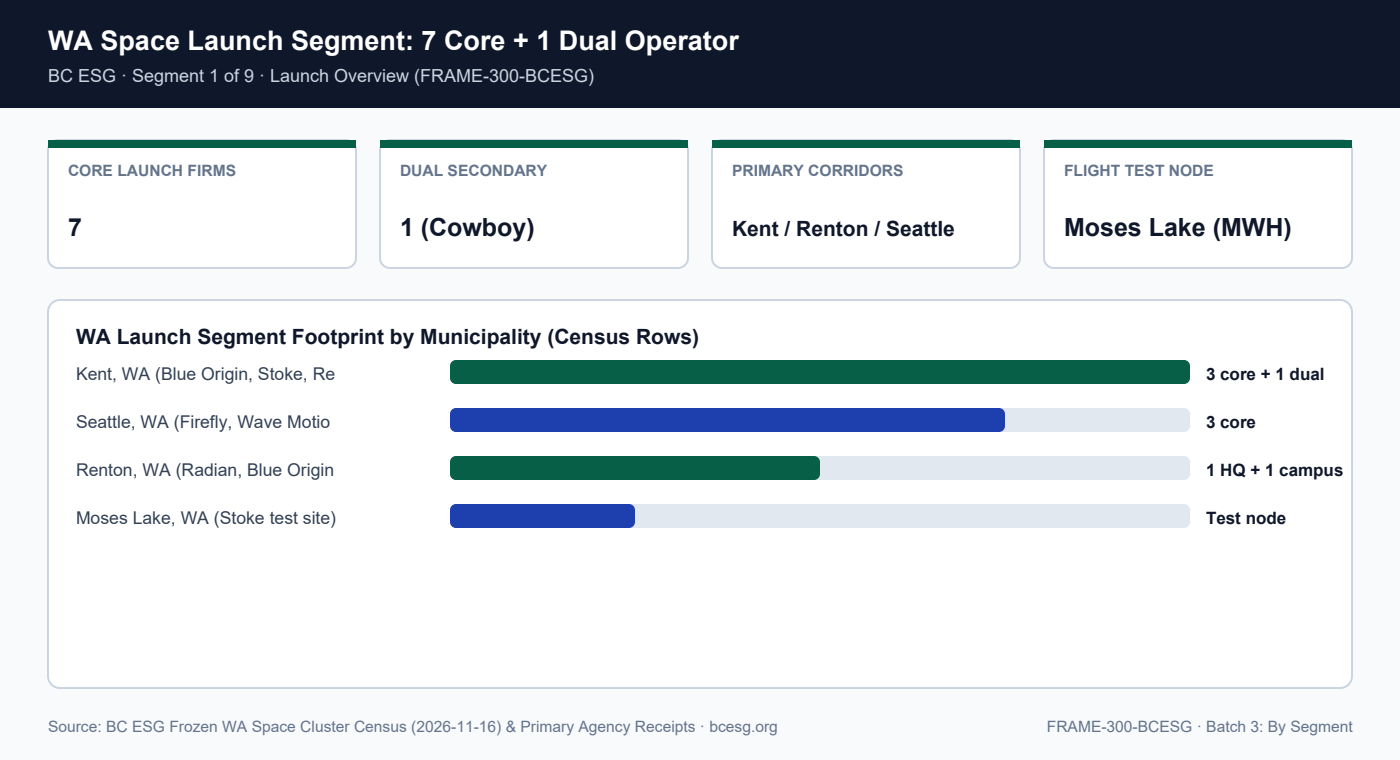
    Per the frozen Washington Space Cluster Census, Washington's Launch segment comprises 7 core operators (WA-SPC-001 through WA-SPC-007) concentrated in Kent, Renton, and Seattle, plus 1 dual-segment operator (Cowboy Space, whose primary Census assignment is Orbital Data Centers with Big Iron launch vehicle development as secondary).

    Unlike Florida or California coastal pads, Washington's launch segment performs vehicle architecture, propulsion integration, rideshare mission management, and static/subscale testing in-state—shipping flight hardware to coastal orbital launch complexes while testing engines and prototypes in Kent, Redmond, and Moses Lake.

    CompanyWA FacilityCensus ClassPrimary FocusCensus Profile
    Blue OriginKent, WA (HQ & manufacturing) / Renton, WACore (Launch)Heavy-lift New Glenn, BE-4, lunar landersProfile #1412
    Stoke Space TechnologiesKent, WA (21009 59th Pl S) / Moses Lake test siteCore (Launch)Reusable Nova vehicle & 2nd stage; >$1.8B reportedProfile #1415
    Relativity SpaceKent, WA (engineering & propulsion hub)Core (Launch)Terran R vehicle engineering & propulsionProfile #1466
    Radian AerospaceRenton, WACore (Launch)Horizontal-takeoff/landing orbital spaceplaneProfile #1469
    Firefly AerospaceSeattle, WA (mission-management unit)Core (Launch)Acquired Spaceflight Inc. rideshare integrationProfile #1472
    Wave Motion LaunchSeattle, WA (Industrial District)Core (Launch)Kinetic / supersonic gas launch startupGrouped #1553
    SpaceLaunchSeattle, WACore (Launch)Launch integration & mission managementGrouped #1553
    Cowboy Space (Secondary)Kent, WA (~290,000 sq ft)Core (Primary: Orbital Data Centers; Secondary: Launch)Big Iron 15-ton rocket-to-datacenter conceptProfile #1424

    Census Segment Boundary & Dual-Segment Treatment

    No company is re-homed from the frozen Census CSV. Cowboy Space stays counted once under Orbital Data Centers and is cross-referenced here solely as a secondary launch developer.
    Next Segment Deep Dives

    Companion Launch packages cover Moses Lake & Kent test infrastructure, FAA Part 450 & NEPA disclosure obligations, and Kent Valley vs. Moses Lake continuity exposure.

    Related BC ESG Guides & Verified Primary Sources

BC ESG

ESG Strategy, Sustainability Intelligence, and Business Continuity for Forward-Thinking Organizations

© 2026 BC ESG — Business Continuity, ESG & Sustainability Intelligence