
Who Issues This Ask, Authority, and Binding Status
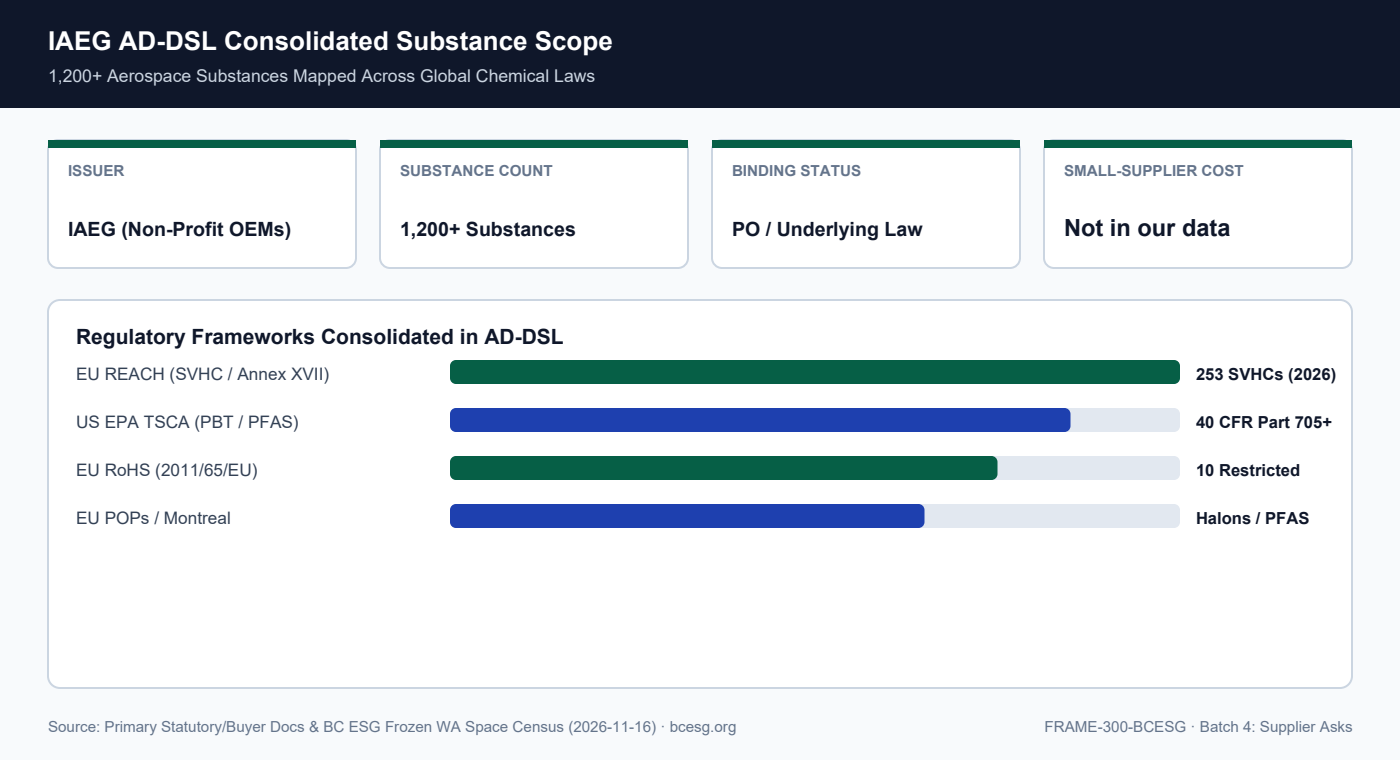
The Aerospace and Defense Declarable Substances List (AD-DSL) is maintained by the International Aerospace Environmental Group (IAEG)—a non-profit association of global aerospace OEMs including Boeing, Airbus, Lockheed Martin, RTX, Safran, Leonardo, and Rolls-Royce.
AD-DSL itself is a voluntary industry reference list designed to stop OEMs from sending conflicting spreadsheets. However, the underlying chemicals on the list reflect binding statutes (EU REACH, US EPA TSCA, EU RoHS) when products enter those jurisdictions, and AD-DSL screening becomes contractually binding when a prime requires AD-DSL / IPC-1754 declarations in a Purchase Order.
| Underlying Regime | Example Aerospace Substances | Statutory vs. Contractual |
|---|---|---|
| EU REACH SVHC / Annex XIV | Hexavalent chromium (Cr6+), cadmium, NMP, hydrazine | Binding for EU market; PO flow-down in US |
| US EPA TSCA / Part 705 | PFAS fluoropolymers (PTFE seals/wire), PIP (3:1) | Binding US federal law on manufacturers/importers |
| EU RoHS (2011/65/EU) | Lead solder, hexavalent Cr, PBB/PBDE | Binding for EU EEE; space exemptions exist |
Evidence Required & Small-Supplier Effort Cost
Suppliers check Safety Data Sheets (SDS), mill/plating certifications, and sub-tier supplier declarations against the current AD-DSL substance table, reporting any substance above threshold (typically 0.1% w/w for REACH SVHCs) via IPC-1754 XML or the prime's portal.
IAEG makes AD-DSL reference materials available to the industry; internal engineering/SDS-review hours for a small WA shop are not in our data.
WA Space Cluster Segments & Companies Affected
AD-DSL screening hits Propulsion (coatings, seals, energetic binders), Components & Suppliers (chromate conversion coatings, cadmium plating, prepreg resins at Janicki Industries and Electroimpact), and Satellite Manufacturing.