Category: Space Cluster Segments

Segment-level analysis across launch, satellite manufacturing, propulsion, in-space servicing, orbital data centers, components, and ground systems.

  • In-Space Servicing Continuity: Marysville Cascade Terrace vs. Tukwila/Seattle

    In-Space Servicing Continuity: Marysville Cascade Terrace vs. Tukwila/Seattle

    BC ESG · Washington Space Cluster Segments (November 16, 2026)
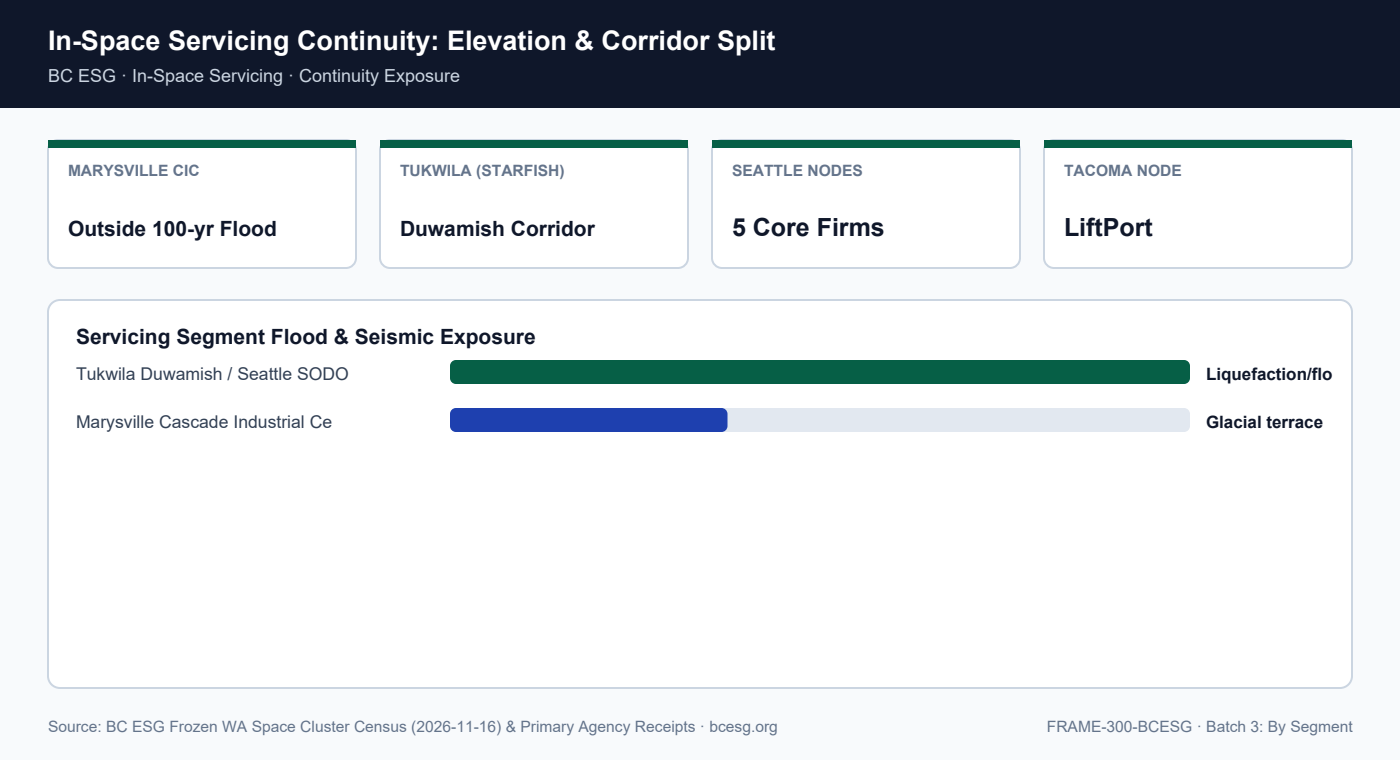
    Sourced Baseline: Gravitics sits on Marysville's higher glacial terrace outside the 100-year floodplain; Starfish Space sits in Tukwila's Duwamish corridor; 5 firms sit in Seattle.
    TAKEAWAY BRIEF · PDF & MARKDOWN TWIN
    Servicing Continuity & Geography
    Download the formatted 2-page briefing sheet (PDF) or read the single-source Markdown twin for Servicing Continuity & Geography.
    In-Space Servicing Continuity: Elevation & Corridor Split

    Why Marysville's Cascade Industrial Center Outperforms South King County on Flood Risk

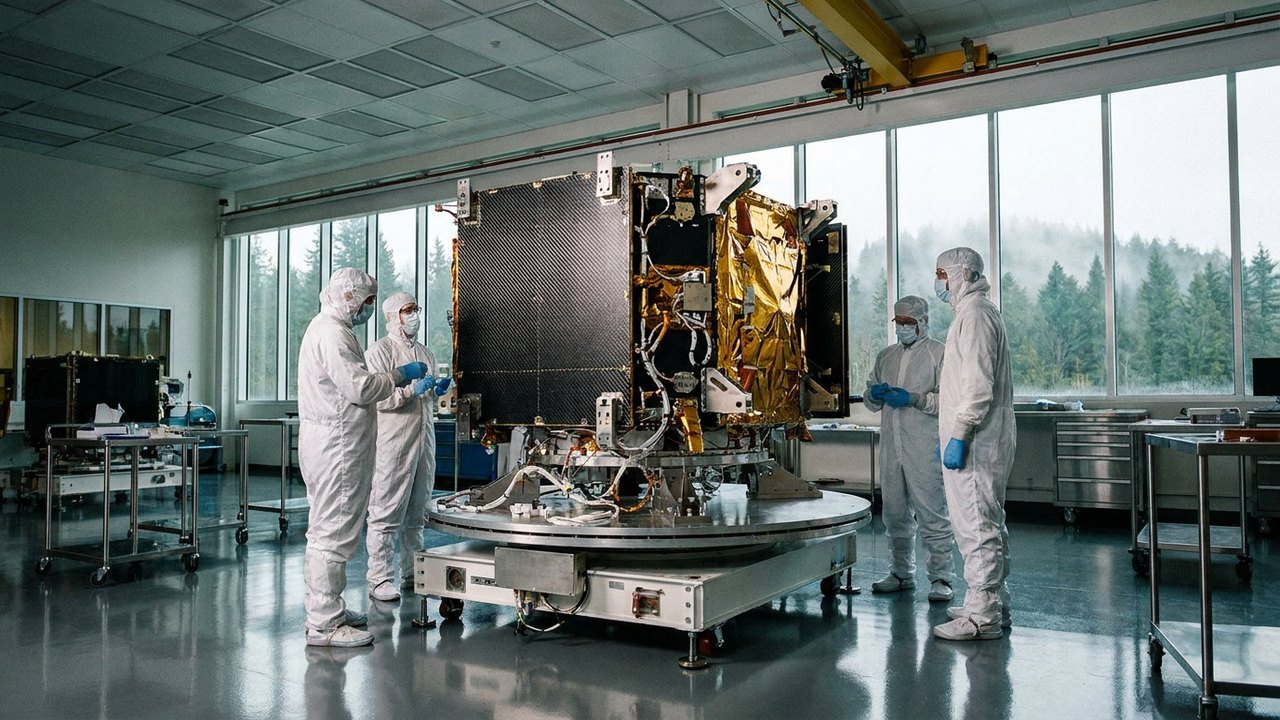
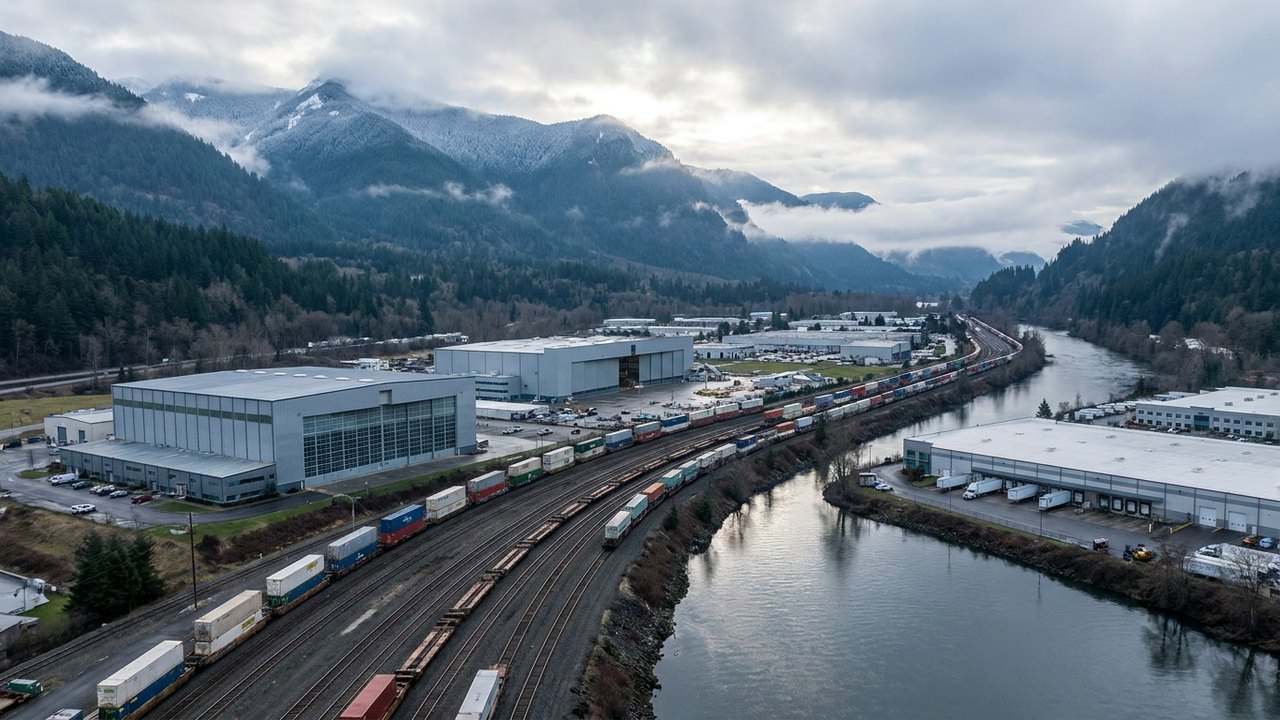
    Gravitics (4150 152nd St NE, Marysville) operates inside the 4,000-acre Cascade Industrial Center, which sits on an elevated glacial terrace outside the 100-year floodplain—insulating large-diameter orbital pressure-vessel tooling from Snohomish/Ebey Slough riverine flooding.

    By contrast, Starfish Space (665 Andover Park W, Tukwila) sits in the Lower Green-Duwamish corridor, and five Seattle-based servicing/testing firms sit near Puget Sound industrial/seismic zones.

    NodeOperatorsPhysical SettingPrimary Continuity Note
    Marysville (CIC)GraviticsElevated glacial terraceOutside 100-year floodplain; Paine Field/I-5 access
    TukwilaStarfish SpaceGreen-Duwamish industrial corridorCompound riverine/tidal backwater & seismic fill
    Seattle / TacomaInterlune, SpaceRig, Orbital Robotics, AstroSweep, gravityLab, LiftPortUrban/port industrialSODO liquefaction; lean lab footprints

    Related BC ESG Guides & Verified Primary Sources

  • In-Space Servicing Compliance: NOAA Part 960 NEI, FCC ISAM & ITAR Cat XV

    In-Space Servicing Compliance: NOAA Part 960 NEI, FCC ISAM & ITAR Cat XV

    BC ESG · Washington Space Cluster Segments (November 16, 2026)
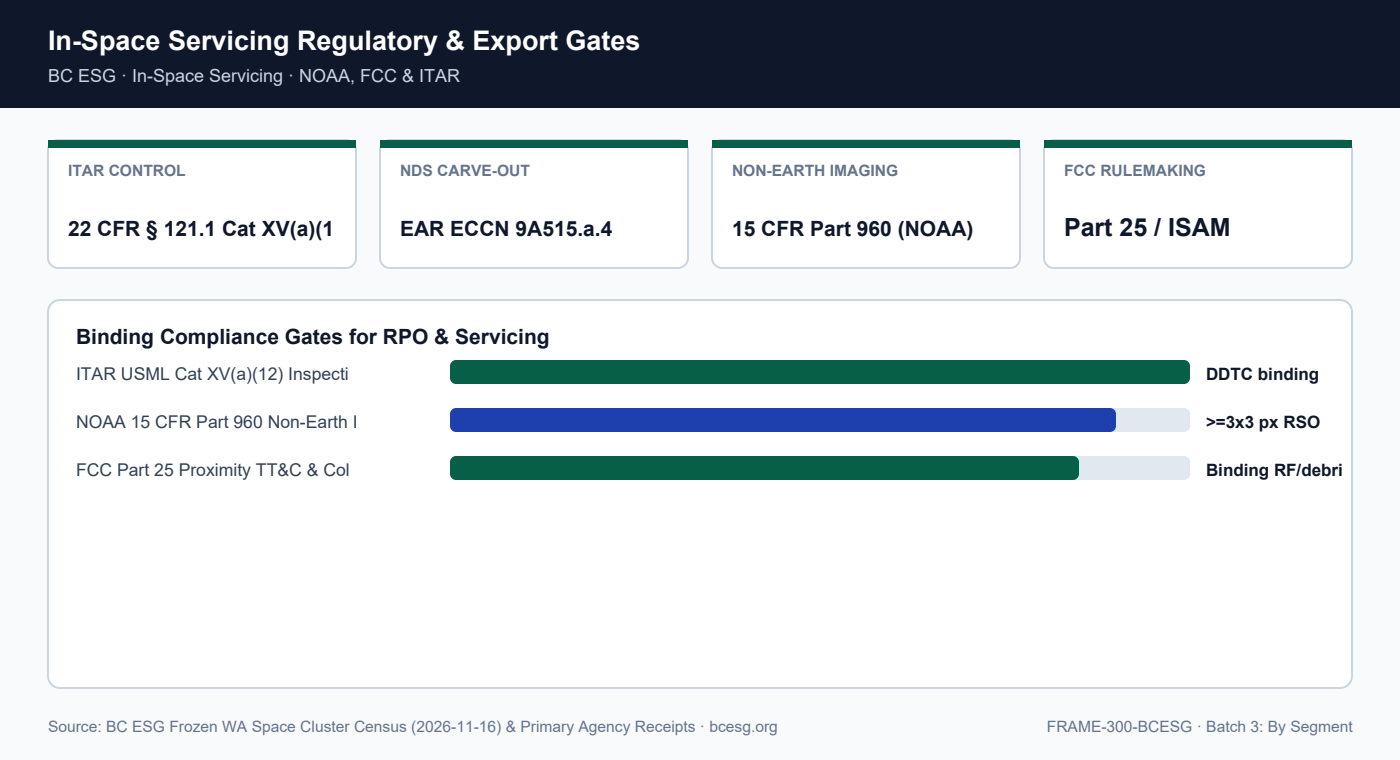
    Sourced Baseline: Binding RPO gates: ITAR 22 CFR § 121.1 Cat XV(a)(12) (with NASA Docking System EAR 9A515.a.4 carve-out), NOAA 15 CFR Part 960 NEI consent, and FCC Part 25 proximity TT&C.
    TAKEAWAY BRIEF · PDF & MARKDOWN TWIN
    Servicing Compliance: NOAA, FCC & ITAR
    Download the formatted 2-page briefing sheet (PDF) or read the single-source Markdown twin for Servicing Compliance: NOAA, FCC & ITAR.
    In-Space Servicing Regulatory & Export Gates

    Why Servicing Carries Stricter Export & Imaging Rules Than Standard Satellites

    Spacecraft designed to inspect, grapple, or dock with another spacecraft trigger ITAR USML Category XV(a)(12) (22 CFR § 121.1) under State Department DDTC jurisdiction—unless they dock exclusively via the standard NASA Docking System (NDS), which shifts jurisdiction to Commerce EAR ECCN 9A515.a.4.

    Furthermore, optical or radar sensors used during rendezvous and proximity operations (RPO) that can resolve artificial Resident Space Objects (>= 3×3 pixels) trigger NOAA 15 CFR Part 960 Commercial Remote Sensing licensing, requiring third-party owner consent and interagency notification before Non-Earth Imaging (NEI).

    FrameworkCitationTriggerOperational Rule
    ITAR USML Cat XV(a)(12)22 CFR § 121.1Spacecraft inspection, grappling, dockingDDTC defense-article control (unless NDS -> 9A515.a.4)
    NOAA Remote Sensing15 CFR Part 960Optical/radar RPO & Non-Earth ImagingCRSRA license & target-owner consent
    FCC Part 25 ISAM47 CFR Part 25Proximity TT&C & active debris removalInter-satellite links & collision-risk filing

    Related BC ESG Guides & Verified Primary Sources

    Related Supplier Asks (Batch 4)

  • RPO Spacecraft, Modular Habitats & Lunar Resource Hardware in WA

    RPO Spacecraft, Modular Habitats & Lunar Resource Hardware in WA

    BC ESG · Washington Space Cluster Segments (November 16, 2026)
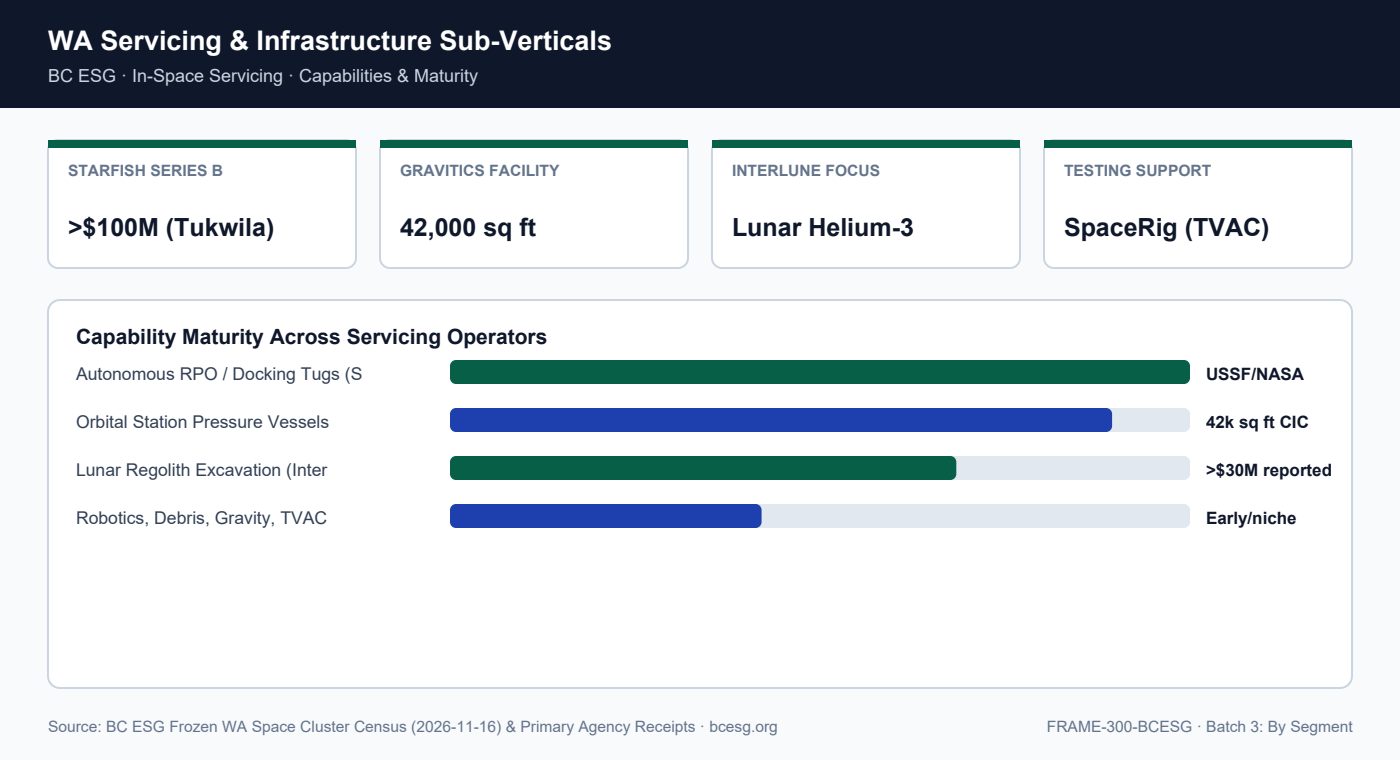
    Sourced Baseline: Starfish Space holds >$100M Series B & Space Force/NASA contracts; Gravitics builds 42k sq ft StarMax modules; 5 early-stage peers carry thinner public records.
    TAKEAWAY BRIEF · PDF & MARKDOWN TWIN
    RPO, Habitats & Lunar Resource Hardware
    Download the formatted 2-page briefing sheet (PDF) or read the single-source Markdown twin for RPO, Habitats & Lunar Resource Hardware.
    WA Servicing & Infrastructure Sub-Verticals

    From Autonomous Docking Tugs to Orbital Pressure Vessels

    In Tukwila, Starfish Space builds the Otter orbital servicing vehicle for satellite life-extension and active debris disposal, backed by U.S. Space Force and NASA contracts. In Marysville, Gravitics manufactures StarMax modular pressure vessels for commercial space stations.

    In Seattle and Tacoma, Interlune develops lunar regolith excavation systems for Helium-3 extraction, while SpaceRig provides mobile thermal-vacuum (TVAC) and flight-readiness testing. Orbital Robotics, AstroSweep, gravityLab, and LiftPort remain early-stage R&D concepts.

    Sub-VerticalOperatorsWA CityContract / Capital Signal
    RPO & Active DeorbitStarfish SpaceTukwila>$100M Series B; USSF & NASA contracts
    Orbital Station ModulesGraviticsMarysville (CIC)42,000 sq ft manufacturing & design facility
    Lunar Resource ExtractionInterluneSeattle>$30M total reported funding
    Testing & Early R&DSpaceRig, Orbital Robotics, AstroSweep, gravityLab, LiftPortSeattle / TacomaThin-record / early-stage

    Related BC ESG Guides & Verified Primary Sources

  • Washington In-Space Servicing & Orbital Infrastructure: Overview & Roster

    Washington In-Space Servicing & Orbital Infrastructure: Overview & Roster

    BC ESG · Washington Space Cluster Segments (November 16, 2026)
    Sourced Baseline: 8 core In-Space Servicing operators in the frozen Census CSV (3 individual profiles + 5 thinner-record startups in Grouped #1559); 0 companies re-homed.
    TAKEAWAY BRIEF · PDF & MARKDOWN TWIN
    In-Space Servicing Overview & Roster
    Download the formatted 2-page briefing sheet (PDF) or read the single-source Markdown twin for In-Space Servicing Overview & Roster.
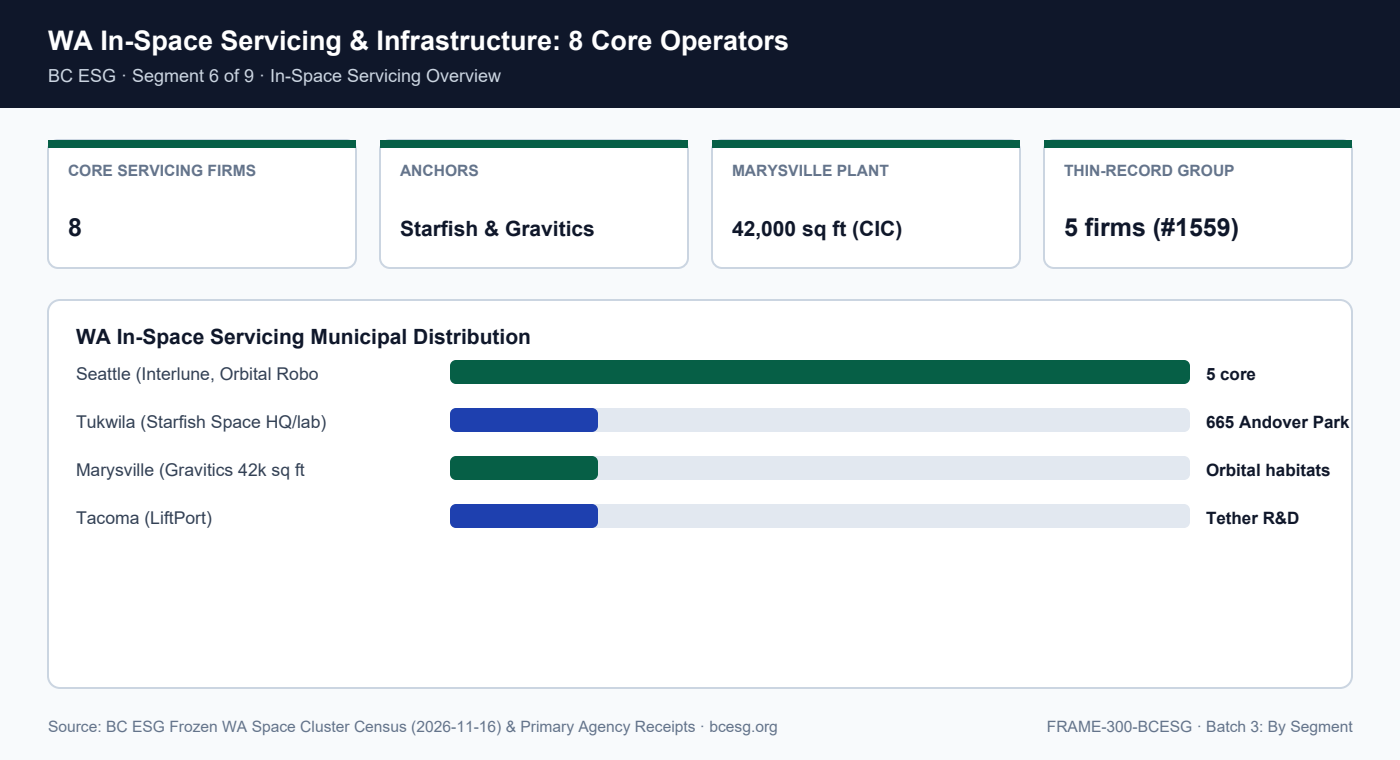
    WA In-Space Servicing & Infrastructure: 8 Core Operators

    What Washington's In-Space Servicing & Orbital Infrastructure Segment Builds

    Washington's In-Space Servicing & Orbital Infrastructure segment comprises 8 core operators (WA-SPC-026 through WA-SPC-033) in the frozen Census CSV. Three firms carry substantial public/contract receipts: Starfish Space (Tukwila; >$100M Series B, Space Force/NASA Otter servicing tug), Gravitics (Marysville; 42,000 sq ft StarMax orbital station module facility), and Interlune (Seattle; lunar Helium-3 excavation hardware).

    Five earlier-stage or thinner-record operators—Orbital Robotics, AstroSweep, gravityLab, LiftPort, and SpaceRig—are documented concisely in the In-Space Servicing Core Group without padding.

    CompanyWA FacilityCensus ClassPrimary FocusCensus Profile
    Starfish SpaceTukwila, WA (665 Andover Park W)CoreOtter autonomous satellite servicing & deorbit tugProfile #1444
    GraviticsMarysville, WA (4150 152nd St NE, 42k sq ft)CoreStarMax modular orbital station pressure vesselsProfile #1441
    Orbital RoboticsSeattle, WACoreAutonomous robotic orbital servicingGrouped #1559
    AstroSweepSeattle, WACoreSpace debris mitigationGrouped #1559
    InterluneSeattle, WACoreLunar Helium-3 & regolith excavation hardwareProfile #1493
    gravityLabSeattle, WACoreSpinning artificial-gravity orbital research craftGrouped #1559
    LiftPortTacoma, WACoreLunar space elevator & orbital tether conceptsGrouped #1559
    SpaceRigSeattle, WACoreFlight readiness network (mobile TVAC, propellant)Grouped #1559

    Related BC ESG Guides & Verified Primary Sources

  • Ground Segment Continuity: Brewster Wildfire/Grid Corridor vs. Puget Sound Hubs

    Ground Segment Continuity: Brewster Wildfire/Grid Corridor vs. Puget Sound Hubs

    BC ESG · Washington Space Cluster Segments (November 16, 2026)
    Sourced Baseline: Brewster Teleport (USEI) faces Okanogan County wildfire and transmission-line exposure; Puget Sound cloud/ground hubs depend on diverse fiber and substation feeds.
    TAKEAWAY BRIEF · PDF & MARKDOWN TWIN
    Ground Continuity: Brewster & Cloud Hubs
    Download the formatted 2-page briefing sheet (PDF) or read the single-source Markdown twin for Ground Continuity: Brewster & Cloud Hubs.
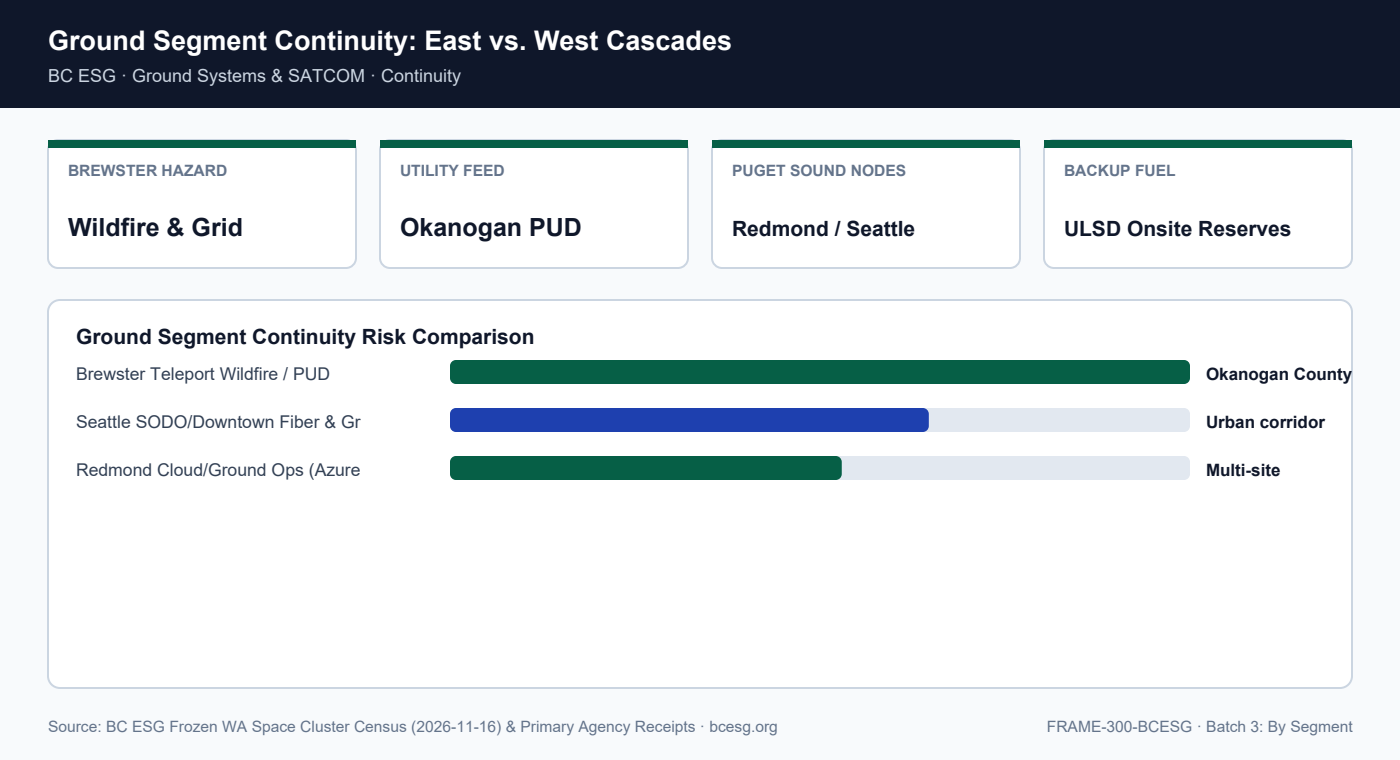
    Ground Segment Continuity: East vs. West Cascades

    Why Brewster Teleport Carries a Completely Different Continuity Profile

    Unlike Puget Sound floodplain facilities, US Electrodynamics in Brewster (Okanogan County) faces wildfire and radial transmission-line exposure in an arid basin served by Okanogan County PUD—requiring defensible fire-break perimeters, dual-feed utility routing, and multi-day onsite ULSD fuel reserves.

    By contrast, Microsoft Azure Space, AWS Aerospace & Satellite, RBC Signals, and Viasat mitigate local outage risk through geographically distributed global antenna networks and Columbia Basin / multi-region cloud interconnects.

    NodeOperatorsPrimary Continuity ThreatResilience Design
    Brewster, WA (Okanogan)US Electrodynamics (USEI)Regional wildfire & PUD line outageFire breaks, onsite diesel reserves, dual feeds
    Redmond / SeattleAzure Space, AWS, RBC, ViasatSubsea/terrestrial fiber cut, urban seismicMulti-region cloud & global dish failover

    Related BC ESG Guides & Verified Primary Sources

  • Ground & SATCOM Compliance: FCC Part 25, OET-65 RadHaz & Diesel Generator Permits

    Ground & SATCOM Compliance: FCC Part 25, OET-65 RadHaz & Diesel Generator Permits

    BC ESG · Washington Space Cluster Segments (November 16, 2026)
    Sourced Baseline: Earth stations are not categorically excluded from RF NEPA review (47 CFR § 1.1307(b)); standby diesel generators require PSCAA NOCOA / WAC 173-400 permits and ULSD.
    TAKEAWAY BRIEF · PDF & MARKDOWN TWIN
    Ground Compliance: Part 25, RadHaz & Air
    Download the formatted 2-page briefing sheet (PDF) or read the single-source Markdown twin for Ground Compliance: Part 25, RadHaz & Air.
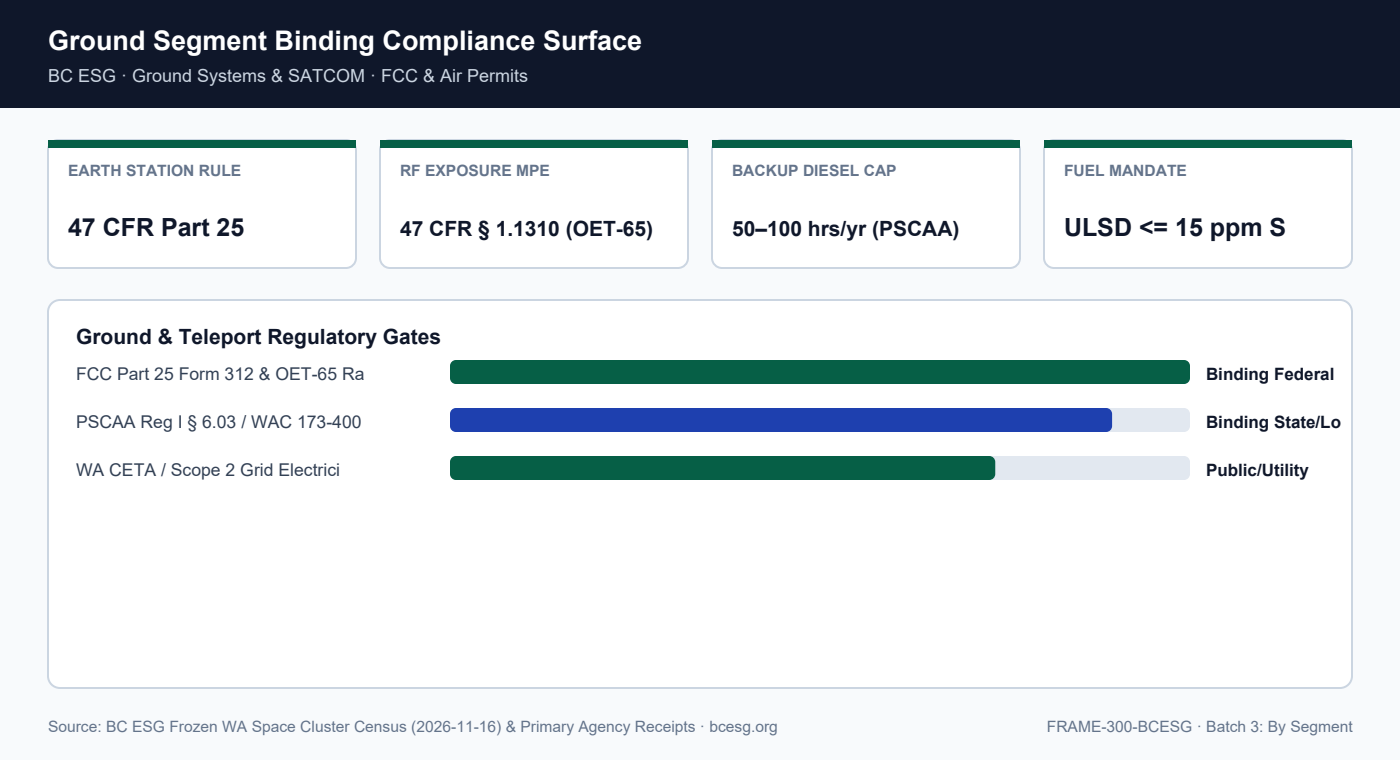
    Ground Segment Binding Compliance Surface

    RF Radiation Hazard (RadHaz) & Backup Generator Air Permitting

    Under 47 CFR Part 25 and 47 CFR § 1.1307(b), Part 25 earth stations are not categorically excluded from environmental review for human RF exposure. Applicants must submit a Radiation Hazard (RadHaz) study under OET Bulletin 65 against 47 CFR § 1.1310 MPE limits; exceeding public limits triggers a formal Environmental Assessment (§ 1.1311) and physical interlocks/fencing.

    On the ground-facility side, standby emergency diesel generators (RICE) supporting teleports or operations centers in King, Pierce, Snohomish, and Kitsap counties require a PSCAA Regulation I, Section 6.03 Notice of Construction Order of Approval (WAC 173-400-110 statewide): EPA Tier 2–4 compliance, 50–100 hour/year non-emergency testing caps, non-resettable hour meters, and Ultra-Low Sulfur Diesel (<= 15 ppm sulfur).

    RuleCitationTriggerRequirement
    FCC Earth Station & RadHaz47 CFR Part 25; § 1.1307(b); § 1.1310Parabolic uplink antennasForm 312, OET-65 RadHaz study, fencing/interlocks
    PSCAA / WA Standby DieselPSCAA Reg I § 6.03; WAC 173-400-110Backup RICE generatorsNOCOA permit, 50-100 hr/yr cap, ULSD <=15 ppm
    WA Clean Energy (CETA)RCW 19.405Utility power procurement (MSFT/AMZN)2030 GHG-neutral / 2045 100% clean utility grid

    Related BC ESG Guides & Verified Primary Sources

    Related Supplier Asks (Batch 4)

  • Cloud Ground Stations, Teleports & Multi-Network SATCOM in Washington

    Cloud Ground Stations, Teleports & Multi-Network SATCOM in Washington

    BC ESG · Washington Space Cluster Segments (November 16, 2026)
    Sourced Baseline: Cloud ground-station engineering sits in Redmond/Seattle while physical RF dishes concentrate in dry eastern basins (Brewster Teleport, Columbia Basin fiber).
    TAKEAWAY BRIEF · PDF & MARKDOWN TWIN
    Cloud Ground Stations & Teleports
    Download the formatted 2-page briefing sheet (PDF) or read the single-source Markdown twin for Cloud Ground Stations & Teleports.
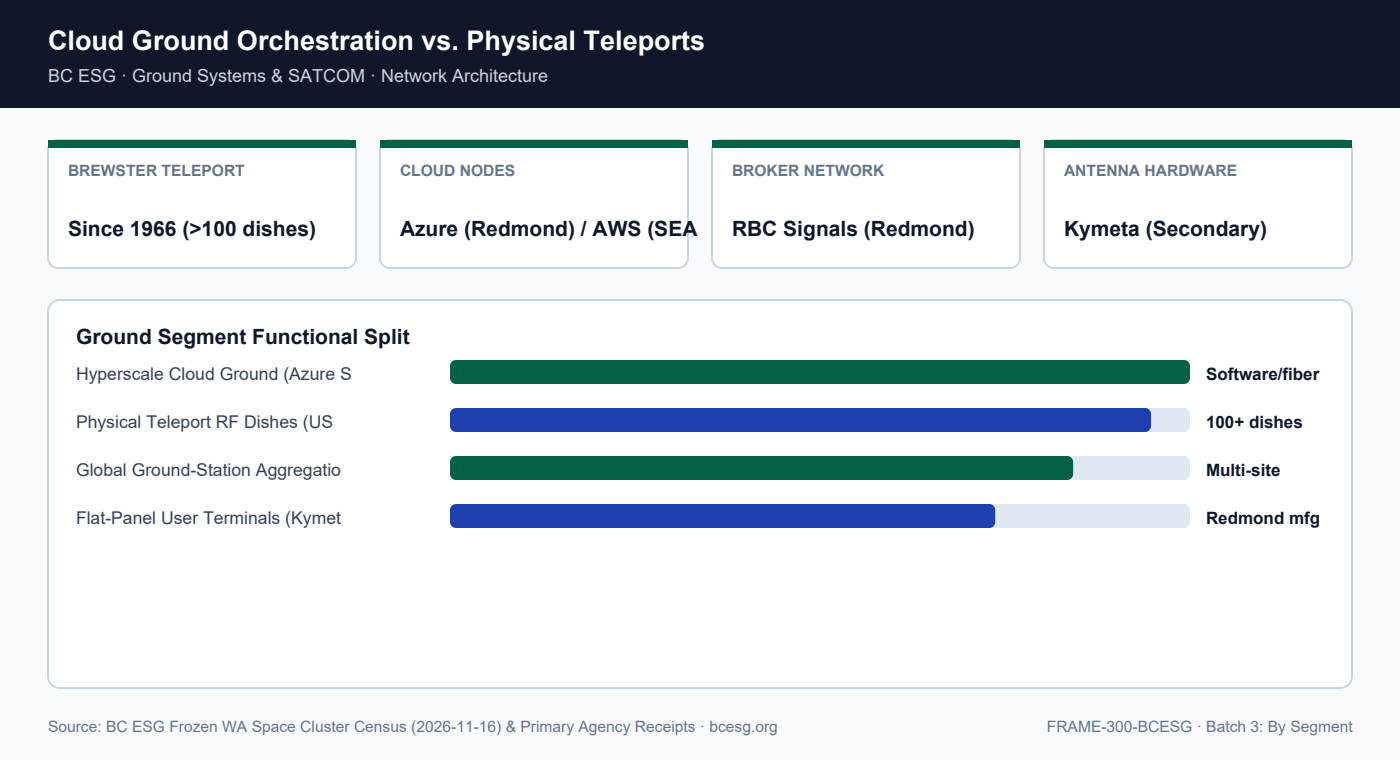
    Cloud Ground Orchestration vs. Physical Teleports

    Why Ground Engineering Lives in Puget Sound While Dishes Sit East of the Cascades

    Rain-fade and urban RF congestion make Puget Sound suboptimal for Ka/V-band downlinks, so physical dish farms like US Electrodynamics (USEI) sit in Brewster (Okanogan County) in the dry rain shadow east of the North Cascades—serving commercial SATCOM, FAA air traffic, and DoD missions.

    Meanwhile, Microsoft Azure Space (Redmond), AWS Aerospace & Satellite (Seattle), RBC Signals (Redmond), and Viasat (Seattle) anchor software-defined ground orchestration, cloud ingest, and global antenna-network brokering in Metro Seattle.

    LayerOperatorsWA GeographyFunction
    Physical RF TeleportUS Electrodynamics (USEI)Brewster, WA (Okanogan)100+ parabolic dishes; RF uplink/downlink
    Cloud Ground OrchestrationAzure Space, AWSRedmond, Seattle (+ Columbia Basin)Virtual modems, cloud ingest, orbital compute
    Multi-Site Ground NetworkRBC Signals, ViasatRedmond, SeattleShared antenna capacity & aero/gov SATCOM

    Related BC ESG Guides & Verified Primary Sources

  • Washington Ground Systems & SATCOM: Overview & Census Roster

    Washington Ground Systems & SATCOM: Overview & Census Roster

    BC ESG · Washington Space Cluster Segments (November 16, 2026)
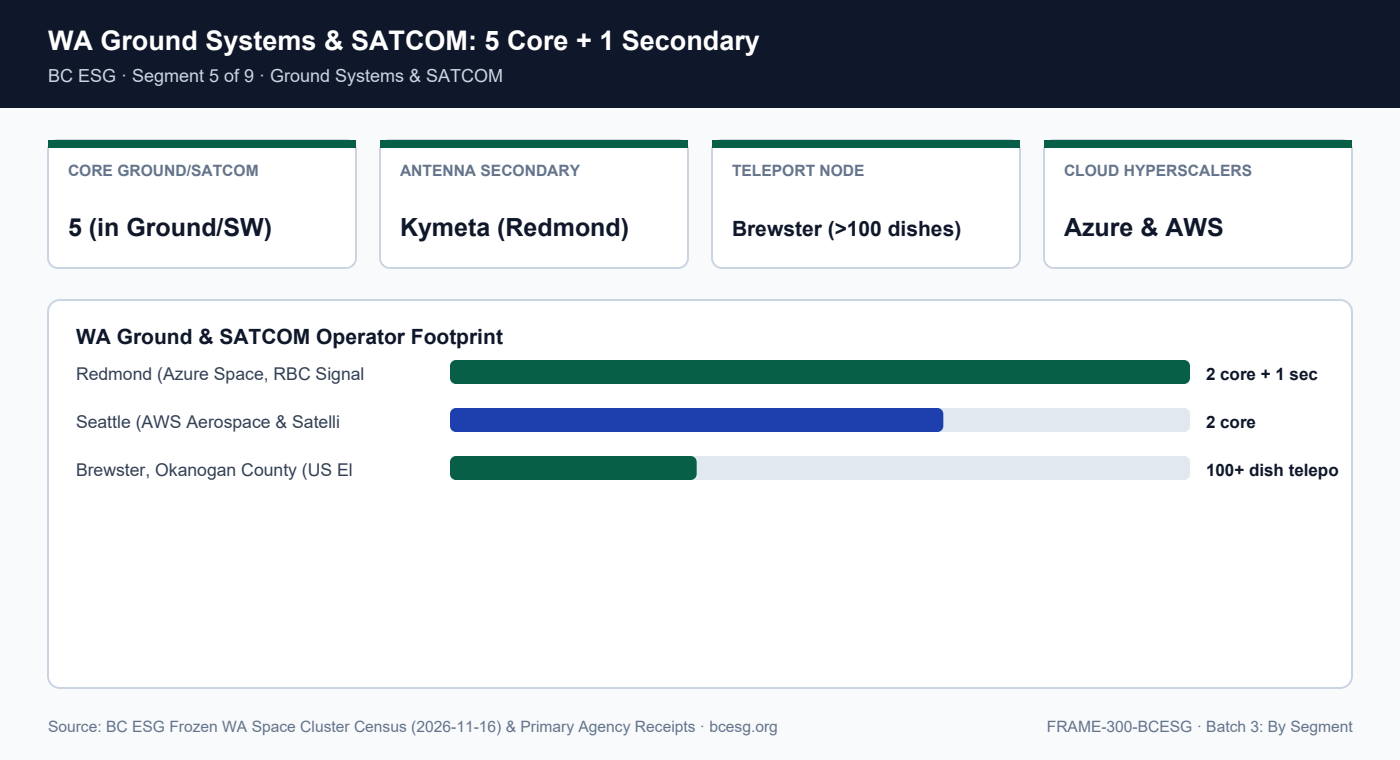
    Sourced Baseline: 5 core Ground/SATCOM operators inside Census Ground Systems / Software (plus Kymeta cross-referenced as secondary from Components & Suppliers); 0 re-homed.
    TAKEAWAY BRIEF · PDF & MARKDOWN TWIN
    Ground Systems & SATCOM Overview
    Download the formatted 2-page briefing sheet (PDF) or read the single-source Markdown twin for Ground Systems & SATCOM Overview.
    WA Ground Systems & SATCOM: 5 Core + 1 Secondary

    What Washington's Ground Systems & SATCOM Segment Does

    In the frozen Census CSV, Ground Systems and Software are combined in a 14-company Ground Systems / Software category. Following the Census without re-homing, this segment covers the 5 dedicated ground-network and SATCOM operators (Microsoft Azure Space, AWS Aerospace & Satellite, RBC Signals, US Electrodynamics, and Viasat), while cross-referencing Kymeta (Redmond flat-panel SATCOM antennas) as secondary from Components & Suppliers.

    Washington bridges both hyperscale cloud ground orchestration (Azure Orbital in Redmond, AWS Ground Station in Seattle) and physical RF teleport infrastructure (US Electrodynamics in Brewster, operating since 1966 with over 100 parabolic dishes).

    CompanyWA FacilityCensus PlacementGround / SATCOM RoleCensus Profile
    Microsoft Azure Space (Orbital)Redmond, WACore (MSFT; Ground Systems / Software)Cloud & satellite ground-station integrationProfile #1538
    AWS Aerospace & SatelliteSeattle, WACore (AMZN; Ground Systems / Software)AWS Ground Station & aerospace cloud unitProfile #1541
    RBC SignalsRedmond, WACore (Ground Systems / Software)Global multi-antenna ground-station networkProfile #1544
    US Electrodynamics (USEI)Brewster, WA (Okanogan County)Core (Ground Systems / Software)Commercial satellite teleport (>100 dishes)Grouped #1565
    ViasatSeattle, WA (regional office)Core (VSAT; Ground Systems / Software)Satellite communications & connectivityProfile #1547
    Kymeta (Secondary)Redmond, WACore (Primary: Components & Suppliers)Flat-panel electronically steered SATCOM antennasProfile #1517

    Related BC ESG Guides & Verified Primary Sources

  • Power Systems Continuity: PNNL/Vallecitos Split & Puget Sound Nodes

    Power Systems Continuity: PNNL/Vallecitos Split & Puget Sound Nodes

    BC ESG · Washington Space Cluster Segments (November 16, 2026)
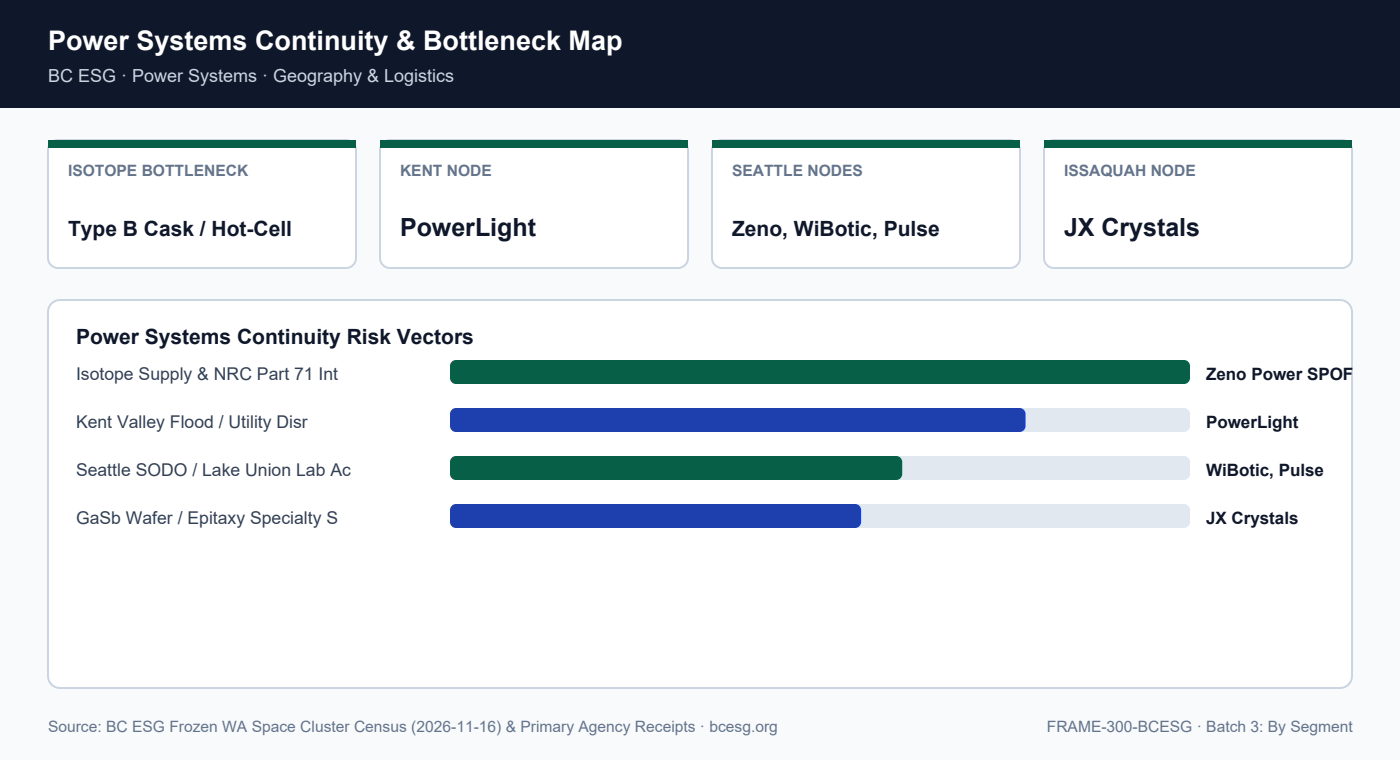
    Sourced Baseline: Zeno Power's continuity depends on NRC Type B cask transport and Vallecitos CA hot-cell capacity; PowerLight sits in Kent; WiBotic/Pulse sit in Seattle; JX Crystals in Issaquah.
    TAKEAWAY BRIEF · PDF & MARKDOWN TWIN
    Power Systems Continuity & SPOFs
    Download the formatted 2-page briefing sheet (PDF) or read the single-source Markdown twin for Power Systems Continuity & SPOFs.
    Power Systems Continuity & Bottleneck Map

    Where Continuity Risk Actually Lands for Space Power

    For Zeno Power, continuity risk is overwhelmingly licensing and interstate nuclear logistics: hot-cell availability in Sunol, CA, PNNL test access in Richland, WA, and NRC Type B transport cask scheduling.

    In Puget Sound, PowerLight Technologies faces Kent Valley Green River corridor exposure, while WiBotic (Seattle), JX Crystals (Issaquah), and Pulse Space (Seattle) operate smaller R&D labs where specialty GaSb semiconductor wafers or laser-diode supply chains represent greater bottlenecks than heavy plant floors.

    OperatorWA NodePrimary Continuity ExposureMitigation
    Zeno PowerSeattle / PNNL RichlandHot-cell & Type B cask transport (CA <-> WA)Dual PNNL & Vallecitos agreements
    PowerLightKent, WAGreen River corridor; outdoor test airspaceIndoor fiber-power test bays
    JX CrystalsIssaquah, WAGaSb epitaxy / specialty cell supplyInventory buffering
    WiBotic / PulseSeattle, WASeattle seismic/utility; UN 38.3 carrier rulesModular PCB assembly

    Related BC ESG Guides & Verified Primary Sources

  • Power Systems Compliance: NRC 10 CFR 30/71, FDA/ANSI Laser & FCC Part 18

    Power Systems Compliance: NRC 10 CFR 30/71, FDA/ANSI Laser & FCC Part 18

    BC ESG · Washington Space Cluster Segments (November 16, 2026)
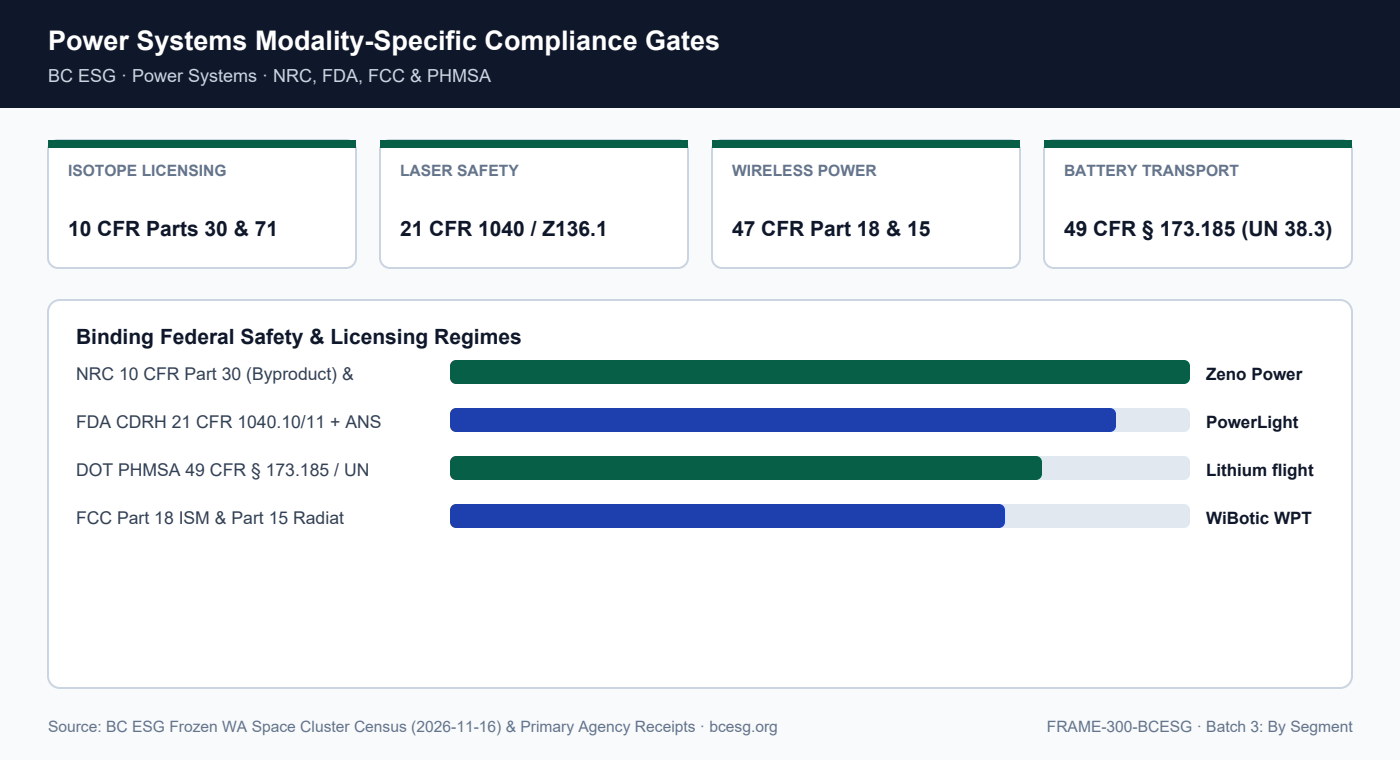
    Sourced Baseline: Binding modality gates: NRC 10 CFR 30/71 (radioisotopes), FDA 21 CFR 1040.10/11 & ANSI Z136.1 (lasers), FCC Part 18/15 (WPT), and DOT PHMSA 49 CFR § 173.185 / UN 38.3 (lithium cells).
    TAKEAWAY BRIEF · PDF & MARKDOWN TWIN
    Power Compliance: NRC, Laser & FCC Part 18
    Download the formatted 2-page briefing sheet (PDF) or read the single-source Markdown twin for Power Compliance: NRC, Laser & FCC Part 18.
    Power Systems Modality-Specific Compliance Gates

    Distinct Federal Licensing Regimes by Power Technology

    Space power companies face zero-overlap federal safety regimes dictated by energy carrier. Radioisotope systems (Zeno Power) require NRC 10 CFR Part 30 byproduct material licensing and 10 CFR Part 71 NRC-certified Type B accident-resistant transport casks.

    Optical power beaming (PowerLight Technologies) is governed by FDA CDRH (21 CFR Parts 1040.10 & 1040.11) accession reporting and ANSI Z136.1 Maximum Permissible Exposure limits with automated beam-interrupt interlocks, plus FAA/USSF airspace deconfliction. Wireless inductive charging (WiBotic) requires FCC Part 18 (47 CFR Part 18) ISM equipment authorization, FCC Part 15 telemetry compliance, and DOT PHMSA 49 CFR § 173.185 / UN 38.3 8-test lithium battery transport qualification.

    RegimeCitationApplies ToCore Requirement
    NRC Byproduct & Transport10 CFR Parts 30 & 71Radioisotope power (Zeno Power)Isotope possession license & Type B casks
    FDA CDRH & ANSI Laser21 CFR 1040.10/.11; ANSI Z136.1Free-space laser beaming (PowerLight)Form 3632, MPE interlocks, airspace check
    FCC WPT & EMI47 CFR Part 18 & Part 15Inductive/resonant charging (WiBotic)ISM field limits & RF interference control
    DOT PHMSA Lithium49 CFR § 173.185 (UN 38.3)Flight/robot lithium battery systems8 mandatory altitude/thermal/shock tests

    Related BC ESG Guides & Verified Primary Sources

    Related Supplier Asks (Batch 4)

  • Radioisotope, Laser Power-Beaming & Wireless Charging in Washington

    Radioisotope, Laser Power-Beaming & Wireless Charging in Washington

    BC ESG · Washington Space Cluster Segments (November 16, 2026)
    Sourced Baseline: Zeno Power demonstrated Sr-90 at PNNL Richland with CA hot-cell production; PowerLight/JX Crystals advance 10W->1kW+ beaming and GaSb TPV; Pulse Space is thin-record.
    TAKEAWAY BRIEF · PDF & MARKDOWN TWIN
    Nuclear, Laser & Wireless Power Footprint
    Download the formatted 2-page briefing sheet (PDF) or read the single-source Markdown twin for Nuclear, Laser & Wireless Power Footprint.
    WA Space Power Architectures & Test Nodes

    Four Non-Conventional Power Stacks Anchored in Puget Sound

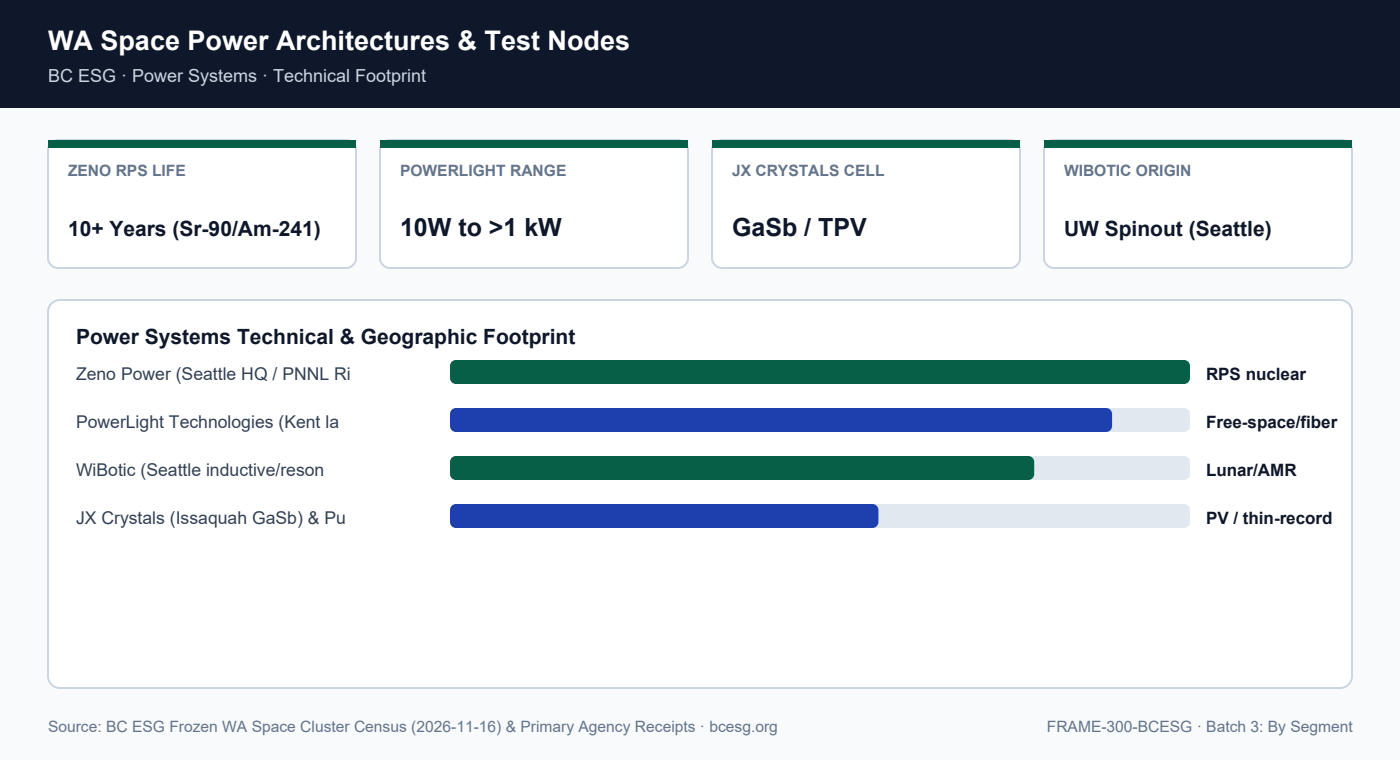
    Zeno Power (Seattle HQ) develops lightweight Strontium-90 and Americium-241 Radioisotope Power Systems delivering 10+ years of electric and thermal power for lunar and seabed missions. Zeno demonstrated its first Sr-90 heat source prototype at Pacific Northwest National Laboratory (PNNL) in Richland, WA, while siting hot-cell production at Vallecitos Nuclear Center in Sunol, CA.

    For optical and wireless power delivery, PowerLight Technologies (Kent, formerly LaserMotive) transmits 10W to >1 kW via free-space laser or power-over-fiber; JX Crystals (Issaquah) builds Gallium Antimonide (GaSb) thermophotovoltaic receivers; and WiBotic (Seattle) builds autonomous wireless charging for rovers and robots. Pulse Space (Seattle) carries a thin public record and is treated concisely in Grouped #1562.

    ModalityOperator(s)WA NodesOut-of-State / Lab Partner
    Radioisotope (Sr-90 / Am-241)Zeno PowerSeattle HQ, Richland (PNNL demo)Sunol, CA (Vallecitos hot-cell)
    Optical Laser Power BeamingPowerLight, JX CrystalsKent, IssaquahDoD / NASA lunar crater studies
    Wireless Inductive / RF ChargingWiBoticSeattleCommercial AMR & lunar rover OEMs
    Space Power-as-a-ServicePulse SpaceSeattleEarly-stage (thin public record)

    Related BC ESG Guides & Verified Primary Sources

  • Washington Space Power Systems: Overview & Census Roster

    Washington Space Power Systems: Overview & Census Roster

    BC ESG · Washington Space Cluster Segments (November 16, 2026)
    Sourced Baseline: 5 dedicated space-power core firms sit inside the frozen Census CSV's Components & Suppliers bucket (0 re-homed), plus Crane Aerospace (dual) and Avalanche Energy (adjacent).
    TAKEAWAY BRIEF · PDF & MARKDOWN TWIN
    Power Systems Overview & Roster
    Download the formatted 2-page briefing sheet (PDF) or read the single-source Markdown twin for Power Systems Overview & Roster.
    WA Space Power Systems: 5 Core + 1 Dual + 1 Adjacent

    Census Mapping Note & What the Power Systems Segment Builds

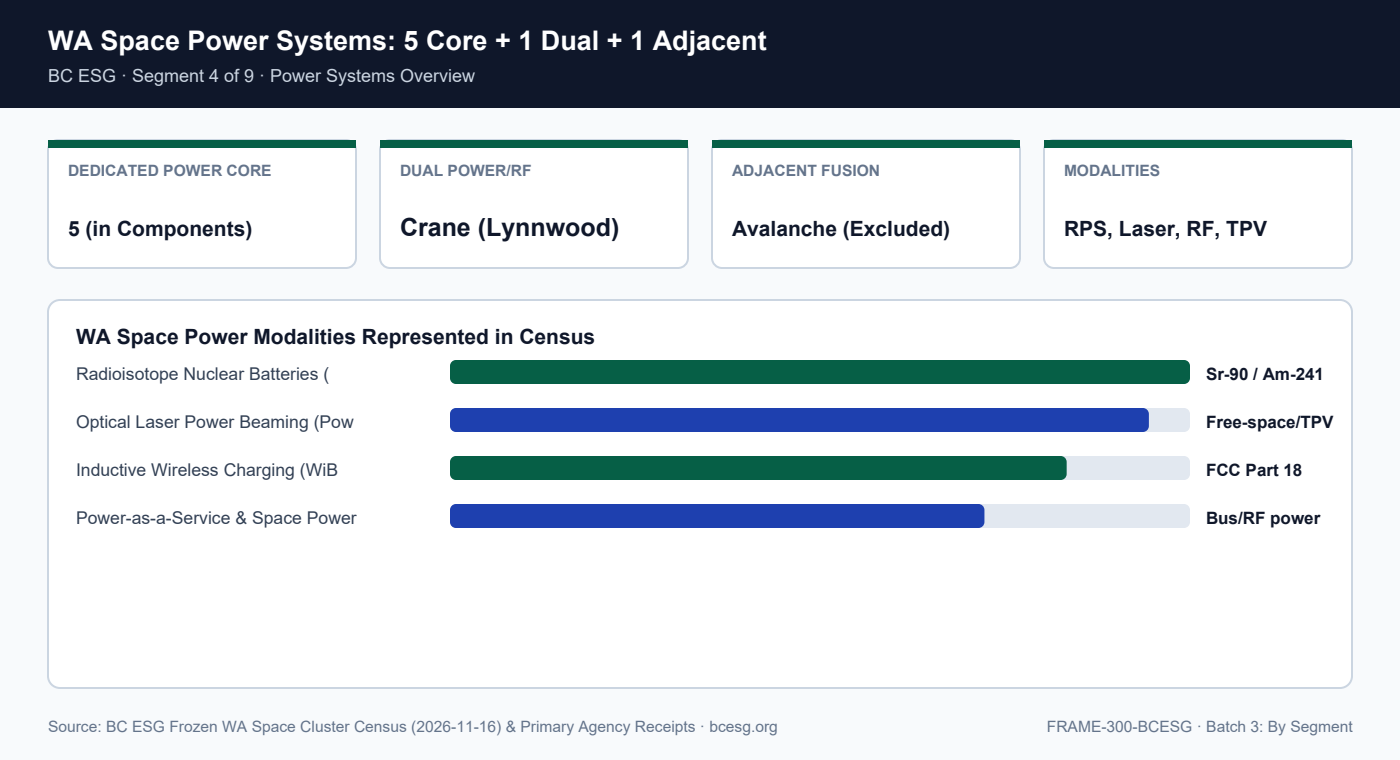
    In the frozen Census CSV, dedicated space-power developers sit inside the 17-company Components & Suppliers category rather than a separate CSV label. Following the Census without re-homing any row, this segment tracks the 5 core space-power specialists (PowerLight Technologies, JX Crystals, WiBotic, Zeno Power, and Pulse Space), cross-references Crane Aerospace & Electronics (space-qualified power conversion), and segregates Avalanche Energy as adjacent.

    Together, these operators cover the full non-solar-panel power stack for lunar night survival, orbital robotics, and deep-space missions: radioisotope power systems (RPS), high-power optical laser beaming, thermophotovoltaic (TPV) receivers, and autonomous wireless charging.

    CompanyWA FacilityCensus PlacementPower ModalityCensus Profile
    PowerLight TechnologiesKent, WACore (Census: Components & Suppliers)Optical / laser power beaming (free-space & fiber)Profile #1523
    JX CrystalsIssaquah, WACore (Census: Components & Suppliers)GaSb photovoltaic & thermophotovoltaic (TPV) cellsGrouped #1562
    WiBoticSeattle, WACore (Census: Components & Suppliers)Autonomous wireless charging for lunar/space robotsProfile #1526
    Zeno PowerSeattle, WA (PNNL Richland test / CA hot-cell)Core (Census: Components & Suppliers)Radioisotope power systems (Sr-90 / Am-241)Profile #1529
    Pulse SpaceSeattle, WACore (Census: Components & Suppliers)Space power-as-a-service architectureGrouped #1562
    Crane Aerospace & Electronics (Secondary)Lynnwood, WACore (Components & Suppliers)Space-qualified power electronics & RFProfile #1502
    Avalanche Energy (Adjacent)Seattle / Richland, WAAdjacent (Excluded from Core 67)Compact fusion energy R&DAdjacent #1463

    Related BC ESG Guides & Verified Primary Sources

BC ESG

ESG Strategy, Sustainability Intelligence, and Business Continuity for Forward-Thinking Organizations

© 2026 BC ESG — Business Continuity, ESG & Sustainability Intelligence