Who Issues This Ask, Authority, and Binding Status
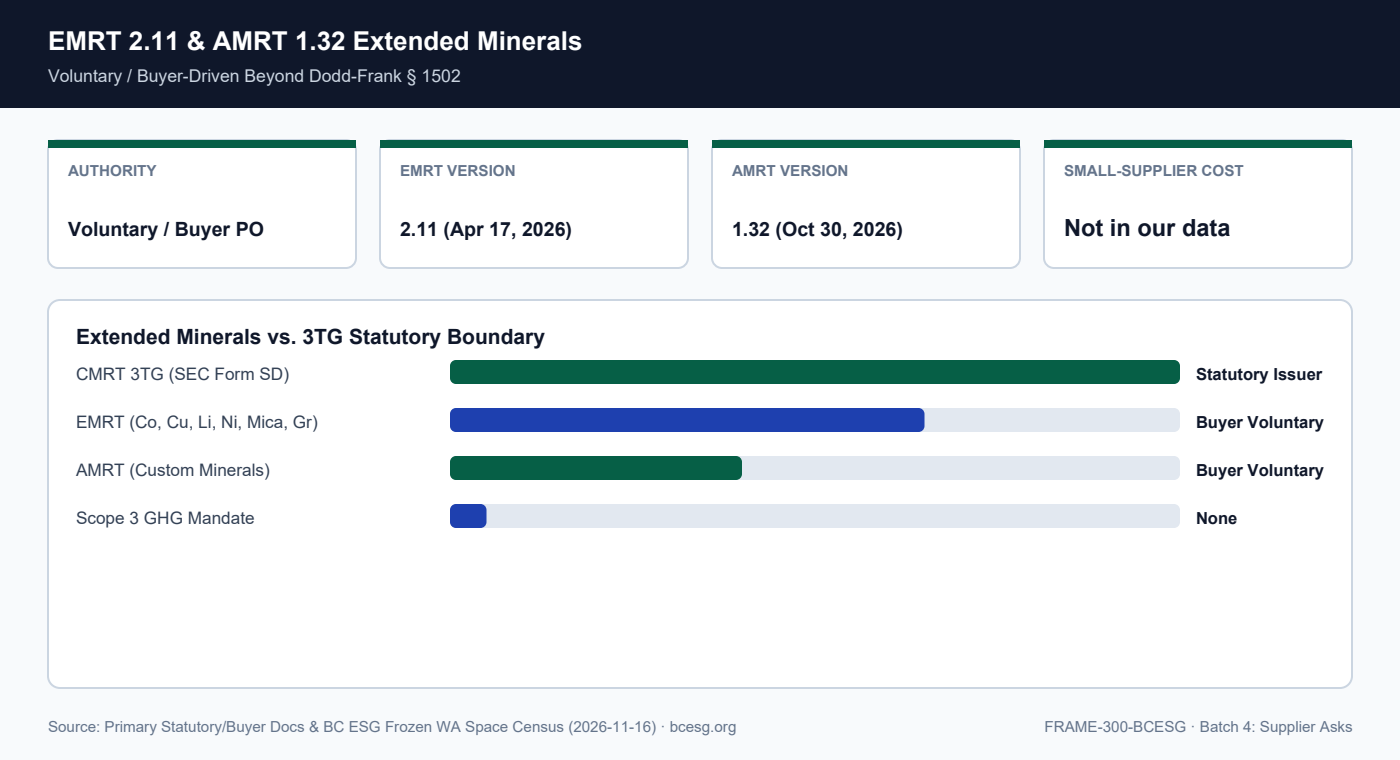
Extended mineral requests arrive via OEM sustainability teams and Tier-1 battery, propulsion, or electronics buyers using the Responsible Minerals Initiative (RMI) EMRT 2.11 (released April 17, 2026, covering cobalt, copper, natural graphite, lithium, natural mica, and nickel) and AMRT 1.32 / 1.32.1 (released October 30, 2026, for buyer-selected minerals).
Unlike 3TG under 17 CFR § 240.13p-1, no US federal statute or SEC rule mandates EMRT or AMRT. These asks are voluntary / customary unless explicitly incorporated as a deliverable in a buyer's purchase contract or supplier quality agreement. They carry no Scope 3 GHG requirement (FAR Case 2021-015 was withdrawn January 13, 2025).
| Template | Minerals Covered | Release Date | Statutory Mandate? |
|---|---|---|---|
| EMRT 2.11 | Cobalt, copper, natural graphite, lithium, natural mica, nickel | April 17, 2026 | No — voluntary / buyer PO only |
| AMRT 1.32 / 1.32.1 | Buyer-selected / emerging minerals | October 30, 2026 | No — voluntary / buyer PO only |
| CMRT 6.6 (Comparison) | Tin, tantalum, tungsten, gold (3TG) | April 17, 2026 | SEC Rule 13p-1 on public issuers |
Evidence Required & Small-Supplier Effort Cost
Suppliers satisfy the ask by completing the RMI EMRT 2.11 or AMRT 1.32 Excel workbook (Declaration and Smelter/Refiner tabs) or issuing a written scope statement if supplied parts contain none of the six EMRT minerals.
RMI templates are free to download ($0). Internal supplier labor and smelter-tracing costs are not in our data; WA shops supplying copper busbars, lithium-ion power packs, or nickel-superalloy hardware (Inconel) face the highest traceability lift.
WA Space Cluster Segments & Companies Affected
EMRT 2.11 lands primarily on Power Systems (e.g., WiBotic battery/wireless charging) and Components & Suppliers working with nickel superalloys and copper electronics, including Exotic Metals Forming (adjacent) and Xanfab.