Who Issues This Ask, Authority, and Binding Status
Product Carbon Footprint (PCF) and Scope 3 supplier data requests come from sustainability teams at commercial satellite operators, cloud ground primes, or European-linked aerospace OEMs (such as Airbus/Safran/EU CSRD filers—see BC ESG Post #22).
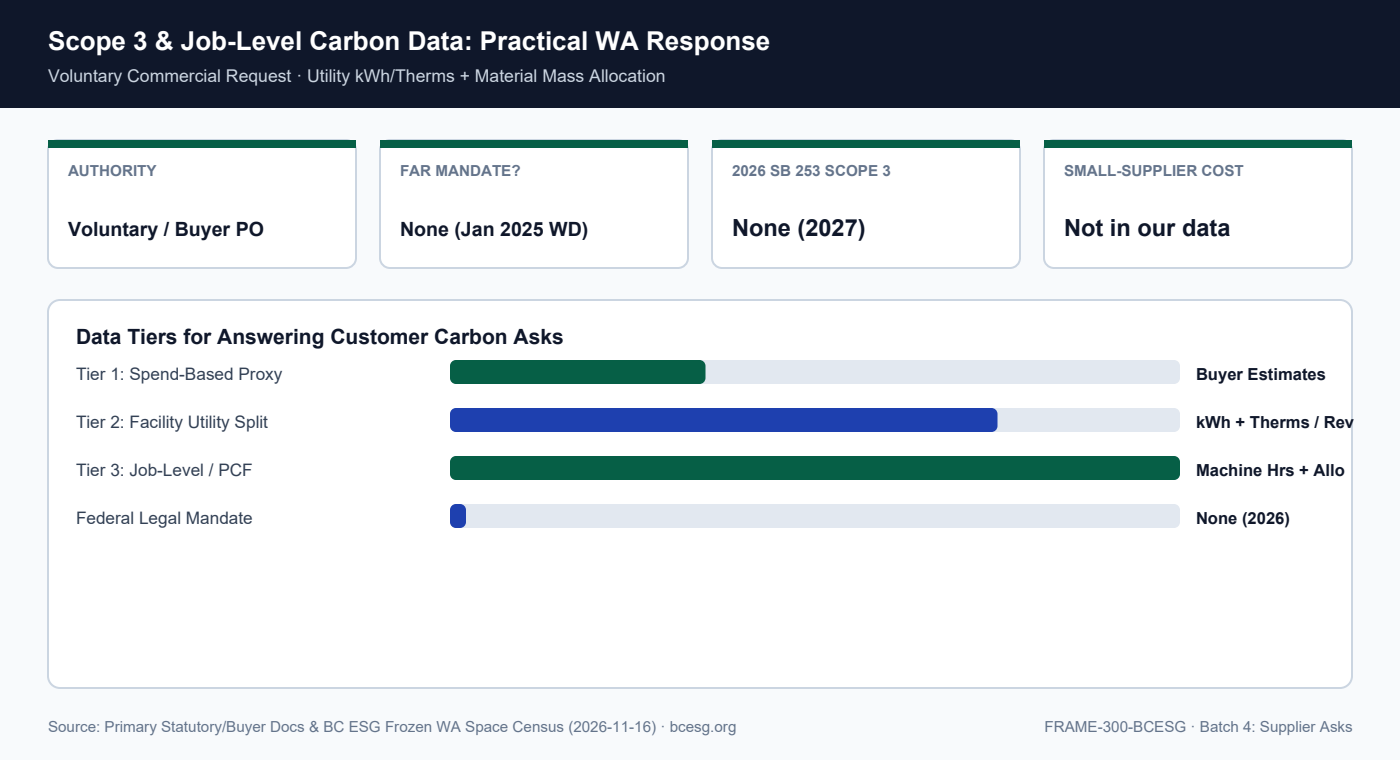
In the US, no federal law or FAR clause mandates Scope 3 reporting (FAR Case 2021-015 died January 13, 2025), and CA SB 253 Scope 3 does not start until 2027. Thus, these asks are voluntary unless written into a commercial contract.
| Approach | Data Inputs | When to Use |
|---|---|---|
| Utility-Bill Allocation | 12-mo kWh + therms + revenue/hours share | Best default for <50-person WA machine/fab shops |
| Job-Level / PCF | Alloy mass (kg) + mill cert + machine kWh | Only if required by a high-value commercial PO |
| Spend-Based (Buyer) | Invoice $ only (EEIO factor) | Buyer calculates; $0 supplier effort |
Evidence Required & Small-Supplier Effort Cost
Adapting BC ESG's Scope 3 Field Guide (Post #920) and Vendor Carbon Report Template (Page #145), a small WA shop can answer cleanly using a 1-page Facility Utility Allocation (annual electricity kWh from Puget Sound Energy/Seattle City Light + natural gas therms, divided by total shop revenue or machine-hours) rather than hiring an LCA consultant.
Exact consultant or LCA-software costs are not in our data; an in-house utility-allocation sheet requires only utility bills and basic spreadsheet math.
WA Space Cluster Segments & Companies Affected
Applies selectively to suppliers with EU CSRD or commercial ESG buyers across Components & Suppliers, Satellite Manufacturing, and Ground Systems & SATCOM.
Related BC ESG Guides & Verified Primary Sources
- WA Space Cluster Census Hub
- Scope 3 Supplier Data Field Guide (Post #920)
- Vendor Carbon Report Template (Page #145)
- Carbon Accounting Guide (Post #9)