Deciding Instrument: 90 FR 2663 (Jan 13, 2025), DoD 2025-O0004 (Mar 7, 2025), & SEC Rescission (May 29, 2026) | Date: January 13, 2025 – May 29, 2026
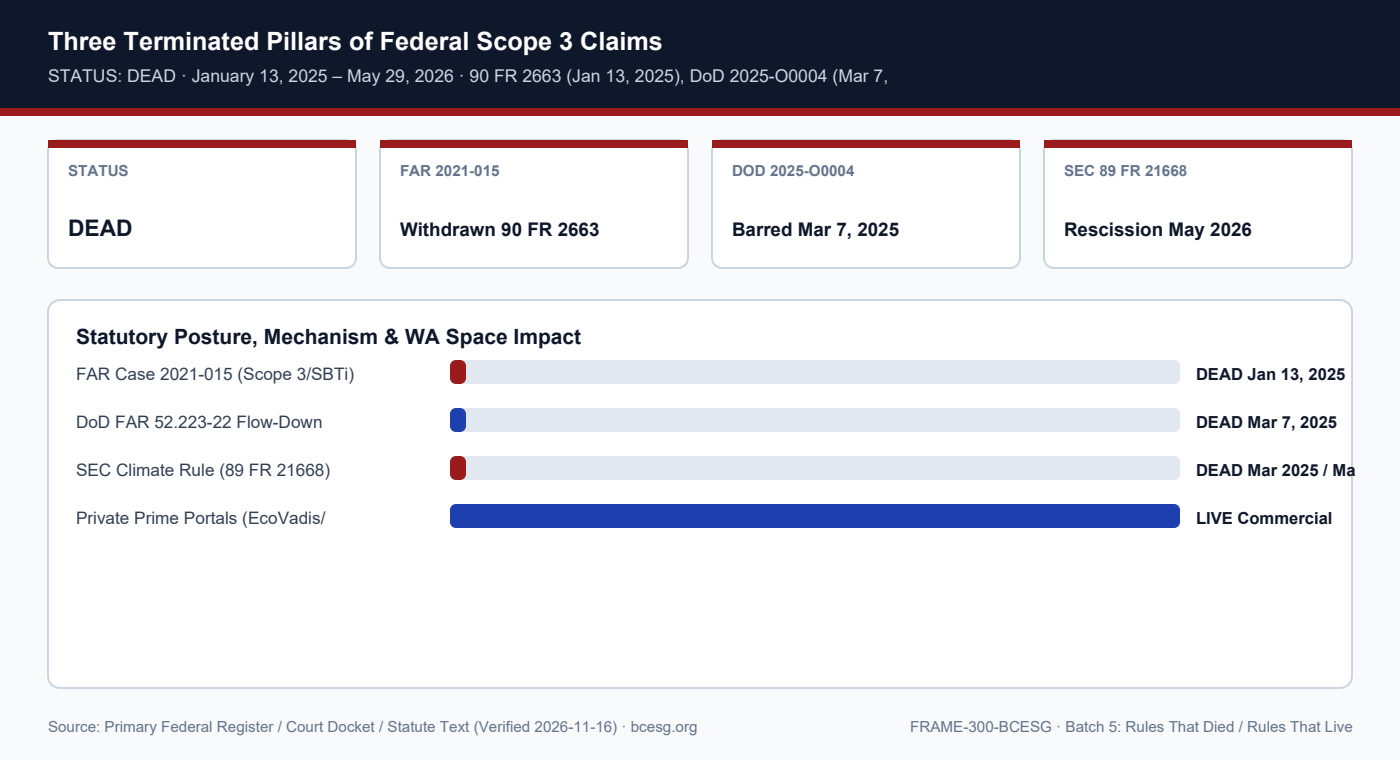
Verdict & Proof: Every claim that 'a federal Scope 3 mandate is coming' is DEAD. All three federal mechanisms that could have required Scope 3 reporting—FAR Case 2021-015 (withdrawn 90 FR 2663), DoD GHG deviations (barred 2025-O0004), and the SEC climate rule (omitted Scope 3 in 2024, defense dropped 2025, proposed for rescission May 2026)—have been terminated.
RULE STATUS BRIEF · PDF & MARKDOWN TWIN
Federal Scope 3 Claim (DEAD)
Download the formatted 2-page rule-status brief (PDF) or read the single-source Markdown twin for Federal Scope 3 Claim (DEAD).
Mechanism of Death: Zero Surviving Federal Statutory Hooks
Consultant decks sold to aerospace suppliers in 2023–2024 routinely warned that a federal Scope 3 mandate was imminent. Every federal pillar behind that claim is now dead: FAR Case 2021-015 was formally withdrawn on January 13, 2025 (90 FR 2663); DoD barred FAR 52.223-22 via Class Deviation 2025-O0004 on March 7, 2025 (backed by FY24 NDAA Sec. 318); and the SEC dropped its defense of 89 FR 21668 on March 27, 2025 before proposing full rescission on May 29, 2026.
There is no active federal rulemaking in OMB/OIRA or the Federal Register proposing a federal Scope 3 mandate for space or defense contractors.
Do not budget for federal Scope 3 audit compliance.
Challenge any vendor pitch claiming 'FAR/SEC requires Scope 3 in 2026–2027.'
Separate dead federal law from live commercial prime scorecards.
Federal Pillar
Deciding Instrument
Date
Status
FAR Case 2021-015
90 FR 2663 Withdrawal Notice
Jan 13, 2025
DEAD
DoD GHG Deviations
Class Deviation 2025-O0004
Mar 7, 2025
DEAD
SEC Climate Rule
SEC Vote + May 29, 2026 Rescission
Mar 27, 2025 / May 29, 2026
DEAD
What Replaced It: Commercial Primes & State/EU Spillover
While federal Scope 3 mandates are dead, commercial customers (Amazon Leo, Boeing commercial programs, European satellite buyers under EU CSRD) still request Scope 1+2 and product-level carbon data through EcoVadis or CDP to satisfy their own corporate targets or non-federal laws.
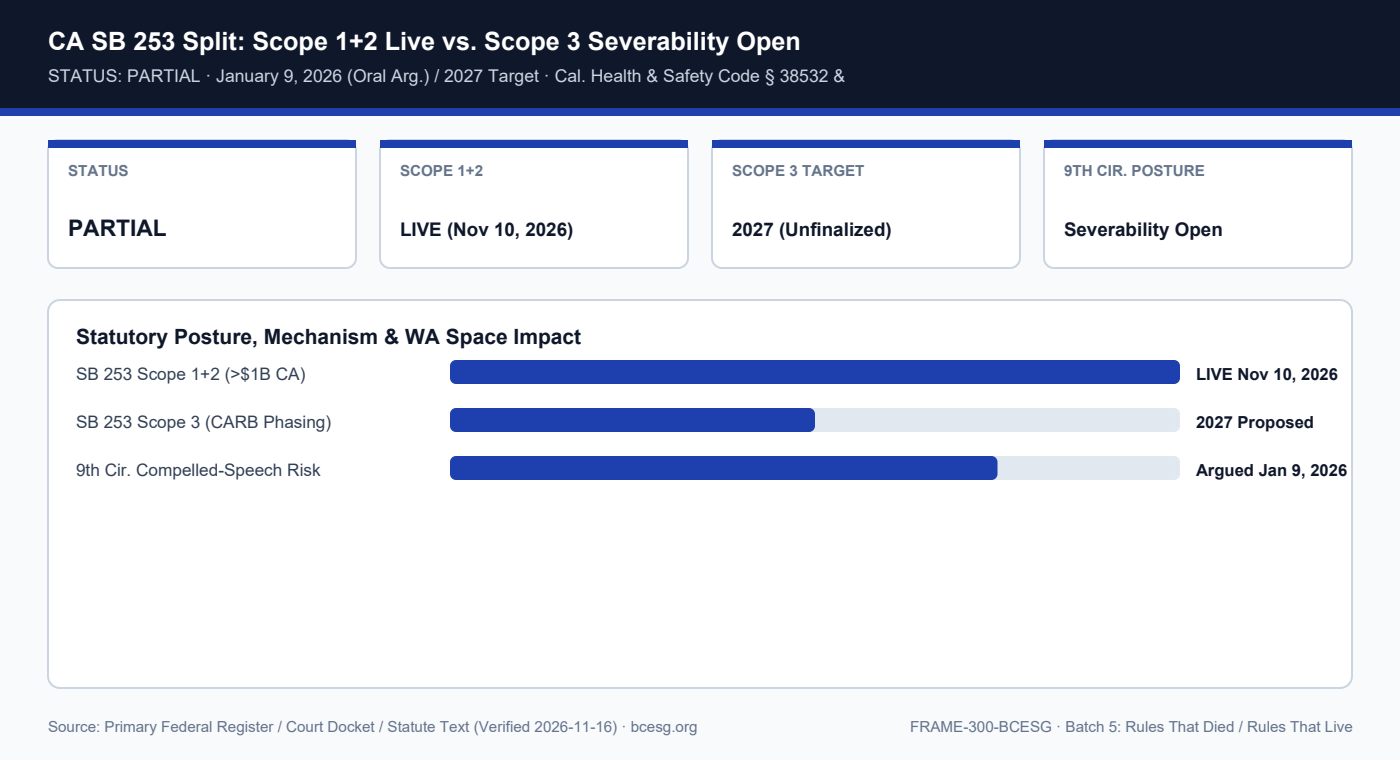
Verdict & Proof: SB 253's Scope 3 provision is PARTIAL / CONTESTED. While the Ninth Circuit declined to enjoin SB 253 as a whole (leaving Scope 1+2 LIVE for Nov 10, 2026), the January 9, 2026 appellate panel heavily questioned Scope 3 compelled-speech constitutionality and severability, and CARB has not finalized 2027 Scope 3 rules.
RULE STATUS BRIEF · PDF & MARKDOWN TWIN
CA SB 253 Scope 3 (PARTIAL)
Download the formatted 2-page rule-status brief (PDF) or read the single-source Markdown twin for CA SB 253 Scope 3 (PARTIAL).
SB 253 cannot be described as uniformly live or dead. While the Ninth Circuit denied a preliminary injunction against SB 253 in November 2025—allowing CARB's Scope 1+2 reporting deadline of November 10, 2026 to proceed—the appellate panel at the January 9, 2026 oral argument (Chamber of Commerce v. CARB / Sanchez, No. 25-5327) focused sharply on whether Scope 3 value-chain disclosures constitute unconstitutional compelled speech and whether Scope 3 is severable from Scope 1+2.
At the agency level, CARB has scheduled mandatory Scope 3 reporting for 2027 and floated narrowing initial categories (such as purchased goods, waste, and business travel), but those implementing rules remain in rulemaking and subject to the pending Ninth Circuit merits decision.
Scope 1+2 is LIVE (>$1B entities doing business in CA, Nov 10, 2026).
Scope 3 has zero 2026 statutory filing obligation.
Ninth Circuit merits decision on Scope 3 and severability remains pending.
SB 253 Component
2026 Legal Status
Deadlines & Court Posture
Scope 1 + Scope 2
LIVE
Nov 10, 2026 initial filing (no 2026 assurance)
Scope 3 (Value Chain)
PARTIAL / CONTESTED
2027 CARB target; 9th Cir. First Amendment & severability pending
Companion SB 261
ENJOINED
Enjoined Nov 18, 2025 by 9th Cir. No. 25-5327
What WA Space Suppliers Actually Face
Even while SB 253 Scope 3 sits in 2027 rulemaking and appellate litigation, California-nexus primes preparing their own 2026–2027 inventories still send voluntary or contractual carbon-data surveys to Washington suppliers. Distinguish a customer's commercial request from an active state statutory mandate.
Deciding Instrument: 9th Cir. Preliminary Injunction Order, Chamber of Commerce v. CARB / Sanchez, No. 25-5327 | Date: November 18, 2025
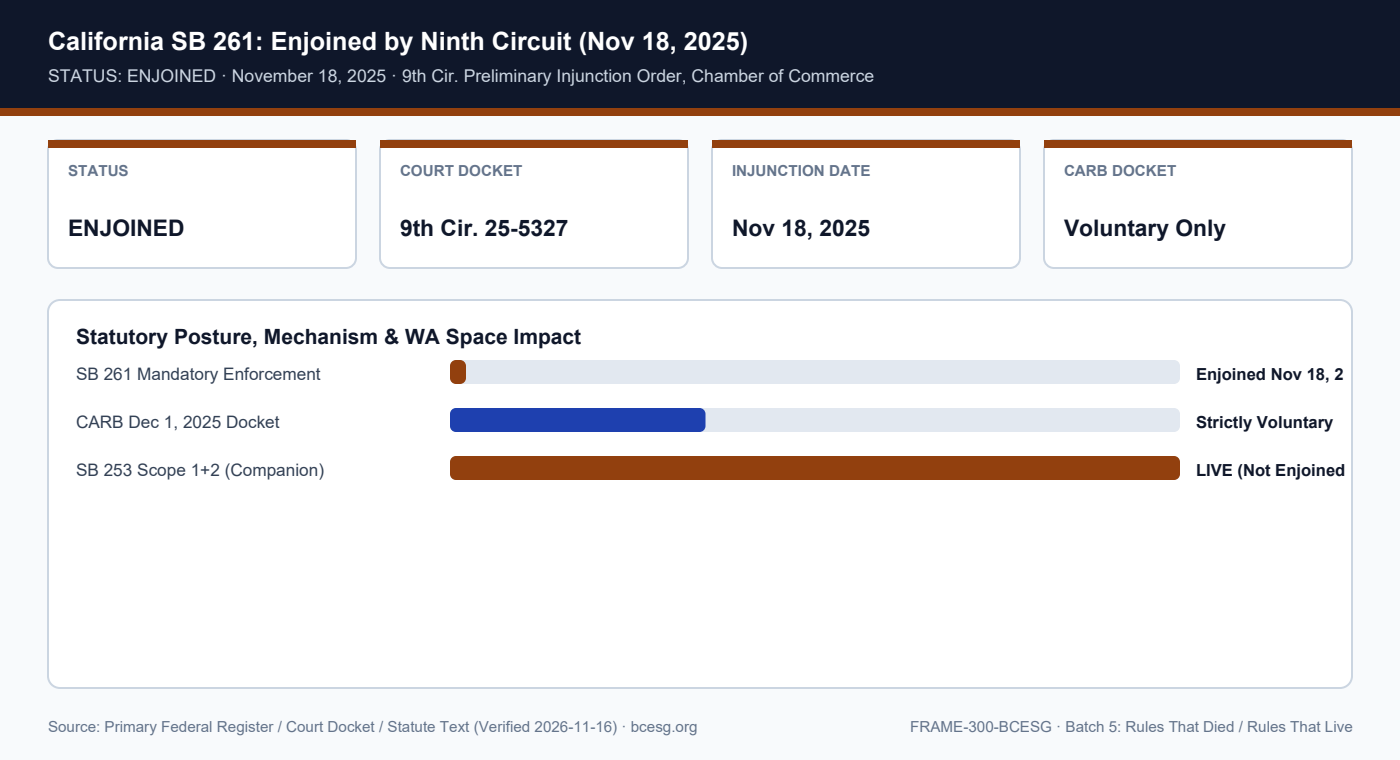
Verdict & Proof: California SB 261 is ENJOINED. On November 18, 2025, the Ninth Circuit issued a preliminary injunction barring enforcement of SB 261 pending appeal. CARB confirmed it will not enforce the January 1, 2026 statutory deadline and opened a strictly voluntary docket on December 1, 2025.
RULE STATUS BRIEF · PDF & MARKDOWN TWIN
CA SB 261 (ENJOINED)
Download the formatted 2-page rule-status brief (PDF) or read the single-source Markdown twin for CA SB 261 (ENJOINED).
Mechanism of Injunction: Ninth Circuit Order (No. 25-5327)
Under Cal. Health & Safety Code § 38533 (SB 261), companies with >$500M in annual revenue doing business in California were originally scheduled to publish biennial TCFD-aligned climate-related financial risk reports by January 1, 2026. Following a district court denial in C.D. Cal. (No. 2:24-cv-00801), plaintiffs appealed to the Ninth Circuit (No. 25-5327).
On November 18, 2025, the Ninth Circuit granted a preliminary injunction enjoining enforcement of SB 261 pending appeal, finding serious First Amendment compelled-speech questions. Oral arguments were held January 9, 2026, and a final merits ruling remains pending.
Mandatory January 1, 2026 SB 261 filing deadline is unenforced.
CARB opened a voluntary public docket on December 1, 2025 for companies electing to file anyway.
Do not confuse SB 261 (ENJOINED) with SB 253 Scope 1+2 (LIVE).
Provision
Statutory Target
Current Status (Nov 16, 2026)
SB 261 Biennial Risk Report
>$500M entities doing business in CA (Jan 1, 2026)
ENJOINED — 9th Cir. injunction Nov 18, 2025
CARB SB 261 Public Docket
Opened Dec 1, 2025
Voluntary submissions only; zero enforcement
SB 253 Scope 1+2 (Companion)
>$1B entities doing business in CA (Nov 10, 2026)
LIVE — Injunction denied by 9th Cir.
What Applies Instead: Voluntary Filing & Companion SB 253
No state enforcement penalty applies to skipping SB 261 while the Ninth Circuit injunction remains in effect. However, >$1B entities doing business in California remain legally subject to SB 253 Scope 1+2 emissions reporting, which the Ninth Circuit declined to enjoin.
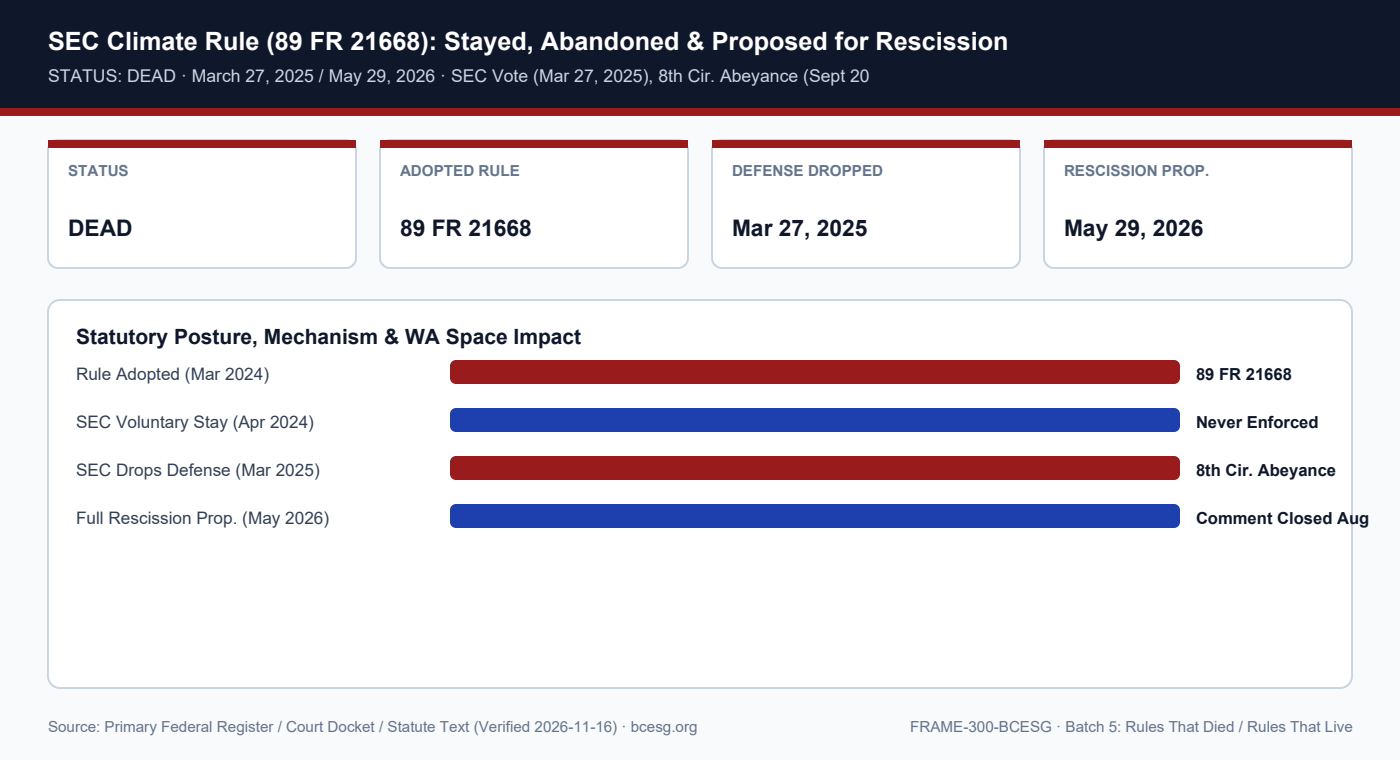
Verdict & Proof: The 2024 SEC Climate Disclosure Rule (89 FR 21668) is DEAD. Voluntarily stayed in April 2024, the SEC voted March 27, 2025 to drop its court defense in Iowa v. SEC, the Eighth Circuit placed the case in abeyance in September 2025, and on May 29, 2026 the SEC proposed rescinding the rule in full.
RULE STATUS BRIEF · PDF & MARKDOWN TWIN
SEC Climate Rule (DEAD)
Download the formatted 2-page rule-status brief (PDF) or read the single-source Markdown twin for SEC Climate Rule (DEAD).
Mechanism of Death: Administrative Stay, Abandoned Defense & 2026 Rescission
Adopted in March 2024 (89 FR 21668) without a Scope 3 mandate, the SEC's climate disclosure rule was immediately challenged and consolidated in the Eighth Circuit (Iowa v. SEC). The SEC voluntarily stayed the rule in April 2024—meaning it never took effect and zero companies ever filed under it.
On March 27, 2025, the Commission voted to end its legal defense of the rule. In September 2025, the Eighth Circuit placed the litigation in abeyance. On May 29, 2026, the SEC issued a formal proposed rulemaking to rescind the climate disclosure rules in their entirety (comment period closed August 3, 2026).
Zero compliance dates under 89 FR 21668 ever became operative.
SEC counsel withdrew defense March 27, 2025; Eighth Circuit abeyance entered September 2025.
Suspended all compliance deadlines pending 8th Cir. review
SEC Vote to End Court Defense
Mar 27, 2025
Terminated agency defense in Iowa v. SEC
8th Circuit Abeyance Order
Sep 2025
Litigation suspended while SEC pursues repeal
SEC Proposed Full Rescission
May 29, 2026
Formal rulemaking to delete 89 FR 21668 rules
What Replaced It: 2010 Materiality Guidance & State/Foreign Rules
No new federal SEC climate rule replaced 89 FR 21668. Publicly traded space companies (such as Amazon, Boeing, L3Harris, and BlackSky) remain governed by the SEC's general 2010 interpretive guidance on material climate risks inside Form 10-K filings.
Meanwhile, large issuers doing business in California or Europe still face California SB 253 (Scope 1+2) and EU CSRD (for >1,000-employee / >€450M turnover groups), which drive downstream supplier requests regardless of the SEC rollback.
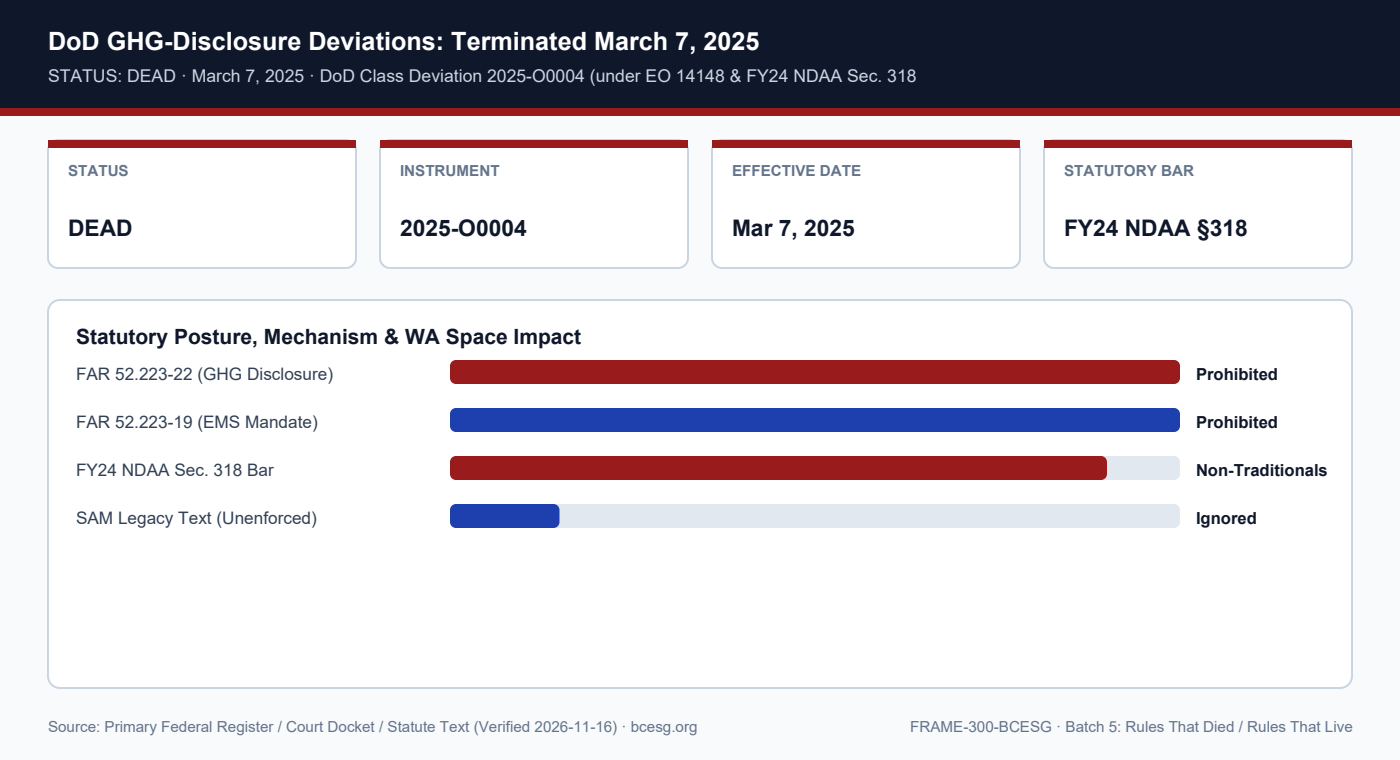
Deciding Instrument: DoD Class Deviation 2025-O0004 (under EO 14148 & FY24 NDAA Sec. 318) | Date: March 7, 2025
Verdict & Proof: DoD GHG-disclosure mandates are DEAD. On March 7, 2025, OUSD(A&S) issued Class Deviation 2025-O0004 prohibiting DoD contracting officers from using FAR 52.223-22 (GHG Disclosure) and FAR 52.223-19 (EMS) in solicitations and contracts.
RULE STATUS BRIEF · PDF & MARKDOWN TWIN
DoD GHG Deviations (DEAD)
Download the formatted 2-page rule-status brief (PDF) or read the single-source Markdown twin for DoD GHG Deviations (DEAD).
Mechanism of Death: Class Deviation 2025-O0004 & FY24 NDAA Sec. 318
Following Executive Order 14148 (which revoked EO 14057), the Office of the Under Secretary of Defense for Acquisition and Sustainment (DPCAP) issued Class Deviation 2025-O0004 on March 7, 2025. The deviation directs all DoD components (Army, Navy, Air Force, Space Force, and defense agencies) to stop including FAR 52.223-22 (Public Disclosure of Greenhouse Gas Emissions and Reduction Goals—Representation) and FAR 52.223-19 (Compliance with Environmental Management Systems) in new solicitations and contracts.
Even prior to 2025-O0004, Section 318 of the FY 2024 NDAA (implemented via Class Deviation 2024-O0009) statutorily barred DoD from requiring non-traditional defense contractors to disclose GHG inventories as a condition of award. Together, the statutory bar and Class Deviation 2025-O0004 render DoD GHG-disclosure flow-downs moot.
Class Deviation 2025-O0004 (Mar 7, 2025) bars FAR 52.223-22 and FAR 52.223-19 across DoD.
DoD components issued solicitation amendments and contract modifications stripping legacy sustainability clauses.
SAM.gov backend prompts that lag behind regulatory deletions are non-enforceable.
DoD Clause / Deviation
Pre-2025 Posture
Post-March 7, 2025 Posture
FAR 52.223-22 (GHG Representation)
Included in covered DoD solicitations
DEAD — Barred by Class Deviation 2025-O0004
FAR 52.223-19 (EMS Compliance)
Included for covered facilities
DEAD — Barred by Class Deviation 2025-O0004
NDAA FY24 Sec. 318 / 2024-O0009
Shielded non-traditional contractors
LIVE — Statutory bar remains in force
DFARS 252.204-7012 / ITAR
Mandatory CUI & export controls
LIVE — Unchanged and strictly enforced
What Replaced It: Quality, Export & Cyber Flow-Downs Remain Mandatory
Nothing replaced FAR 52.223-22 in defense space procurement. However, defense-space primes in Washington (such as Aerojet Rocketdyne/L3Harris in Redmond, Boeing, and Northrop Grumman) continue to enforce non-climate statutory mandates: ITAR (22 CFR 120-130), DFARS 252.204-7012 (NIST SP 800-171), DFARS 252.225-7009 (Specialty Metals), and AS9100D quality gates.
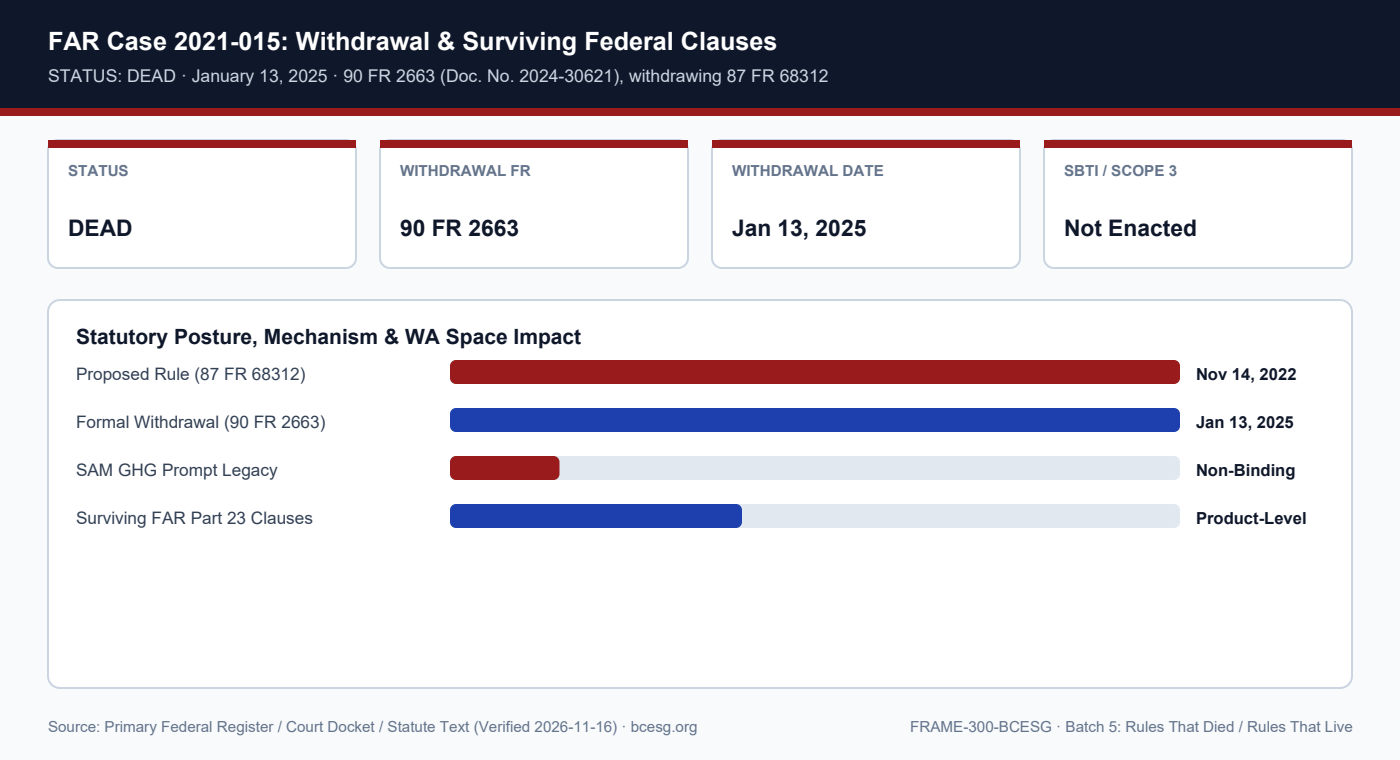
Verdict & Proof: FAR Case 2021-015 is DEAD. The FAR Council (DoD, GSA, NASA) formally withdrew the November 14, 2022 proposed rule (87 FR 68312) on January 13, 2025 (90 FR 2663). No federal contractor faces a FAR-mandated Scope 1, 2, or 3 inventory or SBTi target-setting clause under this rulemaking.
RULE STATUS BRIEF · PDF & MARKDOWN TWIN
FAR Case 2021-015 (DEAD)
Download the formatted 2-page rule-status brief (PDF) or read the single-source Markdown twin for FAR Case 2021-015 (DEAD).
Mechanism of Death: Federal Register Withdrawal (90 FR 2663)
On January 13, 2025, the Department of Defense, General Services Administration, and NASA jointly published a withdrawal notice in the Federal Register (90 FR 2663, Document Number 2024-30621), terminating FAR Case 2021-015 without issuing a final rule. The withdrawn 2022 proposal (87 FR 68312) would have required major federal contractors ($50M+ in annual federal obligations) to publish Scope 1, 2, and relevant Scope 3 inventories and set Science Based Targets (SBTi), while requiring significant contractors ($7.5M–$50M) to disclose Scope 1 and 2 emissions.
Because the rulemaking was withdrawn prior to finalization, it never entered Title 48 of the Code of Federal Regulations. Any consultant deck or prime-contractor questionnaire citing FAR Case 2021-015 as an active or pending federal mandate is relying on a terminated docket.
Withdrawn before final rule: 87 FR 68312 (Nov 14, 2022) -> 90 FR 2663 (Jan 13, 2025).
Zero enforceable FAR Part 23 GHG inventory or SBTi requirement exists for Washington space suppliers.
DoD reinforced the termination via Class Deviation 2025-O0004 (March 7, 2025).
Element
Withdrawn Proposal (87 FR 68312)
Current Status (90 FR 2663, Jan 13, 2025)
Scope 1+2 Inventory ($7.5M+ contractors)
Proposed mandatory annual SAM/CDP disclosure
DEAD — Withdrawn; no FAR mandate
Scope 3 & SBTi ($50M+ contractors)
Proposed mandatory disclosure & validation
DEAD — Withdrawn; never codified
FAR 52.223-22 Representation
Legacy GHG representation in SAM
DEAD — Barred in DoD via 2025-O0004
FAR Part 23 Product Clauses
Recovered content / EPEAT / biobased
LIVE — Narrow product-level rules only
What Replaced It: Surviving Federal Clauses & Private Portal Asks
Nothing replaced FAR Case 2021-015 at the federal acquisition level. Legacy representations in the System for Award Management (SAM) tied to repealed executive orders (such as FAR 52.223-22) were stripped of enforcement by agency deviations. What remains live in FAR Part 23 are narrow, product-level sustainable procurement clauses (such as biobased, recovered-material, and energy-efficient product preferences).
For Washington space-cluster manufacturers, climate data requests today come exclusively from commercial primes (such as Amazon Leo or Boeing commercial programs) or state-level statutes like California SB 253—never from a federal FAR climate mandate. See our Batch 4 Supplier Ask guide for how to answer prime portals without conceding non-existent federal authority.
BC ESG · WA Space Cluster Supplier Asks (November 16, 2026)
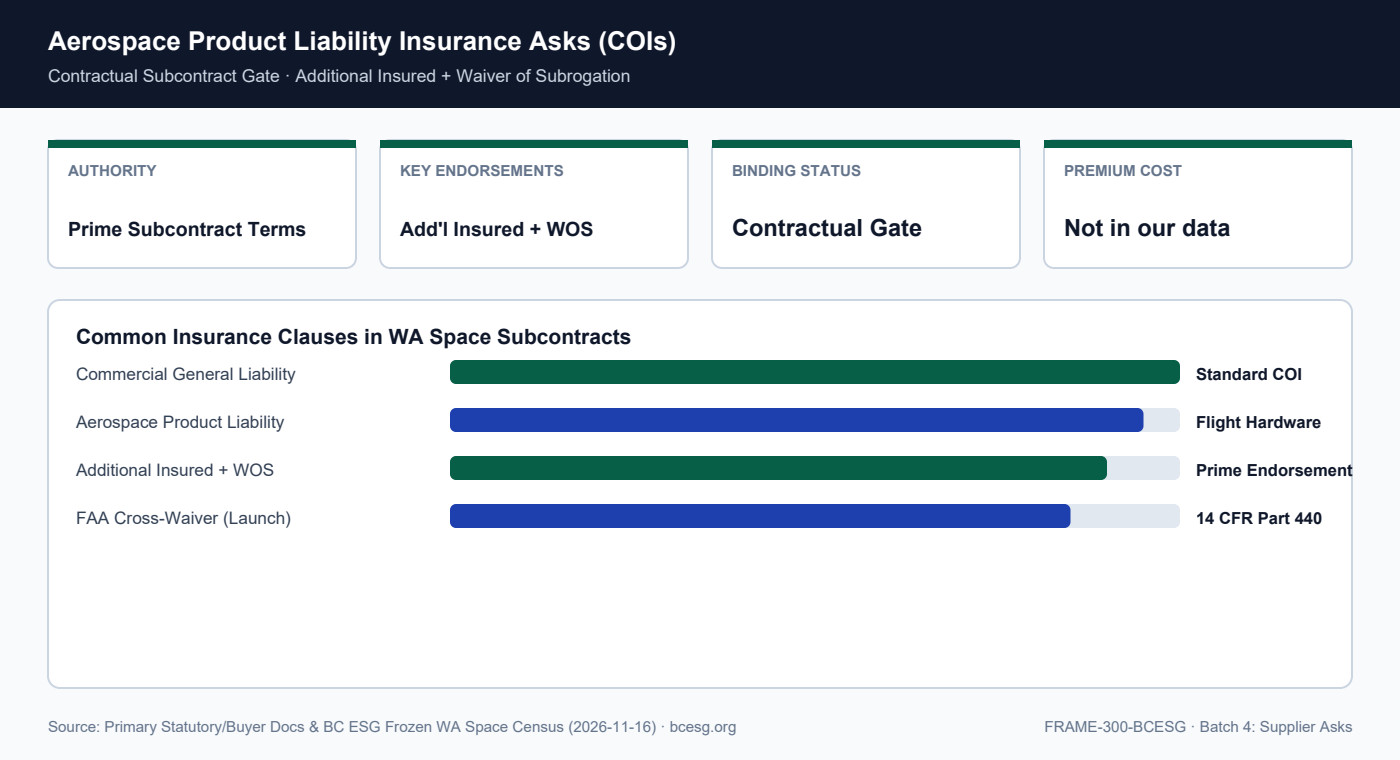
Sourced Baseline: Commercial contract requirement (NOT a statute on sub-tier vendors) where primes require Certificates of Insurance (COIs) carrying Aviation/Aerospace Product Liability, Additional Insured status, and Waivers of Subrogation before PO release.
TAKEAWAY BRIEF · PDF & MARKDOWN TWIN
Aerospace Product Liability COIs
Download the formatted 2-page briefing sheet (PDF) or read the single-source Markdown twin for Aerospace Product Liability COIs.
Who Issues This Ask, Authority, and Binding Status
Prime procurement teams require a Certificate of Insurance (COI) during vendor onboarding, often demanding Aerospace/Aviation Products Liability, Additional Insured endorsements, and Waivers of Subrogation.
Binding status: Insurance limits are commercial contractual requirements (not statutory mandates on sub-tier shops), distinct from the statutory FAA launch cross-waiver (14 CFR § 440.17) that flows down on licensed commercial launch activities.
Coverage / Endorsement
Why Primes Ask
Common Small-Shop Trap
Aerospace Products Liability
Covers flight-hardware failure claims
Standard CGL policies often exclude aviation/space
Additional Insured + Waiver of Subrogation
Shifts defense & blocks insurer subrogation
Requires explicit broker endorsement
FAA Launch Cross-Waiver
14 CFR § 440.17 statutory flow-down
Mandatory on FAA-licensed launch subcontracts
Evidence Required & Small-Supplier Effort Cost
Suppliers deliver an ACORD 25 Certificate of Insurance naming the prime as Additional Insured with a Waiver of Subrogation endorsement—and flag standard CGL 'aircraft/spacecraft exclusions' to their broker before signing.
Aerospace product-liability premium rates depend on flight-criticality and revenue and are not in our data.
BC ESG · WA Space Cluster Supplier Asks (November 16, 2026)
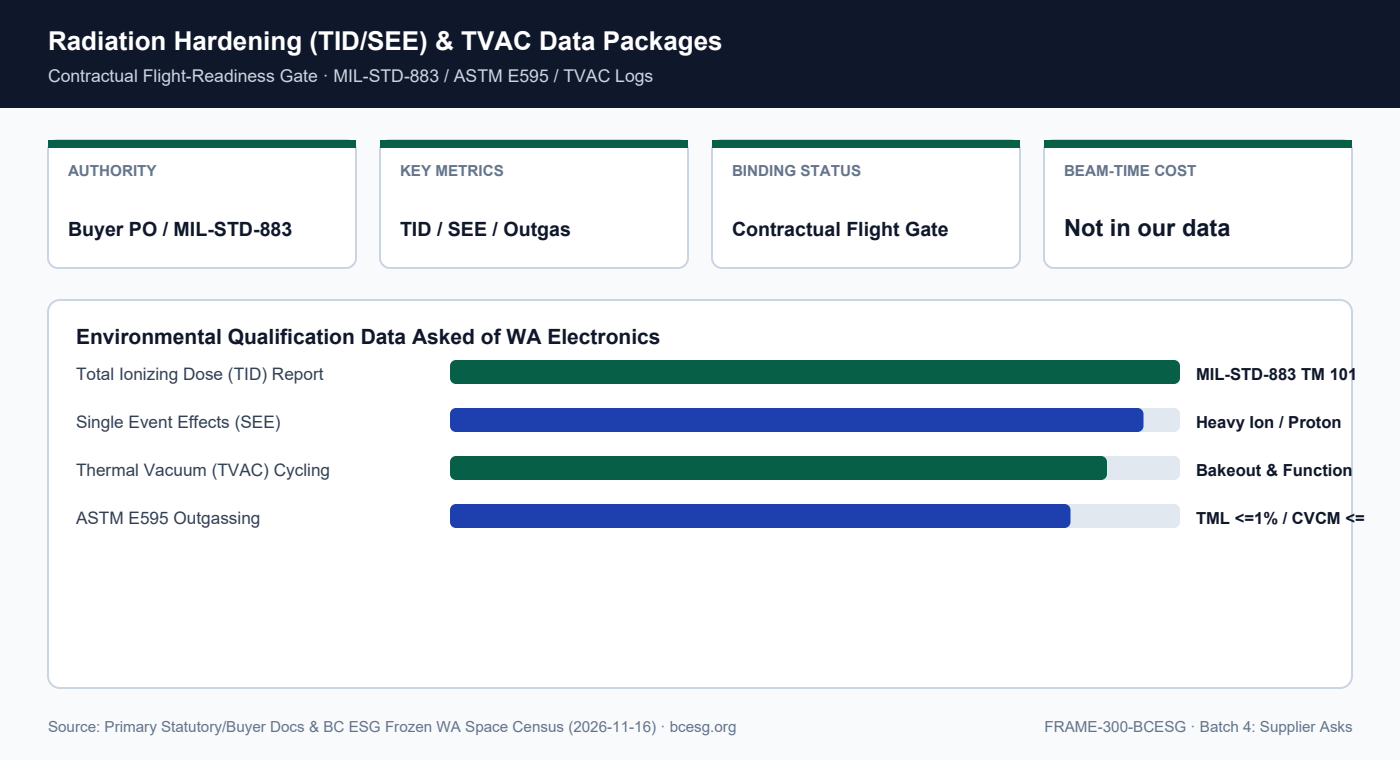
Sourced Baseline: Contractual engineering qualification asks issued by satellite and lunar primes referencing MIL-STD-883, NASA/GSFC radiation guidelines, and ASTM E595 outgassing. Not a statute; binding when written into prime flight-hardware POs.
TAKEAWAY BRIEF · PDF & MARKDOWN TWIN
Radiation & TVAC Test Data Packs
Download the formatted 2-page briefing sheet (PDF) or read the single-source Markdown twin for Radiation & TVAC Test Data Packs.
Who Issues This Ask, Authority, and Binding Status
Satellite and cislunar primes ask WA electronics and payload vendors for Total Ionizing Dose (TID), Single Event Effects (SEE), Thermal Vacuum (TVAC), and ASTM E595 outgassing test reports.
Binding status: These are contractual technical specifications (not statutes), binding when invoked by a buyer's Statement of Work or ICD.
Test Package
Standard / Metric
Required Deliverable
TID / SEE Radiation
MIL-STD-883 / NASA-GSFC
Lot radiation test report or heritage trace
TVAC / Bakeout
Program thermal profile
Chamber pressure/temp curves + functional pass
Outgassing
ASTM E595 (TML <=1.0%, CVCM <=0.1%)
Material lot outgassing test cert
Evidence Required & Small-Supplier Effort Cost
Suppliers submit lot-specific radiation test reports (or heritage analysis) and TVAC thermal-profile logs—often executed via specialized WA test providers like The Radiation Team (Tukwila/Renton) or SpaceRig (Seattle).
Cyclotron/heavy-ion beam time and TVAC chamber rates are not in our data.
BC ESG · WA Space Cluster Supplier Asks (November 16, 2026)
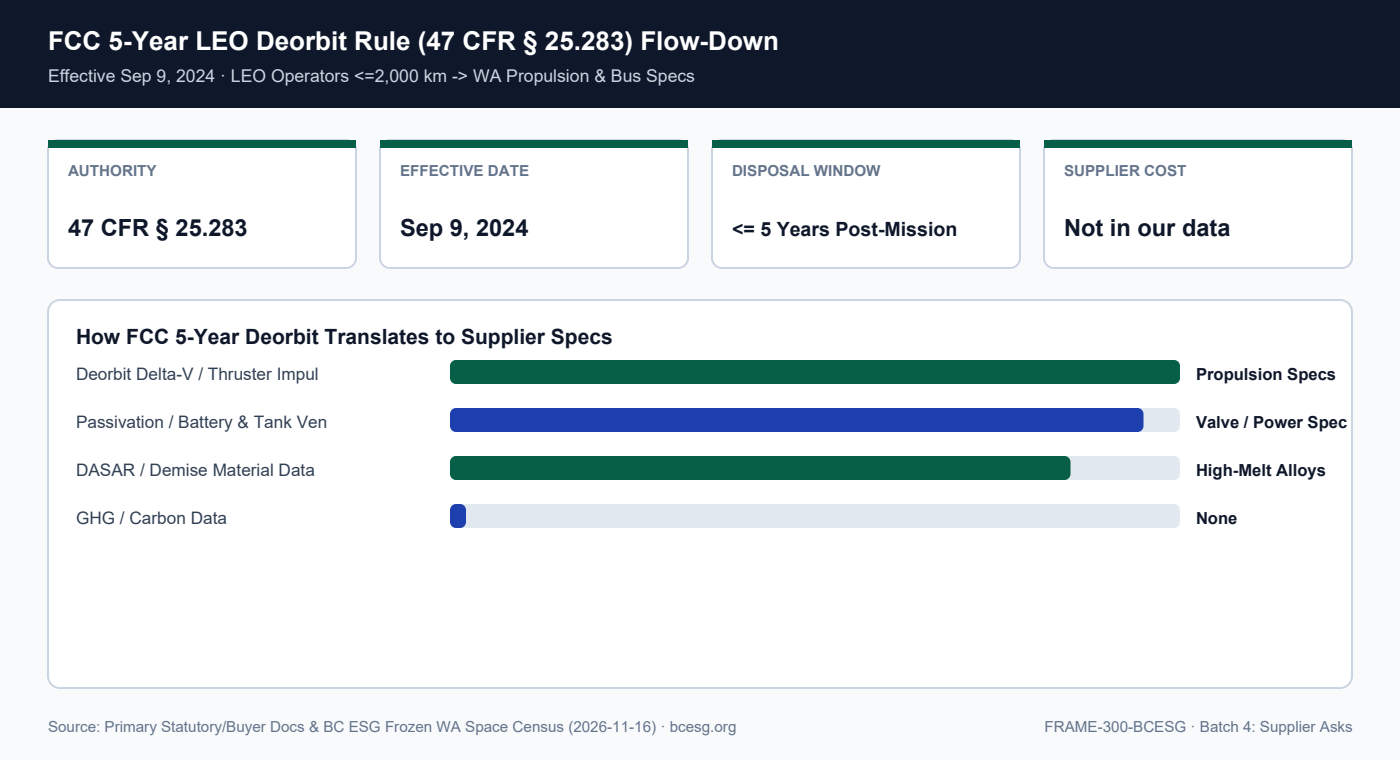
Sourced Baseline: Binding US federal regulation (47 CFR § 25.283, effective Sep 9, 2024) on FCC-licensed LEO satellite operators (<=2,000 km). Flows down to WA propulsion, passivation, and bus suppliers as propellant-budget, valve-venting, and casualty-risk specs.
TAKEAWAY BRIEF · PDF & MARKDOWN TWIN
FCC 5-Year Deorbit Flow-Downs
Download the formatted 2-page briefing sheet (PDF) or read the single-source Markdown twin for FCC 5-Year Deorbit Flow-Downs.
Who Issues This Ask, Authority, and Binding Status
Commercial LEO satellite operators—including SpaceX (Starlink), Amazon Leo, BlackSky, and Hubble Network—must satisfy the FCC's 5-year post-mission disposal rule (47 CFR § 25.283) for satellites below 2,000 km.
Binding status:47 CFR § 25.283 is binding US federal law on FCC satellite licensees, and lands on WA hardware suppliers as contractual engineering specifications (propulsion total impulse, end-of-life passivation valves, and material melt-temperature data for NASA DAS casualty analysis).
FCC Rule Element
Supplier Engineering Deliverable
<= 5-Year Deorbit (<= 2,000 km)
Propulsion delta-V & reliability qualification data
End-of-Life Passivation
Latch/vent valve & battery discharge FMEA
Re-entry Casualty (< 1 in 10,000)
Component alloy mass & melt-temp inputs for ODAR
Evidence Required & Small-Supplier Effort Cost
Suppliers provide thruster total-impulse qualification data, passivation reliability FMEAs, and alloy melt/mass properties for the prime's FCC Orbital Debris Assessment Report (ODAR).
Engineering qualification costs are not in our data.
BC ESG · WA Space Cluster Supplier Asks (November 16, 2026)
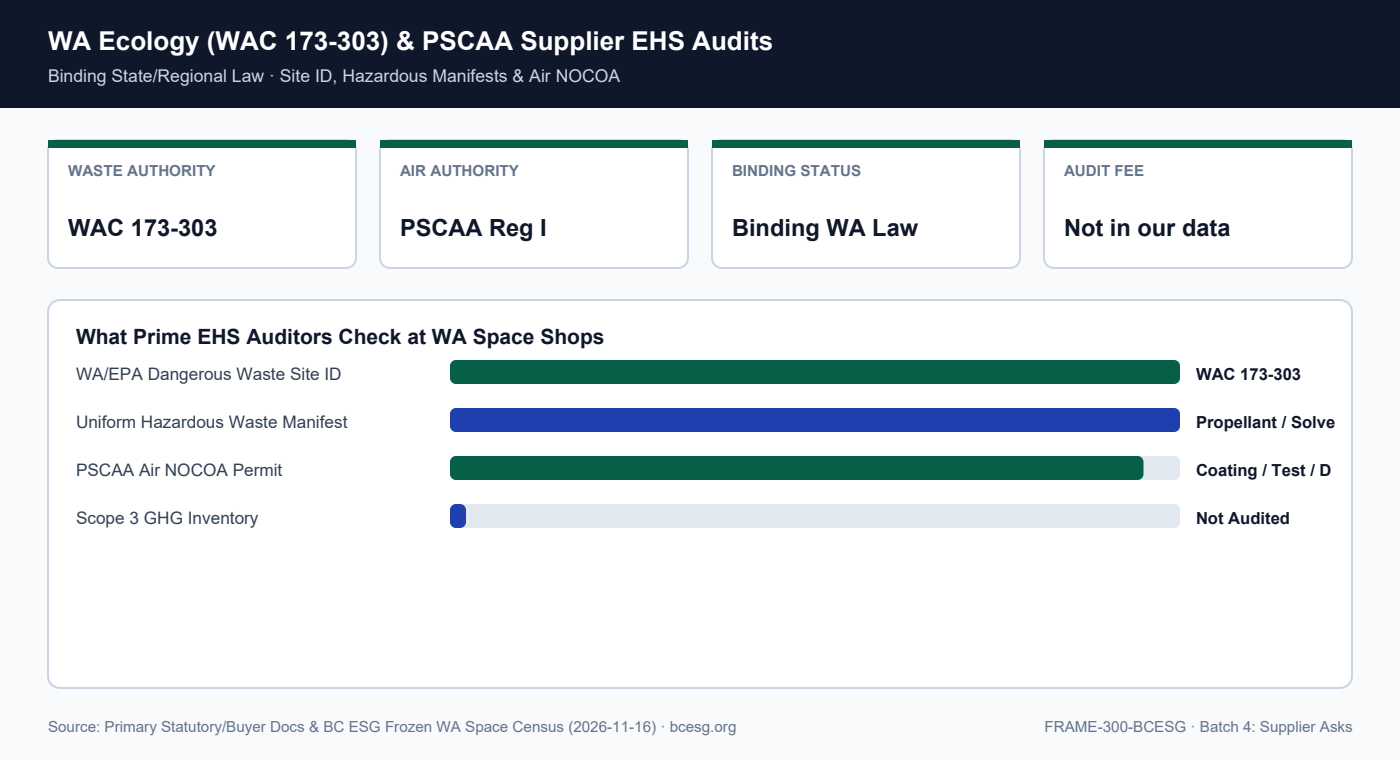
Sourced Baseline: Binding WA state & regional law (WAC 173-303 Dangerous Waste; Puget Sound Clean Air Agency Reg I). Primes audit chemical, propulsion, and composite suppliers to verify EPA/WA Site IDs, manifests, and air Notices of Construction (NOCOA) before awarding POs.
TAKEAWAY BRIEF · PDF & MARKDOWN TWIN
WA Ecology Waste & PSCAA Audits
Download the formatted 2-page briefing sheet (PDF) or read the single-source Markdown twin for WA Ecology Waste & PSCAA Audits.
Who Issues This Ask, Authority, and Binding Status
Prime EHS audit teams (Boeing, L3Harris/Aerojet, Blue Origin) inspect chemical-processing, composite, and propulsion subcontractors for Washington Department of Ecology Dangerous Waste (WAC 173-303) and Puget Sound Clean Air Agency (PSCAA) compliance.
Binding status:WAC 173-303 and PSCAA regulations are binding Washington State / regional laws independent of any customer contract.
WA / Regional Permit
Agency
Trigger
Dangerous Waste Site ID + Manifests
WA Dept. of Ecology (WAC 173-303)
Solvents, plating, prepreg, propellants
Air NOCOA
PSCAA (King/Pierce/Snohomish/Kitsap)
Paint/composite booths, diesel gensets, test stands
ISGP Stormwater
WA Dept. of Ecology
Industrial aerospace manufacturing (NAICS 3364)
Evidence Required & Small-Supplier Effort Cost
Suppliers maintain an active WA/EPA Dangerous Waste Site ID, signed Uniform Hazardous Waste Manifests (for spent solvents, chromates, prepreg resin waste, hydrazine/peroxide), PSCAA Notice of Construction Order of Approval (NOCOA) for spray booths/generators/test stands, and WA Ecology ISGP stormwater SWPPP logs.
Permit and licensed TSDF disposal fees depend on waste volume and are not in our data.
BC ESG · WA Space Cluster Supplier Asks (November 16, 2026)
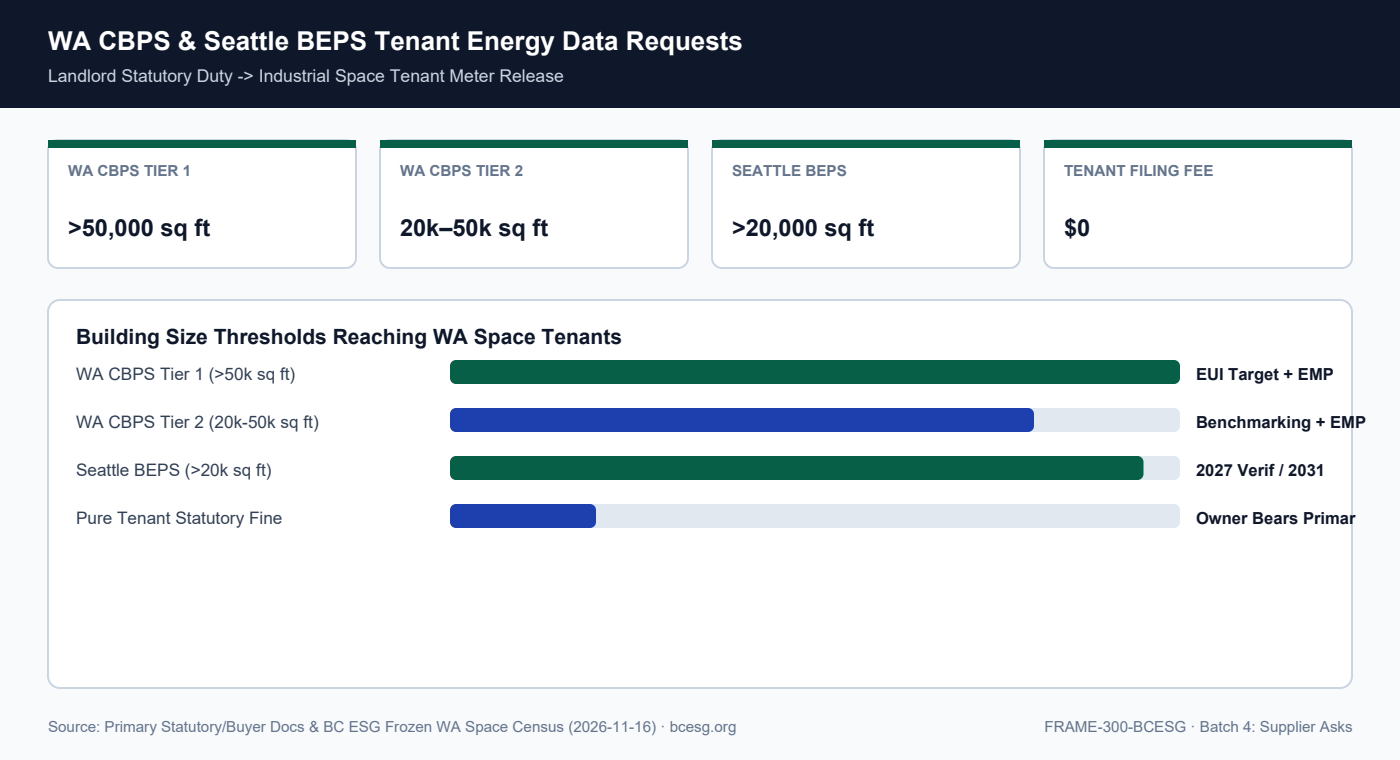
Sourced Baseline: Binding WA/Seattle building laws (WA CBPS Tier 1 >50k sq ft / Tier 2 20k-50k sq ft; Seattle BEPS >20k sq ft) on building owners. Industrial space tenants in Kent, Tukwila, and Seattle receive landlord utility-release and ENERGY STAR Portfolio Manager data requests.
TAKEAWAY BRIEF · PDF & MARKDOWN TWIN
WA CBPS & Seattle BEPS Tenant Data
Download the formatted 2-page briefing sheet (PDF) or read the single-source Markdown twin for WA CBPS & Seattle BEPS Tenant Data.
Who Issues This Ask, Authority, and Binding Status
Industrial warehouse and aerospace-campus landlords in Kent, Tukwila, Renton, Redmond, and Seattle issue utility-data release forms to space-cluster tenants to comply with Washington's Clean Buildings Performance Standard (CBPS) (see BC ESG Post #1171) and Seattle BEPS (see BC ESG Post #1275).
Binding status: Both laws are binding on covered building owners (>20,000 sq ft for WA CBPS Tier 2 and Seattle BEPS; >50,000 sq ft for WA CBPS Tier 1). Tenants have no direct state filing obligation unless a commercial lease shifts benchmarking/utility-sharing duties onto the tenant.
Program
Building Size
Tenant Role
WA CBPS Tier 1
> 50,000 sq ft
Utility meter release / lease EUI cooperation
WA CBPS Tier 2
20,000 – 50,000 sq ft
Benchmarking meter access for owner
Seattle BEPS
> 20,000 sq ft (Seattle)
2027 GHG verification meter data
Evidence Required & Small-Supplier Effort Cost
Tenants satisfy the landlord ask by signing a utility meter release authorization (Seattle City Light / PSE) or exporting monthly kWh/therm totals for ENERGY STAR Portfolio Manager.
There is no state fee for a tenant utility release ($0); lease-negotiation/admin time is not in our data.
WA Space Cluster Segments & Companies Affected
Affects leased industrial/cleanroom facilities across Kent Valley and Seattle, including Stoke Space (168k sq ft Kent), Cowboy Space (~290k sq ft Kent), Starfish Space (Tukwila), and BlackSky (Tukwila).
BC ESG · WA Space Cluster Supplier Asks (November 16, 2026)
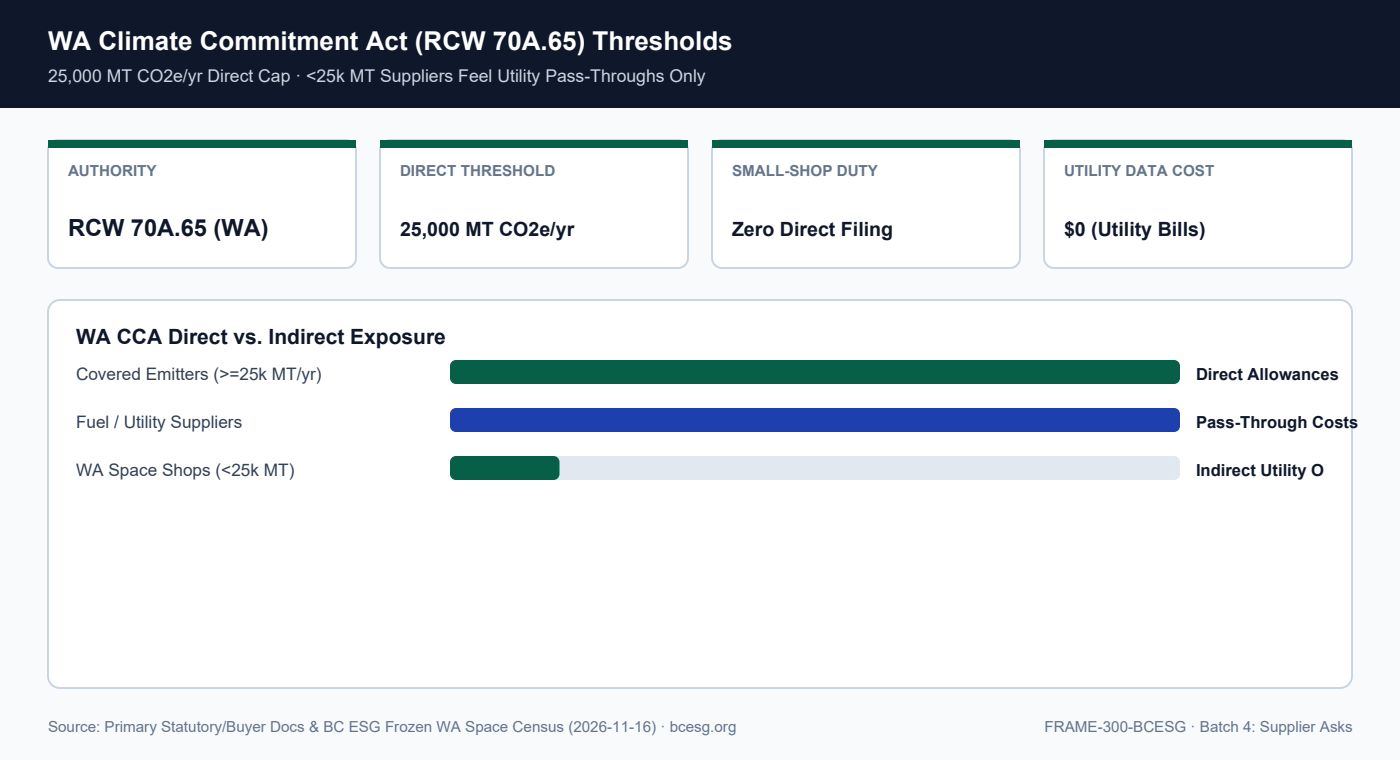
Sourced Baseline: Binding WA state law (RCW 70A.65) ONLY on covered entities emitting >=25,000 MT CO2e/year. Small/mid-sized WA space suppliers (<25k MT) have zero direct CCA allowance obligation, though they feel CCA indirectly via utility/fuel pass-throughs and customer energy-data asks.
TAKEAWAY BRIEF · PDF & MARKDOWN TWIN
WA CCA & Utility Data Requests
Download the formatted 2-page briefing sheet (PDF) or read the single-source Markdown twin for WA CCA & Utility Data Requests.
Who Issues This Ask, Authority, and Binding Status
Industrial landlords, utilities, and prime sustainability teams sometimes ask WA space manufacturers for facility natural gas and electricity totals citing Washington's Climate Commitment Act (CCA, RCW 70A.65).
Binding status:RCW 70A.65 is binding Washington State law—but only on facilities, fuel suppliers, and electric utilities emitting 25,000 metric tons CO2e or more per year. Small and mid-sized WA space machine shops and satellite integrators fall well below 25,000 MT CO2e/yr and have zero direct CCA reporting or allowance-auction duty.
Threshold
WA CCA Duty
Supplier Action
>= 25,000 MT CO2e/yr
Binding cap-and-invest allowances & reporting
Ecology GHG report + auction allowances
< 25,000 MT CO2e/yr (Typical WA Shop)
Zero direct CCA filing duty
Provide utility bills only if contractually asked
Evidence Required & Small-Supplier Effort Cost
If a prime requests energy data voluntarily, 12 months of Puget Sound Energy / Snohomish PUD / Seattle City Light kWh and natural gas therm totals suffice. No third-party CCA verification is required below 25,000 MT CO2e/yr ($0 state filing fee; admin hours not in our data).