Category: Space Cluster Compliance & Continuity

Supplier disclosure asks, regulatory timelines, freight/valley continuity, state policy, and orbital sustainability.

  • CMMC 2.0 (32 CFR Part 170) & DFARS 252.204-7021 Phased Rollout

    CMMC 2.0 (32 CFR Part 170) & DFARS 252.204-7021 Phased Rollout

    BC ESG · WA Space Cluster Supplier Asks (November 16, 2026)
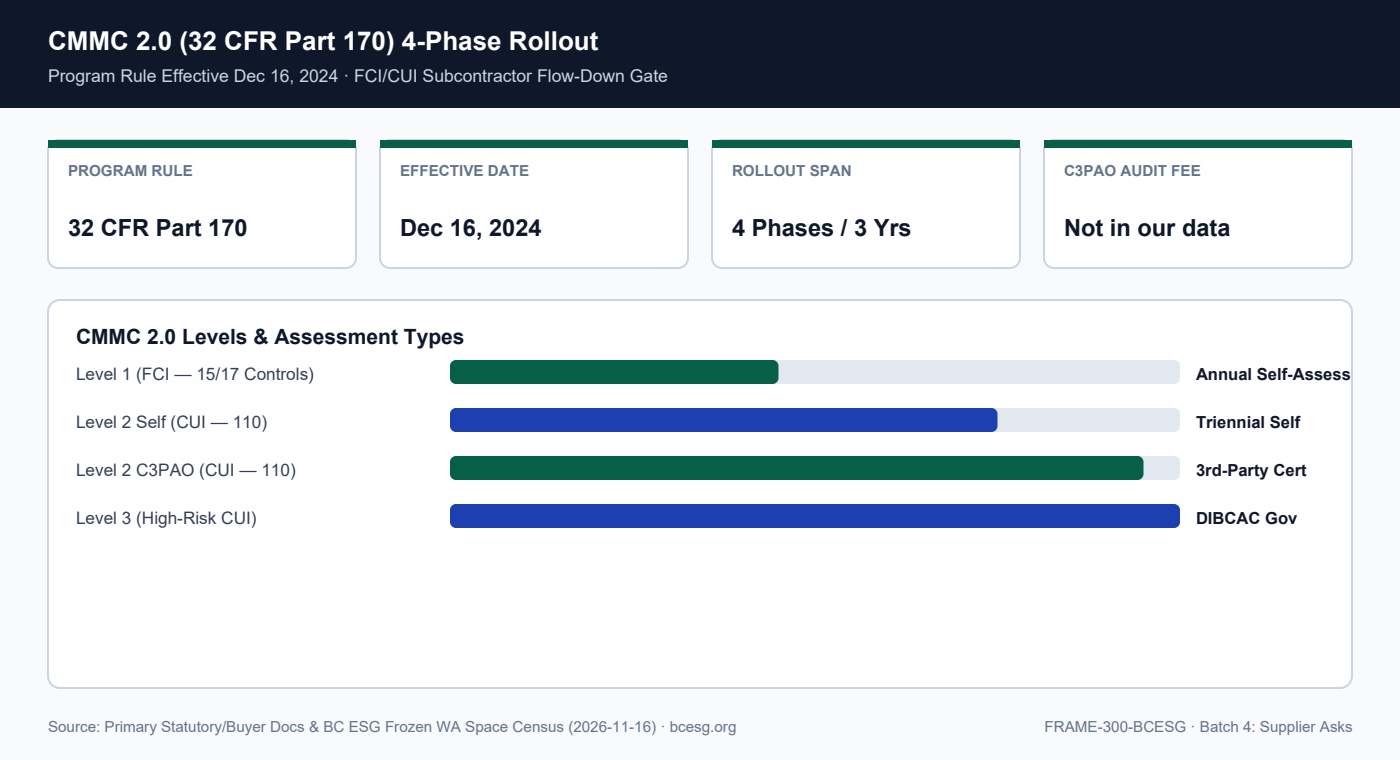
    Sourced Baseline: Binding DoD federal regulation (32 CFR Part 170, effective Dec 16, 2024; 89 FR 83092) operationalized via DFARS 252.204-7021 across a 3-year, 4-phase rollout. Flows down to subcontractors ONLY if they process, store, or transmit FCI or CUI.
    TAKEAWAY BRIEF · PDF & MARKDOWN TWIN
    CMMC 2.0 & DFARS 252.204-7021
    Download the formatted 2-page briefing sheet (PDF) or read the single-source Markdown twin for CMMC 2.0 & DFARS 252.204-7021.
    CMMC 2.0 (32 CFR Part 170) 4-Phase Rollout

    Who Issues This Ask, Authority, and Binding Status

    CMMC 2.0 readiness surveys and flow-downs are issued by DoD space primes under 32 CFR Part 170 (effective December 16, 2024; 89 FR 83092) and DFARS 252.204-7021.

    Binding status: 32 CFR Part 170 and DFARS 252.204-7021 are binding US federal regulations rolling out over four annual phases. Under 32 CFR § 170.23, primes must flow down CMMC requirements only to subcontractors that process, store, or transmit Federal Contract Information (FCI) or Controlled Unclassified Information (CUI) (excluding COTS).

    CMMC LevelData ScopeVerification Method
    Level 1FCI only (FAR 52.204-21)Annual self-assessment + affirmation in SPRS
    Level 2CUI (NIST SP 800-171)Triennial C3PAO certification (or self-assessment in Phase 1)
    Level 3High-value CUI (NIST SP 800-172)DIBCAC government-led assessment

    Evidence Required & Small-Supplier Effort Cost

    Depending on the solicitation phase and data sensitivity, suppliers post an annual Level 1 Self-Assessment, a triennial Level 2 Self-Assessment in SPRS, or obtain a triennial Level 2 C3PAO Certification (Phase 2+).

    C3PAO third-party assessment fees and enclave-architecture costs vary by scope and are not in our data.

    WA Space Cluster Segments & Companies Affected

    Lands directly on defense-space software, electronics, and build-to-print contractors in Software & Mission Services and Components & Suppliers.
    Related BC ESG Guides & Verified Primary Sources

  • DFARS 252.204-7012, NIST SP 800-171 & 72-Hour DIBNet Reporting

    DFARS 252.204-7012, NIST SP 800-171 & 72-Hour DIBNet Reporting

    BC ESG · WA Space Cluster Supplier Asks (November 16, 2026)
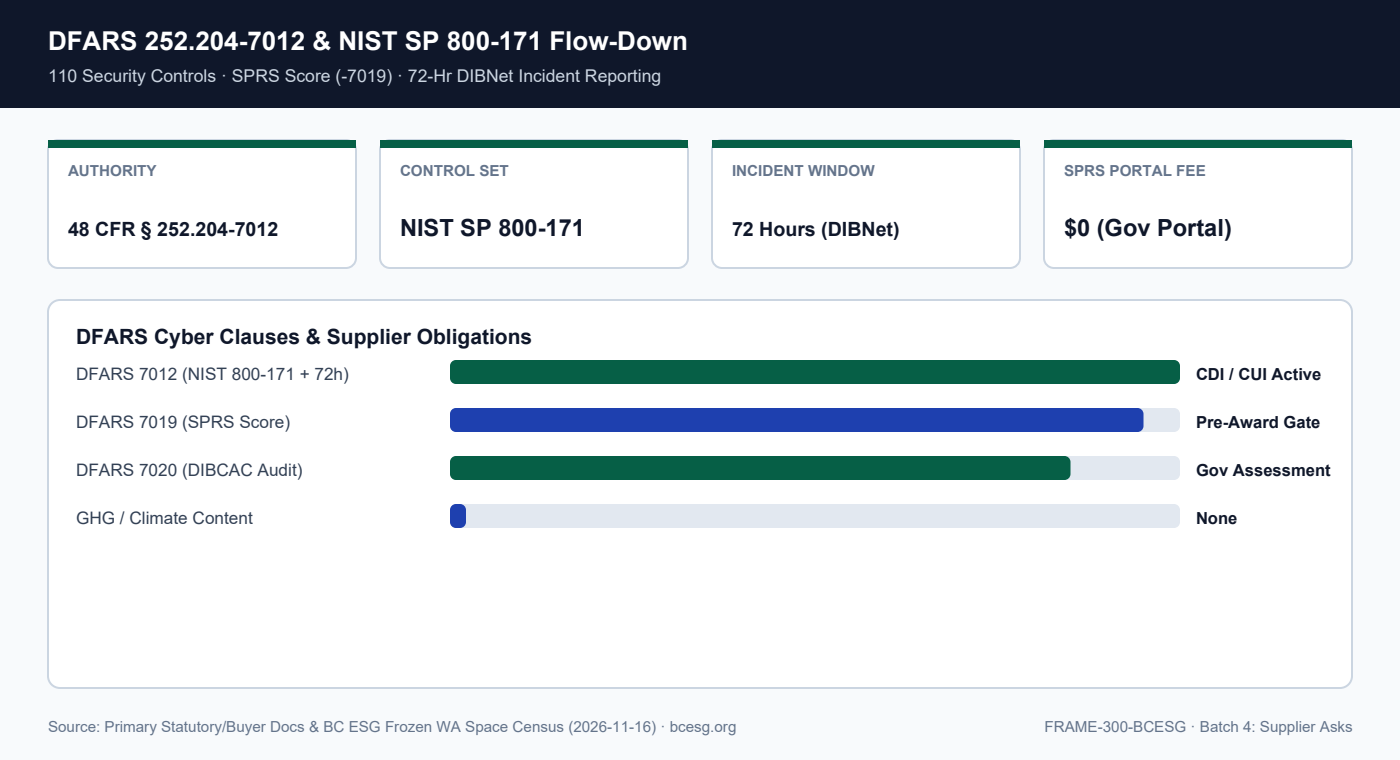
    Sourced Baseline: Binding DoD federal regulation (48 CFR §§ 252.204-7012, -7019, -7020). Requires subcontractors handling Covered Defense Information (CDI/CUI) to implement NIST SP 800-171's 110 controls, post a Basic Assessment score in SPRS, and report cyber incidents to DIBNet within 72 hours.
    TAKEAWAY BRIEF · PDF & MARKDOWN TWIN
    DFARS 7012 & NIST 800-171
    Download the formatted 2-page briefing sheet (PDF) or read the single-source Markdown twin for DFARS 7012 & NIST 800-171.
    DFARS 252.204-7012 & NIST SP 800-171 Flow-Down

    Who Issues This Ask, Authority, and Binding Status

    DFARS 252.204-7012, -7019, and -7020 flow down from every DoD space prime—including The Boeing Company, Aerojet Rocketdyne (L3Harris), ARKA (CACI), and national-security space integrators—whenever a subcontractor receives Covered Defense Information (CDI) / CUI.

    Binding status: 48 CFR §§ 252.204-7012, -7019, and -7020 are binding US federal regulations on DoD contracts and subcontracts involving CDI/CUI (excluding COTS-only orders).

    ClauseRequirementEvidence for Prime
    DFARS 252.204-7012NIST SP 800-171 + FedRAMP Mod cloud + 72h DIBNetSSP, POA&M, ECA medium-assurance cert
    DFARS 252.204-7019Current SPRS Basic Assessment score (<3 yrs)SPRS score confirmation screenshot/date
    DFARS 252.204-7020Allow DoD DIBCAC Medium/High assessmentFlow-down acceptance in subcontract

    Evidence Required & Small-Supplier Effort Cost

    Suppliers must maintain a System Security Plan (SSP) and Plan of Action & Milestones (POA&M) against NIST SP 800-171 (110 controls), submit a Basic Self-Assessment score (-203 to +110) into the DoD SPRS portal (per -7019), ensure cloud hosts meet FedRAMP Moderate equivalency, and preserve forensic logs for 72-hour DIBNet reporting.

    SPRS submission is free ($0); IT/GCC High migration and SSP consulting costs vary widely by shop size and are not in our data.

    WA Space Cluster Segments & Companies Affected

    Applies across Software & Mission Services (M42 Space Engineering, Integrate), Components & Suppliers, and In-Space Servicing.

    Related BC ESG Guides & Verified Primary Sources

  • EAR (15 CFR 730–774) & ECCN 9A515/9E515 Supplier Determinations

    EAR (15 CFR 730–774) & ECCN 9A515/9E515 Supplier Determinations

    BC ESG · WA Space Cluster Supplier Asks (November 16, 2026)
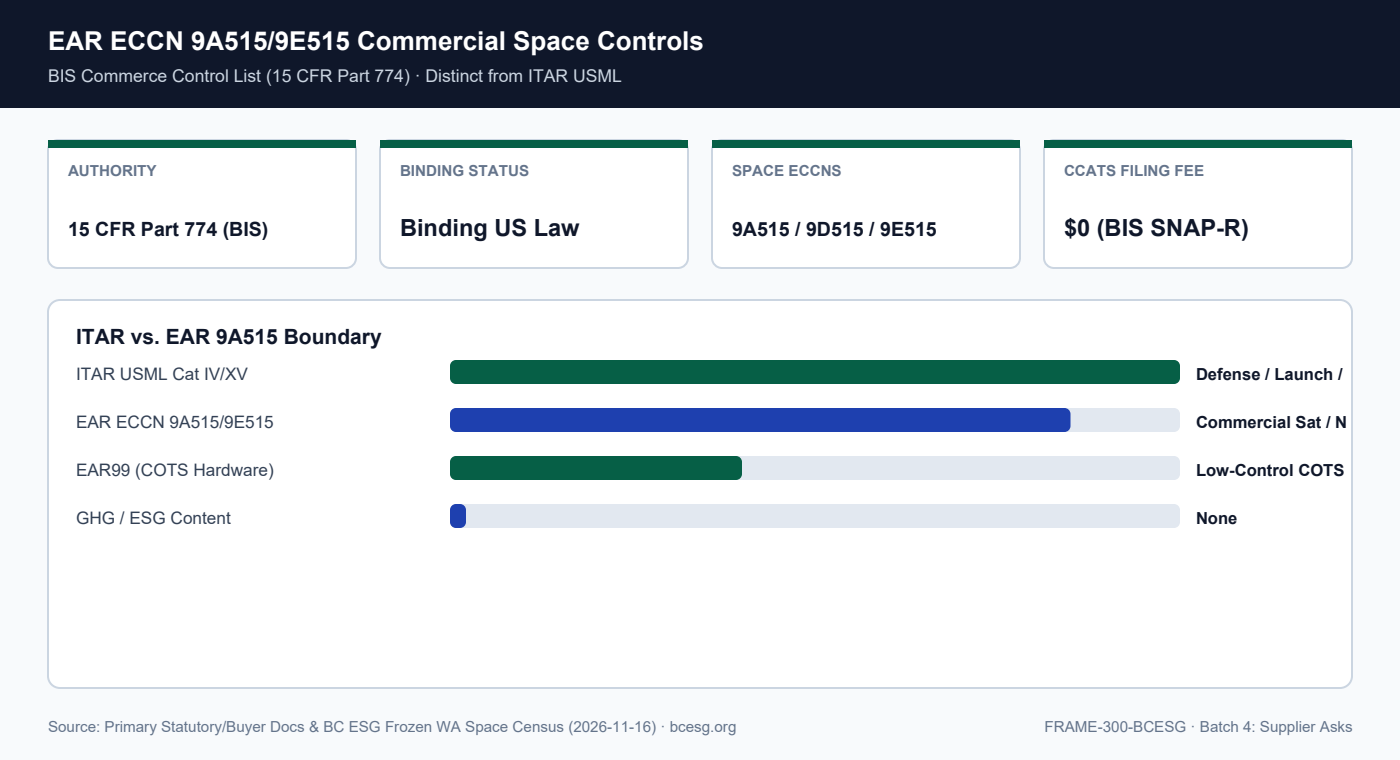
    Sourced Baseline: Binding US federal law (15 CFR Parts 730–774, Bureau of Industry and Security). Commercial spacecraft and related items (including Non-Earth Imaging / NDS carve-outs) fall under ECCN 9A515/9E515 rather than ITAR. Suppliers are asked for formal ECCN classifications on quotes and packing slips.
    TAKEAWAY BRIEF · PDF & MARKDOWN TWIN
    EAR 9A515 ECCN Determinations
    Download the formatted 2-page briefing sheet (PDF) or read the single-source Markdown twin for EAR 9A515 ECCN Determinations.
    EAR ECCN 9A515/9E515 Commercial Space Controls

    Who Issues This Ask, Authority, and Binding Status

    Commercial satellite and ground-system primes—such as Amazon Leo, SpaceX (Starlink), BlackSky, and Kymeta—routinely ask WA suppliers to state the Export Control Classification Number (ECCN) on quotes, POs, and commercial invoices.

    Binding status: The Export Administration Regulations (15 CFR Parts 730–774, BIS) are binding US federal law. Commercial spacecraft, ground-station hardware, and non-USML space components typically fall under ECCN 9A515 (hardware), 9D515 (software), or 9E515 (technology).

    ECCNScopeTypical WA Space Item
    9A515Commercial spacecraft & related commoditiesCommercial satellite buses, antennas, NDS hardware
    9D515 / 9E515Software & technology for 9A515 itemsFlight/ground telemetry SW, CAD/build packages
    EAR99Low-tech commercial off-the-shelf itemsStandard brackets, unspecialized shop supplies

    Evidence Required & Small-Supplier Effort Cost

    Suppliers provide a written Export Classification Statement (ECCN or EAR99 determination) backed by Order of Review analysis against 15 CFR Part 774—or a BIS CCATS (Commodity Classification Automated Tracking System) ruling if classification is ambiguous.

    BIS does not charge a filing fee for CCATS submissions in SNAP-R; outside trade-counsel review costs are not in our data.

    WA Space Cluster Segments & Companies Affected

    Affects commercial hardware and software vendors in Satellite Manufacturing, Ground Systems & SATCOM, and In-Space Servicing (e.g., NASA Docking System 9A515.a.4 carve-outs).

    Related BC ESG Guides & Verified Primary Sources

    Underlying Rule Status & Deciding Instruments (Batch 5)

  • ITAR (22 CFR 120–130) & USML Category IV/XV Supplier Flow-Downs

    ITAR (22 CFR 120–130) & USML Category IV/XV Supplier Flow-Downs

    BC ESG · WA Space Cluster Supplier Asks (November 16, 2026)
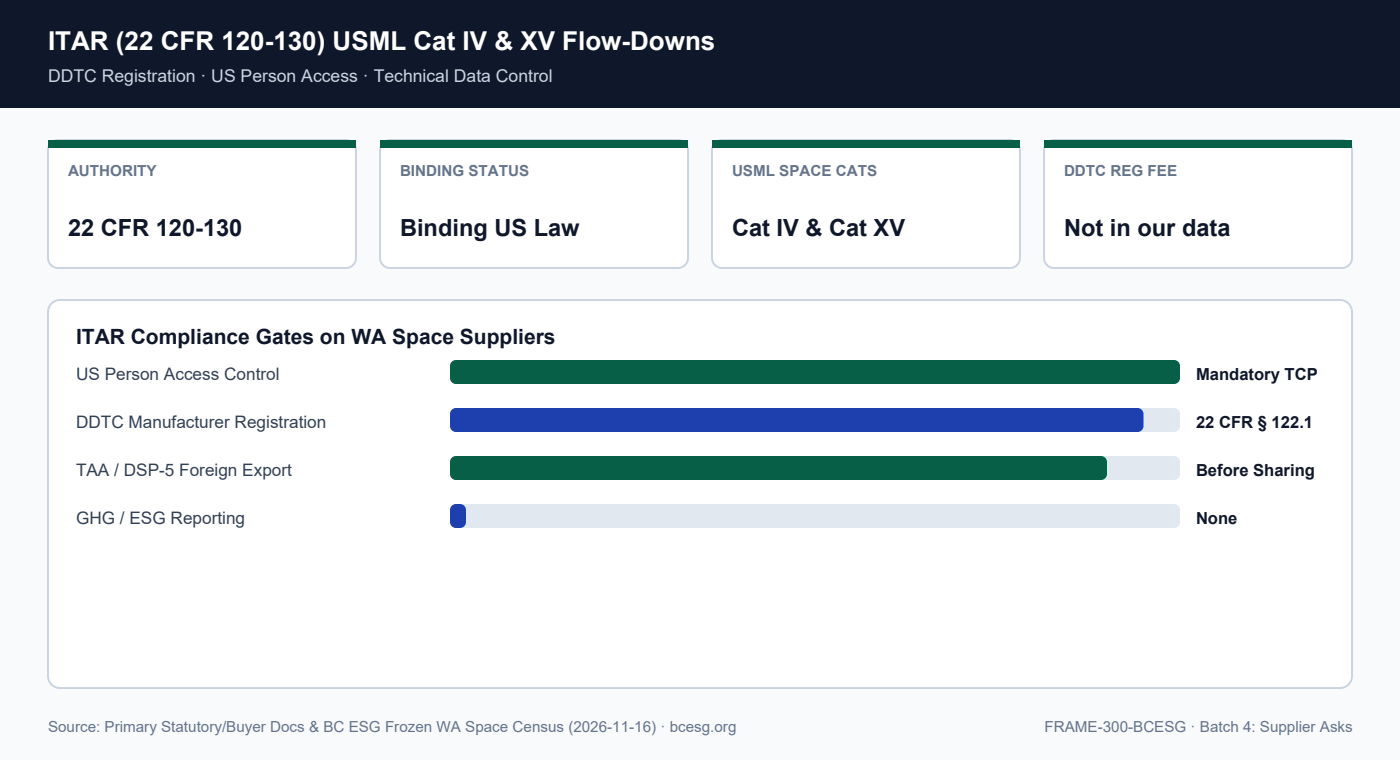
    Sourced Baseline: Binding US federal law (22 CFR Parts 120–130, DDTC). Governs launch vehicles (USML Cat IV) and spacecraft/servicing (USML Cat XV). Requires DDTC registration for manufacturers/exporters, strict US Person access controls, and export licenses for foreign persons.
    TAKEAWAY BRIEF · PDF & MARKDOWN TWIN
    ITAR (22 CFR 120-130) Flow-Downs
    Download the formatted 2-page briefing sheet (PDF) or read the single-source Markdown twin for ITAR (22 CFR 120-130) Flow-Downs.
    ITAR (22 CFR 120-130) USML Cat IV & XV Flow-Downs

    Who Issues This Ask, Authority, and Binding Status

    ITAR compliance letters and technical-data flow-downs are issued by every WA launch, propulsion, and defense-space prime—including Blue Origin, SpaceX, Stoke Space, Aerojet Rocketdyne, and Starfish Space.

    Binding status: ITAR (22 CFR Parts 120–130, Directorate of Defense Trade Controls) is binding US federal law regardless of contract size. Any US manufacturer of USML Category IV (launch/propulsion) or Category XV (spacecraft/RPO servicing) defense articles must register with DDTC (22 CFR § 122.1) even if it never exports.

    ITAR RequirementCFR CitationSupplier Proof
    Manufacturer Registration22 CFR § 122.1Active DDTC Registration Letter
    US Person Access Control22 CFR § 120.62Written Technology Control Plan (TCP) + I-9/citizenship check
    Cloud / Email Storage22 CFR § 120.54FIPS 140-2/3 end-to-end encryption (US servers)

    Evidence Required & Small-Supplier Effort Cost

    Primes require a signed ITAR / US Person Compliance Representation, proof of active DDTC registration (if manufacturing defense articles), a Technology Control Plan (TCP), and badge/network segregation preventing foreign-person access to ITAR CAD/drawings.

    Current DDTC registration tier fees and outside export-counsel costs are not in our data.

    WA Space Cluster Segments & Companies Affected

    Applies across Launch, Propulsion, In-Space Servicing, and Software & Mission Services (M42 Space Engineering).

    Related BC ESG Guides & Verified Primary Sources

    Underlying Rule Status & Deciding Instruments (Batch 5)

  • NASA-STD-8739 Workmanship, Soldering & Harnessing Flow-Downs

    NASA-STD-8739 Workmanship, Soldering & Harnessing Flow-Downs

    BC ESG · WA Space Cluster Supplier Asks (November 16, 2026)
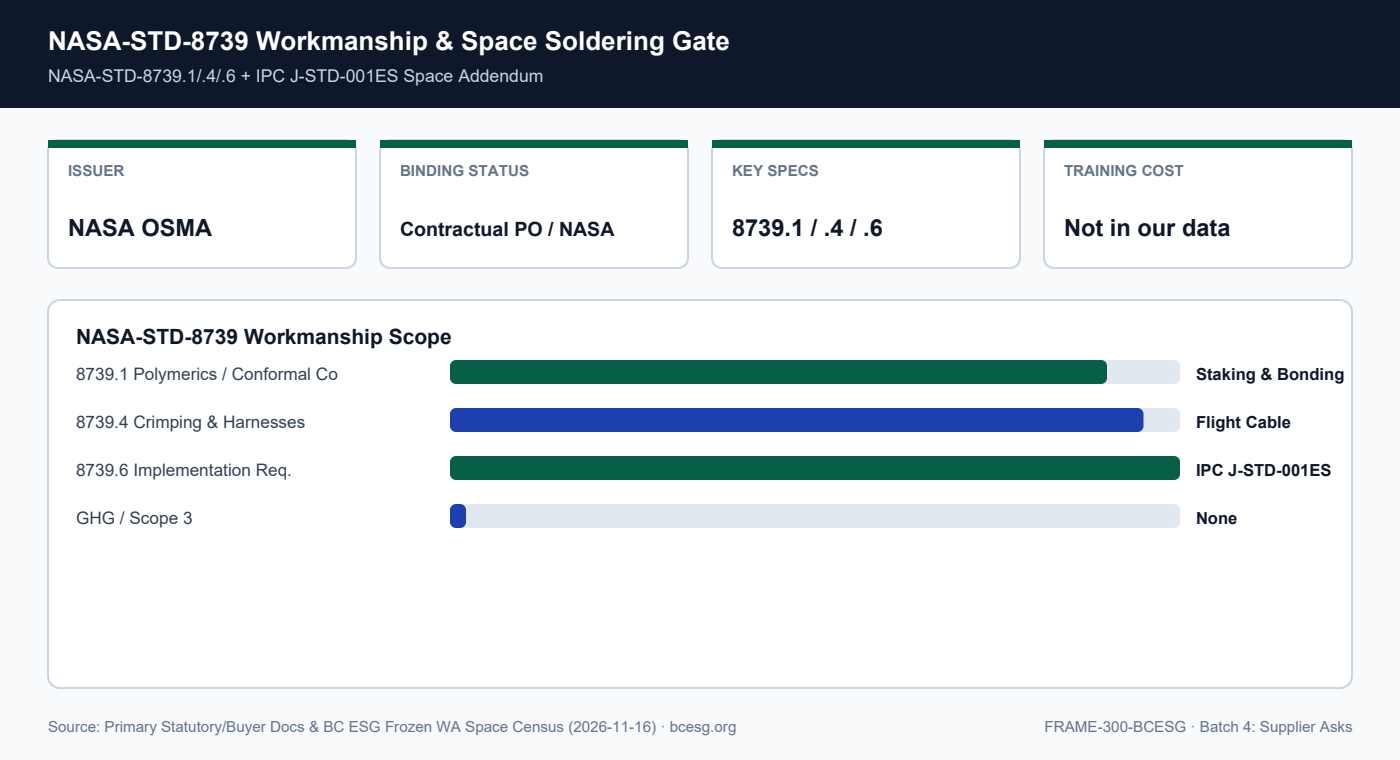
    Sourced Baseline: Published by NASA Office of Safety and Mission Assurance (standards.nasa.gov). Binding on NASA prime contracts and subcontracts when invoked by PO or drawing; frequently paired with IPC J-STD-001 Space Addendum for flight avionics and harnesses.
    TAKEAWAY BRIEF · PDF & MARKDOWN TWIN
    NASA-STD-8739 Workmanship
    Download the formatted 2-page briefing sheet (PDF) or read the single-source Markdown twin for NASA-STD-8739 Workmanship.
    NASA-STD-8739 Workmanship & Space Soldering Gate

    Who Issues This Ask, Authority, and Binding Status

    NASA-STD-8739 requirements flow down from NASA centers and commercial/lunar primes (e.g., Blue Origin HLS, Aerojet Rocketdyne, Gravitics, Starfish Space) on flight avionics, cable harnesses, and conformal-coated assemblies.

    Binding status: NASA technical standards are binding when incorporated into a NASA prime contract and flowed down via PO or engineering drawing.

    StandardScopeRequired Supplier Proof
    NASA-STD-8739.6Implementation requirements (adopts IPC J-STD-001ES)Current IPC J-STD-001 Space Addendum certs
    NASA-STD-8739.4Crimping, interconnecting cables, harnessesTrained operator/inspector logs + pull-test records
    NASA-STD-8739.1Polymeric application (conformal coat, staking)Material shelf-life + cure/thickness logs

    Evidence Required & Small-Supplier Effort Cost

    Suppliers provide active operator and inspector certifications (IPC J-STD-001 with Space Addendum ES per NASA-STD-8739.6, plus NASA-STD-8739.1/.4 training records where specified), calibrated crimp/torque tool logs, and lot inspection records.

    Certification training course fees are not in our data.

    WA Space Cluster Segments & Companies Affected

    Affects avionics, harness, and power-electronics suppliers in Components & Suppliers (Xanfab, Crane Aerospace & Electronics) and In-Space Servicing.

    Related BC ESG Guides & Verified Primary Sources

  • DFARS 252.225-7009 Specialty Metals & Domestic Melt Compliance

    DFARS 252.225-7009 Specialty Metals & Domestic Melt Compliance

    BC ESG · WA Space Cluster Supplier Asks (November 16, 2026)
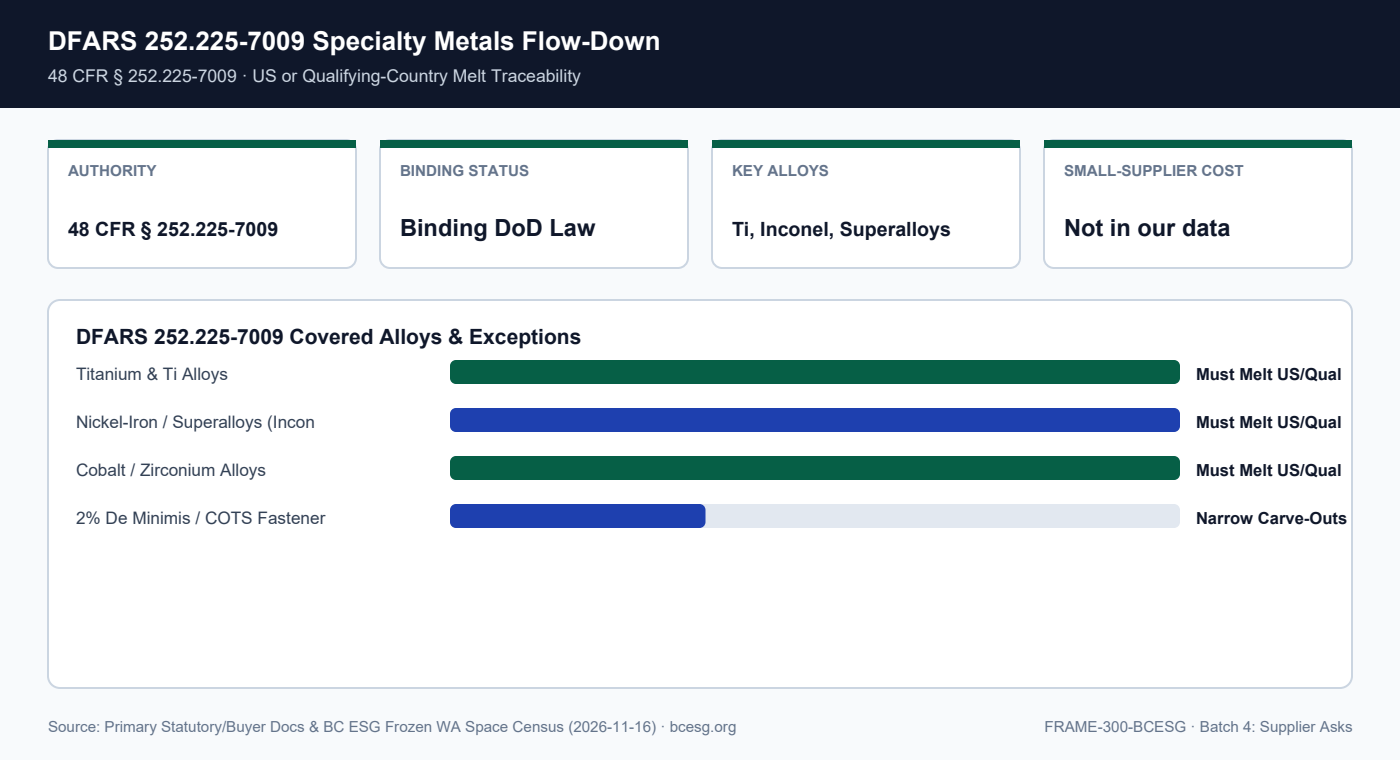
    Sourced Baseline: Binding DoD federal regulation (48 CFR § 252.225-7009; 10 U.S.C. § 4863). Requires titanium, Inconel, superalloys, and specialty steels in defense/space hardware to be melted or produced in the US or a qualifying country, with full mill-to-part traceability.
    TAKEAWAY BRIEF · PDF & MARKDOWN TWIN
    DFARS 252.225-7009 Specialty Metals
    Download the formatted 2-page briefing sheet (PDF) or read the single-source Markdown twin for DFARS 252.225-7009 Specialty Metals.
    DFARS 252.225-7009 Specialty Metals Flow-Down

    Who Issues This Ask, Authority, and Binding Status

    Every DoD prime and Tier-1 integrator flows down DFARS 252.225-7009 (Restriction on Acquisition of Certain Articles Containing Specialty Metals) on propulsion, structural, and fastener subcontracts.

    Binding status: 48 CFR § 252.225-7009 is binding US federal law implementing 10 U.S.C. § 4863. Any specialty metal (titanium, nickel-iron/Inconel superalloys, cobalt alloys, specialty steels) delivered under a covered DoD contract must be melted in the United States, its outlying areas, or a qualifying country (per DFARS 225.872-1), unless a narrow statutory exception applies (e.g., COTS fasteners, 2% de minimis non-high-performance electronics).

    Alloy FamilyDFARS 252.225-7009 RuleRequired Shop Record
    Titanium & Ti-6Al-4VMelted in US or qualifying countryMill Test Report (MTR) showing country of melt
    Inconel / Nickel SuperalloysMelted in US or qualifying countryHeat-lot traceable MTR + CoC
    COTS Fasteners / 2% De MinimisNarrow statutory exceptions applyDocumented exception basis on PO file

    Evidence Required & Small-Supplier Effort Cost

    Suppliers satisfy the clause by maintaining original Mill Test Reports (MTRs) showing heat number and country of melt, flowing the clause down to all sub-tier bar/forging vendors, and issuing a signed DFARS 252.225-7009 Certificate of Compliance with each shipment.

    Material price premiums for domestic/qualifying-country melt vs. non-compliant stock vary by alloy market conditions and are not in our data.

    WA Space Cluster Segments & Companies Affected

    Directly impacts WA hard-metal and propulsion fabricators in Components & Suppliers (Space Valves, Karman Space & Defense) and Adjacent Aerospace (Exotic Metals Forming, Tessera, Orion Industries).

    Related BC ESG Guides & Verified Primary Sources

  • SAE AS5553 & DFARS 252.246-7007/7008 Counterfeit Electronic Parts

    SAE AS5553 & DFARS 252.246-7007/7008 Counterfeit Electronic Parts

    BC ESG · WA Space Cluster Supplier Asks (November 16, 2026)
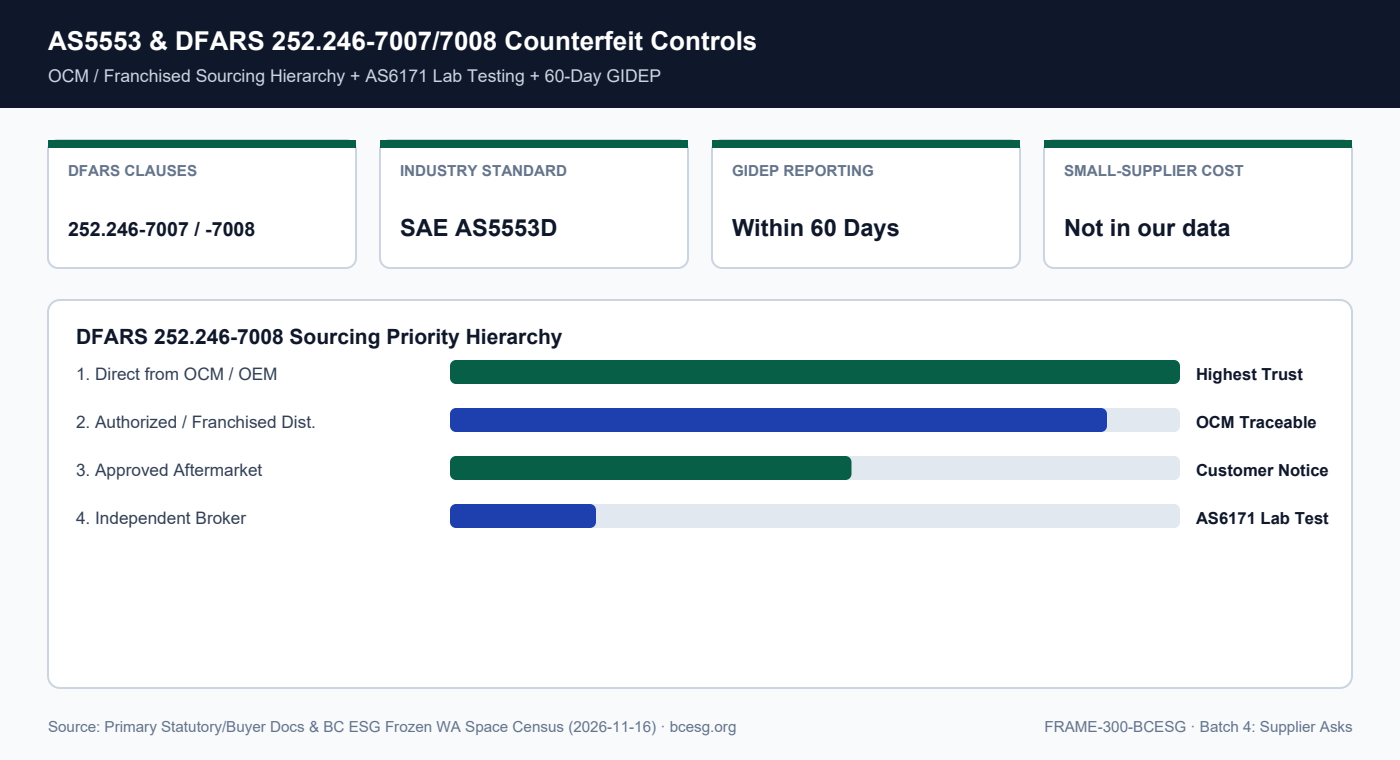
    Sourced Baseline: Binding DoD federal regulation (48 CFR §§ 252.246-7007 & 252.246-7008) paired with SAE AS5553D. Mandates OCM/authorized-distributor sourcing, counterfeit avoidance plans, AS6171 testing for non-authorized parts, and 60-day GIDEP reporting.
    TAKEAWAY BRIEF · PDF & MARKDOWN TWIN
    AS5553 & DFARS Counterfeit Parts
    Download the formatted 2-page briefing sheet (PDF) or read the single-source Markdown twin for AS5553 & DFARS Counterfeit Parts.
    AS5553 & DFARS 252.246-7007/7008 Counterfeit Controls

    Who Issues This Ask, Authority, and Binding Status

    Counterfeit-parts flow-downs arrive from DoD and national-security space primes under DFARS 252.246-7007 (Contractor Counterfeit Electronic Part Detection and Avoidance System) and DFARS 252.246-7008 (Sources of Electronic Parts), alongside commercial/space primes invoking SAE AS5553D.

    Binding status: DFARS 252.246-7007 and 252.246-7008 are binding US federal regulations (48 CFR Part 252) on covered DoD contracts and flow down to all subcontractors supplying electronic parts or assemblies. SAE AS5553D is a commercial standard used to operationalize compliance.

    Control ElementAuthorityRequired Supplier Artifact
    Avoidance SystemDFARS 252.246-7007 / AS5553DWritten Counterfeit Control Plan + staff training
    Authorized SourcingDFARS 252.246-7008OCM / franchised distributor CoC & lot traceability
    Broker / Obsolete PartsDFARS 252.246-7008Written customer notice + SAE AS6171 lab test report
    Suspect Part ReportingDFARS 252.246-7007Quarantine log + GIDEP report within 60 days

    Evidence Required & Small-Supplier Effort Cost

    Suppliers must maintain a written Counterfeit Control Plan, enforce an Approved Supplier List (ASL) prioritizing OCMs and franchised distributors, retain OCM Certificates of Conformance and chain-of-custody records (typically 10+ years), quarantine suspect parts, and report confirmed/suspect counterfeits to GIDEP and the contracting officer within 60 days.

    Open-market broker buys require customer notification and SAE AS6171 authentication testing. Exact testing/lab fees are not in our data.

    WA Space Cluster Segments & Companies Affected

    Lands directly on WA electronics, RF, and avionics suppliers in Components & Suppliers (Xanfab, Crane Aerospace & Electronics, Honeywell Aerospace, The Radiation Team) and Satellite Manufacturing.

    Related BC ESG Guides & Verified Primary Sources

  • Nadcap Special Process Accreditation (Welding, NDT, Composites, Heat Treat)

    Nadcap Special Process Accreditation (Welding, NDT, Composites, Heat Treat)

    BC ESG · WA Space Cluster Supplier Asks (November 16, 2026)
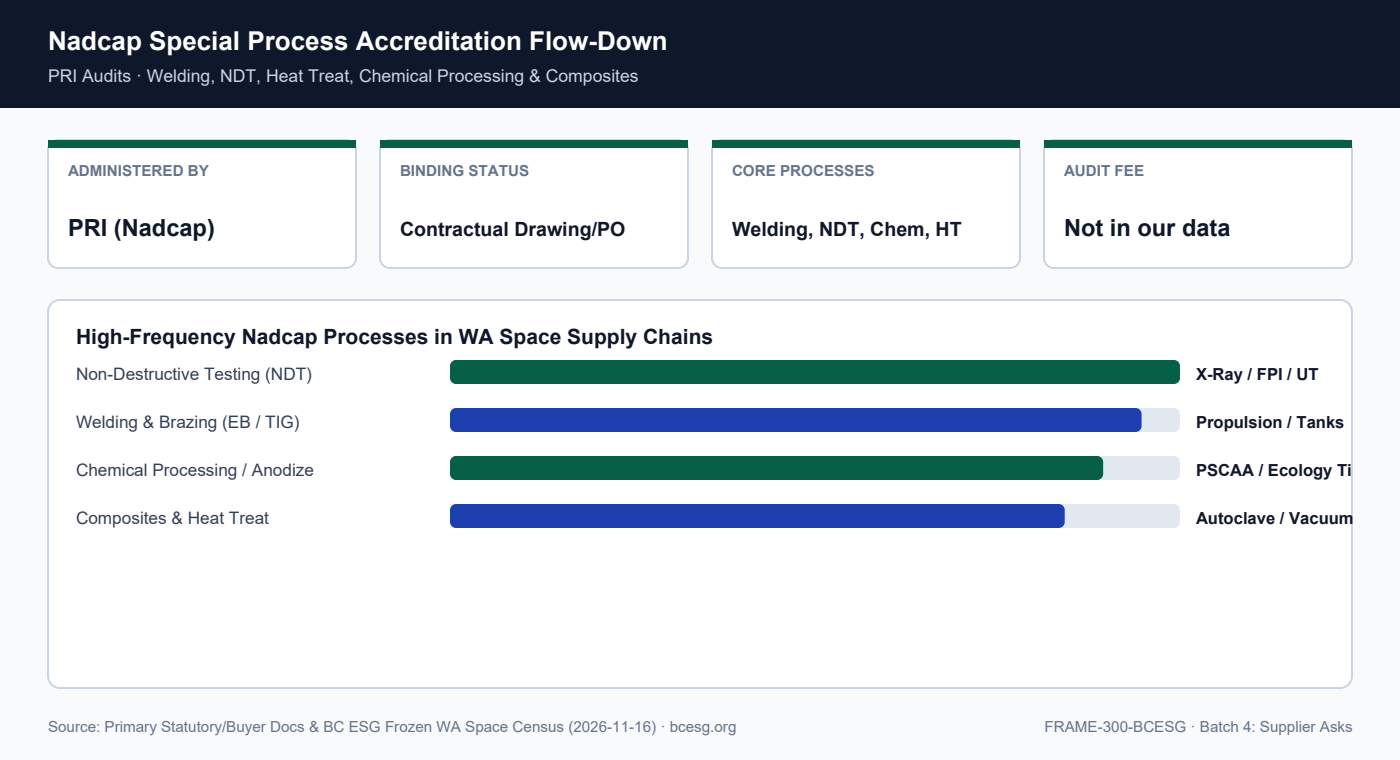
    Sourced Baseline: Administered by the Performance Review Institute (PRI). Industry-managed accreditation (not a statute) that becomes contractually binding whenever prime drawings or POs mandate Nadcap-accredited welding, NDT, chemical processing, heat treating, or composites.
    TAKEAWAY BRIEF · PDF & MARKDOWN TWIN
    Nadcap Special Process Gate
    Download the formatted 2-page briefing sheet (PDF) or read the single-source Markdown twin for Nadcap Special Process Gate.
    Nadcap Special Process Accreditation Flow-Down

    Who Issues This Ask, Authority, and Binding Status

    Nadcap accreditation is mandated by aerospace primes—including The Boeing Company, Aerojet Rocketdyne (L3Harris), and Tier-1 propulsion/launch integrators—whenever special processes cannot be fully verified by post-process inspection alone.

    Administered by the Performance Review Institute (PRI), Nadcap is a voluntary industry-cooperative program that is contractually binding when invoked by engineering drawings or Approved Supplier List rules.

    Special ProcessTypical WA Space UseOption for Small Machine Shops
    Welding / BrazingPropellant lines, thrust chambers, cryogenic valvesMaintain Nadcap or sub-tier to accredited shop
    NDT (FPI, X-Ray, UT)Structural castings, welds, composite bondlinesOutsource to Puget Sound Nadcap NDT house
    Chemical ProcessingPassivation, anodize, chromate conversionOutsource; triggers WA Ecology / PSCAA permits

    Evidence Required & Small-Supplier Effort Cost

    Suppliers provide an active PRI eAuditNet Nadcap Certificate for the exact process scope (e.g., NDT AC7114, Welding AC7110, Chemical Processing AC7108, Composites AC7118) or subcontract special processes exclusively to a prime-approved Nadcap processor and attach their Certificate of Conformance to AS9102 Form 2.

    PRI audit fees and remediation costs depend on process count and audit days and are not in our data.

    WA Space Cluster Segments & Companies Affected

    Critical across Components & Suppliers (Janicki Industries, Karman Space & Defense, Space Valves), Propulsion, and Launch.

    Related BC ESG Guides & Verified Primary Sources

  • AS9102 First Article Inspection (FAI) Packages for WA Space Shops

    AS9102 First Article Inspection (FAI) Packages for WA Space Shops

    BC ESG · WA Space Cluster Supplier Asks (November 16, 2026)
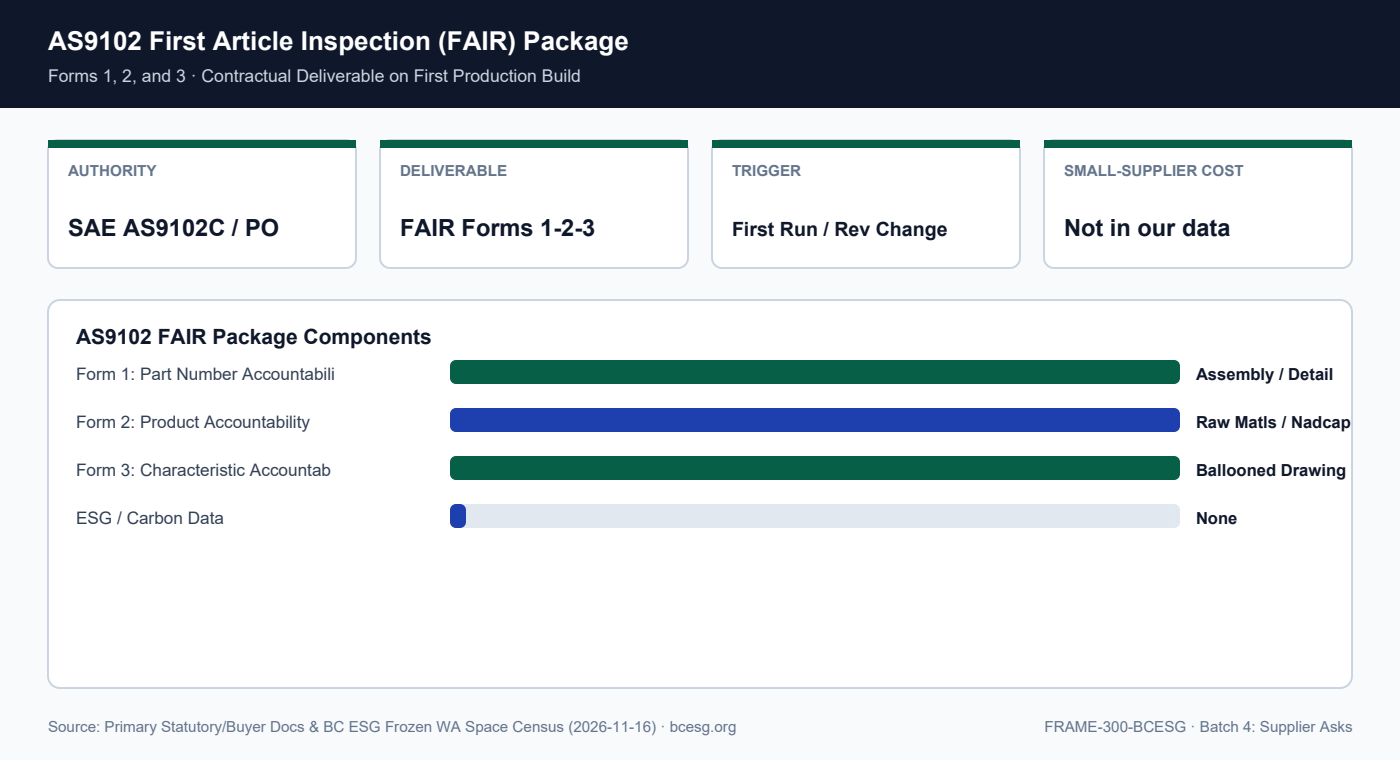
    Sourced Baseline: Issued by space primes and Tier-1s under SAE AS9102 (current revision AS9102C). Voluntary industry standard that becomes contractually binding on first production runs, design changes, or source transfers.
    TAKEAWAY BRIEF · PDF & MARKDOWN TWIN
    AS9102 First Article Inspection
    Download the formatted 2-page briefing sheet (PDF) or read the single-source Markdown twin for AS9102 First Article Inspection.
    AS9102 First Article Inspection (FAIR) Package

    Who Issues This Ask, Authority, and Binding Status

    AS9102 First Article Inspection (FAI) asks are issued by every launch, satellite, and propulsion prime (Blue Origin, SpaceX, Stoke Space, The Boeing Company) on new part numbers, engineering revisions, or facility moves.

    SAE AS9102C is an industry standard, not a statute; it is contractually binding when invoked by the buyer's PO or AS9100D Clause 8.5.1.3.

    FAIR FormRequired EvidenceCommon Audit Failure
    Form 1Part/drawing rev, serial number, sub-tier FAIR IDsMismatched drawing revision
    Form 2Alloy heat/lot certs, Nadcap special-process CoCsMissing DFARS specialty-metal melt origin
    Form 3100% ballooned print dimensions & actual CMM valuesUnverified GD&T datums or missing notes

    Evidence Required & Small-Supplier Effort Cost

    Suppliers submit a complete First Article Inspection Report (FAIR)—typically via Net-Inspect or PDF—comprising Form 1 (Part Number Accountability), Form 2 (Product Accountability: raw material certs, special process CoCs, functional tests), and Form 3 (Characteristic Accountability keyed to a ballooned engineering drawing).

    Internal CMM/inspection and Net-Inspect hours per part are not in our data.

    WA Space Cluster Segments & Companies Affected

    Affects all build-to-print machine shops and composite fabricators in Components & Suppliers (Space Valves, Janicki Industries) and Adjacent Aerospace (Tessera, Orion Industries).

    Related BC ESG Guides & Verified Primary Sources

  • AS9100D Quality Management System & IA9100 Transition for WA Suppliers

    AS9100D Quality Management System & IA9100 Transition for WA Suppliers

    BC ESG · WA Space Cluster Supplier Asks (November 16, 2026)
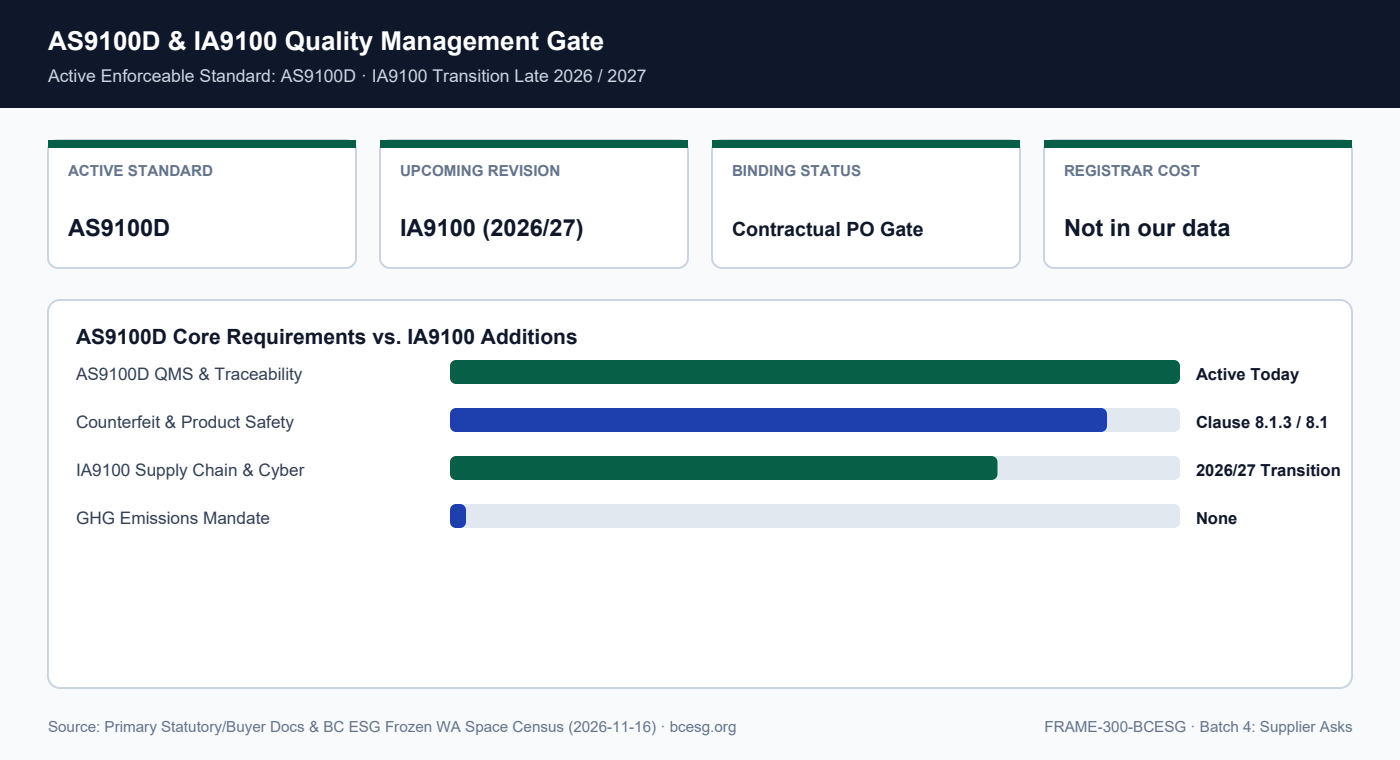
    Sourced Baseline: Published by IAQG/SAE (AS9100D). Not a statute, but contractually binding across almost all WA space primes and Tier-1s. AS9100D remains the active enforceable standard today; IA9100 (tied to ISO 9001:2026) is targeted for late 2026 / early 2027 with a multi-year transition window.
    TAKEAWAY BRIEF · PDF & MARKDOWN TWIN
    AS9100D & IA9100 Quality Gate
    Download the formatted 2-page briefing sheet (PDF) or read the single-source Markdown twin for AS9100D & IA9100 Quality Gate.
    AS9100D & IA9100 Quality Management Gate

    Who Issues This Ask, Authority, and Binding Status

    AS9100D certification is demanded by virtually every WA space prime—including Blue Origin, SpaceX, Stoke Space, The Boeing Company, and Aerojet Rocketdyne—via Supplier Quality Requirements (SQR) manuals and Purchase Orders.

    AS9100D is an industry standard maintained by the International Aerospace Quality Group (IAQG) and SAE International, not a government regulation; it is contractually binding as a hard gate to Approved Supplier List (ASL) onboarding. AS9100D remains the active, enforceable standard today. IAQG is rebranding the next revision to IA9100 (aligned with ISO 9001:2026, expected late 2026 / early 2027) with a formal multi-year transition period.

    StandardStatus (Nov 2026)Supplier Action
    AS9100DActive & enforceable todayMaintain OASIS-listed certification & surveillance audits
    IA9100 (ISO 9001:2026)Expected late 2026 / early 2027Monitor IAQG; plan during 2-3 yr transition window
    AS9120B (Distributors)Active for aerospace stockistsRequired for hardware/electronics distributors

    Evidence Required & Small-Supplier Effort Cost

    Suppliers satisfy the ask by presenting an active AS9100D certificate listed in the IAQG OASIS database from an accredited Certification Body (or passing a prime's second-party quality audit if grandfathered for prototype/R&D work).

    Registrar audit fees and QMS consulting costs vary by headcount and scope and are not in our data.

    WA Space Cluster Segments & Companies Affected

    AS9100D is the baseline gate across Components & Suppliers (Space Valves, Janicki Industries, Electroimpact, Xanfab, PacAero) and Launch.

    Related BC ESG Guides & Verified Primary Sources

  • ISO 14001 Environmental Management System (EMS) Supplier Asks

    ISO 14001 Environmental Management System (EMS) Supplier Asks

    BC ESG · WA Space Cluster Supplier Asks (November 16, 2026)
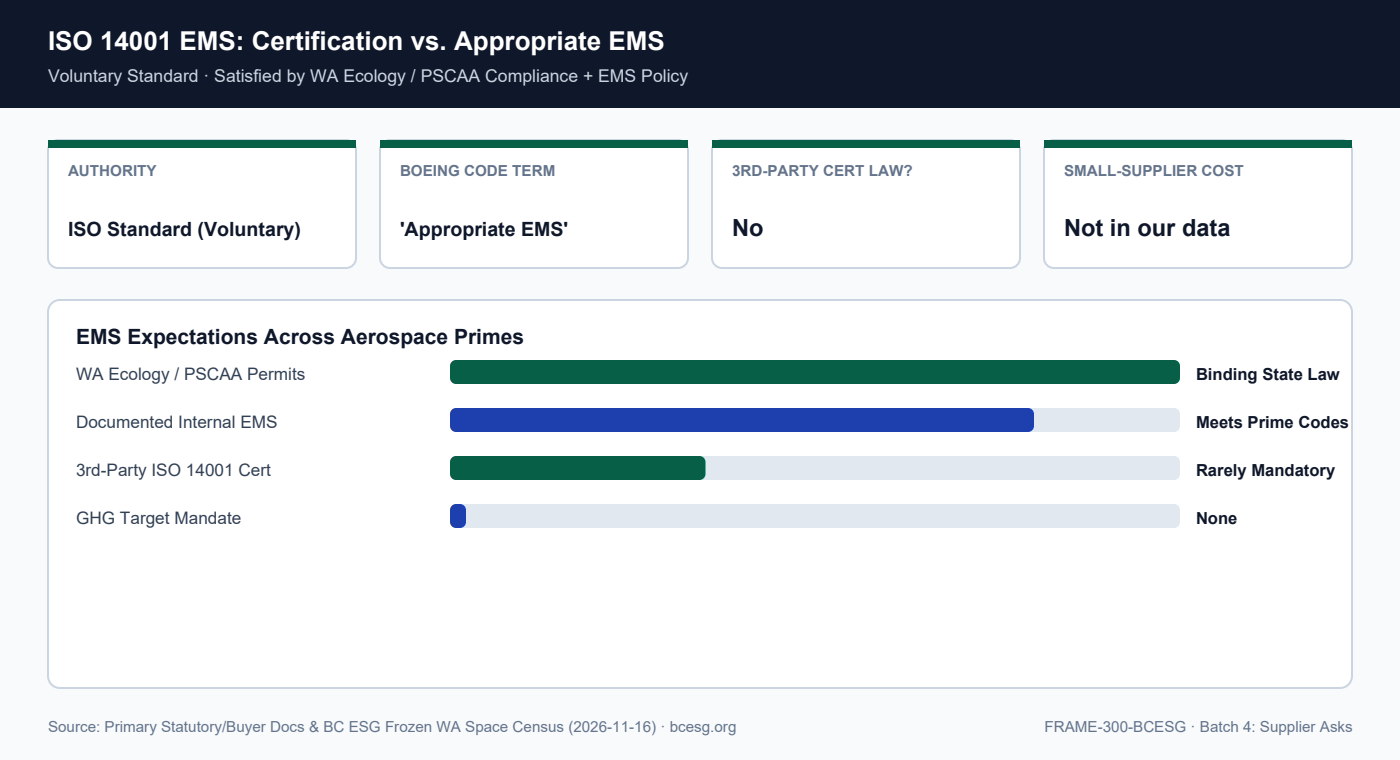
    Sourced Baseline: ISO 14001 is a voluntary international EMS standard. Some primes (e.g., Boeing's Supplier Code of Conduct) expect an 'appropriate EMS' aligned with pollution prevention, while few require third-party ISO 14001 registration from small WA machine shops.
    TAKEAWAY BRIEF · PDF & MARKDOWN TWIN
    ISO 14001 EMS Expectations
    Download the formatted 2-page briefing sheet (PDF) or read the single-source Markdown twin for ISO 14001 EMS Expectations.
    ISO 14001 EMS: Certification vs. Appropriate EMS

    Who Issues This Ask, Authority, and Binding Status

    Vendor onboarding questionnaires from primes like The Boeing Company ask whether a supplier maintains an ISO 14001 certification or an Environmental Management System (EMS).

    ISO 14001 is a voluntary international standard, not a law. Boeing's Supplier Code of Conduct expects suppliers to maintain an 'appropriate EMS' for safety and pollution prevention, but does not universally require third-party ISO 14001 registration for small sub-tier shops unless explicitly written into a specific Purchase Order.

    EMS TierBinding?What Satisfies Prime Questionnaires
    WA Ecology / PSCAA PermitsBinding WA LawActive waste ID, air NOCOA, ISGP stormwater SWPPP
    Internal EMS PolicyBuyer-expected (Boeing Code)Written EHS policy + annual aspect/spill review
    3rd-Party ISO 14001 CertVoluntary unless in POAccredited registrar certificate

    Evidence Required & Small-Supplier Effort Cost

    If third-party certified, upload the ISO 14001 certificate. If uncertified, most primes accept a documented internal EMS binder combining your WA Ecology Dangerous Waste (WAC 173-303), PSCAA air permit, stormwater ISGP, and spill-prevention procedures.

    Third-party registrar audit fees for ISO 14001 are not in our data.

    WA Space Cluster Segments & Companies Affected

    Relevant to chemical-using and manufacturing shops in Propulsion and Components & Suppliers (Aerojet Rocketdyne, Janicki Industries, Karman Space & Defense).

    Related BC ESG Guides & Verified Primary Sources

  • Customer Scope 3 & Product Carbon Footprint (PCF) Asks for WA Suppliers

    Customer Scope 3 & Product Carbon Footprint (PCF) Asks for WA Suppliers

    BC ESG · WA Space Cluster Supplier Asks (November 16, 2026)
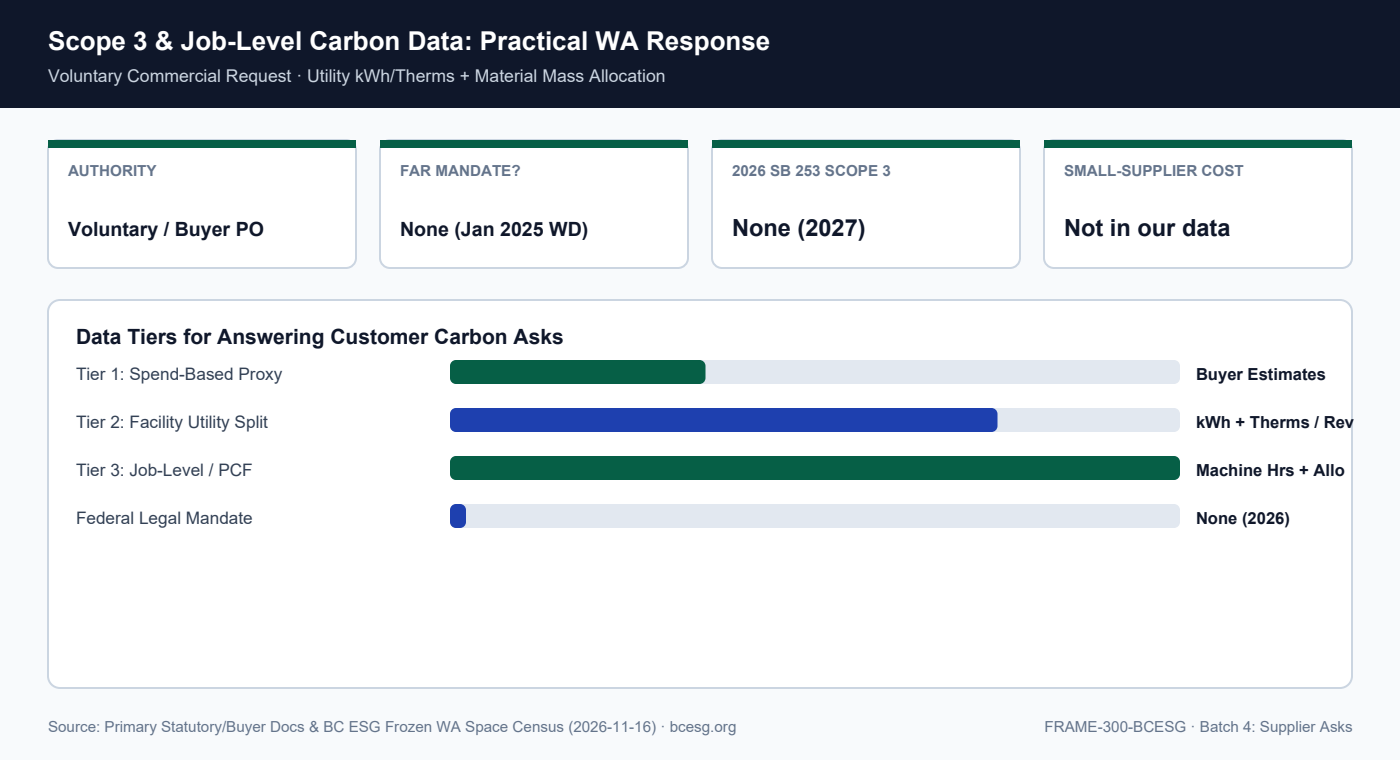
    Sourced Baseline: Voluntary/commercial customer requests for Scope 3 or Product Carbon Footprint (PCF) data. Zero federal FAR mandate (FAR Case 2021-015 withdrawn Jan 2025) and zero 2026 CA SB 253 Scope 3 mandate. Adapts BC ESG's Vendor Carbon Report framework (Post #920, Pages #144-#145) to WA space suppliers.
    TAKEAWAY BRIEF · PDF & MARKDOWN TWIN
    Scope 3 & Job-Level Carbon Data
    Download the formatted 2-page briefing sheet (PDF) or read the single-source Markdown twin for Scope 3 & Job-Level Carbon Data.
    Scope 3 & Job-Level Carbon Data: Practical WA Response

    Who Issues This Ask, Authority, and Binding Status

    Product Carbon Footprint (PCF) and Scope 3 supplier data requests come from sustainability teams at commercial satellite operators, cloud ground primes, or European-linked aerospace OEMs (such as Airbus/Safran/EU CSRD filers—see BC ESG Post #22).

    In the US, no federal law or FAR clause mandates Scope 3 reporting (FAR Case 2021-015 died January 13, 2025), and CA SB 253 Scope 3 does not start until 2027. Thus, these asks are voluntary unless written into a commercial contract.

    ApproachData InputsWhen to Use
    Utility-Bill Allocation12-mo kWh + therms + revenue/hours shareBest default for <50-person WA machine/fab shops
    Job-Level / PCFAlloy mass (kg) + mill cert + machine kWhOnly if required by a high-value commercial PO
    Spend-Based (Buyer)Invoice $ only (EEIO factor)Buyer calculates; $0 supplier effort

    Evidence Required & Small-Supplier Effort Cost

    Adapting BC ESG's Scope 3 Field Guide (Post #920) and Vendor Carbon Report Template (Page #145), a small WA shop can answer cleanly using a 1-page Facility Utility Allocation (annual electricity kWh from Puget Sound Energy/Seattle City Light + natural gas therms, divided by total shop revenue or machine-hours) rather than hiring an LCA consultant.

    Exact consultant or LCA-software costs are not in our data; an in-house utility-allocation sheet requires only utility bills and basic spreadsheet math.

    WA Space Cluster Segments & Companies Affected

    Applies selectively to suppliers with EU CSRD or commercial ESG buyers across Components & Suppliers, Satellite Manufacturing, and Ground Systems & SATCOM.

    Related BC ESG Guides & Verified Primary Sources

    Underlying Rule Status & Deciding Instruments (Batch 5)

BC ESG

ESG Strategy, Sustainability Intelligence, and Business Continuity for Forward-Thinking Organizations

© 2026 BC ESG — Business Continuity, ESG & Sustainability Intelligence