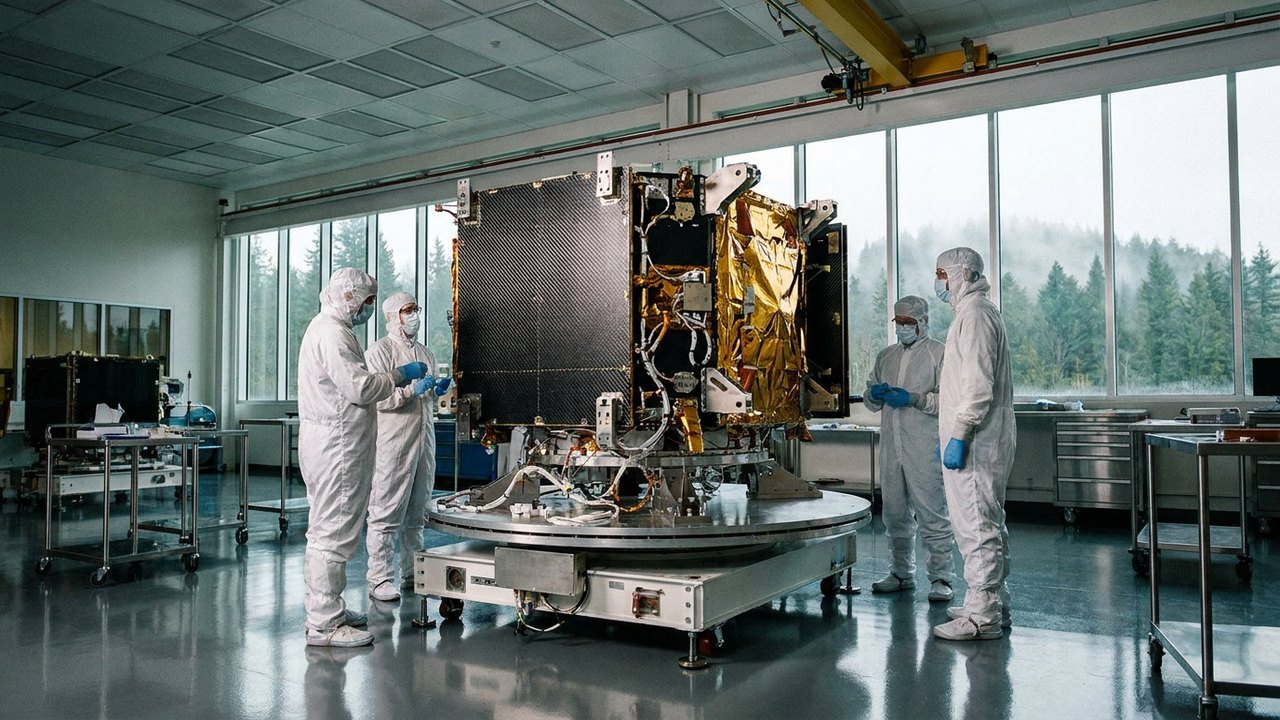
BlackSky Tukwila facility verified against Step 0 Census; regulatory mechanics verified against 15 CFR Part 960 and 47 CFR § 25.283 as of 2026-11-16.
ORBITAL SUSTAINABILITY · CONSTELLATION SCALE · FCC / NOAA LICENSING & CENSUS RECORD
BlackSky LEO EO Disposal & Compliance
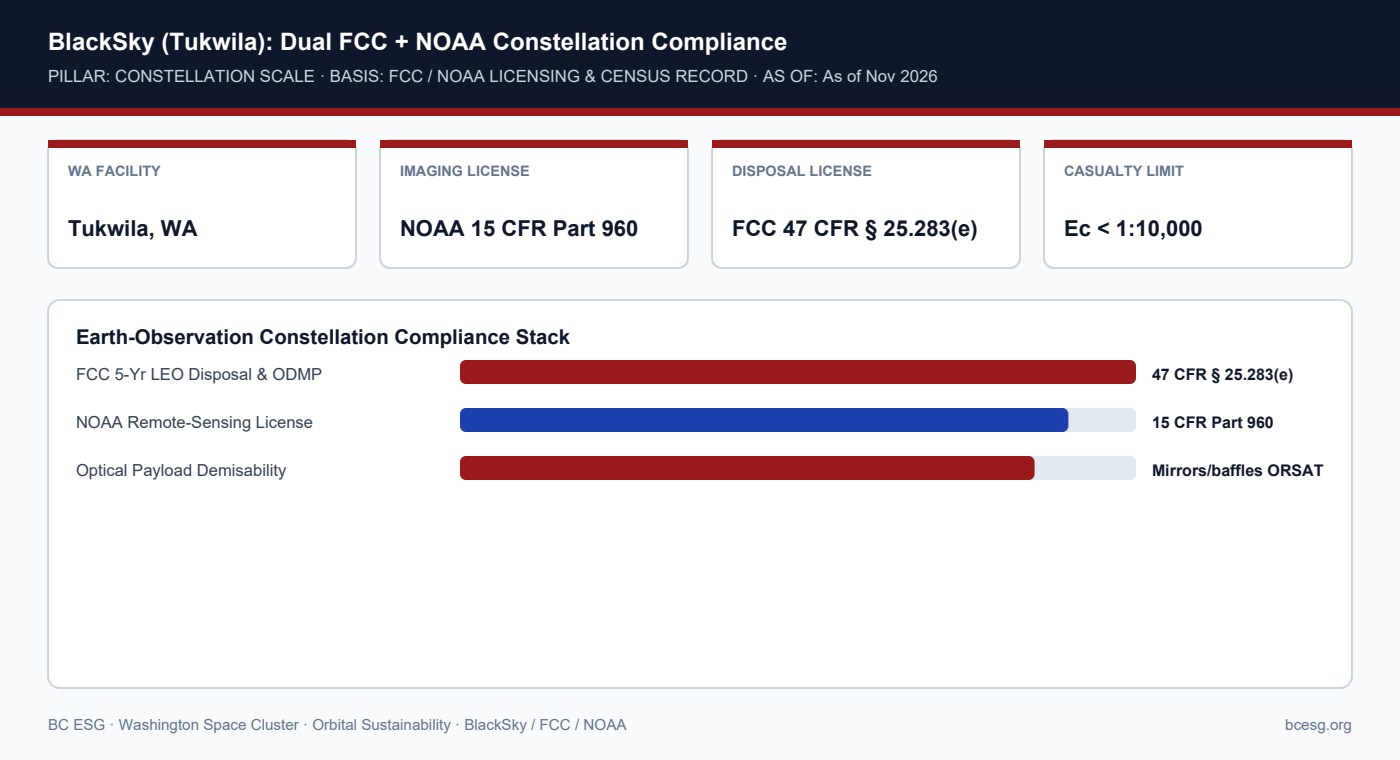
Tukwila-based BlackSky operates an Earth-observation LEO constellation governed simultaneously by NOAA 15 CFR Part 960 (imaging/data) and FCC 47 CFR § 25.283(e) (5-year post-mission disposal and ODMP compliance).
Primary Authority / Source: BlackSky / FCC / NOAA | As-Of / Horizon: As of Nov 2026
Documented Instrument & Engineering Record
- Tukwila EO operator: BlackSky maintains its Seattle South / Tukwila, WA facility (12501 E Marginal Wy S), operating high-revisit optical imaging satellites in LEO.
- Dual-agency licensing: BlackSky satellites require NOAA 15 CFR Part 960 authorization for commercial Earth imaging and FCC Part 25 authorization for RF downlinks and orbital debris mitigation.
- Optical payload demisability challenge: Earth-observation telescopes contain dense optical assemblies (mirrors, mounts, star trackers) that require careful ORSAT thermal modeling to stay under the 1:10,000 casualty threshold.
- Replenishment cadence: As Gen-3 satellites replace legacy units, each new authorization after September 29, 2024 is bound by the 5-year post-mission disposal ceiling.
EO Constellation Sustainability Controls (BlackSky Profile)
| Compliance Domain | Agency / Rule | EO-Specific Engineering Focus |
|---|---|---|
| 5-Year Post-Mission Decay | FCC 47 CFR § 25.283(e) | Low-LEO altitude + propulsion/drag sizing |
| Optical Telescope Demise | FCC ODMP / NASA-STD-8719.14C | Mirror & mount material survivability (<15 J) |
| Remote-Sensing Clearance | NOAA 15 CFR Part 960 | Relies on FCC ODMP; enforces license conditions |
| Conjunction Screening | 18th SDS / Space-Track | Maneuver planning across mid-inclination shells |
Mission Designer, Compliance Lead & Founder Takeaways
- Earth-observation operators face a tighter mass budget than broadband mega-constellations, making telescope demisability a critical early-design check.
- NOAA's reliance on FCC ODMP reviews means any FCC orbital-debris deficiency can jeopardize remote-sensing license standing.
- Operating in lower LEO shells improves imaging resolution while simultaneously shortening passive atmospheric decay time.
Connected Census Profiles, Segments & Rules
- BlackSky (Tukwila) Census Profile
- NOAA Part 960 & FCC Debris Handoff
- Reentry Casualty Risk & Demisability