
Short answer: Under New Jersey’s Clean Energy Act (P.L. 2018, c. 17; N.J.S.A. 48:3-87.10), owners of commercial (Class 4A) and multifamily residential (Class 4C, 5+ units) buildings exceeding 25,000 gross sq ft must benchmark and submit whole-building energy and water data annually by July 1 using ENERGY STAR Portfolio Manager and a DOE Unique Building Identifier (UBID).
For corporate logistics, pharma, and multifamily portfolios operating across the Northeast corridor, New Jersey avoids the municipal patchwork seen in Massachusetts and New York City—one statewide NJBPU standard governs every municipality from Newark and Jersey City down to Camden.
- Governing Authority: Clean Energy Act of 2018 (P.L. 2018, c. 17; N.J.S.A. 48:3-87.10) & NJBPU Benchmarking Order.
- Administering Agency: New Jersey Board of Public Utilities (NJBPU).
- Covered Tax Classes: MOD-IV Class 4A commercial (office, industrial/warehouse, retail) & Class 4C residential (5+ units) >25,000 gross sq ft.
- Annual Recurring Deadline: July 1 (following initial October 1, 2023 cycle launch).
- Distinct Requirements: Mandatory whole-building water data alongside energy, plus U.S. DOE UBID assignment inside Portfolio Manager.
Standardize New Jersey >25,000 sq ft Class 4A & 4C Benchmarking Before July 1
MOD-IV Property Class Screening & the Water + UBID Mandate
NJBPU determines building applicability using municipal tax-assessor MOD-IV records rather than owner self-reporting. Warehouse and industrial complexes in Middlesex, Hudson, Bergen, and Burlington counties taxed under Class 4A—and apartment complexes of 5+ units taxed under Class 4C—enter scope whenever gross floor area exceeds 25,000 sq ft.
Two compliance details routinely trigger NJBPU rejection notices: omitting water utility meters (New Jersey explicitly pairs water benchmarking with energy under N.J.S.A. 48:3-87.10) and leaving the Unique Building Identifier (UBID) custom ID field blank inside Portfolio Manager.
- Regulated Utility Data Tools: NJ electric and gas utilities provide automated or portal-based aggregated whole-building usage under BPU privacy/aggregation guidelines (4/5 rule thresholds).
- Uniform Statewide Scope: New Jersey imposes no separate city-level EUI or GHG performance cap ordinances today, though NJBPU’s public benchmarking scores increasingly surface in municipal green-building and lender underwriting reviews.
| Program Dimension | New Jersey CEA Rule | Compliance Requirement |
|---|---|---|
| Statutory Threshold | N.J.S.A. 48:3-87.10 | MOD-IV Class 4A commercial & Class 4C (5+ units) >25,000 sq ft |
| Covered Utilities | NJBPU Order / Portfolio Mgr | Whole-building electric, gas/thermal fuel AND water consumption |
| Property Identifier | Custom Field in ESPM | Mandatory DOE Unique Building Identifier (UBID) + NJ tax block/lot |
| Annual Filing Schedule | Post-2023 Recurring Cadence | July 1 annually via NJBPU ENERGY STAR Portfolio Manager link |
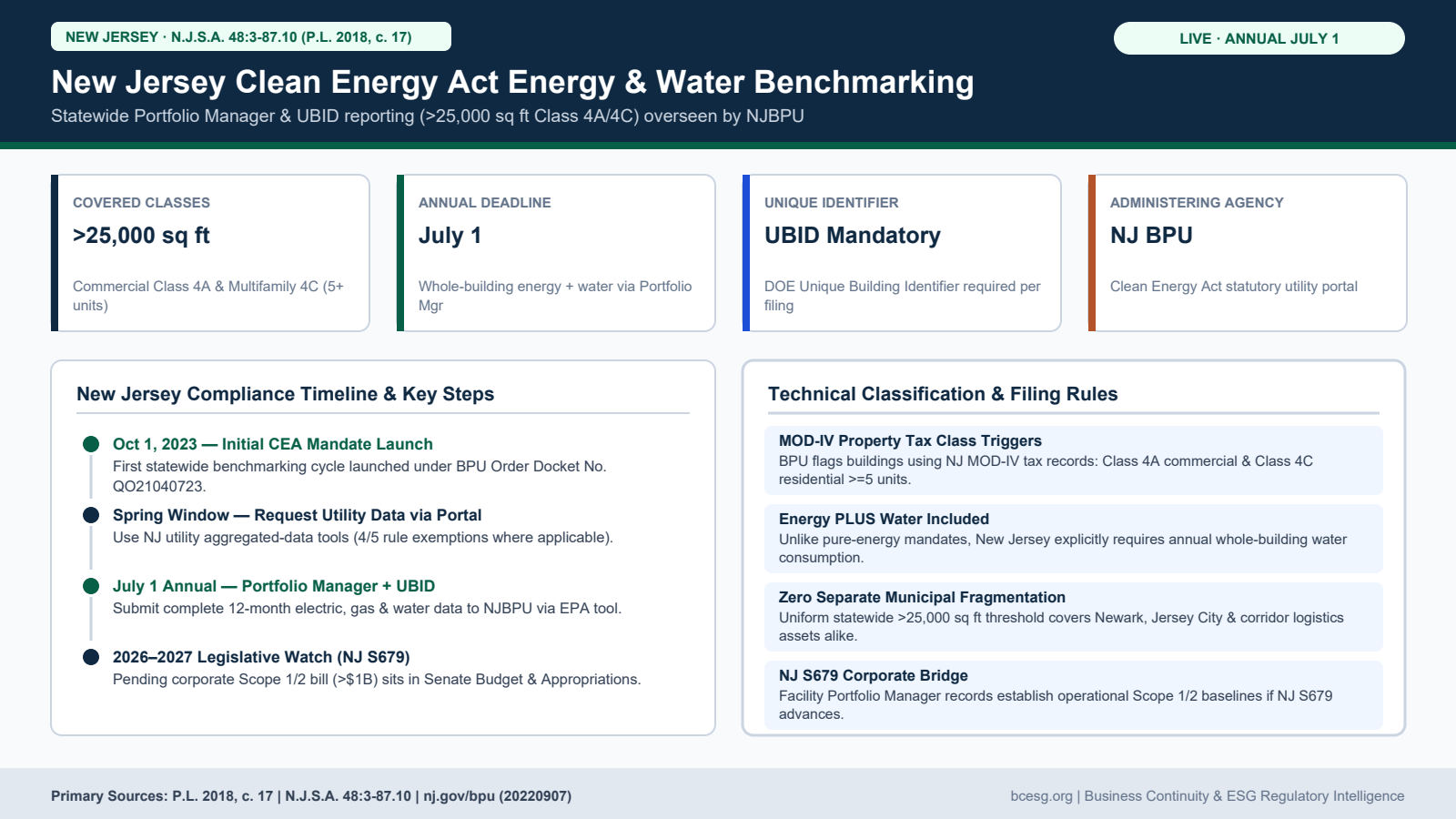
Strategic Link: Portfolio Manager Baselines & Pending NJ S679 Disclosure
While New Jersey’s benchmarking law carries no statewide EUI penalty cap today, facility energy data feeds directly into corporate GHG reporting—particularly if New Jersey advances NJ S679 (pending corporate climate disclosure legislation amended in 2026 to cover Scope 1 and Scope 2 emissions for firms >$1B revenue).
Compare New Jersey’s July 1 schedule against Maryland’s June 1 verified BEPS deadline and NYC’s May 1 LL84 deadline to keep Mid-Atlantic property managers aligned on one quarterly utility audit cycle.
Compliance Execution Checklist
| Step | Owner / Team | Auditable Deliverable |
|---|---|---|
| 1. MOD-IV Lookup | Tax / Asset Lead | Verify parcel Class (4A/4C) and >25,000 sq ft status on municipal MOD-IV tax records & BPU list. |
| 2. UBID Assignment | Energy Analyst | Generate/confirm building UBID and map NJ municipal Block/Lot numbers inside Portfolio Manager. |
| 3. Utility + Water Sync | Property Ops | Pull 12-month aggregated electric/gas data plus municipal water bills ahead of June 1. |
| 4. Submit July 1 | Compliance Lead | Submit via NJBPU reporting link and retain confirmation receipt for ESG/NJ S679 audits. |
Keep This New Jersey Compliance Checklist Handy
Frequently Asked Questions
Are industrial warehouses subject to New Jersey's benchmarking law?
Yes. Industrial, warehouse, logistics, retail, and office buildings taxed under New Jersey MOD-IV Class 4A that exceed 25,000 gross sq ft are covered by NJBPU benchmarking.
Does New Jersey require water consumption reporting as well as electricity and gas?
Yes. N.J.S.A. 48:3-87.10 requires annual whole-building water benchmarking in addition to electric and natural gas/heating energy usage.
What is a UBID and why does NJBPU require it?
A Unique Building Identifier (UBID) is a standardized geographic footprint code maintained by the U.S. DOE so NJBPU can match Portfolio Manager submissions cleanly against municipal MOD-IV parcel records.
Primary Authorities & Official Resources
- New Jersey Board of Public Utilities (NJBPU) — Clean Energy Act Benchmarking Order
- Maryland BEPS (Mid-Atlantic Comparative) — BC ESG
- Massachusetts LBER Statewide Benchmarking — BC ESG
Informational notice: This guide summarizes enacted statutes, regulations, or pending legislative records from the primary authorities linked above as of November 14, 2026. It is not legal, accounting, or licensed engineering advice.