
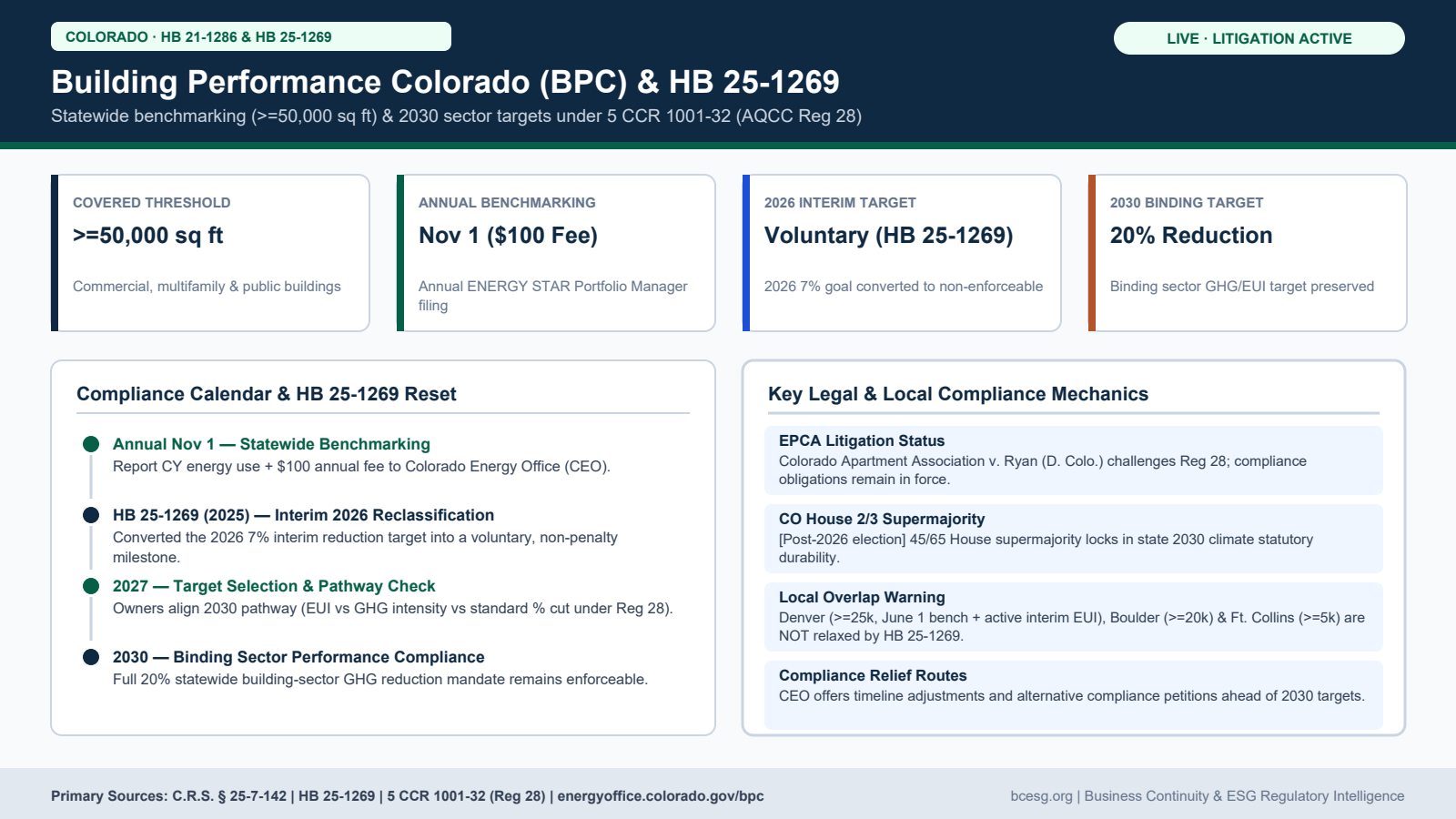
Short answer: Colorado’s statewide building performance statute remains live and binding for 2030—even though HB 25-1269 removed mandatory penalties around the interim 2026 milestone. Under Building Performance Colorado (BPC) and HB 25-1269, covered owners of commercial, multifamily, and public buildings of 50,000 gross sq ft or more must continue annual November 1 benchmarking ($100 fee) and remain legally on track for the 2030 20% sector emissions/EUI target.
Two structural traps catch Colorado asset managers off guard: mistaking HB 25-1269’s voluntary 2026 state target for a pause on municipal Energize Denver interim caps, and assuming pending federal EPCA litigation excuses annual state reporting.
- Governing Authority: C.R.S. § 25-7-142 (HB 21-1286), HB 25-1269 (2025), and AQCC Regulation 28 (5 CCR 1001-32).
- Administering Agencies: Colorado Energy Office (CEO) & CDPHE Air Quality Control Commission.
- Covered Threshold: Commercial, multifamily, and public buildings ≥50,000 gross sq ft statewide.
- Annual Benchmarking: Due every November 1 via Portfolio Manager with a $100 annual compliance fee.
- 2026 vs. 2030 Split & Litigation: 2026 7% state target is now voluntary/non-penalty (HB 25-1269); 2030 20% target stays binding; Colorado Apartment Association v. Ryan (D. Colo.) EPCA challenge active without stay.
Navigate Colorado BPC, HB 25-1269 Relief, and Energize Denver Overlap
What HB 25-1269 Changed—and What Stayed Binding
Under the original HB 21-1286 and Regulation 28 schedule, buildings ≥50,000 sq ft faced an intermediate 7% sector-wide reduction milestone in 2026 ahead of the 20% reduction target in 2030. Recognizing post-pandemic grid mix and capital lead times, the General Assembly enacted HB 25-1269 in 2025.
HB 25-1269 expressly converted the 2026 7% interim goal into a non-enforceable voluntary goal, relieving owners from state interim civil penalties in 2026–2027. However, HB 25-1269 left the November 1 annual benchmarking obligation intact and preserved full statutory authority for the 2030 20% sector emissions/EUI reduction requirement.
- Compliance Pathway Flexibility: Building owners select between hitting a property-type Energy Use Intensity (EUI) target, an operational Greenhouse Gas Intensity (GHGI) target, or a standardized percentage EUI/GHG reduction pathway under Regulation 28.
- 2026 Election Trajectory Context (Inferred): Following the November 2026 Colorado House shift to a 45/65 two-thirds majority, legislative repeal risk against the 2030 BPC statutory mandate is low, signaling long-run regulatory continuity for decarbonization planning.
| Obligation Layer | Scope & Citation | Current Deadlines & Enforceability |
|---|---|---|
| Annual Benchmarking | C.R.S. § 25-7-142 (>=50k sq ft) | Annual Nov 1 Portfolio Manager report + $100 fee (Live/Mandatory) |
| 2026 Interim Target (7%) | HB 25-1269 (amending Reg 28) | Converted to non-enforceable voluntary target (No 2026 state fine) |
| 2030 Binding Target (20%) | 5 CCR 1001-32 (AQCC Reg 28) | Mandatory 2030 EUI / GHGI / % reduction compliance preserved |
| EPCA Preemption Suit | Colorado Apt. Assoc. v. Ryan (D. Colo.) | Litigation active; no injunction staying BPC filings or 2030 roadmap |
Don't Confuse State Relief With Energize Denver or Local Rules
Colorado owners frequently apply statewide HB 25-1269 logic across Denver, Boulder, Fort Collins, and Aspen portfolios—creating unexpected local noncompliance. Local ordinances operate on independent home-rule statutory authority and lower square-footage triggers.
Owners managing multi-state western real estate should cross-check Colorado’s 50,000 sq ft floor against Washington CBPS (>20,000 sq ft Tier 2) and California AB 802 (>50,000 sq ft June 1 benchmarking) to harmonize Portfolio Manager data requests across utilities.
- Denver (Energize Denver, DRMC Ch. 4): Covers buildings ≥25,000 sq ft with June 1 annual benchmarking and separate interim/final EUI caps—NOT converted to voluntary by state HB 25-1269.
- Boulder & Fort Collins: Boulder mandates ≥20,000 sq ft annual benchmarking plus 10-year audits/RCx and LED retrofits; Fort Collins BEWS requires annual June 1 benchmarking down to 5,000 sq ft.
Litigation Posture: Colorado Apartment Association v. Ryan
Industry groups filed Colorado Apartment Association v. Ryan in U.S. District Court (D. Colo.) arguing federal Energy Policy and Conservation Act (EPCA) preemption against state building energy caps. Because no court injunction currently suspends BPC benchmarking or Regulation 28’s 2030 planning obligations, owners should treat litigation as background legal risk rather than a filing excuse—similar to how NYC Local Law 97 compliance proceeded to Court of Appeals resolution while deadlines ran.
Compliance Execution Checklist
| Step | Owner / Team | Auditable Deliverable |
|---|---|---|
| 1. Annual Nov 1 Filing | Property Mgr | File whole-building Portfolio Manager data + remit $100 fee to Colorado Energy Office before Nov 1. |
| 2. Pathway Audit | Energy Engineer | Select optimal 2030 Reg 28 pathway (EUI vs. GHGI vs. standard %) and verify meter accuracy. |
| 3. Municipal Separation | Portfolio Lead | Segregate Denver (>=25k), Boulder (>=20k), Ft. Collins (>=5k), and Aspen schedules from state BPC rules. |
| 4. CapEx & Petitions | Asset Finance | Document equipment end-of-life windows and file CEO timeline adjustments early if hardship applies. |
Keep This Colorado Compliance Checklist Handy
Frequently Asked Questions
Did HB 25-1269 repeal Building Performance Colorado?
No. HB 25-1269 converted only the interim 2026 7% reduction goal into a non-enforceable voluntary milestone. Annual November 1 benchmarking ($100 fee) and the 2030 binding 20% sector reduction target under AQCC Regulation 28 remain in force.
When is annual Colorado BPC benchmarking due?
Every November 1 for buildings of 50,000 gross sq ft or more, accompanied by a $100 annual fee paid to the Colorado Energy Office.
Does HB 25-1269 relax Energize Denver deadlines for my Denver building?
No. Energize Denver is a separate municipal ordinance (covering buildings >=25,000 sq ft with June 1 annual benchmarking and local EUI targets) unaffected by Colorado's state interim adjustment.
Primary Authorities & Official Resources
- Colorado Energy Office — Building Performance Colorado (BPC)
- Colorado General Assembly — HB 25-1269 Bill Record
- DC BEPS Pathway Management Reference — BC ESG
- Washington Clean Buildings Performance Standard Guide — BC ESG
Informational notice: This guide summarizes enacted statutes, regulations, or pending legislative records from the primary authorities linked above as of November 14, 2026. It is not legal, accounting, or licensed engineering advice.