BC ESG · WA Space Cluster Supplier Asks (November 16, 2026)
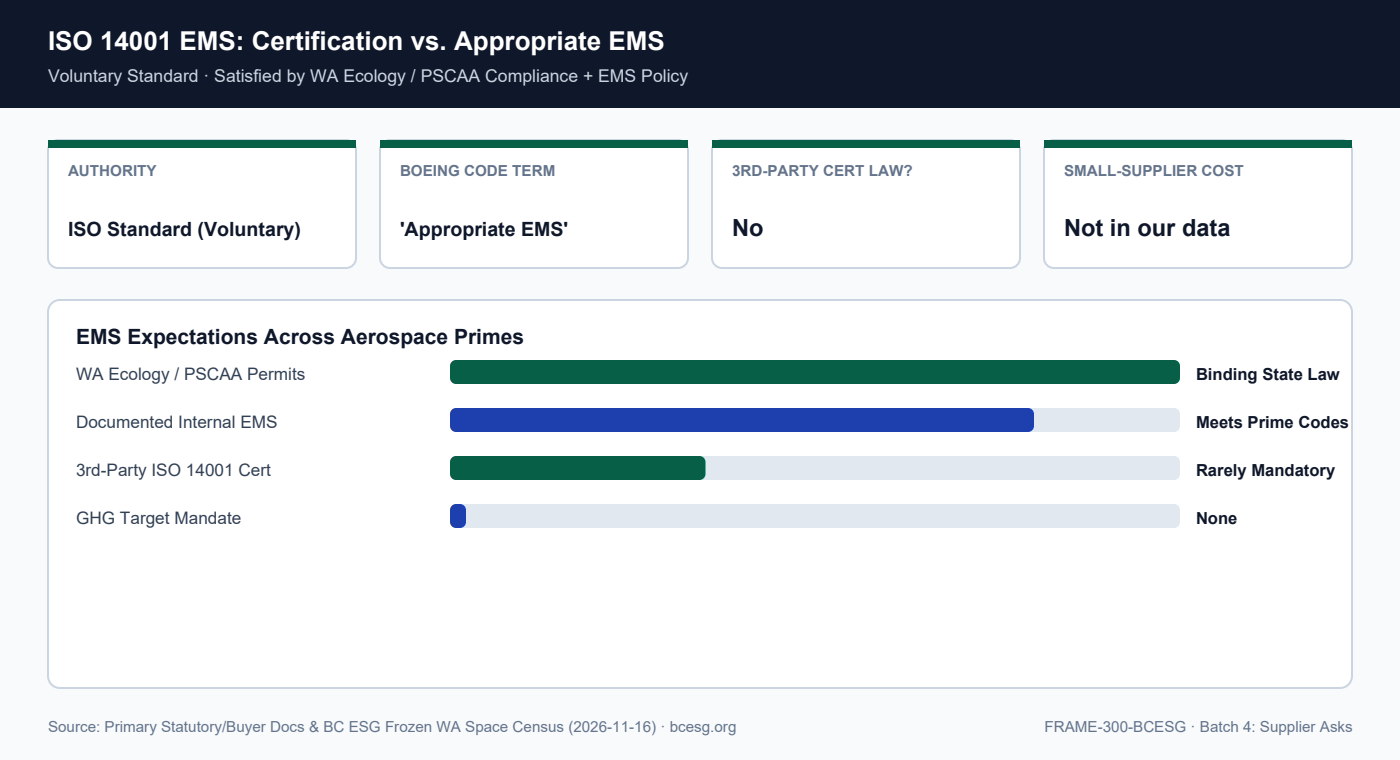
Sourced Baseline: ISO 14001 is a voluntary international EMS standard. Some primes (e.g., Boeing's Supplier Code of Conduct) expect an 'appropriate EMS' aligned with pollution prevention, while few require third-party ISO 14001 registration from small WA machine shops.
TAKEAWAY BRIEF · PDF & MARKDOWN TWIN
ISO 14001 EMS Expectations
Download the formatted 2-page briefing sheet (PDF) or read the single-source Markdown twin for ISO 14001 EMS Expectations.
Who Issues This Ask, Authority, and Binding Status
Vendor onboarding questionnaires from primes like The Boeing Company ask whether a supplier maintains an ISO 14001 certification or an Environmental Management System (EMS).
ISO 14001 is a voluntary international standard, not a law. Boeing's Supplier Code of Conduct expects suppliers to maintain an 'appropriate EMS' for safety and pollution prevention, but does not universally require third-party ISO 14001 registration for small sub-tier shops unless explicitly written into a specific Purchase Order.
EMS Tier
Binding?
What Satisfies Prime Questionnaires
WA Ecology / PSCAA Permits
Binding WA Law
Active waste ID, air NOCOA, ISGP stormwater SWPPP
Internal EMS Policy
Buyer-expected (Boeing Code)
Written EHS policy + annual aspect/spill review
3rd-Party ISO 14001 Cert
Voluntary unless in PO
Accredited registrar certificate
Evidence Required & Small-Supplier Effort Cost
If third-party certified, upload the ISO 14001 certificate. If uncertified, most primes accept a documented internal EMS binder combining your WA Ecology Dangerous Waste (WAC 173-303), PSCAA air permit, stormwater ISGP, and spill-prevention procedures.
Third-party registrar audit fees for ISO 14001 are not in our data.
BC ESG · WA Space Cluster Supplier Asks (November 16, 2026)
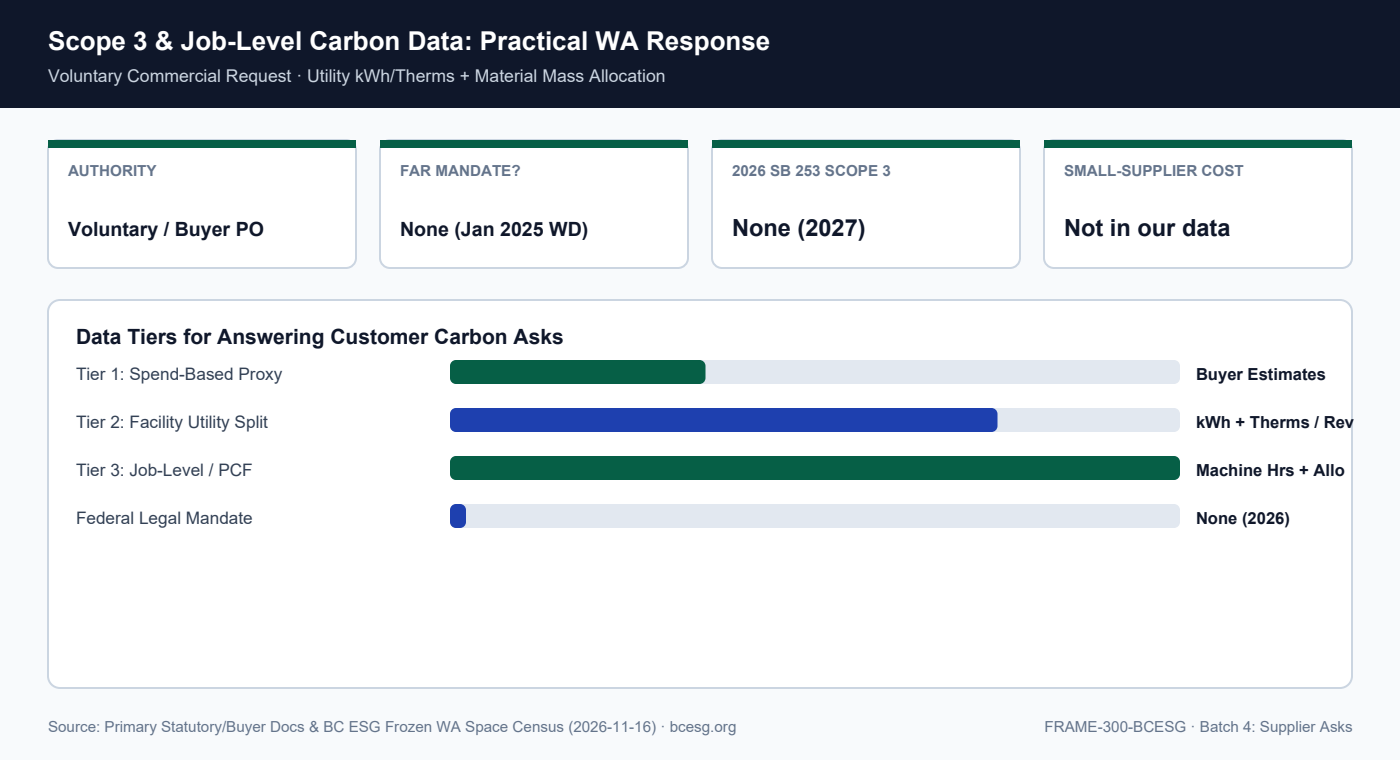
Sourced Baseline: Voluntary/commercial customer requests for Scope 3 or Product Carbon Footprint (PCF) data. Zero federal FAR mandate (FAR Case 2021-015 withdrawn Jan 2025) and zero 2026 CA SB 253 Scope 3 mandate. Adapts BC ESG's Vendor Carbon Report framework (Post #920, Pages #144-#145) to WA space suppliers.
TAKEAWAY BRIEF · PDF & MARKDOWN TWIN
Scope 3 & Job-Level Carbon Data
Download the formatted 2-page briefing sheet (PDF) or read the single-source Markdown twin for Scope 3 & Job-Level Carbon Data.
Who Issues This Ask, Authority, and Binding Status
Product Carbon Footprint (PCF) and Scope 3 supplier data requests come from sustainability teams at commercial satellite operators, cloud ground primes, or European-linked aerospace OEMs (such as Airbus/Safran/EU CSRD filers—see BC ESG Post #22).
In the US, no federal law or FAR clause mandates Scope 3 reporting (FAR Case 2021-015 died January 13, 2025), and CA SB 253 Scope 3 does not start until 2027. Thus, these asks are voluntary unless written into a commercial contract.
Approach
Data Inputs
When to Use
Utility-Bill Allocation
12-mo kWh + therms + revenue/hours share
Best default for <50-person WA machine/fab shops
Job-Level / PCF
Alloy mass (kg) + mill cert + machine kWh
Only if required by a high-value commercial PO
Spend-Based (Buyer)
Invoice $ only (EEIO factor)
Buyer calculates; $0 supplier effort
Evidence Required & Small-Supplier Effort Cost
Adapting BC ESG's Scope 3 Field Guide (Post #920) and Vendor Carbon Report Template (Page #145), a small WA shop can answer cleanly using a 1-page Facility Utility Allocation (annual electricity kWh from Puget Sound Energy/Seattle City Light + natural gas therms, divided by total shop revenue or machine-hours) rather than hiring an LCA consultant.
Exact consultant or LCA-software costs are not in our data; an in-house utility-allocation sheet requires only utility bills and basic spreadsheet math.
BC ESG · WA Space Cluster Supplier Asks (November 16, 2026)
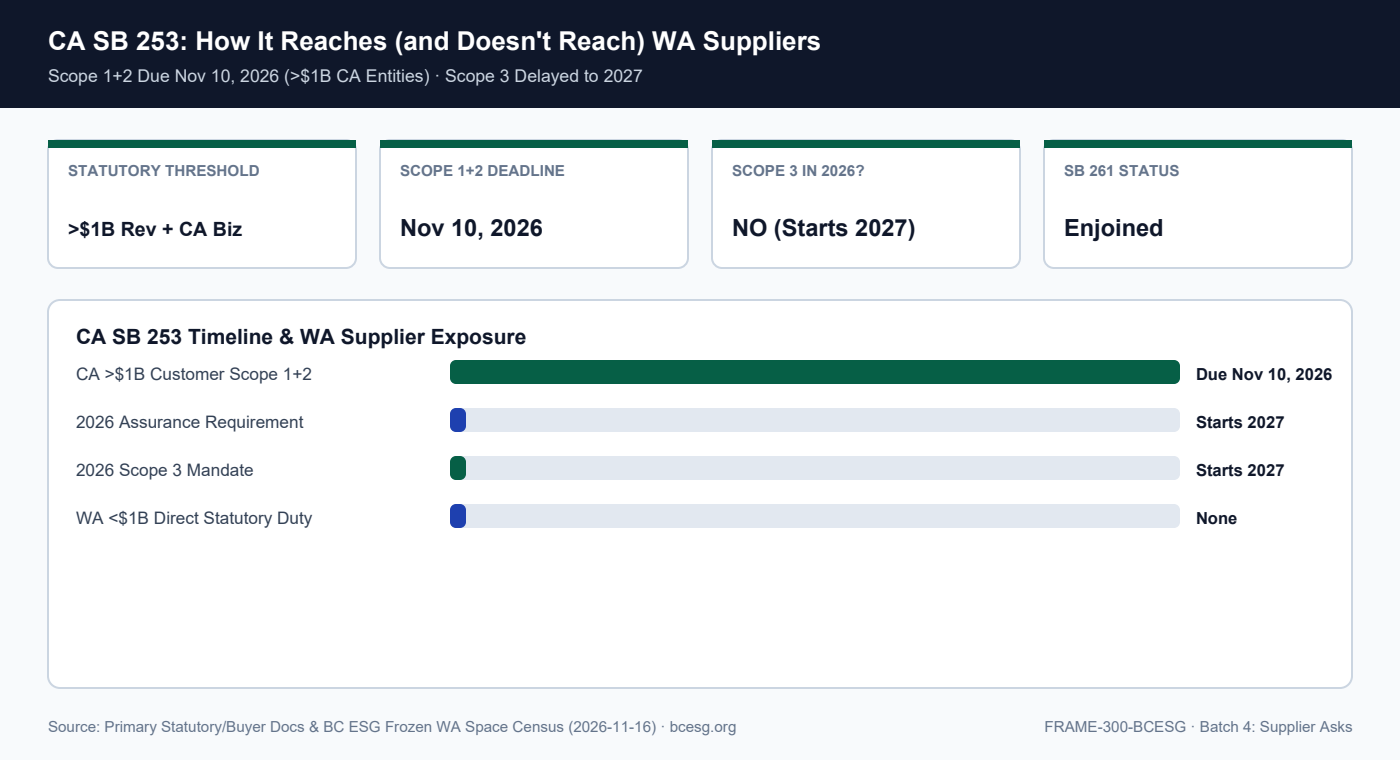
Sourced Baseline: CA SB 253 binds US entities doing business in California with >$1B annual revenue. CARB set the Scope 1+2 deadline at November 10, 2026 (with 'good faith' enforcement) and pushed Scope 3 to 2027. WA suppliers <$1B have zero direct SB 253 duty; CA customers cannot cite SB 253 as a 2026 Scope 3 mandate.
TAKEAWAY BRIEF · PDF & MARKDOWN TWIN
CA SB 253 Scope 1+2 via CA Customers
Download the formatted 2-page briefing sheet (PDF) or read the single-source Markdown twin for CA SB 253 Scope 1+2 via CA Customers.
Who Issues This Ask, Authority, and Binding Status
California's SB 253 (Climate Corporate Data Accountability Act, overseen by CARB) binds only US-organized entities doing business in California with total annual revenues exceeding $1 billion. Large California aerospace customers (e.g., SpaceX HQ/Hawthorne, Relativity HQ/Long Beach, K2 Space HQ/Torrance, Viasat HQ/Carlsbad, Northrop/Lockheed CA units) are subject to SB 253 if they meet those thresholds.
Dead-rule & timeline boundary: CARB adjusted the inaugural Scope 1 and Scope 2 reporting deadline to November 10, 2026, under a first-year 'good faith' ('give what you have') enforcement posture with no third-party assurance required in 2026. Crucially, Scope 3 (value-chain) reporting is NOT required in 2026—it is slated to begin in 2027. Meanwhile, SB 261 remains enjoined (see BC ESG Post #916). Thus, a <$1B WA supplier has zero direct SB 253 filing duty, and any 2026 supplier survey claiming SB 253 requires Scope 3 today is premature.
SB 253 Component
CARB 2026 Rule State
Effect on <$1B WA Supplier
Scope 1 & 2
Due Nov 10, 2026 for >$1B CA entities; good-faith enforcement
Zero direct filing duty on <$1B WA firms
Scope 3 (Supply Chain)
NOT required in 2026; slated for 2027
Any 2026 request is voluntary / early prep
3rd-Party Assurance
Not required for 2026 Scope 1+2; limited assurance starts 2027
No audit cost on WA suppliers in 2026
Evidence Required & Small-Supplier Effort Cost
When a CA >$1B prime asks a WA supplier for utility-level data ahead of 2027 Scope 3 readiness, a simple Scope 1 (natural gas/propane/diesel) and Scope 2 (electricity kWh) summary from 12 months of Puget Sound Energy / Snohomish PUD / Seattle City Light bills satisfies the ask.
Software or consultant fees are unnecessary for basic utility rollups; internal admin effort is not in our data (typically a few hours of utility-bill aggregation for a single-facility shop).
BC ESG · WA Space Cluster Supplier Asks (November 16, 2026)
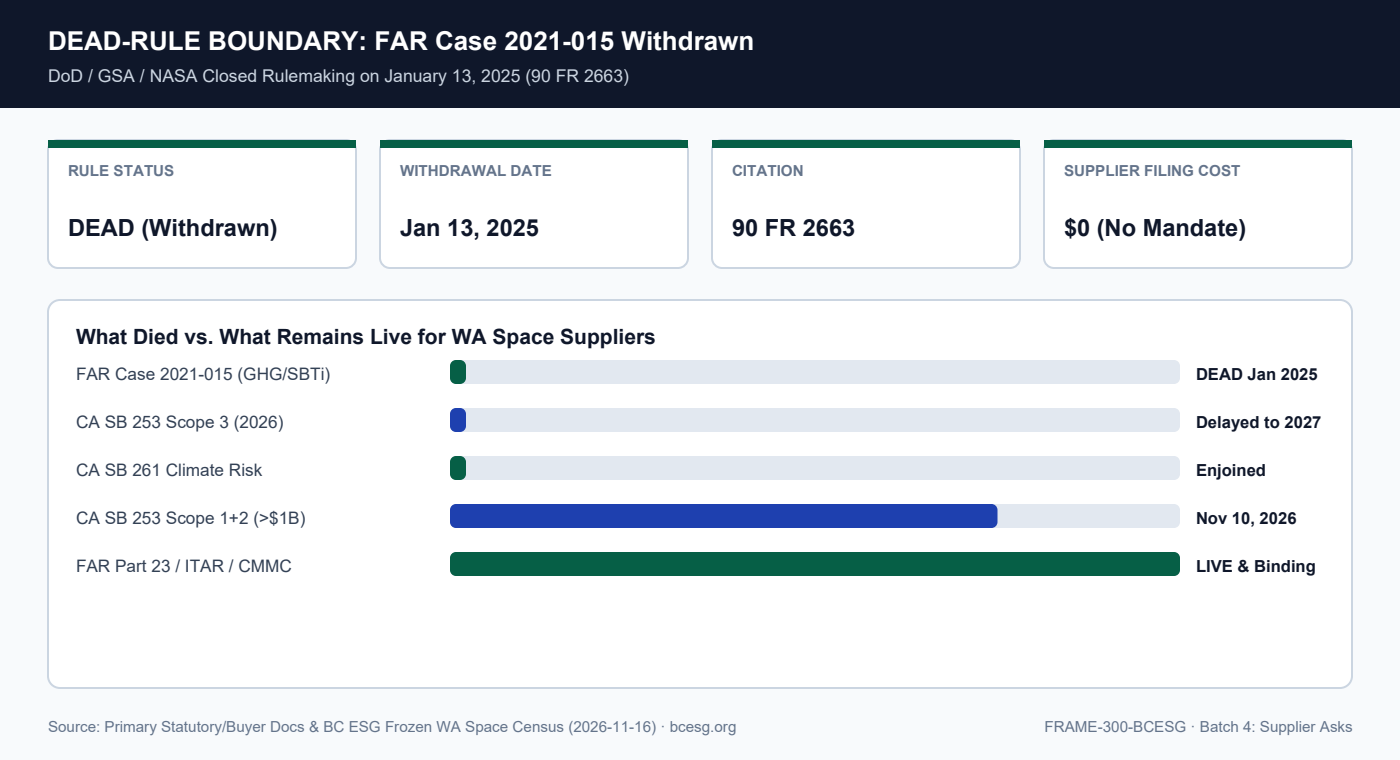
Sourced Baseline: DEAD RULE: On January 13, 2025, DoD, GSA, and NASA formally withdrew FAR Case 2021-015 (90 FR 2663) and closed the rulemaking. There is zero sweeping FAR or DoD/NASA mandate requiring space contractors to disclose Scope 1/2/3 GHG emissions or set SBTi targets.
TAKEAWAY BRIEF · PDF & MARKDOWN TWIN
Dead FAR Climate Rule (Jan 2025)
Download the formatted 2-page briefing sheet (PDF) or read the single-source Markdown twin for Dead FAR Climate Rule (Jan 2025).
What Died on January 13, 2025 (And Why Suppliers Still Hear About It)
In November 2022 (87 FR 68312), the FAR Council proposed FAR Case 2021-015 (Disclosure of Greenhouse Gas Emissions and Climate-Related Financial Risk), which would have forced major federal contractors to publish Scope 1, 2, and 3 GHG inventories, disclose climate-financial risks, and set science-based reduction targets (SBTi).
That rule is dead. On January 13, 2025 (90 FR 2663), DoD, GSA, and NASA formally withdrew FAR Case 2021-015 and closed the case, citing insufficient time and a shifting regulatory landscape. Any outdated questionnaire, consultant pitch, or legacy RFP template claiming a 'federal FAR Scope 3 mandate' is citing a withdrawn, non-existent rule.
Climate / ESG Rule
Current Status (Nov 2026)
Impact on WA Space Suppliers
FAR Case 2021-015 (Federal GHG/SBTi)
DEAD — Withdrawn Jan 13, 2025 (90 FR 2663)
$0 federal mandate; reject false 'FAR GHG' claims
CA SB 253 Scope 1 & 2
LIVE for >$1B CA entities (Nov 10, 2026)
No direct duty on <$1B WA firms
CA SB 253 Scope 3
Not required in 2026 (starts 2027)
No 2026 statutory Scope 3 flow-down
CA SB 261
Enjoined (see BC ESG Post #916)
Not enforced while injunction stands
Evidence Required & Effort Cost Today
Zero. Because FAR Case 2021-015 was withdrawn before finalization, there is no federal FAR GHG disclosure clause, no DoD climate-disclosure deviation in force, and no federal requirement to register SBTi targets. Effort cost to satisfy a dead rule is $0.
If a prime contractor still asks for carbon data, it is doing so voluntarily (e.g., IAEG/EcoVadis or CDP) or to prepare for California SB 253 (Scope 1 & 2 due Nov 10, 2026 for >$1B CA entities; Scope 3 delayed to 2027).
BC ESG · WA Space Cluster Supplier Asks (November 16, 2026)
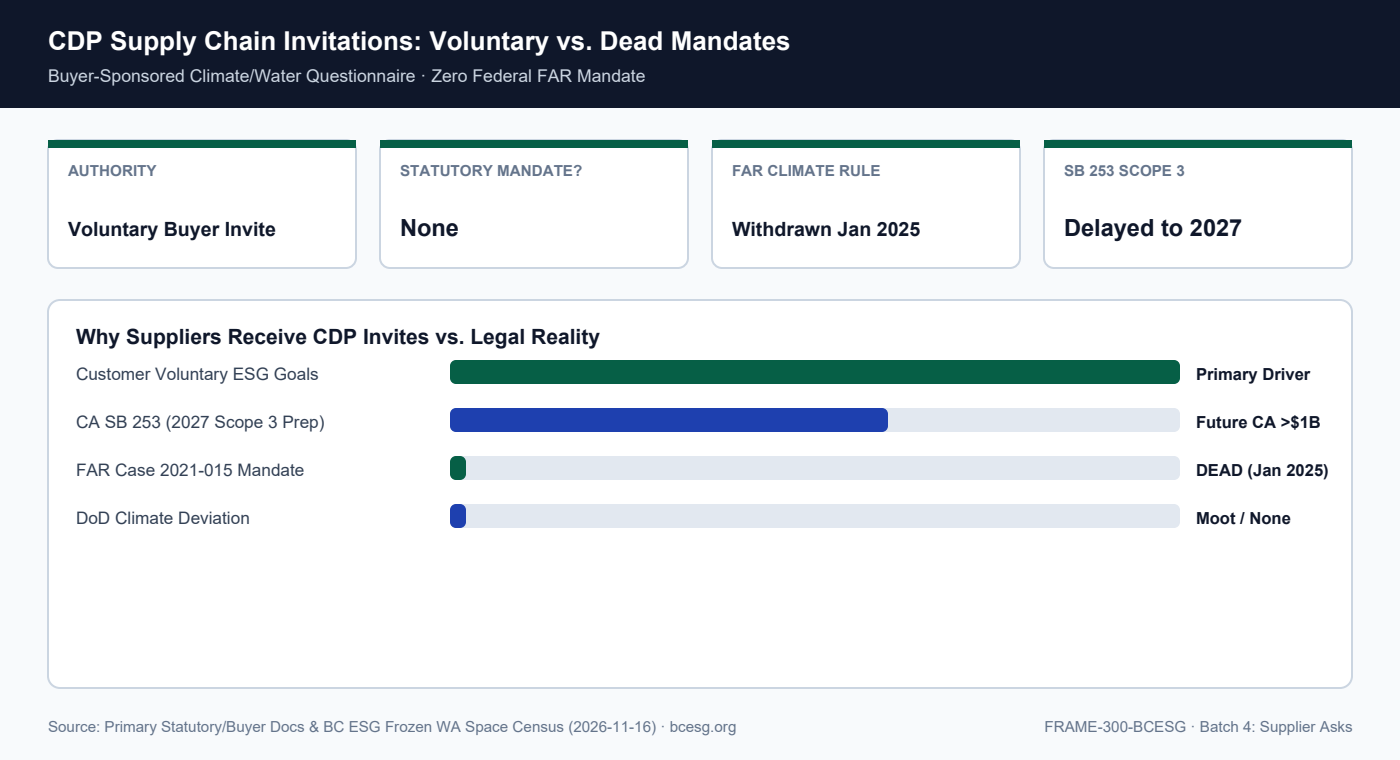
Sourced Baseline: Voluntary buyer-requested disclosure issued by CDP Supply Chain members (e.g., large cloud, defense, or commercial primes). Not a US law or federal contract mandate; FAR Case 2021-015 was withdrawn Jan 2025 and CA SB 253 Scope 3 does not start until 2027.
TAKEAWAY BRIEF · PDF & MARKDOWN TWIN
CDP Supply Chain Invitations
Download the formatted 2-page briefing sheet (PDF) or read the single-source Markdown twin for CDP Supply Chain Invitations.
Who Issues This Ask, Authority, and Binding Status
CDP Supply Chain invitations are sent by large corporate buyers (often cloud/tech primes like Microsoft Azure Space or AWS Aerospace & Satellite, or major public defense primes) through the CDP (formerly Carbon Disclosure Project) portal.
A CDP invitation is strictly voluntary—it carries zero statutory force. Dead-rule boundary: many suppliers assume CDP disclosure is legally required for federal contractors, but FAR Case 2021-015 was formally withdrawn on January 13, 2025 (90 FR 2663), and California SB 253 Scope 3 reporting is not required in 2026 (slated for 2027 only for >$1B CA-doing-business entities).
Question
Verified Current State (Nov 2026)
Primary Basis
Is CDP Supply Chain legally binding?
No — voluntary buyer request unless in a binding PO
CDP Supply Chain Program
Does FAR require CDP / SBTi?
No — FAR Case 2021-015 withdrawn Jan 13, 2025
90 FR 2663
Does CA SB 253 require Scope 3 in 2026?
No — Scope 1+2 only (Nov 10, 2026); Scope 3 starts 2027
CARB SB 253
Evidence Required & Small-Supplier Effort Cost
Responding to a CDP Supply Chain invitation requires completing CDP's SME or full corporate climate/water questionnaire (Scope 1 and 2 emissions, energy use, and governance).
Exact CDP administrative fees for invited SMEs vary by sponsorship tier and are not in our data in full; many buyers sponsor first-time SME access, while internal GHG-inventory labor scales with facility utility-bill complexity.
BC ESG · WA Space Cluster Supplier Asks (November 16, 2026)
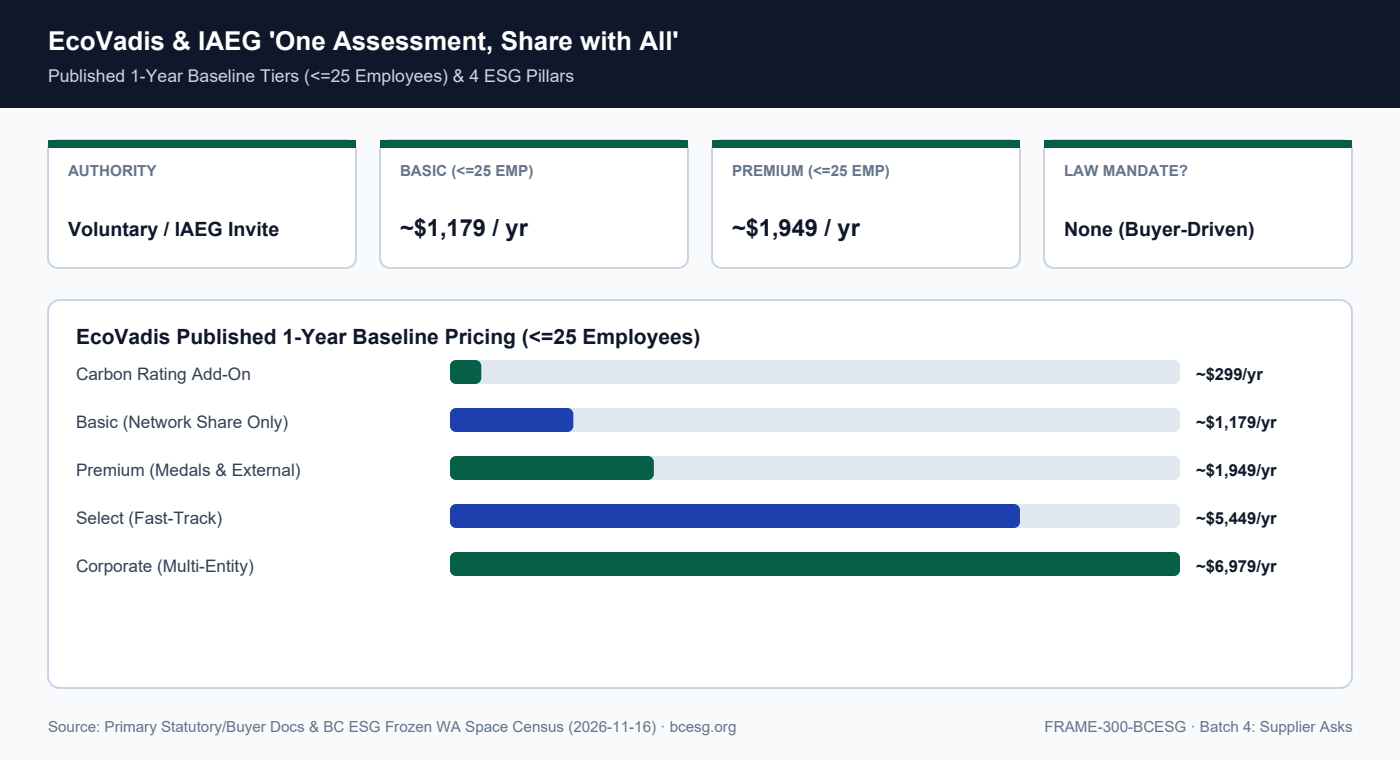
Sourced Baseline: Voluntary buyer-invited ESG rating under the International Aerospace Environmental Group (IAEG) 'One Assessment, Share with All' model. Not a law or federal regulation. Published EcoVadis 1-year baseline pricing starts at ~$1,179/yr (Basic) to ~$6,979/yr (Corporate) for <=25 employees, scaling by headcount.
TAKEAWAY BRIEF · PDF & MARKDOWN TWIN
EcoVadis & IAEG Assessment
Download the formatted 2-page briefing sheet (PDF) or read the single-source Markdown twin for EcoVadis & IAEG Assessment.
Who Issues This Ask, Authority, and Binding Status
EcoVadis invitations reach Washington space suppliers when an IAEG member OEM (such as Boeing, Airbus, Lockheed Martin, RTX, Safran, or Leonardo) requests a standardized corporate sustainability scorecard under IAEG's 'One Assessment, Share with All' model.
EcoVadis is a voluntary commercial rating platform, not a statutory or regulatory mandate. It becomes a commercial gate only when a prime makes an active EcoVadis scorecard a condition of bidding or maintaining preferred-supplier status. Dead-rule boundary: EcoVadis includes optional carbon/Scope 3 questions, but no US federal FAR or DoD rule mandates EcoVadis or Scope 3 reporting following the January 13, 2025 withdrawal of FAR Case 2021-015 (90 FR 2663).
EcoVadis Plan (<=25 Employees)
Published 1-Yr Rate
Key Capability
Carbon Rating (Invite)
~$299 / yr
Scope 1/2 carbon scorecard & estimator only
Basic
~$1,179 / yr
Full 4-pillar scorecard; share inside EcoVadis network only
Priority review / multi-entity group consolidation
Evidence Required & Published Small-Supplier Cost
Suppliers complete an online questionnaire across four pillars—Environment, Labor & Human Rights, Ethics, and Sustainable Procurement—backed by documentary policies, training logs, and KPIs (not unverified assertions). Suppliers typically receive up to 6 weeks to fill out the questionnaire before paying to submit.
Per EcoVadis's published pricing for micro-enterprises (25 or fewer employees, 1-year term, excluding taxes): Basic is ~$1,179/yr (share within EcoVadis network only; no medals), Premium is ~$1,949/yr (eligible for medals/badges and external sharing), Select is ~$5,449/yr, Corporate is ~$6,979/yr, and a standalone Carbon Rating add-on is ~$299/yr. Rates increase for larger headcount brackets (26–99, 100–999, 1,000+).
BC ESG · WA Space Cluster Supplier Asks (November 16, 2026)
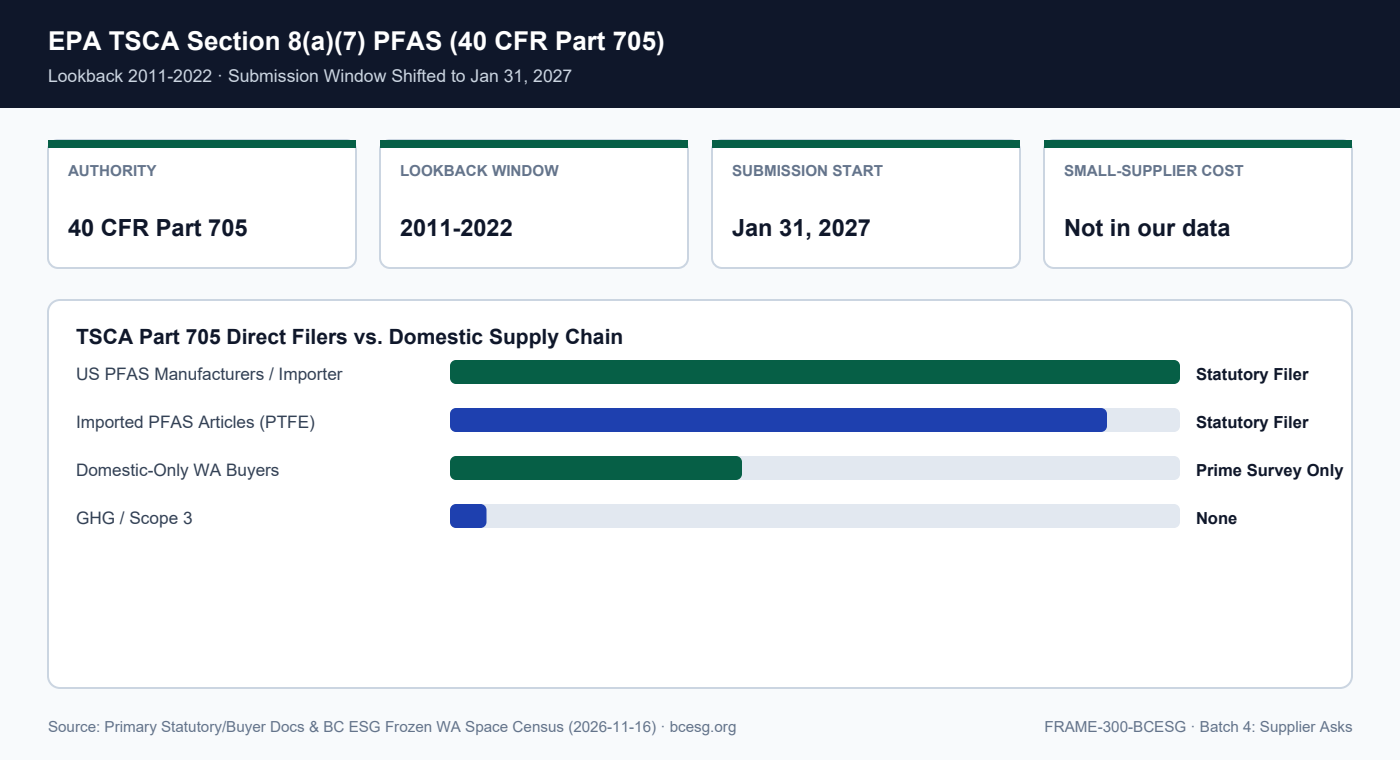
Sourced Baseline: Binding US federal law (40 CFR Part 705) for entities that manufactured or imported PFAS (including PFAS-containing articles like PTFE seals/wiring) between 2011 and 2022. EPA shifted the submission window start to January 31, 2027. Purely domestic purchasers are not direct filers, but receive upstream prime questionnaires.
TAKEAWAY BRIEF · PDF & MARKDOWN TWIN
EPA TSCA PFAS (Part 705) Inquiries
Download the formatted 2-page briefing sheet (PDF) or read the single-source Markdown twin for EPA TSCA PFAS (Part 705) Inquiries.
Who Issues This Ask, Authority, and Binding Status
PFAS supplier questionnaires come from aerospace primes and Tier-1 integrators preparing their own US EPA TSCA Section 8(a)(7) (40 CFR Part 705) filings—or screening BOMs for fluoropolymers (PTFE/Teflon seals, Viton O-rings, fluorosilicone, wire insulation, and AFFF/coatings).
Statutorily, 40 CFR Part 705 is binding US federal law on any entity that manufactured or imported PFAS (including PFAS inside imported articles) for commercial purposes between January 1, 2011 and December 31, 2022. EPA subsequently pushed the official submission period start to January 31, 2027 (or 60 days after a forthcoming final rule). If a WA shop bought domestic PTFE seals from a US distributor and never imported parts directly, it is not a statutory Part 705 filer, though primes may still ask for PFAS presence under contractual material-disclosure terms.
Role in Supply Chain
Statutory Duty under 40 CFR Part 705
Expected Evidence
Imported PFAS or PFAS-containing parts (2011–2022)
Binding EPA CDX filing (window starts Jan 31, 2027)
CDX submission + 5-yr recordkeeping
Domestic-only buyer/machinist of US-made PTFE
No direct EPA Part 705 filing duty
Prime PFAS attestation / AD-DSL if PO-required
Scope 3 / GHG Emissions
Not part of TSCA Part 705
None
Evidence Required & Small-Supplier Effort Cost
Direct importers file electronically via EPA's CDX (Central Data Exchange) under the 'known to or reasonably ascertainable by' standard; domestic sub-tier suppliers respond to prime surveys with a PFAS Presence/Absence Attestation or IPC-1754 / AD-DSL declaration.
Exact small-supplier administrative and CDX-prep hours are not in our data.
BC ESG · WA Space Cluster Supplier Asks (November 16, 2026)
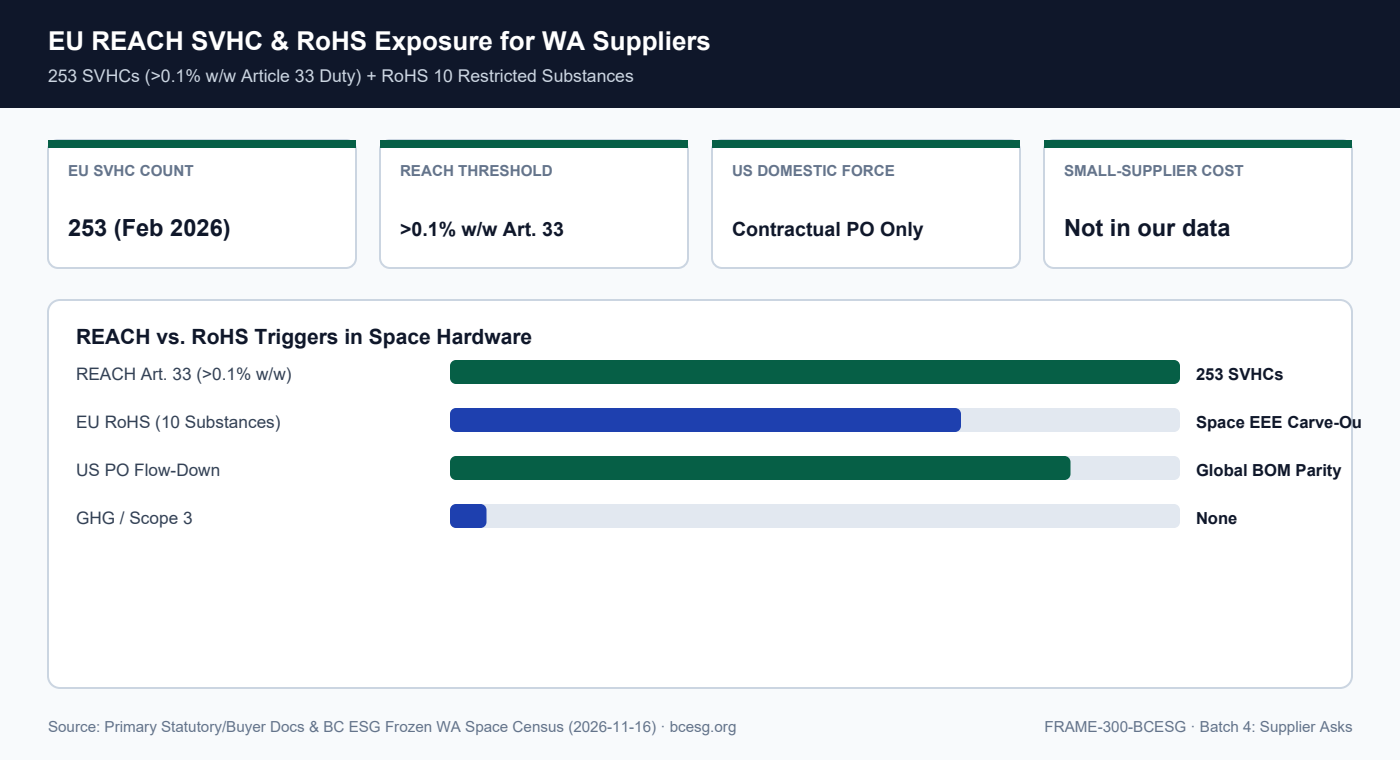
Sourced Baseline: EU REACH (EC 1907/2006, 253 SVHCs as of Feb 2026) and RoHS (2011/65/EU) are binding EU laws for articles/EEE placed on the EU market. On US-only WA suppliers, they apply solely via prime contractual flow-down (e.g., for European launch/satellite customers or global BOMs).
TAKEAWAY BRIEF · PDF & MARKDOWN TWIN
EU REACH SVHC & RoHS Flow-Downs
Download the formatted 2-page briefing sheet (PDF) or read the single-source Markdown twin for EU REACH SVHC & RoHS Flow-Downs.
Who Issues This Ask, Authority, and Binding Status
EU REACH (Regulation (EC) No 1907/2006) and EU RoHS (Directive 2011/65/EU) flow down to Washington space suppliers through primes selling satellites, ground terminals, or components into Europe, or maintaining a single global Bill of Materials.
Legally, EU REACH and RoHS bind only entities placing articles or electrical/electronic equipment (EEE) on the European Union / EEA market. For a WA supplier shipping exclusively to a US prime, REACH/RoHS compliance is not US law—it is contractually binding only if written into the prime's Purchase Order or drawing notes. Note also that RoHS includes specific exemptions for military/aerospace reliability (e.g., tin-lead solder for high-reliability space flight hardware), whereas REACH Article 33 communication applies whenever any of the 253 SVHCs (as of the February 4, 2026 ECHA update) exceeds 0.1% weight by weight.
EU Rule
Current 2026 Threshold / Scope
US Supplier Binding Trigger
EU REACH Art. 33 (SVHC)
253 SVHCs (Feb 2026); >0.1% w/w per article
EU importer/market placement or Prime PO flow-down
EU EEE placement or Prime PO; space/defense exemptions
GHG / Scope 3
Not covered by REACH or RoHS
None (FAR 2021-015 withdrawn Jan 2025)
Evidence Required & Small-Supplier Effort Cost
Suppliers provide a signed REACH Article 33 Declaration (listing any SVHC >0.1% w/w by article, or confirming zero SVHCs above threshold) and a RoHS Certificate of Compliance (citing applicable exemptions such as Pb solder if used in flight-critical assemblies), or submit via IPC-1754 Class E/F.
Internal lab testing or BOM-audit costs are not in our data; most small WA shops rely on upstream distributor/mill Certificates of Analysis and SDSs rather than destructive chemical testing.
BC ESG · WA Space Cluster Supplier Asks (November 16, 2026)
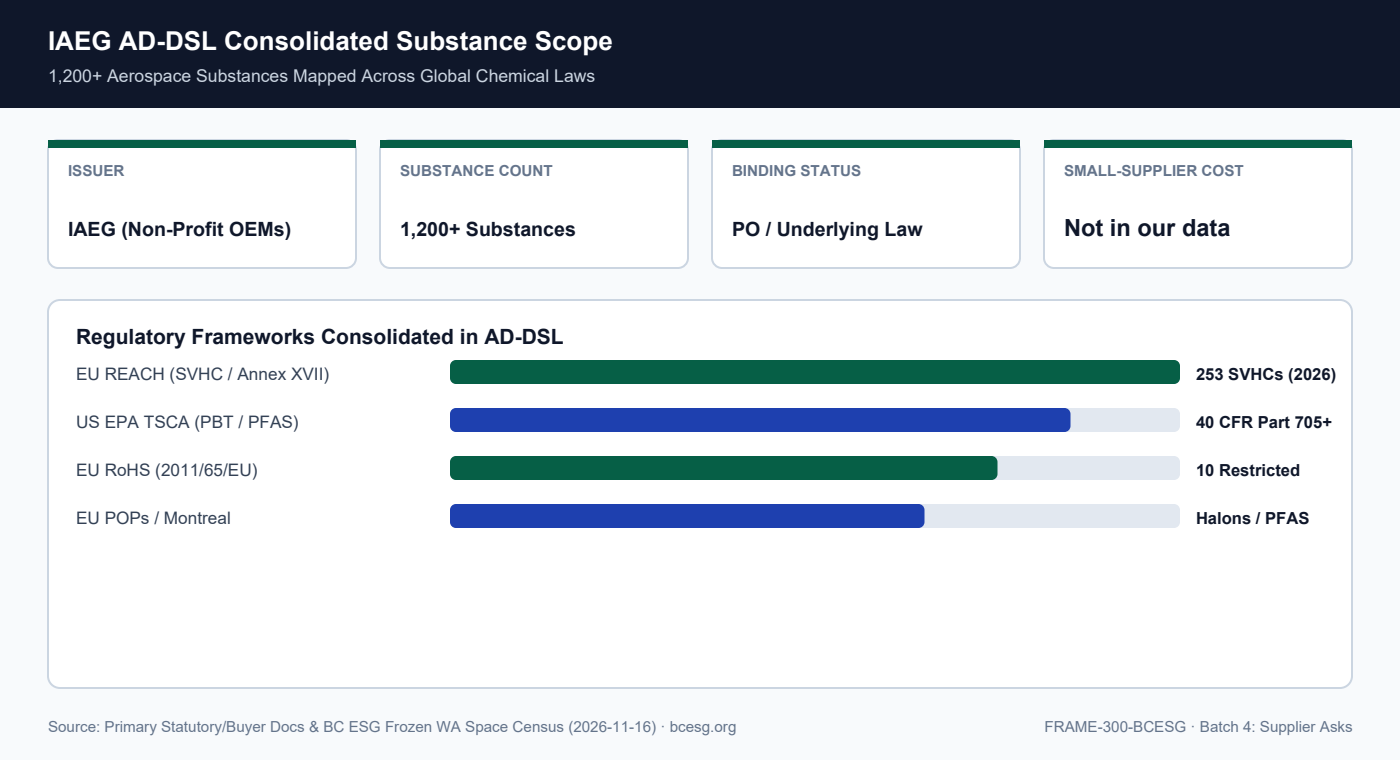
Sourced Baseline: Maintained by the International Aerospace Environmental Group (IAEG), the Aerospace & Defense Declarable Substances List (AD-DSL) consolidates 1,200+ regulated substances (REACH, RoHS, TSCA, POPs). Voluntary industry reference; binding only via OEM POs or the underlying statutes.
TAKEAWAY BRIEF · PDF & MARKDOWN TWIN
IAEG AD-DSL Substances List
Download the formatted 2-page briefing sheet (PDF) or read the single-source Markdown twin for IAEG AD-DSL Substances List.
Who Issues This Ask, Authority, and Binding Status
The Aerospace and Defense Declarable Substances List (AD-DSL) is maintained by the International Aerospace Environmental Group (IAEG)—a non-profit association of global aerospace OEMs including Boeing, Airbus, Lockheed Martin, RTX, Safran, Leonardo, and Rolls-Royce.
AD-DSL itself is a voluntary industry reference list designed to stop OEMs from sending conflicting spreadsheets. However, the underlying chemicals on the list reflect binding statutes (EU REACH, US EPA TSCA, EU RoHS) when products enter those jurisdictions, and AD-DSL screening becomes contractually binding when a prime requires AD-DSL / IPC-1754 declarations in a Purchase Order.
Suppliers check Safety Data Sheets (SDS), mill/plating certifications, and sub-tier supplier declarations against the current AD-DSL substance table, reporting any substance above threshold (typically 0.1% w/w for REACH SVHCs) via IPC-1754 XML or the prime's portal.
IAEG makes AD-DSL reference materials available to the industry; internal engineering/SDS-review hours for a small WA shop are not in our data.
BC ESG · WA Space Cluster Supplier Asks (November 16, 2026)
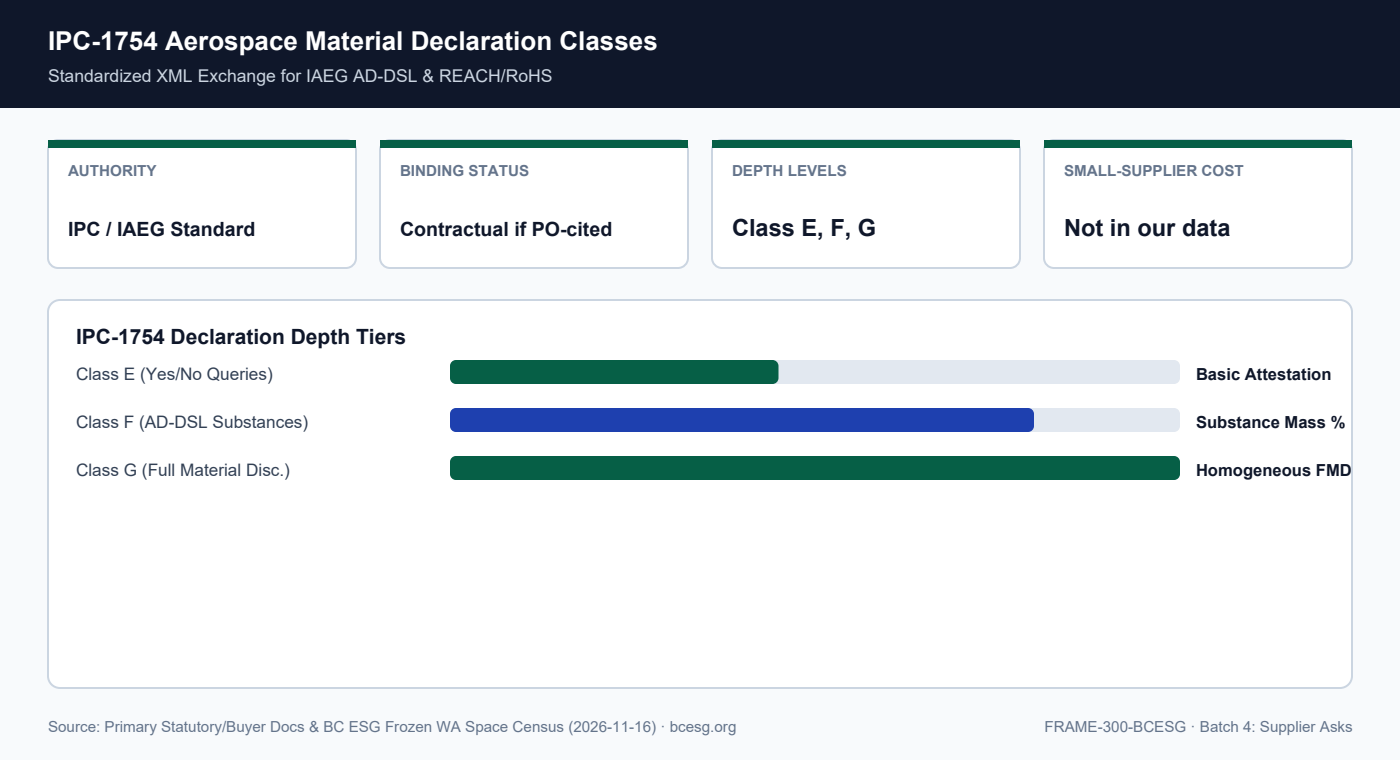
Sourced Baseline: Published by IPC (Global Electronics Association) and adopted by IAEG as the aerospace data-exchange standard for chemical/material declarations (Class E, F, G). Voluntary industry standard; contractually binding when invoked by Boeing or Tier-1 OEMs.
TAKEAWAY BRIEF · PDF & MARKDOWN TWIN
IPC-1754 Material Declarations
Download the formatted 2-page briefing sheet (PDF) or read the single-source Markdown twin for IPC-1754 Material Declarations.
Who Issues This Ask, Authority, and Binding Status
IPC-1754 requests come from major aerospace and defense OEMs—including The Boeing Company and International Aerospace Environmental Group (IAEG) members—seeking standardized chemical composition data for delivered parts and assemblies.
IPC-1754 is a voluntary industry data-exchange standard published by IPC (Global Electronics Association) in coordination with IAEG; it is not a statute. It becomes contractually binding when a prime's engineering drawing, supplier quality manual, or Purchase Order specifies IPC-1754 XML submission. It does not include GHG or Scope 3 emissions data.
Full Material Disclosure (FMD) to homogeneous level
Long-lifecycle flight hardware / obsolescence
Evidence Required & Small-Supplier Effort Cost
Suppliers respond using an IPC-1754-compliant XML declaration (often via customer portals or compliance platforms) at the requested depth: Class E (query-level true/false/unknown compliance), Class F (declarable substance mass or percentage against a list such as IAEG AD-DSL), or Class G (Full Material Disclosure down to homogeneous material level).
Standard purchase fees from IPC and third-party compliance software subscriptions vary by vendor; exact small-supplier compliance costs are not in our data.
BC ESG · WA Space Cluster Supplier Asks (November 16, 2026)
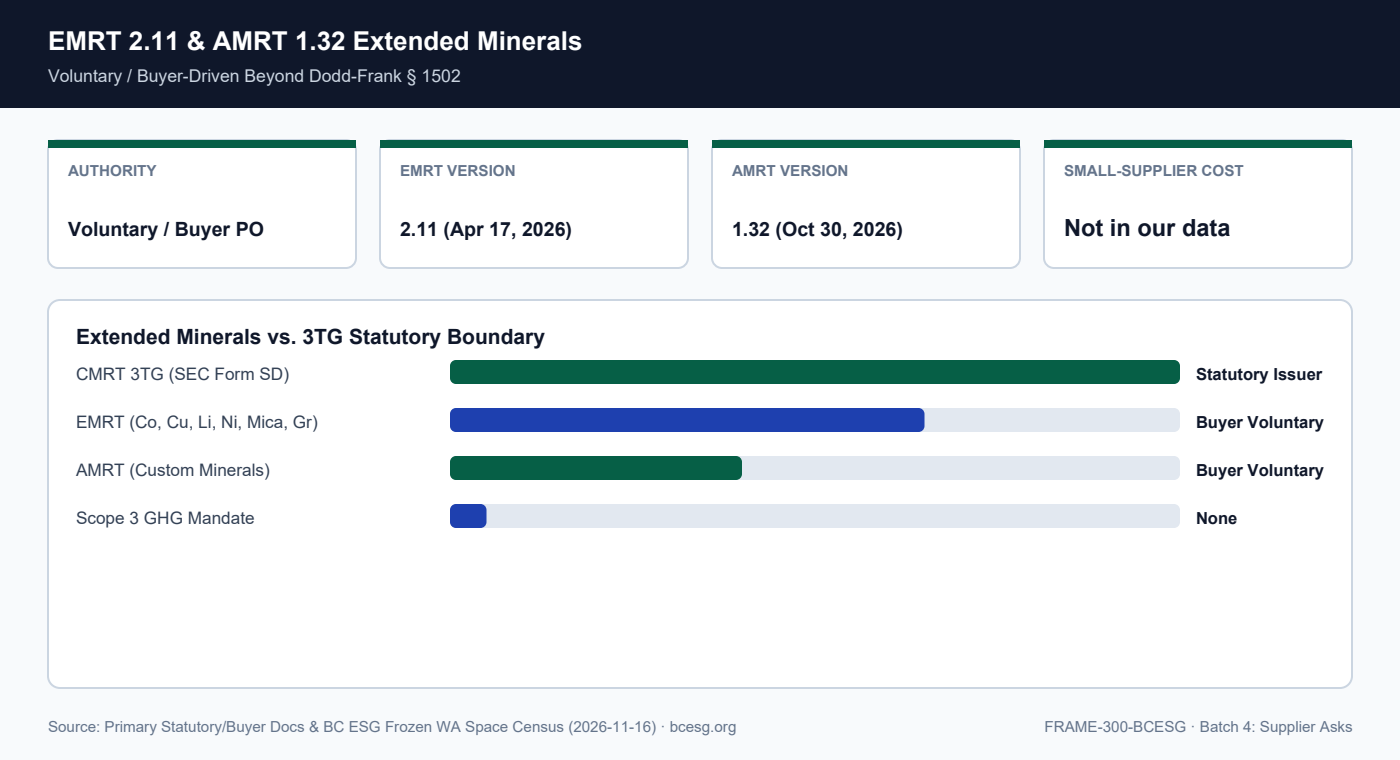
Sourced Baseline: Issued voluntarily by OEMs and battery/electronics buyers using RMI's Extended Minerals Reporting Template (EMRT 2.11, Apr 2026) and Additional Minerals Reporting Template (AMRT 1.32, Oct 2026). Not mandated by SEC Rule 13p-1; binding only if written into a buyer contract.
TAKEAWAY BRIEF · PDF & MARKDOWN TWIN
EMRT 2.11 & AMRT 1.32 Extended Minerals
Download the formatted 2-page briefing sheet (PDF) or read the single-source Markdown twin for EMRT 2.11 & AMRT 1.32 Extended Minerals.
Who Issues This Ask, Authority, and Binding Status
Extended mineral requests arrive via OEM sustainability teams and Tier-1 battery, propulsion, or electronics buyers using the Responsible Minerals Initiative (RMI) EMRT 2.11 (released April 17, 2026, covering cobalt, copper, natural graphite, lithium, natural mica, and nickel) and AMRT 1.32 / 1.32.1 (released October 30, 2026, for buyer-selected minerals).
Unlike 3TG under 17 CFR § 240.13p-1, no US federal statute or SEC rule mandates EMRT or AMRT. These asks are voluntary / customary unless explicitly incorporated as a deliverable in a buyer's purchase contract or supplier quality agreement. They carry no Scope 3 GHG requirement (FAR Case 2021-015 was withdrawn January 13, 2025).
Suppliers satisfy the ask by completing the RMI EMRT 2.11 or AMRT 1.32 Excel workbook (Declaration and Smelter/Refiner tabs) or issuing a written scope statement if supplied parts contain none of the six EMRT minerals.
RMI templates are free to download ($0). Internal supplier labor and smelter-tracing costs are not in our data; WA shops supplying copper busbars, lithium-ion power packs, or nickel-superalloy hardware (Inconel) face the highest traceability lift.
BC ESG · WA Space Cluster Supplier Asks (November 16, 2026)
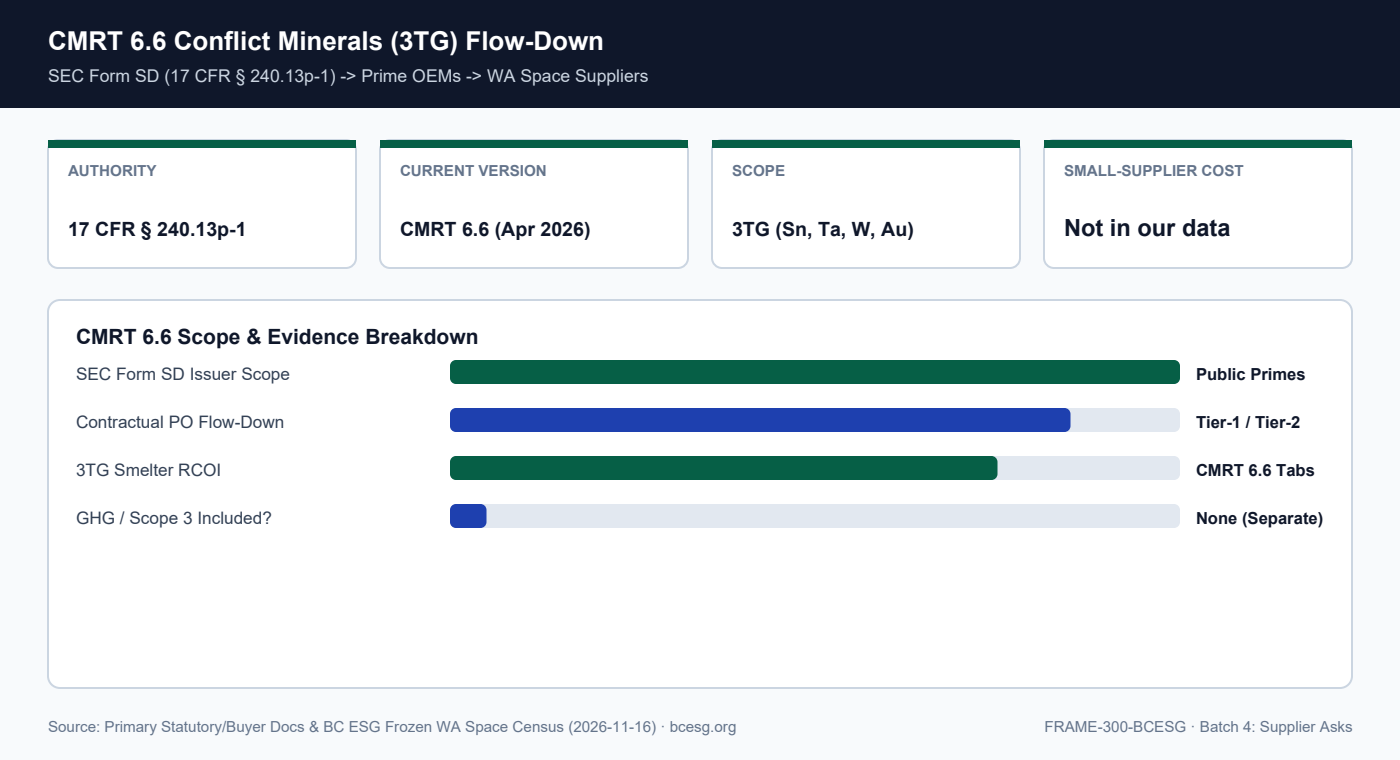
Sourced Baseline: Issued by SEC-reporting aerospace primes and Tier-1 OEMs under SEC Rule 13p-1 (17 CFR § 240.13p-1). Statutorily binding on SEC issuers; contractually binding on private WA suppliers only when incorporated into purchase orders. Current RMI template is CMRT 6.6 (released April 17, 2026).
TAKEAWAY BRIEF · PDF & MARKDOWN TWIN
CMRT 6.6 Conflict Minerals (3TG)
Download the formatted 2-page briefing sheet (PDF) or read the single-source Markdown twin for CMRT 6.6 Conflict Minerals (3TG).
Statutorily, Rule 13p-1 binds only SEC-reporting issuers, not privately held Washington machine shops or electronics assemblers. However, once a prime embeds conflict-minerals flow-down clauses into its Master Terms or Purchase Order, the ask becomes contractually binding on the supplier. Note the dead-rule boundary: CMRT 6.6 covers 3TG minerals only (tin, tantalum, tungsten, gold) and carries zero GHG or Scope 3 reporting mandate; the proposed FAR Climate Rule (FAR Case 2021-015) was withdrawn on January 13, 2025 (90 FR 2663).
Current Template: CMRT 6.6 (released April 17, 2026) adds Requester Product Number/Name fields and updated Smelter Reference Lists.
Binding Status: Contractual flow-down when cited in PO terms; statutory only for SEC issuers.
Dimension
Verified Requirement / Current State
Primary Source
Statutory Authority
SEC Rule 13p-1 (Dodd-Frank § 1502) — Form SD issuers only
17 CFR § 240.13p-1
Supplier Binding Status
Contractually binding when included in Prime PO / Terms
Prime Supplier Terms
Active Template
RMI CMRT 6.6 (released April 17, 2026)
Responsible Minerals Initiative
Materials Covered
Tin, Tantalum, Tungsten, Gold (3TG) only
RMI CMRT 6.6
GHG / Scope 3 Mandate
None; FAR Case 2021-015 withdrawn Jan 13, 2025 (90 FR 2663)
Federal Register
RMI Template Fee
$0 (free download); internal labor cost not in our data
RMI Portal
Evidence Required & Small-Supplier Effort Cost
A supplier satisfies the request by downloading the official CMRT 6.6 Excel workbook from RMI, completing the Declaration tab (answering Questions 1–7 on 3TG presence and Reasonable Country of Origin Inquiry), populating the Smelter List tab with verified RMI Smelter IDs from upstream mill/alloy certificates, and passing the built-in Checker tab with zero errors.
In effort terms, RMI does not charge a fee to download or submit CMRT 6.6. Exact small-supplier labor hours and software costs are not in our data; effort scales with BOM complexity—a single-alloy CNC shop (e.g., 6061 aluminum or 304 stainless with zero 3TG) typically completes a company-level negative declaration in one pass, whereas PCB assemblers using tin-lead/SAC solder and gold-plated connectors must roll up distributor CMRTs.