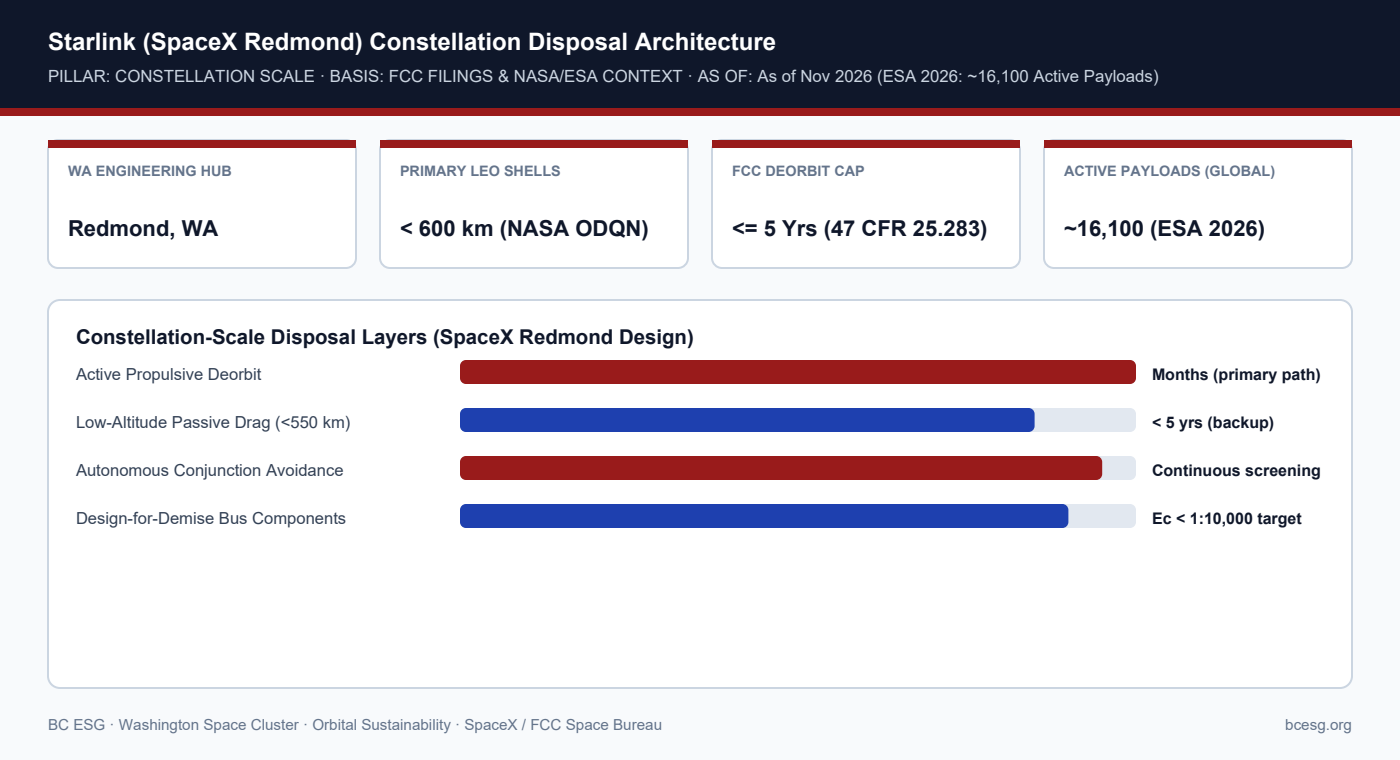
Global active payload count (~16,100) cited from ESA 2026 Space Environment Report (data through end of 2025); Starlink shell context from NASA ODQN (2025–2026).
ORBITAL SUSTAINABILITY · CONSTELLATION SCALE · FCC FILINGS & NASA/ESA CONTEXT
SpaceX Redmond Constellation Disposal
SpaceX's Redmond-engineered Starlink constellation operates primarily below 600 km, pairing onboard Hall-effect thrusters for active propulsive deorbit with low-altitude passive drag backup and demisable bus design to satisfy FCC 5-year and 1:10,000 limits at fleet scale.
Primary Authority / Source: SpaceX / FCC Space Bureau | As-Of / Horizon: As of Nov 2026 (ESA 2026: ~16,100 Active Payloads)
Documented Instrument & Engineering Record
- Redmond engineering anchor: SpaceX's Redmond, WA facility designs and builds Starlink satellites, making Puget Sound a primary engineering center for mega-constellation orbital sustainability.
- Low-altitude safety net: As noted in NASA ODPO's Orbital Debris Quarterly News (ODQN, 2025–2026), Starlink operates primarily below 600 km—where residual atmospheric drag naturally clears defunct spacecraft well inside the 5-year FCC ceiling even if propulsion fails.
- Active propulsive deorbit: Nominal end-of-life satellites use onboard electric propulsion to lower perigee rapidly in months rather than waiting years for passive decay.
- Aggregate casualty scrutiny: At thousands of active satellites—part of ~16,100 functioning payloads worldwide per ESA's 2026 Space Environment Report (data through end of 2025)—regulators evaluate both per-satellite demisability and fleet-wide reentry risk.
Constellation-Scale Disposal Obligations vs. Single-Satellite Rules
| Compliance Dimension | Single-Satellite Baseline | Mega-Constellation Multiplier |
|---|---|---|
| Deorbit Timeline | <= 5 years post-EOM | Months via propulsive descent; <5-yr passive backup |
| Reentry Casualty (Ec) | < 1:10,000 per event | Fleet-wide demisability or controlled reentry |
| Collision Avoidance | Manual / ad-hoc maneuvers | Autonomous onboard conjunction screening |
| Propulsion Reliability | Pass/fail single unit | Statistical failure-rate disclosure in FCC ODMP |
Mission Designer, Compliance Lead & Founder Takeaways
- Operating below ~550–600 km provides a physical passive-decay backstop that higher-altitude constellations lack.
- Suppliers providing avionics, solar arrays, or structural brackets to constellation primes must meet strict material-demisability specs.
- Every constellation replenishment cycle increases launch cadence and reentry mass—driving regulatory focus on aggregate fleet reliability.
Connected Census Profiles, Segments & Rules
- SpaceX Redmond Census Profile
- FCC 5-Year Disposal Rule Mechanics
- Tracked Objects vs. Modeled Debris (2026)