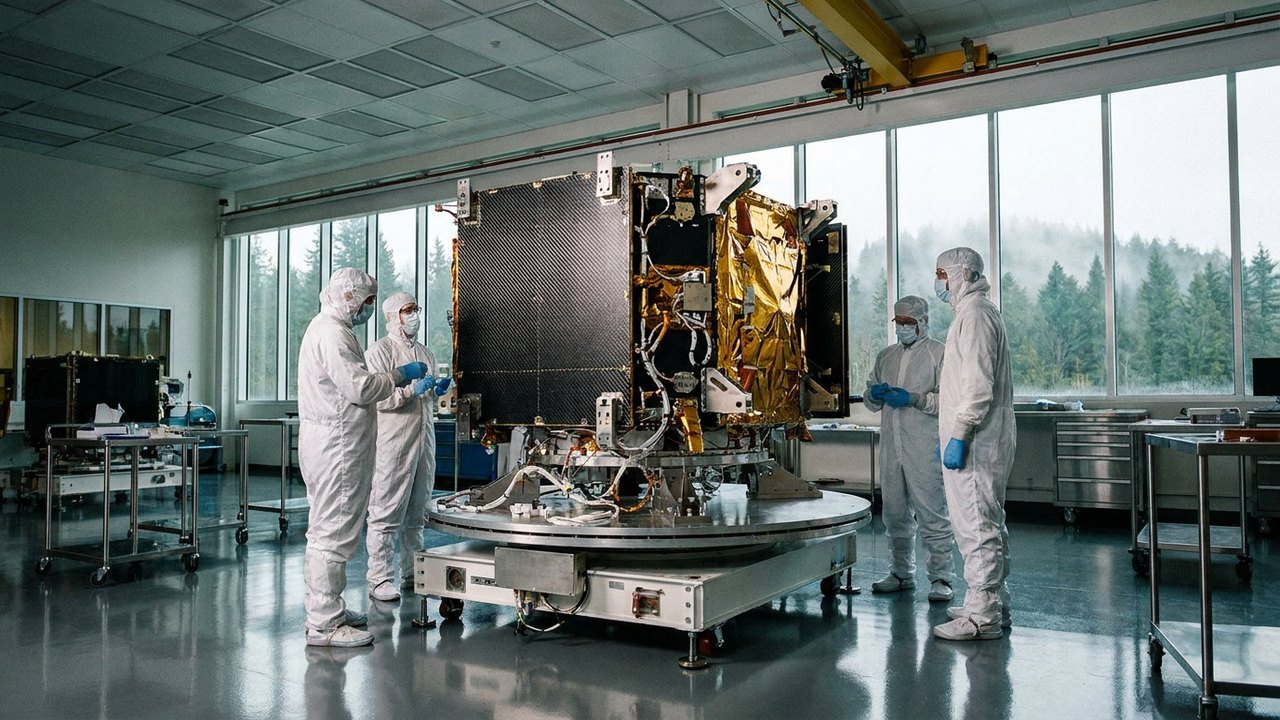
Comparative analysis grounded in Starfish Space public contracts (SDA/SES/NASA) and FCC/ESA frameworks as of 2026-11-16.
ORBITAL SUSTAINABILITY · WA SERVICING & HABITATS · AGENCY CONTRACTS & COMMERCIAL MODELS
Life Extension vs. Active Debris Removal
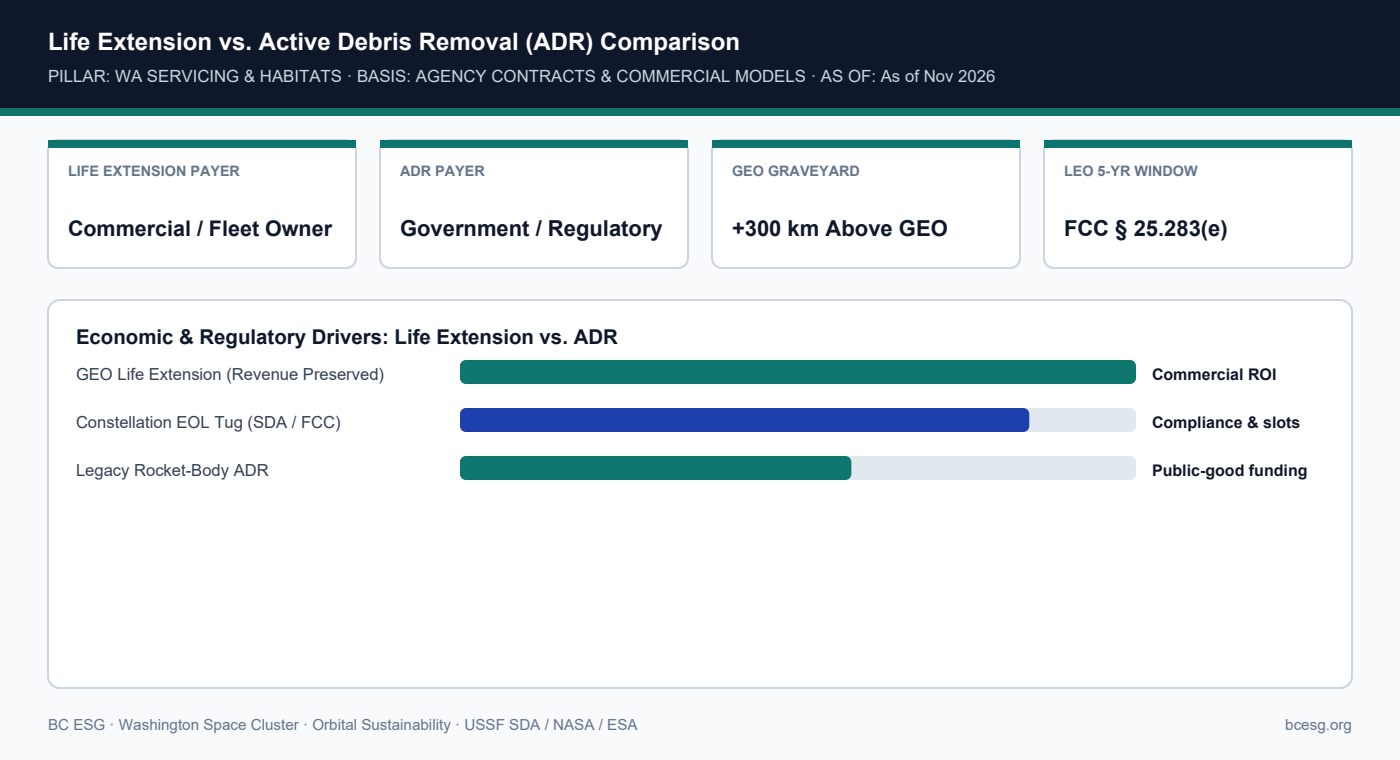
In-space servicing splits into revenue-generating life extension (station-keeping for active GEO/LEO assets) and Active Debris Removal (deorbiting defunct satellites or rocket bodies)—with different payers, liability rules, and FCC/ODAR disposal handoffs.
Primary Authority / Source: USSF SDA / NASA / ESA | As-Of / Horizon: As of Nov 2026
Documented Instrument & Engineering Record
- Two distinct business models: Life extension extends revenue on healthy spacecraft whose propellant is nearly exhausted; ADR removes non-functional objects that generate zero revenue for an owner.
- Why ADR relies on government contracts: Because no private operator earns revenue from removing legacy defunct rocket bodies, ADR is funded primarily by agencies (such as USSF SDA, NASA, or ESA) or triggered by regulatory disposal mandates.
- Disposal handoff: Under FCC § 25.283(e), an operator that loses propulsion in LEO faces a 5-year disposal clock—creating a commercial market for contracted EOL deorbit tugs.
- GEO vs. LEO physics: In GEO, servicers provide station-keeping or move clients to a graveyard orbit (~300 km above GEO); in LEO, servicers lower perigee for atmospheric reentry.
Life Extension vs. Active Debris Removal (ADR) Matrix
| Dimension | Life Extension | Active Debris Removal (ADR) |
|---|---|---|
| Target Asset | Fuel-depleted but functional satellite | Defunct satellite or spent upper stage |
| Primary Buyer | Commercial fleet operator (e.g., GEO) | Government (SDA, NASA, ESA) / compliance |
| Orbital Action | Station-keeping / orbit raise | Perigee lowering for reentry / graveyard |
| Liability Posture | Contractual service agreement | Requires owner consent + govt coordination |
Mission Designer, Compliance Lead & Founder Takeaways
- Compliance leads should not count on unproven third-party ADR as a primary FCC ODMP baseline; regulators expect onboard propulsion or low-altitude passive decay first.
- Servicers like Starfish Space bridge both markets—targeting commercial GEO life extension alongside Space Force SDA LEO disposal contracts.
- Every servicing vehicle must itself comply with 5-year disposal and passivation rules after completing its final client mission.
Connected Census Profiles, Segments & Rules
- Starfish Space Otter Servicing Record
- In-Space Servicing Continuity Exposure
- FCC 5-Year Disposal Rule Mechanics