Short answer: Minnesota’s statewide Large Building Energy Benchmarking Program (Minn. Stat. § 216C.331) reached full Phase 2 coverage on June 1, 2026, requiring commercial and multifamily buildings (5+ units) of ≥50,000 gross sq ft to submit annual energy data to the Minnesota Department of Commerce by June 1.
Equally important for Twin Cities property managers is what happened locally: both St. Paul (Energize Saint Paul) and St. Louis Park discontinued their standalone municipal benchmarking mandates into state law, while Edina narrowed locally to 25,000–49,999 sq ft and Minneapolis continues co-enforcing ≥50,000 sq ft locally.
- Governing Authority: Minn. Stat. § 216C.331.
- Administering Agency: Minnesota Department of Commerce — Large Building Energy Benchmarking Program.
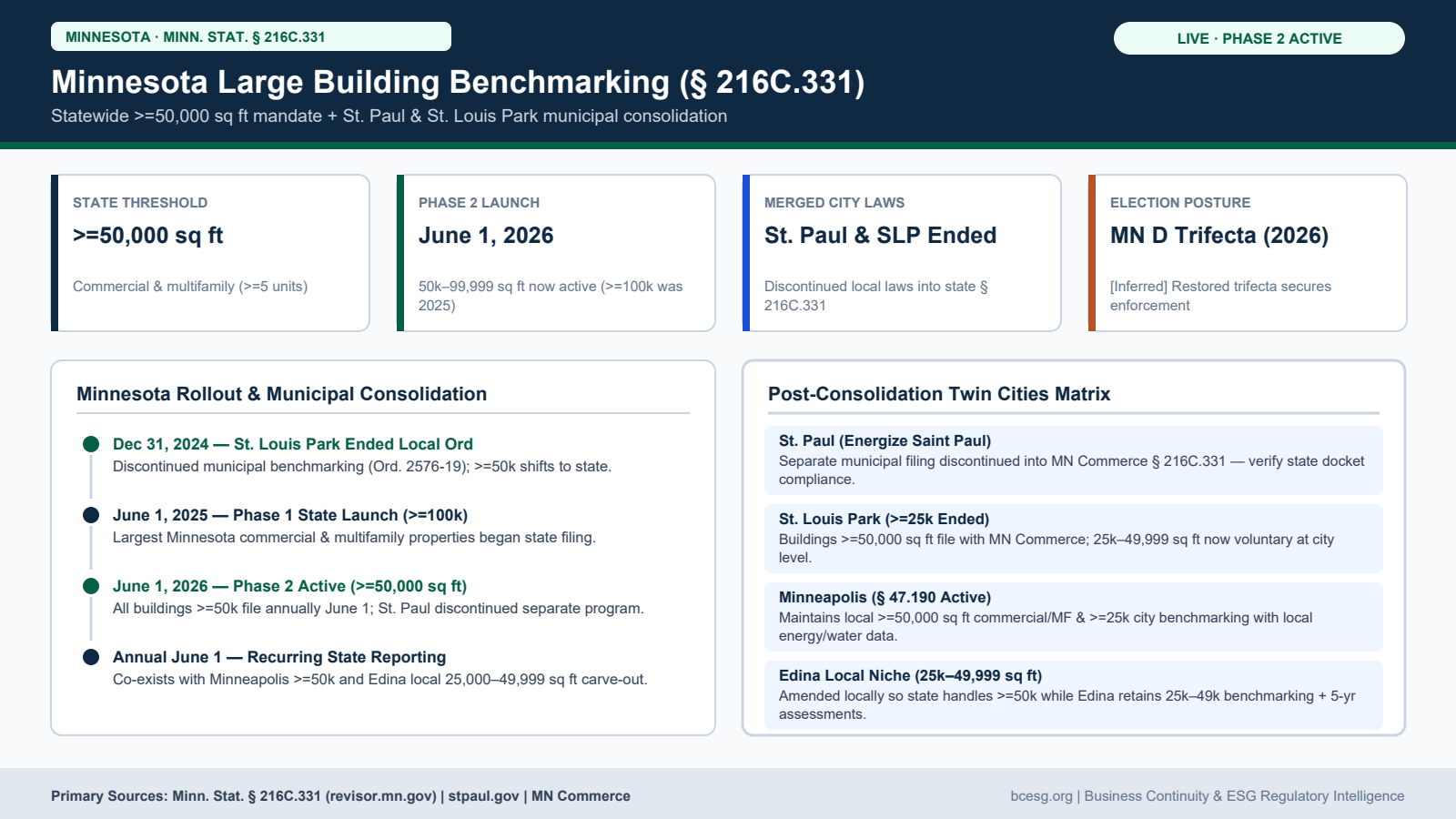
- Covered Threshold & Schedule: ≥100,000 sq ft launched June 1, 2025 (Phase 1); ≥50,000 sq ft active June 1, 2026 (Phase 2); recurring June 1 annually.
- Municipal Consolidations: St. Paul and St. Louis Park retired separate municipal programs into § 216C.331; Edina shifted ≥50k buildings to state law and kept 25k–49,999 sq ft locally.
- Post-2026 Policy Trajectory (Inferred): Minnesota’s November 2026 House shift restoring a unified DFL trifecta increases legislative durability for state benchmarking enforcement and future building-decarbonization bills.
Navigate Minnesota § 216C.331 After St. Paul & St. Louis Park Consolidated Into State Law
Statewide Phased Rollout: From 100k (2025) to >=50k Active Now (2026+)
Minn. Stat. § 216C.331 covers private commercial buildings and multifamily residential buildings with five or more dwelling units across Minnesota’s core metropolitan counties and covered jurisdictions as specified in statute. Phase 1 swept in properties ≥100,000 sq ft for the June 1, 2025 cycle; Phase 2 pulled every qualifying building 50,000 to 99,999 sq ft into active annual June 1 compliance in 2026.
Because Minnesota winters create high space-heating fuel intensity, accurate Portfolio Manager natural gas and district steam normalization—backed by automated Xcel Energy and CenterPoint utility data feeds—is essential before public score release.
| Jurisdiction / Layer | Current Floor & Law | Active 2026–2027 Status |
|---|---|---|
| Minnesota State (§ 216C.331) | Commercial & MF (5+ units) >=50,000 sq ft | ACTIVE NOW — June 1 annual to MN Commerce |
| St. Paul, MN | Former >=50k Energize Saint Paul | DISCONTINUED locally — file via MN § 216C.331 |
| St. Louis Park, MN | Former >=25k Ord. 2576-19 | DISCONTINUED Dec 31, 2024 — >=50k files with state |
| Edina, MN | Amended Efficient Buildings Ord. | Active locally ONLY for 25,000–49,999 sq ft (June 1) |
| Minneapolis, MN | Code Ch. 47 § 47.190 (>=50k) | Active municipal energy + water filing due June 1 |
Twin Cities Consolidation Matrix: St. Paul, St. Louis Park, Edina & Minneapolis
Compliance consultants using outdated 2023–2024 checklists routinely tell Twin Cities owners to submit four separate city reports. That is no longer accurate after Minnesota implemented § 216C.331:
Read alongside our California AB 802 and Massachusetts LBER guides, Minnesota illustrates how state statutes increasingly absorb local ordinances above 50,000 sq ft—leaving smaller municipal niches like Edina’s 25k–49k tier active locally.
- St. Paul (Energize Saint Paul — Discontinued Locally): Replaced by statewide MN Commerce § 216C.331 reporting for ≥50,000 sq ft assets.
- St. Louis Park (Discontinued End of 2024): Former ≥25,000 sq ft municipal mandate ended December 31, 2024; properties ≥50,000 sq ft file with MN Commerce while 25k–49k moved to voluntary sustainability programs.
- Edina (Amended Local Niche 25,000–49,999 sq ft): Defers ≥50,000 sq ft assets to state § 216C.331 while enforcing local June 1 energy/water benchmarking and 5-year energy assessments on 25,000–49,999 sq ft properties.
- Minneapolis (Ch. 47 § 47.190 Active): Continues local energy and water benchmarking due June 1 alongside state § 216C.331 (≥50,000 sq ft private; ≥25k city).
Compliance Execution Checklist
| Step | Owner / Team | Auditable Deliverable |
|---|---|---|
| 1. Jurisdiction Map | Asset Mgmt | Tag each MN asset >=25k sq ft as State-Only (incl. St. Paul / >=50k SLP), Dual Mpls+State, or Edina 25k-49k. |
| 2. Utility Connect | Property Ops | Connect Xcel Energy / CenterPoint automated whole-building Portfolio Manager feeds before April. |
| 3. File by June 1 | Compliance Lead | Submit state § 216C.331 (and Minneapolis/Edina where applicable) by June 1 annually. |
| 4. 2027 Policy Watch | ESG Lead | Track restored MN trifecta committee activity for potential corporate disclosure or BPS bills. |
Keep This Minnesota Compliance Checklist Handy
Frequently Asked Questions
Do buildings in St. Paul or St. Louis Park still file separate city benchmarking reports?
No. Both St. Paul (Energize Saint Paul) and St. Louis Park (effective end of 2024) discontinued their separate municipal benchmarking mandates, consolidating >=50,000 sq ft properties into Minnesota's statewide § 216C.331 program.
What changed in Edina after Minnesota passed § 216C.331?
Edina amended its Efficient Buildings Ordinance so buildings >=50,000 sq ft report to the state while Edina retains local June 1 energy and water benchmarking plus 5-year energy assessments specifically for 25,000–49,999 sq ft buildings.
Does Minnesota § 216C.331 cover residential apartments?
Yes. Multifamily residential buildings with five or more units and >=50,000 gross sq ft are covered alongside commercial properties.
Primary Authorities & Official Resources
- Minnesota Legislature — Minn. Stat. § 216C.331 Large Building Energy Benchmarking
- City of St. Paul — Energize Saint Paul Discontinuation & State Transition Notice
- New Jersey Clean Energy Act Benchmarking Guide — BC ESG
Informational notice: This guide summarizes enacted statutes, regulations, or pending legislative records from the primary authorities linked above as of November 14, 2026. It is not legal, accounting, or licensed engineering advice.