Short answer: Washington’s Clean Buildings Performance Standard (CBPS) is already in active statutory enforcement for the state’s largest nonresidential buildings. Under RCW 19.27A.200–.240 and Washington Department of Commerce rules (WAC 194-50), Tier 1 buildings over 220,000 sq ft faced their initial June 1, 2026 compliance date, followed by staggered 2027 and 2028 deadlines extending down to 20,000 sq ft commercial and multifamily properties.
Unlike pure benchmarking laws that stop at energy score disclosure, Washington CBPS pairs mandatory governance—a designated Energy Manager, a living Energy Management Plan (EMP), and an Operations & Maintenance (O&M) program—with enforceable Energy Use Intensity targets (EUIt) or Life Cycle Cost Analysis (LCCA) investment packages for Tier 1 properties.
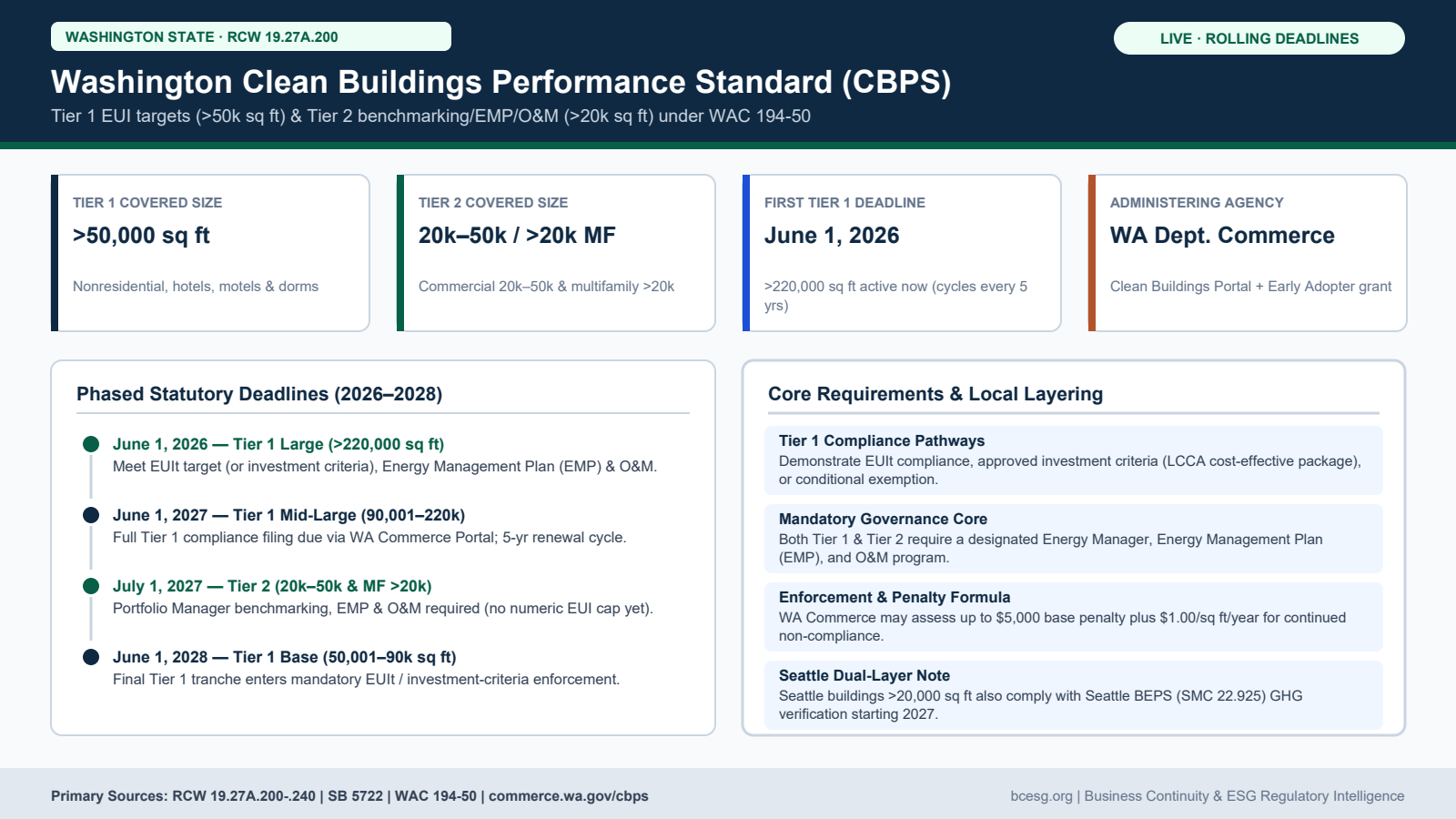
- Governing Authority: RCW 19.27A.200–.240 (HB 1257 of 2019; expanded by SB 5722 of 2022) & WAC 194-50.
- Administering Agency: Washington Department of Commerce Clean Buildings Program.
- Tier 1 Deadlines: June 1, 2026 (>220,000 sq ft); June 1, 2027 (90,001–220,000 sq ft); June 1, 2028 (50,001–90,000 sq ft).
- Tier 2 Deadline: July 1, 2027 for commercial 20,000–50,000 sq ft and all multifamily residential >20,000 sq ft (benchmarking + EMP + O&M).
- Maximum Penalty: Up to $5,000 base fine plus $1.00 per square foot of gross floor area per year of continued Tier 1 non-compliance (Tier 2 carries separate benchmarking/reporting enforcement).
Operationalize Washington CBPS Compliance Across Tier 1 & Tier 2 Assets
Tier 1 vs. Tier 2 Coverage and Phased Deadlines (2026–2028)
Following the 2022 passage of SB 5722, Washington divided covered stock into two statutory tiers using conditioned vs. gross floor area excluding parking garages. Every covered building sits on a recurring 5-year compliance cycle anchored to its size band.
Owners with multi-building campuses should verify whether campus-level or individual-building metering governs their Commerce Clean Buildings Portal account, as single-campus utility feeds alter EUIt baseline normalization.
- Tier 1 (Nonresidential, Hotels, Motels & Dormitories >50,000 sq ft): Must benchmark weather-normalized EUI, adopt an EMP and O&M program, and either meet the assigned property-type EUIt or execute all cost-effective measures identified via an ASHRAE Standard 100 / LCCA investment audit.
- Tier 2 (Commercial 20,000–50,000 sq ft & Multifamily >20,000 sq ft): Currently requires Portfolio Manager benchmarking, an Energy Management Plan, and an O&M manual by July 1, 2027—without a numeric Tier 1 EUIt cap in this initial cycle.
| Building Category | Size & Property Scope | Statutory Duty & Next Deadlines |
|---|---|---|
| Tier 1 — Largest | Nonresidential, hotels, motels, dorms >220,000 sq ft | EUIt / LCCA + EMP + O&M due June 1, 2026 (active; 5-yr cycle) |
| Tier 1 — Mid-Large | Nonresidential, hotels, motels, dorms 90,001–220,000 sq ft | EUIt / LCCA + EMP + O&M due June 1, 2027 |
| Tier 1 — Base | Nonresidential, hotels, motels, dorms 50,001–90,000 sq ft | EUIt / LCCA + EMP + O&M due June 1, 2028 |
| Tier 2 — Small / MF | Commercial 20,000–50,000 sq ft & Multifamily >20,000 sq ft | Benchmarking + EMP + O&M due July 1, 2027 (no EUI cap yet) |
Compliance Pathways, EMP Governance, and Conditional Exemptions
Washington’s Department of Commerce evaluates Tier 1 submissions through three operational doors inside the Clean Buildings Portal. Selecting the wrong pathway late in the cycle creates avoidable audit risk because LCCA engineering studies and O&M logs require at least 12 months of documented execution prior to filing.
If a building operates in Seattle (>20,000 sq ft), remember that compliance with statewide CBPS does not exempt the asset from Seattle’s Building Emissions Performance Standard (SMC 22.925), which adds municipal GHG intensity (GHGI) reporting and verification beginning in 2027. Portfolios crossing the Columbia River should also align schedules with Oregon’s HB 3409 BPS, which mirrors Washington’s Tier 1/Tier 2 architecture.
- EUIt Compliance Path: Demonstrate weather-normalized EUI at or below the Commerce target for your occupancy mix.
- Investment Criteria Path (LCCA): When achieving EUIt is technically or economically infeasible, submit a qualified Energy Audit and Life Cycle Cost Analysis proving every package meeting statutory ROI criteria was installed.
- Conditional Exemptions: Covers low occupancy (<50% physical occupancy during measurement year), agricultural/industrial process loads exceeding 50% of energy use, pending demolition permits, or severe financial hardship verified with Commerce prior to deadline.
Penalties and Financial Risk Comparison Across Jurisdictions
Failure to document an EMP, O&M program, or EUIt compliance under WAC 194-50 triggers formal notices prior to fine assessment. Because maximum statutory fines compound up to $5,000 plus $1.00/sq ft annually, a 150,000 sq ft non-compliant office tower faces up to $155,000 per year in civil exposure before accounting for capital catch-up costs.
Compared against east-coast carbon caps such as NYC Local Law 97 ($268/tCO2e) or Washington D.C. BEPS, Washington’s investment criteria safety valve protects capital-constrained owners—provided documentation begins early enough to run a full 12-month metered O&M cycle.
Compliance Execution Checklist
| Step | Owner / Team | Auditable Deliverable |
|---|---|---|
| 1. Portal Claiming | Asset Mgmt | Verify WA Commerce Clean Buildings Portal building ID, square footage (excl. garage), and Tier 1/2 tiering. |
| 2. EMP & O&M Setup | Chief Engineer | Appoint qualified Energy Manager and launch written EMP + 12-month documented O&M preventive logs. |
| 3. Pathway Audit | PE / ASHRAE Auditor | Run Portfolio Manager EUI gap check; initiate ASHRAE Level 2 / LCCA study immediately if above EUIt. |
| 4. Exemption / Filing | Compliance Lead | Submit conditional exemptions or Early Adopter Incentive claims ahead of June 1 / July 1 statutory dates. |
Keep This Washington State Compliance Checklist Handy
Frequently Asked Questions
Do multifamily apartment buildings have to meet EUIt energy caps under Washington CBPS?
Not under the current statutory cycle. Multifamily residential buildings greater than 20,000 sq ft fall under Tier 2, which requires ENERGY STAR Portfolio Manager benchmarking, an Energy Management Plan (EMP), and an O&M program by July 1, 2027, rather than numeric Tier 1 EUIt limits.
What happens if a Tier 1 building misses its June 1, 2026 compliance date?
The Washington Department of Commerce issues violation notices with mitigation windows before imposing statutory penalties up to $5,000 base plus $1.00 per square foot per year of continued non-compliance under WAC 194-50.
Does complying with Washington CBPS satisfy Seattle BEPS?
No. Covered Seattle buildings greater than 20,000 sq ft must comply with both statewide WA CBPS and Seattle's municipal Building Emissions Performance Standard (SMC 22.925), which introduces GHG emissions verification starting in 2027.
Primary Authorities & Official Resources
- Washington Dept. of Commerce — Clean Buildings Performance Standard (CBPS)
- Revised Code of Washington — RCW 19.27A.200 (Clean Buildings Statute)
- Oregon Statewide BPS (Comparative Tier 1/Tier 2 Cousin) — BC ESG
- Washington, D.C. BEPS Pathways Guide — BC ESG
Informational notice: This guide summarizes enacted statutes, regulations, or pending legislative records from the primary authorities linked above as of November 14, 2026. It is not legal, accounting, or licensed engineering advice.