Updated: November 14, 2026 — Refreshed to reflect current statutory cycles, verification rules, and post-election regulatory posture.
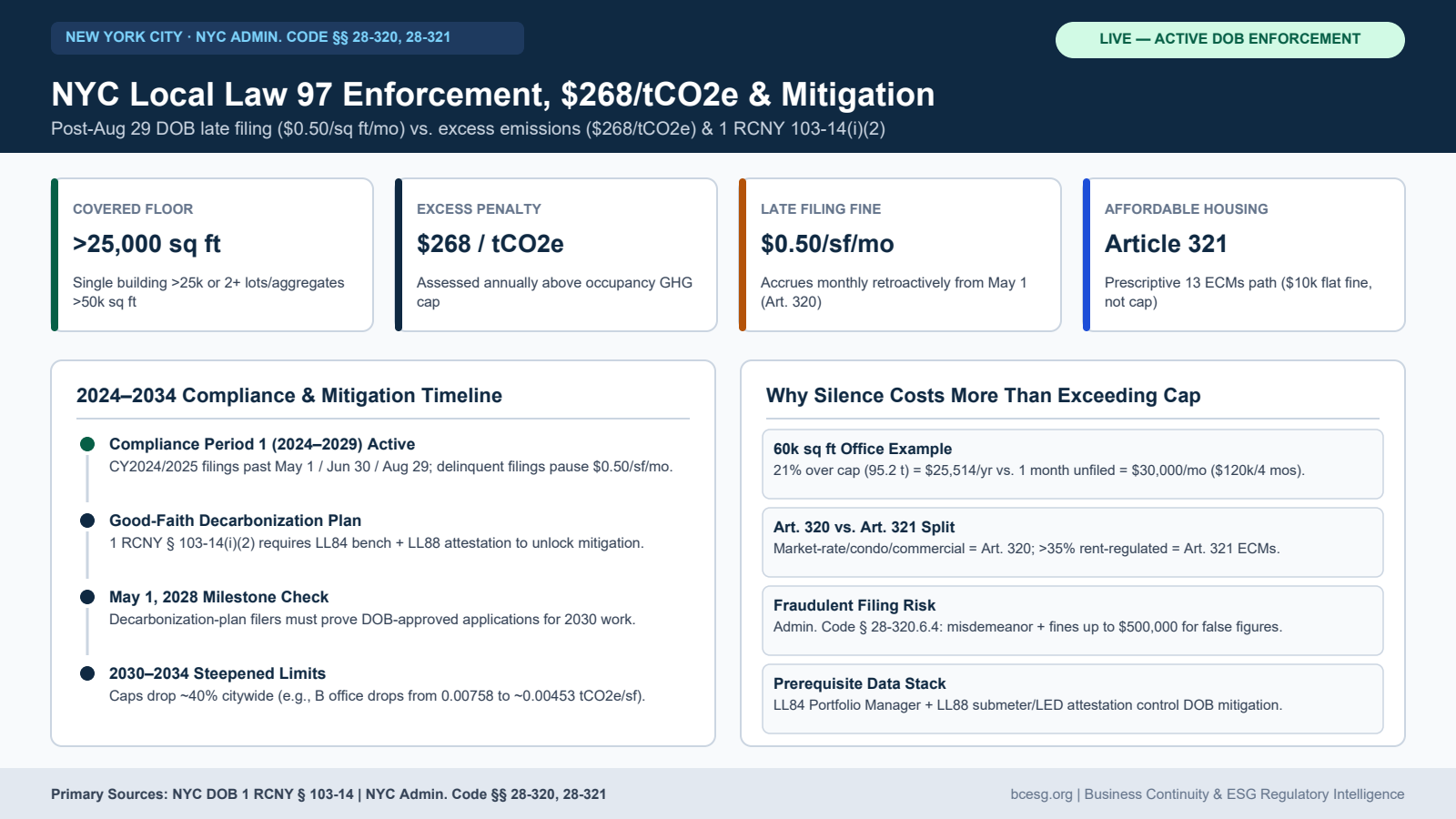
Short answer: With New York City’s Cycle 1 (2024–2029) reporting windows past May 1, June 30, and August 29 and preemption challenges rejected by the New York Court of Appeals in Glen Oaks Village Owners, Inc. v. City of New York, NYC Local Law 97 (Admin. Code §§ 28-320 & 28-321) is in full active DOB enforcement. For unfiled or delinquent covered properties (>25,000 sq ft single building, or >50,000 sq ft across multiple buildings on one tax lot), the immediate cash risk is not the carbon cap itself — it is the compounding $0.50 per square foot per month non-filing penalty running retroactively to May 1.
Once DOB receives a certified Registered Design Professional (RDP) report, monthly late fees stop accruing and evaluation shifts to the underlying occupancy-group cap (e.g., 0.00758 tCO2e/sq ft for Business Group B offices in 2024–2029) and whether the owner qualified for mitigated penalties under 1 RCNY § 103-14(i)(2). Pair this operational manual with our NYC LL84, LL88, LL97 & LL33 Calendar Guide and LL84 Benchmarking Prerequisite Walkthrough.
Statutory Status at a Glance
Covered Thresholds: Single buildings >25,000 gross sq ft; 2+ buildings on the same tax lot >50,000 sq ft; or 2+ condo buildings governed by the same board >50,000 sq ft.
Two Legal Tracks: Article 320 (market-rate commercial, institutional, and residential <=35% rent-regulated) faces annual carbon caps and $268/tCO2e fines; Article 321 (affordable/rent-regulated >35% or NYCHA/HUD-assisted) follows the one-time 13 Prescriptive Energy Conservation Measures (PECMs) or 2030 cap demonstration ($10,000 flat non-compliance fine).
Penalty Asymmetry: An unfiled 60,000 sq ft Group B office at 21% over cap incurs ~$25,514/year for emissions vs. $30,000/month ($120,000 over 4 months) simply for remaining unfiled past May 1.
Good-Faith Mitigation Gate: Under 1 RCNY § 103-14(i)(2), owners invoking a Decarbonization Plan must hold submitted LL84 benchmarking and LL88 lighting/submetering attestations on file and hit the May 1, 2028 DOB permit/approval milestone.
2030 Cliff Prep: Cycle 2 (2030–2034) drops commercial Group B office intensity caps roughly 40% (~0.00453 tCO2e/sq ft), shifting electrification economics well ahead of 2029.
Print-First Compliance Brief
Download the NYC Local Law 97 Enforcement & Mitigation Reference
2-page Print-First PDF covering DOB’s $0.50/sq ft/month vs. $268/tCO2e penalty math, Article 320 vs. Article 321 rules, and 1 RCNY § 103-14(i)(2) good-faith mitigation.
Late-Filing Mathematics vs. $268/tCO2e Carbon Caps & Criminal Misstatement Risk
Building owners who miss annual May 1 reporting (or approved June 30 / August 29 extension windows) often confuse carbon-overage liability with administrative filing delinquency. Under NYC Admin. Code § 28-320.6, the $0.50/sq ft/month failure-to-file penalty is statutory, accumulates continuously from May 1 until DOB accepts a certified filing, and cannot be waived simply because actual emissions sat below the occupancy cap.
Equally critical is filing accuracy. Under Admin. Code § 28-320.6.4, knowingly submitting a false LL97 report or fraudulent Registered Design Professional attestation is a misdemeanor carrying fines up to $500,000. Owners resolving delinquent filings must reconcile Portfolio Manager meter boundaries, co-gen/steam coefficients, and space-type square footage directly against DOB property records.
Filing First Stops the Bleed: Even if final emissions confirm an overage at $268/tCO2e, submitting the certified filing halts the monthly $0.50/sq ft clock immediately.
Extension Mechanics (1 RCNY § 103-14): Standard extensions run only through timely May 1/June 30 administrative requests; once an un-extended deadline passes, DOB treats the parcel as delinquent.
Renewable Energy Credits (RECs) & Deductions: Only NYSERDA Tier 4 NYC-deliverable RECs (credited strictly against electricity emissions) qualify — general out-of-state voluntary RECs do not offset LL97 overages.
Track & Citation
Covered Building Scope
Primary Compliance Metric
Maximum Statutory Penalty
Article 320 (2024–2029)
Commercial, condo & residential <=35% rent-regulated >25k sf
Occupancy GHG limit (e.g., 0.00758 tCO2e/sf Group B)
Steepened limits (~0.00453 tCO2e/sf Group B office)
$268/tCO2e + stricter false-filing rules
NYC Local Law 97 enforcement posture under Admin. Code §§ 28-320 and 28-321: late-filing exposure vs. excess emissions penalties and good-faith decarbonization plan prerequisites.
For Article 320 buildings unable to meet 2024–2029 limits economically on day one, 1 RCNY § 103-14(i)(2) offers mitigated penalties — provided the owner filed LL84 benchmarking on time, completed LL88 lighting and submetering attestations, and submitted a stamped Decarbonization Plan demonstrating net-zero 2050 alignment with no REC offsets allowed inside that mitigation period.
Meanwhile, Article 321 qualifying properties (buildings with >35% rent-regulated units, Mitchell-Lama, or HDFC cooperatives) operate on an entirely separate track: demonstrating compliance either with the 2030 emissions limit or installing all 13 applicable Prescriptive Energy Conservation Measures (pipe insulation, steam traps, low-flow fixtures, weatherization, etc.), where missed filings draw a $10,000 flat violation rather than $268/tCO2e.
Decarbonization Plan Lock-In: Choosing good-faith mitigation waives REC compliance through 2029 and legally commits the asset to securing DOB-approved work permits by May 1, 2028.
State-Local Portfolio Note: New York’s executive-order state benchmarking covers state-owned assets only — private NYC landlords follow LL97 and LL84 as their exclusive statutory baseline.
Compliance Execution Checklist
Step
Owner / Team
Auditable Deliverable
1. Prerequisite Gate Check
Property / Compliance
Verify LL84 Portfolio Manager acceptance and LL88 attestation on DOB NOW.
2. Art. 320 vs 321 Confirm
Legal / Tax Lot Counsel
Pull DHCR/HPD rent-regulation counts or tax-lot square footage from DOF records.
How do NYC Local Law 97 late-filing fines compare to the $268/tCO2e emissions penalty?
Under NYC Admin. Code § 28-320.6, failing to file an LL97 report incurs $0.50 per gross square foot per month starting May 1. For a 60,000 sq ft office moderately above cap, four months unfiled costs $120,000 — nearly five times a full year's $25,514 overage penalty.
What does an Article 320 Good-Faith Effort mitigation plan require?
Under 1 RCNY § 103-14(i)(2), owners must demonstrate on-time LL84 benchmarking, LL88 lighting/submetering attestation, and an RDP-stamped Decarbonization Plan with DOB-approved construction applications by May 1, 2028.
Is Local Law 97 still facing preemption litigation?
No. In Glen Oaks Village Owners, Inc. v. City of New York (2025), the New York Court of Appeals ruled in the City's favor, confirming New York State's CLCPA did not preempt NYC's local emissions caps.
Informational notice: This guide summarizes enacted statutes, regulations, or pending legislative records from the primary authorities linked above as of November 14, 2026. It is not legal, accounting, or licensed engineering advice.
If investors or regulators ask how you manage algorithmic risk in ESG data and decisions, this 2026 guide covers governance, documentation, and disclosure patterns.
AI systems have graduated from “nice to have” technology to material ESG risk. The landscape shifted decisively in 2026, and organizations that haven’t built AI governance frameworks are now facing disclosure obligations they didn’t anticipate.
The convergence of three regulatory forces—the EU AI Act’s high-risk tier implementation, the CSRD (Corporate Sustainability Reporting Directive) inclusion of AI as an ESG material risk, and a wave of US state-level AI transparency laws—has created a new reality: AI governance is now a boardroom issue, not just an IT issue.
The Regulatory Landscape Shift in 2026
The EU AI Act entered full implementation for high-risk systems in 2026. High-risk designation now covers AI used in critical infrastructure, employment decisions, credit decisions, and any system that can create legal or similarly significant effects. Organizations deploying these systems must maintain technical documentation, implement human oversight mechanisms, and maintain detailed audit logs—or face fines up to 6% of global revenue.
The California AI Transparency Act took effect January 1, 2026, requiring disclosure of AI-generated content and detailed training data provenance. This isn’t optional disclosure to regulators; it’s disclosure to users and consumers. A California-based company deploying AI in customer-facing roles must now disclose that fact and describe where the training data came from.
Texas passed the Responsible AI Governance Act and Colorado enacted the AI Act, both focused on algorithmic discrimination prevention. These states are now requiring algorithmic impact assessments for any AI system used in hiring, lending, housing, or insurance decisions. Texas explicitly requires evidence that algorithms don’t discriminate by protected class; Colorado mandates algorithmic transparency and opt-out mechanisms.
CSRD, now in full effect for many EU organizations, has formalized AI governance as a material ESG risk category alongside climate, labor, and supply chain. If your organization uses AI to make consequential decisions or creates algorithmic bias risk, CSRD requires disclosure in your sustainability report—just as you’d disclose Scope 2 emissions.
The Disclosure Obligation Framework
Here’s what ESG teams and compliance officers need to understand: AI governance disclosure falls into three overlapping buckets.
Algorithmic Accountability Disclosure: What AI systems does your organization deploy? What decisions do they influence? What safeguards are in place to prevent discrimination or harm? This is the California AI Transparency Act requirement. It’s also what CSRD reviewers will ask about. The disclosure should include: system purpose, training data sources, human oversight mechanisms, and documented testing for bias and accuracy.
Explainability and Human Oversight: Can you explain how the algorithm makes decisions? Who reviews those decisions? This is the core of EU AI Act compliance for high-risk systems. The requirement isn’t perfect explainability—it’s documented human oversight and a mechanism to challenge algorithmic decisions. Insurance underwriting AI? That means having a human underwriter review or spot-check claims. Employment AI? That means someone can explain to a candidate why they weren’t hired.
Governance Process Disclosure: How does your organization govern AI systems? Who approves new deployments? How do you monitor for drift, bias, or performance degradation? CSRD reviewers want evidence of governance structure: a chief AI officer or designated AI governance committee, documented policies, regular audit procedures, and clear escalation paths when issues arise.
The Cross-Sector Implementation Challenge
AI governance requirements look different depending on your industry, but the core disclosure obligation is universal. Here’s how this plays out in four critical sectors:
Property Restoration & Insurance Claims: Organizations using AI-powered damage assessment tools (drone imagery analysis, computer vision systems) must disclose the accuracy rates of those systems, the human review process when AI assessments seem incorrect, and the liability framework when AI assessments are wrong. Read the restoration sector analysis here. The restoration industry adopted AI assessment tools faster than governance frameworks kept pace—2026 is the year that gap gets exposed.
Insurance Underwriting & Risk: State insurance commissioners are conducting detailed examinations of algorithmic underwriting and pricing models. Carriers must now disclose which variables their algorithms use, prove those variables don’t correlate with protected classes, and maintain an appeal process when an applicant challenges an algorithmic decision. The insurance sector governance framework is detailed here. Carriers using AI in claims handling face parallel requirements: transparency about which claims are routed to automated decision-making, what percentage of claims are adjudicated purely by algorithm, and human appeal mechanisms.
Business Continuity & Operational Resilience: The newer risk—and the one most organizations haven’t addressed—is AI dependency as a single point of failure. When GenAI tools, workflow automation, or AI-powered decision support systems go down, how long before operations halt? Business continuity governance for AI is explored in detail here. BC teams need to map AI systems into their Business Impact Analysis and develop resilience strategies for when vendor tools or internal AI systems fail.
Healthcare Facility Operations: The FDA’s Quality Management System Regulation, effective in 2026, now treats AI and machine learning medical devices under expanded oversight. CMS is flagging AI systems in clinical decision-making. Healthcare facility governance requirements are outlined here. The complexity: clinical AI (diagnostic support, treatment planning) and operational AI (predictive maintenance, scheduling) follow different regulatory tracks, but both need governance.
Building the Governance Framework
Organizations that move fast in 2026 will establish an AI governance framework with these components:
AI System Inventory: Document every AI system in use: internal tools, SaaS platforms, embedded vendor algorithms. For each, record: purpose, decision authority (does it decide or recommend?), training data source, accuracy metrics, human review process, and last audit date.
Risk Assessment Protocol: Assess each system’s ESG risk: Does it affect protected classes? Does it influence consequential decisions? Could failure cause operational harm? High-risk systems get more rigorous oversight.
Governance Accountability: Assign clear accountability: Who approves new AI deployments? Who monitors for bias and drift? Who handles escalations when AI systems fail or produce unexpected outcomes? This should ladder up to the board or an audit committee.
Documented Human Oversight: For high-risk systems, document the human oversight mechanism. This doesn’t mean humans should override every algorithmic decision; it means someone can explain the decision and has the authority to escalate or appeal it.
Regular Audit and Testing: Establish a cadence for testing AI systems—at minimum annually—for accuracy, bias, drift, and compliance with documented performance standards. Document the results.
Disclosure Readiness: Prepare your ESG disclosure now. Be ready to answer: What AI systems do you use? How do you govern them? What safeguards are in place? What testing have you done? CSRD reviewers, state regulators, and proxy advisory firms are going to ask these questions. Organizations with documented frameworks will move through audits far more quickly.
The Convergence Risk
The real challenge isn’t any single regulation. It’s the convergence: CSRD disclosure requirements + EU AI Act penalties + California transparency obligations + state-level algorithmic discrimination rules = a comprehensive governance obligation that most organizations haven’t integrated.
The organizations building advantage in 2026 are the ones treating AI governance not as a compliance checkbox but as a core ESG and operational risk framework. They’re integrating it into capital allocation, vendor evaluation, and board reporting. They’re making algorithmic accountability a competitive advantage, not a liability.
Your ESG team, compliance team, IT team, and board need to align on AI governance right now. The regulatory window for moving fast and building legitimate frameworks is open in Q2 and Q3 2026. By Q4, regulators will have sharper guidance on enforcement, and the organizations without documented frameworks will be scrambling.
KPI Design for ESG Performance: Leading Indicators, Lagging Metrics, and Target-Setting Frameworks
Updated October 6, 2026.
If you are designing ESG KPIs for board or CSRD reporting, this guide distinguishes leading vs lagging indicators and target-setting practices.
ESG KPI Definition: Environmental, social, and governance key performance indicators (KPIs) are quantifiable metrics that measure ESG performance, inform decision-making, and demonstrate progress toward strategic objectives. Effective KPI systems balance leading indicators (predictive, activity-based) with lagging indicators (outcome-based, retrospective) aligned with GRI Standards, ISSB frameworks, and business strategy.
Editable Desk Workbook • 3 Linked Sheets • Live Formulas
Download the editable Excel workbook pre-populated with 24 Leading & Lagging KPIs across E, S, and G pillars (CSRD/ESRS, ISSB & GRI aligned, RACI owners, and live Variance / % Progress / RAG formulas), or preview the Summary Sheet PDF first.
KPIs form the quantitative backbone of ESG performance management. Well-designed KPIs enable organizations to:
Translate ESG strategy into measurable objectives
Track progress toward targets and identify performance gaps
Enable accountability through performance management systems
Support investor communication and ESG rating provider submissions
Drive organizational alignment around shared ESG priorities
Identify emerging risks and opportunities through early warning signals
Effective KPI systems integrate three critical elements: leading indicators that predict future outcomes, lagging indicators that measure actual results, and aligned targets that establish clear performance expectations. This comprehensive approach enables both proactive management and transparent accountability.
Leading Indicators vs. Lagging Indicators
Understanding Leading Indicators
Leading indicators are activity-based metrics that predict future outcomes. They measure inputs, activities, or intermediate outcomes that influence ultimate results. Leading indicators enable organizations to:
Predict future performance: Leading indicators signal future results, enabling proactive adjustments
Enable early intervention: Organizations can address issues before they manifest as performance failures
Support continuous improvement: Early feedback enables rapid iteration and optimization
Demonstrate management effectiveness: Leading indicators reflect management actions and priorities
Understanding Lagging Indicators
Lagging indicators measure actual outcomes and ultimate results. They reflect the combined impact of all activities and are less controllable in the short term. Lagging indicators provide:
Accountability for results: Clear measurement of actual achievements versus targets
Outcome validation: Confirmation that activities produce intended results
Comparability: Standard metrics enabling peer comparison and investor assessment
Materiality alignment: Outcomes that directly reflect material ESG impacts
Leading and Lagging Indicators by ESG Pillar
Environmental KPIs
Issue Area
Leading Indicators
Lagging Indicators
Climate & Emissions
Energy audits completed, renewable energy investments, efficiency projects launched, green team participation
Effective KPIs emerge from double materiality assessments identifying issues critical to the business and stakeholders. KPIs should:
Address issues in the high-high quadrant of materiality matrices (high financial and impact materiality)
Support strategic ESG objectives and business imperatives
Align with long-term business strategy and value creation
Reflect stakeholder priorities and expectations
Step 2: Select Indicators Aligned with Established Frameworks
Leading frameworks provide established metrics ensuring consistency and comparability:
GRI Standards: Sector-specific metrics covering environmental, social, and governance issues
ISSB Standards: Climate-related disclosures and sustainability metrics focused on investor relevance
CSRD/ESRS: Required metrics for EU-listed companies
Industry-specific standards: Sector frameworks (e.g., SASB for specific sectors)
Science-based targets: Climate targets aligned with climate science
Step 3: Design the Leading Indicator System
Leading indicators should be:
Within management control: Reflect activities and initiatives that managers can directly influence
Timely: Measured frequently (monthly, quarterly) to enable real-time management
Predictive: Demonstrably correlate with future lagging indicator outcomes
Actionable: Provide clear implications for management decisions
Balanced: Mix of activity-based (programs launched, people trained) and intermediate outcome metrics
Example – Climate Leading Indicator System:
A manufacturing company establishes leading indicators for carbon emissions reduction:
• Energy audits completed (by facility, by quarter)
• Renewable energy MW contracted or installed
• Energy efficiency projects with positive ROI approved and funded
• Employee green team participation rate
• Supplier Scope 3 emissions reduction commitments received
These leading indicators predict future emissions reductions by tracking activities that drive change.
Step 4: Design the Lagging Indicator System
Lagging indicators should be:
Material to stakeholders: Measure outcomes that matter to investors, regulators, and communities
Comparable: Align with industry standards and peer metrics enabling benchmarking
Verified: Independently auditable and subject to third-party assurance
Historical: Tracked consistently over multiple years enabling trend analysis
Boundary-clear: Transparent scope (direct operations, supply chain, value chain)
Example – Climate Lagging Indicator System:
The same manufacturer measures actual carbon outcomes:
• Absolute Scope 1 emissions (mtCO2e annually)
• Absolute Scope 2 emissions (mtCO2e annually)
• Scope 3 emissions from purchased goods and services (mtCO2e annually)
• Carbon intensity (mtCO2e per unit production, per $ revenue)
• Year-over-year emissions reduction rate (%)
These lagging indicators demonstrate whether leading indicator activities produced intended emissions reductions.
Target-Setting Frameworks
Science-Based Targets (SBT)
For climate metrics, science-based targets aligned with limiting global warming to 1.5°C or 2°C provide credible, externally validated targets:
Targets relative to peer performance or industry averages:
Peer comparison: Aim to be in top quartile of industry on specific metrics
Best-in-class: Match or exceed leading companies in industry sector
Advantages: Credible, achievable, understandable to stakeholders
Limitations: May not be ambitious if industry lagging on ESG
Trajectory-Based Targets
Targets based on historical improvement rates and future trajectory:
Linear reduction: Equal percentage reduction each year (e.g., 5% annually)
Accelerating reduction: Faster reduction over time as efficiency improvements compound
Baseline approach: Set baseline year (typically most recent full year) and establish targets relative to baseline
Stakeholder-Defined Targets
Targets informed by stakeholder expectations and needs:
Investor expectations: Targets aligned with investor guidance and capital market expectations
Regulatory requirements: Targets meeting or exceeding regulatory minimums
Community needs: Targets addressing specific community concerns and priorities
NGO commitments: Targets aligning with NGO commitments and industry initiatives
KPI Measurement and Data Governance
Data Collection Systems
Reliable KPI systems require robust data collection:
Primary data: Direct measurement from company operations (utility bills, employee records, safety systems)
Secondary data: Information from suppliers, partners, and external databases
Estimation methods: Well-documented approaches for data gaps or partial information
System integration: ERP, HR, sustainability, and operational systems contributing to KPI data
Quality Assurance
Data quality is critical for KPI credibility:
Accuracy: Regular audits confirming data reflects actual performance
Completeness: Comprehensive coverage of relevant operations and business units
Consistency: Uniform definitions and measurement methodologies across organization
Timeliness: Data available for timely decision-making and performance management
Traceability: Clear audit trails documenting data sources and calculations
Assurance and Verification
Credibility requires external verification:
Third-party assurance: Limited or reasonable assurance from external auditors or consultants
Internal audit: Audit committee oversight of ESG data and systems
Financial audit integration: Growing integration of ESG metrics into financial audit scope
Public disclosure: Transparent reporting of assurance scope and findings
Integrating KPIs with Business Performance
Executive Compensation Linkage
Linking executive compensation to ESG KPIs drives organizational alignment:
Compensation structure: 10-25% of variable compensation typically tied to ESG KPIs
Balance: Equal weighting of ESG KPIs with financial metrics
Governance: Board committee oversight of ESG KPI selection and performance assessment
Transparency: Clear disclosure of KPI targets and actual achievement
Operational Management Integration
ESG KPIs should integrate with operational management:
Balanced scorecard: ESG KPIs alongside financial and operational metrics
Strategic alignment: KPIs linked to strategic objectives and business unit accountability
Real-time dashboards: Visual management systems enabling team-level tracking and accountability
Performance reviews: Individual performance assessment including ESG KPI contribution
Frequently Asked Questions
Q: How many KPIs should organizations track?
Most organizations track 10-20 core KPIs across ESG pillars, with additional metrics for specific material issues. More KPIs increase measurement burden and dilute focus. Best practice emphasizes quality over quantity—fewer, well-designed indicators drive better management than numerous metrics.
Q: How frequently should KPIs be reviewed?
Leading indicators should be reviewed monthly or quarterly for real-time management. Lagging indicators are typically reviewed quarterly and annually. The full KPI system should undergo annual review to assess continued relevance, with reassessment if material issues change significantly.
Q: Can organizations use external benchmarking for ESG KPIs?
Yes, benchmarking provides valuable context for ESG performance. Peer comparison helps organizations understand competitive positioning and identify improvement opportunities. However, KPIs should reflect internal materiality assessment rather than external benchmarking alone. Leading ESG organizations establish ambitious targets exceeding peer averages.
Q: How should organizations handle data limitations or estimation?
Organizations should disclose data limitations transparently. GRI Standards permit estimation where direct measurement is unavailable, provided estimation methodologies are documented and disclosed. As measurement systems mature, estimation should progressively be replaced with direct measurement. Significant estimation should be flagged for stakeholder awareness.
Q: How do KPIs relate to ISSB and CSRD requirements?
ISSB standards focus on investor-relevant KPIs addressing financial materiality. CSRD requires comprehensive KPIs addressing both financial and impact materiality. Organizations should establish KPIs addressing both standards’ requirements, with CSRD requirements typically being more comprehensive including broader stakeholder considerations.
About this article: Published by BC ESG on March 18, 2026. This comprehensive guide covers ESG KPI design including leading and lagging indicators, target-setting methodologies, and measurement frameworks. Content reflects GRI Standards, ISSB requirements, science-based target approaches, and industry best practices current as of 2026.
Circular Economy and Waste Reduction: Zero-Waste Strategy for Business Operations
Updated October 6, 2026.
If you are building a zero-waste or circular operations program, this guide ties waste KPIs, supplier engagement, and disclosure frameworks to measurable targets.
By BC ESG | Published March 18, 2026 | Updated March 18, 2026
The circular economy is a regenerative economic model that minimizes waste and maximizes resource efficiency by keeping products and materials in use for as long as possible through design, reuse, repair, remanufacturing, and recycling. Unlike the linear “take-make-dispose” model, circular principles embed waste reduction into product design, supply chain operations, and end-of-life management. This approach aligns with ISSB IFRS S1 (material impacts and value creation) and EU CSRD requirements for environmental progress, reducing operational costs, regulatory risk, and carbon footprint simultaneously.
Circular Economy Fundamentals and Business Models
The circular economy operates on three core principles, articulated by the Ellen MacArthur Foundation:
1. Design Out Waste and Pollution
Products and services should be designed to eliminate waste and pollution from inception. This requires:
Lifecycle assessment (LCA): ISO 14040/14044 methodology to evaluate environmental impacts from raw material extraction through end-of-life, identifying hotspots for intervention
Design for disassembly: Products engineered for easy separation of materials, enabling selective recycling or remanufacturing
Material innovation: Substituting virgin materials with recycled, bio-based, or renewable inputs (e.g., post-consumer recycled plastics, mycelium leather, seaweed biopolymers)
Chemical safety: Eliminating hazardous substances that impede recycling or harm human health during use (REACH compliance in EU, California Proposition 65 in US)
2. Keep Products and Materials in Use (Biological and Technical Cycles)
The circular economy recognizes two distinct material cycles:
Biological cycle: Organic materials (food waste, cellulose, natural fibers) are designed to safely biodegrade or decompose, returning nutrients to soil. Composting infrastructure, anaerobic digestion, and soil amendment capture value from organic waste streams.
Technical cycle: Synthetic materials and durable goods cycle through multiple uses: first use → reuse (secondhand markets) → repair (spare parts, refurbishment services) → remanufacturing (component recovery) → recycling (material recovery). Each cycle extends asset value and delays end-of-life disposal.
3. Regenerate Natural Systems
Beyond minimizing harm, circular systems should contribute positively to environmental restoration through regenerative agriculture, habitat restoration, and ecosystem service provisioning.
Extended Producer Responsibility (EPR) and Regulatory Frameworks
EPR frameworks hold manufacturers and producers accountable for the environmental impact of their products throughout the lifecycle, incentivizing circular design. Key regulatory trends (2026):
EU Directives and Taxonomy Materiality (Updated Jan 2026)
The EU Single-Use Plastics Directive, Packaging and Packaging Waste Directive (revised 2024), and Digital Products Act mandate EPR schemes for packaging, electronics, batteries, and textiles. The updated EU Taxonomy (effective Jan 2026) incorporates materiality thresholds: activities must align with circular principles and demonstrate waste minimization (e.g., <2% non-hazardous waste to landfill for manufacturing activities).
ISSB IFRS S1 and Resource Efficiency Disclosure
ISSB IFRS S1 (General Sustainability Disclosure) expects organizations to disclose material impacts on natural capital, including waste generation, material efficiency metrics (e.g., material consumption per revenue unit), and circular business model innovation. Organizations should quantify waste streams by type (hazardous, non-hazardous, recyclable, landfill, incineration) and geographic location.
GRI Standards and Waste Accounting
GRI 306 (Waste, 2020) requires disclosure of total waste generated (with breakdowns), waste handled by external parties, and progress toward zero-waste or waste reduction targets. Organizations should track Scope 1 waste (direct) and Scope 2 waste (outsourced waste management).
Zero-Waste Strategy Implementation
Waste Assessment and Baseline Establishment
Organizations must conduct comprehensive waste audits to:
Quantify waste streams by source (manufacturing process waste, packaging, office/operational waste, product end-of-life)
Prevention/Reduction: Eliminate waste at source (process optimization, packaging reduction, material substitution). Reduces disposal costs and environmental impact most effectively.
Reuse: Use products or materials multiple times without reprocessing (refillable containers, secondhand markets, donation programs).
Recycling: Process waste into new materials or products (material recovery, mechanical recycling, chemical recycling). Requires infrastructure and market demand.
Recovery: Energy recovery via incineration or waste-to-energy. Preferable to landfill but lower priority than reuse/recycling.
Disposal: Landfill, incineration without energy recovery, or deep-sea disposal. Last resort for non-recoverable waste.
Operational Waste Reduction Initiatives
Manufacturing/processing: Lean manufacturing (reducing material loss), process water recycling, hazardous waste minimization through chemistry innovation, equipment preventive maintenance to reduce scrap rates.
Packaging: Right-sizing packaging to product dimensions, material optimization (reducing weight while maintaining protection), transition to reusable or recyclable materials, consumer take-back programs.
Supply chain: Supplier engagement for reduced packaging, pallet and container reuse networks, logistics optimization to minimize damage-related waste.
Workplace: Waste separation (compost, recyclables, trash), office paper reduction via digitalization, procurement of recycled content products, employee engagement/behavior change programs.
Circular Business Model Innovation
Product-as-a-Service (PaaS)
Organizations retain ownership of products and charge customers for usage (e.g., lighting-as-a-service, equipment leasing). This incentivizes manufacturers to design durable, repairable, remanufacturable products because they bear the cost of replacement.
Resale and Secondhand Markets
Certified refurbishment programs, authorized resellers, and reverse logistics extend product life. Example: automotive parts suppliers operate vehicle end-of-life (ELV) take-back programs, recovering 90%+ of vehicle materials through disassembly and recycling.
Take-Back and Recycling Programs
Manufacturers establish consumer take-back schemes (e.g., IKEA furniture recycling, Apple device trade-in programs, textile brand garment collection for upcycling). EPR mandates increasingly require manufacturers to fund or operate these systems.
Industrial Symbiosis and Waste-to-Resource Networks
Organizations identify opportunities to convert one company’s waste into another’s raw material (e.g., brewery spent grain → animal feed, steel mill slag → cement production). Industrial parks and circular economy clusters facilitate these partnerships.
Measurement and Reporting of Waste Reduction Impact
Key Performance Indicators (KPIs)
Waste intensity: Total waste per revenue unit (kg waste / €M revenue), normalized for year-over-year comparison
Waste diversion rate: Percentage diverted from landfill (recycled, composted, reused, energy recovered)
Hazardous waste: Absolute quantity, intensity, and trend; compliance with regulatory limits
Recycled content percentage: % of input materials sourced from recycled/recovered sources; demonstrates circular purchasing
Material recovery rate: % of product mass recoverable at end-of-life via documented take-back programs
Environmental Impact Quantification
Lifecycle assessment (LCA) quantifies the full environmental impact of waste reduction initiatives:
Carbon footprint avoided: Reducing virgin material extraction, transportation, and processing lowers Scope 1, 2, 3 emissions significantly (e.g., recycled aluminum saves ~95% energy vs. virgin aluminum)
Water consumption reduced: Recycling and reuse typically require less water than virgin material production
Landfill diversion: Measured in tonnes; also reduces methane emissions from landfill decomposition (reported as CO₂e avoided)
GRI 306 and ISSB IFRS S1 Alignment
Organizations should report waste data consistent with GRI 306:
Total waste generated (absolute, intensity)
Breakdown by composition and disposal method
Waste managed by external parties (disclosure of downstream waste impacts)
Progress toward zero-waste targets
Frequently Asked Questions
What is the difference between recycling and circular economy design?
Recycling captures value from end-of-life waste but requires energy, infrastructure, and market demand. Circular economy design prevents waste at source through product redesign, reuse, and repair systems. Circular design addresses root causes; recycling manages symptoms. Leading organizations prioritize design-out waste and reuse over recycling in the waste hierarchy.
How is waste accounting handled under GRI 306 and ISSB IFRS S1?
GRI 306 requires disclosure of total waste generated (absolute and intensity), breakdown by composition and hazard classification, and disposal method (landfill, recycling, incineration, etc.). ISSB IFRS S1 expects materiality assessment and disclosure of resource efficiency impacts, including waste streams. Organizations should align both frameworks: quantify waste, segment by source, and disclose progress toward zero-waste targets as part of material impact assessment.
What defines “zero waste” for certification purposes?
True zero waste (<100% diversion from landfill) is rare. Industry certifications (Zero Waste Business Bureau, TRUE Certification) typically define zero waste as ≥90% waste diversion or ≥99% in some standards. The remaining non-diverted waste must be non-hazardous and unavoidable. Most organizations target 95%+ diversion as a practical zero-waste proxy.
How does extended producer responsibility (EPR) impact circular economy strategy?
EPR shifts financial and physical responsibility for end-of-life management from municipalities to producers, creating incentive structures favoring circular design. Manufacturers absorb costs of take-back, recycling, and remanufacturing, making durable, repairable, recyclable products economically rational. EPR compliance accelerates circular business model adoption and waste reduction investment across industries.
What lifecycle assessment (LCA) standard should organizations use for circular economy claims?
ISO 14040/14044 are the international standards for LCA methodology, ensuring consistent system boundary definition, impact categories, and data quality. Organizations should conduct cradle-to-grave or cradle-to-cradle LCAs to assess the true environmental benefit of circular interventions (e.g., recycling vs. virgin material production). Third-party verification of LCA claims strengthens credibility and prevents greenwashing.
Connecting Related ESG Topics
Circular economy strategy integrates with broader environmental and social performance. Explore related articles:
Published by: BC ESG (bcesg.org) | Date: March 18, 2026
Standards Referenced: Ellen MacArthur Foundation Circular Economy Principles, ISO 14040/14044 (LCA), GRI 306 (Waste), ISSB IFRS S1, EU Taxonomy (updated Jan 2026), EU Single-Use Plastics Directive, EU Packaging Waste Directive (2024)
Reviewed and updated: March 18, 2026 for EU Taxonomy materiality thresholds (effective Jan 2026) and EPR landscape
AI Governance in ESG: Algorithmic Bias, Model Transparency, and Responsible AI Frameworks in 2026
Updated October 6, 2026.
If you govern AI systems that touch hiring, credit, or ESG analytics, this guide covers algorithmic bias testing, model transparency, and disclosure expectations in 2026.
AI governance is emerging as a critical fourth pillar of corporate ESG strategy in 2026, alongside environmental, social, and governance considerations. As organizations deploy generative AI, machine learning, and algorithmic decision-making systems across operations—from hiring to credit underwriting to supply chain optimization—regulators and investors are demanding transparency, bias testing, and accountability frameworks. The EU AI Act, NIST AI Risk Management Framework, and evolving board-level oversight requirements establish AI governance as non-negotiable ESG infrastructure, distinct from traditional IT governance and deeply integrated with risk management and compliance functions.
Artificial intelligence is no longer a peripheral technology siloed in data science teams. By 2026, AI systems make or influence critical business decisions affecting employees, customers, suppliers, and communities. An insurance company’s AI underwriting model determines whether applicants access coverage. A retailer’s algorithmic hiring system filters which candidates advance to interviews. A financial institution’s credit model allocates capital across markets. A healthcare organization’s resource allocation AI determines patient prioritization. Each of these systems carries ESG risk: algorithmic bias can exclude protected groups, model opacity can obscure decision rationales, data poisoning can be exploited for competitive advantage, and system failures can trigger catastrophic operational disruption. Modern ESG governance must address these risks systematically.
The Regulatory Inflection: EU AI Act, NIST Framework, and Board Accountability
The legal landscape for AI governance crystallized in 2024–2026. The European Union’s AI Act, enacted in 2024 and entering enforcement in 2025–2026 across phased timelines, establishes binding requirements for high-risk AI systems. High-risk classification includes AI used in hiring, credit decisions, critical infrastructure control, and law enforcement. Requirements include algorithmic risk assessment, bias testing, model transparency, human oversight, and data governance. Non-compliance triggers substantial fines (up to €30 million or 6% of global revenue—whichever is greater).
The U.S. National Institute of Standards and Technology released the AI Risk Management Framework (NIST RMF) in 2024, providing voluntary guidance on identifying, measuring, managing, and governing AI risks. While not binding, the NIST RMF has become the de facto standard referenced in regulatory frameworks globally—similar to how TCFD established climate risk reporting norms that preceded mandatory rules. Financial regulators (SEC, Fed, OCC), FTC guidance on algorithmic transparency, and emerging state-level AI laws all cite or incorporate NIST RMF concepts.
Most significantly for ESG professionals: board-level AI oversight requirements are becoming standard governance expectations. SEC guidance on board cybersecurity expertise has expanded to signal expectations for board competency in AI risks. Major institutional investors (BlackRock, Vanguard, CalPERS) are explicitly demanding AI governance transparency in proxy voting and engagement. Companies without board-level AI governance committees or C-level officers with explicit AI accountability are being flagged as governance gaps by proxy advisors.
Algorithmic Bias and Fairness: ESG-Specific AI Risks
Algorithmic bias is fundamentally an ESG risk, not merely a technical risk. When an AI hiring system deprioritizes candidates from underrepresented backgrounds—whether through proxy variables (zip code correlating with race), historical training data patterns (reflecting past discrimination), or system architecture flaws (optimizing for metric that inadvertently encodes bias)—it directly undermines diversity and inclusion (DEI) commitments and exposes organizations to legal liability.
Examples from 2025–2026 practice illustrate the exposure:
Credit and lending: Algorithmic credit scoring models deployed by financial institutions have been shown to systematically disadvantage borrowers from certain geographic regions or socioeconomic backgrounds, triggering ECOA (Equal Credit Opportunity Act) violations and algorithmic discrimination lawsuits.
Hiring and promotion: Recruiting AI systems trained on historical hiring data can systematically underweight applications from women or minorities if historical hires skewed male/majority. Organizations like Amazon famously discovered gender bias in recruiting AI trained on male-dominated past hires.
Insurance underwriting: Underwriting algorithms that use proxy variables (type of vehicle owned, neighborhood density) can inadvertently correlate with protected characteristics, creating actuarially defensible but ethically problematic outcomes.
Healthcare resource allocation: AI systems triaging patients or allocating ICU beds have been found to systematically disadvantage Black patients when trained on historical data that reflected healthcare disparities.
ESG disclosure requirements now explicitly demand AI bias assessment. CSRD requires companies to address algorithmic discrimination as a social materiality issue. California CCPA and emerging state privacy laws include algorithmic bias disclosure. Investors increasingly ask about bias testing protocols, remediation timelines, and governance accountability for algorithmic fairness as part of ESG engagement.
Model Transparency and Explainability: The Governance Standard
A second critical ESG risk is model opacity. Black-box AI systems—neural networks, large language models, complex ensemble models—provide predictions or recommendations without explaining the reasoning. In high-stakes decisions (credit, hiring, healthcare, criminal justice), lack of transparency is increasingly unacceptable from an accountability perspective and increasingly illegal under emerging regulations.
The EU AI Act explicitly requires explainability for high-risk systems. GDPR’s right to explanation requires that individuals subject to automated decisions have meaningful insight into the decision-making process. NIST RMF emphasizes transparency, interpretability, and auditability as core AI risk management functions. SEC climate disclosure guidance requires disclosure of models and assumptions in climate scenario analysis—foreshadowing expectations that non-climate AI systems will face similar transparency demands.
ESG-specific transparency requirements include:
Model documentation: Clear documentation of AI system purpose, training data sources, algorithm selection, and performance metrics across demographic groups.
Governance controls: Processes for model validation, ongoing performance monitoring, and decision-making chains (where AI makes autonomous decisions vs. where human review is required).
Explainability mechanisms: For high-stakes decisions, capability to explain individual decisions in human-understandable terms—not merely aggregate model accuracy.
Audit trails: Complete logging of model changes, retraining events, performance drift detection, and remediation actions.
Stakeholder disclosure: Clear communication to affected parties (employees, customers, borrowers, patients) about algorithmic decision-making and their rights to review and challenge decisions.
Organizations should reference bcesg.org’s Governance category for frameworks on board-level oversight and accountability structures for AI systems.
Data Governance and Model Failure: Cybersecurity and ESG Convergence
A third AI governance risk is data poisoning and model failure. Machine learning systems are vulnerable to adversarial attacks: malicious actors can deliberately inject corrupted training data, craft inputs designed to trigger model failures, or exploit system dependencies to cause cascading breakdowns. Financial trading algorithms, medical diagnosis systems, autonomous vehicles, and critical infrastructure controls are all vulnerable to AI-specific attack vectors.
ESG governance must address AI-specific cybersecurity. Data governance frameworks should include protocols for: detecting poisoned training data, validating data source integrity, monitoring model performance for signs of attack, maintaining model versioning and rollback capabilities, and testing system resilience under adversarial conditions. This is distinct from traditional cybersecurity, which focuses on data theft or system access; AI-specific threats target the integrity and reliability of algorithmic decision-making itself.
Board governance of AI should integrate traditional cybersecurity and risk management with AI-specific oversight: AI model governance committees, chief AI risk officers, model performance dashboards, and incident response protocols for AI system failures. Organizations without this integration risk discovering AI security gaps only after operational failures or regulatory enforcement actions.
Responsible AI Frameworks: Building ESG-Aligned AI Governance
Leading organizations are implementing responsible AI frameworks that integrate ethical principles, regulatory compliance, and business continuity. Key components include:
AI governance structure: Board-level AI oversight (dedicated committee or integration into existing governance), C-level accountability (Chief AI Officer or Chief Risk Officer with explicit AI mandate), and cross-functional AI ethics committees spanning legal, compliance, HR, risk, and technical leadership.
Risk assessment protocols: Systematic evaluation of AI systems for bias risk, explainability requirements, data governance needs, and cybersecurity vulnerabilities. Use NIST RMF or equivalent framework as the assessment baseline.
Bias testing and remediation: For any AI system making decisions affecting human outcomes (hiring, credit, healthcare, insurance), implement bias testing across demographic groups. Document testing methodology, results, and remediation plans in ESG disclosure.
Model transparency: Establish explainability thresholds: high-stakes decisions require human-interpretable explanations; lower-stakes decisions may accept less transparent models. Document thresholds and rationales.
Data governance: Ensure data governance policies address training data provenance, validation, contamination detection, and access controls. Treat data quality as a governance function, not merely an operational detail.
Ongoing monitoring: Implement performance monitoring for deployed models: detection of bias drift (model becomes less fair over time), accuracy drift (model performance degrades), and adversarial vulnerability. Establish alert thresholds and response protocols.
Incident response: Develop AI-specific incident response protocols: procedures for detecting model failures, escalation and disclosure, remediation timelines, and stakeholder communication. Treat AI system failures with same severity as cybersecurity incidents.
ESG disclosure should document governance structure, risk assessment frameworks, bias testing results (aggregated to protect privacy), and remediation timelines. This transparency signals to investors and regulators that the organization is proactively managing AI governance risks.
Cross-Site Implications: AI Governance in Risk Management, Underwriting, and Healthcare
AI governance affects multiple industry clusters. Risk management and insurance professionals must assess AI-specific risks in underwriting, claims processing, and capital allocation. RiskCoverageHub.com’s guidance on AI underwriting risks addresses how algorithmic systems affect pricing, selection, and discrimination risk in insurance contexts.
Business continuity planners must incorporate AI system failures into operational resilience scenarios. Model failure, data poisoning attacks, or regulatory enforcement action forcing AI system shutdown can trigger operational disruption. ContinuityHub.org’s frameworks on AI as a business continuity risk detail integration of AI governance into operational resilience and disaster recovery planning.
Healthcare facilities face specific AI governance complexity: medical device AI, diagnostic algorithms, resource allocation systems, and clinical decision support systems all carry high stakes. HealthcareFacilityHub.org’s resources on medical device cybersecurity and AI governance address healthcare-specific regulatory requirements and patient safety implications of AI system failures.
Building AI Governance Capability in 2026
Organizations should treat AI governance as urgent, not aspirational:
Q1–Q2 2026: Establish board-level AI governance accountability and cross-functional AI governance committee. Conduct inventory of AI systems in current use (you will find more than initially recognized).
Q2–Q3 2026: Prioritize high-risk AI systems (those affecting hiring, credit, underwriting, healthcare, critical infrastructure). Conduct bias testing and explainability assessment for top 10–20 systems.
Q3–Q4 2026: Develop governance policies, data governance frameworks, and incident response protocols. Begin ESG disclosure preparation documenting governance structure and risk management approach.
Q4 2026–Q1 2027: Extend assessment to remaining AI systems. Build monitoring infrastructure for deployed models. Prepare for ESG disclosures in 2027 annual reports.
The regulatory and investor pressure on AI governance will only intensify through 2027–2028. Organizations treating it as a 2026 priority will develop governance maturity and competitive advantage; those deferring risk remediating quickly under regulatory pressure in 2027.
Related Resources on bcesg.org
Explore Related AI Governance and Governance Topics
Governance Category – Board oversight, accountability, and corporate governance frameworks
ESG Metrics Category – AI performance measurement and bias assessment methodologies
For Insurance and Risk Management AI:RiskCoverageHub.com addresses AI governance in underwriting, claims processing, and capital allocation decisions, including algorithmic discrimination risk and regulatory compliance in insurance AI.
For Business Continuity and Operational Resilience:ContinuityHub.org covers AI system failure scenarios, data poisoning risks, and integration of AI governance into business continuity planning and disaster recovery.
For Healthcare-Specific AI Governance:HealthcareFacilityHub.org details medical device AI governance, clinical decision support system risk management, and patient safety implications of AI system failures.
For Property and Infrastructure Context:RestorationIntel.com addresses AI applications in infrastructure assessment, property damage evaluation, and restoration planning relevant to AI governance in critical asset management.
Global ESG Regulatory Convergence: ISSB Adoption, Jurisdictional Mapping, and Interoperability
Updated October 6, 2026.
Updated Nov 2, 2026 — added the free ISSB convergence quick card, ISSB adoption & interoperability print pack, and ISSB convergence copilot downloads to this guide.
If you map ISSB S1/S2 adoption across jurisdictions, this guide compares EU CSRD, California, SEC, and emerging climate disclosure regimes as of October 2026.
Definition: Global ESG regulatory convergence refers to the increasing alignment of sustainability disclosure standards across jurisdictions around the ISSB (International Sustainability Standards Board) standards, which provide a globally consistent, investor-focused baseline for climate and broader environmental, social, and governance disclosure. As of March 2026, 20+ jurisdictions have adopted or are implementing ISSB standards, creating a framework for interoperability across regional standards (EU CSRD, SEC climate rule, California SB 253) while significant gaps and conflicts remain.
Instant ISSB Regulatory Convergence Downloads
Equip Your Compliance Team or Feed Your AI Assistant
Grounded strictly in published ISSB IFRS S1/S2 standards, EU CSRD, SEC climate rules, and California SB 253. Zero legal advice—practical working tools and AI routines for multi-jurisdictional reporting.
Field ReferenceFREE
ISSB Convergence Quick Card
2-page field card: IFRS S1 & S2 foundation, 20+ jurisdictions mapped, named-market snapshot (EU CSRD, UK, Japan, Canada, Australia, Singapore), and the core rule: convergence is not identity.
The International Sustainability Standards Board (ISSB)
History and Development
The ISSB was formally established in 2022 under the International Financial Reporting Standards (IFRS) Foundation, building on the TCFD (Task Force on Climate-related Financial Disclosures) framework. The ISSB published two foundational standards in June 2023:
IFRS S1 (General Requirements): Overarching principles for identifying and disclosing material sustainability-related financial information
IFRS S2 (Climate): Specific requirements for climate-related disclosures aligned with TCFD; requires Scope 1, 2, and (in certain cases) Scope 3 GHG emissions reporting
ISSB Standard Fundamentals
The ISSB standards are grounded in key principles:
Double Materiality Assessment: Companies must disclose information material to investors (financial materiality) and information where company impacts are material to society/environment (impact materiality)
Investor-Centric Focus: Primary objective is providing investors with decision-useful information; non-financial stakeholders’ interests are secondary
Alignment with TCFD: IFRS S2 incorporates TCFD recommendations; companies already TCFD-compliant face minimal incremental burden
Industry-Specific Guidance: ISSB acknowledges material issues vary by industry; industry guidance is under development
Global Jurisdictional Adoption Status (March 2026)
Jurisdictions Adopting or Implementing ISSB
As of March 2026, 20+ jurisdictions have announced adoption or implementation of ISSB standards. Key markets include:
European Union
The EU has adopted a convergence approach, integrating ISSB principles into the CSRD (Corporate Sustainability Reporting Directive). Large companies (>500 employees) must comply with CSRD starting 2024 (for certain companies) and 2025-2026 (for others). CSRD is more comprehensive than ISSB (covering social issues, board diversity, supply chain due diligence) but aligns on climate and environmental metrics.
United Kingdom
The FCA (Financial Conduct Authority) has announced alignment with ISSB standards for UK-listed companies. Transition from TCFD to ISSB-aligned requirements is underway, with full implementation expected 2025-2026. The UK Taxonomy also incorporates ISSB principles.
Japan
Japan has adopted ISSB standards. The Financial Services Agency requires large companies to adopt ISSB by 2030. Japan has also developed supplementary requirements addressing social issues material to Japanese stakeholders (female leadership, labor practices).
Canada
Canada has aligned with ISSB, requiring large companies to disclose climate-related information consistent with ISSB standards. Implementation timeline: 2024-2026 for Scope 1-2 emissions; Scope 3 phased in 2027-2028.
Australia
Australia has legislated climate disclosure requirements aligned with ISSB. The Treasury Laws Amendment (2023) requires all ASX-listed companies to disclose climate risks and emissions using ISSB/TCFD framework. Reporting begins 2024.
Singapore
Singapore has adopted ISSB-aligned standards. The SGX (Singapore Exchange) requires listed companies to comply with ISSB disclosure standards, with phased implementation through 2026.
United States
The SEC climate rule is partially aligned with ISSB on Scope 1-2 emissions but differs on Scope 3 requirements and materiality framework. The SEC has indicated longer-term convergence toward ISSB standards, but current rule proceeds independently due to US constitutional and regulatory constraints.
Hong Kong
Hong Kong has aligned disclosure requirements with ISSB. Listed companies on HKEX must comply with ISSB-aligned climate and sustainability standards.
Partial Adoption and Emerging Markets
Many other jurisdictions (Brazil, India, Indonesia, Mexico, South Korea, Taiwan, Thailand, Vietnam) have signaled adoption or are developing ISSB-aligned standards. However, implementation timelines vary, and full convergence remains years away. Some jurisdictions maintain parallel or alternative frameworks.
Comparative Analysis: ISSB vs. Regional Standards
Dimension
ISSB (S1, S2)
EU CSRD
SEC Climate Rule
California SB 253
Scope 1-2 Emissions
Required
Required
Required (2026)
Required (2026)
Scope 3 Emissions
If material; phased
Required for all companies
If material; phased
If material (40% threshold)
Social Disclosure
Limited (materiality-based)
Comprehensive (governance, labor, human rights)
Climate-only
Climate-only
Governance Disclosure
Climate governance required
Board diversity, executive comp linkage
Climate governance required
Implicit in adaptation planning
Assurance
Limited (ISSB S1/S2 silent)
Limited assurance required
Not mandated
Not mandated
Liability Standard
Varies by jurisdiction
Administrative penalties, director liability
Securities fraud standards
Strict liability (SB 261)
Multi-Jurisdictional Reporting Architecture
Operationalize Global Regulatory Convergence
Don’t let divergent regional timelines or conflicting materiality thresholds stall your compliance program. Apply the article’s core operational principle: build once to the strictest standard reaching your corporate group. Whether you need printable working matrices and trackers or structured prompts to run compliance audits inside your own AI assistant, these tools provide an immediate, auditable pathway across ISSB, EU CSRD, SEC, and California SB 253.
• Regime Reference Table: ISSB vs CSRD vs SEC vs CA.
• Jurisdiction Tracker: 20+ countries with exposure flags.
• Compliance Matrix: “Build once to strictest” worksheet.
• Crosswalk Worksheet: Single vs double materiality.
• 3-Year Roadmap: Phased planner with accountability logs.
• AI Copilot Routines: 4 interactive workflows ($17).
Secure 1-Click Square Checkout
Interoperability Challenges and Solutions
Key Interoperability Gaps
Materiality Definitions: ISSB relies on investor materiality; CSRD requires double materiality assessment; these can produce conflicting scope and disclosure requirements
Engage Stakeholders: Invest in investor and regulator engagement to understand evolving standards and expectations
Barriers to Convergence
Jurisdictional Sovereignty and Policy Divergence
While ISSB provides a common language, full convergence is constrained by jurisdictional differences in climate policy priorities, social values, and regulatory philosophy. For example:
EU prioritizes just transition and social inclusion; requires board diversity and supply chain due diligence not in ISSB
US emphasizes investor protection; applies securities fraud standards inconsistent with ISSB liability frameworks
California imposes strict liability for misstatements, departing from ISSB approach
Emerging markets may lack capacity or resources to implement full ISSB standards
Political Resistance and Business Advocacy
Business groups in some jurisdictions (US, Australia, some Asian markets) continue to oppose aggressive climate disclosure, citing competitiveness concerns and constitutional objections. This political resistance has delayed or diluted ISSB adoption in certain regions.
Emerging Standards and Future Directions
Nature-Related Financial Disclosure (TNFD)
The Task Force on Nature-related Financial Disclosures published its framework in 2023. As of March 2026, TNFD is complementing ISSB in progressive jurisdictions (EU, UK, Australia) by extending disclosure requirements to biodiversity and ecosystem impacts. Full ISSB integration of TNFD principles is expected 2026-2027.
Social and Governance Standards
ISSB is developing supplementary standards for material social and governance issues. Early drafts address human capital (labor practices, diversity), business conduct (anti-corruption, ethics), and supply chain governance. Finalization expected 2026-2027.
AI and Emerging Risk Disclosure
Regulators are considering requirements for disclosure of AI-related risks and governance. ISSB may expand to cover AI governance and risks in future iterations.
Should my company adopt ISSB standards even if not required by regulation?
Yes. ISSB provides a globally recognized baseline for ESG disclosure, facilitating investor understanding and capital market efficiency. Voluntary ISSB adoption demonstrates sustainability commitment and can enhance investor relations. Additionally, as more jurisdictions adopt ISSB-aligned standards, early adoption reduces future compliance burden.
How do I reconcile ISSB materiality with CSRD double materiality?
ISSB’s single materiality (investor-centric) is narrower than CSRD’s double materiality (investor + impact). To satisfy both, assess issues under both standards: include items material to investors (ISSB) plus items material to society/environment even if not investor-material (CSRD). This produces comprehensive disclosure satisfying strictest requirements.
What is the interoperability between ISSB and EU CSRD?
High interoperability on climate metrics (Scope 1-2-3 emissions); moderate on governance (CSRD requires board diversity, executive comp linkage); low on social issues (CSRD comprehensive, ISSB minimal). EU companies should start with CSRD requirements and supplement with ISSB where applicable.
Will ISSB Scope 3 requirements eventually align with SEC and California?
Likely, but with lag. SEC climate rule currently doesn’t mandate Scope 3; California requires Scope 3 if material (40%+). ISSB similarly requires Scope 3 “if material.” Convergence toward comprehensive Scope 3 reporting is probable over next 3-5 years as climate science and investor demand increase.
How does TNFD integrate with ISSB?
TNFD is complementary to ISSB. While ISSB focuses on investor-material sustainability risks/opportunities, TNFD addresses nature-related financial risks and dependencies. Integration of TNFD into ISSB standards is expected 2026-2027. For now, progressive companies disclose against both frameworks.
ISSB Adoption Tracker: Which Jurisdictions Have Adopted IFRS S1 and S2 (2026)
As of mid-2026, around 36 jurisdictions representing more than 60% of global GDP have adopted, are aligning with, or are progressing toward the ISSB’s IFRS S1 and IFRS S2 sustainability disclosure standards. Roughly 28 have formally adopted them on a voluntary or mandatory basis, with about 12 more committed to following. Adoption is rarely a direct copy of the global text: most jurisdictions enact a locally branded standard (UK SRS, Australia’s ASRS/AASB S2, Japan’s SSBJ, Canada’s CSDS, Brazil’s CBPS) built on IFRS S1/S2 as the baseline, then phase in mandatory reporting by company size between 2025 and 2030.
Jurisdiction-by-jurisdiction adoption status
Jurisdiction
Local standard / route
Status
First reporting year
Mandatory or voluntary
Australia
ASRS (AASB S1 & AASB S2)
Adopted
FY beginning on/after 1 Jan 2025
Mandatory (phased by size to 2027)
United Kingdom
UK SRS S1 & S2 (six UK amendments)
Adopted (endorsed 25 Feb 2026)
2027 (proposed mandatory; voluntary now)
Voluntary now; mandatory proposed from 2027
European Union
ESRS under CSRD (interoperable with ISSB)
Aligning (interoperability mapping)
FY2024 (large entities, phased)
Mandatory (own ESRS regime, not direct ISSB)
Japan
SSBJ Standards (Application, Theme 1 & 2)
Adopted
FY ending Mar 2027 (largest firms)
Voluntary FY2026; mandatory phased from FY2027
Canada
CSDS 1 & CSDS 2
Adopted
2025 (voluntary)
Voluntary (mandatory securities rule walked back)
Brazil
CBPS 01 & 02 (CVM Resolution)
Adopted
2024 (voluntary)
Voluntary (2026 mandatory phase removed by CVM Res. 244)
China (Mainland)
CSDS Basic Standard (MOF) + exchange rules
Aligning
2026 (FY2025 reports, large/dual-listed)
Mandatory phased to full alignment by 2030
Hong Kong SAR
HKFRS S1 & S2 / HKEX listing rules
Adopted
FY beginning on/after 1 Jan 2025
Comply-or-explain; full adoption targeted 2028
Singapore
SGX-aligned ISSB climate disclosures
Adopted
FY2025 (listed issuers)
Mandatory (Scope 3 from FY2026)
Malaysia
National Sustainability Reporting Framework (NSRF)
Adopted
2025 (Group 1)
Mandatory (phased: Group 2 2026, Group 3 2027)
Nigeria
IFRS S1 & S2 (FRC adoption roadmap)
Adopted
2024 (voluntary)
Voluntary to 2026; mandatory phased from 2027
Hong Kong / Taiwan (Chinese Taipei)
TWSE ISSB-aligned roadmap
Adopted
2026 (largest listed companies)
Mandatory (phased by capitalisation)
South Korea
KSSB draft standards (ISSB-based)
Proposed
2026 onward (under consultation)
Mandatory expected (timeline being finalised)
Türkiye
TSRS (Turkish Sustainability Reporting Standards)
Adopted
FY2024
Mandatory (above thresholds)
Pakistan / Sri Lanka / Bangladesh
National adoption of IFRS S1 & S2
Adopted
2025 (phased, voluntary first)
Voluntary moving to mandatory
United States
No federal ISSB adoption (state rules e.g. California)
Not adopted
n/a (California SB 253/261 from 2026)
Voluntary federally; some state mandates
The global picture: how many jurisdictions, what share of the economy, and EU interoperability
The IFRS Foundation reports that approximately 36 jurisdictions have adopted, used, or are taking steps toward the ISSB Standards, together representing well over half of global GDP (more than 60% by recent counts) and a large share of global market capitalisation and greenhouse gas emissions. Of the first batch of detailed jurisdictional profiles published, 14 of 17 set a target of fully adopting IFRS S1 and S2, while the rest target the climate-only requirements (IFRS S2) or partial incorporation. The dominant pattern is a national standard that uses IFRS S1/S2 as its baseline with limited local modifications, then phases mandatory reporting in by entity size over 2025-2030.
The most important convergence point is the European Union. The EU does not adopt IFRS S1/S2 directly; it has its own European Sustainability Reporting Standards (ESRS) under the Corporate Sustainability Reporting Directive (CSRD), which use a double-materiality lens (impact on the world plus financial materiality) rather than the investor-focused single-materiality baseline of the ISSB. To avoid double reporting, the ISSB and EFRAG published joint interoperability guidance mapping the climate disclosures, so companies reporting under both ESRS and ISSB can do so efficiently. The ISSB’s financial-materiality definition in IFRS S1 is aligned with ESRS’s financial-materiality definition, with ESRS layering the additional impact-materiality assessment on top. This interoperability is the mechanism that lets the ISSB function as the global baseline while the EU’s broader regime sits alongside it.
Frequently Asked Questions
How many countries have adopted ISSB standards?
As of 2026, roughly 36 jurisdictions have adopted, used, or are progressing toward the ISSB’s IFRS S1 and S2 standards. About 28 have formally adopted them on a voluntary or mandatory basis, with around 12 more committed to introducing them. Together these jurisdictions represent more than 60% of global GDP.
Has the US adopted ISSB standards?
No. The United States has not adopted IFRS S1 or S2 at the federal level, and the SEC’s own climate disclosure rule has faced legal and political challenges. Some US states have moved independently, most notably California’s SB 253 and SB 261, which impose climate and emissions disclosure obligations beginning in 2026, but these are state mandates rather than ISSB adoption.
Are IFRS S1 and S2 mandatory?
It depends on the jurisdiction. The ISSB itself only issues the standards; individual jurisdictions decide whether and when to make them mandatory. Australia, Singapore, Malaysia, China, Türkiye, and Hong Kong have mandatory or comply-or-explain regimes phasing in from 2025-2026, while the UK, Canada, Japan (initially), Brazil, and Nigeria start voluntary and move toward mandatory reporting over later years.
How do ISSB standards relate to the EU ESRS?
The EU uses its own European Sustainability Reporting Standards (ESRS) under the CSRD, not IFRS S1/S2 directly. ESRS applies double materiality (impact plus financial), whereas the ISSB baseline is investor-focused single (financial) materiality. The ISSB and EFRAG published interoperability guidance that maps the two for climate disclosures, so companies subject to both can report once and satisfy both regimes for the overlapping content.
When did Australia’s ISSB-aligned reporting become mandatory?
Australia’s mandatory climate reporting under the Australian Sustainability Reporting Standards (ASRS), built on AASB S1 and AASB S2 (which incorporate IFRS S1 and S2), applies to financial years beginning on or after 1 January 2025 for the largest entities, then phases in to additional groups from 1 July 2026 and 1 July 2027. It is one of the first major mandatory ISSB-aligned regimes in the world.
What is the difference between the ISSB standards and a jurisdiction’s local version?
The ISSB publishes IFRS S1 (general sustainability-related financial disclosures) and IFRS S2 (climate-related disclosures) as a global baseline. Jurisdictions typically enact a locally named standard, such as the UK SRS, Australia’s ASRS, Japan’s SSBJ, Canada’s CSDS, or Brazil’s CBPS, that uses the IFRS S1/S2 text as its foundation but adds local amendments, effective dates, transition reliefs, and scoping rules suited to that market. The substance stays largely aligned so disclosures remain globally comparable.
Updated Oct 31, 2026 — added the free CSRD post-Omnibus scope card, compliance roadmap print pack, and CSRD copilot bot book downloads to this guide.
If CSRD and ESRS are on your 2026–2028 reporting roadmap, this guide maps Omnibus I scope changes, wave timelines, and double materiality after the February–2026 simplification package.
Published: March 18, 2026 | Author: BC ESG | Category: Sustainability Reporting
Definition: The EU Corporate Sustainability Reporting Directive (CSRD) mandates large EU companies and EU-listed SMEs to disclose detailed sustainability information aligned with European Sustainability Reporting Standards (ESRS). The January 2026 Omnibus Directive narrowed CSRD scope from initial projections, affecting approximately 85-90% of companies subject to original estimates. The ESRS framework covers environmental, social, and governance (ESG) topics with double materiality assessment at its foundation.
Instant CSRD & ESRS Compliance Downloads
Navigate CSRD & ESRS After the 2026 Omnibus
Field-ready scope cards, printable 4-phase implementation checklists, double materiality worksheets, ESRS E1–E5 / S1–S4 / G1 reference sheets, and AI compliance audit routines built directly from this roadmap.
Quick ReferenceFREE
Scope Quick Card
2-page field card: The scope test on one card — who must report after the 2026 Omnibus: large-listed test (€750M+ revenue or 500+ employees), non-EU €150M nexus test, and 2030 exemptions and delays.
Introduction: EU Regulatory Momentum and the 2026 Omnibus Update
The EU’s Corporate Sustainability Reporting Directive (CSRD), adopted in November 2022, represents the most comprehensive mandatory sustainability reporting framework globally. In January 2026, the EU adopted the Omnibus Directive, which narrowed the scope of CSRD applicability while maintaining core disclosure requirements. This guide addresses the updated regulatory landscape, implementation requirements, and compliance roadmap for affected organizations.
As of March 2026, the reporting timeline is:
2024-2025: Large listed companies (initially 500+ employees) begin first CSRD disclosures (reporting 2024 data)
2025-2026: Mid-cap listed companies (250+ employees) begin disclosures
2026-2027: SMEs and non-EU companies with significant EU operations transition to CSRD
EU CSRD Overview: Scope and Timeline After Omnibus Amendment
Original CSRD Scope (Pre-Omnibus)
The original CSRD directive proposed coverage of:
All large companies (>250 employees or €50M revenue/€25M assets)
All EU-listed companies (with limited exceptions)
Non-EU companies with significant EU revenue (>€150M EU-generated revenue)
2026 Omnibus Amendment: Narrowed Scope
The January 2026 Omnibus Directive reduced applicability through several mechanisms:
Company Category
Original CSRD
Post-Omnibus
Large Listed Companies
All (€250M+ revenue OR 500+ employees)
€750M+ revenue OR 500+ employees AND 2 of 3 criteria
Mid-Cap Listed
250+ employees OR €50M+ revenue
Opt-out provision; delayed timeline
Small Listed Companies
Covered; proposed exemption
Exemption confirmed (phase-in timeline)
Private Companies
Large private companies covered
Narrowed thresholds; phase-in
Non-EU Companies
€150M+ EU revenue threshold
Clarified nexus; practical application
Estimated Scope After Omnibus
The Omnibus amendments reduce CSRD applicability to approximately 85-90% of original estimates, affecting roughly 15,000-17,000 entities globally (down from ~20,000+ originally projected). Key impacts:
Many mid-cap listed companies now have opt-out options or delayed timelines
Large private companies face narrowed thresholds; phase-in timeline extends to 2030
SME disclosure requirements (if covered) further delayed to 2030
Non-EU companies with EU operations face clearer but more stringent nexus tests
European Sustainability Reporting Standards (ESRS) Framework
ESRS Structure: Topical Standards
The European Sustainability Reporting Standards consist of 10 topical standards covering environmental, social, and governance topics:
EU Taxonomy assessment (if applicable) and disclosure
Board-level approval and sign-off on disclosures
Publication of annual report with integrated ESRS disclosures
Operational Compliance Suite
Put This Phased Roadmap & Double Materiality Assessment Into Action
Meeting CSRD disclosure deadlines requires disciplined cross-functional governance across Finance, Legal, HR, and Operations. Arm your implementation team with printable Phase 1–4 checklists, double materiality scoring matrices, ESRS topical quick-reference sheets, and AI routines that audit disclosure readiness and generate audit-ready methodology notes.
Human Capital: Personnel costs; pension obligations; workforce value creation
Assurance Requirements Under CSRD
Assurance Timeline
CSRD assurance requirements phase in over time:
2025 (Large Listed – 2024 data): Limited assurance by statutory auditor OR independent assurance provider
2026 onwards: Assurance providers must be independent (not primary financial auditor)
2028 onwards: Transition to “Reasonable Assurance” for specified disclosure areas
Assurance Scope
Assurance should cover:
Completeness of material ESRS topic disclosures
Accuracy and reliability of reported metrics and KPIs
Consistency with underlying governance and processes
Alignment with CSRD and ESRS requirements
EU Taxonomy alignment disclosure (if applicable)
Frequently Asked Questions
How did the January 2026 Omnibus amendment affect CSRD scope?
The Omnibus amendment narrowed CSRD applicability by raising size thresholds (€750M+ revenue), offering opt-out options for some mid-cap listed companies, and delaying SME requirements to 2030. The scope was reduced from ~20,000+ entities to approximately 15,000-17,000 entities (85-90% of original estimates).
Are non-EU companies subject to CSRD?
Non-EU companies are subject to CSRD if they have a significant EU nexus. Applicability is determined by EU revenue threshold (post-Omnibus clarification) or listing on EU exchanges. Non-EU companies should assess their specific situation based on updated guidance from their relevant competent authority.
What is double materiality and why is it important?
Double materiality assesses both financial materiality (how ESG factors impact company) and impact materiality (how company impacts environment/society). This comprehensive approach ensures disclosures address both investor needs and broader stakeholder interests, supporting sustainable business practices.
Is Scope 3 emissions disclosure required under ESRS E1?
ESRS E1 requires Scope 1 and 2 emissions universally. Scope 3 is required if material based on double materiality assessment. For many organizations, Scope 3 is material and required. Measurement should follow GHG Protocol methodology.
How does CSRD align with ISSB standards?
CSRD and ESRS are complementary to ISSB standards. Both use double materiality and investor-centric frameworks. ESRS provides more granular requirements on specific topics (e.g., pollution, supply chain labor) not covered in ISSB. Organizations can achieve both ISSB and CSRD compliance with aligned disclosure strategies.
What happens to companies that miss CSRD deadlines?
Non-compliance with CSRD triggers regulatory enforcement actions, including fines and potential disclosure suspension. The CSRD is enforced by national competent authorities (financial regulators) with power to impose penalties. Early compliance is advisable to avoid enforcement actions and maintain investor confidence.
Conclusion
The EU CSRD and ESRS framework, refined by the January 2026 Omnibus amendment, represents the most comprehensive mandatory sustainability reporting regime globally. While the Omnibus narrowed scope to approximately 85-90% of original estimates, affected organizations face stringent disclosure requirements grounded in double materiality and integrated with financial reporting. Organizations subject to CSRD should prioritize materiality assessment, establish robust data governance, and plan for phased implementation aligned with applicable timelines. Early action strengthens governance maturity, supports data quality, and demonstrates leadership to investors and stakeholders.
EU CSRD After the Omnibus: Who Must Report and When (2026 Status)
Yes, the EU Corporate Sustainability Reporting Directive (CSRD) is still in force, but the Omnibus I “simplification” package adopted on 24 February 2026 dramatically narrowed it: mandatory reporting now applies only to companies with more than 1,000 employees and over EUR 450 million in net turnover, cutting the number of in-scope companies by roughly 80-90% (from about 50,000 to around 5,000). Most remaining large companies (Wave 2/3) now file their first report in 2028 for financial year 2027.
Item
Before the Omnibus
After the Omnibus (2026 status)
In-scope threshold
EU companies meeting 2 of 3 criteria: 250+ employees, EUR 40M+ balance sheet, or EUR 50M+ net turnover (plus listed SMEs)
More than 1,000 employees and more than EUR 450M net turnover; listed-SME mandate removed
Wave 1: continues for FY2024-2026; Wave 2 & 3: first report in 2028 for FY2027; non-EU groups: 2029 for FY2028
ESRS data points
~1,000+ data points, including voluntary disclosures and planned mandatory sector-specific standards
Mandatory data points cut ~60-61%; all voluntary data points removed; mandatory sector-specific standards scrapped
Assurance
Limited assurance, with a legal mandate to move toward reasonable assurance later
Limited assurance only; the path to mandatory reasonable assurance is removed
What changed in the 2025 Omnibus
The European Commission published its Omnibus I proposal on 26 February 2025, and the Council formally signed off the final directive on 24 February 2026 (published in the Official Journal on 26 February 2026, in force 18 March 2026). The package made four major changes:
Stop-the-clock: A separate “stop-the-clock” directive (EU 2025/794, published 16 April 2025) postponed reporting by two years for companies not yet reporting (Waves 2 and 3), moving their first reports from 2026/2027 to 2028.
Raised thresholds: Mandatory reporting now applies only to companies with more than 1,000 employees and more than EUR 450 million in net annual turnover, replacing the old “2 of 3” test that started at 250 employees.
Scope cut: The higher thresholds remove roughly 80-90% of previously in-scope companies, dropping the population from about 50,000 to around 5,000. Listed SMEs are no longer mandated, and the non-EU (third-country) parent threshold rose to EUR 450 million of EU turnover.
ESRS revision: EFRAG’s simplified standards (draft delegated act published by the Commission in May 2026) cut mandatory data points by about 60-61%, removed all voluntary data points, and eliminated the obligation to develop mandatory sector-specific standards. The revised ESRS apply from FY2027, with optional early application from FY2026.
What is still required
CSRD was simplified, not repealed. Companies that remain in scope still face substantive obligations:
Double materiality: The core principle stays. Companies must still report on how sustainability issues affect the business and how the business affects people and the environment.
ESRS-based disclosures: In-scope companies report against the (slimmed-down) European Sustainability Reporting Standards, including climate, governance, and material ESG topics.
Limited assurance: Sustainability reports must still be checked under a limited-assurance standard from the first year of application.
Digital tagging: Disclosures must still be machine-readable (digitally tagged) and published in the management report.
Wave 1 continuity: Original Wave 1 companies that already started reporting generally continue for FY2024-2026, though member states may exempt those that fall below the new thresholds.
Compliance Toolkit Overview
Compare CSRD Post-Omnibus Compliance Tools & Bot Systems
Choose the right level of operational depth for your reporting team: rapid field scope reference, printable working checklists & logs, or an interactive AI copilot that audits documents and drafts disclosures.
Field Summary
Scope Quick Card
2-page field reference summarizing who must report after the 2026 Omnibus.
• Post-Omnibus scope decision matrix & thresholds
• Large listed test (€750M+ revenue or 500+ emp)
• Mid-cap opt-out & SME exemptions to 2030
• Non-EU €150M nexus test and practical application
• Applicability timeline across Waves 1 to 4
Yes. CSRD remains EU law and was not repealed. The 2026 Omnibus I package simplified and narrowed it, raising the size thresholds, delaying reporting deadlines, and cutting the number of required data points, but the directive, its double-materiality requirement, and ESRS-based reporting all remain in force for the largest companies.
Who is exempt after the Omnibus?
Companies with 1,000 or fewer employees, or with EUR 450 million or less in net turnover, fall outside mandatory CSRD scope. Listed small and medium-sized enterprises are no longer required to report, and many mid-sized companies that were originally captured (those above the old 250-employee line) are now exempt. Roughly 80-90% of previously in-scope companies are removed.
When is the first CSRD report due?
It depends on the wave. Wave 1 companies (already reporting under the old NFRD) published their first reports in 2025 for financial year 2024 and continue through FY2026. Waves 2 and 3 now file their first CSRD report in 2028, covering financial year 2027. Non-EU parent groups report from 2029 for FY2028.
Does CSRD apply to US companies?
It can. A non-EU company (including a US parent) is caught if its group generates more than EUR 450 million in net turnover in the EU and it has an EU subsidiary or branch above the relevant size threshold (a branch with more than EUR 50 million turnover, or a subsidiary that is itself a large EU company). These third-country groups report from 2029 for financial year 2028. The Omnibus raised the EU-turnover trigger from EUR 150 million to EUR 450 million, so fewer US companies are now in scope.
How many companies are still in scope of CSRD?
Approximately 5,000 companies, down from an estimated 50,000 under the original directive. The higher thresholds (1,000+ employees and EUR 450M+ turnover) account for the roughly 80-90% reduction in the in-scope population.
What level of assurance does CSRD require now?
Limited assurance, the same standard required since the directive took effect. The Omnibus removed the previous legal requirement for the Commission to escalate to reasonable assurance later, so reasonable assurance is no longer on the mandatory roadmap. The deadline for the Commission to adopt limited-assurance standards was pushed to July 2027.
IFMA’s Facility Management Pulse Report for October–December 2025 is out, and the headline is blunt: project delays are no longer the exception. Only 10% of organizations report all projects on schedule. Most are seeing 1–40% delayed, and about 17% are dealing with delays on more than 40% or all of their projects.
Project delays are now the norm for facilities managers, per IFMA Pulse.
“Only 10% of organizations report that all projects are on schedule. Most report that 1%–40% of projects are delayed, and about 17% report that more than 40% or all projects are delayed.”
IFMA FM Market Pulse Report, Oct–Dec 2025
The top drivers are scope changes (51%) and supply chain issues (49%), followed by permitting/regulatory approvals (34%) and funding delays (32%). Quality and safety problems barely register. This is planning and market friction, not execution failure.
The part that matters most for ESG-focused owners is the contract response. Facilities managers are tightening terms to manage volatility and compliance risk:
Cybersecurity / data security requirements: 55%
Price-escalation clauses: 47%
ESG or sustainability provisions: 45%
Shorter price-hold windows: 30%
Almost two-thirds are also rescoping, deferring, changing vendors, or shifting to domestic/regional suppliers because of tariffs. Projects are still moving — just with tighter controls on pricing, compliance, and information.
What this means for your retrofit and LL97 work
If you’re sequencing capital work on existing buildings, the retrofit priority stack still holds: do the highest-impact, lowest-regret items first unless engineering says otherwise. The IFMA data just adds urgency — scope creep and supply delays are the two biggest killers, so locking ESG and data requirements into the contract early protects both schedule and compliance.
For New York owners, this lines up directly with LL84 benchmarking as the LL97 prerequisite and the 2030 cap tightening scenarios. You need clean energy data before you can defend a retrofit plan or negotiate an adjustment. The same discipline that protects against scope changes also protects against missing the cap.
Practical takeaway: when you update master services agreements or vendor onboarding, add a short ESG/data clause — emissions reporting per job, in your format, as a condition of final payment. It turns the 45% trend into a controlled advantage instead of another source of delay.
Do the work in this order unless the engineer of record says otherwise. The expensive mistake in an existing building is a plant replacement that never got metering, envelope, or controls first. Deadlines below were checked against the cited agency pages on October 26, 2026. Where a source did not support a figure, the figure is not in this page.
The five-stage stack
Stage 1. Metering hygiene and the envelope. Get intervals into ENERGY STAR Portfolio Manager that you would sign. Confirm the meter list, the gross floor area, and the use types. Commission the air barrier and close the leaks you can reach before you size new equipment. In New York City, LL84 benchmarking is the LL97 prerequisite. A cap you cannot measure is a cap you will miss.
Stage 2. Operational tuning before capital. Use an ASHRAE Level II audit to separate controls from equipment. Schedules, setbacks, static-pressure resets, and sensor calibration belong here, while the existing plant is still the plant. The point is a measured drop in energy use before anyone buys a chiller.
Stage 3. Envelope and heat recovery at the moment you are already opening the building. Glazing film, roof insulation at membrane replacement, and a dedicated outdoor-air system with energy recovery. Do this when the roof or the air handler is already in the capital plan, not as a surprise project after the new plant is ordered.
Stage 4. Central plant, after the load is real. Heat-pump cascades, variable refrigerant flow, and thermal storage are sized to the load that remains after stages 1 through 3. Replacing a boiler against last year’s peak, with the envelope still open, oversizes the electric service and the machine.
Stage 5. On-site solar and storage, against the residual. Photovoltaics and batteries address what is left, including demand charges. They do not excuse an unmetered building, and off-site certificates are not a substitute for the on-site work when a law is counting the building’s own energy or emissions. Document claims with the same care as the meter data.
Dates are compliance or reporting dates from the cited source. A date that has already passed is written that way.
Program
What is due
Source checked October 26, 2026
New York City Local Law 97, Article 320
Annual emissions limits are in effect for covered buildings. The civil penalty for exceeding a year’s limit is the excess metric tons of CO2e multiplied by $268. A late annual report is a different penalty: gross floor area times $0.50 per month. Limits tighten again in 2030. This page does not state a percentage cut for 2030.
Covered buildings on this path file a compliance report and either install the prescriptive measures or meet the 2030 emissions limit. The Department of Buildings states a $10,000 penalty for a late report and a $10,000 penalty for failing to demonstrate a pathway.
WAC 194-50-150 sets the first reporting dates: more than 220,000 gross square feet, June 1, 2026 (that date has passed); more than 90,000 and less than 220,001, June 1, 2027; more than 50,000 and less than 90,001, June 1, 2028. Commerce states the maximum penalty as $5,000 plus $1.50 per square foot of gross floor area. An extension can be requested up to six months before or after the compliance date. A building with an approved extension is not penalized if it complies inside that extension. Owners of the June 1, 2026 cohort who have not finished should be in the portal now, not waiting on a future deadline.
Residential buildings with 15 or more units, and nonresidential buildings of 20,000 square feet or more, report annual energy and water use. The standing deadline on the City’s BERDO page is May 15. Emissions standards start in 2025 or 2030 depending on the building, on a path to net-zero in 2050. For the 2026 cycle the City extended reporting, and third-party verification where it applied, to August 15, 2026. That extended date has passed.
Annual benchmarking is due June 1 for the prior calendar year. The rules dated August 27, 2026 still state performance targets in calendar years 2025, 2027, and 2030 unless a timeline extension or alternate compliance option is approved. The City’s September 1, 2026 technical guidance and performance page describe an opt-in that moves the interim target to 2028, drops the later interim year, and moves the final target from 2030 to 2032. Confirm which timeline the building actually elected.
Compliance dates in the September 1, 2026 small-building guidance: December 31, 2026 for 20,000 to 24,999 square feet; December 31, 2027 for 15,000 to 19,999; December 31, 2028 for 10,000 to 14,999; December 31, 2029 for 5,000 to 9,999.
New York owners should run the $268-per-ton calculator and the 2030 cap scenarios before a plant decision. A building that is inside the current limit can still be a 2030 problem at the same energy use. Boards should tie the stack to a resolution and a reserve study. The co-op and condo playbook and the good-faith strategies cover the building that is already over the cap.
Section 179D amounts for taxable years beginning in 2026
These are the Internal Revenue Service figures for the energy efficient commercial buildings deduction. They are not the 2023 maximums, and they are not a quote for a specific building.
Certified reduction in total annual energy and power cost
Section 179D(b)(2) base amount
Section 179D(b)(3) increased amount (prevailing wage and apprenticeship)
25 percent
$0.59 per square foot
$2.97 per square foot
Each percentage point above 25 percent
plus $0.02, not above $1.19
plus $0.12, not above $5.94
Revenue Procedure 2025-32, section 4.25, is the source of that formula for taxable years beginning in 2026. The Instructions for Form 7205 (revised December 2025) state the same base path in words: for tax years beginning in 2026, $0.59 per square foot at 25 percent energy savings, increasing by 2 cents per percentage point, up to $1.19 per square foot at 55 percent savings. The same instructions’ maximum table lists $5.94 as the full (increased) amount and $1.19 as the partial amount for tax years beginning on or after January 1, 2026.
The deduction ends for later construction starts. The same Form 7205 instructions, and section 2.11 of Revenue Procedure 2025-32, state that Public Law 119-21 terminated section 179D for property the construction of which begins after June 30, 2026. A project that started construction on or before that date can still be inside the deduction if the other statutory conditions are met. A project whose construction begins after that date is outside section 179D. Confirm the construction-start date with tax counsel before anyone underwrites these dollars.
Disclaimer: This guide is prepared for commercial facility directors, building engineers, and asset managers for strategic capital planning. It does not replace site-specific ASHRAE Level I/II/III energy audits, mechanical engineering designs, or stamped compliance filings by a licensed Professional Engineer (PE) or Registered Architect (RA).
LL97 emissions compliance is only as good as the energy data system underneath it. LL84-style benchmarking via ENERGY STAR Portfolio Manager is not a side quest. It is the data spine for intensity, property type, and year-over-year truth. The filing walkthrough is already here: DOB NOW, ESPM, and BEAM.
Operator checklist
Every covered BIN has a maintained ESPM property
Property type matches reality (mixed-use rules understood)
Changing property type to “game” factors without basis
Tenant meters invisible to the landlord
Different consultants using different ESPM copies
Benchmarking marked “done” while LL97 data is still wrong
If the meters are a mess, do not debate 2030 electrification first. File with honest data, then fix coverage. The non-filing estimator is what you owe while you argue about the plant.
You cannot decarbonize or recover a multi-tenant asset with landlord-only emails. Data access, retrofit disruption, and emergency instructions all require a communication system.